
Cameroon to Colombia: An Anglophone man flees violence in Francophone-dominated Cameroon toward the US, only to be intercepted by Panamanian authorities.
Written by: Kim Wilson
Franklin, a male Cameroonian, leaves a comfortable job as an accountant to evade mounting threats against him by Francophone authorities. Leaving behind a family, he makes it as far as Colombia, South America, where he joins a group of Cameroonian men interested in crossing from Colombia to Panama. But in the Darién jungle—an expanse of swamps, mountains, rivers and forests—Franklin is apprehended by Panamanian authorities. He is returned to Colombia where he plots his next steps.
Even as he braced for the most dangerous leg of his journey northward, perhaps of his life, Franklin could burst into a hearty laugh that transported everyone to a future he had clearly imagined multiple times for himself since fleeing Cameroon. It is a future in which he rejoins his wife and two-year-old son who have been in hiding since he fled to seek asylum. A future free from the violence he faced back home. Free from smugglers whose services he has come to rely on for survival on his journey through Latin America.
Just 24 hours before, Franklin and a group of fellow Cameroonians he met along the way had been returned by Panamanian officials to Colombia after four days trekking through the Darién Gap. They were back in Capurganá, a remote tourist destination known for its picturesque, white-sand beaches. Now, they bantered in pidgin English, laughing and teasing one another, having bathed and consumed their first meal in days. Another Cameroonian mused that if he makes it to America and starts a new life there, he'll teach his kids their dialect to keep their culture alive. "It's how we knew we were from the same place when we first found each other. You can immediately tell if someone is from Anglophone Cameroon," Franklin explained.
Meanwhile, a few meters away, a group of Colombian men on motorbikes carried out a tense negotiation with other migrants staying in the house behind us on the cost of getting smuggled into Panama that evening. As the sun inched closer towards the horizon, Franklin and his companions were thirty minutes away from making a second attempt at crossing through the Darién Gap into Panama. But somehow the nightmare that awaited them for a second time in the jungle was momentarily outweighed by something far more powerful—their dreams for what lay beyond.
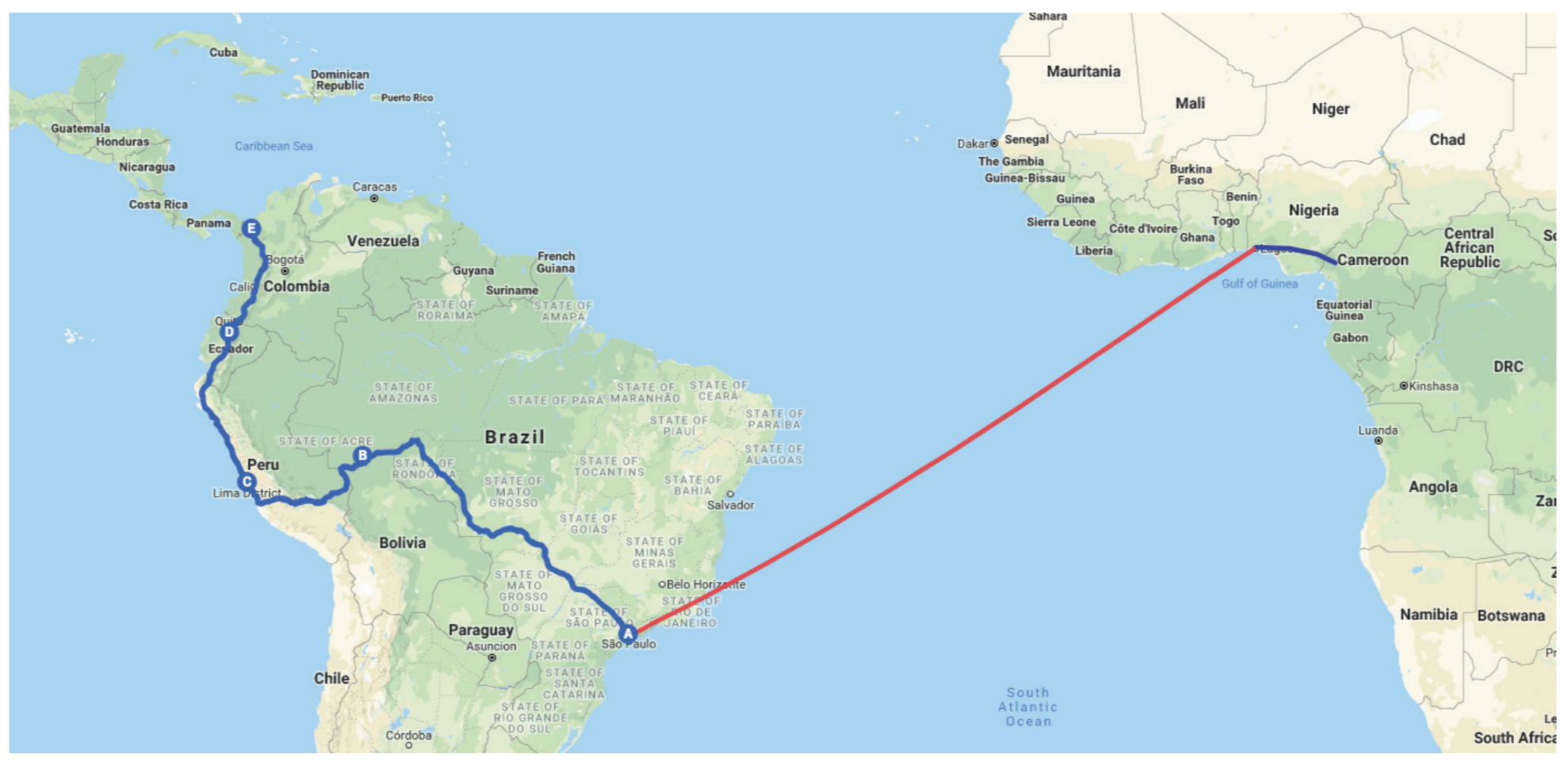
For more than three years, the Isthmus of Darién, linking North and South America, has served as a crucial passageway for migrants from around the world trying to reach the US southern border. Franklin was joined by migrants hailing from such countries as Haiti, Ghana, Nepal, India, and Pakistan. Even as the US government remained closed, with lawmakers battling over whether to fund a border wall along the US-Mexico border, migrants pushed forward, confident that the challenges that awaited them, both legal and physical, were preferable to the ones they left behind.
For Franklin, those challenges began one evening in October 2017, more than six thousand miles east of Capurganá in his native country of Cameroon, when he went to retrieve medicine from a pharmacy for his seven-month-old son. As we sat outside, shielded from the hot Colombian sun, he described how that fateful night set in motion a series of events that led him to one of the world's most dangerous jungles.
On his way back from the pharmacy, he noticed a military vehicle driving erratically in his direction. At first, he assumed it was speeding to face off with Anglophone separatist groups in the area, but the vehicle soon lost all control and careened into oncoming traffic. The accident landed Franklin in the hospital for two weeks. In November, he was called in for questioning, where a government official asked him questions in French despite his limited understanding of the language: "Are your cars documented? Do you have a license?" Franklin politely complied with the officer's inquiries, but towards the end he interjected, asking why a military vehicle was driving so erratically. The officer did not answer and sent Franklin home.
Franklin did not hear from the government for some time. Then, he received another court summons and, in September 2018, almost a year after the accident, was called in for additional questioning. The officer ordered him to sign a statement saying separatists were responsible for the accident. When Franklin refused, they threatened him with jail and locked him in an office for two hours to reconsider his decision. Franklin tried explaining that he was merely a witness but did not know what exactly happened. They said he was a witness and a claimant. Eventually he was released, but upon returning home, he found himself unable to fall asleep. With his sick mother and sister living with him as well as his infant son, he felt their security was no longer guaranteed. A few days later, his house was surrounded by police who broke in and beat him severely. The next day, he and his family fled. He quickly arranged for his wife and child to live somewhere they would not be found by government officials.
At this point in the story, Franklin paused and put his head down. I got the feeling this was the first time he had spoken about this in a while.
"My mother told me, 'You have to leave,'" he said. "So I went from Cameroon to Nigeria. I got support from a friend from Douala [a coastal city in southwest Cameroon]. With $500, I went from Buea [the capital of the Southwest Region of Cameroon] to Nigeria dressed, foolishly, in a tracksuit and glasses so that they couldn't recognize me." Passing through war-torn areas, where killings and kidnapping were increasingly common, he said he kept his hood up the entire bus ride to avoid detection. He tried to remain as low-key as possible. "I haven't spoken with my family since I left," he said.
Here, another Cameroonian male, Joseph, about five years younger than Franklin, joined us at the table. He listened intently.
Within a few days, however, Franklin realized that Nigeria would not be a long-term solution. If discovered, he would be deported to his home country. "Nigeria and Cameroon governments are working together," the other Cameroonian, Joseph, interjected. "They both want us out. If you are in Nigeria, they'll send you back no matter what." Joseph described how he had fled Cameroon after being threatened by both Anglophone separatist groups and the Francophone-majority government. He left behind a thriving clothing business. He said hearing gunshots in the streets became the new normal almost overnight, either from separatists or from the government trying to crack down. His tone was much more severe than Franklin's. He was visibly angered by the set of circumstances that led him to the situation he presently found himself in. "You can't even wear a black T-shirt now," he said, pointing to Franklin's shirt. Franklin laughed, responding, "It's true! I would be shot wearing this shirt by the government. This is what the separatists wear."
Worried that other African governments would treat him similarly, Franklin decided he had no choice but to leave the continent. He flew to Brazil, from Lagos to Sao Paolo, where he was told he would be sent back unless he applied for asylum. Despite worrying that he would be unable to thrive in a place where he did not speak the language, he chose to seek asylum. He commented on how open and cooperative Brazil had been for him, how Brazilians tried to understand and listen to his story. "They ask you, can you be in Brazil and study the language?" he said. He told them yes, but had already set his eyes on the United States, where he could seek asylum without having to learn a new language. "I received help from some people who would transport me to Lima, Peru," he said.
Of all the countries he has passed through, Peru, Ecuador, and Colombia have been the most difficult. "They don't care. Their concern is, 'Where you are going?' and once you succeed to fulfill their requirements, they tell you to move," he said. Colombia has been the most expensive. "Of $1,000, you will pay $800 in Colombia," he said. For Franklin, the expenses started as soon as he crossed the border between Ecuador and Colombia by bus. In an armed robbery, he lost nearly everything, including most of his money, his passport, and other belongings. Bribing Colombian officials had also become requisite for moving forward. He said officials would never accept payments directly but would instead send a surrogate to receive the cash. In Cali, Colombia, for example, he described how he went to a migration office where he stood in line to receive a transit visa. When he got to the front of the line, they told him he was ineligible and sent him outside. A few minutes later, he was approached by a child on a bicycle who had a picture of him standing in line at the migration office. He gave the child some cash who returned minutes later with a transit document. "It's a very strong and sophisticated network," he said.
Franklin did not go into detail about how he financed each part of his journey, other than to say that he used some savings, borrowed a bit from a friend, and that "sometimes you have a good Samaritan who gives you something that should have been a cost." Working had not been an option for him thus far, even in the informal economy. He said it had served him well to be frugal, leading him to eat just one meal a day. Joseph added that many Cameroonians they knew had borrowed money from friends and family, used savings, or—for those who had more time to prepare—pledged some physical asset that possessed liquid value, such as property or livestock.
I asked Franklin what the most difficult part of the journey had been. "Today," he responded almost immediately. "In the forest, we fell into the hands of the Panama military, who sent us back on the boat," I recalled that I had encountered Franklin's group just as they had been returned, and at that time, they all seemed agitated and defeated, having endured several days in the jungle where they had been robbed and where they struggled to stay nourished. The thought of doing it all over again must have been demoralizing. They had been leaving the Migración Colombia office located in downtown Capurganá to make their way back to the hostel they had stayed at before when I introduced myself. One young man—who I would later find out is Joseph—was about to pay a visit to the agent who arranged their passage into Panama.
Now, having showered and eaten, both Franklin and Joseph were significantly more upbeat but remained anxious about whether they would be able to renegotiate another trip into the jungle, especially since they had already paid and had nothing left to offer. Joseph's visit to the agent didn't seem to have resolved anything. They were also anxious about speaking with me. "They don't like that we're speaking with you," Franklin said. I asked who he was referring to, and he said, "The guys who are helping us get to Panama. They think you're going to ruin their business. This is very dangerous research that you're doing, you know. But it's important."
When I asked them to describe the journey they took into the jungle earlier in the week, they started by sharing their experience at the Migración Colombia office in Capurganá. They were instructed not to move 200 meters from the place they were staying and that they had just two days to leave. After finalizing plans to enter the forest, they left at night by boat: "You go to the ocean, and they yell, 'Enter, enter!' It's about a 100-to-125-minute boat ride, and then they yell, 'Jump out! Move, move!'" The landing fee was $50. As soon as they hit the ground, they began hiking and did not stop until dawn the next day.
Joseph, I could tell, wanted to change the subject. He wanted to return to what had driven him to leave Cameroon in the first place. Somehow, he had been implicated with the Anglophone separatists in his town and was targeted to be shot. He fled to Ghana, where he could pretend to be Nigerian. "They have a distinct way of talking; they are like 'Oh boy, how far?'" he said. Joseph reached his hand out to me to imitate the popular Nigerian greeting he had come to master. One night he met someone in a bar who said he could get to the US through the Americas. All he needed to do was look up a few tourist destinations in Ecuador and apply for a tourist visa. Within a few weeks, he had made arrangements and arrived safely in Quito, Ecuador, where, much to his surprise, he met dozens of Cameroonian families also fleeing to the US. "I thought I was the only one! But there were many people running," he said.
Franklin interrupted, "And most of them are young men. Let me ask you, what country wants its young able men to move out like this? We are young men with energy. My friend [pointing to Joseph] had a business. I was an accountant." Joseph then began talking about how Cameroonians perceived the United States: "Growing up as children, we viewed the US as a model for the world. And when Obama was elected, we saw this and said, 'Wow, that place is really fair.'" He lamented how the U.S. appears to be retreating from the African continent over the past few years and that optimism for more-accountable local government was fading among people his own age. "Now the US is increasingly absent from Africa, and China is taking its place. And they are exploitative."
At this point in the interview, a young, fashionably dressed Colombian man approached Joseph and quietly asked him for something. Joseph got up from the table and did not return for the remainder of the interview. When I asked Franklin who that man was, he said he was part of the group helping them reach Panama.
Franklin picked up where Joseph left off: "I'm very appreciative of the US because it is the only country that will accept us. The USA is a safe haven on earth. But there should be a safer way for people to get there and keep them safe." Franklin proposed an access point for people like him, where he could be processed. In this case, "there would be no need to go through the jungle . . . if I had a camp, where people reviewed my case, you would reduce the number of deaths in the jungle. Some get lost in there, including parents of little children. I believe there can be a better way of doing this that would end the movement through the jungle."
. . .
The following day I stopped by the hostel and saw Franklin again. He was with his fellow traveling companions, belting his hearty laugh that seemed to lift everyone up even as they prepared to reenter the jungle. I asked if he had anything else he'd like to tell me. He paused and looked up.
"You must move; you keep going to a land that will accept you, and you can be free."
I left him my WhatsApp number in case he had questions about the research. He said he'd let me know when he made it to Panama.
I have not yet received a WhatsApp message.
📝 This article was originally published in a collection of biographies by the Henry J. Leir Institute at The Fletcher School of Law & Diplomacy and Tufts University.
You can Download the original collection below ⬇️