
Cameroon to Colombia: An Anglophone woman hopscotches through Africa and South America as she moves north
Written by: The Journeys Project
After fleeing her village under the threat of rage and torture, this 36-year-old entrepreneur stays in a camp in Nigeria, but without food and surrounded by illness, she leaves in search of work. After a string of odd jobs, she is able to save enough to take a bus to Ghana. From there, a close childhood friend helps her reach South America by bus, and then arranges multiple flights for her to and within South America. Upon reaching Quito, she moves north by bus to Turbo, then Capurganá, the fishing village that fronts the Darień Gap, a 60-mile stretch of jungle that links Colombia to Panama. Upon reaching the Panamanian border after days of walking, she is turned back to Colombia by the Panamanian police.
"I am from Cameroon, and am 36 years old. I speak English, so I am from the Anglophone part of the country. I have a daughter, who is about 15 years old, a young woman. At home in Cameroon, I had my own little business. I did not have any business partners helping me and mostly traded things, like cotton, to Nigeria. In Cameroon, there is no life. The military, controlled by the Francophone section, tortures you. You are tortured by the government for being Anglophone. They burn down your houses. You become homeless. They rape you.
"I ran empty-handed from my village when they came. I had no time to take money or any of my belongings. Not even my Visa card. So, I fled on foot from the Anglophone section of Cameroon to Nigeria, where I stayed in a community school that had been converted into a camp. It was free to stay there, but it was crowded, with up to 600 people inside. There was no support and a total lack of food, and people were sick all around me. People even died from lack of food and from diseases, and there was no water. In Nigeria, I decided I couldn't be in the camp any longer. I had heard and seen people being extracted from the camp and sent back to Cameroon. I was scared of being sent back, so I decided to travel across Nigeria—foot to car, foot to car—always between being on foot and riding in a car.
"In the north of Nigeria, I had to work to make some money for myself, because I had nothing and had no way of receiving money from home. I left all of my family behind in Cameroon, including my mother.
My mother is still there but can't do anything. Nobody can. They all stay inside their homes, doors locked. My mother can't even go outside to send me some money.
"In the north of Nigeria, I helped fix hair, I washed clothes, I watched over children, I babysat, I did other little jobs, and saved a very little bit of money that helped me to leave Nigeria. I didn't want a long-term job there because I knew I would not stay. But the money I saved was enough for me to leave. I would maybe get 1,000 Nigerian naira [approximately $2.75] for washing, which is less than even $5 maybe. But I did it. I also helped a little bit with farming when I could and when I saw the chance. Finally, I had enough to leave.
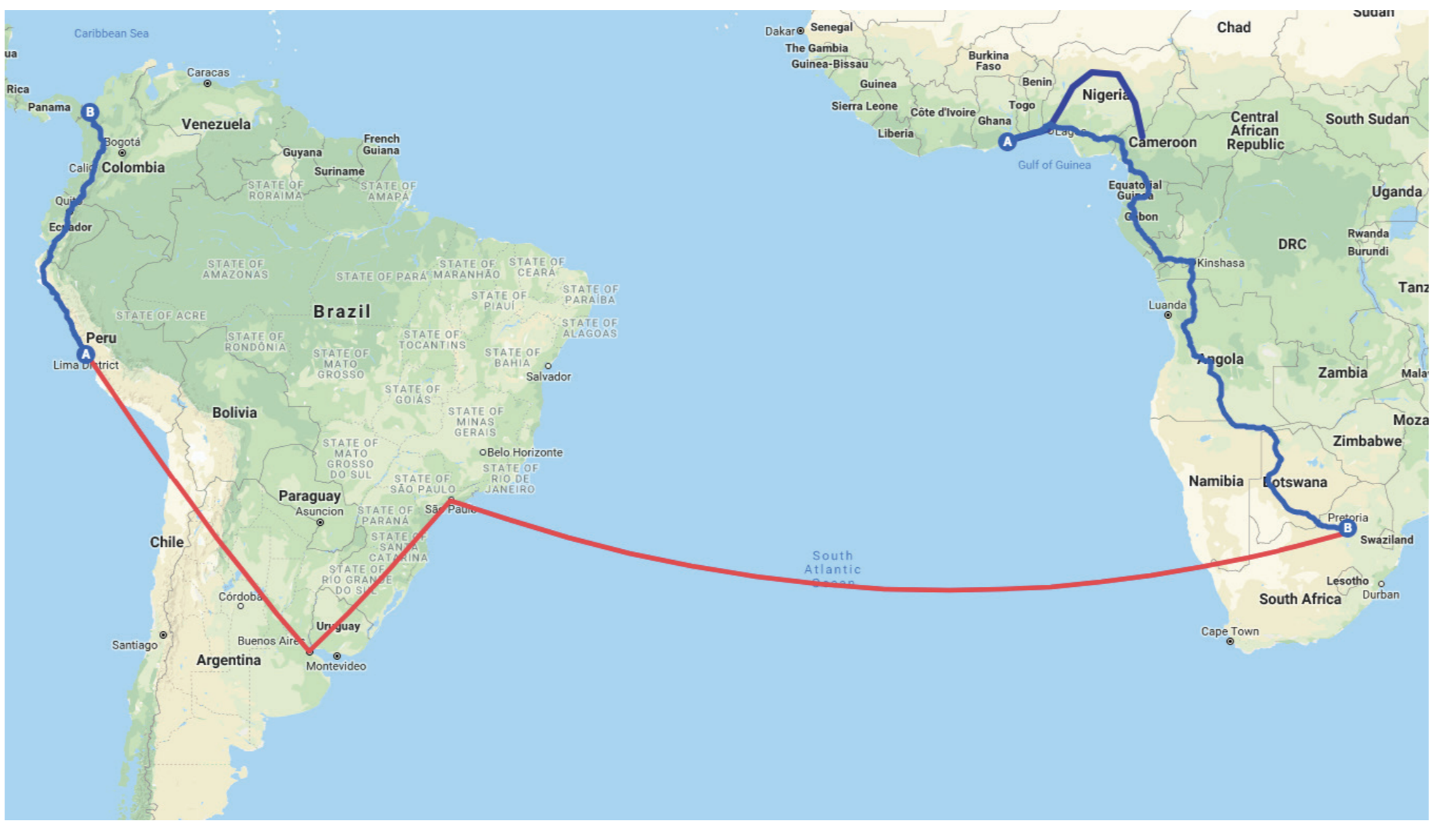
"From Nigeria I traveled to Ghana by bus. It cost about 12,000 naira, or about $20 [officially, approximately $33]—it was not very expensive. Someone gave me money for the trip. I can't say who it is, but it is someone I met in Nigeria, not in Cameroon, and they were not from Cameroon. They continue to help me travel. I have to pay him back one day, but there is no contract or written note, just a verbal promise. This person helped me. I was in a bad situation and needed the money. I am a single woman, traveling alone. When I got to Ghana, I stayed in a safe house, but it was just somewhere to put my head. It was not comfortable, and there were between twelve or maybe even fifteen people in the house. I didn't get to know any of them, and I was there for over a month. I felt safe in Ghana, but there was no work there for me, and I wanted to move on. A childhood friend from school, also in Ghana, sent me some money, about $400, to make the rest of the journey. I decided to come to Latin America.
"I spent two days and two nights in transit, always moving. First, I took a bus to South Africa and flew from there to Sao Paulo, Brazil. The same childhood friend from Ghana helped me with all of these expenses by sending me money through Western Union. I then went directly to Buenos Aires, Argentina, and from there to Lima, Peru. I finally ended up in Quito, Ecuador. The same friend helped me with all of the flight payments—I do not know how much he spent—and he doesn't expect to be paid back because he is a friend. But I had no more money, so this long journey made me tired. There was some food on the flight, but I could never buy anything in the airport because I had no money.
"In Quito, I finally stopped my transit. I stayed in a hotel in the city for just a few nights, and it cost about $125. Someone helped me to pay for this too... I will call him (her eyes narrow and she becomes apprehensive while saying this) a businessman. Someone connected me to this businessman, and he helped with my hotel. I then had some cash with me and felt a bit safer with some cash; I do not remember how much, but not very much. I then moved on to Colombia.
"After Quito, throughout Colombia, I was on my own. I had to prepare a bag, water, and food and made it to Turbo. I took a bus, bus, bus all the way from the Colombian border to Turbo, and the businessman helped me to buy my ticket. I then took a boat to Capurganá. Now I am here in Capurganá. I tried to enter the Darién jungle and made it a few days in, but the Panamanian police turned me back. Now, I am back in Capurganá for the second time, and I have no money.
"I am not surprised that I am doing this on my own, as I am responsible. But no one warned me about doing this journey as a single woman. It is terrifying—scary to walk all day and night, and if you are tired, you just have to sleep on the leaves on the jungle floor. My feet are swollen, and my legs and feet are in so much pain from walking, walking. And I am alone. If I am a woman, I have to fight for myself and do everything by myself to fight. I don't have a shoulder to cry on. I have family and a partner in Cameroon that I miss, and I miss my daughter. She is still there, and it is very hard to be far away from her. She is a very good girl, but I was worried. I had her transferred to the French zone so she would be safer. She is staying with a relative and going to school because I wanted her to have an education. I had some money saved up in my bank account from having my own business, so after I left, I found a way to contact my mother with my Visa card and PIN information. I told her to take that money out and use it to pay for my daughter to be safe and educated. That is why I have nothing saved for myself. I've always been a single mother. It is hard to migrate, but I have to make do. And I am glad that my daughter is safe. I talk with her sometimes on WhatsApp.
"There is always danger in being a woman. I remember when I was a young girl, my mother asked me to go to secondary school in the English zone and to stay with an uncle of mine. My uncle was living with his friend at the time, and we all lived together in a single room of the same house. One night, my uncle's friend wanted to touch me in the middle of the night, and I screamed and screamed. My uncle chased him out of the house. So of course, I fear rape. It is hard to have all of the safety and security you need as a woman when you are on your own.
"I do not use contraception while migrating. Whether I am raped and become pregnant or not is between God and me. This is not a woman's journey, though. Women do not have the physical strength of men, so if someone wanted to rape me, it would be hard for me to fight. I don't have money, which can sometimes make you safer if you can pay people off. I am not that physically strong, so if an obstacle comes, I may not be able to face it. For men, it is easier; they are physically stronger and don't have to fear sleeping outside, as I did in the jungle. Women can't sleep outside—too many dangers—so I always have to pay for and find a place to sleep. This is not always easy. I just have God and me, in the jungle, to keep me safe.
"I am going crazy, especially when I think of having to go back to the jungle. I have no money—I don't know what to do or even where to start. I just have $1." (She pulls out a crumpled $1 bill from her dress—the only money she has.) "Getting Wi-Fi is also hard, but you need Wi-Fi because it is important to connect with people for money and also to be able to tell them that you are okay.
"My biggest challenge is that I have no money and am here illegally, so I can't stay— I only have no passport. I don't want to go back to the jungle, and I think this will be the hardest part. In the jungle, having no money is a problem because you have to pay bribes. You can negotiate on your own, but you have to pay them. The businesspeople can help you pay the bribes if you pay them cash first. Or a friend, like mine, can help you pay for travel tickets. I have no health issues, but my feet hurt; I have pain all over my body from the jungle; I am homeless, frustrated, broke, and stranded. But you have to laugh [laughs]—you have to laugh a lot. It is funny for one person to go through so much!
"I keep going, then. I have to fight for my daughter and for her future. I want to go to America, where I will have a better future for myself, my mother, and my daughter. I seek guidance and prayers for my trip, as I am a Catholic. I sometimes go to church in the different towns, but not always. But I always have my Bible, even in the jungle. When I left Cameroon, I took my Bible—it was important and the first thing that came to my mind: safety and my Bible, because God is always there.
"You can call me Superwoman, for sure. My mother always called me that when I was younger—she even thought that I was a male when I was in her stomach because I was so strong, and was confused when I came out and was a woman. Anything that a man does, I always do it. I am always walking on my own; I have my own business; I am not afraid. Men are not scared, and they have big hearts—they can do anything. That's me."
Superwoman took a deep, slow breath and shifted her gaze to the sky. "My God, I need your presence now," she whispered. She looked out into the distance and started to silently weep.
📝 This article was originally published in a collection of biographies by the Henry J. Leir Institute at The Fletcher School of Law & Diplomacy and Tufts University.
You can Download the original collection below ⬇️