
Written by: Alexander Burlin
Table of Contents
Summary
Following calls for a "New Way of Working" to achieve Agenda 2030 and commitments made at the 2016 World Humanitarian Summit, policymakers have increasingly looked to the "nexus approach" to address protracted forced displacement crises. This approach can be defined as an aim to strengthen collaboration, coherence, and complementarity across humanitarian, development, and peace actions by focusing on collective outcomes and sustainable solutions. The 2018 Global Compact on Refugees (GCR), for example, emphasises the importance of nexus-oriented refugee responses to ease pressures on host countries and enhance refugee self-reliance, particularly in cases of protracted displacement.
Although the nexus approach has been lauded for offering new tools to tackle displacement crises, actors working within the nexus of humanitarian aid and development have faced a wide range of challenges, from differences in institutional cultures and the lack of flexible financing to finding the right balance between short-term interventions to meet immediate needs and long-term goals to ensure self-reliance and socio-economic integration. Critics have also argued that the nexus approach often lacks context-sensitivity, impact, and regard for humanitarian and protection mandates.
Against this background, EBA organised a series of exclusive roundtable discussions on the nexus approach and forced displacement during Spring 2021. The series brought together world-leading researchers, practitioners, and policymakers working on the nexus in displacement contexts, bearing in mind three goals. First, we wanted to foster an exchange of experiences, ideas, and best practices between participants. Second, we sought to identify critical areas of future research for participating researchers and the EBA secretariat. Third, we aimed to expand EBA's network of experts working on the nexus and forced displacement to identify potential writers for future reports, as well as members for future reference groups.
The series featured three roundtable discussions structured around different themes: internal displacement, livelihoods and financial health, and coherent displacement responses (the third roundtable on coherent displacement responses was co-organised with the OECD Development Centre). Each roundtable was guided by a keynote statement written by one or several experts in these areas. This report presents the keynote statements as well as the salient findings from each roundtable discussion, drafted by the EBA secretariat. Since all discussions were held under the Chatham House Rule, statements are not attributed to a specific speaker. At the end of the report, we present an analysis of some of the shared conclusions that emerged from the three roundtables.
Key Takeaways
Roundtable 1. “Internal Displacement and the Humanitarian-Development Nexus”
The first roundtable, "Internal Displacement and the Humanitarian-Development Nexus," examined the scope for humanitarian and development actors to work together to support internally displaced persons (IDPs) and host communities. While research relating to a nexus approach in refugee situations is relatively widespread, it has generally been lacking for internal displacement. The keynote statement for this roundtable was written by Dr. Sarah Miller and focused on delineating current challenges and opportunities for applying a nexus approach when working with IDPs. The former includes the fact that most actors who participate in the so-called Cluster Approach (the dominant international response structure for internal displacement) are humanitarian-focused, as well as the fact that the international architecture for IDPs was generally not designed with durable solutions in mind. The latter includes the emergence of working groups and other bodies at national and regional levels, like the Durable Solutions Initiative (DSI) in Ethiopia.
Another opportunity is that most international frameworks for working with IDPs are rooted in human rights law and the notion that governments are responsible for IDPs – this should facilitate work with development actors. A third opportunity is increasing cooperation with peacebuilding actors. This is of particular importance in the case of conflict-induced internal displacement, where the re-establishing of peace, security, and rule of law is critical to the return, local integration, and resettlement of displaced communities.
Among the topics brought up during the roundtable discussion, some participants highlighted that international legal and policy instruments like the Inter-Agency Standing Committee (IASC) Framework on Durable Solutions for IDPs have been effective in stimulating governments, practitioners, and academics to address IDP issues and develop regional and national laws and policies. Nevertheless, the implementation of such instruments and the incorporation of existing standards into domestic law have only occurred sporadically at the discretion of states. This was attributed to the lack of an enforcement mechanism. Laws and policies also tend to focus on conflict-induced displacement at the expense of climate and disaster-induced displacement – the most common form of internal displacement. Participants reaffirmed that international actors and governments also need to do more to prevent displacement, both in terms of climate and conflict, including by developing instruments that explicitly account for the effects of environmental disasters and mainstreaming Disaster Risk Reduction (DRR) into humanitarian and development programming. The table also exchanged lessons learned for navigating the politicisation of IDPs in many contexts; one such lesson was the value of creating space for conversation on national and local levels through using research and evidence, including political-economic analyses.
The roundtable discussion highlighted multiple areas where future research is needed, including the role of peace actors, the duration and impact of climate and disaster displacement, the strengthening of livelihoods in fragile contexts, and how to understand development and displacement linkages on a normative level.
📝 This article was originally published as a report by the Henry J. Leir Institute at The Fletcher School of Law & Diplomacy and Tufts University.
Download the original report below ⬇️
Roundtable 2. Beyond Livelihoods: "Financial Health" and the Humanitarian-Development Nexus
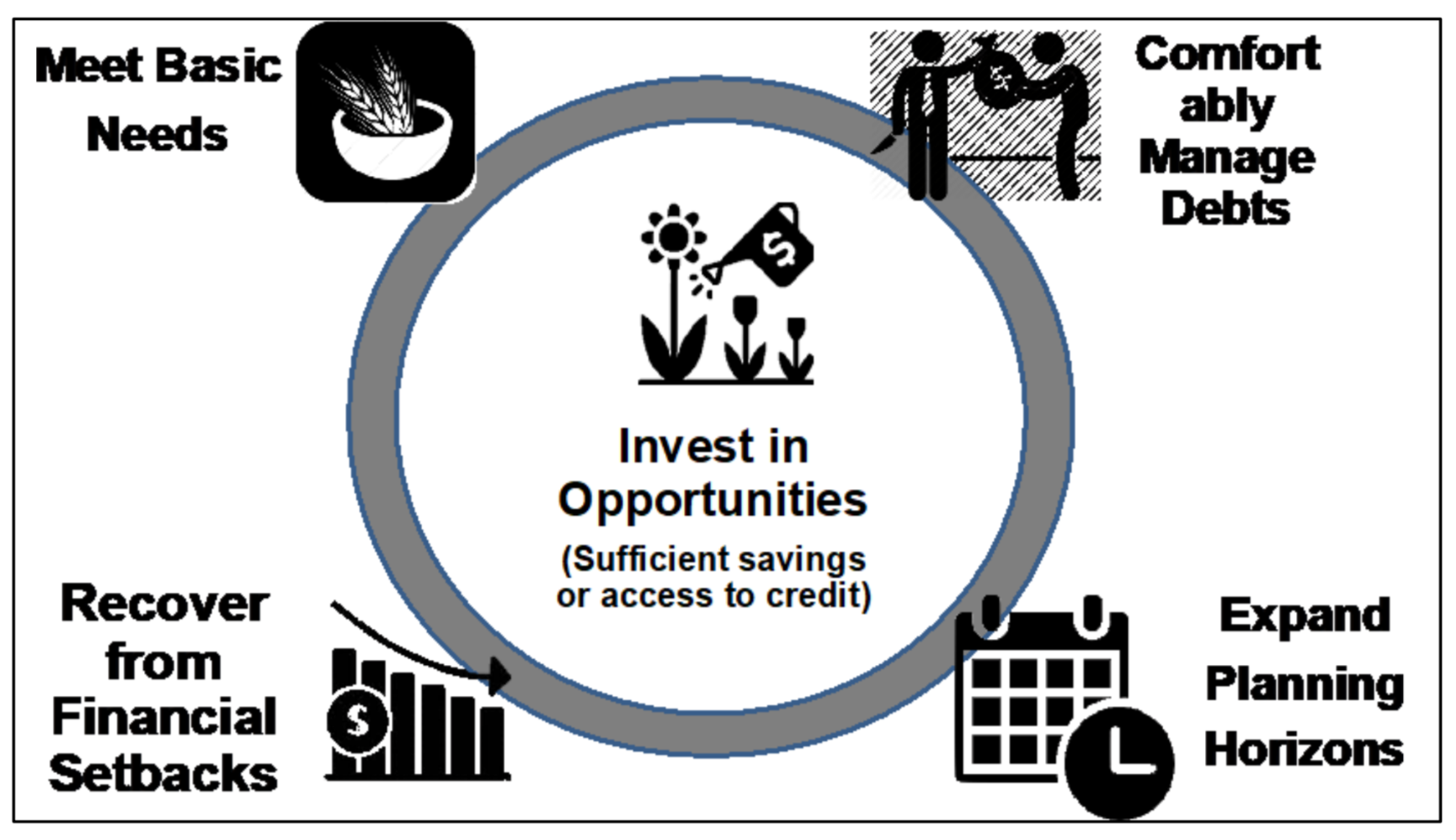
The second roundtable, "Beyond Livelihoods: 'Financial Health' and the Humanitarian-Development Nexus," examined how approaches to understanding and working with displaced persons' livelihoods can be refined. The keynote statement for this roundtable was written by Dr. Karen Jacobsen and Kim Wilson. The authors note a long-standing critique of the design, implementation, and evaluation of livelihoods programmes and argue for the need to build on existing frameworks (like the Sustainable Livelihoods Framework) to develop concrete and measurable financial indicators useful in displacement contexts. To this end, they introduce the concept of Financial Health as a framework for analysing livelihoods and financial capital to inform programming. Under a Financial Health framework, refugees or migrants can be said to be "financially healthy" when they are able to do the following over the course of four years (beginning with their arrival): 1) meet basic needs; 2) comfortably manage debt; 3) recover from financial setbacks; 4) access a lump sum to enable investment in assets and opportunities; and 5) continually expand their planning horizons.
Case studies conducted by the authors in Uganda, Mexico, Jordan, and Kenya showed that most displaced persons are financially unhealthy in the arrival phase, and that progression of financial health only takes place in welcoming economies (i.e., where there are no restrictive policies and barriers such as lack of documentation). The statement also discusses services, programs, or initiatives that can support financial health, including financial services (best provided by development actors), and humanitarian assistance such as cash programs, skills-building, and help with the provision of documentation.
During the roundtable discussion, participants noted that Financial Health is an overall useful analytical framework insofar as it moves beyond narrow analyses of material well-being focusing on income to a broader understanding of how well individuals can meet their basic needs, mitigate financial shocks, and build financial resilience. This analytical shift is required to design and implement more effective programmes. In addition to examining the Financial Health framework specifically, participants argued for a growing need to rethink livelihoods programming in light of the increasing protractedness and urbanisation of forced displacement. Here, two dimensions were mentioned that may inform future programming: one supply-oriented, client-centred approach that looks at ways of developing capacities and skills of beneficiaries to enable them to join the labour market, and one demand-oriented market-centred approach that seeks to strengthen markets and open them up to displaced persons (such as a Market Systems Development approach). Demand-oriented approaches were noted to be less common in displacement contexts, and it is critical that these are explored further. Moreover, participants reiterated that donors must do more to support such work by funding humanitarian organisations that want to do longer-term, innovative programs for supporting displaced people's livelihoods.
The roundtable discussion highlighted a number of areas where future research is needed, including evidence on "what works" for livelihoods, the impact of Covid-19 on livelihoods, the role of informal livelihoods, and ways of leveraging cash assistance.
The third roundtable, "Ensuring Coherence Across New Donor and Host Country Measures to Address Forced Displacement," was co-organised by EBA and the OECD Development Centre. The roundtable examined the ways in which donor countries and hosting developing countries address forced displacement, with a particular focus on coherence, implementation, and coordination with local actors. The keynote statement for this roundtable was written by Dr. Jason Gagnon and Mona Ahmed. The authors note that a growing emphasis on the Humanitarian-Development-Peace Nexus entails a growing complexity of displacement responses. In turn, this leads to the need for increased coordination at multiple levels, including across and within donors, between donors and hosting countries, between national and local governments, and across hosting countries from the same affected region. They further map current approaches taken by donor and hosting developing countries to address the HDP nexus and forced displacement.
These range from specific instruments and bodies to general migration management strategies and "mainstreaming" of forced displacement in existing development work. The mapping further shows that the adoption of new displacement measures has been more widespread in some sectors, like Education. In addition, the authors highlight two pillars that are essential for building a strong foundation to implement instruments for addressing forced displacement: specialised actors for specific interventions and the leveraging of local actors, including local government leaders, local businesses, and local NGOs.
During the roundtable discussion, participants reaffirmed the need for close partnerships between donors and host states, while noting that the degree of coherence differs across contexts, actors, and sectors. The establishment of institutionalised frameworks and partnerships, such as national response plans, was noted as a prerequisite for coherence. Response plans reportedly work best when they explicitly assess the cost of refugee or IDP inclusion. Moreover, participants highlighted that the role of inter-host state relations is often overlooked in discussions of coherence. In this regard, political dialogue between neighbouring host states should be encouraged, both to prevent policy differentiation and backsliding and to push host governments to adopt more inclusive measures. Another topic under discussion was the role of international organisations and frameworks. Although the presence of international implementers can sometimes present challenges to donor and host state coherence by promoting parallel systems – as was reported to be the case in some countries – participants noted that international organisations and UN agencies often make a positive contribution by implementing programs that align with national measures. Participants also discussed how international frameworks like the Global Compact on Refugees can facilitate coherence by bringing various actors into conversation. Nevertheless, such frameworks should be seen as a means rather than an end. They are primarily meant to provide policy guidance, and do not constitute funding agreements or detailed response plans.
The roundtable discussion highlighted a number of areas where future research is needed, including the impact of Covid-19 on refugee inclusion in national strategies, opportunities and challenges for localising global displacement instruments, and the role of digitalisation in modern displacement responses.
Crosscutting Reflections
The three roundtables organised as part of this series examined forced displacement from different angles: one looked at a form of displacement (internal displacement), one looked at a type of intervention (livelihoods), and one looked at coordination between different stakeholders (coherence across donor and host country instruments). Despite such varying topics, the tables spoke to several shared themes that highlight contemporary opportunities and challenges for work with refugee and IDP crises:
- Addressing protracted displacement requires an area-based approach that takes into account the impact of displacement both on displaced persons and the host community.
- Displacement responses should focus on several "levels" of interventions, starting with the local, and scaling up to the national and regional.
- When it comes to addressing forced displacement, context is key – on a macro, meso, and micro level.
- The issue of displacement is inseparable from larger, structural challenges, most notably economic development.
- Donors and practitioners need more and better evidence and data to guide programming.
- Global instruments for forced displacement play an important role, but on-the-ground implementation may be limited.
- Preventing, managing, and resolving forced displacement are fundamentally political activities.
These takeaways are discussed throughout the roundtable chapters and reflected upon in the concluding section of this working paper.
Roundtable 1. Internal Displacement and the Humanitarian-Development Nexus
Keynote Statement: The Humanitarian-Development Nexus and Internal Displacement – Challenges and Opportunities
Dr. Sarah Deardorff Miller, Senior Fellow, Refugees International
Practitioner and academic voices are clear: the gap between development and humanitarian work is a detriment to protection and assistance to displaced persons, including internally displaced persons (IDPs). A lack of a "nexus approach," understood to mean the coordination, coherence, and complementarity between humanitarian and development work, can also impede durable solutions and exacerbate tensions between IDPs and local host communities.¹ Yet, while nexus research relating to refugees is extensive, it is generally lacking on internal displacement.
This is surprising, given that IDPs far outnumber refugees: there are some 45.7 million IDPs, compared with 26 million refugees.² It is also surprising because the plight of IDPs arguably embodies humanitarian-development nexus challenges. Indeed, transitioning from emergency humanitarian assistance to longer-term development assistance and protection for IDPs is compounded by a range of obstacles often present in work with IDPs. First, IDPs by definition are still within their home country, and therefore may be more difficult to identify and access than refugees. Moreover, the state may be unable or unwilling to offer protection and assistance to IDPs, or in some cases, may be the reason for their displacement. In addition, compared to refugees, there are fewer organisations exclusively dedicated to IDPs, and laws and norms around internal displacement may be more difficult to enforce. Finally, IDPs tend to receive less attention and resources from the international community than refugees. These unique challenges can widen the gap between humanitarian and development work.
However, IDP situations can also provide some opportunities for relief
and development actors to work in concert, perhaps in ways that refugee
situations may not allow. Indeed, in some cases, aid and development
actors have been able to promote direct cooperation with the state
through national or regional platforms, even working with peacebuilding
actors, as well.
How then can we understand the current state of challenges and potential
opportunities for humanitarian and development actors to work together
in IDP situations? What specific mechanisms are already in place that help
to bridge the divide, and in contrast, what is lacking? Amidst renewed
interest in finding solutions to internal displacement – especially
protracted internal displacement – what tools and models should be
emphasised to better build cooperation between humanitarian and
development actors?
This brief paper discusses the humanitarian-development gap in IDP
situations, and unpacks some of the challenges and opportunities, with the
aim of provoking further discussion on how to pursue a nexus approach
that bridges the divide. The issues listed are not exhaustive but highlight
some of the key questions and context to the nexus in IDP situations.
Challenges
A system designed for immediate humanitarian response in the context of protracted displacement
The majority of the world's IDPs live in protracted displacement.³ Governments are first and foremost responsible for protecting and assisting IDPs. Yet, it is often the case that governments are unable or unwilling to respond to IDPs, and in some cases, the government is even the cause of internal displacement. Thus, an array of organisations – mostly humanitarian – respond instead. These range from the UN and large international non-governmental organisations (NGOs) to smaller national NGOs. Because this type of response was ad hoc, the cluster approach was developed in 2005 as a way to address gaps and increase predictability and accountability in IDP response.⁴ Clusters are made up of UN and non-UN actors who share information and coordinate their actions in specific sectors of humanitarian action, thus providing clear leadership.⁵
A small number of responding organisations work on both development and relief activities, and more recently development actors like UNDP and financing institutions like the World Bank have also worked more directly with IDPs and host communities. Moreover, some clusters have leaned toward both humanitarian and development work, and some, like the early recovery cluster, were development-oriented. Nonetheless, the majority of actors responding within the cluster approach are humanitarian-focused.⁶
IDP responses are unlikely to be designed with durable solutions in mind
Similarly, the international architecture for IDPs was generally not designed with durable solutions in mind. Because it tends to focus on short-term humanitarian response, the current system leaves few entry points for development actors to plan and implement longer-term projects, many of which would be essential for a road toward durable solutions. This could include self-reliance, livelihoods or labor market access for IDPs, or longer-term projects relating to access to education, health, or social services that are better suited to development actors' expertise.
Finding solutions for IDPs requires a different approach, which includes broader thinking about integration and resettlement – not just return – as solutions. This may mean focusing on the economic inclusion of IDPs and their access to livelihoods, local markets, and financing opportunities.
Certainly, the provision of shelter and food remains important, but recognising that needs change over time and that IDPs are an important part of local host communities is critical to realising solutions.⁷
Humanitarian and development actors have different ways of working
Humanitarian and development actors are inherently different. At minimum, their funding cycles and lengths of projects differ, and more substantively, their philosophical foundations may differ, as well. Generally speaking, humanitarian actors tend to focus on immediate relief and assistance for IDPs, whilst development actors tend to focus on the stresses that displacement causes for national development plans.⁸ This often means that development actors work more closely with governments – particularly local governments – and are more likely to see them as a partner. By contrast, humanitarian actors certainly have the permission of governments to carry out their work, and in some cases work in partnership. But their presence is often due to the fact that the government is unable to offer sufficient relief. This dynamic means that humanitarians may be more likely to envision a "hand-off" of their projects after a period of time – either to government or development actors.
However, the "hand-off" approach has some obvious drawbacks, most notably that development actors do not see their work as simply an extension of humanitarian work for a longer period of time. Rather, they may be more likely to draw on area-based approaches that are intended for the broader population, not IDPs in particular. For these reasons, it is challenging to bring development actors into humanitarian coordination mechanisms like the clusters, and it is not surprising, then, that the Early Recovery cluster has largely been viewed as unsuccessful.⁹
Opportunities
Country-and-regional-level IDP-focused groups and initiatives provide opportunities for humanitarian-development actors to work in concert
Amidst these challenges, IDP situations also present some unique opportunities for relief and development actors to cooperate. For one, working groups and other bodies at national and regional levels have emerged as potential platforms for bridging the gap. The Durable Solutions Platform, for example, engages NGOs, civil society and researchers from across humanitarian and development organisations – many of whom are Syrian – in working toward solutions for displaced Syrians, including IDPs.¹⁰ In addition, the Durable Solutions Initiative (DSI) in Ethiopia has fostered coordination across development, humanitarian and peacebuilding actors at local and national levels of government – an important way of working in a country with vastly different regional contexts. In Ethiopia's Somali region, for example, the DSI has facilitated a shared commitment amongst relevant government line ministries, the UN Country Team, international financial institutions (IFIs), donors and NGOs to work towards achieving durable solutions to internal displacement.¹¹
The Joint IDP Profiling Service in Iraq has also demonstrated how development and humanitarian organisations can work with government and researchers to collect data on IDPs,¹² and lessons learned in Colombia, Mali, Nigeria, Somalia and Turkey have shown other opportunities for humanitarian-development-peace nexus initiatives.
And at a regional level, the Regional Durable Solutions Secretariat (ReDSS), which operates in East Africa and the Horn of Africa, works as a coordination and information hub for finding solutions to internal displacement. It is made up of 14 NGOs¹³ and seeks to improve joint learning and programming, inform policy processes, enhance capacity development and facilitate coordination in the collective search for durable solutions.¹⁴
Promoting a whole-of-government approach
The Guiding Principles on Internal Displacement and other frameworks for IDP response are rooted in human rights law, and the notion that governments are responsible for IDPs. There is thus scope for developmental support to government capacity-building, which includes state institutional mandates, legislation, and regulatory issues. It also points to opportunities to work with different parts of the government – something development actors may be particularly well-placed to do – thus promoting a whole-of-government approach to IDP response. Indeed, practitioners and academics emphasise a whole-of-government approach as essential to protecting and assisting IDPs and working toward solutions to their displacement. The fact that humanitarians and development actors may have different relationships with different arms of the government may present more opportunities for government buy-in across a range of ministries and offices. This is especially important in IDP responses; while national commitment is critical, most of the work of supporting solutions falls on the shoulders of provincial or local authorities.
Cooperation with peacebuilding actors (triple-nexus)
The nexus is most often thought of in relation to humanitarian and development actors. But peacebuilding actors are particularly important to responding to IDPs, especially in relation to finding durable solutions to their displacement. Re-establishing peace, security, and the rule of law is critical to the return, local integration, and resettlement of IDPs.
Peacebuilding often encompasses a wide array of actors well beyond IDPs, including armed groups, various branches of the military, peacekeepers, and government officials at all levels. Stabilisation programs are more likely to be aligned with the work of development actors than humanitarians, who may hesitate to work with peace and security actors for fear that aid might be associated with political solutions and thus compromise humanitarian principles of neutrality and impartiality.
And yet, to realise durable solutions for IDPs, issue areas like reconciliation, resettlement elsewhere in the country, return, and reintegration may require peace and security actors to work more closely with humanitarians. Moreover, humanitarian actors should be challenged to consider how to reduce long-term reliance on aid, and recognise that, "Conflict-sensitivity, localisation, context-specificity, rights-based approaches and sustainability, when put into action through targeted and complementary planning and programming across the Nexus, can become the building blocks for sustaining peace."15
UN systemwide reform and new opportunities
While it may be designed with humanitarian response in mind – at times an obstacle to including development actors – the cluster system is relatively well-functioning for quick response. This provides some stability on which to build longer-term, development responses to internal displacement. This is most clearly seen in recent calls for UNDP and UNHCR, as cluster leads for the Early Recovery and Protection clusters, to advise UN Resident Coordinators/Humanitarian Coordinators (HC/RCs) to develop a strategy for durable solutions for displaced people.¹⁶ As part of the Secretary-General's changes to the UN development and peace and security approaches, more fully empowered HC/RCs will ideally find new opportunities to bring together relief, development and peace/security actors.¹⁷
Donors and financing institutions can take steps to bridge the gap
Many donors have tended to reinforce the relief-development gap, with many aid agencies having separate departments for humanitarian and development assistance, while funding for stabilisation and peace operations comes through different channels. Moreover, most humanitarian aid – 80 per cent – goes through multilateral bodies while most development aid – 77 per cent – is channelled bilaterally.¹⁸ However, some donors, like DFID and JICA, have moved to merge their humanitarian and development programs, while others like Canada and Australia have brought their aid agencies into their foreign ministries in order to strengthen the link between foreign policies and aid.¹⁹This generates inevitable questions about the independence and neutrality of humanitarian assistance, but more broadly demonstrates the important role of donors in the nexus approach to internal displacement.
Conclusion
In conclusion, this paper has outlined some of the challenges and opportunities to bridge the nexus in IDP situations, but there are many more. The good news is that there is momentum in the international community: attention on both IDP issues in general, and on finding creative and effective ways to bridge the relief-development gap. Moreover, development and financing institutions are increasingly entering the displacement space, bringing funding, attention, expertise and different approaches.
Unfortunately, there is no shortage of case studies to examine. Skyrocketing new internal displacement in countries like Ethiopia, coupled with long-term IDP populations, creates a range of needs for humanitarian, development and peacebuilding actors to address. IDP participation is still lacking in planning, implementation, and decision-making about their situation, and this should also factor heavily into strategies that seek to bridge the divide.
Discussion Summary
The EBA roundtable on "Internal Displacement and the Nexus" took place on February 26, 2021, 15:00–16:45 CET. It brought together researchers, practitioners, and policymakers working with IDPs in different contexts. The roundtable discussion focused on three topics: a) evaluating current practices and existing instruments; b) challenges and opportunities for ensuring durable solutions; and c) data and areas of future research. This summary presents the salient points discussed by the participants.
Taking Stock of International Instruments for Work with IDPs
The roundtable began with taking stock of international instruments for work with IDPs. Since the late twentieth century, a number of international instruments have been developed for working with IDPs, most notably the Guiding Principles on Internal Displacement and the Inter-Agency Standing Committee (IASC) Framework on Durable Solutions for IDPs. The Guiding Principles were adopted in 1998 and serve as a normative framework for addressing the needs of IDPs. The principles are based on the fact that IDPs are citizens of their countries and should enjoy the corresponding rights, including rights implicit in international human rights and humanitarian law. The Guiding Principles address protection concerns and grounds for humanitarian assistance, and provide a basis for durable solutions (return, integration, or resettlement). The IASC framework builds on the Guiding Principles to provide clarity on what durable solutions entail and offers guidance on how to achieve them.
The participants discussed the incorporation, implementation, and relevance of these instruments in a contemporary context. On the one hand, participants noted that these instruments have been effective in stimulating governments to address IDP issues and develop regional and national laws and policies. On a regional level, the 2009 Kampala Convention has crystallised the Guiding Principles, particularly for member states of the African Union; this was highlighted as an important step forward. On a national level, dozens of states have adopted laws and policies that are closely aligned with the Guiding Principles. Nevertheless, the incorporation of existing standards into domestic law has only occurred sporadically at the discretion of states; pre-existing research shows that many states that have laws and policies on IDPs do not align with existing international instruments. Beyond their use in regional and national laws, existing international instruments have been helpful for civil society and academics in understanding and advocating for the rights of IDPs.
Participants further noted that the Guiding Principles and the IASC Framework are solely soft law instruments that lack enforcement mechanisms. A lack of binding legal frameworks makes work and advocacy related to IDPs more difficult than work with refugees in some regards, as the latter is informed by the 1951 Refugee Convention – a legally binding treaty. Implementation is also an issue on a national level; even when soft law instruments have informed domestic policies and laws for work with IDPs, many have noted a discrepancy between the standard prescribed in such policies and laws and the implementation of these standards on the ground. More research is needed to understand not only the emergence of laws and policies but also implementation "gaps". What does it take for a government to pass a policy or law for IDPs that lines up with international standards? What does it take for a government to actually implement it and improve the lives of IDPs?
Climate and Disaster-induced Displacement
A central theme of the roundtable was the question of climate and disaster-induced displacement – the most common form of internal displacement, and one which is becoming increasingly widespread. Participants noted that conflict-induced displacement tends to dominate global strategies and frameworks for IDPs. Such a bias is, for instance, reflected in the Guiding Principles, which remain conflict-oriented and are not fully equipped to tackle climate and disaster displacement, particularly when it comes to Disaster Risk Reduction (DRR). At the national level, many states also lack domestic policies and legal frameworks for climate and disaster-induced displacement. According to a recent study conducted by one of the participants, out of 46 countries that are affected by internal displacement linked with disasters, only about half have policies acknowledging displacement resulting from the effects of climate change.
In the absence of laws and policies for climate and disaster-induced displacement, some pointed out that other frameworks can be used to help design and advocate for appropriate national and subnational responses; for instance, the Sendai Framework for Disaster Risk Reduction may be used in conjunction with a wider body of international human rights law to help implement DRR strategies in work with IDPs. Nevertheless, there is a need to develop international instruments for internal displacement that explicitly account for the effects of climate and natural disasters.
Participants also pointed to a strong need to better understand the duration and long-term impact of climate and disaster-induced internal displacement. At present, most ongoing work and policy on climate and disaster treat such displacement as a short-term phenomenon that does not require serious consideration of durable solutions, and that does not have a significant impact on the receiving community. A recent study conducted by one of the participants showed that out of 27 countries with policies acknowledging the link between climate change and displacement, only 4 mentioned durable solutions, and only a handful considered the impact of this type of internal displacement on host communities.
The prevailing understanding of disaster and climate displacement as short-term stands in contrast with recent evidence, particularly for climate displacement. For many climate and disaster IDPs, a return may not be possible or probable, partly because previous habitats may be unlivable (e.g. due to sea-level rise or destruction of infrastructure), or because in many situations it is the choice of IDPs themselves to stay in the places they seek refuge.²⁰ In such cases, the impact of IDPs on host communities remains unclear, although some participants have found that there are cases where host communities are positively inclined to receiving IDPs due to an increase in market opportunities and possibilities for other forms of economic and social exchanges. More systematic data is now needed to understand both the duration of climate-and-disaster-induced internal displacement and how long-term displacement can impact host communities.
The Nexus Approach and IDPs
The table also discussed various aspects of the nexus approach as it relates to internal displacement. One such aspect was the relationship between the nexus approach and durable solutions, the latter representing the central ambition for work with IDPs. The complexities of internal displacement often mean that achieving durable solutions requires a multitude of approaches, including work with humanitarian, development, and peacebuilding actors. A nexus approach is highly relevant in this context, but participants noted the importance of making a distinction between the nexus approach as a means and durable solutions as a goal. Progress in using the nexus approach should be measured by the degree of engagement and investment of different actors in coming together for a shared outcome. This shared outcome can include durable solutions, but also various areas of social and economic support to IDPs as they await a durable solution. It is therefore important that a nexus approach is implemented from the beginning of a crisis to support beneficiaries during the entire transition towards durable solutions.
Participants also discussed to what extent the nexus approach is reflected in existing response structures. Over the past twenty years, progress has been made on coordinating responses to internal displacement, particularly on a UN level. However, much of the focus has been on achieving coordination between humanitarian actors – most notably by using a cluster approach – and some noted that the present coordination system remains somewhat "myopic." In recent years, there has been important progress to include development actors in IDP coordination fora, for instance through the UN Development System reform. Nevertheless, participants argue that the role of development on a normative level is often unclear. For instance, as advocacy for a nexus approach is becoming increasingly widespread, the question remains whether stakeholders are meant to integrate internal displacement into development policies, or whether they are meant to use development policies to address international displacement. Moreover, many actors are still at the periphery of dominant coordination structures, including peace and peacebuilding actors, international financial institutions (IFIs), national and local actors, and bilateral partnerships.
An Area-based and Participatory Approach to Building Resilience and Self-reliance
The table also discussed other approaches to work with IDPs that should be mainstreamed into humanitarian, development, and peace interventions. For one, stakeholders need to adopt an area-based approach that addresses the concerns of IDPs in tandem with the concerns of other related populations. Traditional programming is typically based on divisions between different groups, such as IDPs, host community members, returnees, and refugees. Such divisions can at times be damaging to effective programming and prevent social cohesion. In Burkina Faso, for instance, the international response in IDP-affected areas has exacerbated tensions between IDPs and the local host community by solely providing rations and cash assistance to the former– despite high needs amongst some members of the latter. Indeed, participants noted that host communities themselves are impacted by the arrival of IDPs and should be entitled to humanitarian and development assistance in order to leave no one behind, preferably by reinforcing local institutions. Taking an area-based approach sometimes requires the adoption of new terminology to identify beneficiaries; some participants suggested that the term “displacement affected communities” can be used in this regard.
There is also a recognition that future work with internal displacement must be oriented toward building resilience and self-reliance for displacement-affected communities. To this end, participants noted that the question of livelihoods and labour market inclusion should be considered more seriously by IDP stakeholders. Displacement often comes with significant challenges for ensuring access to livelihoods. When IDPs arrive in a new location, they may lack formal and informal networks that facilitate employment, such as friends and family or membership in professional unions or associations. Displacement may also mean that people are not able to pick up previous forms of livelihoods at their new location, as one participant noted to be the case with displaced pastoralists in Somalia and Ethiopia.²¹ These communities must receive opportunities to develop new skills that speak to the new economic environment.
Facilitating sustainable employment and livelihoods is rarely an easy task in IDP situations. Considering that internal displacement typically occurs in the context of economic crisis, participants noted that such work often has to take place in a weak labour market. A lack of economic opportunities does not just make finding employment for IDPs more difficult, but also means that stakeholders must factor in the possibility that such employment may exacerbate social tensions with the host community, especially if the latter perceives that IDPs are “stealing” job opportunities. At the same time, the arrival of IDPs can also produce new market opportunities and support the local economy given the right context. Taking livelihoods seriously entails combining humanitarian and development approaches that take into account the types of skills, networks, and resources that can be created and mobilised to facilitate employment, both for IDPs and – when appropriate – host communities. Although this is a difficult task, the legal situation for IDPs must be considered an important opportunity, especially when compared to work with refugees; since IDPs flee within their country of citizenship, they typically do not face legal obstacles to employment, unlike refugees.²²
Participants also argued for the importance of using participatory approaches when working with IDPs. Generally speaking, IDPs tend to be seen as objects of intervention, stripped of agency in shaping interventions that are taking place. This applies not just to interventions by international actors, but also to government interventions. A more bottom-up approach is necessary, and stakeholders should encourage displaced people to participate and decide about policies and interventions, whether humanitarian, developmental, or political. To this end, it is also important to see IDPs as citizens actively taking part in the future of the nation in general and the hosting region in particular.
Internal Displacement – A Fundamentally Political Issue
Working with IDPs often requires a high degree of political sensitivity and involvement of peacebuilding actors. According to the IASC Framework, the primary responsibility to provide durable solutions for displaced communities should be assumed by the relevant national authorities. In many contexts, however, this is often the same entity that has caused IDPs to flee in the first place. How can stakeholders – and particularly humanitarian actors – work with governments to ensure solutions in such cases? The table exchanged some lessons learned for navigating the politicisation of IDPs in challenging contexts, including creating space for conversation on national and local levels through durable solutions working groups. Such space can be facilitated by using research and evidence, including political-economic analyses, to help show how solutions can be imagined and how they may benefit the wider community and a national government.
Moving forward, participants argued that the international community needs to do a better job at resolving conflicts. International actors often tend to focus on supporting IDPs and the host community in coping with internal displacement once this has taken place – more attention needs to focus on providing an end to the same. On the one hand, this can take the form of high-level political action by paying more attention to peace and peacebuilding initiatives. On the other hand, humanitarian and development actors need to do more to mainstream durable solutions in activities and programming by considering how initiatives can contribute to solutions in the medium and long term.
According to the table, international actors and governments also need to do more to prevent displacement, both in terms of climate and conflict. This relates to the aforementioned discussion on the limitations of global instruments, which overlook the role of prevention. Although arbitrary displacement is discussed in the Guiding Principles,²³ and some progress has been made on a regional level (such as under Article 3 of the Kampala Convention), more work is required to mainstream prevention on a global, multilateral, and political level. Like work with solutions, prevention can be mainstreamed into humanitarian and development programming, for instance by considering land and housing challenges, and how interventions can contribute to disaster risk reduction.
In recent years, some promising practices can be noted in relation to the nexus approach and durable solutions. The Regional Durable Solutions Secretariat (ReDSS), for instance, was created in 2015 as a network of NGOs working with displacement-affected communities in East Africa and the Horn of Africa. It aims to maintain focused momentum and stakeholder engagement towards durable solutions by providing a platform for research and analysis, capacity development, policy dialogue, and coordination. Another promising practice is the Somalian Durable Solutions Initiative (DSI), launched in 2016 by the Federal Government of Somalia (FGS) and the Deputy Special Representative of the Secretary-General, Resident and Humanitarian Coordinator (RC/HC). The initiative aims to promote durable solutions and support the implementation of the Somali National Development Plan (NDP), focusing on the improvement of living situations and livelihoods of displacement-affected communities.
Working on a Local Level
Preventing and preparing for displacement, particularly climate and disaster-induced displacement, requires a strong local connection and the development of local disaster preparedness frameworks. One participant noted that a good example of ongoing efforts at increasing prevention and preparedness on a local level is found in the sister cities approach in Indonesia, where two cities partner up to share experiences and best practices for resilience building. Prevention work on a local level should not only include local government; other participants discussed how a wide range of actors should be involved in such work, including universities and national human rights institutions. By building capacity, empowering local researchers, and mainstreaming displacement into university curricula, stakeholders can help promote a "bottom-up approach" and contribute to sustainable change.
Donors and financing play an important role in enabling improved responses on a national and local level. In line with the 2016 Grand Bargain²⁴ and commitments to increase the localisation of aid, donors need to look at new ways of financing not just national host governments but also other national and local actors, such as local government, local civil society actors, and local academics. The table discussed how certain financing tools may be particularly useful to improve responses to IDP situations. Transitional development assistance (TDA), for instance, is an important tool that donors can use to bridge the gap between humanitarian aid and development and build resilience and socio-economic stability.²⁵ TDA instruments involve multi-year funding that may be mobilised outside political preliminaries and cooperation agreements to enable shortened funding processes. Such instruments may be particularly useful on a local level where a quick review of the socio-economic and political context can be undertaken.
Future Research Agenda
The roundtable participants identified several areas where further research is required, including:
The role of peace actors: There is a need for more knowledge about how peace actors can best be mobilised to support ongoing and future work with internal displacement. What roles may different peace actors play, such as security forces, peacebuilding organisations, mediating actors, etc.? What are existing good examples of where peace actors have worked with humanitarian and development actors to bring solutions to displacement? It was noted that Sweden is a good actor to conduct this research due to the availability of resources and a traditional focus on peacebuilding and peace research.
The duration and impact of climate and disaster displacement: Preliminary studies indicate that climate and disaster-induced displacement may sometimes be long-term, despite prevailing notions of the short duration of such events. We need more data on the time frame of climate and disaster IDPs. When and why do such IDPs choose to return, settle, or relocate? For medium- and long-term climate and disaster displacement, we also need more research on the consequences for host communities, including potential positive impacts.
Livelihoods in challenging contexts: There is a growing sense that fostering resilience and self-reliance for IDPs and host communities is critical both to help cope with displacement and to facilitate durable solutions. More evidence is needed to understand how stakeholders can work together to improve labour market access and prospects for employment, including by considering social resources. This is particularly important in contexts with weak economies and limited job opportunities.
Development and displacement linkages: The nexus agenda has called for closer collaboration between humanitarian and development actors. To many, the role of development is still unclear on a normative level, and more evidence and data are needed to inform development programming on an operative level. What works? What does not work? How can the Sustainable Development Goals be leveraged to inform work with displaced populations? To what extent do existing instruments for internal displacement include a development perspective, and vice versa?
Solving and preventing displacement: Although many new techniques have been developed for responding to internal displacement, the ability of the international community to prevent and solve displacement is still inadequate. How can stakeholders mobilise to prevent conflict, climate and disaster-induced displacement? What additional instruments, skills, and resources are necessary? Similarly, how can stakeholders mobilise to solve different types of displacement? How can the IASC framework on durable solutions for IDPs be developed and updated to remain relevant in a changing world?
Roundtable 2. Beyond Livelihoods: "Financial Health" and the Humanitarian-Development Nexus
Keynote Statement: "Financial Health" and the Humanitarian-Development Nexus
Dr. Karen Jacobsen and Kim Wilson, Fletcher School of Law & Diplomacy, Tufts University
For years, humanitarian and development scholars and practitioners have refined their approaches to understanding people's livelihoods in contexts of displacement. Frameworks such as the Sustainable Livelihoods Framework (SLF)²⁶ or Making Markets Work for the Poor (M4P)²⁷ have helped practitioners organise their observations and shed light on complex systems related to livelihoods or markets. We are not rejecting such existing livelihoods frameworks, but rather building on their financial capital component, which we consider to be under-specified and relatively neglected, given its outsize importance. We propose that a refinement of existing frameworks is needed. Simply put, displaced people are primarily concerned with their household finances (income, savings and credit), because their financial situation determines whether they survive and thrive. Household financial situations therefore need to be given priority both in the analysis of displacement and in the design of programming and advocacy that seek to improve their situation. The SLF identifies financial assets as one of five types of livelihood assets, but we argue that household finances should be given priority and provided with concrete indicators or benchmarks, which the SLF and other frameworks lack.
The concept of Financial Health (FH) (already deployed in financial inclusion discourse) is a way of benchmarking a person's financial situation. In this paper, we propose a Financial Health framework for displacement contexts and adapt the financial inclusion indicators accordingly. We define financial health and provide five concrete measures for assessing the extent to which displaced people have attained it. These financial health benchmarks can become the basis for decision-making and program design in both humanitarian and development settings.
Refugee Livelihoods Programming and its Shortfalls
For decades, scholars and practitioners have documented the successes and failures of refugee livelihoods programming.²⁸ There are many critiques, but very broadly they concern design, implementation, and evaluation:
In the design of livelihood programs, UN agencies and non-governmental organisations fail to map out and incorporate the local political and economic landscape (city, camp, village) of the host country, and fail to take into account what refugees and migrants are already doing to support themselves.²⁹ In so doing, livelihood programming becomes a technical exercise, focused on providing income to individuals, and fails to grasp the wider context in which displaced people survive and thrive. This is a longstanding critique also of development programs, most notably by James Ferguson in The Anti-Politics Machine as far back as 1990.³⁰
In the implementation of livelihood programs, a shortage of trained and knowledgeable staff at the local level and lack of coordination among the different actors supporting livelihood programs tends to erode impact and hamper success.³¹
Evaluation efforts rarely monitor the impact of livelihood programs on the lives of refugees and host populations, as well as on wider institutions (like markets), thus blocking any lessons that might improve such programs. One study of the effectiveness of livelihoods programs in conflict-affected settings found almost no livelihood evaluations.³²
We believe that some of these problems are addressed by a Financial
Health Framework. Conceptually, a FH framework focuses on a narrower
but very important aspect of a person’s life, namely one’s finances. Rather
than try to capture many different aspects of a person’s livelihood, as does
the SLF, the FH framework assumes that finances are the foundation and
priority for displaced people as they try to get their lives back on track.
From a programming perspective, this more focused approach enables the
following:
- Design: Financial health programming seeks to help households and individuals strengthen their financial health, i.e., build financial resilience to weather shocks and pursue wider life goals by taking into account what people are already doing to generate income, and what they would like to do in the near future and in the long-term.
- Implementation: a financial health focus makes it easier to figure out the kinds of skills needed by program staff to support new programs as well as activities already being implemented by displaced people + hosts (eg., VSLAs).
- Evaluation: the benchmarks and clear objectives of financial health programs can be more easily monitored and evaluated, not least because existing financial inclusion programs already have a good evaluation methodology.
We elaborate on these ideas in the following sections.
Financial Health – an Analysis Framework for Displacement Settings
Financial health, a recent paradigm emerging from the financial inclusion sector,³³ addresses both people's ability to withstand and recover from (financial) shocks, and their future orientation. It focuses on how households or individuals pursue the financial wherewithal to attain their goals – including non-financial ones. Strengthening their financial health thus becomes the program/policy goal. Stated simply, financial health is achieved when an individual or household's daily systems build the financial resilience to weather shocks and pursue financial goals.
Does a Financial Health Framework differ from other livelihoods frameworks?
We are not rejecting existing livelihoods frameworks, but rather building on their financial capital component. The Sustainable Livelihoods Framework maps the types of capital: human, social, political, physical/natural and financial that underpin people's livelihoods, taking into account the various structures, policies and processes that shape livelihood strategies and outcomes. Similarly, the M4P Framework, widely adopted in the development sector, also helps practitioners organise and analyse complex systems, but through a market lens. The Financial Health Framework builds on both frameworks to develop concrete, measurable financial indicators useful in contexts of displacement.
The SLF has benefited from decades of research, evaluation, and changes in program design. Each of the SLF livelihood assets (or 'capitals') is associated with specific indicators to measure change. For example, human capital assets are measured by anthropometric indicators such as arm circumference (to measure nutrition), or literacy and numeracy to measure educational attainment. The same can be said for natural capital - land and water quality can be precisely measured.
Much more could be done to measure financial capital, which contributes to and benefits from the four other capitals. Without financial capital, people cannot pay for their children's schooling, or purchase seeds and fertiliser. A Financial Health Framework uses simple, measurable benchmarks to understand how people are doing financially, and thereby adds important dimensions to program design, implementation and evaluation.
Measuring financial health in displacement contexts – when is it achieved?
Based on our own research, we have adapted existing financial health indicators for use in displacement contexts. Refugees or migrants are "financially healthy" when they can do the following over the course of four years, beginning with their arrival:
- Meet basic needs. Can they access the resources they need – from gifts, loans, savings, income, bartering, or charity – to secure food, shelter, clothing, medicine, or other essential products and services?
- Comfortably manage debt. Refugees and migrants arrive indebted to smugglers and those who financed their journeys (friends, family members, other financiers). Some debt is manageable, but too much can render individuals and households vulnerable to ostracization, violence, and extortion.
- Recover from financial setbacks. Loss of a job or loss of an income-earning family member can produce financial hardship. So can a medical emergency or a broken asset. Being able to borrow from social networks, access humanitarian aid, or dip into savings will enable recovery from a setback.
- Access a lump sum to enable investment in assets and opportunities. Many refugees arrive stripped of their assets and savings. Being able to borrow a lump sum can enable people to invest in assets or opportunities that can produce income or increase safety or improve long-term prospects such as education and training or better housing. A lump sum is at least 5% of per capita GDP, in this case, of the host country.³⁴
- Continually expand their planning horizons. Over time, new arrivals move from daily hand-to-mouth struggles (what we call survivelihoods) to increase their activities and find themselves able to contemplate a financial future beyond the present day.
Regarding the five financial health indicators, there is more work to be done by humanitarian and development practitioners and scholars. For example: what is a desirable lump sum? What is comfortably manageable debt? In the US, after years of study, financial health outcomes have become benchmarked. A lump sum is defined as 5% of per capita GDP. A debt-to-income ratio should be no higher than 33%. Such specific benchmarks will help practitioners and researchers measure and respond to financial health outcomes in different displacement contexts.
Our Field Research
For the past four years, the authors have focused their research on the integration of refugees and migrants. The Refugees in Towns project³⁵ at Tufts University features more than 40 in-depth case studies on how refugees, migrants, and host populations negotiate integration in the towns they live in. The Journeys Project,³⁶ also at Tufts, features essays, reports, and videos on the financial journeys of refugees and migrants in diverse environments. Below we draw on two recently completed projects, one that focuses on Uganda and Mexico, and the other on Jordan and Kenya. Our research questions included:
- What factors contribute to the financial integration of displaced people?
- How do these factors vary in urban settings vs. rural settings, and in camps?
- How do financial services foster financial integration compared with other factors?
Understanding people's financial situations and how they manage their money sheds light on both financial and non-financial issues. Answers to simple questions about money, a subject many people consider neutral and will speak about quite openly, reveal customs, preferences, and strategies that seem at first disconnected from money. In studying people's financial lives, we also learnt about the importance of networks, information, language, gender, social norms, skills, security, and documentation.
Livelihoods and Financial Health
The livelihoods of poor refugees unfold in a pattern.³⁷ On arrival, they typically rely on the charity and help of friends and family, humanitarian assistance from local, national and international agencies – especially cash assistance, and houses of worship.³⁸ After getting their bearings, most find menial work. In cities this could be sweeping the steps of a church, selling food in the street, or washing clothes. In rural camps and settlements, refugees find farm work outside the camp. We call these activities "survivelihoods," our term for menial work that shows a person's willingness to work, but which seldom brings in enough money to support themselves or their families. During the survivelihoods stage, refugees continue to rely on local support, and some get remittances from family members in the sending country or abroad, for help with housing, school fees, access to land, and even food. Then, after some period of time (months or more), some refugees are able to save a little, invest in their livelihood or secure better employment, and, for those with connections, skills, and a sense of industry, a ratcheting-up process begins that continues over several years (see Figure 2).
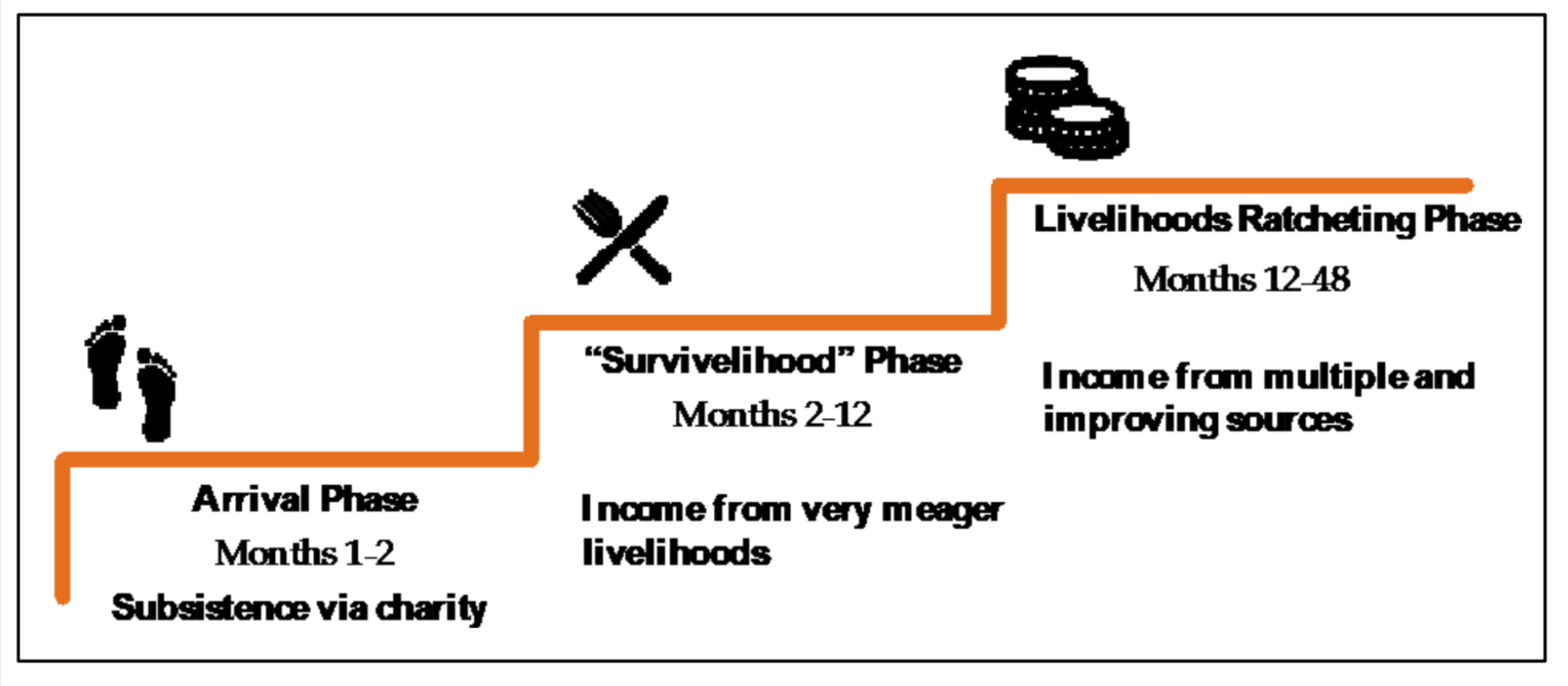
Not all refugees are able to ratchet up their livelihoods; many enabling factors must be in place – indeed, a vast literature explores the success and failure of refugee livelihoods.³⁹ Some portion of the population will continue to struggle with physical and mental health problems (the latter are often higher in refugee populations as a result of their displacement experience⁴⁰), with being a single parent, and with other personal challenges. They will always need targeted humanitarian assistance, and extra help with their livelihoods. As in all populations, whether displaced or not, only some individuals will have the entrepreneurial ability, the luck, the resources, and the networks to be successful.
Applying the Financial Health Framework
In our two recent studies, we found that in the arrival phase, most of our respondents were financially unhealthy. They relied on charity (local or remittances) to meet basic needs; were burdened by debt; could not weather financial setbacks; had no access to funds (lump sums) to pursue opportunities; and their planning horizons barely extended beyond a day.
For these people, most of whom eventually found some form of survivelihoods, it was difficult to pursue any kind of income-earning activity until they found their bearings, which could take months. Income from survivelihoods was too modest to contribute to financial health, and charity was key to survival. But some of our respondents were able to strengthen their financial health after a year or two in the ratcheting phase. Their income began to cover basic needs, and they were paying down debts. Some were able to pool a small reserve that eased financial setbacks and allowed modest investments, typically in schooling, housing, and business assets. Planning horizons expanded to months and even years. However, these were often best-case scenarios, where working permits and business licenses were available and in (usually urban) contexts where economic activity was vibrant.⁴¹
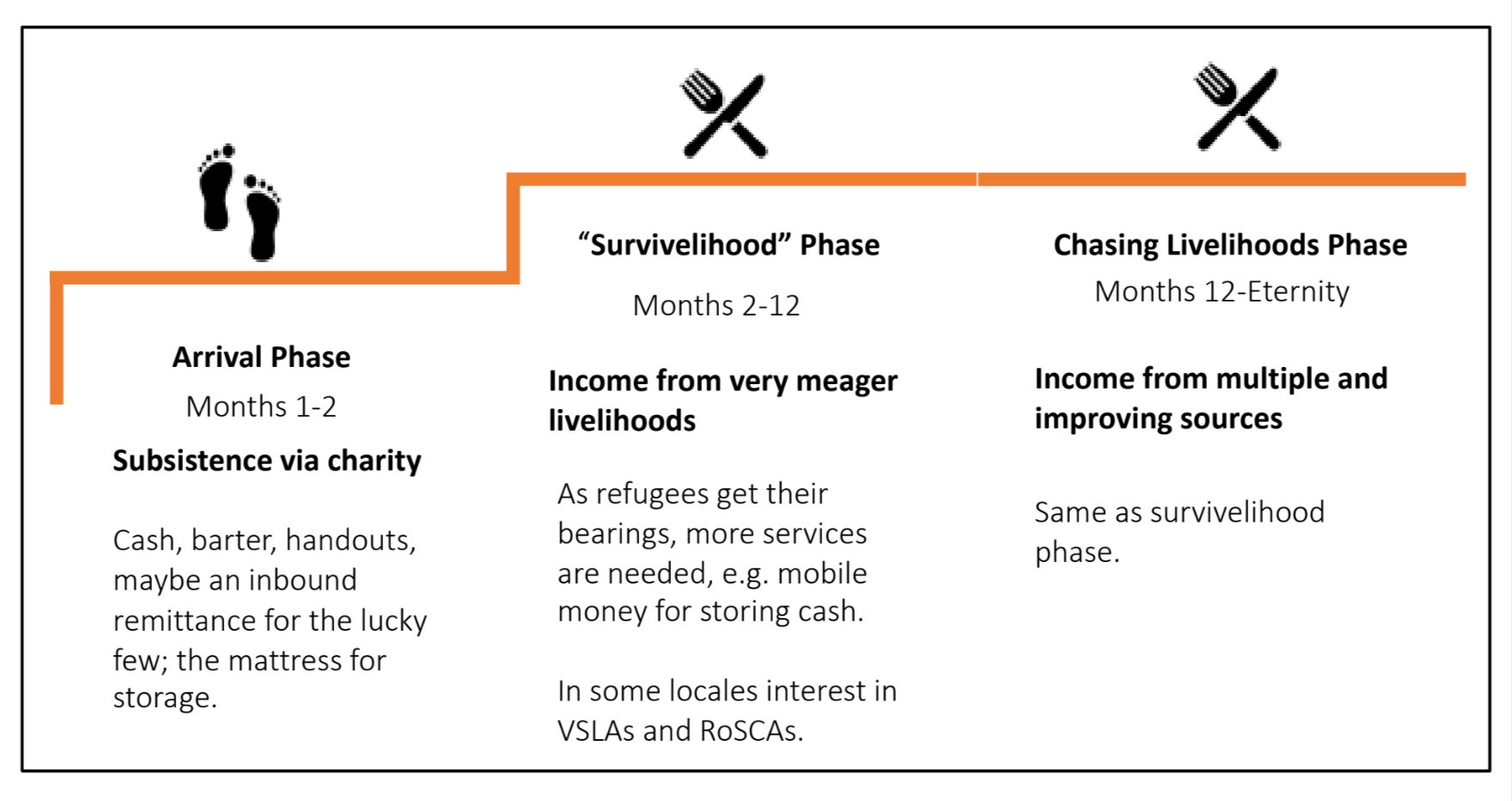
The progression of financial health only takes place in welcoming economies or, at the very least, those that are not punishing, i.e., where there are restrictive policies and barriers such as lack of documentation (IDs and work and business permits). In punishing economies, refugees are much less able to progress, and the process looks more like the diagram below (Figure 3). Instead of ratcheting up their livelihoods, refugees resort to chasing myriad meagre ones. When refugees constantly struggle with punishing policy issues, their financial health flatlines.
A range of services, programs, or initiatives could support financial health. These include financial services (best provided by development actors), and humanitarian assistance such as cash programs, but also other programs such as skills-building and help with the provision of documentation.
Financial services and Financial Health
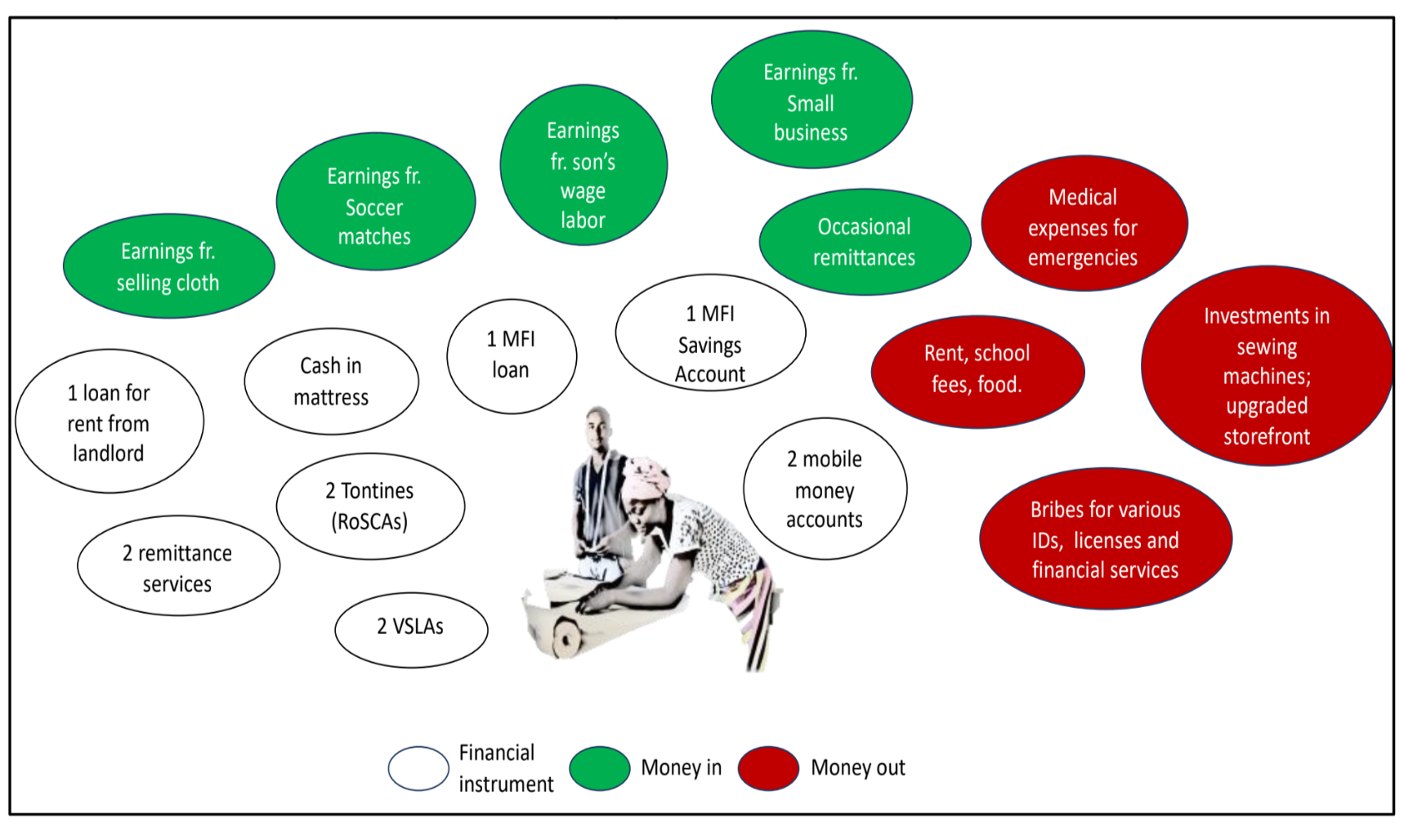
Our research found that financial services co-evolved with and supported growing financial health. Many respondents said well-designed and appropriate financial services related to savings, loans, and remittances strengthened their livelihoods, and generated more reason to use those services. They saw financial services as particularly valuable as their livelihoods became more robust.
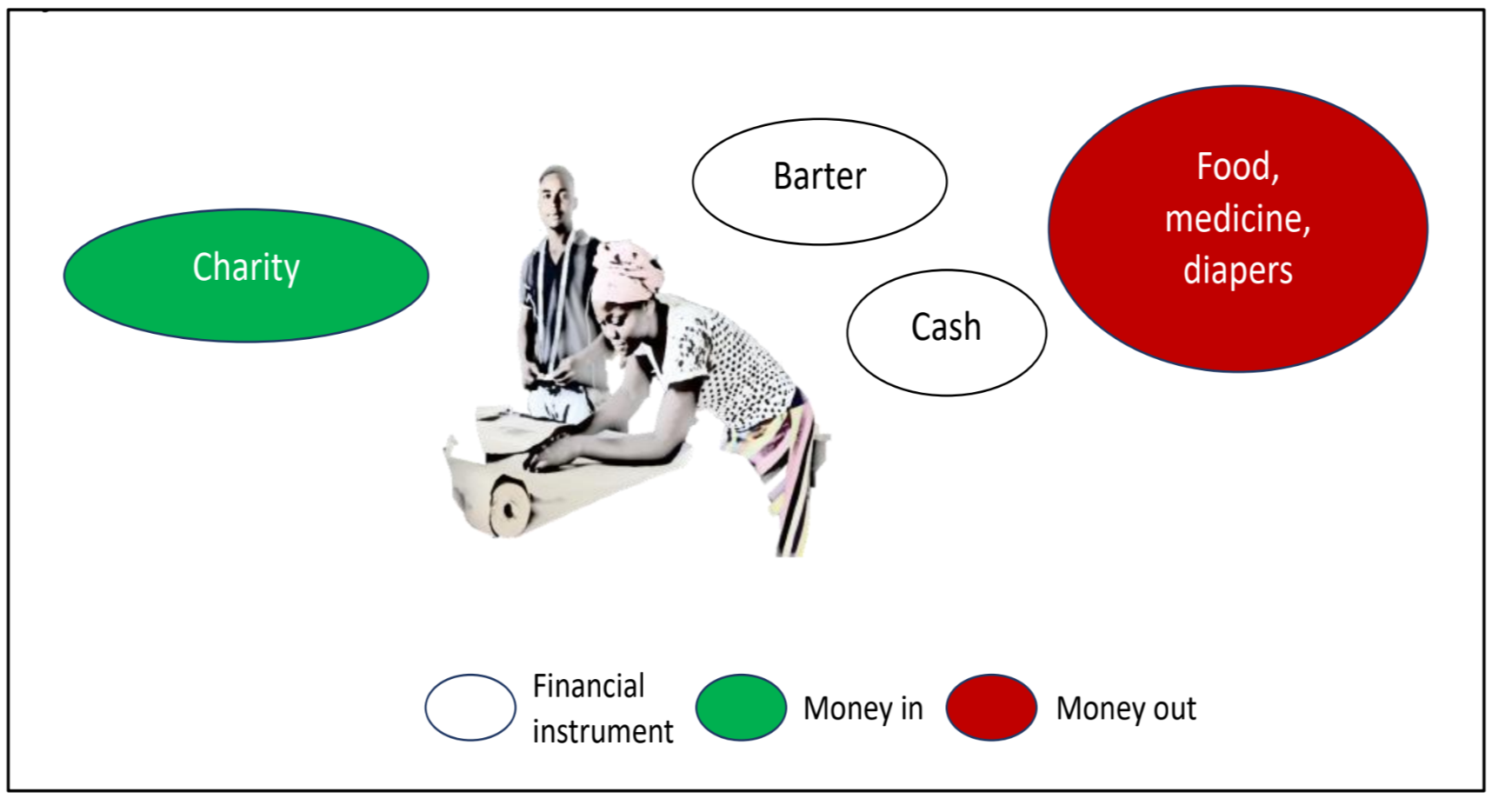
In the arrival phase, respondents used cash (loans and charity) primarily, and some used mobile money and money transfer services to receive remittances. But as they found their footing, some joined savings clubs like village savings and loan associations (VSLAs) or rotating savings and credit associations (RoSCAs). People used the mattress, so to speak, rather than banks as their main vessel for saving any spare cash.
As respondents moved through the ratcheting phase, they kept up their use of cash, mobile money accounts, and savings clubs, and continued to borrow from (and often loan money to) friends and family. Some began saving in mobile money accounts, especially those with small businesses where storing cash on their person or in their home was dangerous. Others got bank accounts (often as part of a humanitarian cash assistance program) and reported saving modestly.⁴² Some, such as those with a retail business or mobile money kiosk, saved aggressively. The demand for credit in the ratcheting phase increased, but options were limited to VSLAs, family and friends, and the occasional microfinance institution (MFI). Some borrowed from the few MFIs that offered credit to refugees and migrants, but many refugees wanted more credit options as they continued to strengthen their financial health and expand their planning horizons.
For example, in Uganda, a welcoming economy, many households, including female-headed households, were able to transition from the arrival phase to the survivelihood phase in just a few months. After several months to a year, they could transition again toward the healthier incomes experienced in the ratcheting phase. Our research shows that the financial portfolios of refugees evolved from the use of basic instruments to more sophisticated ones – all predicated on improved income. The diagram below (Figure 4) illustrates how a Congolese couple who arrived with no money initially had very little use for financial services. However, over time, as their sources and amounts of income increased, so did their use of financial services. As their livelihoods became more robust, so did their financial portfolios.
Financial services enhance the financial health of displaced people, but are rarely the most important contributing factor. Specific types of humanitarian assistance – and whether households have access to them – also affect financial health. Examples are cash assistance, skills-building programs (such as language, business skills, literacy (including computer literacy) and numeracy), the presence of a resettlement program and possession of appropriate documentation.⁴³ Each of these factors has a direct role to play in financial health and could be incorporated into programs.
Conclusion: Financial Health at the Nexus of Development and Humanitarianism
Supporting displaced people in protracted situations is no longer a matter of humanitarian assistance alone. Development perspectives and programming, with their long-term view and experience of financial inclusion programs, have much to offer. Our adapted financial health framework for displacement settings applies to both displaced and local populations and offers a way to explore how all people move toward financial health, supported by both development and humanitarian actors.
Like the Comprehensive Refugee Response Framework (CRRF), the Financial Health Framework adopts a sustainable approach that links humanitarian and development actors, including national and local authorities, financial institutions, civil society, private sector, and refugee and host communities. Like the CRRF, the Financial Health Framework can be used to measure change for both migrants and refugees and for host families. The Financial Health Framework thus fits with the guiding principles outlined in the UN's 2018 Global Compact for Safe, Orderly and Regular Migration (GCM).
Discussion Summary
The EBA roundtable on "Beyond Livelihoods: 'Financial Health' and the Humanitarian-Development Nexus" took place on March 2, 2021, 15:00–16:45 CET. It brought together researchers, practitioners, and policymakers working with Refugees and IDPs in different contexts. The roundtable discussion focused on three areas: a) mapping trends and shortcomings in current livelihoods policy and practice; b) identifying opportunities to improve and refine livelihood programs; and c) identifying areas of future research. This summary presents the salient points discussed by the participants.
Financial Health is a Useful Analytical Framework with Clear Additionality
The roundtable began by discussing the scope and potential utilisation of the financial health framework presented in the keynote statement. Financial health was not taken as a substitute for other frameworks, such as the Sustainable Livelihoods Framework, but rather as a tool that provides a refined set of dimensions and indicators to measure and understand the economic lives of displaced people. The five indicators proposed to capture financial health move beyond narrow analyses of material well-being, focusing on income to a broader understanding of how well individuals can meet their basic needs, mitigate financial shocks, and build financial resilience. For instance, as some participants noted, a key factor that tends to affect the economic lives of displaced people is indebtedness; financial health would allow stakeholders to consider the consequences of such indebtedness in multiple areas of a person's financial life. Although most of the discussion focused on the financial health of refugees and IDPs, participants noted that the framework is non-discriminatory in nature and can be applied to displaced communities and host communities alike.
Although the financial health framework is not a programming framework, the measurements collected using the financial health indicators can be used to identify opportunities and challenges for livelihoods programming. Some noted that the framework can be used as an "x-ray" into the status of market and livelihoods opportunities, as well as the financial resources and strategies that displaced communities draw on. Nevertheless, since financial health is a person-centred framework, practitioners and researchers need to supplement such information by analysing structural economic components, including market institutions, using other dimensions and indicators. The financial health framework can also be used to identify how programming impacts beneficiaries; by monitoring the financial health of individuals over a period of time, implementing organisations and donors can see if their programs are effective in building financial resilience and in what ways. Since financial health looks at overall determinants of how well individuals are faring in life, some participants also noted that the metric can be used to inform programming in other sectors, such as education and health.
While many participants found the financial health framework useful, some noted that it could be improved by engaging concepts and tools from a human rights and development sphere. For instance, the four indicators for financial health presented in the keynote do not account for negative coping strategies for increasing livelihoods, such as child labour or marriage. A family could therefore be "financially healthy" even if they receive steady income from their working children.
Sustainable Livelihoods are Built Through Labour Market Initiatives
A large portion of the roundtable was spent on discussing trends in livelihoods programming – as well as what is needed moving forward. Traditional displacement responses tend to be short-sighted and focus on direct delivery to alleviate poverty. Participants noted that although such an approach may be necessary in an emergency phase, it can easily create a dependence on international aid in the medium or long term. Provision of humanitarian assistance can also undermine local markets and private sector actors, such as when the distribution of food items suppresses opportunities for farmers and grocers in the host community. The past decade has seen a positive development in livelihoods approaches insofar as more actors are using cash rather than in-kind assistance. This helps support the local market and contributes to a country's economic growth. Nevertheless, some participants noted that cash distributions still create dependence on donors and may result in tensions with host community members, especially when the latter are excluded from humanitarian interventions.
Participants argued for a growing need to rethink livelihoods programming, particularly considering the increasing protractedness and urbanisation of forced displacement. Livelihoods programmes need to become more sustainable – moving beyond short-term humanitarian assistance – and address the opportunities and challenges presented by out-of-camp residence. The latter includes the possibility of integrating displaced persons in the labour market as well as working in tandem with host community interventions. In this regard, initiatives like the 2018 Global Compact on Refugees have highlighted that access to jobs and sustainable sources of income is key to promoting self-reliance for displaced people and easing the pressure on host countries, and represent an important step towards achieving durable solutions. Participants noted that rethinking livelihoods entails a paradigm shift in how stakeholders see displaced communities; refugees and IDPs must be viewed as actors for development that can promote economic opportunities – whether as entrepreneurs, employees, or consumers – and contribute to the economic growth of host countries. Humanitarian and development actors are also required to adopt an area-based approach that provides support to both displaced persons and the host community. Not only does this foster social cohesion, but it can also mitigate potential negative impacts of displacement on the host labour market and contribute to the resilience of the host state overall.
To promote sustainable livelihoods, participants highlighted two dimensions that may inform future programming: one supply-oriented, client-centred approach that looks at ways of developing capacities and skills of beneficiaries to enable them to join the labour market, and one demand-oriented market-centred approach that seeks to strengthen markets and open them up to displaced persons. In the case of the former, one promising practice is the Graduation Approach used by the Danish Refugee Council in Jordan.⁴⁴ The approach entails a sequenced and time-bound package of services that combines elements of social protection (including consumption support and mentoring), livelihood development (seed capital, technical and vocational skills training), and financial inclusion (savings and financial literacy) to foster sustainable inclusion in the labour market. Demand-oriented approaches were noted to be less common in displacement contexts, with few stakeholders working with Market Systems Development (MSD). Recently, one promising example of mainstreaming MSD into refugee responses is the joint ILO-UNHCR Approach to Inclusive Market Systems (AIMS) for Refugees and Host Communities.⁴⁵ The approach combines supply and demand interventions to a) develop skills and capacities of the target group to engage with the market, and b) develop sectors and value chains that can expand and diversify market opportunities.
The creation of sustainable livelihoods often requires a combination of humanitarian and development approaches. In this regard, participants noted that humanitarian and development actors are still guided by different frameworks, strategies, institutional cultures, and funding streams – this creates challenges for effective livelihoods responses. On the one hand, humanitarian actors typically lack funds and mandates to engage in the type of long-term livelihoods strategies that are required to build sustainable livelihoods. For many, short-term assistance programs are the only option in the current donor landscape. On the other hand, development actors usually take a long time to arrive in displacement contexts, creating a delay in the shift towards sustainable livelihoods programming. New opportunities for strengthening linkages between humanitarian and development actors are provided for in the Global Compact on Refugees and the Comprehensive Refugee Response Framework. Both call for a joined-up humanitarian and development response from the beginning of the crisis and connect displacement responses to the Sustainable Development Goals (SDGs) and Agenda 2030. Nevertheless, participants reiterated that donors must do more to support such work by funding humanitarian organisations that want to do longer-term, innovative programs for supporting displaced people's livelihoods.
Livelihoods Programs Need to be Context-specific, Person-based, and Adaptive
As noted by some participants, programs for sustainable livelihoods must be guided by a deep understanding of the economic and legal environment in which these interventions are aimed. In some situations, markets are highly functional, but remain inaccessible to displaced populations for policy and legal reasons. This requires advocacy for policy changes, such as the introduction of accessible work permits for Syrian refugees in Jordan. In others, markets are weak and incapable of absorbing displaced communities, requiring more sustained efforts at promoting economic growth and job creation. Context analyses also need to take into consideration a transnational or regional dimension – in northern Uganda, for example, many refugees' livelihoods are supported through cross-border trade with South Sudan – as well as the political circumstances that affect governments' willingness to include refugees in national labour markets. A conclusion of the roundtable discussion was that in contexts where markets are functional and robust, there is not a lot of work humanitarian stakeholders have to do if they are able to remove barriers to inclusion.
Beyond an analysis of the economic, policy, and legal environment, stakeholders also need to design person-based programs that take into consideration the livelihood profiles and financial health of beneficiaries. To be most effective, programs should consider existing livelihoods strategies, including ones in the informal sector, as well as realistic assessments of what type of livelihoods beneficiaries are likely to commit to in the medium to long term. Participants also noted that actors working with livelihoods must be adaptive and follow the financial health trajectories of beneficiaries. During a "survivelihoods" phase, for example, support to sustainable livelihoods may have to be combined with various forms of assistance to support the basic needs of individuals; when beneficiaries have begun to access sustainable income streams and ratchet up their livelihoods, other initiatives may become more important, such as those focusing on saving and investment.
Stakeholders also need to consider that the financial health trajectories of beneficiaries are not always linear but may deteriorate after a period of improvement. This has been made especially clear during the Covid-19 pandemic, when many refugees and IDPs have lost their livelihoods due to government shutdowns or economic stagnation. Considering the unpredictable trajectories for the financial health of displaced communities, actors implementing livelihoods and financial inclusion programs cannot base their programming on data measured at one point in time. Instead, they must follow beneficiaries for a longer period to see how their trajectories develop and adapt their programmes accordingly.
More Data and Evidence are Required to Guide Programming
Participants noted that a continuing challenge for designing sustainable livelihoods programs is the lack of data and evidence on "what works". Monitoring and evaluation activities often are deprioritised in crisis situations, which limits opportunities for learning in relation to livelihoods and displacement. Some participants also discussed how humanitarian and development actors do not sufficiently share available information and data. Academics and practitioners are often afraid to show preliminary results before a study is published and may sometimes opt to keep results for internal use only, particularly when these reflect "poorly" on implementing organisations vis-à-vis donors. In this way, it is both necessary to collect more data and to create new platforms, mechanisms, and dialogues for exchanging such data. It was noted that donors play a key role in this regard insofar as they can create "safe spaces" for organisations to transparently discuss their results.
While more data and evidence are required, the need for context-specific programming means that it is difficult to create generalisable portfolios for best practices for building sustainable livelihoods. What is successfully implemented in one country, city, or camp may not work elsewhere. Similarly, different groups of beneficiaries may experience different outcomes from the same programs. Against this background, participants noted that data should be collected to guide rather than prescribe programming. Stakeholders working in one context can analyse the factors and circumstances that created success – or failure – in another context and adapt such findings to inform their programs. Similarly, frameworks for livelihoods programming in displacement contexts should focus on the factors and circumstances that stakeholders can consider when designing and evaluating programs, not offer generalised blueprints to be applied across contexts. This was noted to be the case in the Market System Development (MSD) approach, which provides parameters for stakeholders to consider for developing markets rather than a set of actions or initiatives that they must undertake.
Some progress was mentioned in relation to data collection on livelihoods. For one, the World Bank-UNHCR Joint Data Centre⁴⁶ was highlighted as an important step in building an evidence base for livelihoods programming. The centre includes approximately 100 data sets available for licensed use. Moreover, some participants noted that there is growing – albeit still limited – donor interest in funding long-term pilot programs and experimental interventions with a research component. For instance, the IKEA Foundation is now supporting IRC with a five-year program in Kenya and Uganda⁴⁷which includes a series of pilots and two waves of randomised controlled trials to unpack what type of livelihoods programmes work best in these settings. By funding experimental, iterative, and long-term programmes with significant budget flexibility, donors like the IKEA Foundation enable continuous Monitoring, Evaluation, and Learning (MEL) activities and the production of new evidence to inform future programming.
Future Research Agenda
The roundtable participants identified several areas where further research is required, including:
Evidence on "what works": To help guide stakeholders in designing programs for sustainable livelihoods, participants noted an overarching need to collect more data on "what works". This is particularly the case when it comes to labour market initiatives: what are the factors that enable displaced persons to access labour markets, and how can labour markets be strengthened in displacement contexts? One suggestion for this type of research was to adopt a positive deviance approach. Such an approach would: a) identify countries, cities, organisations, and programs that have been very successful in promoting and enabling financial health and sustainable livelihoods, b) document those examples in the form of an encyclopaedia of successful practices, and c) analyse what these cases have in common that have enabled them or led to successful outcomes.
Impact of Covid-19 on livelihoods: As noted by some of the participants, the Covid-19 pandemic has had a significant impact on the livelihoods and financial health of displaced persons. Government restrictions and collapsing economies have meant that many refugees and IDPs have lost sources of income and positive gains in financial health. More data is required both to understand the impact of the pandemic and how stakeholders can support clients to regain their livelihoods once the pandemic subsides.
Informal livelihoods: In many displacement contexts, refugees and IDPs primarily work in the informal labour market, either because legal and policy constraints forbid formal employment, or because formal employment opportunities are limited. Despite this, there is often a lack of data on how, when, and where displaced persons work in the informal market. More research is required to capture and measure informality as well as inform livelihoods programmes in the informal sector.
Leveraging cash assistance: As more stakeholders are moving from in-kind assistance to cash assistance, more data is required to understanding how such assistance can best be leveraged to improve financial health outcomes. What, for example, are the best ways of distributing cash: are lump sums or multi-payments more helpful? What are the factors that can influence the outcomes of cash assistance? Another dimension to explore is the linkages between cash assistance and financial inclusion.
Roundtable 3. Ensuring Coherence Across New Donor and Host Country Measures to Address Forced Displacement
Keynote Statement: How do Donor and Host Developing Countries Address Forced Displacement?
Dr. Jason Gagnon and Mona Ahmed, OECD Development Centre⁴⁸
The number of forcibly displaced persons in the world has risen considerably in recent years, with concern centred on the increasingly protracted nature of displacement and its disproportionate effects on developing economies. Several developing countries are hosting significant flows of forcibly displaced persons for the first time. Donor countries are facing a new complex multi-layered dimension to their humanitarian and development support. The result has been a shift in the approach to how best to address forced displacement in developing countries, by bringing humanitarian and development actors together for more sustainable solutions. This short background paper⁴⁹ presents and analyses the ways in which donor countries and hosting developing countries address forced displacement, with a particular focus on coherence, implementation, and coordination with local actors. It underlines lessons learned and proposes policy recommendations for the path forward.
Forced Displacement is a Development Issue
The number of forcibly displaced persons in the world has increased significantly over the years, affecting developing countries disproportionately (Figure 5). Most forcibly displaced persons originate and live in developing countries, driven by conflict, natural disasters, and persecution. The total number of forcibly displaced persons in 2019, including internally displaced persons (IDPs), was 79.5 million, an all-time high. Virtually all refugees (99.8%) originate from developing countries, including 6.6 million from the Syrian Republic, 3.7 million from Venezuela, 2.7 million from Afghanistan, 2.2 million from South Sudan, and 1.1 million from Myanmar. Developing countries also host the most forcibly displaced persons. Colombia, Pakistan, and Uganda were among the five countries that hosted the largest number of refugees worldwide. According to the latest 2020 UNHCR data (mid-year), 84% of all refugees (including Venezuelans) were living in a low- or middle-income country⁵⁰. As developing countries have limited fiscal space and capacity to deal with not only humanitarian assistance but also long-term solutions, addressing forced displacement flows has become a major global development challenge, disrupting the lives and livelihoods of people across several regions of the world.
The complex and protracted nature of forced displacement has also meant that return (or voluntary repatriation) rates to origin countries are increasingly low. From the mid-1990s up until around 2010, the total number of forcibly displaced persons remained relatively stable at around 40 million, as the possibilities of voluntary repatriation, local integration, or resettlement to third countries were more conceivable at that time. As conflict and natural disasters have intensified over the last decade, only 3.9 million refugees were able to return to their country of origin between 2010 and 2019.⁵¹ In 2015, the average length of stay for refugees in protracted crises was 26 years, up from an average of nine years in the early 1990s.⁵²
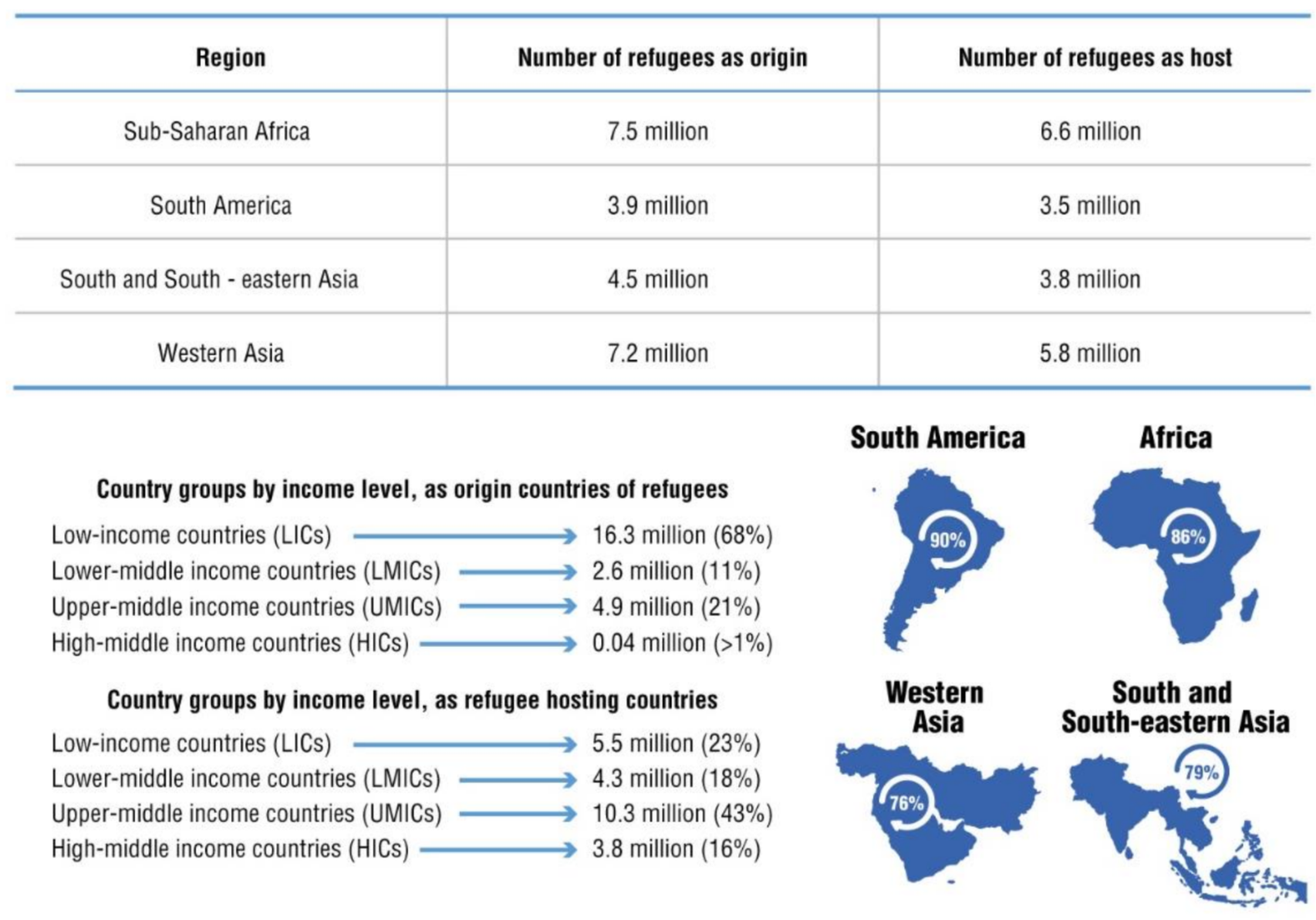
Given the increasingly protracted nature of conflict, forced displacement has therefore become a development issue beyond peace and humanitarian dimensions. It spans and embroils entire regions, calling into question broader implications, including its links with the goals of the 2030 Agenda, and the pledge to leave no one behind. Indeed, the increasing attention and concern on the issue of forced displacement led to the inclusion of an SDG indicator in 2019, accounting for the "proportion of the population who are refugees by country of origin". Concern about the links between forced displacement and development is also reflected in the 2018 Global Compact on Refugees, which was signed by 181 countries, aiming at easing pressure on host countries and enhancing refugee self-reliance, amongst other objectives. Attention to the issue also reflects a more general concern about global migration governance. The 2030 Agenda's SDG target 10.7 aims to facilitate orderly, safe and responsible migration and mobility of people, including through implementation of planned and well-managed migration policies, which helped pave the way to a Global Compact on Migration (GCM) in 2018.
Integration can lead to a better outcome for forcibly displaced persons and hosting countries. Indeed, migrants and refugees can be a boon for hosting countries. The skills of refugees represent significant economic potential, as refugees can be entrepreneurs, investors, and innovators in the hosting country. How well migrants are integrated into the hosting country's labour market is directly linked with their economic contribution to the country, measured through economic growth or through their fiscal impact.⁵³ This implies that hosting countries adopt out-of-camp policies so that forcibly displaced persons can increase their integration and their likelihood to participate in economic activities.
Shifting Gears on Forced Displacement
The importance of fostering an approach beyond humanitarian instruments has required efforts to support longer-term development perspectives. Such efforts have been promoted by the Humanitarian-Development-Peace (HDP) nexus, whose major aim is to address the immediate needs of vulnerable groups while ensuring longer-term investments that tackle the underlying causes of conflict and vulnerability and reduce recurrent shocks. Such a broad and complex agenda calls for greater efforts by a combination of actors, notably development partners, the private sector, hosting societies and civil society organisations (CSOs), to provide the opportunity for forcibly displaced persons to become more self-reliant and for hosting societies to become more resilient to such flows. Particular attention should be drawn to the education and upskilling needs and the employment of refugees, while investing in the local governance and infrastructure of host communities.
The complexity of adding several additional layers to an already convoluted development and humanitarian situation also means much emphasis on coordination is required. Coordination is indeed required at several levels:
- across and within donors;
- between donors and hosting countries;
- between national and local governments;
- across hosting countries from the same affected region;
- across the several relevant actors from all backgrounds;
- globally to ensure that commitments in the GCR and GCM are pushing in the same direction, but also coherent with the 2030 Global Agenda's objectives.
These reasons are essentially why both donors and hosting developing countries are shifting gears on the ways they address forced displacement. The new protracted and high-volume context of forced displacement has necessitated new ways of thinking, new actors implementing, new objectives to reach, and a more long-term view in addressing forced displacement. It requires national coordination, but also local contextual mechanisms. It requires a general overarching development view, but also several specialised sectoral and targeted interventions. It also needs to maintain humanitarian and first-needs operations, while weaving in such longer-term perspectives. The multi-layered challenge of forced displacement as it stands today therefore needs new instruments and coordination mechanisms.
What does this mean in practice? The policy response to forced displacement has traditionally been viewed through a humanitarian lens, providing for first needs and ensuring the safety of both refugees and hosting communities. They have primarily focused, for example, on interventions of protection, shelter, food, nutrition, and water, sanitation, and hygiene (WASH). As displacement situations in developing countries are protracted, however, much political interest has turned towards creating pathways for inclusion and local integration of refugees. In this regard, the adoption of the HDP nexus principles by the donor community has been a crucial step to incorporate more development-oriented objectives in addressing forced displacement. The development angle has ushered in initiatives on education, upskilling, employment, entrepreneurship, and local governance and resilience. A number of initiatives are increasingly growing in interest, as they find themselves at the exact intersection of the humanitarian and developmental perspectives. These include, for instance, social protection, legal counsel and documentation, and psychosocial support, all of which support the humanitarian protection of refugees, while ensuring a long-term perspective (Figure 6).
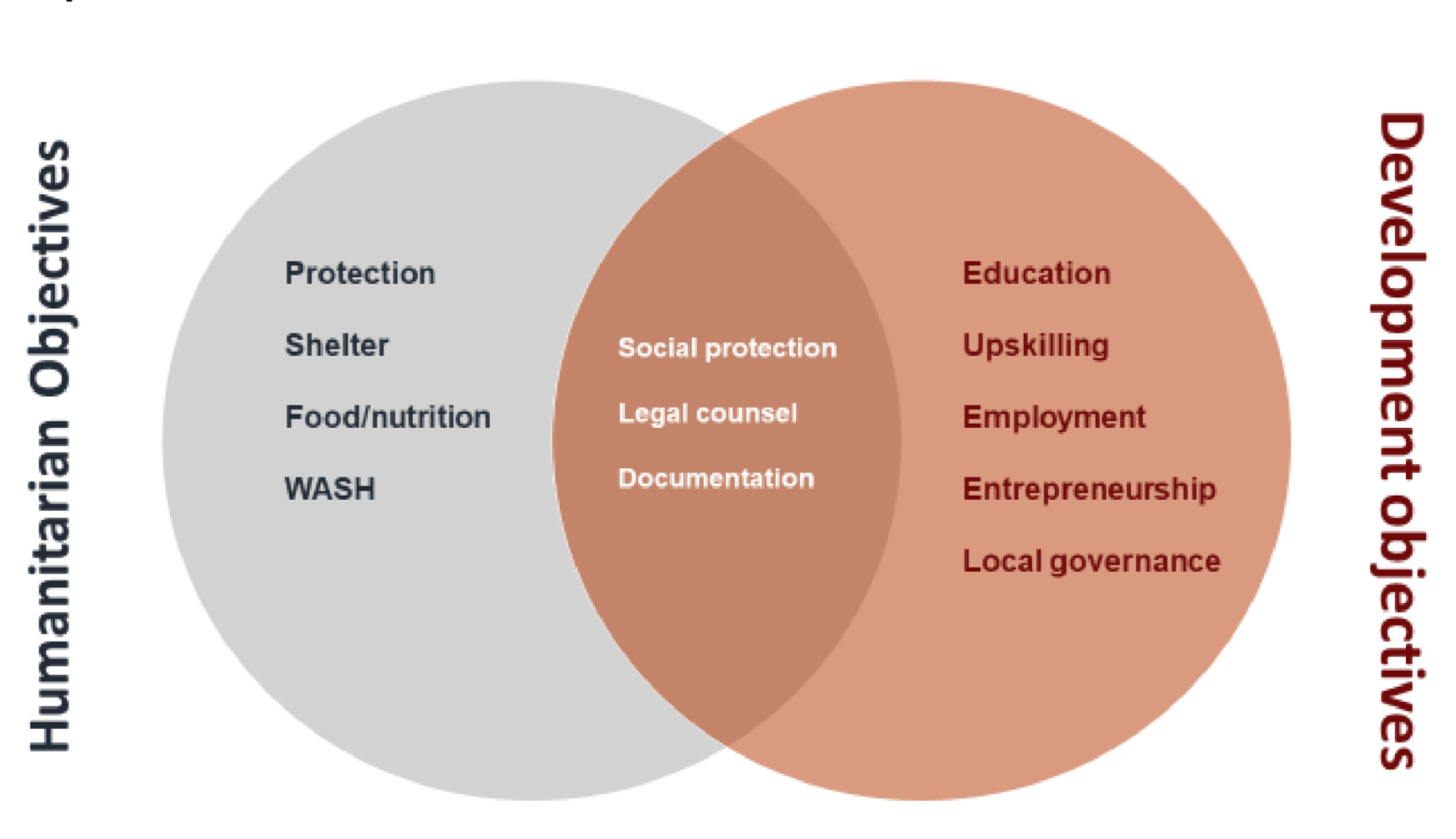
How do Donor Countries Address Forced Displacement?
In recent years, donor countries have developed instruments that range from the very specific, on forced displacement, to the very broad, on development (Figure 7). What determines the type of instrument depends on whether forced displacement is treated as a separate thematic area, or whether it is mainstreamed across several instruments.
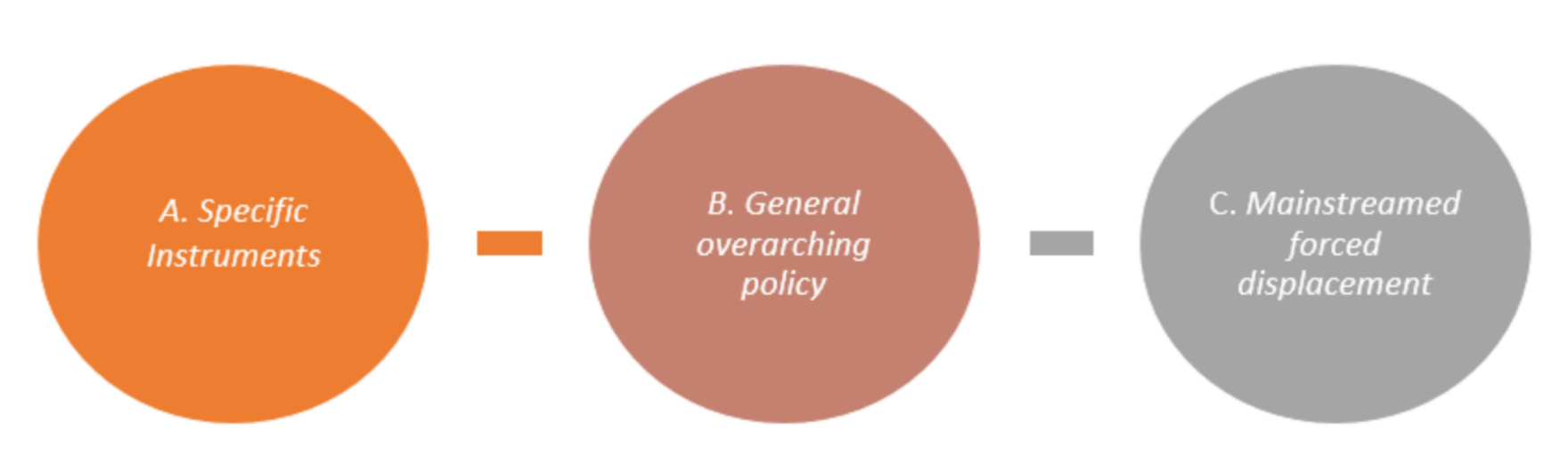
Germany's Special Initiative on Forced Displacement and the Netherlands' Prospects Partnership instrument are examples of specifically targeted instruments. Germany's Special Initiative on Forced Displacement, created in 2014, addresses forced displacement through financial and technical support, specifically for refugees and IDPs, while contributing to the stability of hosting communities and mitigating further causes of forced displacement. The initiative has been constantly evolving, focusing on infrastructure, education, WASH, employment and training, and how to integrate more long-term job support.
The Netherlands' Prospects Partnership was launched in 2019 in partnership with five international institutions (World Bank, IFC, ILO, UNICEF and UNHCR), with the explicit goal of incorporating a stronger development perspective in forced displacement crises. The instrument brings together partners with different thematic expertise to tackle the challenges of forced displacement crises in three ways: strengthening hosting country and community resilience, enabling local socio-economic inclusion and improving access to education and protection for children.
Other instruments are less explicit in name and objective, but they act as specific guides for the country's actions on forced displacement in developing countries. In the United Kingdom, for example, the 2017 Humanitarian Reform Policy changed the country's approach to forced displacement in three different ways: (1) a stronger focus on building resilience and resolving conflicts before crises strike, (2) bringing together humanitarian and development funding, and (3) reforming the international humanitarian system, including greater collaboration with the private sector.
Most donor countries, however, address forced displacement through their pre-existing humanitarian or development programmes. Programmes that have primarily humanitarian objectives include Australia's Foreign Policy White Paper (2017), France's MINKA instrument (since 2017), the Turkish Cooperation and Coordination Agency (TIKA) (since 2008), the Humanitarian Action Office (HAO) in Spain (since 2007). In other countries, forced displacement instruments are mainstreamed into pre-existing national, regional, or global strategies on development. Sweden's Regional Cooperation Strategy in Africa (2016-20) or its Bilateral Strategy of Development Cooperation in Bangladesh (2014-20) are primarily development strategies, but are used to address forced displacement in certain contexts.
How do Hosting Developing Countries Address Forced Displacement?
The extent and volume of forced displacement flows in developing countries is an unprecedented phenomenon. For many countries, the task of managing sudden inflows and integrating new populations into society is a new concern, as human mobility has intensified and diversified throughout the world. In response, a wide range of instruments to address forced displacement according to national context have been developed. Such strategies and plans can be summarised into three broad categories: specific instruments with humanitarian and development objectives, strategies that are specific to forced displacement, and general migration management strategies (Figure 8).

Instruments specifically created to address forced displacement with a longer-term development perspective have also been developed. In Pakistan, for instance, the Refugee Affected and Hosting Areas (RAHA) Programme focuses on long-term development, and carries out projects in the field of education, health, infrastructure and social protection.
The majority of hosting developing countries, however, have adopted plans and strategies that are specific to forced displacement. Some of these plans focus primarily on humanitarian dimensions, such as Bangladesh's 2018 Joint Response Plan for the Rohingya Humanitarian Crisis, while others complement short-term emergency relief measures with longer-term objectives of integration, such as Rwanda's 2019 Strategic Plan for Refugee Inclusion.
In addition, several hosting developing countries have created dedicated commissions to help manage the response to forced displacement (Table 1). Such commissions typically play the role of first point of contact and define national priorities, identify gaps, and are responsible for the overall coordination of refugee assistance interventions in the country.
Education often forms the bedrock of strategies on the integration of forcibly displaced persons. Uganda's CRRF strategy, for example, guarantees universal primary and lower secondary education for refugees. In Ghana, education for forcibly displaced persons is assured in both refugee camps and urban settings. Labour market insertion and the promotion of entrepreneurship further contribute to the self-reliance of forcibly displaced persons. The 2017 Ecuadorian human mobility law grants refugees the right to work and study, as does Djibouti's 2017 national law on refugees. Egypt's Response Plan for Refugees and Asylum-seekers from Sub-Saharan Africa, Iraq and Yemen sets specific targets on self-employment opportunities for refugees combined with training courses that allow refugees to identify market needs. Boosting local governance structures also supports measures on local integration. In Pakistan, the RAHA Programme has implemented more than 1300 infrastructure projects, including flood protection schemes and waste management systems, to protect the most vulnerable and marginalised communities. Mainstreaming crosscutting issues, such as the protection of children and women, is also a common target in implementing forced displacement instruments.
A small number of countries address forced displacement within more general overarching plans on migration management. This is the case for Ghana's 2016 National Migration Policy, Costa Rica's 2018 Plan for the comprehensive management of mixed migratory flows and Ecuador's 2017 Human Mobility Plan. The focus areas in these overarching plans are diverse and range from admission and protection to the provision of basic services, education, social and economic integration, health, and justice.
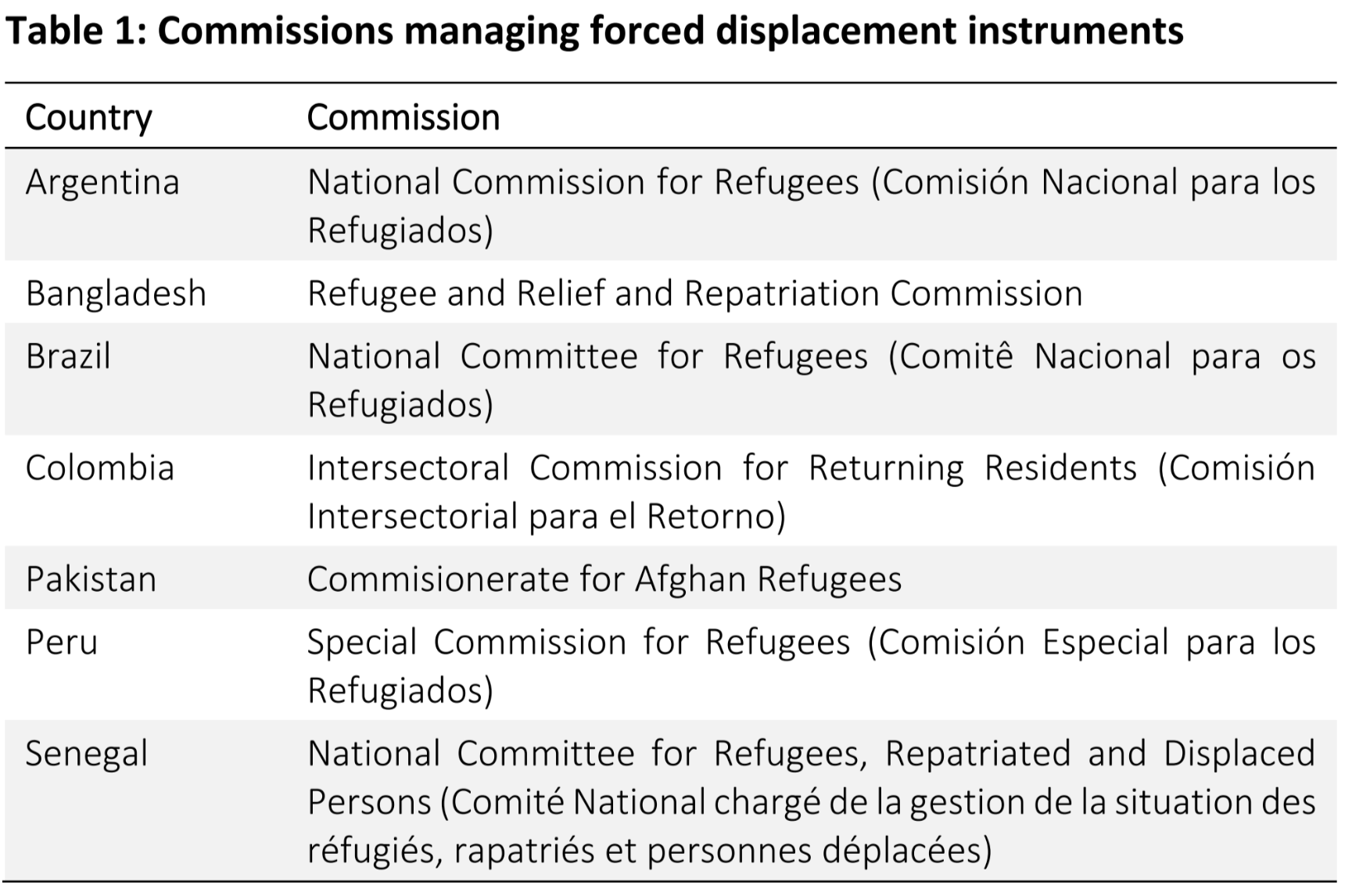
How Should Instruments Addressing Forced Displacement be Implemented?
The changing landscape of forced displacement, and the application of new ways of addressing it, both from donors and hosting countries, has put in question what works, and how to effectively implement it. Indeed, there is no roadmap, nor many examples on which to build and contextualise. However, two pillars stand out on which to build a strong foundation: the use of specialised actors for specific interventions and the leveraging of local actors.
The implementation of forced displacement instruments in hosting countries requires a combination of several actors, including specialised international organisations. These organisations include the UNHCR and IOM, but also agencies and organisations with specific mandates (e.g. UN Women, ILO, FAO, and UNICEF) depending on the situation at hand. As donor countries increasingly design instruments that bridge humanitarian and development actors in their aid efforts, they also play a key role in implementing partner country national projects. Finally, national and local actors may constitute the most important pillar of the overall implementation due to their familiarity with local conditions and customs.
Local actors also constitute an important pillar in the implementation, as forced displacement instruments are designed to respond to needs in specific localities and contexts. Their familiarity with local conditions are in particular helpful when identifying and reaching out to target groups. As the integration of forcibly displaced people is primarily a local phenomenon, it is pivotal to work with local government leaders, but also local businesses and NGOs. Local actors are also well positioned to foster peaceful relationships between migrants and host communities. By actively engaging with constituencies, local authorities can shift mentalities and underline the positive impacts of diversity on local economies.
With the adoption of the Marrakesh Mayors Declaration in 2018, cities formally committed to implement local and joint programs to better coordinate and tailor services provided for migrants. Since the outbreak of the Covid-19 pandemic, the mayors of Amman, Kampala, and São Paulo further pledged to ensure safe and equitable access to services for refugees, including healthcare and economic relief. In São Paulo, the city created the "Connect the Dots" project (Projeto Ligue os Pontos), in which rural farmers collaborate with migrant kitchen workers in order to prepare meals and distribute them to vulnerable groups in the city. The Argentinian province of Buenos Aires authorised migrants from Venezuela with invalidated professional medical degrees to work in local health care systems, a practice that will eventually expand to other areas.
Partnerships with local businesses contribute to the self-reliance of forcibly displaced persons by focusing on employment, entrepreneurship and upskilling. In 2014, the Jordan-based Luminus Education Group began offering technical and vocational education and training (TVET) to Syrian refugees. Its Employment Hub assists in finding companies that are hiring, and Luminus' start-up accelerator "ShamalStart" promotes entrepreneurship. Another example of growing involvement of local businesses is Inyenyeri, a Rwandan social enterprise, that opened a shop inside Kigeme Camp in 2016, in which households received a free cooking stove lease in exchange for signing up for a pellet subscription. As part of this project, Inyenyeri hired more than 20 refugees as customer service representatives responsible for managing the shop, selling stoves, and training others about their use. Many donor and hosting countries also rely on local NGOs for the implementation of forced displacement instruments. In Ghana, for example, the Adventist Development Relief Agency (ADRA), the National Catholic Secretariat (NCS) and the Christian Council of Ghana (GCG) implement WASH, shelter, health and education services.
To support local actors in the implementation of forced displacement instruments, investments in urban and territorial planning are necessary. Rapid and unplanned migration flows are challenging for local authorities, as limited fiscal resources impede the provision of basic services. In order to create inclusive spaces for livelihood generation and social cohesion, data collection and the development of neighbourhood profiles, the practice of mapping context and existing local capacities, can be useful tools. Neighbourhood profiles in the Lebanese cities of Tyre and Tripoli, for example, enabled city leaders and humanitarian and development actors to prioritise actions and to monitor the impacts of support programmes for forced displacement. Successful urban planning further requires the inclusion of migrant communities in local decision-making processes. Their participation amongst a variety of stakeholders gives voice to their concerns and perspectives and helps anticipate social challenges that may arise. It is also a means of capturing knowledge and ideas that migrant populations bring from their origin countries (CMI et al., 2020).⁵⁴
Policy Recommendations
Based on the review and lessons learned so far, a number of policy recommendations can be made, which will help further foster the shift towards more development-oriented objectives and strengthen and help fulfil the global instruments and objectives of the GCR, the HDP nexus and more broadly, the GCM:
- Create platforms for peer learning on how to integrate the HDP nexus into addressing forced displacement.
- Make the agenda more than a humanitarian agenda, but also a social and economic one.
- Cross-pollinate and leverage already existing development efforts.
- Broaden the boundaries for dealing with forced displacement.
- Incorporate more actors, learn from them, and ensure they are at the policy table.
Discussion Summary
The EBA/OECD Development Centre roundtable on "Ensuring Coherence Across New Donor and Host Country Measures to Address Forced Displacement" took place on April 12, 2021, 15:00–16:45 CET. It brought together policymakers, practitioners, and researchers working with refugees and IDPs in different contexts. The roundtable discussion focused on three areas: a) mapping and discussing current instruments and measures to address forced displacement; b) identifying gaps, challenges, and opportunities for ensuring coherence between donors, host states, and implementing partners; and c) identifying areas of future research. This summary presents the salient points discussed by the participants.
A nexus-oriented, Area-based Approach is Needed and is Currently Lacking
The participants in the roundtable reiterated the need for a development approach to address forced displacement. Across the world, displacement situations are becoming increasingly protracted, placing a burden both on displaced populations and host communities. This requires stakeholders to support the self-reliance of refugees on the one hand and the resilience of host communities on the other. It was also noted that these two agendas are closely interrelated, as the self-reliance of refugees benefits host community resilience and vice versa; for instance, when refugees participate in the formal labour market, they can contribute to the economic growth of the host country and help grow government revenue through taxed incomes. A joint focus on displaced and host communities also reduces a potential undermining of social cohesion.
While a shift towards a development approach has taken place in many countries, participants noted that a humanitarian approach often remains dominant in addressing forced displacement. This is especially the case in recent crises, as development actors tend to wait to engage in displacement responses until there is clear evidence of displacement being protracted. The slow mobilisation of development actors was seen as a key challenge by roundtable participants, and some participants noted that stakeholders must work with the presumption that forced displacement will be protracted from the beginning and programme accordingly. Such an approach has recently been applied by some stakeholders, including the UK and its 2017 Humanitarian Reform Policy, but more work is needed in this area. Moreover, in many protracted situations, donor fatigue has meant that the ability to implement a rigorous and comprehensive response is weakening.
Beyond calls for more extensive and earlier development interventions, participants highlighted the importance of involving peace actors in the country/region of origin, both to prevent and reduce the drivers of displacement and to end protracted displacement by facilitating sustainable return. Although the need for close collaboration between humanitarian and development actors is relatively well-recognised, participants noted that the involvement of peace actors remains marginal in most displacement situations. Another key aspect which has only recently begun to be explored is the role of private sector actors, who play a critical role in leveraging additional funds as well as providing job opportunities for displaced persons and host communities.
The roundtable participants emphasised the key role of national host governments in offering forcibly displaced communities protection and access to public services, as well as facilitating broader inclusion and integration in line with a nexus approach. The type of measures host countries provide is contingent upon political, economic, and social factors, as well as institutional capacities and previous experiences. Some countries, like Colombia, have adopted measures to fully integrate refugees and migrants at all levels of society, leveraging decades of experience with internal displacement and institutional capacity building. Other host countries see displaced populations as temporary residents where the only possible durable solution is return or resettlement. In such cases, a development and resilience-oriented approach can be adapted to support refugees and the host community while the former await durable solutions elsewhere.
The Degree of Donor and Host State Coherence Differs Across Contexts
Donors and implementing partners should work closely with national partners to ensure coherence and synergy between international and domestic measures to address displacement. In taking stock of current levels of coordination, participants demonstrated that the degree of coherence differs across contexts and actors.
In some host countries, there is a reported strong collaboration between donors, host governments, and implementing partners to carry out a development and resilience-based approach. Often, the prerequisite for such coherence is the establishment of institutionalised frameworks of partnerships, such as national response plans. The Jordan Response Plan to the Syria Crisis (JRP) is one example of a framework that successfully integrates the refugee response into a broader strategy for host community resilience and government support, bringing together donors, UN agencies, and international and national NGOs. The JRP is also aligned with national development plans and global frameworks like the Global Compact on Refugees. Another positive example is the Comprehensive Refugee Response Framework in Uganda, which similarly integrates the refugee response into a broader strategy for host community resilience and government support.
Some noted that national response and development plans work best at achieving coherence when they explicitly assess the cost of refugee or IDP inclusion; this allows donors to provide direct and adequate support to government budgets. In the Horn of Africa and Jordan, for instance, cost assessments have enabled donors to support the inclusion of refugees in national systems for healthcare and education.
Other contexts bear witness to weaker coherence across donor and host country measures to address forced displacement. In Egypt – where there are over six million migrants and refugees – donor involvement has often been limited to short-term support channelled through international organisations and "parallel systems" that do not link up with those used by the government. This has made it difficult for the Egyptian government to find international support for the integration of refugees into public systems and for stakeholders to strengthen the resilience of host communities. Even when donors do support national governments, some noted that the former may prioritise certain types of interventions that run counter to the priorities of the latter. In Jordan, for instance, donors have sometimes focused on "soft" development activities – such as awareness-raising – rather than "hard" ones like infrastructure development (which are often preferred by the government); in the education sector, this was noted in the donor push for more awareness campaigns on education enrolment, rather than support to increase classroom capacity.
A dimension that is often overlooked in discussions of coherence is the role of inter-host state relations. A lack of coherence between states' host policies in the same region can affect refugee protection negatively; in many contexts, including the EU, differences in host policies have resulted in a "race to the bottom" in which host states seek to disincentivise the arrival of asylum seekers by increasingly curtailing the rights awarded to refugees. Against this background, participants noted that stakeholders should support political dialogue between neighbouring host states to increase regional policy coherence. Such dialogue can not only prevent policy differentiation and backsliding but also push governments to adopt more inclusive measures. This has been the case in the Horn of Africa, where dialogue between host governments has facilitated the right to free mobility for refugees as well as the right to work in some host countries.
Although the presence of implementing partners can sometimes present challenges to donor and host state coherence by promoting parallel systems – as was reported to be the case in Egypt – participants noted that international organisations and UN agencies often make a positive contribution by implementing programs that align with national measures. This is the case in Colombia, where the national government has received extensive support from UNHCR and IOM to manage the influx of displaced Venezuelans. Some participants also noted that implementing partners play a key role in liaising between donors and host governments; for instance, in the case of the Dutch PROSPECTS partnership, international organisations play a mediatory role between the Dutch Ministry of Foreign Affairs and host state governments that are not formally included in the instrument.
International Frameworks Facilitate Coherence, but Challenges Remain
A growing number of multilateral processes and outcome documents have facilitated a more coherent response to forced displacement crises, including the 2016 Grand Bargain and World Humanitarian Summit, the 2018 GCR, and the roll-out of the Comprehensive Refugee Response Framework (CRRF). Some participants reported that these frameworks have prompted a shift to an area-based and development-oriented approach with a joint focus on refugees, IDPs and the host community – particularly for donors – as well as more extensive support towards national and local governments. Similarly, others stated that frameworks like the CRRF have facilitated the inclusion of development actors in some displacement responses, including in Uganda. Participants also noted that new frameworks for displacement management have been successful in bringing in non-traditional actors, such as the World Bank. These actors have played a critical role in supporting the measures of host governments; in the Horn of Africa, the engagement of the World Bank was credited with promoting the leadership of host governments both on a policy and operational level through innovative approaches like the Development Response to Displacement Impacts Project.
While participants emphasised that international frameworks do facilitate coherence, some challenges were noted. For one, stakeholders highlighted that such instruments are primarily meant to provide policy guidance, and do not constitute funds or detailed response plans. In the case of the CRRF, for instance, financial resources are not pledged against the framework, and it does not provide comprehensive reporting of humanitarian and development activities. In Uganda, this has meant that stakeholders lack awareness of existing development measures and therefore a good understanding of how coherence can best be achieved. Moreover, some noted that such frameworks do not facilitate adequate coordination mechanisms, particularly on a donor-donor level. Closer collaboration and more transparent reporting are needed moving forward, both for humanitarian and development actors.
Localising Responses – a Way Forward
Participants reaffirmed that local actors, and particularly local governments, play a critical role in responding to forced displacement. When refugees and IDPs are not in camps or settlements, as is increasingly the case, it often falls upon city governments and municipalities to care for these populations. Although donors and implementing partners should continue to support national governments, work with local actors must be increasingly prioritised, especially considering that local government and civil society actors typically face significant challenges in receiving direct funds from international organisations and donor countries. Such work can also bring additional value as local actors often sit closer to beneficiary populations than national actors and may thus be better placed to provide context-specific, on-the-ground services. In countries where national government actors show limited engagement in the refugee response or where national government actors lack the capacity to work with donors and partners coherently, collaboration with local actors becomes particularly valuable.
While international donors have historically oriented themselves almost exclusively to national governments, recent years have seen the development of some instruments and measures that better cater to the local dimension. One participant mentioned that the EU Emergency Trust Fund for Africa has facilitated significant partnerships on a municipal level in the Horn of Africa, partnerships which enhanced access to basic services on the sub-national level and improved social cohesion between refugees and host communities. Overall, however, the roundtable noted a continued widespread lack of coordination between donors and host governments on a sub-national level. This is the case in Uganda, where humanitarian actors have only recently begun to consider cities like Kampala as important partners. More direct support to and coordination with local governments is needed moving forward.
Future Research Agenda
The roundtable participants identified several areas where further research is required, including:
The impact of Covid-19: The Covid-19 pandemic has presented both challenges and opportunities for a coherent nexus approach to forced displacement. On the one hand, the pandemic has aggravated the socio-economic circumstances for many displaced and host communities, pushing stakeholders to prioritise humanitarian assistance at the expense of development assistance in some contexts. At times, the pandemic has resulted in a return of parallel systems that are not aligned with government measures. On the other hand, the pandemic has underscored the need for an area-based approach for all stakeholders. In many host states, displaced communities have been included in national Covid-19 response plans, and donors have scaled up their support to national systems. How can donors, host states, and implementing partners ensure coherence when addressing both forced displacement and the consequences of the pandemic? How can increasing humanitarian needs be balanced in a nexus approach?
Localising global instruments: The past decade has witnessed the development of multilateral global frameworks and mechanisms for promoting a nexus approach to displacement and strengthening coherence between donors and host states. More research is now needed to understand how such instruments can be implemented on national and local levels. How can global policy frameworks be translated into response and development plans? What are the prerequisites and factors that will facilitate successful implementation? How do global standards and guidelines relate to the political will and capacity of host states and local governments? How can we scale up so that all can benefit from humanitarian and development funds?
Digitalisation: In recent years, the intersection between digitalisation and forced displacement has received increasing attention, especially following the Covid-19 pandemic. On the one hand, digital tools can be used by implementing organisations and partners to ensure a more efficient response (for instance, by using blockchain technology to distribute assistance). On the other hand, refugees themselves can use digital tools to increase their resilience and self-reliance (for instance, by finding digital livelihoods or networking opportunities). Participants noted that more research is required to understand how various stakeholders can leverage digitalisation for positive outcomes. Potential research questions include: How can stakeholders best promote digital literacy and access amongst beneficiaries? How can data protection be ensured as displacement responses are becoming increasingly digitalised? How can digital livelihoods be used to increase the self-reliance of refugees, IDPs, and host communities?
Mapping the road to inclusion: The inclusion of displaced persons in government systems and formal labour markets is a key priority moving forward. Inclusion rarely happens overnight, but often takes the form of a progressive set of steps taken by governments and the international community. More research is required to map and analyse the road to inclusion, and what might influence outcomes. In this regard, at least four key dimensions or "tipping points" were identified by the participants: 1) Who has access to what types of government systems and where? And who is funding this? 2) How do we move from non-contributory inclusion to a reality in which refugees and other displaced populations contribute (for instance, going from social safety to long-term labour opportunities)? 3) How do you go from informality to formality in the labour market? 4) How do we promote increasingly humanitarian mechanisms built into government and development services?
Conclusion: Crosscutting Reflections
The three roundtables organised as part of this series examined forced displacement from different angles: one looked at a form of displacement (internal displacement), one looked at a type of intervention (livelihoods), and one looked at coordination between different stakeholders (coherence across donor and host country instruments). Despite such varying topics, the tables spoke to several shared themes that highlight contemporary opportunities and challenges for work with refugee and IDP situations.
First, addressing protracted displacement requires an area-based approach that takes into account the impact of displacement both on displaced persons and the host community. The majority of all refugees and IDPs are hosted in low-and-middle-income countries where the local population often faces their own challenges, including high levels of poverty and low levels of human development. The arrival of displaced persons can put extra strain on labour markets and public services, requiring additional support by the international community. If aid is exclusively provided for the benefit of displaced persons, this can also aggravate social tensions and disincentivise the host government from promoting integration. Nevertheless, the arrival of displaced persons can also bring positive effects to the host community. Refugees and IDPs can stimulate the local market, contribute to economic growth, and bring new ideas, solutions, and experiences. It is key that such contributions are explored, communicated, and supported by all stakeholders.
Second, displacement responses should focus on several "levels" of interventions, starting with the local and scaling up to the national and regional. At present, international actors and donors often favour programming and support on the national level, whether as direct assistance to host governments or through projects implemented by other national actors. Such support is important and should be encouraged, especially considering that governments play a key role in responding to displacement. Nevertheless, more aid needs to target the local level, including local government and civil society. Local stakeholders are often more directly affected by displacement, and typically possess the most detailed knowledge of what, why, and where support is needed. Humanitarian and development actors should therefore increase coordination at the local level moving forward. Humanitarian and development actors also need to do more to take into consideration regional dimensions of displacement. The economic, social, and political circumstances in a host state are often intimately connected with those of neighbouring states; for instance, displaced persons and nationals may rely on cross-border trade and economic opportunities, and refugee policies in one country might affect that of its neighbour. More effort is required to ensure coherent responses across the local, national, and regional levels.
Third, when it comes to addressing forced displacement, context is key – on a macro, meso, and micro level. On a macro level, each host country that receives displaced persons has its own social, economic, and political circumstances, just as each wave of displacement originates from a country with a unique social, economic, and political history. This means that host societies and displaced communities face different challenges and opportunities for managing displacement and ensuring durable solutions. Similarly, on a meso level, certain groups face specific advantages and disadvantages, and the type of institutions in place may differ from one location or community to another. On an individual level, each displaced person brings their own socio-economic, psychological, and political background, and varying physical and mental abilities. Differences across nations, communities, groups, and individuals mean that a single strategy is rarely sufficient for addressing the needs of displaced persons and host community members – a multitude of approaches may instead be required simultaneously. Moreover, such context changes over time; on a national level, the host economy may grow or shrink, just as personal circumstances may improve and worsen.
Change rarely happens linearly, and a period of progress may be followed by significant setback. This has been the case especially during Covid-19, when economies have shrunk, livelihoods have been lost, and humanitarian and protection needs have increased. It is therefore not only key that stakeholders pay close attention to context when designing programmes, but also that such context is continuously monitored; for instance, by tracking the financial health of beneficiaries.
Fourth, the issue of displacement is inseparable from larger, structural challenges, most notably economic development. A lack of economic opportunities may cause individuals to flee their homes, either as a stand-alone factor or by contributing to violence and persecution. It is therefore essential that more preventative work be done to support economies and create resilience in areas at risk of displacement. In reception countries, the state of the local economy often determines how well displaced persons and the host community are able to cope with displacement. The linkages between economic development and displacement have been widely recognised amongst the international community, including in the 2018 Global Compact on Refugees, which emphasises the need to foster self-reliance amongst displaced people and resilience amongst the host community. Promoting self-reliance and resilience requires the creation of sustainable livelihood opportunities – something that is often missing in displacement contexts. To this end, Market Systems Development interventions should be explored further, especially in fragile contexts. Nevertheless, economic development is not the only structural challenge closely intertwined with displacement. Climate change, for instance, represents an increasing challenge – especially for internal displacement – requiring increased efforts at prevention, particularly in terms of Disaster Risk Reduction.
Fifth, donors and practitioners need more and better evidence and data to guide programming. Many types of problems and potential solutions are relatively new to humanitarian and development stakeholders: humanitarian actors have rarely worked with medium- to long-term programming whereas development actors have traditionally primarily focused on national populations. Stakeholders need more examples of "what works" when it comes to promoting socio-economic inclusion and wellbeing for refugees (and host communities), including in terms of market development. At the same time, what works in one context will not necessarily work in another; evidence on what works must therefore be thoroughly studied to look at enabling factors of success that can inform programming. Stakeholders also need quality, disaggregated data on displacement, including for the duration of displacement and population demographics. Such data is, for example, needed to understand to what extent climate-and-disaster-displaced communities are likely and able to return to their homes. The linkages between humanitarian and development actors and peacebuilding actors also remain an area that needs more research.
Sixth, global instruments for forced displacement play an important role, but on-the-ground implementation may be limited. Over the past decades, a number of legal and policy frameworks have been adopted to address and resolve the forced displacement crisis, ranging from the Guiding Principles on Internal Displacement to the Comprehensive Refugee Response Framework. These instruments play a key role in diffusing norms, and many can be traced to progressive reform in national and regional legislation. Such instruments may also contribute to significant progress in terms of on-the-ground operations and programmes; in Uganda, for instance, the Comprehensive Refugee Response Framework has brought humanitarian and development actors closer together. Nevertheless, there is often a large discrepancy between the extent to which norms and practices are adopted on paper and the extent to which they are implemented in practice. The key question is how to ensure implementation – without clear enforcement mechanisms, what can stakeholders do?
Seventh, preventing, managing, and resolving forced displacement are fundamentally political activities. Although humanitarian and development organisations can play an important role in alleviating humanitarian needs and poverty and promote self-reliance and resilience, governments play the key role in preventing, managing, and resolving forced displacement. Political conflict drives the majority of all forced displacement today. Preventing conflict – thereby preventing displacement – is a highly political mission, as is resolving conflict to enable refugees and IDPs to return. When displacement becomes protracted, integration and resettlement often remain the only viable durable solutions, both of which depend on the political will of host and resettlement countries. Although many countries are hesitant to accept refugees on a permanent basis – often due to a perceived risk of socio-economic and political backlash – others have shown bold leadership; Colombia, for instance, has recently decided to naturalise over one million displaced Venezuelans. A key factor in enabling Colombia's response has been the support of the international community. Even when full political integration does not take place, the degree of temporary socio-economic integration is often a contentious political question. This is also the case regarding the support provided by donors: where, and in which format, aid is distributed often depends as much on political considerations as it does on humanitarian and development needs. The political nature of forced displacement is a challenge – but also a solution. As the case of Colombia shows, displacement can be "solved" when political will exists, and when humanitarian and development stakeholders join in to support displaced persons and host communities.
Footnotes
Works Cited
Albu, M. (2008). “Making Markets Work for Poor Comparing M4P and SLA frameworks: Complementarities, divergences and synergies,” The Springfield Centre, United Kingdom.
Arevalo, S. P. et al. (2015). Beyond cultural factors to understand immigrant mental health: Neighborhood ethnic density and the moderating role of pre-migration and post-migration factors. Social Science Medicine, 138(1), pp. 91–100.
Bailey, S. and Pavanello, S. (2009). “Untangling Early Recover.” HPG Policy Brief 38. October 2009. Available: https://www.odi.org/sites/odi.org.uk/files/odi-assets/publications-opinion-files/5309.pdf
Cazabat, C. (2020). Measuring the Cost of Internal Displacement on IDPs and Hosts: Case Studies in Eswatini, Ethiopia, Kenya and Somalia. IDMC. Available: https://www.internal-displacement.org/sites/default/files/publications/documents/202001-cost-of-displacement-africa-case-studies.pdf
Chan, C. S. et al. (2015). The contribution of pre- and post-disaster social support to short- and long-term mental health after Hurricanes Katrina: A longitudinal study of low-income survivors. Social Science Medicine, 138(1), pp. 38–43.
CMI et al. (2020). “Local inclusion of migrants and refugees – A gateway to existing ideas, resources and capacities for cities across the world.” Available: https://www.cmimarseille.org/knowledge-library/guidance-document-local-inclusion-migrants-and-refugees
De Vriese, M. (2006). Refugee Livelihoods: A Review of the Evidence. Geneva, Switzerland: Evaluation and Policy Analysis Unit, UNHCR.
Durable Solutions Platform (2021). “About Us,” [Online]. Available: https://dsp-syria.org/about-us [6 June 2021].
Ferguson, J. (1990). The Anti-Politics Machine: “Development,” Depoliticization, and Bureaucratic Power in Lesotho. Cambridge: Cambridge University Press.
Ferrández, P. C. (2021). From Basic Needs to the Recovery of Livelihood: Local Integration of People Displaced by Drought in Ethiopia. IDMC. Available: https://www.internal-displacement.org/sites/default/files/publications/documents/21_0318_Local_integration_in_Ethiopia.pdf
Ferris, E. and Miller, S. D. (2020). “Does the International System Support Solutions to Internal Displacement?” Research Briefing Paper for the United Nations Secretary-General’s High Level Panel on Internal Displacement, August 2020. Available: https://www.un.org/internal-displacement-panel/research-partnerships
Gagnon, J. and Ahmed, M. (forthcoming 2021). “Towards more sustainable solutions to forced displacement: What measures are hosting developing countries applying to address forced displacement?” OECD Development Policy Papers, OECD Publishing, Paris.
Gagnon, J. and Rodrigues, M. (2020). “Towards more sustainable solutions to forced displacement: What measures are donor countries applying to forced displacement in developing countries?” OECD Development Policy Papers, No. 34, OECD Publishing, Paris. Available: https://doi.org/10.1787/d1d44405-en
Government of Ethiopia (2019). “Nation Launches Durable Solutions Initiative to Support IDPs.” Available: https://reliefweb.int/report/ethiopia/nation-launches-durable-solutions-initiative-support-idps
IASC (2020). “Exploring Peace within the Humanitarian-Development-Peace Nexus (HDPN),” Issue Paper, October 2020. Available: https://interagencystandingcommittee.org/system/files/2020-10/Issue%20paper%20-%20Exploring%20peace%20within%20the%20Humanitarian-Development-Peace%20Nexus%20%28HDPN%29.pdf
IASC (2008). “Guidance on the Concept of ‘Provider of Last Resort.’” Available: https://www.humanitarianresponse.info/sites/www.humanitarianresponse.info/files/documents/files/IASC%20Guidance%20on%20Provider%20of%20Last%20Resort.pdf
IASC (2006). “IASC Guidance Note on Using the Cluster Approach to Strengthen Humanitarian Response.” Available: https://interagencystandingcommittee.org/working-group/documents-public/iasc-guidance-note-using-cluster-approach-strengthen-humanitarian
ILO (2021). “Approach to Inclusive Market Systems (AIMS) for Refugees and Host Communities,” [Online]. Available: https://www.ilo.org/empent/Projects/refugee-livelihoods/lang--en/index.htm [7 June 2021].
IRC. (2021). “The IKEA Foundation awards €30 million grant to the International Rescue Committee to support livelihoods development for urban refugees in East Africa,” [Online], January 28. Available: https://www.rescue.org/press-release/ikea-foundation-awards-eu30-million-grant-international-rescue-committee-support [7 June 2021].
Jacobsen, K. and Fratzke, S. (2016). Building Livelihood Opportunities for Refugee Populations: Lessons from Past Practice. Washington, DC: Migration Policy Institute.
Joint Data Centre (2021). “Our Mission and Strategy,” [Online]. Available: https://www.jointdatacenter.org/who-we-are/#mission [7 June 2021].
Kälin, W. and Chapuisat, H. E. (2017). “Breaking the Impasse: Resolving Protracted Internal Displacement as Collective Outcome,” OCHA Policy and Studies Series. Available: https://www.unocha.org/sites/unocha/files/Breaking-the-impasse.pdf
Koizumi, K. and Hoffstaedter, G. (2015). Urban refugees challenges in protection, services and policy. New York: Routledge.
Ladha, T. (2017). “Beyond Financial Inclusion: Financial Health as a Global Framework,” Center for Financial Services Innovation.
Mallett, R. and Slater, R. (2016). Livelihoods, Conflict and Aid Programming: Is the Evidence Base Good Enough?, Disaster 40(2), pp. 226–45.
OECD (2020). “DAC Recommendation on the Humanitarian-Development-Peace Nexus. 2020.” Available: https://legalinstruments.oecd.org/public/doc/643/643.en.pdf
OECD and ILO (2018). “How Immigrants Contribute to Developing Countries’ Economies,” OECD Publishing/International Labour Organization. https://dx.doi.org/10.1787/9789264288737-en
OECD (2016). “Perspectives on Global Development 2017: International Migration in a Shifting World,” OECD Publishing. Available: https://dx.doi.org/10.1787/persp_glob_dev-2017-en
Perret, L. (2019). Operationalizing the Humanitarian–Development–Peace Nexus: Lessons learned from Colombia, Mali, Nigeria, Somalia and Turkey. Geneva: IOM. Available: https://publications.iom.int/fr/system/files/pdf/operationalizing_hdpn.pdf
ReDSS (2021). “About ReDSS,” [Online]. Available: https://regionaldss.org/index.php/who-we-are/about-redss/ [6 June 2021].
Serrat, O. (2017). Knowledge Solutions: Tools, Methods, and Approaches to Drive Organizational Performance. Singapore: Springer.
Tufts University (2021). “The Journeys Project,” [Online]. Available: https://sites.tufts.edu/journeysproject/ [7 June 2021].
Tufts University (2021). “Refugees in Towns,” [Online]. Available: https://www.refugeesintowns.org [7 June 2021].
Van Raemdonck, L. (2019). Comparison of Four Different Livelihood Programmes for Urban Refugee Women in Durban, South Africa: Insights from the Capability Approach. Journal of International Migration and Integration / Revue de l integration et de la migration internationale, 20(2), pp. 497–519.
Weishaupt, S. (2020). “The Humanitarian-Development-Peace Nexus: Towards Differentiated Configurations,” UNRISD Working Paper 2020-8. Available: https://www.unrisd.org/80256B3C005BCCF9/(httpAuxPages)/384F8172D81CA0B2802585DC003903AB/$file/WP2020-8---Weishaupt.pdf
UNHCR (2021). “Strengthening resilience in crises through Transitional Development Assistance (TDA),” [Online]. Available: https://globalcompactrefugees.org/article/strengthening-resilience-crises-through-transitional-development-assistance-tda [5 April 2021].
UNHCR. (2020). “Global Trends in Forced Displacement 2019.” Available: https://www.unhcr.org/globaltrends2019/
UNHCR. (2020). “Mid-Year Trends 2020.” Available: https://www.unhcr.org/statistics/unhcrstats/5fc504d44/mid-year-trends-2020.html
United Nations (2021). “United to Reform,” [Online]. Available: https://reform.un.org [7 June 2021].