
Venezuela to Colombia: An LGBTQ+ woman finds her way—first with friends, then alone—ending up in the grim town of Turbo.
Written by: Amanda Borquaye, under the supervision of Kim Wilson
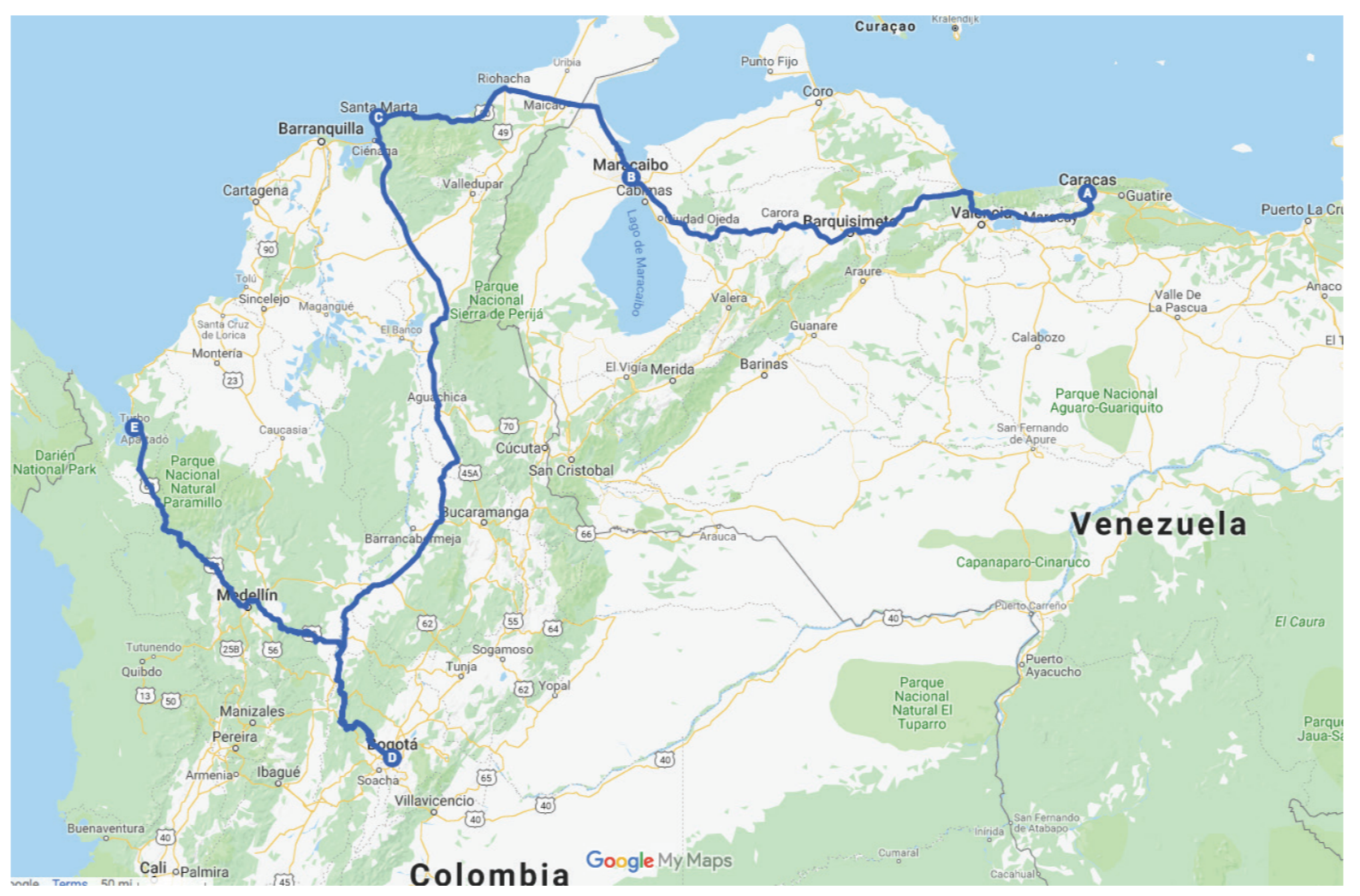
A colorful, larger-than-life woman leaves her beloved family in Venezuela to find employment and personal fulfillment in Colombia. Zigzagging from Santa Marta on Colombia's coast to Bogotá, the country's capital in the Andes, back to Santa Marta, and eventually to the coastal town of Turbo, Roset juggles friends, work, and lodging. Though she is able to cobble a life together, she is not, as she relays, really living. For that to happen, she needs to feel a sense of dignity. Clothes, travel, and meaningful work would contribute to that dignity but, for the moment, feel out of reach.
The interview was held in Glamour Salon de Belleza, a beauty salon where Roset works as a hairdresser. The salon is brightly lit by fluorescent lights. Jersey Shore, British edition, plays on a small flat-screen TV on the back wall, and the faint mist of hairspray hangs in the air. A manicurist and the salon owner, who is also the receptionist, joke in the background. A day earlier, Padmini, a member of our interview team, had her hair cut here. When we returned later that night, her hair was still on the floor. Photos of glamorous women with edgy haircuts line the walls, and small bins on the floor hold nail supplies and store-bought hair creams and soaps. A lone sink stands against the back wall, and a few black pleather chairs line the edges. When I entered, Roset was giving a client a hair-smoothing treatment. Upon finishing, the client grabbed a magazine and went to sit under the hair dryer for what would become two hours. Roset suggested that we talk from her beauty chair, blow dryer in hand. However, the noise from the street—the endless honking of cars, the commotion of mango carts, and women chattering loudly in Spanish—made hearing difficult, so we headed into a small rectangular room in the back reserved for waxing. Roset sat uncomfortably on a footstool while I plopped down next to her on the pale, flecked linoleum floor. The entire room smelled vaguely of wax and hairspray.
Roset preferred that I use the pronouns "her" and "she" when referring to her. Roset openly identifies as a transgender woman. She also described herself as gay. Her birth name is Hector, but another transgender friend in Spain gave her the more feminine name Roset, which is roughly Hector backwards.
Roset is currently alone in Colombia. She is the child of humble parents, both fishermen, and her father was ex-military. She said that she had always felt more feminine than masculine and grew up feminized, always buying traditionally feminine things. In secondary school, between classes, she would even hide in the bathroom to secretly apply powder and other makeup. When her mother saw her buying these things and realized that she had a feminine bearing, she came to talk to Roset. At first, it was difficult for Roset's mother to accept that she was transgender, and for a while she saw her child's gender as merely an impulse to cross-dress. She would not let Roset leave the house in feminine attire. However, by watching a show called Caso Cerrado—popular in Venezuela and throughout Latin America, which is very similar to Judge Judy in the US—Roset's mother changed. Some of the cases tried on the show dealt with LGBTQ+ people. Roset's mother observed that members of the gay community were accepted, and even defended, on TV. Over time, she became more comfortable with the idea of Roset's gender and came to accept and even embrace it.
Roset's father, however, had an entirely different reaction: pure shock. He was a serious, stern man—perhaps, Roset said, due to his military background. He never told Roset to change who she was, but she believes that he was very uncomfortable with her gender and sexuality. It took him time to accept her orientation, but he eventually came around. Roset explained how when she told her family she was leaving Venezuela to migrate to Colombia, her father cried. It was the first and only time that Roset has ever seen him cry. He calls her frequently to tell her he loves her and is proud of her. Her migration has been very tough on the whole family.
Roset left Venezuela about three years ago. She did not want to leave but felt she had to; there was no work for her, especially in the wake of President Maduro's election and subsequent tenure. Prior to the economic meltdown, Roset said that she had lived well. She worked for a chemical and petroleum company called Maritime, cleaning as part of the custodial staff. On the side, she pursued her passion for doing beauty treatments. In 2013, she began working on the side as a makeup assistant in Venezuela, living in a small village called San Timoteo. Wanting more opportunity, she moved to Caracas to fulfill her dream of being fully immersed in the beauty business. Life in Caracas, according to Roset, was spectacular. She would go out often, make herself up, and have a healthy dating life within the gay community. During this time, she also began to experiment with her sexuality—something liberating and confidence-building for her. She found romantic success within the gay community, quickly learning the ropes—both romantic and sexual—of being openly gay and dated many men her own age. After this initial period of experimentation, self-discovery, and self-love, she began to settle down with more serious partners. She experienced her first relationship when she was 20 years old. She described all her relationships as stable, live-in partnerships where she could openly express herself and live her gender identity and sexuality. She said she "fell in love and suffered" with three different partners. Afterward, she decided to be alone, at least for a while.
With the rise of Maduro, it soon became evident to Roset that the Venezuelan economy was sinking. Recognizing that the situation was not going to improve anytime soon, Roset made the tough decision to leave Venezuela for Colombia. Through friends, she had heard of opportunities in the beauty business. To enter Colombia, Roset first traveled from Caracas to Maracaibo, Venezuela. She then crossed the Maicao border in Maracaibo. She had gathered funds to make the journey. It cost about $250 to take a taxi from Maracaibo to the Maicao border, a ride that lasted nine hours. Roset was traveling with three others, all gay men from Venezuela. They split the cost of the taxi. The trip involved more than the cost of transportation; the taxi driver helped them make the border crossing, for which he demanded more money.
Her friend and fellow traveling companion, Javier, was in charge of administering the money for the group of four. None of them had proper entry documents; although Roset has a passport, it had not been stamped, so she is in Colombia illegally. It then cost 25,000 Colombian pesos (approximately $9) to get from the border at Maicao to Santa Marta, Colombia, a sum that was again split four ways. She said that here again the taxi driver took advantage of their situation. He knew, she sensed, of their desperation and demanded more money, an additional 6,000 pesos (approximately $2). The Venezuelan police also asked for bribes, though she did not disclose the amount. However, neither the Venezuelan police nor the taxi drivers stole from them, though she admitted they had nothing worth stealing. Furthermore, the Colombian police did not ask for money.
In Colombia, Roset first lived in Santa Marta, where life was very hard for her. On the advice of a friend of one of her traveling companions, she stayed in a private home, sleeping on a sheet on the bare floor of the hostess's living room. As difficult as the situation was, their hostess did not ask for any payment. Yet, even though the lodging was free, it was unbearably hot. She would wake up as early as 5 a.m. The friends who lived in the house were all men. Few jobs were available in this coastal Caribbean town, so Roset often did not work at all. If and when she did, she arranged hair in her hostess's house. Lack of income was not her only challenge: she was often harassed, with people calling her a maricón (a derogatory term for LGBTQ+ people in Latin America) and degrading her in other verbal and physical ways. She also faced a lot of racism for being Venezuelan. She had heard stories of some people being taken, burned, or killed because of their race and was very afraid of both sexual and physical abuse.
Her three traveling companions sold arepas, a popular street food in Colombia, while Roset arranged hair. She could make 10,000–20,000 pesos (approximately $3–6) per haircut. For a while, they were managing, but as time wore on, small bouts of infighting among various members of the foursome worsened into serious disagreements. They decided to go their separate ways. Though they could not live together, Roset is still in contact with them, and they are on good terms.
Santa Marta's slack economy offered even fewer opportunities for work than Venezuela did. Roset felt compelled to try something new and so moved to Bogotá. A friend of hers in Bogotá gave her bus tickets to travel and opened her apartment to Roset, charging her nothing.
However, in Bogotá, life was even more difficult than in Santa Marta. Competition for hairdressers, especially within the Venezuelan community, was tight. Prices for beauty and hair products were higher, and she had even fewer clients than before. She left after three months, returning to Santa Marta where she found work in a beauty salon. But despite working in the line of activity—beauty—that she loved, she did not find employment in the salon fulfilling. "I like to experiment with hair and beauty," she said. "It is an art!" In Santa Marta, she had very little freedom to be creative.
Through a personal connection, she was referred to the Glamour Salon in Turbo, a town 277 miles west on the same coast. The job is not great, but "for now, I must just keep fighting." Though many of her LGBTQ+ friends and acquaintances have had to take on sex work to survive, Roset insists she has never had to enter into any form of prostitution. The only way she is getting by, she believes, is because she has a skill set—hairdressing, styling, and esthetics—that she is good at, and has had the immense fortune of having friends who look out for her.
Roset said she feels more serious now than before she departed Venezuela—her life has changed. In love and in friendship, she wants to be with those who value her and can understand the life she has lived, which has been difficult. She admits she is her own worst critic. She judges herself for having "a too-feminine personality" or for being "too overweight." During our conversation, she paused and looked briefly at the floor of the waxing room, eyes downcast: "I have not accepted myself," she said, the weight of her words falling hard and cold in the pale fluorescent light. Her eyes began to water as she said—emphatically gesturing toward herself with her short hands, fingernails unpainted—that Colombian men are distinct from Venezuelan men. In Venezuela, she would have been fabulously dressed just the way she was, in a grey T-shirt, charcoal sweater, and leggings, with pin-straight, jet-black, mid-length hair. But in Colombia, men are different. They judge her. The men in Colombia are vain, she said, and very strict with what they consider physically attractive. If Colombian men were her fantasy, she was their nightmare. To be accepted, she felt a pressing need to be "spectacularly wow." She could do this with her personality, she said, but couldn't physically change who she was.
Her situation in Turbo breaks her heart. She was used to having a lot of friends, providing the "wow" factor with her personality. But now she is not even given a second look and feels very alone. In Turbo, she couldn't live how she wanted to, as she did not make enough money to meet her basic needs. She currently makes only 10,000 pesos ($3) per haircut; even in Turbo, the economy used to be better than it is now, and she used to move a lot more money through the salon even six months ago. Now, she doesn't go out but goes from work directly home.
She tries to relax in Turbo, but she wants to do more than relax—she wants to really live. She dreams of traveling, buying material goods, buying necessities. She wants to look pretty, be pretty. She wants to send money to her family, all of whom are still in Venezuela, but cannot do this. Life in Turbo is expensive. Roset lives in a guest house that costs 20,000 pesos ($6) daily, though she receives a discounted daily rate of 15,000 pesos ($4.75), thanks to her friendship with the owner. However, when she cannot pay her rent, the owner imposes a fine and, as a result, she has incurred significant debt. At one point, she owed 80,000 pesos (approximately $25), but now, after paying it down, she only owes 25,000 pesos ($8).
As for her other basic needs, the local restaurant owners are her friends, and sometimes when she does not have money, she fixes their hair for free, and they feed her as an exchange. She receives loans from friends, which creates more debt for her, but as she notes, it is good debt, as it is with friends. Much better, she added, to be in debt to friends than to a landlord and fear losing her room. When she cannot repay her friends with cash, she often pays them with free hair and beauty treatments.
Upon thinking about the future, Roset mentioned that she does not have a lot of hope or expectations. She thought that Colombia would be a better place to live than Venezuela, but it hasn't been.
"Everything fell apart, boom!" she exclaimed. She is in debt and does not know how to pay the rent. Meanwhile, she can't feel good about herself as it is "terrible" to not have enough to live with dignity. Yet most crucially, Roset noted, her migration experience and living in Turbo has "destroyed my self-esteem and sense of being." In Venezuela, she described herself as having been well put-together and made up. Now, she looks in the mirror and doesn't recognize herself and is jealous of others who have the ability to make themselves up and live. She sighed as she stated that she has gone two years without a romantic partner of any kind. Her lack of money and her migration journey, more than impacting her ability to access basic goods and services, have impacted her ability to buy the things she needs—clothing, makeup, simple jewelry—that help her to transform into the woman she wants to be and really is. It has destroyed her gender identity.
Yet, as Roset made sure to point out, she has other dreams. She wants to meet the love of her life. She wants to live a proud and dignified life, and to travel. Her hope is to go to Spain, Mexico, and England, Newcastle in particular, a place that appeared on her travel radar after watching Jersey Shore, British edition, on TV. "I would like to go to New York, where I can feel like a queen, or like a Kardashian," she said. Yet most of all, Roset would like to be an entrepreneur—again, like a Kardashian, she said with a wink and a flourish of her hands, eyes turned upward to an invisible God. She would like to have her own salon or chemical makeup company that would manufacture creams, makeup, and hair treatments. It might take 40 or 50 years, she said, but "I will make it happen."
Roset wants to work in Turbo until March, after which she hopes to leave for Ecuador, where any income she earns would be in US dollars and where she could begin to save for travel to Spain. Friends have already offered to gift her a ticket to Quito, and a friend in Quito from her life in Venezuela has offered her a room.
Carrying so much burden so often, and living the life she has lived, is horrible, Roset concluded. But she said with a smile,
"I am strong, and I can overcome all."
📝 This article was originally published in a collection of biographies by the Henry J. Leir Institute at The Fletcher School of Law & Diplomacy and Tufts University.
You can Download the original collection below ⬇️