
Cameroon to Colombia: A married tailor, traveling alone, finds himself stuck in the Spanish-speaking Americas, longing to reach a place where people speak English.
Written by: Amanda Borquaye, under the supervision of Kim Wilson
We saw two men standing on the second-floor balcony of one of the migrant hostels in Turbo. It was midday and sweltering. The men were leaning on the railing, staring at the road below, one of them wearing a white and red Los Angeles Angels baseball cap. I yelled up to the men in French: "Hey! Your cap is for a Los Angeles team! We're from the United States. You?"
The men invited us up to the balcony. They were from Ghana and the Central African Republic. They introduced us to their friend Feliz, a middle-aged man from the Anglophone region of Cameroon.
He had been in Turbo for a few days and was struggling. He didn't speak Spanish and said he was frustrated by South America because of the language difficulties. "It's impossible to get work!" he said several times during our conversation.
In Cameroon, Feliz, which means happy in Spanish, had been a tailor. He said he made African-style clothing but was skilled in many types of designs; he had sewn the pleated khaki pants he was currently wearing. But the conflict in the Anglophone region of Cameroon forced him to leave. Fighters had entered his region and killed several people he knew. Feliz described hearing of people who were decapitated in their homes, their bodies dragged into the road, and then set on fire. "It's better to die somewhere else, in some other way. I'll take the risk," he said. He heard that fighters would soon be approaching his town, so he left at dusk. His wife didn't travel with him.
He hiked through a forest until he reached a nearby city where he was able to get a moto (motorcycle) taxi. He used moto taxis to cross several countries until he reached Nigeria. He knew he could communicate with others in Nigeria, and that he would find ample travel opportunities. He had a passport and some money saved from his clothing business and knew he'd be able to buy a plane ticket to a place like Brazil cheaply.
He flew from Nigeria to Istanbul, Istanbul to Lima, Lima to Buenos Aires, and Buenos Aires to Sao Paolo. He said it exhausted all of his money. While in the Sao Paolo airport, he met a local woman and they chatted about his travels, how he didn't have a plan or anywhere to stay. She owned a nursing home and offered him an empty room there.
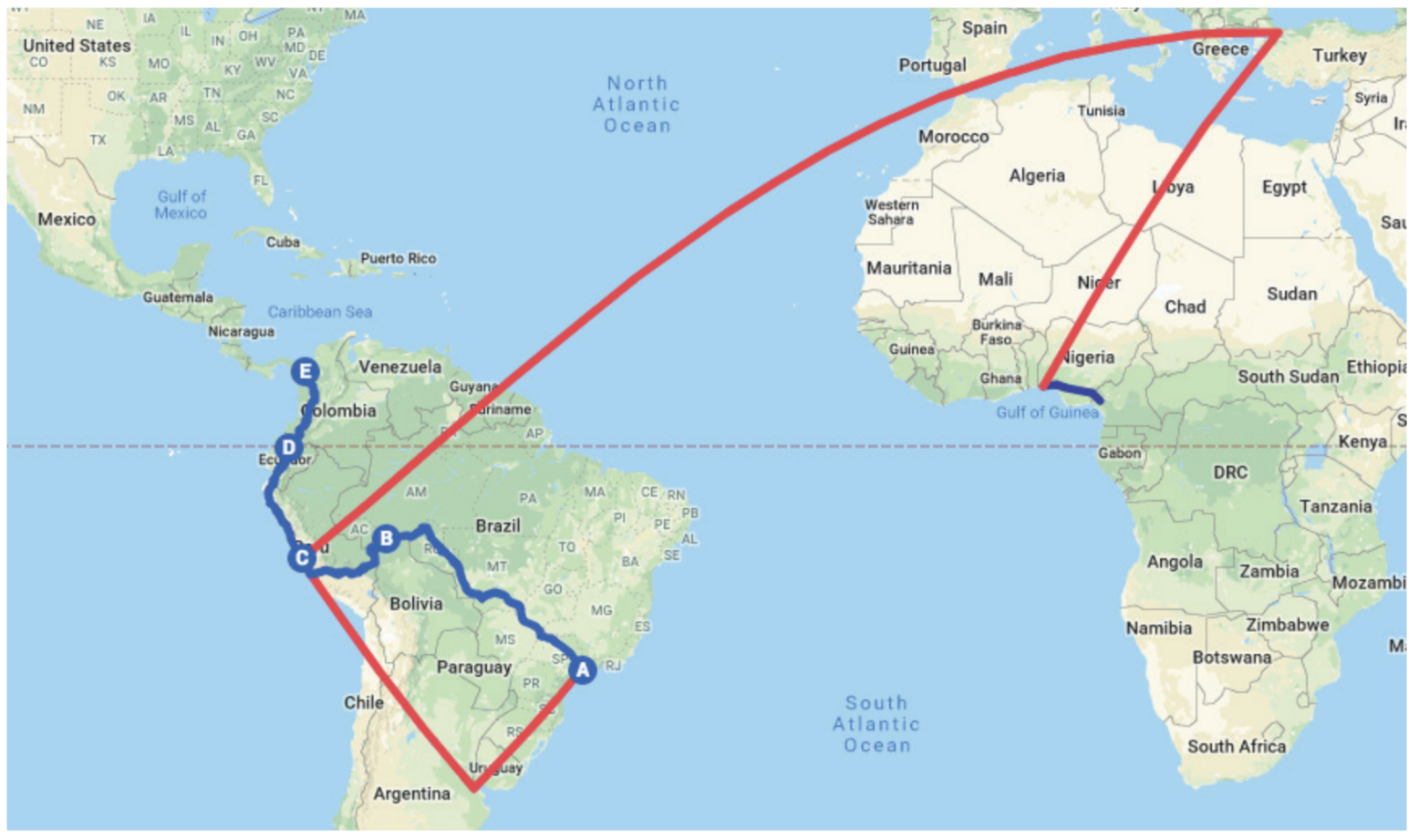
Feliz lived in the nursing home for a week while he tried to learn more about Sao Paulo. He laughed about the experience and said it was unpleasant because the elderly people around him were incredibly old, spoke a language he didn't understand, and weren't fully coherent or mentally stable. During his time in Sao Paulo, with help from someone undisclosed, he applied for protected status in Brazil and received it.
He lived in Sao Paolo for an unspecified amount of time ("very, very short") and quickly grew intensely frustrated by communication difficulties. He was unable to find work due to language barriers, so he decided to move on. He traveled by bus to Colombia—four days to Peru, three days to Ecuador, one day to Medellin, one day to Turbo. He was unable to explain how he knew to follow this route or what happened at border crossings. He didn't use an agent or smuggler. He said he did odd jobs along the route—cleaning shops, sweeping sidewalks—which gave him enough money to buy a ticket to the next location.
Now in Turbo, he is still frustrated by language barriers and unable to find work. He showed me his wallet and said he currently has $2,000 Colombian pesos ($0.63): "It's not even enough to buy water." The beer I shared with him was his first sustenance in more than a day. He said he's headed to Capurganá next but has no end destination in mind, except that he wants to reach "anywhere that speaks English." He's undaunted, he said, by what he's heard of the Darién Gap, the punishing jungle that divides Colombia from Panama, because a death in the jungle would be preferable to the death that is waiting for him at home.
He said he hasn't spoken to his wife since starting the journey. He can't afford to refill the credit on his cell phone and thus has no idea if she made it out of Cameroon alive.
📝 This article was originally published in a collection of biographies by the Henry J. Leir Institute at The Fletcher School of Law & Diplomacy and Tufts University.
You can Download the original collection below ⬇️