
Written by: Subin Mulmi, under the supervision of Kim Wilson
Table of Contents
"I left for the US in 2009, and after a long and arduous journey that spanned three years, I finally reached Texas in 2012. I spent around $15,000 for the journey and an additional $4,000 for my bond in the detention center, all of which I had borrowed from different sources in Nepal. I have been working 7 to 12 hours every day for the last six years, but I have yet to pay back my loan."
—Ajay Kumar Singh
The 2015 earthquake in Nepal resulted in the deaths of 8,970 people, with 22,302 injured.¹ Several reports have estimated that more than one million houses were destroyed, affecting the lives of six million people.² Only a handful of families have been relocated to safer places.³ Even before the quake, the country was reeling from the effects of the decade-long civil war that claimed the lives of 13,236 people and led to the disappearance of thousands more.⁴ In June 2009, the Nepal IDP Working Group reported that up to 70,000 people displaced by the conflict had not yet found durable housing. They remained unable to return home, integrate locally, or resettle elsewhere.
Unsurprisingly, people like Ajay embarked on journeys to other parts of the world, both in search of a better livelihood and to escape the natural and political turmoil in Nepal. While many could migrate to any part of the world, they chose the United States. I wanted to understand how such migrants, who came from one of the poorest regions of the world, were able to accumulate the required funding for an extremely expensive trip.⁵
In this essay, I trace their financial journeys from the point of their departure in Nepal to several points along their route and, finally, to their destination. This essay is based on a study I conducted in two stages.
In the first stage, I interviewed 13 migrants in Costa Rica, all of whom hailed from South Asia (10 Nepalis, 2 Indians, and 1 Pakistani), asking them about the financial aspects of their journey. In the second stage, I interviewed 6 Nepali immigrants living in New York and Boston who had come to the US some time back and had either acquired asylum or had filed for asylum in the Immigration Tribunal. For convenience purposes, the respondents interviewed in the first stage of the study are now referred to as "Nepali Migrants" while the respondents interviewed in the second stage are referred to as "Nepali Immigrants." Even though this essay focuses particularly on the financial journeys of Nepalis, it draws on references made by three South Asian migrants who were also interviewed.
“Let’s Not Talk about Money”
Nepali Migrants were open about sharing the details of their journeys in Costa Rica as their memories were fresh and they were eager to talk about their struggles with a compatriot. As a Nepali student living in the US, I could sense a strong excitement among several who had plenty of questions regarding the US, the country they aimed to reach. They answered most of my questions regarding the physical and emotional challenges they faced. In particular, they detailed their ordeals in the Darién Gap. Some shared information about the number of countries they had to travel through just to get to South America and the money they spent on the smugglers and as bribes to police officers. However, when I asked them about the sources of the funds, only one of them was willing to disclose it.
I asked Ramesh, a lawyer from Nepal and possibly the group leader, about how he was able to accumulate money for the trip. He deflected the question and suggested I speak to the Indian migrants. And he was right. The two Indian migrants and a Pakistani migrant were more candid about the money they spent and where they got it from. In a joint interview with Himal, Naren, Subhash, and Shiva, when I gradually brought up the topic of the total cost of the trip, Subhash politely answered on behalf of the group and said, “Let’s not talk about money. It might land us in trouble.”
Estimating the Total Cost of the Journey
Among the 10 Nepalis interviewed in Costa Rica, three told me the total cost of the trip. Ghanshyam and Sandeep, who were interviewed together, said the total cost of each of their trips was $30,000, which I learned later is a typical rate. After taking a string of flights to get to Brazil, both travelled across multiple borders on buses and sometimes even on foot. Ghanshyam claimed that for an additional $2,000, his agent offered to get him directly to Ecuador. Sandeep verified this, saying he was offered the same service for the same price. Despite Subhash saying, "Let's not talk about money," Himal gave me a cost estimate. He said, "I heard that the entire cost of the trip is $15,000 and the maximum is $20,000, but the agent charged double that. The remaining money is their profit."
Gorkha gave a detailed account of his costs. He had spent $15,000–$16,000 to get to Costa Rica and needed an additional $15,000 to make it to the US. Both Ghanshyam and Gorkha confirmed that payments are made in Nepal to the agents of the smugglers at different stages of the journey. I discuss how these installments work in a subsequent part of this essay.
The Nepali immigrants interviewed in the US openly provided information about the total costs of their journeys. All six of them gave me a number. Out of the six, only Chhewang arrived in the US with a tourist visa and decided to claim asylum upon arrival. His cost was predictably much lower than those without a tourist visa, as he did not have to pay an agent. Chhewang, who came to the US in 2014, spent $1,000 for his plane ticket and another $5,000 for his legal fees. The remaining five got to the US before 2014 and had incurred costs in the range of $10,000–$20,000, excluding the legal fees. Out of the six, only Ajay had successfully gained asylum, so he had no further legal costs. However, in this essay, I will not account for legal costs, as the variance between the costs is high and depends on the specifics of each case.
The Nepali immigrants in the US emphasized the bond amount they had to pay to get out of detention. The bond amount significantly increased the cost of the journey. The bond is supposed to be paid by a native US resident and provides a guarantee to the Immigration Tribunal that the petitioner of the asylum case will attend the hearing. The five Nepali immigrants I interviewed confirmed they were put in touch with a US resident by their agents who would pay the bond amount but who had to be reimbursed in Nepal. Ajay said,
After getting to the US, I informed my agent back home, and when my bond amount was decided, I told my wife to deposit the Nepali equivalent amount in the bank account of my agent. The agent must have given that money to my bond guarantor in the US. Now that I have gained asylum, the bond amount will be returned to my guarantor. I don't even know where he is right now, but I don't care. I am just happy to get the Green Card.
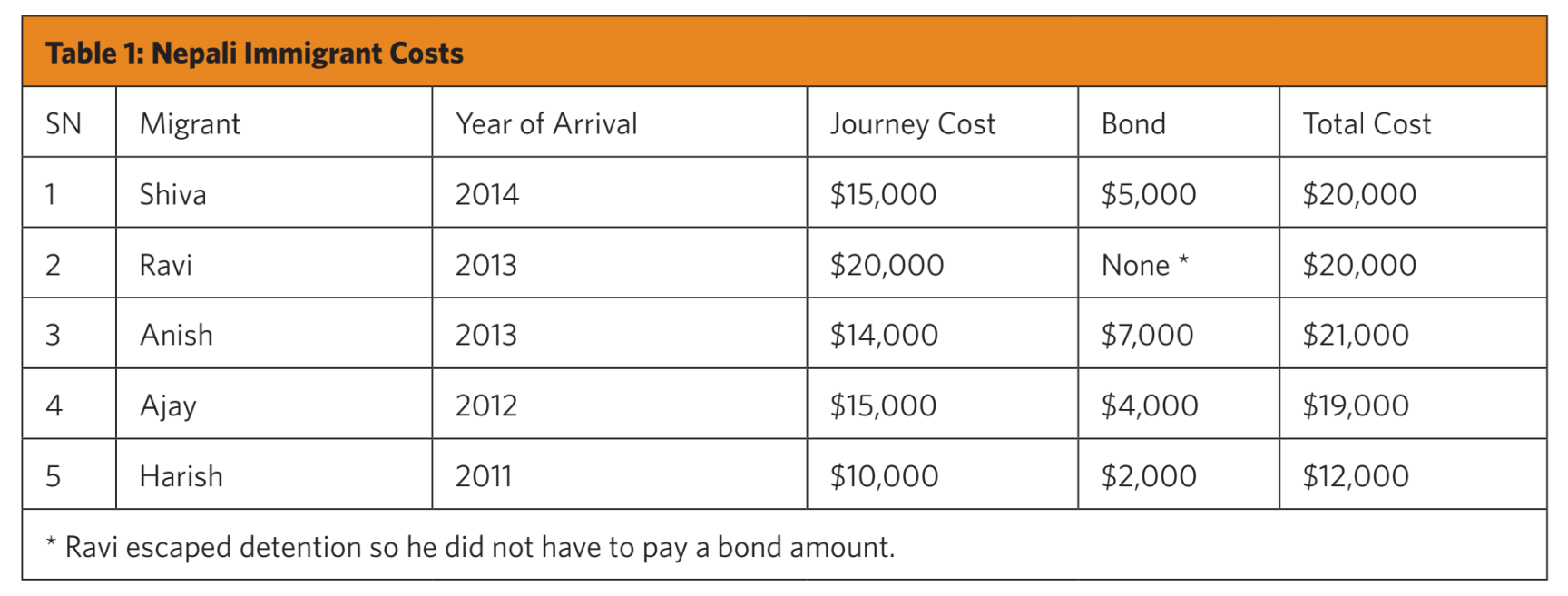
Keeping all the costs in mind, Table 1 shows the total costs of the five Nepali immigrants, the corresponding year of their arrival, and the cost of the bond.
A slight increase in cost every year is clear, and by 2019 it has reached a much higher level, around $30,000. Similar to the incoming migrants in Costa Rica, the six US immigrants were also circumspect about answering questions related to the sources of the funds. Ravi, Shiva, and Harish claimed that they sold off parental properties to finance their journeys. Anish and Ajay were scared that disclosing this information might harm other incoming migrants. They seemed to indicate that the sources of funding might not be entirely legal.
Apart from the total cost, the US immigrants also spoke about the various payments they made while crossing South and Central American borders. The next part of the essay outlines additional costs incurred during the journey.
Mode of Payment
As mentioned by Ghanshyam and Gorkha, the full amount was paid to the local agent in Nepal in at least two installments. Ghanshyam, interviewed in Costa Rica, had already disbursed $25,000 of the total payment of $30,000 and was required to pay the remaining $5,000 when he got to Mexico. Gorkha, on the other hand, had to make his payments in three installments.
Gorkha said, "I had to deposit $15,000 before reaching Delhi. After leaving Delhi, I had to deposit $2,000, and then after reaching Costa Rica, I had to deposit $4,000." Gorkha had not paid the third installment as he was stuck in Costa Rica when I interviewed him and was uncertain whether he wanted to continue the journey. Gorkha was the only migrant who gave a detailed description of how he paid his local agent:
"I paid the first installment myself while I was in Nepal. After I got to Delhi, I informed my wife. She went to the local bank which is a 30-minute bus ride from my village. She then deposited the money in the agent’s account. . . . I carried around $1,000 for costs along the way and when I reached Capurganá, [a town at the entrance of the Darién Gap] an agent gave me $250. I wasn’t given any money in any other part of the journey.”
Ajay mentioned that he paid his local agent the total amount before he began the journey. However, while trying to cross the Ecuadorian border, he was caught without proper documents and had to spend two years in Ecuador trying to earn enough money to cross the border again. After Ajay's failed attempt to cross the border, his agent demanded an additional sum, which he had to pay to the agent in Ecuador.
Ajay's case is different as his journey began in 2009 and things have changed since then. But still, clearly, payments are mostly made to agents in Nepal in separate installments.
Costs Along the Way
Contrary to the other South Asian migrants, the Nepali migrants were well taken care of by the agents throughout most of their journeys. They did not have to pay for hotels and food. Those were taken care of by agents. While talking to Nepali migrants in a temporary shelter in Costa Rica, Ramesh candidly made a complaint about the food and said, "The food in this camp has to be the worst of all. While we were in Brazil, Ecuador, Peru, and Colombia, we were kept in nice hotels and were given proper Nepali masu bhaat."⁶
In addition to money paid to agents in Nepal by family members, the journey entails other costs along the way. In some cases, the local agents gave migrants a spending allowance. The two Indian migrants who did not have agents ended up paying much larger amounts to cross borders than did their Nepali counterparts. The Nepalis had fewer troubles crossing the various borders to Costa Rica; the agents had guided them in paying bribes, fares, and fees to several public officials, and in paying donkers.⁷
All Nepali migrants also carried some hard cash. Ghanshyam and Sandeep carried $2,000 with them for on-the-road expenses and an additional $2,000 for unforeseen expenses. Gorkha carried $1,000. Himal, Naren, Subhash, and Shiva did not disclose how much they carried but mentioned that each of them was given $150 by their respective agents when they got to Capurganá, even though they had travelled separately. Gorkha was given $250 by his agent in Capurganá. Based on the varied circumstances of costs incurred in the journey to Costa Rica, I have divided costs into two categories: (a) costs to get to Capurganá and (b) costs from Capurganá to Costa Rica.
Getting to Capurganá
All migrants interviewed in Costa Rica had their own specific journeys and paid diverse amounts to get as far as Capurganá, at the edge of the Darién Gap. Also, not all provided a detailed account of their expenses. Ghanshyam and Sandeep, while trying to reach Turbo (Colombia) by bus, were stopped by the police in three different places and had to pay $20 each to keep moving. Himal also paid the police in three different places in Colombia, one of which he distinctly remembered as Cali. According to him, the police asked his group for $40–$50 each, and he ended up paying a total of $150. Subhash and Shiva had a more unfortunate experience where the police took all their money. Subhash did not remember the place of the "robbery," but according to Shiva, the place was right before they crossed to Cali. Gorkha claimed to have been “robbed” by the police in two places as well.
Gorkha said, "We were robbed once between Cali and Medellin where they took $10–$20, and next between Medellin and Turbo where they stripped us naked and took money from us. They took everything from four people." Ajay, on the other hand, while trying to remember the details of his journey that took place almost eight years ago, told me that he paid around $10–$20 to the police in each of the border crossings. Ramesh also claimed to have heard stories of "robbery" by the police while crossing Colombia but said that his group did not have such trouble. Ramesh further stated, "In Colombia, the police do not listen to the agents. Otherwise, the agents fix everything, and we are not troubled."
The journey to Capurganá is quite similar for all migrants, as their major hurdle was the police in Colombia. However, the length of the journey through the Darién Gap varies depending on the donker guiding the group, as do the costs incurred while in the jungle. It took Vikramjeet three weeks to cross the jungle, whereas Gorkha was able to cross it in just 4 days.
From Capurganá to Costa Rica
After getting to Capurganá, the Nepali migrants had to cross the dangerous jungles of the Darién Gap. Till this point, the local Nepali agent had arranged for the subsequent agents throughout the journey. Once in Capurganá, migrants had to find a donker to cross them through the jungle. The donkers normally charged $20, but since passage was not pre-arranged by the migrant's agent, the costs differed from migrant to migrant. After crossing the jungle, they reached the camps in Panama. Some ended up spending time in all three camps, whereas others were able to avoid one or two of them. Since the costs for each were distinct, I have laid down the details for each Nepali migrant.
Ghanshyam
When we reached Capurganá, we had to pay $70 to a donker for two days. Then he charged us $20 every morning for seven days (the advance of $70 also included the fee for the first two days). So in total, I had to pay $170. After we got to the first camp, I had to pay $1 to sleep and had to pay to eat too. I ended up spending $10 there. Then we had to pay $25 each to get the boat ride to the second camp. And then to get to Costa Rica, I had to pay $45. It was a ride of eight to nine hours and we had to take two buses. For the first bus I paid $20 and for the second bus I paid $25.
Ghanshyam ended up paying $250, which includes the donker's fee, the rent for the camps in Panama, and the bus fare to Costa Rica.
Himal
My group initially agreed to pay $100 to the donker for two days. On the first day, however, we met another donker on the way. The donker made an offer to charge us $40 for one and a half days, so we ditched our previous donker. On the second day, in the morning, the donker charged us $20 extra. After making us walk for four hours, he charged us $40 again. Then he left us on our own. We were then robbed by the mafia. They took our money, phones, and bags. I lost around $400. I was able to save some money, as I had hidden most of my money in my cell phone charger and the bamboo stick I carried with me. I saved more than I lost. On the seventh day, we finally reached the camp. To get to the second camp, I paid $5, and to get to the third camp by boat, I paid $25.
Himal had a more unfortunate journey in the jungle. Himal ended up paying $200 to the donkers and lost $400 after he was robbed by the 'mafia.'⁸ He would have lost a lot more had he not smartly hidden some cash. He paid an additional $30 to get to the third camp in Panama.
Naren
I paid $130 to three different donkers on the way. On the way, my group changed the donker who agreed to take us across the jungle at a rate of $10 per day. But after a day, he ran away. I had already paid him $70 on the first day. I met five donkers on the way. We decided on one of them. On the first day, the donker charged us $70 for one night. He also had a weapon. He made us walk till 5 a.m. in the morning. On the second day, we met two new donkers who charged us $20 per day, and we had to pay them every morning. Two Bangladeshis from my group disagreed to pay the $20 and left on their own, but we stayed with the donker. They woke us up at 11 a.m. on the third day. Then another donker who was following them made an offer to take us at $10 per day, and we agreed. We were told by our previous donkers not to trust him, but still went for this donker who charged us less money. On the fourth day, the donker asked us for $10 in the morning, which he collected from all of us and then ran away. After this, we just walked beside the river and looked for footsteps. On the sixth day, we met the Indians, and we paid their donker $20, who led us to the first camp. We had to leave six Sri Lankans on the way as they could not walk.
Naren gave a more detailed description of the events that transpired. He was visibly still traumatized by the experience and seemed to remember all the details of the arduous journey.
Donkers betraying migrants was a common occurrence. Michael, a Pakistani migrant, and Ravindra, an Indian migrant, were also left behind by their respective donkers. Gorkha had to complete the final day of the journey without his donker. Looting by the mafia was not only common but expected. They had been warned by others who had walked ahead. In preparation, some cleverly hid their money. This leg of the journey, the passage through the Darién Gap, was the toughest both in terms of its physical trials but also in terms of loss of money. The removal of migrant cash by the mafia increased the total cost of their journeys.
Sources of Funding
Even though only Gorkha and Ajay spoke about the specific sources of their funding, I have made an attempt to analyze the common patterns between them. As mentioned earlier, Gorkha had already paid around $16,000 to his local agent and needed an additional $15,000 to complete the journey. When I asked him how he was able to collect the $16,000, his response was surprising. He said:
I only had one and a half to two lakhs ($1,000–$2,000), which I had earned while working in Kerala as a tree cutter. My brother-in-law came up with the remaining money from different sources. He told me that he had taken a loan of 5 lakh INR ($8,000) from Chemical Bhagwati Kshetram Mandir in India at an interest of around 24 percent per annum. My agent helped my brother-in-law get the remaining money since he is someone I know.
Ajay, on the other hand, claimed that he took a loan from a person in his village. He had to mortgage his land to get the loan. However, he reported that finding such lenders is not too difficult. He said, "It is not that difficult to get a loan when we say we want to go to the US. There are many rich people willing to give the loan."
That a good number of Nepalis are making this expensive trip every day suggests that getting a loan is not a major hurdle for many. Similarly, the five Nepalis interviewed in the US did not speak of significant challenges to getting loans. I had also interviewed a New York-based immigration lawyer who handled many cases of migrants coming from Nepal. She explained that Nepali clients did not have an issue regarding furnishing funds for additional legal costs or for bond money.
Gorkha's account of obtaining funds through Chemical Bhagwati Kshetram Mandir – which he described as a religious trust⁹ – reveals lenders reside far and wide and even across borders. The exorbitant interest rate levied on the loan to Gorkha, however, made me suspicious of his honesty, and I could not find more information about religious trusts¹⁰ loaning out money to anyone.¹¹ Nevertheless, his nonchalance regarding getting the additional $15,000 he needed to complete the journey indicates the relative ease by which such persons can get access to loans.
This raises more questions than answers and thus requires new research to find out who funds migrants and how money is moved from one agent to another across countries. A possible answer was provided by an immigration lawyer who claimed that some migrants make permanent domiciles in the South and Central American nations and start working as agents. She also speculated that since most of the Nepali migrants come from a few select regions of the country, agents might be from the same village. This also gives a possible explanation about how the funds are moved from one country to another. Using informal systems such as the hundi is not out of the question.
Conclusion
Plagued by the 2015 earthquake and the aftereffects of the decade-long armed conflict, many Nepalis left for the US with hope for a better life. In simple words, I tried to find out details about the amounts of money spent to complete their journeys. Most migrants were apprehensive about sharing any details regarding money, a trait specific to Nepalis. Many Nepali migrants in Costa Rica feared that disclosing information about journey finances might get them in trouble with authorities. However, the Nepali immigrants were more forthright about details regarding the total cost of the trip.
I estimated the total costs and found that they have increased as years have passed, and the current cost ranges from $30,000–$35,000. The Nepali immigrants emphasized the bond amount they had to pay as a big factor in their migration costs. The bond amount significantly increased the total cost and was paid by the Nepali immigrants themselves through another person residing in the US.
Payment for the trip was not made entirely up front but was instead disbursed in several installments. The peculiar thing about Nepali migrants was that they did not have to worry about food and accommodation costs during the journey. Those were part of their package. Out-of-pocket expenses included bribes for the Colombian police and payment to donkers. The donkers proved unreliable, charging at least $20 a day and offering no assurance that migrants would safely reach the camps in Panama. But the $20 could increase significantly while migrants were still in the jungle. They had no power to negotiate. If they did not pay donkers directly, which many did, they paid them indirectly when robbed by the mafia allied with the donkers.
Questions still remain on who funds these migrants. We do know that migrants take hefty loans for the journey, and such loans seem easy to acquire. Despite our unanswered questions regarding the source of these loans or how payments move around the world, we do understand that many Nepalis still make the conscious decision to borrow egregious sums to reach the "dreamland" of the United States. The financial cost does not account for the physical and emotional costs of the journey. Hopefully, this essay has raised a few of the financial issues and generated a list of questions which, if answered, can more completely trace the financial journeys of Nepali migrants to the US.
📝 This article was originally published as a report by the Henry J. Leir Institute at The Fletcher School of Law & Diplomacy and Tufts University.
Download the original report below ⬇️