
Syria to Turkey: Straying hundreds of miles north, in no hurry to face the consequences of his escape, a young Syrian professional takes a circuitous route to reach Turkey
Written by: The Journeys Project
In documenting this man's story, we use in quotes "the country north of Turkey" to allude to the land through which he walked 500 miles without pinpointing the country. He never referred to it as the "country north of Turkey," always to the actual country.
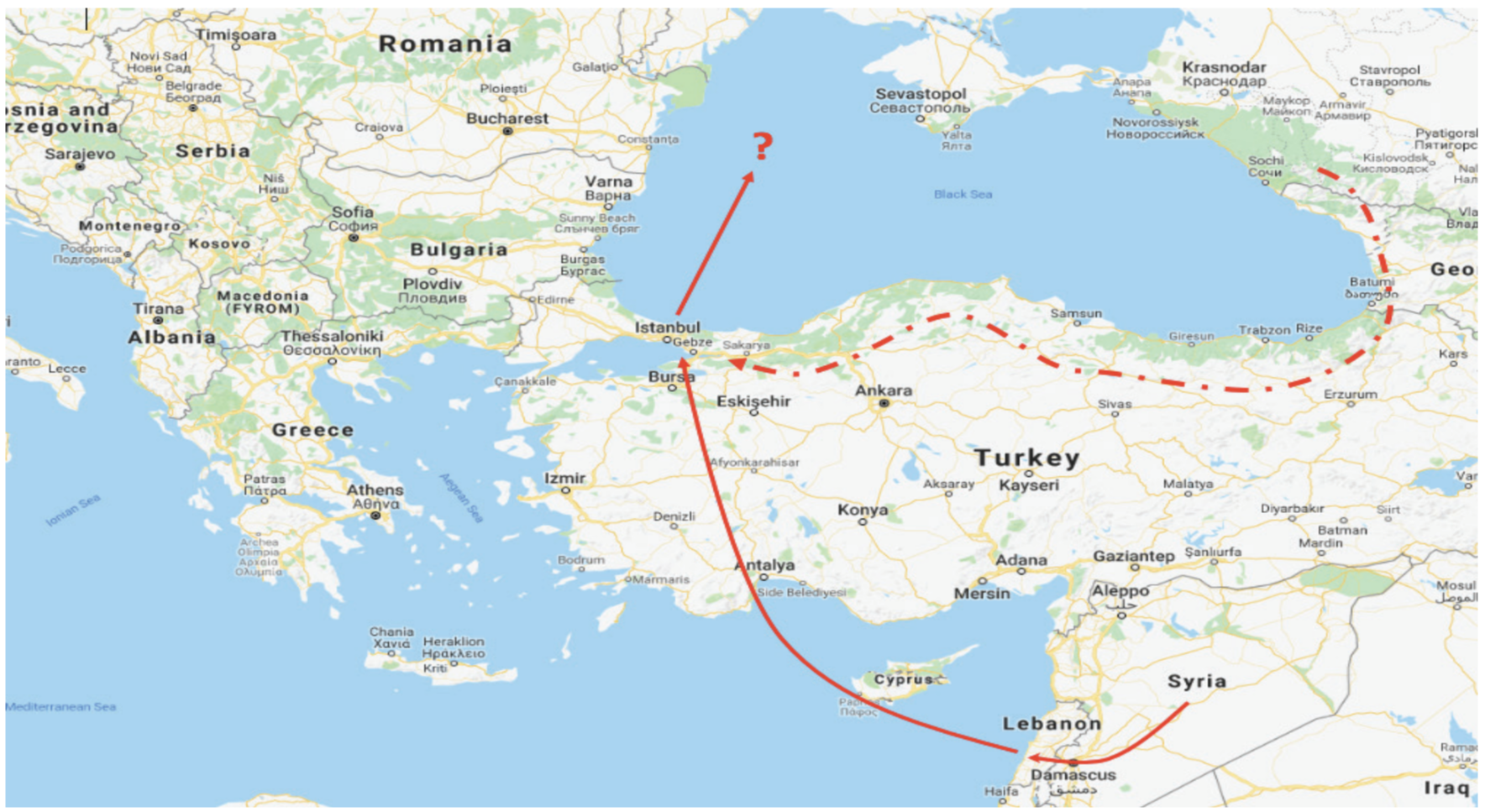
We have switched some of his paragraphs to maintain the flow of his journey from Syria to Lebanon to "the country north of Turkey," where he sets off on a 500-mile walk through the wilds, then finally travels to Turkey, where he now has a job.
"I worked for a UN agency in Syria. It was a well-paid position. I spent days at the office working, and at night I spent time with close friends. At 1 a.m. I would go home and then rise and repeat the next morning.
"After I graduated from university, I was looking for a job. There was a vacancy in a UN program. I interviewed for it, then realized they wanted someone with more technical knowledge, so I explained that I lacked the qualities they were looking for. I think they admired my honesty, and so they offered me another position. My role was an assistant for the program. Then I had my finger in all the pies, so I moved into database management and coordinating field research.
"I left Syria in late 2012 when my job ended after the start of the uprising. I was arrested twice for participating in the protests. The organization laid some of us off, as my job required me to travel between cities and they could not guarantee our security. I faced trouble at checkpoints, so I decided to travel. Turkey wasn't my destination; I decided to try a northern country. I wanted to go to a university there. I studied the language."
He explained that he traveled from Syria to Beirut and then continued: "I flew from Beirut to Istanbul, then on to 'the country north of Turkey' that I wanted to explore. I kept my money on me the whole time I traveled. I brought winter clothes, but didn't end up needing those because the best way to fight cold is by using layers. I also brought my ID, certificates, passport, and military service book.
"When in the 'country north of Turkey,' I worked in a bakery when I ran out of money. My boss paid us daily wages. I got bored and had to leave. So I used my remaining money to buy a tent and a hiking backpack." He went on to explain that there was a particular city he wanted to visit and so set off on a 500-mile journey.
"Working on the farms in the towns wasn't easy. There were times when I would not find a job for a few weeks. Then I would find one and use the money to buy bread and mayonnaise. There was one incident when I could not find work for four weeks. I hunted for food with a Swiss Army knife. All my money came and went on the trip; I started the trip broke and earned enough money for each day.
"In one place, I was paid cash for day labor and spent that money on a daily basis. I spent as I earned to get some food. I had been able to save money working as a bouncer. I saved $500. I used that to buy the ticket to Istanbul, some $180. To get the ticket, I had met an American, part of a missionary group. He helped me buy the ticket online using his credit card. I paid him in cash. We are still friends on Facebook. He 'liked' my hiking experience. We were friends.
"I remember when I left Syria, I had $1,800 on me. This was a lot of money for me. It was my savings from the work I was doing. The possibility of losing it was too much. If I'd known how to wire it to a safe account and pick it up there, I would have, but didn't know how to do that. Even when I was in one place, it was hard for me as a foreigner to open a bank account with a temporary residency permit. By the time I had been there long enough, the money was gone.
"When I crossed to Turkey, the authorities stamped my passport and let me in. I slept on a bench in front of the Blue Mosque for three weeks, looking for an apartment I could afford. I found a room for 150 Turkish lira (about $30) per month, with only a mattress and a chair. On the bench, I was completely ignorant. I blocked out the existence of other Syrians. I didn't want to introduce myself to anyone else because I didn't trust them. I kept my cash with me on the bench, in my socks.
"I enjoyed the apartment with this old guy. He confused English and Russian, combining them to talk to me. I started looking for a job because my $300 was running out. I ate one meal a day, and sometimes I even forgot to eat because I got used to low food consumption. I started posting on Craigslist to teach Arabic, English, and Russian to try to make some money. I asked if market shops were hiring. I found Craigslist through looking for vacancies on Google. I saw that you could post there that you were looking for a job. I had a laptop on me. The apartment had Internet.
"I had bought a smartphone in 'the country north of Turkey'" with a foreign SIM. I carried it to Turkey and tried to use the maps function, but it didn't have service. Then I got a Turkish SIM card and discovered that the phone was locked, and I had to register it in Turkey. I found out online that some shops can hack a phone for a small fee.
"For phases where I didn't have Internet, there was no way to get in touch with anyone. Throughout my journey, walking between towns, for weeks I wouldn't have any contact with people I knew. I was out of units to call and out of coverage.
"I kept my old foreign number to use on Viber (a cellphone-based communication system that includes voice and text) until 2014. At that point, I was in a better position financially in Turkey, and I sent everyone a message and switched to my Turkish number on Viber. I used Viber to keep in touch with family in Syria, Europe, and Russia. Later on, I started using Skype (a communication technology) instead.
"To send money inside Turkey to people with bank accounts, like my Turkish landlord, I transfer my rent through the bank. It's straightforward and easy. But I cannot make any foreign currency transfers. I've been warned against it and told to inform the bank beforehand.
"I sent money to my family in Syria, but there is no way I could do it through an official system. Western Union can be used, but the Syrian government will give them (my family) the money in Syrian lira for a bad rate. They will lose a huge amount of money. The way we do it, the way most Syrians do it, is I give the money to someone here; they call their relative or coworker in Syria, and that guy gives my family the same amount of money there. Confirmation is on the phone in the same moment.
"In my experience, it is a man who does the transfer in Syria. In my family, my father goes to pick it up, and my sister goes with him as an extra pair of eyes.
"Advantages of unofficial transfer systems are that there is no fee and you can transfer US dollars. The disadvantage of the system is that it is very volatile.
If the person you're working with is not trustworthy, you can lose the money. There is no guarantee; there are no signed papers. This is because it's an unofficial system. People only use it when they've gotten very positive feedback from a trusted source.
"In my situation, my cousin gave me their information [about the person who helps me do transfers here]. I considered it for two months and decided to try it once with a small amount. It instantly went through. I handed him the cash. He called his guy. My dad was there. I talked with him, and he said he received the money right then and there.
"I'm doing well financially now. I can send my family a good sum of money each month if I want to. But they resist my doing this because they want me to use it myself. I send them a sum every few months, whatever I feel is suitable. They are in an OK situation in Syria; they are not in financial need. The money I send, they are saving for emergencies.
"I've never heard of issues with my dad traveling to get the money. I prefer not to send a large amount because it could be dangerous for my dad to carry it back and forth. Most Syrian families I know tend to save money at home, within the household, not in banks, so they prefer to carry smaller or medium sums. The trip is not a huge deal for my father; he's healthy, so it's not an issue.
"No major challenges come to mind about my finances here, just the Turkish banking system that prevents Syrians from transferring foreign currencies to other countries. I have a cousin in Saudi, and I cannot send him money from here. The other issue is the fact that the debit cards issued to us cannot be used online. I cannot do online transactions to buy books online. I do not have PayPal because it's no longer legal in Turkey. When I had PayPal, I only used it to buy things.
"Along the way, there were a few people who helped me. There was the guy who let me use his credit card to buy my airfare. Some truck drivers allowed me to ride with them for a few days.
"Hope? I had a very unexpected experience as I traveled. One day I found an isolated town on the coast in the countryside. There, I realized they are from my tribe. They hosted me there for two days. They considered me as one of the descendants of the people who fought in their wars 200 years ago. I felt like it was worth the 500-mile walk."
📝 This article was originally published in a collection of biographies by the Henry J. Leir Institute at The Fletcher School of Law & Diplomacy and Tufts University.
You can Download the original collection below ⬇️