
Syria to Turkey via Lebanon and Egypt: A family man zigzags across borders, income streams, kinship ties, banks, and modes of money transfer
Written by: The Journeys Project
A Syrian couple with an in-law and two toddlers in tow manage to travel to Egypt via Lebanon before finally arriving in Turkey, where they now live. To manage economically, they patch together a jigsaw of livelihoods and modes of payment, which shifted as they moved from country to country.
"Protests in my area of Syria started late, about a month after they started in Damascus. The security situation wasn't very risky until late 2011, early 2012.
"That's when there started to be checkpoints around town. We were still able to move in and out of town. I had to move in and out every day; almost everyone did, because our jobs were downtown in the city.
"In the middle of 2012, the security situation deteriorated, with more FSA presence in town and even a new, makeshift courthouse with a prison inside. Staying felt risky. We had no choice but to move. Our city had become too expensive. Regime security forces broke in on a monthly basis to inspect every room in every house. They would execute some people to scare people off. They killed one neighbor, a shop owner, and arrested another. It was really scary. In July and August 2012, there were two or three attempts to destroy regime checkpoints in the area, in an effort to invade. We would call each other to figure out how to leave. I moved to my brother-in-law's house for a few days at a time, then we would return. The last time, almost everyone left. We were ten people in the car. My sister asked if anyone was left. I said, 'We've all left except for our father.' He was dead, so we couldn't bring him.
"Before our final departure, it was hard to move in and out through checkpoints, so I stopped working. A friend offered me a job as an interpreter. His clients were in the Gulf. I worked for him for a while. I was paid $500–600 per month, which was enough then. The client paid my friend. My friend paid me by hawala, similar to Western Union. He would send money in my brother's name. Because I didn't leave the neighborhood, my brother would pick up the money in Damascus and send it to me. There were no challenges with the transfer.
"My friend got arrested in my hometown. He was released a few hours later, and his brother and father were arrested and beaten badly. My friend told me that the work would need to stop. He was too frustrated and angry to stay in the country. He wanted to move to Jordan.
"So I was out of work. I don't remember what I had saved, but it was not enough. I got some money from my family. My father had had a shop before he died, and he had sold it, so we had divided that money between us.
"I decided to leave my town, knowing that I could not support my family by working in Damascus, so I went to Egypt. I asked my friends, my sister, and my cousin in the Gulf for money. They gave me some that I could use for tickets to get to Egypt and rent until I could get a job. I lived in a neighborhood of Cairo. My friend had rented an apartment. It was awful, but it was ready.
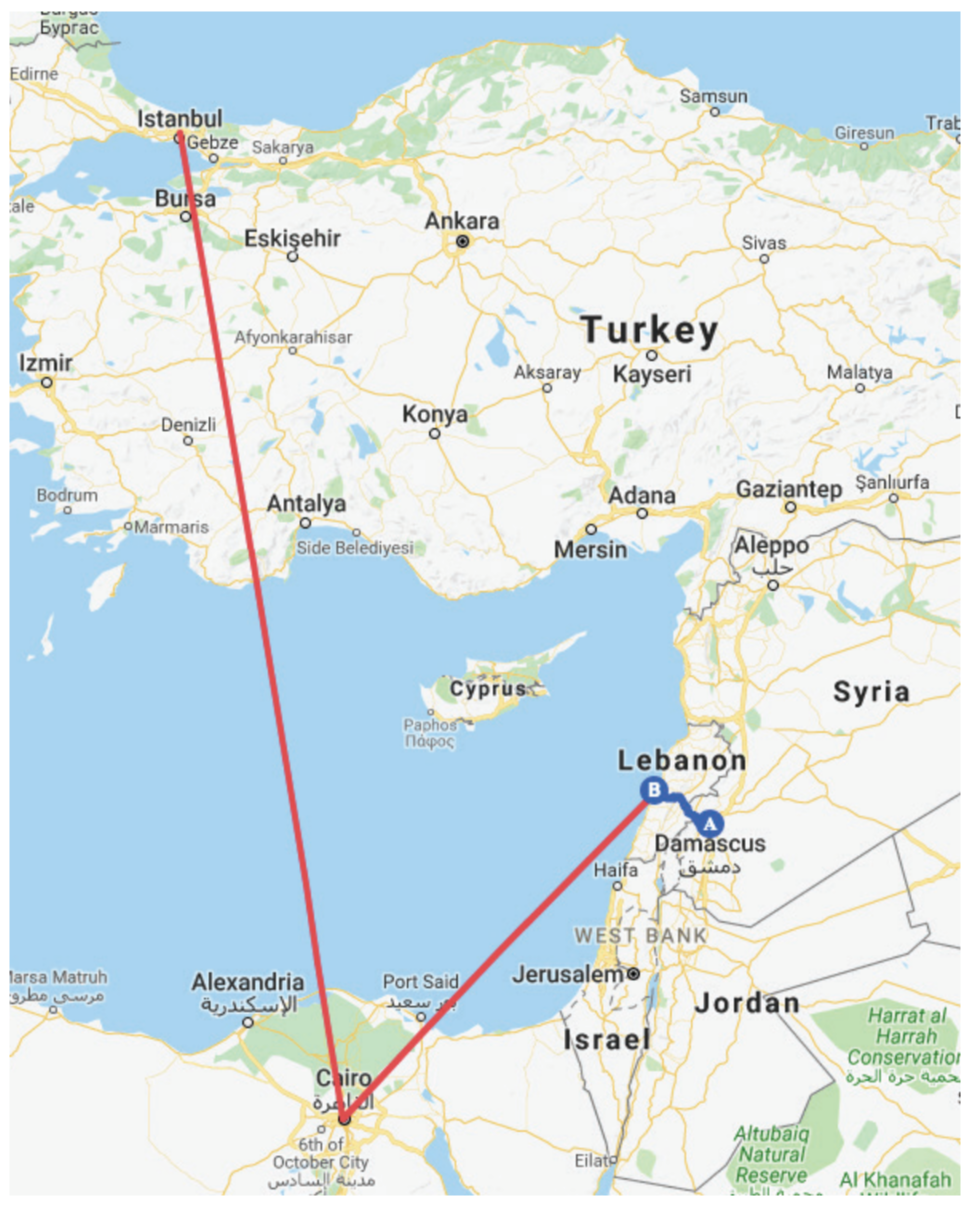
"To get there, we (me, wife, twin toddlers) went by car to Lebanon, then flew to Cairo. My cousin bought the tickets online for me. He also sent $500 to me in Egypt through Western Union. My friend in the Gulf did the same. My sister gave me cash. Another friend gave me $250 in cash. A friend in a difficult situation offered to give me $200 in cash. His brother carried them to my brother, who gave them to me before I left. I had about $3,000 on us. My wife hid the money in her clothes. I had some daily money in my pocket.
"We weren't very concerned about carrying the cash with us; they didn't inspect women then. It wasn't a huge amount, anyways; I mean, we would have been on the street if we lost it, but it wasn't a fortune.
"In Syria, friends and family gave me the money for traveling, mostly in dollars, but some was in Syrian pounds.
"There were no issues with Western Union in Egypt. I had to wait a long time for it, but it went smoothly. I had used Western Union before, when I was in the Gulf, but just once or twice. You didn't need an account; you just needed a passport.
"I applied for jobs, but didn't get any, so I used the time to learn the transportation system. A couple of months later, my friend with the translation company was settled, so we resumed the translation work. I started interpreting online again. I was also able to teach some courses online. Later, my cousin, who was also in Egypt, told me about a customer support company in Egypt. So I began to work in that company full-time. I had three jobs: translation, online teaching, and the technical support job. After three months, I was so exhausted that I resigned from the technical support job. For the translator job, I used Western Union to receive wages from the Gulf and got the transfers in US dollars.
"Later, the brother of that friend, who lived in Egypt, sent the money through bank transfer, and I opened a bank account with an Egyptian bank. I used the bank to receive the transfers; I did not store any money there. For the work originating in Syria, my brother in Syria received the money in person. Payment was always delayed. We'd get the money six months after finishing. The money was paid in Syria, and it stayed there. My family in Syria used that money. For my work in technical, payment was received through a bank that the company had opened for me; I can't remember why I didn't use it for the translation transfers. I would access my cash through ATMs.
"I was okay in Egypt, making enough money to pay the rent. We had moved out of that awful apartment. I lived with my cousins for a while, like 20 days; then I found a worse apartment but with a nicer landlord. Another cousin lived in the building, so we felt safer. My wife and our twins were still with me. My mother joined us in the second apartment.
"A friend of mine had a job in Turkey and asked if I would be interested in a similar job. I interviewed on Skype and was offered the job.
"To work, I had to move to Turkey. My mother decided to go back to Syria because she and my wife were not on great terms, so there was a lot of fighting. At this time, the coup in Egypt had happened, and they required visas for Syrians. So I knew that the move to Istanbul would be a one-way journey with no option of returning to Egypt. There would be a two-week trial at the job. I decided to bring my wife and children after that, if it was stable.
"To prepare to travel to Istanbul, I brought everything that I could within the weight allowance on the plane. I brought my desktop computer and my clothes and some of my clothes for the family. I had 45 kilos of stuff on the plane. I brought some pots and dishes, too. I brought all of the documents, my certificates, and Syrian official documents. I didn't have enough money. I brought $200 only. I came to Istanbul with only $200. My wife had $300–500 with her in Egypt, in cash, in the apartment. At the airport in Istanbul, I thought I'd lost the money. I wanted to get a luggage cart, but I didn't have any Turkish lira to get it. I looked for the $200, but I couldn't find it. I asked a police officer to allow me to exit the airport. I needed help because one of the suitcases was damaged, and I needed to get the money to get the cart. He wouldn't let me. A female officer let me do it; I left my passport with her. My friend was outside; I got some lira from my friend and went back in to get the cart. Then two bags were lost. I found them and then left, three or four hours after arriving.
"Now, when a Syrian is traveling here, I tell them to keep two coins in their pocket, any currency, just to be ready for the carts. My friend that met me at the airport paid for my taxi and brought me to the hotel. The company later refunded me.
"The company had booked me a hotel. I was exhausted and very upset about the money. I got there, and as I was unpacking, I finally found the money in my bag. In the meantime, I had posted an ad online asking for financial help. The guy who had posted the ad gave me $3,000. I owe him a million dollars for that. He didn't know me, and he loaned me the money. I paid him back in installments over the coming months. I used the money to rent an apartment, buy some furniture, and buy my wife's travel ticket. I paid cash at the airline office. I didn't have a credit card then, and I don't have one now.
"For the first four months of work, I couldn't open a bank account, maybe because I didn't have a residence permit. The fixer at work was too busy to help me. I got my salary in cash, but finance was upset about it. I brought the cash home and hid it there. I was paid in US dollars; I would exchange it in small increments. So, I finally opened an account at a bank and was able to receive my salary there.
"For the first few months, I was testing the waters with my work and trying to get a sense of regular expenses. Then I started to pay back the money I owed to people all around the world. I started to allocate money for the people I needed to return money to. My salary was better than before, so I could keep aside money to pay my debts. I had paid some debts in Egypt, but not all of them. I kept the money aside in my mind. To pay back the debts, first to my friend in the Gulf, who had sent me $1,000, a mutual friend of ours came from the Gulf to Turkey, and I paid him. My cousin in the Gulf came to Istanbul by chance, and I gave him the cash. My friend, who had been in a desperate situation and had given me money, said he didn't want it back. Some others said they did not want it back. Both of them said, 'Pay it forward, if you want to.' I can't remember how I made my first transfers to Syria. I never did it the official way, through Western Union or anything. I transferred to my brother and sister the same way I do now. Which is through friends who want to move money to Turkey.
"Say a friend of mine lives in Istanbul, and his family wants to send him money from Syria. I give him the money, and then his family gives my brother or sister the money in Syria. In my mind, no matter how big the amount they want to transfer is, it is better if I give it all to them, even if I have extra funds in Syria. I know I will need it in the future. My sister is my banker. She has been doing this for me for three years. I don't know how much money I have there, probably between $2,000 and $2,500. It's in cash in her husband's safe at his office in Damascus. He has a shop there."
I asked, "What are the challenges or drawbacks to using this system?"
He replied, "I wouldn't say there are any challenges. There is no commission. I trust the people involved in the transaction. I trust my contact and her family a lot. And my contact is my sister, who I trust. There are no risks at all. Other than people finding out about the transaction, like we got money from my wife's father. He's a businessperson. He was detained once. If my brother or sister goes to his shop several times, and he's being observed by security services, and they keep a record of who is coming and going, it could be risky. I haven't thought much about it. In a recent transaction, when I told my sister to go to my wife's father's shop in Damascus, she asked if it were safe. I told her I trusted the guy. This area is now known to be an area for these transactions, and my sister had heard of people being arrested there for doing this. I told my wife about it, and she said it was still safe. My sister liked my wife's father. She liked him. Just a few days before my sister picked up the money, they owed me $4,000. I thought because he's a businessman, it would be safer for a businessman to have some US dollars in his safe, whereas my sister would be vulnerable because it is illegal to have US dollars on you. But my wife's father's neighbor's shop was robbed the other day, and so they asked to take the money.
"In Syria, I opened a bank account for me and my father. My parents had rented the shop and so needed an account to hold the annual rent. My mother had sold a house and needed an account to hold the money. I don't remember why I opened the account, but I did. Maybe just because we were all opening accounts. I got an ATM card. I didn't use mine, but I used my father's to withdraw money for him. We were only able to withdraw $500 per day. When he needed more, I would go to the bank. I used the bank several times there, but it wasn't usual to me. I had an account in the Gulf that I didn't use much.
"I started using PayPal until I moved to Istanbul. I rely on it a lot. Now, it has closed in Turkey. I use PayPal because I do not have a credit card. I have two bank accounts in Turkey. They say that foreigners cannot get credit cards. It's not because I'm Syrian, they say. They are nice, so they make it sound like a universal problem, not just for Syrians. My main bank account, where I receive my salary, is the bank in which I applied for a credit card, with the fixer at work. They needed him to get a document from the municipality in my area proving my residence. It turned out that my apartment is registered as offices, not a residential apartment, so now I'm waiting for my landlord to do it. He's in the Gulf, so it's delayed. I tried again; they said they would let me know in a few weeks. Immediately after leaving, I got an SMS that my application was rejected. She said she solved the problem, and then I got the same message a moment later. I decided not to go back again. I think the hold-up is the residence confirmation document.
"Money transfer is an issue for us now in Turkey; you cannot make any transfers in US dollars. It must be in Turkish lira. I've heard that we cannot use Western Union to send money from Turkey. Transferring money to Syria is still an issue through the hawala systems. I wouldn't feel confident about it; I would worry about the person receiving the money. If I'm wanted by the regime, and I don't think I am, but if I am, and someone received money from me, it would put them at risk. Regularly receiving money from someone in Istanbul would put someone at risk, and they would ask why they are receiving it. The hawala system would register the transfers, and security services could find out.
"Syrian refugees in Europe cannot send money because they must declare it. My brother-in-law owes me some money and wants to send it back. We are struggling to find someone to transfer the money to me. I loaned him money for the journey, and some is left over. He's trying to send me my money that he did not need to spend. We are looking for a way to get it back. I bought tickets for his wife and children.
"Similarly, a friend wanted to give $1,200 to his nephew here. I gave $1,200 of my own money to the nephew but have no way of getting my money back from my friend unless he travels here.
"Moving money from Europe to Turkey is a problem. But it still happens through personal networks and informal hawala systems. I haven't tried it. My brother-in-law is going to try. They take 10 percent.
"There are so many people who helped me. Wow! There is my brother-in-law; actually, my wife's brother-in-law received us in his house in Syria, even though we had brought the babies. He lived in a big apartment with three brothers and their families. They were generous to receive us even though they were already three families. They received us three times.
"All of my friends who gave me money; I still think of my friend in the desperate situation who gave me the money without my asking for it. My friend in the Gulf who said he didn't want the money back; he gave me even more money as a gift for the children.
"A friend who was a regime supporter gave me $250 when I was trying to leave.
"There's a guy in Egypt. I had never met him before, but a friend of mine knew him and called him. He received me at the airport, bought breakfast for us, stocking up the house with cheese, yogurt, jam, and juice. That was the only time I ever met that guy. We were never able to meet again. There were a few guys who helped me when I felt threatened by the landlady. One of my neighbors, an Egyptian guy who had given me an Internet cable. He came over with an older guy, and they talked to the landlady for me. They made me feel safe. I was a stranger. In Syria, if you are in trouble, your neighbors help you. I didn't have anyone in Egypt. But this guy brought an older guy to calm the crazy lady who was threatening my wife. I wish I could thank them."
📝 This article was originally published in a collection of biographies by the Henry J. Leir Institute at The Fletcher School of Law & Diplomacy and Tufts University.
You can Download the original collection below ⬇️