
Syria to Turkey: A physician in her mid-thirties juggles smugglers, conversion rates, and borders to face bias in her new safe zone
Written by: The Journeys Project
We are sitting in a café in Sanliurfa, where I spoke to others a few days earlier. It's warm, and we are both looking forward to drinking "çörçil," a drink made of fresh-squeezed lemon juice and soda water.
Maha is a Syrian woman in her early 30s. She speaks quickly and has distinct, lively features. She came to Sanliurfa after Daesh took control of her hometown in northern Raqqa, in February 2014.
"I was working as a pediatrician at a hospital in my hometown at the time. I could have continued working under Daesh (ISIS), but I didn't want to follow their rules. I might be the last one who crossed the border legally—after that, it became so difficult. I traveled with a close female friend and a male relative. It was difficult to convince my family to allow me to leave—in the end, they let me go because I would be with my friend.
"I was able to take one bag and some money with me; I carried it in my bag. My friend and I crossed at the gate, which was just outside my town. When we arrived, we rented an apartment with another friend. My relatives had connections there, so they were able to find the apartment within one day. The friend who accompanied me from home started working immediately for a medical agency. After one month, I also found a job with the same agency in a small town. The agency was managing a hospital remotely, and I did remote rounds with patients. After eight months, the office moved from that town to Sanliurfa, so I moved as well.
"During that time, the border was basically closed— it was only open for special medical cases. Eventually I lost my job with the medical agency and applied for other positions with humanitarian NGOs. I was offered a job that was actually one grade higher than the position I applied for. From the time I started working in Turkey, I was sending money back to my family in Syria. At first not that much and, after a while, more. It's pretty easy to send money, and I have always used the same method and dealer. In Raqqa, there's a shop with the same branch in Urfa. I give them the amount plus 5 to 10 TL [Turkish lira, $2–3], and they transfer it. I also provide the name of the person who will receive the money; that person will then be able to pick up the money the same day. Fees depend on the amount being sent... I have never had any problems sending money this way; I have a lot of trust in the shop because the owner is a relative of mine.
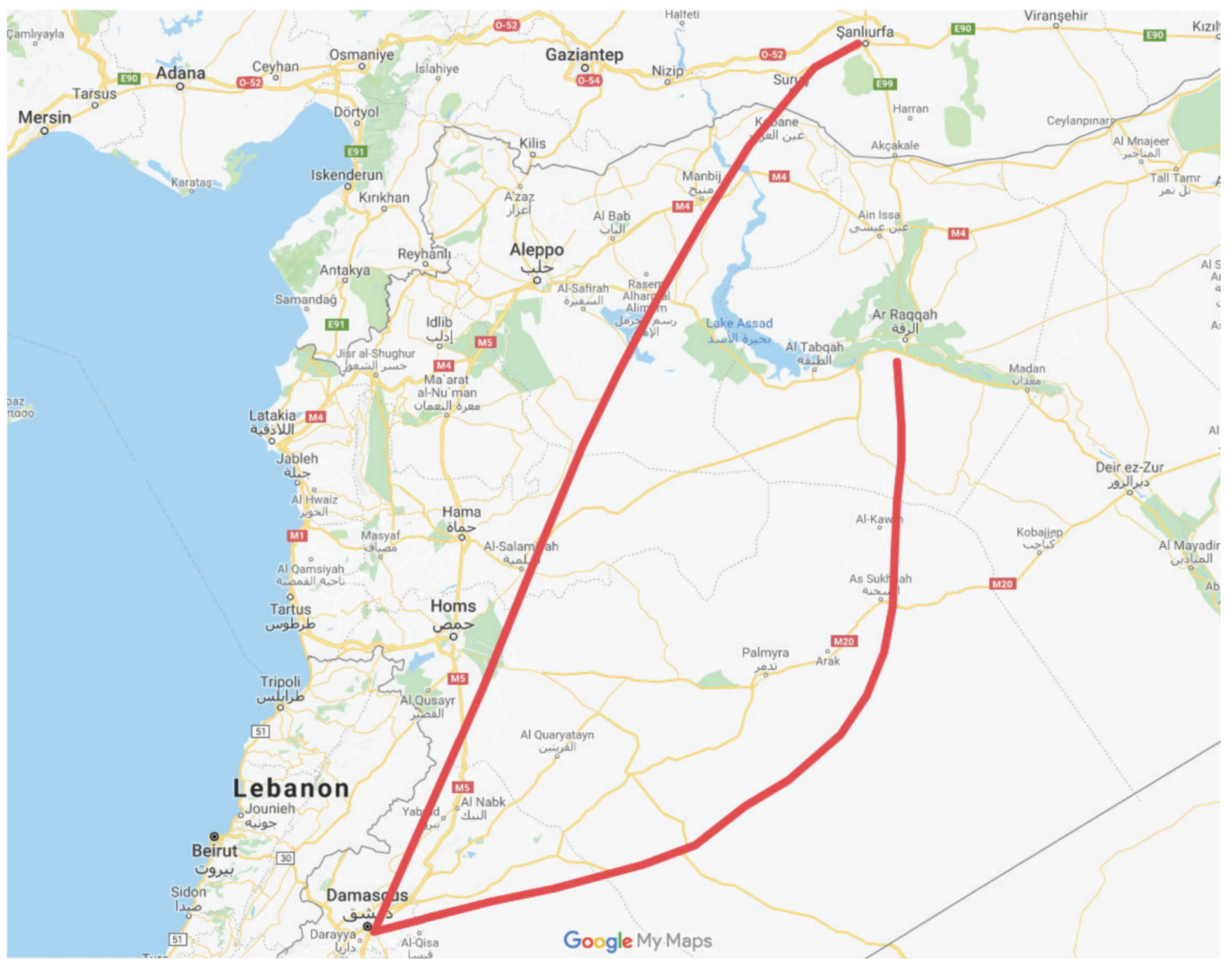
"My family lives in a Daesh-controlled area, and receiving money from Turkey or other countries is not a problem. I returned to Syria for three weeks in 2014 to attend my brother's wedding in Raqqa and take my final medical exam in Damascus. I was able to cross from Turkey to Syria relatively easily: the Turkish authorities let people cross back into Syria two days per week. On the Turkish side, they checked my bags and asked some illogical questions. They also tried to fingerprint me, but I resisted and didn't show my passport. The Daesh guards receiving returnees didn't check or ask any questions, but did require there to be a man to pick me up.
"I stayed in Raqqa for one week following my brother's wedding, which he had postponed so that I could attend. My uncle then took me to Damascus by bus; Daesh would not have let me go without a man. I had to pay 1,000 Syrian pounds [$6] at a government checkpoint.
"I took the exam in Damascus and didn't pass. I noticed that doctors from Damascus had an advantage because they knew the style of questions while I didn't; I remember thinking, 'Screw you, I'm going to Germany,' because I was angry about the unfairness of the Syrian medical certification system.
"I left Damascus for Raqqa, still angry. Things got worse when I realized I forgot my 'Daesh cover' [black abaya, a full-length outer garment worn by some Muslim women]. I put all my Daesh clothes in one bag, and I forgot it—all the way back, I was imagining myself beaten by Daesh. Eventually, I exchanged my pink scarf with the black one of a woman next to me and borrowed a man's black jacket to wrap around myself. I avoided detection at the first two of three Daesh checkpoints, but dreaded the third, which was right next to Daesh's 'punishment office.' The bus driver allowed me to get off before this checkpoint, and I was able to rush home. Usually this neighborhood was crowded with Daesh, but there was no one, and I escaped.
"To return to Turkey, I had to cross illegally because the border gates were closed. I crossed with my 13-year-old brother and seven to ten other people. I paid 200 TL [about $70] for myself and my brother, and we crossed by walking at night near the official gate. Because my brother was with me, I was able to bring more stuff. My brother stayed for two days and then returned to our hometown.
"If the Turkish police catch you, they take your luggage and money and send you back. I recently heard of a family who was caught and held for six hours in a border police station before being sent back to Syria. It was really horrible because they sold their gold to be able to come.
"I seriously considered making the journey to Europe in 2015. Ten months ago, my friend and her husband planned to go, and I was really thinking, almost preparing my stuff to go with them. Eventually, I decided not to go because my family was worried about my safety, especially traveling by sea. I communicate often with my family in Syria, mainly by phone, WhatsApp, and Facebook.
"People find out about smugglers through Facebook. Some draw maps and post them on Facebook to help others. If someone was stuck in Greece, they could ask for help, for example. In the beginning, it was really expensive [to cross from Turkey to Greece], like $1,500. In the end, it was $700 because there were more and more smugglers. I didn't hear about any cases of fraud or exploitation, but smugglers sometimes took people almost to the coast and dropped them off [the boat].
"I applied for a visa for Germany in March 2016. My fiancé lives in Germany, and I want to go there to take a supplemental course for doctors. I have never met my fiancé in person, but we often speak through Skype. In order to obtain the necessary documents for my visa, I hired a smuggler, whom I had heard about through word of mouth, to pick them up in Syria. I sent him my passport and Syrian ID—he had to be my representative to pick up my transcript and other academic documents in Aleppo.
"At first, the smuggler and I agreed that it should take around three weeks, but it ended up taking three months because Aleppo University was bombed. It cost 1,100 TL [$370]. I sent the money via my usual gold shop and asked the owner to hold the money until I received my documents.
"Because I was so desperate, I paid another smuggler, who supposedly has connections within the German embassy, to expedite my visa application. I sent this smuggler my documents and paid 150 TL [$50]. So far, I have heard nothing from the embassy and feel like I wasted my money on the second smuggler. They say they will support you, but they don't do anything. To get more information, I talked to another smuggler, who said the smuggler with embassy contacts is trustworthy and that I should wait. I now contact the embassy smuggler every one to two weeks, but he can never give me any meaningful updates. It's really risky, but sometimes when you need a hope, you cannot think legitimately... Now I question myself: how can I send my documents to a stranger?
"I save little money but send most of it to family and friends. I have participated in a gamia [savings collective] in Syria, but not in Turkey; however, these collectives are common among the Syrian community in Sanliurfa, Turkey. In Syria, I would put 11,000 Syrian pounds [$25] in the jame3ya pot each month. My group consisted of 10–12 people, but groups could be as small as five or as large as twenty. I don't like using the bank—I just take my salary, put it in the house, send some of it to my family, and the rest I keep.
"Some big news in my life is that two of my brothers came to Turkey from Raqqa this month. One paid $1,500 for himself, his wife, and two daughters; the money was his savings from working as a doctor. They were not able to carry any bags. The crossing was not risky, and the family crossed in the daytime via a road and a canal. There was a Turkish guard in a field near them, but he didn't shoot. They had to pay the smuggler beforehand, but would have been able to get their money back if the crossing were unsuccessful.
"For the second brother, however, the crossing was difficult and dangerous, especially the border between Daesh- and FSA [Free Syrian Army]-controlled areas. At this point, men and women were separated. The smuggler was not professional, so the two groups lost each other. The smuggler had told them to walk toward a light, which he said was one hour away. In fact, the groups had to walk for five to six hours, without water. The women slept in a stable, where they had to stay very silent to avoid Daesh detection. Eventually, the two groups were reunited near the Azaz border gate. My sister-in-law had a fake medical report, so she was able to cross, but initially the guards said her husband and child wouldn't be able to. However, my brother called someone with money, and the whole family was able to cross. They were supposed to pay $3,000 but paid $1,500 because of this relationship.
"My brothers both immediately registered for their Temporary Protection IDs in Sanliurfa; one has applied for a German-sponsored scholarship, and the other has opened a dental clinic. Both are studying Turkish and highly motivated to succeed. When they came, they had plans.
"Most Syrians in Germany transfer money to Syria. They don't use banks because it's expensive and because they don't want the German government to know that they're transferring money, as they fear this could lead to a reduction in state support. Instead, my friend transfers money through a Pakistani guy who says he's trying to help Syrians. The man charges a fee of €7 for the first €100 and €3 for each additional €100. Another agent charges €14 per €100. Funds are sent first to Turkey and then from Turkey to Syria, also using a hawala, and people find out about the agent in Germany through word-of-mouth.
"My friend says that the exchange rate is really different in regime- and FSA-controlled areas, around a 25 percent difference. My friend also knows about a man who has money in Syria, so he takes money in Germany and gives his own money through an associate in Syria, thereby avoiding any physical transfer. This man charges a 10 percent commission.
"Some Syrians have also set up businesses importing under-the-table goods, like clothes and cosmetics, from Syria to Germany and then selling them to Syrians who are uncomfortable shopping in German stores or unhappy with German products. There are Facebook groups that advertise and say how to buy these products.
"One of the biggest difficulties for Syrian families is dealing with separation, due to internal and international displacement. Sometimes I am afraid that in the end it will affect our relationships. Another difficulty is bias—on behalf of banks, consulates, and other authorities— against people from Daesh-controlled areas. I hate Daesh and had bad experiences—to be re-victimized by this discrimination is terrible.
📝 This article was originally published in a collection of biographies by the Henry J. Leir Institute at The Fletcher School of Law & Diplomacy and Tufts University.
You can Download the original collection below ⬇️