
Syria to Jordan: A young man and his family face daily challenges with humanitarian cash assistance.
Written by: The Journeys Project
We exited our car and approached the home in a suburban neighborhood on the outskirts of Irbid. On the front step, at least ten pairs of children’s shoes were heaped in a pile, and we stepped around them as two women, both in black abayas, greeted us warmly. They showed us to the sitting room, off to the side of what I imagined to be the main house. The thin walls barely contained the children (many popped in and out during the interview) and their noises as they played and cried just beyond our sight. We took off our shoes inside and sat down on the cushions that lined the room. Five men then entered, and the women quickly disappeared (we did not see them again until the end of the interviews, when they said goodbye to us, although they appeared at the door bearing first coffee, then Pepsi for us as we spoke with the men).
Our first interviewee, Fareed, was seated closest to us. He was dressed sharply, despite the heat. Polished shoes, dress slacks, and a casual button-down that he had dressed up with a tie. His socks had one lone hole, with his toe poking out. His hair was slicked. He was eager to talk to us.
“Syria is the most beautiful country in the world, despite the ruling system. Before things started to collapse, there were no restrictions on life; people could move freely. I often took trips outside of Syria, to visit other countries, and now I regret this, since I didn’t see the value of Syria while I was living there. I really want you to understand that Syrians are not ‘conservative’ people.” By this, I think he meant restrictive towards women, very dedicated to religion, etcetera. “We just like to live our lives freely.
“In Syria I was a government officer, but when things in my hometown became unsafe, I needed to leave with my family. The government began to indiscriminately shoot people in the streets, and that’s what compelled me to finally go. Better to die than be captured by the government.
“Even people just close to demonstrations were rounded up and tortured. There was no value for people’s lives anymore.
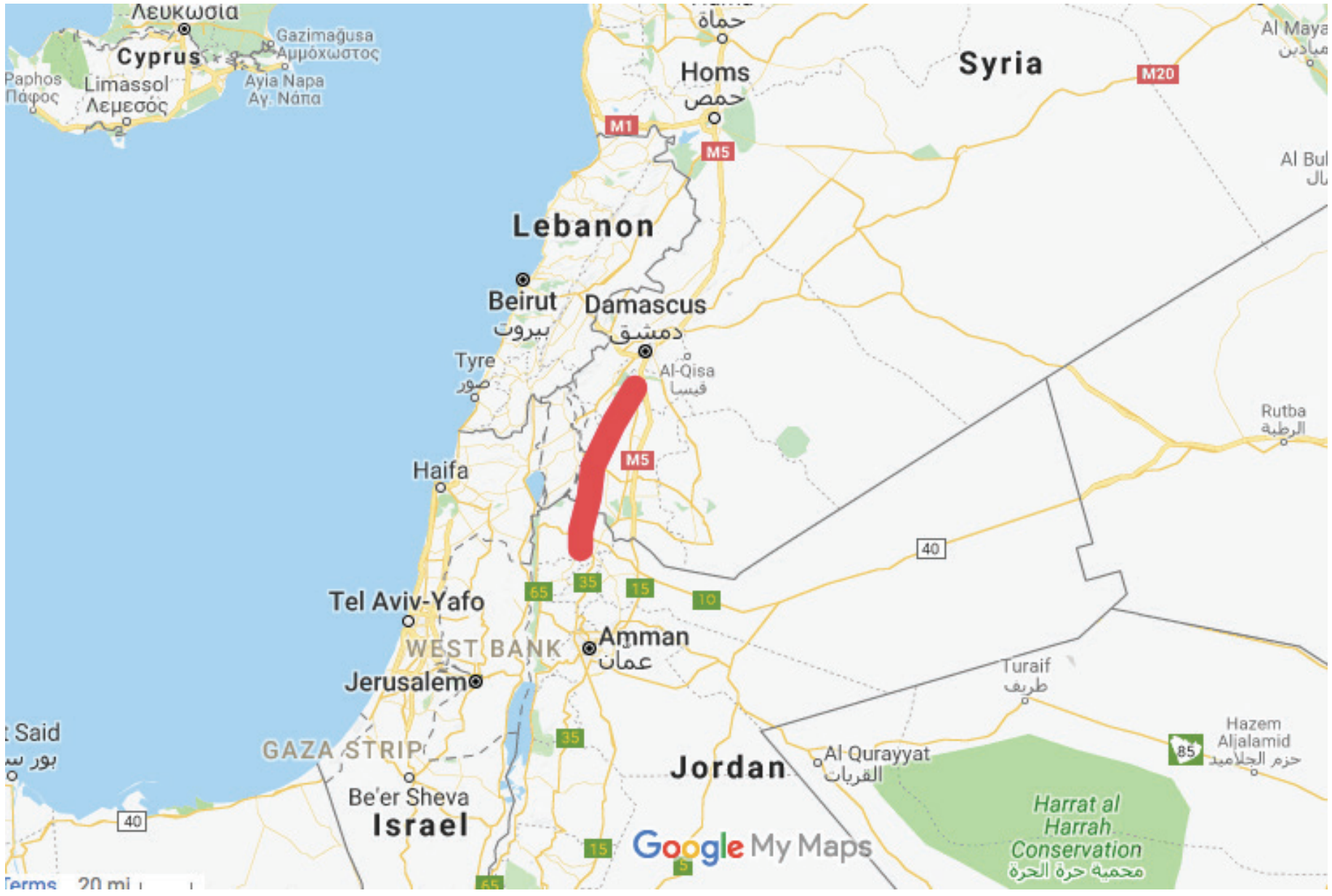
“I brought some clothes with me and the documents I still had. My other important documents were destroyed in a fire in one of my supermarkets that I owned. I also brought a little cash. My wife, four children, and I fled on foot. Along the way, community leaders were helping those on the move, opening channels and providing information about where and how to continue. We traveled on foot because I felt like traveling by car would make us easy targets. Local people helped, free of charge, especially those who were injured, when they could. We walked until we reached Wadi Yarmouk in Jordan, which is where the Jordanian army received us. The Jordanian army was humane and very gentle. They provided us with food, water, and medical treatment. From there, they took us to Zaatari, and we stayed there for 25 days. Then, we moved to a small town in northern Jordan. We have a friend of our family there. We stayed there for three years. Then, we finally came here to Irbid.
“The little cash I brought with me did not last long in Jordan. Now I keep my cash at home; I don’t use a bank. In Syria, I used government banks to apply for loans and for a savings account.” (Accounts were special, for government officers.) “If you wanted to save a large sum of money, however, this was a process that required a lot of vetting—you’d have to answer many questions, and the account would be scrutinized and monitored by intelligence agents. You need a security or intelligence clearance just to open a falafel shop, the smallest of enterprises!
“In Syria, I was an officer in a government ministry, and I had studied at university. But here in Jordan, I take whatever work I can get, usually labor or construction. This is usually paid under the table in cash. Since I’ve been here, I’ve been able to take a few university-level courses, but these have not amounted to any job prospects. The cash I get from my day-to-day work goes quickly to cover daily expenses for me and my family.
“You might go to a restaurant or visit cafes, but my friends and I don’t have that luxury. We simply enjoy visiting each other, since we don’t have the money to do anything else.”
He waxes a bit poetic about how much Syrians love life. There is an awkward exchange, which Ruby, our interpreter, doesn’t want to translate. I press. She explains he was trying to emphasize how much Syrians love life by saying that they really love their women—sexual, yes, but meant playfully, generating bashful chuckles from the other men.
“My friends and I have no use for money-transfer services—there’s no money to transfer! Generally, the biggest challenge is dealing with the iris ID machines, equipment that compares images of a customer’s iris with images on file to verify identity. This is the way most people receive their financial assistance, but in Irbid, there is only one machine in each bank—compared to four or five per bank in Amman—and it’s usually broken or malfunctioning. Some people attempt to collect money two, three, four days in a row with no success. The four branches of the bank are very crowded at collection time. The crowds are volatile; people often physically fight in line, and it’s not safe. It’s not just men in the lines either—women, the sick, and the elderly have to make it through this mess as well. The bank tellers are also very rude to us [refugees]. Because of this, some Syrians don’t bother at all and just don’t collect their financial aid. Bank officers never help us, either. We have to take care of each other in order to keep each other safe. I go all the way to Amman to avoid this mayhem when I need to collect my assistance. To do this, I use almost a third of the money I collect to pay for the trip back and forth. It’s only symbolic help.
“Now, I receive 95JD (about $130) a month from UNHCR. In the beginning, my neighbors here helped me feel at home. I have good relationships with them, but they’ve never been able to help me financially, and I haven’t been able to help them either. I’d say 90 percent of Syrians are working to make extra money under the table, but they can’t admit this for fear it will affect the little aid they do receive. It’s well known that Syrians love to work. Even if I could earn 1,000 JD just sitting on my back, I wouldn’t do it.
“Living here in Jordan means better conditions for me and my family, but also more dignity. After the issues with terrorism in Europe, refugees’ situations in Europe, Lebanon, or Turkey are probably worse than ours are here. Arab people are pure. The gangs you read about in the headlines are not the reality for most Syrians. I hope to one day be part of the effort to rebuild Syria.
📝 This article was originally published in a collection of biographies by the Henry J. Leir Institute at The Fletcher School of Law & Diplomacy and Tufts University.
You can Download the original collection below ⬇️