
DRC to Costa Rica via South America: A 36-year-old Congolese woman flees violence at home, crossing the Darién jungle with her children, to seek asylum in Costa Rica.
Written by: The Journeys Project
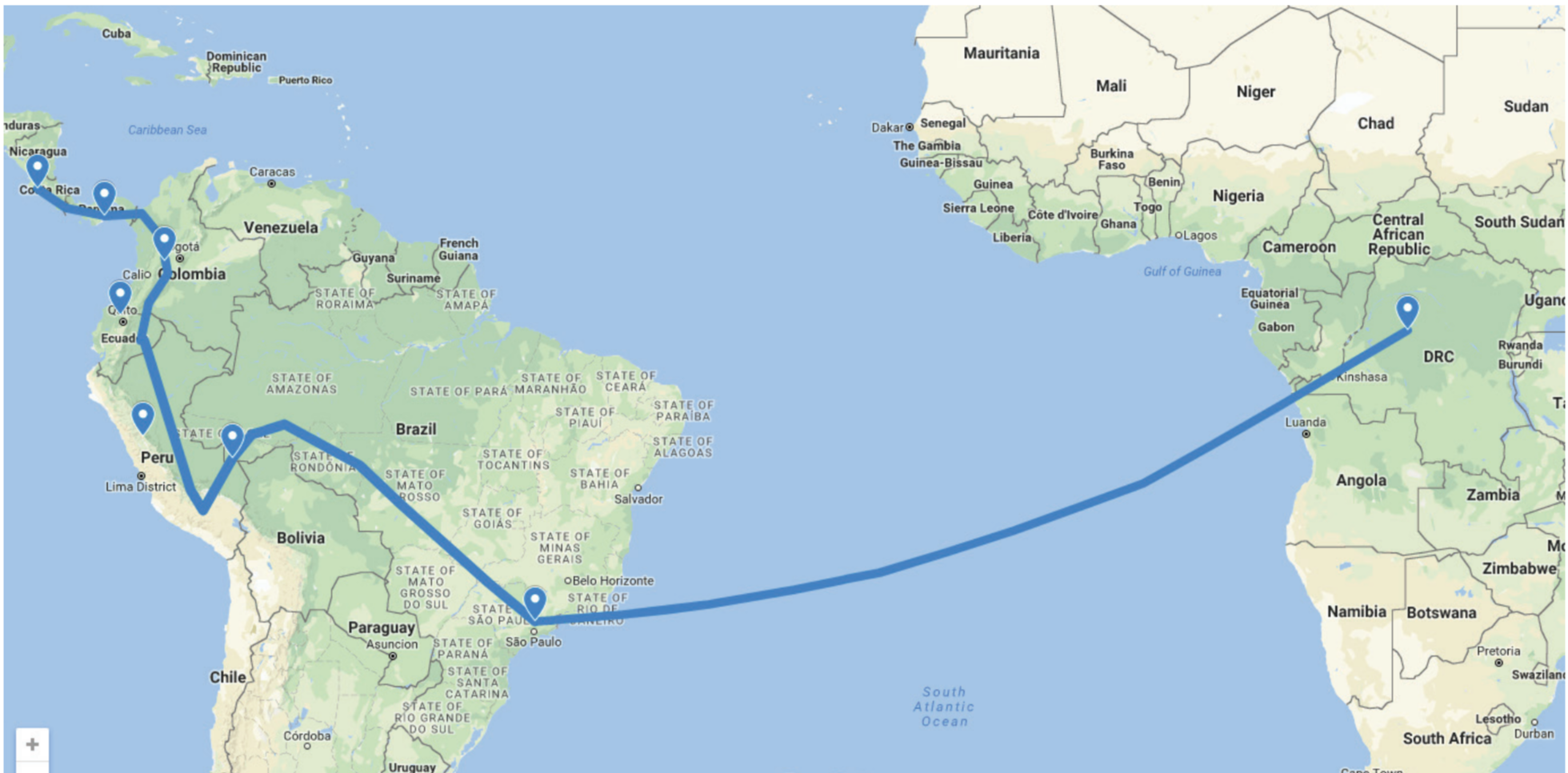
Jolie was forced to flee the Democratic Republic of Congo when the father of her two-year-old son was being hunted by the authorities. Fearing that the authorities would want to catch her as well, Jolie took her two children and ran without notifying anyone. She traveled to Brazil and then followed the well-trodden path to Central America. After arriving in Costa Rica, she applied for asylum and hopes to stay.
In the Democratic Republic of the Congo, Jolie had studied about "Côte Riche" in her history classes, without ever thinking that she would end up in Costa Rica one day. She says she misses the small things about home, such as having the privilege to take care of herself, looking pretty, or doing her hair and nails. Her desire is to stay in Costa Rica to build a life for herself and her two children. She believes this is her destiny.
In the Congo, she used to own a store and sell clothes for a living. It did not earn her a lot of money but was enough to help her get by. Her father died after a serious illness. When we spoke, she said she hadn't had the time to mourn his passing yet. She could not think about him because she has so many problems. Now, she doesn't have a phone and cannot contact anyone in her home country. She has one cousin in Brazil and one in the US.
Jolie ran away with her two children because the authorities had threatened her partner, who is not her husband. He is the father of her son. Her daughter has a different father. Jolie flew to Brazil after a friend told her he'd help her arrange her travel. She speaks Portuguese, which she learned back in the Congo. Her friend bought the air tickets for her and her two children at an agency in the Congo. The tickets for all of them cost about $3,000.
Along the journey, she never needed to convert the dollars she had brought with her into local currency. In each country, she paid in US dollars. Merchants would return the change in local currency. She did not have the identity documents she needed to legally convert money. Her cousin in Brazil was still in possession of their IDs at the time of the interview, and she had no idea if he would send them to her. To retrieve them, she would need to advance him money for the cost of postage, money she did not have. (It's not clear why so many of our subjects left their documentation with relatives. Some mentioned that they thought it would be better to leave them for safekeeping versus losing them to theft. We also suspected that many did not want their stories traced through their IDs either because they feared the prospect of being involuntarily returned or of being tracked by those threatening them.)
It was really important for her to tell us about her country's history. A large measure of our interview time was dedicated to her explanations of the political structure of the Congo and its dictatorship: "Mobutu is a dictator. The Congo should be democratic. It was divided, and it's now a mess. The family has been in power for decades, and they won't stop. He is buried in Morocco, your country. [The interviewers were from Morocco.] We are very poor in Africa. It is very hard for us. We just want to be somewhere where we are free."
The mother and children traveled from Brazil to Colombia by bus, then took another bus to Turbo, and then crossed the Gulf of Urabá by boat to traverse the Darién jungle on foot. They traveled to Panama by bus. Many people helped them with great sacrifice, she explained. But Jolie and her children also had to make sacrifices. Sometimes they wouldn't eat so that they could save the money that they would need for border crossings. Other migrants took pity on her because she was a woman traveling alone with two children. She says they all "have a union" now, like a big family—they understand each other (and communicate via WhatsApp).
Jolie and her children were walking in the jungle for eleven days. For four of those days they were sustained only by water and went without food. At one point in the jungle crossing, Jolie lost track of her son. She was terrified. He was traveling with a group just in front of hers, but then the groups separated. When they reunited, she felt lucky, and also very lucky that she didn't meet the mafia (thieves). "We did not meet them because I prayed not to meet them," she said. The group just behind them did meet them, and the mafia took everything from them.
Jolie wore a backpack through the jungle, from which she had to shed many possessions. It had grown too heavy, and she no longer felt safe carrying such a weight. "One wrong step and you die here," she recalled. "If you miss a rock, you die." She had to lighten her load by tossing whatever she could afford to part with from the pack.
She has applied for asylum in Costa Rica. After going through the worst—including the Darién jungle—she doesn't think she can continue onward to the US with her two children. In the jungle, "I saw death one million times. I saw God everywhere." In the jungle, she prayed for God to help her. She believes he answered her prayers, and this is why she is still alive.
Now and then, Jolie regrets her decision to travel on this journey and thinks about going back. But she says she cannot. Sometimes she says she thinks she would rather die back in her home country. Then she considers the situation. She had no choice but to run. If authorities look for her partner, they will also look for her, and she will not put her children at such risk.
When she was learning about "Côte Riche" in history class, she never thought she would actually be in Costa Rica one day. And yet, as she says, "I am in Costa Rica." She believes "this is destiny." She had no idea about what the journey was going to look like before her departure. Had she known, she would not have made it with her children.
She was not confident in the least. She was scared and appeared lost and unsure about what to do next. She asked the interviewers a lot of questions regarding Mexico and the United States, such as how big and how dangerous they are. She looked like she wanted to stay here in Costa Rica. She was not necessarily in a hurry to go elsewhere because of how exhausted she felt both mentally and physically. She also said that sometimes she wishes she were a man because things would be easier.
📝 This article was originally published in a collection of biographies by the Henry J. Leir Institute at The Fletcher School of Law & Diplomacy and Tufts University.
You can Download the original collection below ⬇️