
Burkina Faso to Mexico: A young man from Burkina Faso orienteers his way across South and Central America in search of a better life in the US.
Written by: The Journeys Project
Aziz left Burkina Faso because he wanted to travel and see the world. He told his family he was going on a trip and left for Brazil. In striking contrast to other migrants, he describes his journey as having few major obstacles, with the exception of crossing the jungle, which was difficult. From Costa Rica, Aziz plans on heading for the United States.
"I'm from the west of Burkina Faso. It was good; I had no problems, but I wanted to travel. I got a visa for Brazil in January 2017 from the embassy in Ouagadougou. I originally tried to go to the Netherlands, but that embassy denied me a tourist visa. They gave me back the application money, and I traveled throughout West Africa, but I could not find work. When I went to Brazil, I traveled alone, but I knew a few people who had gone to Brazil and had stayed on. My younger brother gave me 1 million CFA [West African francs, about $2,000], and I told my parents I was going on this trip. I still stay in touch with my mother. I don't miss anything about Burkina Faso except her.
"I flew to Casablanca, Morocco, and then on to São Paulo in Brazil. When I arrived, my brother [close friend] picked me up and brought me to his house, but I stayed at Casa del Migrante [a migrant shelter]. They gave me papers to come and go, and I worked in a factory making clothes. My friends, three other Burkinabés who I met in Brazil, worked there, too. In Burkina Faso I had 15 cows, and that was my work. Now my father tends to them.
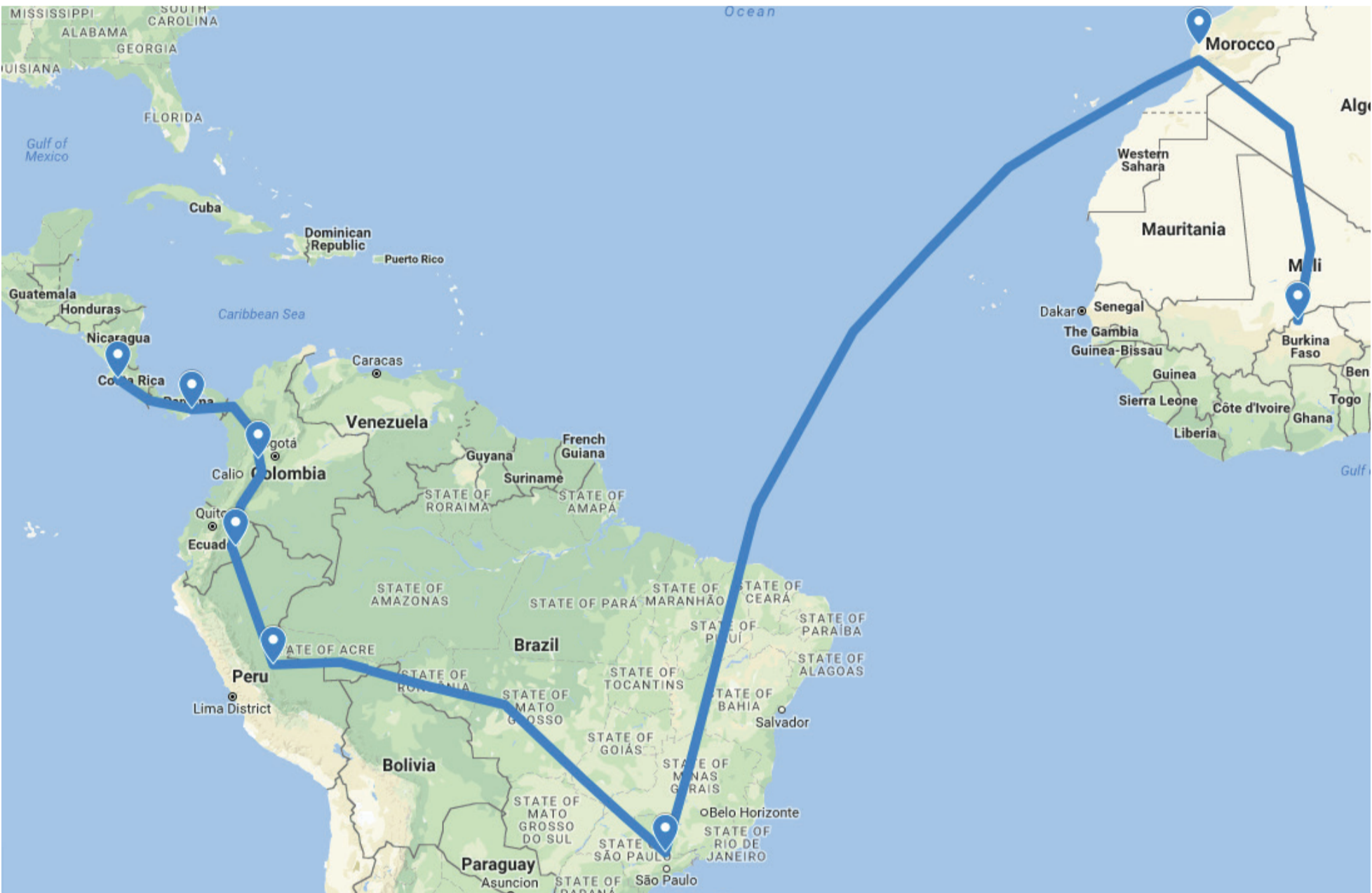
"In July 2017, after I worked for seven months, I decided to make the trip north." (The following timeline does not make sense given his departure date, but this is what he claimed, even after we asked for clarification.) "Four of us from Burkina Faso traveled together. We got information from friends who had already made the journey. We have WhatsApp so we can talk to them when we have Wi-Fi.
"First, we took a bus to Rio Branco in western Brazil; from there it took us three days to get to Peru. The border crossing was normal, and we only had to present our Burkina Faso passports. We passed through Lima and stayed three days before continuing on to Ecuador. We paid $30 [as a bribe] to cross that border—we didn't know that we didn't need a visa in Ecuador until later. Then we spent a week at the Ecuador-Colombia border. All the money I had saved had run out by the time I got to Colombia. We had encountered trouble with Western Union in Ecuador on the border. My friend in Brazil had wired us $500, but it was blocked. The hotel helped us with a second money transfer by giving us ID cards, but my friend still hasn't gotten his first $500 back. We didn't try Western Union again until Costa Rica."
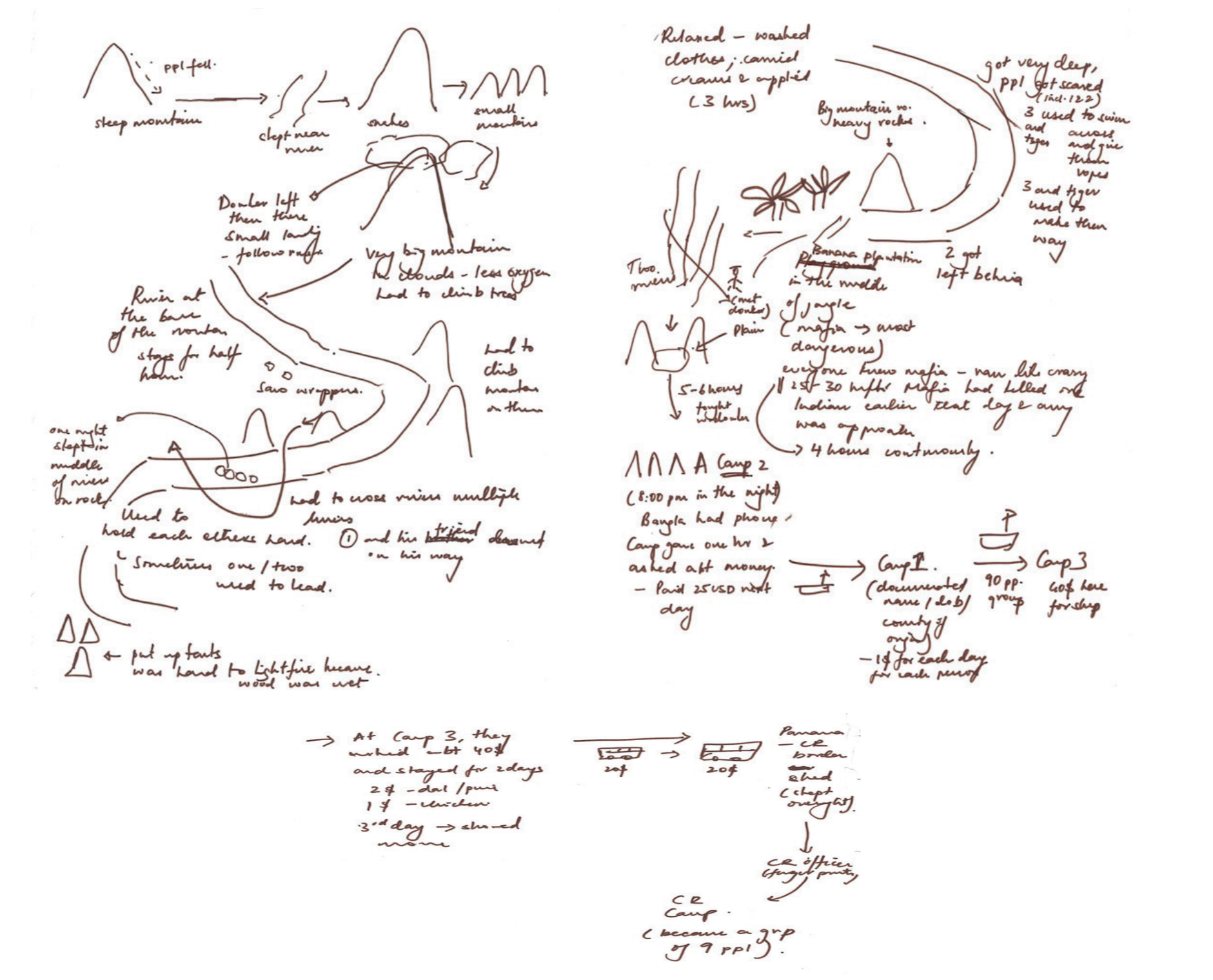
"We crossed the Ecuador-Colombia border easily. Passing through Colombia was fine; we just took a bus to the edge of the jungle and stayed in a hotel. My phone was stolen in Turbo, so I had to buy a new one, but I had enough money. We paid $200 each to take a boat—it was during the day and wasn't overloaded, and it took us three hours to get to Capurganá. Then, we walked through the jungle with other people from other boats. There were 47 or 48 total in our group. Some were from India and Pakistan, and others were Africans. The boat drivers had left us on the beach where guides were waiting to take us through the jungle, so lots of boats joined together as a big group. It took eight days to cross the jungle. All we had was biscuits to eat, and we drank water from the river. We slept at night, but it rained. There were lots of mosquitoes and biting insects, and lions, but we didn't see them. Lots of people got hurt—one of my friends dislocated his ankle and had to go back to Turbo. He's still there. This part of the journey, the jungle in Panama, was the most difficult part. We suffered so much. When we finally got out of the jungle, we were a group of three from Burkina Faso and six from India and Pakistan.
"The police in Panama arrested us and took us to immigration and then the hospital. The police stayed while we were getting treated medically. (I didn't need treatment but others did, and they brought everyone to the hospital for a few hours.) They took us back to immigration. There were about 60 people there, and it was good, similar to this CATEM [Costa Rica's temporary camp for migrants], but we had to clean in the morning and pay for food from a local canteen. Meals were $3, and everyone shared food if someone couldn't afford to pay. We stayed there for one week, and immigration officials were always there. We paid $40 to take one bus to Panama City and another bus to Costa Rica, which took just over twelve hours.
"The police in Costa Rica welcomed us at the southern border and brought us in a bus to the CATEM. They gave us papers and food, and we didn't have to pay. We bought new SIM cards. (We had bought new SIMs in every country except Panama so we could make calls.) We spent $14 and $10 to take two buses here. Immigration told us which buses to take, and it was easy. We've been here for two weeks. It is easy to get money here if you have a passport [and my friend did]... I don't have one. But my friend from Brazil sent money again, and I was able to receive it.
"We are now waiting for our friend, the fourth person, to arrive here before we continue, but he just left Turbo yesterday, so . . . Also, one of my friends doesn't have enough money to continue yet. I do, and one of my friends does.
Aziz showed me a video sent to him on WhatsApp by a friend in the US. His friend is posing with a car and wearing very nice clothes—a hat, leather shoes, and a nice jacket—and says America is very good but cold. Aziz replayed it and noted that the things his friend has in the video are not available for people like him in Burkina Faso. This trip has been fine, he says. The only remarkable thing is how difficult the jungle was.
We heard from Aziz again. He texted us while he was moving through Mexico. He had worried that we had been affected by the earthquake in Guatemala, as he knew we were traveling there from Costa Rica. At the time, he and his Burkinabe companion were doing well.
📝 This article was originally published in a collection of biographies by the Henry J. Leir Institute at The Fletcher School of Law & Diplomacy and Tufts University.
You can Download the original collection below ⬇️