
Cameroon toward the US: Juju, political persecution and domestic violence cause a blind mother of three to leave Cameroon in search of safety
Written by: The Journeys Project
Charm and grit allowed Princess, a nearly blind, single mother of three, to make her journey to Costa Rica and beyond. She had left her children at home in Cameroon in the care of her mother. Political persecution, fear of ritual spells, and economic survival propelled Princess toward the United States. She found her way through Brazil, Peru, Ecuador, Colombia, and Panama, making friends along the way and enduring an extraordinary passage through the Darién Gap. There, in the Darién Gap, she meets "blacks and whites" whom she clings to for survival. She remains unflinching in her determination to go north.
"I had to leave Cameroon. I protested in the marches, and the government began to search for me, hunt me down. I have been beaten and tear-gassed many times. I am English-speaking, and the government is French-speaking. The government treats us like animals."
I met Princess the day before she uttered these words. At our first encounter, she had one hand wrapped around a dipping spoon, and the other shaking a packet of Maggi into a cauldron that simmered with potatoes and carrots. The cauldron rested on three large stones over an open wood fire. We could have been in any of a thousand African villages, except we were near Costa Rica's border with Nicaragua. Behind us rose the Orosí volcano and in front, across a distance of a few kilometers, the sun lowered into the Pacific. Rows of three-stone fires blazed under blackened vessels just like the one Princess was using. Next to them stood an array of barbecues, their grills set into simple concrete structures. Behind these and toward the fence that marked the western boundary of the camp was a broken line of narrow, high-top tables and benches. The crude furniture and kitchens were protected by a corrugated aluminum roof forming what camp officials called the "cooking and dining area." Lanes of weathered tents, torn and sagging, ran between this back area and the camp entrance. Marking the entrance was a boulder painted with the greeting "Welcome to Africa." Called the CATEM del Norte, this camp could house up to 1,500 migrants, but when I met Princess, its numbers were far fewer.
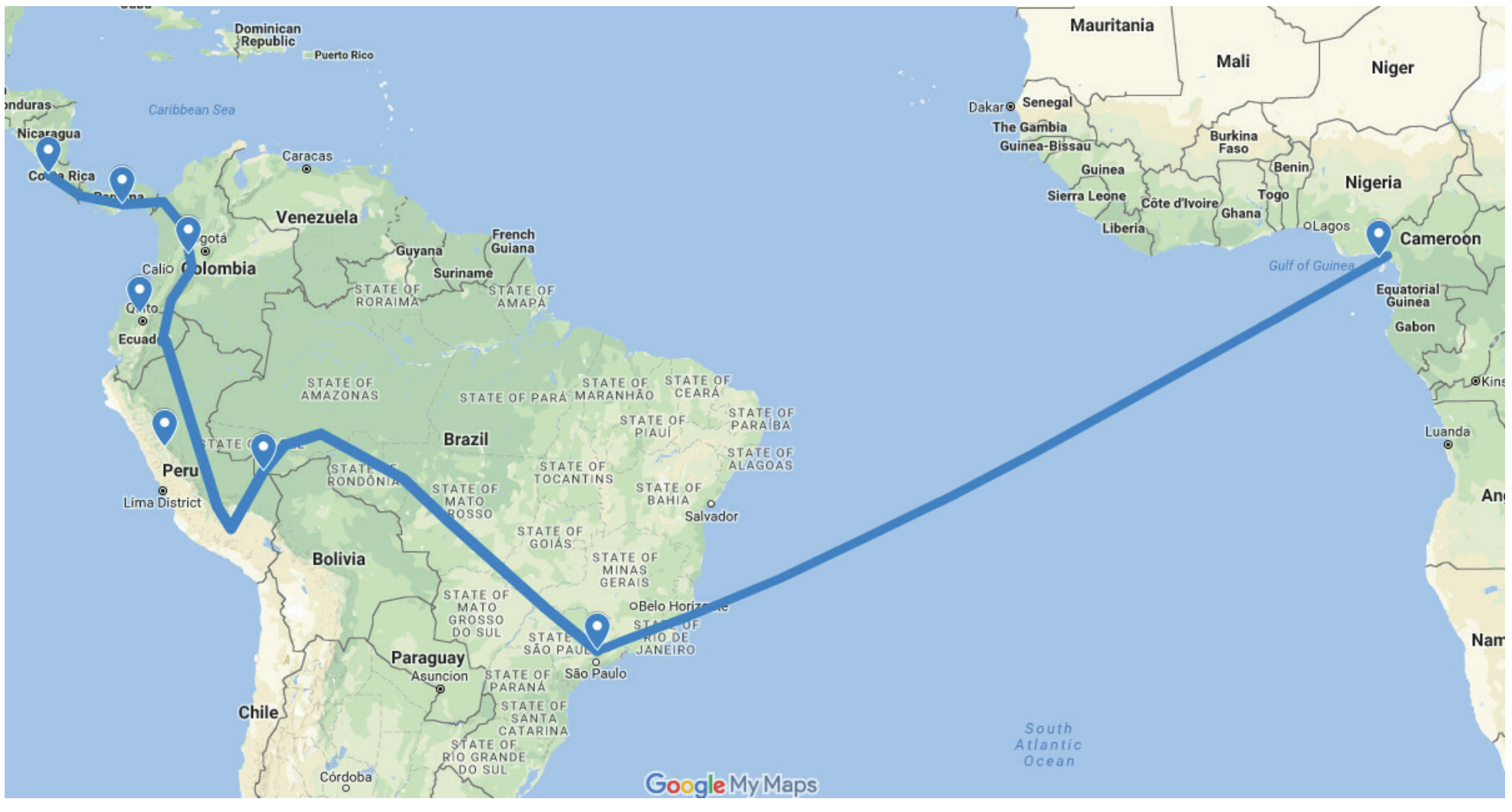
Princess flashed an easy smile as she motioned me toward her, inviting me to taste her stew. I admired how she could turn the sparest camp offerings into a delicious meal. Over the course of the next several days, I came to understand that transforming basic materials or meager amounts of money into something of considerable value was Princess' stock in trade. Her ingenuity and considerable charm had gotten her from Cameroon to Brazil and onward through South America.
At the close of our initial encounter in the camp, I asked if she wanted to accompany me the next day into town for a snack. My hope was to find a locale where Princess felt she could talk freely about her experiences: What brought her here, how did she finance her journey thus far, and what were her plans for moving north?
She agreed. The following morning, I arrived at the camp, handed my passport over to the guard, and made my way to the dining area. This time several men were rolling dice on one of the wooden tables. Someone had etched a game board into a rough tabletop with whatever carving tool had been on hand—maybe a pocketknife. The players were intent. One of them tossed a die, a small cube cut from stone with pips notched into its six faces, onto the table. As it landed, he moved his makeshift token, a bottle cap, around the board.
Princess—skin luminous, hair shining—saw us and greeted me with a warm hug. She asked if I would wait while she put on more comfortable shoes. She returned in a pair of sneakers, then sat on the bench next to another Cameroonian. He muttered something under his breath.
"I won't be coming with you," Princess said. I asked if she was sure. She hesitated and then said, "I changed my mind. I will come with you."
We took a taxi to La Cruz. The CATEM itself stood isolated along a country road so that the only way to travel into town was to walk, hitch a ride from a passing vehicle, which the camp managers disapproved of, or take a taxi.
Our driver dropped us in the square. We decided to search for a nearby phone repair shop. Princess had been curious about replacing the broken glass on the face of her smartphone. The shop was shuttered, so we walked a few blocks to Soda Abigail, a hole-in-the-wall family restaurant.
Despite my offering to pay for her, Princess refused to order a meal. I coaxed, "At least order a beverage." She chose an orange-flavored Fanta from the refrigerator, searched the menu listed on a whiteboard, then decided that fried plantains would go well with the Fanta. She further examined the menu, asked a few questions in Spanish to Arnoldo, the waiter, and then announced that the fish, beans, and rice plate would go well with the plantains and the Fanta. So would an extra portion of salad.
When the food was served, Princess began to talk with gusto.
"A friend had told me that in Brazil life was better than in Cameroon. One night when I knew the police were looking for me, I took a bus to the border of Nigeria. From there I traveled to Abuja and met with a pastor we called 'the Bishop'. I had learned about him through a friend. The Bishop also told me that Brazil would be a better place for me. He arranged and paid for my bus trip to Lagos and my flight to São Paulo. I took only US dollars with me. Once in São Paulo, the authorities kept me for one week at the airport. I slept on a bench while they questioned me. But, really, though I did not like being in detention, they were very nice and fed me three meals a day. I kept saying, 'If you return me to Cameroon, you have killed me.' After being released from the airport, I stayed in São Paulo for two months. A friend who I had been staying with became pregnant. I later learned that she had the baby many months prematurely. But I had to leave her in her pregnancy and move on. There was no work for me in Brazil.
"I left Brazil with a Cameroonian guy and his older brother. It was the three of us traveling together. We went by bus, and it took about a week to reach the border of Peru. In Lima, at the bus station, we met up with another group of Africans—including a Ghanaian and a Togolese. We had not known each other previously. There were about seven of us traveling together to Ecuador by bus."
"In Ecuador I had to stop. My glaucoma was getting worse. As you can see, I am blind. I found a landlord in an Ecuadorian town who was a Senegalese soccer player. I now like to call him 'Footballer'. Footballer had no money, but he was very kind. I had no money either. Up to that point, my traveling companions had helped pay for everything, but they too had to move on. So they left me in the care of Footballer. He was so nice. He liked me for me, and we fell in love. But I was determined to keep moving. Footballer helped me. He found—I don't know how—the money for my bus ticket across Colombia to the Caribbean coast. So I left. In Colombia, the authorities stopped me: I had no visa. They told a similar thing to a man on the bus. The man and I bonded on the ride back to the Ecuadorian border. The man—I call him 'Prof'—had money, so he helped me out. He wanted to go to Peru. I said, 'No, no, not Peru, Prof. We mustn't go there. We must go to Ecuador. You can stay with Footballer and me.' He agreed, and we returned by bus to meet up with Footballer. Prof and I stayed there for a few weeks until we formed a new plan.
"Footballer told Prof: 'You must take care of her. She cannot see. She is blind.' Prof and I set out for Colombia again; this time we knew whom to pay [presumably whom to bribe]. We went through Colombia fairly quickly, stopping in Medellin to change buses. From Medellin we made our way to Turbo. By then I had heard news of the guys I had traveled with—the two brothers—from Brazil to Lima. The older brother had lost his younger brother in the jungle [the Darién Gap that divides Colombia and Panama]. Their guide had spotted the army coming and so hid them both. The younger brother developed great stomach pains while in hiding, and they could not save him. He died there. I was so sad to hear this news.
"From Turbo, Prof and I took a boat to Capurganá [crossing the Gulf of Urabá]. There, we found a guide to take us through the Darién jungle. We walked for two days and came upon a woman with a broken leg. She was also trying to travel north over the same mountains as we, but with her leg broken she could not move. She had slipped while trying to scramble over an enormous, slick boulder. She had been left for dead. Prof said he could not leave her and would not. He urged me to go on. I could not. I was too alone. Prof found a group of 'blacks' and 'whites'. The blacks were a group of five—a family from Cameroon. The whites were from Ethiopia. They were traveling as a group of ten, and Prof convinced them to take me through the jungle. I wished he hadn't. I could not see, and the whites wanted to move faster. The blacks began to hate me. 'Go, go, faster, faster, move, move,' they would say. 'You are blind.' I sang my song to God: 'Lord, I really know you.'"
Princess began to sing the song and then sang it fulsomely in its entirety, drawing looks from those seated nearby. She finished the song and burst into tears.
"One day, we had to ford the river." She explained, tearfully, "The current was swift—too strong. The blacks told me to cross on my own. I could not see, so I clung to them. They got very angry. But I would not let them go. I could feel their hatred as we waded into the current, me clutching them. Once on the other side, I began to crawl along the bank when I tripped over a snake. The whites laughed at me." Her face simulated a jeer. "They called me 'stupid,' but I had to follow them; else I would be stranded there.
"We made our way walking. The mafia [armed bandits] stopped us and robbed us of everything we had. They took my phone and all my money. When I emerged from the jungle, I had nothing. In Costa Rica, a soldier helped me out. He gave me $21, enough to buy a bus ticket to La Cruz, where we are now. A woman at the bus station gave me $40 and told me to buy a phone. I called Prof—I had memorized his number—and learned that he had made it back to Capurganá with the woman with the broken leg. She is now in the hospital. The army in the jungle brought in a helicopter and flew them to Capurganá." She had no idea if it was the Panamanian or the Colombian army. "They are like that, the army. They turn us back, but they also help us. They are our enemy when we don't want them, and when we need them, they are our friends."
The next day, Nabil, a member of our research team, texted me to let us know that Princess had tried to leave the night before but was turned back. I met her at the hostel across from the bus station and asked if she would like a refreshment. She seemed eager to see me and tell me her news. We strolled along a broken sidewalk toward the park and chose a small soda—a snack shop—where we bought more Fanta.
"I don't feel comfortable here," said Princess. "I feel people around me are straining to listen in." I paid for our drinks, and we moved on. After walking a half block, we stopped at a chicken rotisserie where Princess ordered fish, frijoles, and rice. I ordered a plate of fried chicken and salad. We ate, but Princess still did not want to talk. "I feel like people are struggling to hear us, even here." We finished our meal and walked to my hotel, Casa De Los Vientos. The hotel's open bar and reception area gave way to the street. We seated ourselves in the airy lounge area among cheerfully painted chairs and wooden tables. Princess seemed to like the place and at last looked relaxed.
"Last night I made another attempt to cross into Nicaragua, but I would like to tell you about my attempt last week, first. Then I would like to tell you more about my life in Cameroon."
"Last week I negotiated with my contact [smuggler] that I would pay $150 to get through Nicaragua to Honduras. He was charging everyone else $330. I convinced him that I could recruit more clients for him. In both the CATEM and my hostel, I found him fifteen people willing to pay $330 each. They were from Angola, Congo, Ethiopia, Cameroon, and Eritrea. We gathered at the hostel across from the bus station at the appointed time, when our guide contacted us. They came to pick us up in cars and took us to the bay [Puerto Soley]. We walked on foot for a while till we got to our boats. There, I huddled in a small fishing vessel with about half the others. We traveled for four to five hours in the dark and finally reached the shore. We exited the boats, then walked through a forest for about an hour. Waiting for us at the end of our walk was a large truck. Also, two men on bicycles were circling the truck. One of them was talking on his mobile and kept staring at us." Princess mimes a furtive glance. "The driver did not appear to know these guys. We got into the back of the truck, and the driver drove us for about thirty minutes when we were intercepted by a patrol car. The next thing we knew was that we were surrounded by police or immigration officers, or both." Princess described that they appeared to be authorities, but she did not know from which government entity.
"I think Mama Africa's men [a local smuggling ring] were the ones on the bicycles. Someone in La Cruz had tipped them off, the bicycle guys, and alerted them that we were coming. Mama Africa is very competitive. In the end, I did not select her because her prices were too high and she was not willing to negotiate.
"They asked us to get out of the truck, and then one by one snapped our photos. Then, they brought us by bus to a camp where they took our fingerprints. I was menstruating heavily, and I asked if I could please go to the hospital for some supplies. The pharmacies were closed. I had only a sheet wrapped around me, by then soaked in blood. The authorities said no. When the men in our group asked if they could use the toilet, the police said, 'Pee in your pants.' They are never like that in Costa Rica. Everyone here is always nice to us.
"They returned us by truck to the border, and once across it, we took taxis back to La Cruz and the CATEM." She showed me the red bracelet that the CATEM had issued her when she first registered. "They know me there, and I still wore my bracelet. It was about 8:30 at night, and they let me back in." Princess seemed to like wearing the bracelet. She had shown it to me multiple times, as if it were some form of identification that pleased her.
"I let my smuggler know that we had been returned. He seemed to have this information already and promised that without paying more, I could try again. He told everyone who had paid $330 that they would have to pay another $80. He asked me to pay another $150—for a total of $300—but I said no. I would only pay $50 more. When we met up to make the crossing attempt, he said that I would have to wait because he had customers who were willing to pay more. He was very nice and said, 'Don't worry, I will take you, just not tonight.' That was last night, and I will try again tonight.
"I am also going to explore whether I can flag down a truck." She motioned with her hands the secret signal to a driver that you would like to stow away on board. "I hear that the trucks hide you and bring you straight through Nicaragua to Honduras. I heard this from my friend who had her baby in Brazil. By the way, she was able to get to the US before me. She had brought her baby with her and everyone along the way, of course, sympathized with her. She was able to pass ahead of me because people, including her brother in the US, either sent her money or gave her money as she traveled."
Princess and I left the hotel. She wanted to shop for travel clothes in the event she would be hiding inside a truck. We found a shop just down the street from my hotel. It was a discount store. Princess tried on three pairs of jeans. Nothing fit. The shop assistant found a pair of tan pants that stretched. I found her a cotton shirt with black horizontal stripes. She emerged from the makeshift changing room looking 100 percent American, only more chic—sporty, casual, and very put-together. She no longer appeared like a migrant from Africa. Her new outfit matched her shoes and purse. We paid for the clothes and continued to stroll lazily down the street to the park.
"I would like to tell you more about my life back in Cameroon. I was a protester but also the mother of three children." Princess relayed some background about the protests, and later that day I used my university's online library to learn more.
Formerly an emirate, in 1886, Cameroon became a German colony, then after World War I separated into two colonies, one under British and the other under French rule. Today, after decades as an independent country, Cameroon's regions are either English-speaking or French-speaking for the most part. As the ruling party, the French speakers hold the power and have been accused of abusing it, while the Francophone regime accuses Anglophone elites of using identity divisions to their advantage.¹ Sparked by politics at the time of the country's independence and stoked later by student protests,² the clashes around identity continue today,³ with many of the attacks brutal.
Princess emphasized her role as a political protester, showing me video clips on her phone of her village under siege. I could not see Princess in any of the footage. But she was vehement that she was there. As she rehearsed in front of me, I knew this story would play well at the US border when she sought asylum there, a plan she had confided to me but also to pretty much everyone who she had met up with.
Princess continued: "My youngest child was in my belly for twelve months. My other children were born after eight-month terms. This happened because Rofina, my husband's girlfriend, went to a priestess who performed juju.
When I was newly pregnant and beginning to show, Rofina called me from my husband's phone. 'You will never see this child born,' she screamed. She was so jealous that my husband had had sex with me. She called me again and said, 'Look at the phone.' There was a picture of her with my husband naked on a bed. In my eleventh month, my husband came to me and told me to kill the child; then he bit me. He was possessed by Rofina.
"In my twelfth month, I could bear the weight of the baby no more. My belly was enormous. I was becoming a freak to the hospital staff. They wanted to study me, but would not offer me the surgery to remove the baby. I did not have enough money for the procedure. I had become a Christian many years before and decided to visit a pastor who had been to see Prophet TB Jeshua. My pastor had on hand some holy water blessed by the prophet, which he sprinkled over my belly. The next day I gave birth to a boy weighing five kilos. Rofina still had spells cast upon me. She told me I would go blind, and I did."
Princess and I decided to visit a pharmacy in La Cruz to buy eye drops to salve her glaucoma. The pharmacist explained that the only cure for glaucoma was surgery, which Princess already knew. He recommended two different types of eye drops to be taken in sequence that would offer some comfort.
Again, later that night, I turned to the online university library to find out if there were similar stories of sorcery and magic as forces that drove people to embark on such a punishing journey. I learned that juju is indeed a force in migration, but more as part of an oath that a traveler (or trafficked victim) makes to her smuggler rather than a reason for flight.
According to one source,
Parties to the oath-taking directly submit to the supernatural tribune to settle disputes before the deity. The tribune's verdict is final. The oaths are worded in such a way that the swearer invokes a conditional curse upon himself/herself which may include death or illness. It is often believed that swearers, should they default, the misfortune agreed to will befall them through the powers of the 'gods'.⁴
Ben Taub, writing for The New Yorker, explains:
In Benin City, important agreements are often sealed with an oath, administered by a juju priest. The legal system can be dodged or corrupted, the thinking goes, but there is no escaping the consequences of violating a promise made before the old gods. Many sex traffickers have used this tradition to guarantee the obedience of their victims.⁵
He reports further:
One afternoon, I met an elderly Edo juju priestess who maintains a special relationship with the god who lives in the Ogba River. She wore a white sheet and a red parrot feather, and carried a wand decorated with charms, to detect any "demon priest" who challenged her spiritually. When I asked her to explain juju contracts, she said that all parties must obey them, "because the solution is from the gods."
"You say that when you get there you will not run," Sophia, a young woman who had come back from Europe, told me. In exchange for the madam covering travel expenses, the girl agrees to work for her until she has paid back the cost of the journey; the madam keeps her documents, and tells her that any attempt to flee will cause the juju, now inhabiting her body, to attack her. "If you don't pay, you will die," Sophia said. "If you speak with the police, you will die. If you tell the truth, you will die."⁶
But this was not Princess' story. She was not claiming that a juju ritual was an oath to guarantee her debt repayment to a smuggler.⁷ She had emphasized that it had been a pastor in Nigeria who helped her get to Brazil, and he was not expecting payment for her air tickets. Princess had described the dreadful effects of juju as another reason for her departure and, I thought, perhaps the most important. She went on to say that Rofina was making her life miserable, that she believed the various spells performed by Rofina's priestess had made her own efforts to find work impossible. The only way out for Princess was to leave Cameroon.
Princess and I said our goodbyes, and I wished her luck with her travel that night.
The next morning, I went looking for her. She was gone. But she had texted a member of our research team to say that she had made it to Honduras. A boat had taken her around Nicaragua to Honduras, where she would rest till Monday, then head through Guatemala to Mexico.
We heard from her again from the town of Tapachula, Mexico. She had obtained a pass to move north, but it would expire in a few days. That was the last time we heard from her.
📝 This article was originally published in a collection of biographies by the Henry J. Leir Institute at The Fletcher School of Law & Diplomacy and Tufts University.
You can Download the original collection below ⬇️