
Yemen to the US: A highly educated Yemeni flees war, lands in Egypt, travels through South America, then awaits a boat to smuggle him around Nicaragua.
Written by: The Journeys Project
The gregarious, chain-smoking Jalal left Yemen for Egypt in January 2018. In Cairo, a generous friend gifted him $3,000, which he used to book a flight to South America. With a Yemeni father and a Somali mother, Jalal has spent a lifetime straddling two worlds in terms of identity. Now, as a migrant, he again finds himself geographically straddling two worlds as he makes his way to the United States, "the country of freedom." Not entirely Middle Eastern and not entirely African, his unique background reflects the unique journey he's had thus far.
"My mother was Somali, and my father was from Yemen. I grew up in Somalia and got a bachelor's degree in economics and Italian. But I left in 1992 and went to Yemen. I had a family, but one day in 2015 I came home from work and found that my wife had left me. She had taken our son [14] and daughter [12]. I don't know where they are. I heard maybe Saudi Arabia or Iran. I'm still trying to find them."
Jalal was in his early fifties, rail-thin, and sporting salt-and-pepper hair. He wore a blue and white striped polo shirt with blotchy stains and beige slacks. He smiled with his eyes, which he immediately greets you with upon striking up a conversation. He grew anxious when he had gone too long without a cigarette. He took multiple breaks over the course of the (multi-hour) interview to step outside to smoke.
"I didn't plan on leaving [Yemen]. I was just trying to get away. All my life was difficult; there was no security. There was no safe place in Sana'a. The Houthis were placing arms in mosques, hospitals, and schools. There were no jobs but plenty of weapons. They threatened me, saying, 'You are Somali, not Yemeni.'
"I left in January 2018 and went to Cairo, where I stayed six months. Yemenis under the age of 45 cannot go to Egypt because they think they could be terrorists. I was able to get a six-month visa at the airport, but after it must be renewed every month for $100, which is too expensive. I went to the airport to buy a plane ticket to Israel, because I heard that Yemenis are given free access. Two of my friends made it to Israel by crossing through the border with Lebanon. But the person at the airport wouldn't sell me a ticket and told me I needed to go to the embassy first to get a visa. When I got to the embassy, the Egyptian authorities would not let me pass. They wanted to know what business a Yemeni had at the Israeli embassy and wouldn't let me pass to ask for a visa."
I was unable to determine what Jalal meant by "free access." This was possibly a reference to the 1949–50 airlift of Yemenite Jews to Israel. Furthermore, it is highly unlikely that Jalal's friends crossed into Israel via the (closed) border with Lebanon. Prior to the completion of the Egypt-Israel barrier in 2013, African migrants were commonly smuggled from Egypt into Israel through the Sinai Desert.
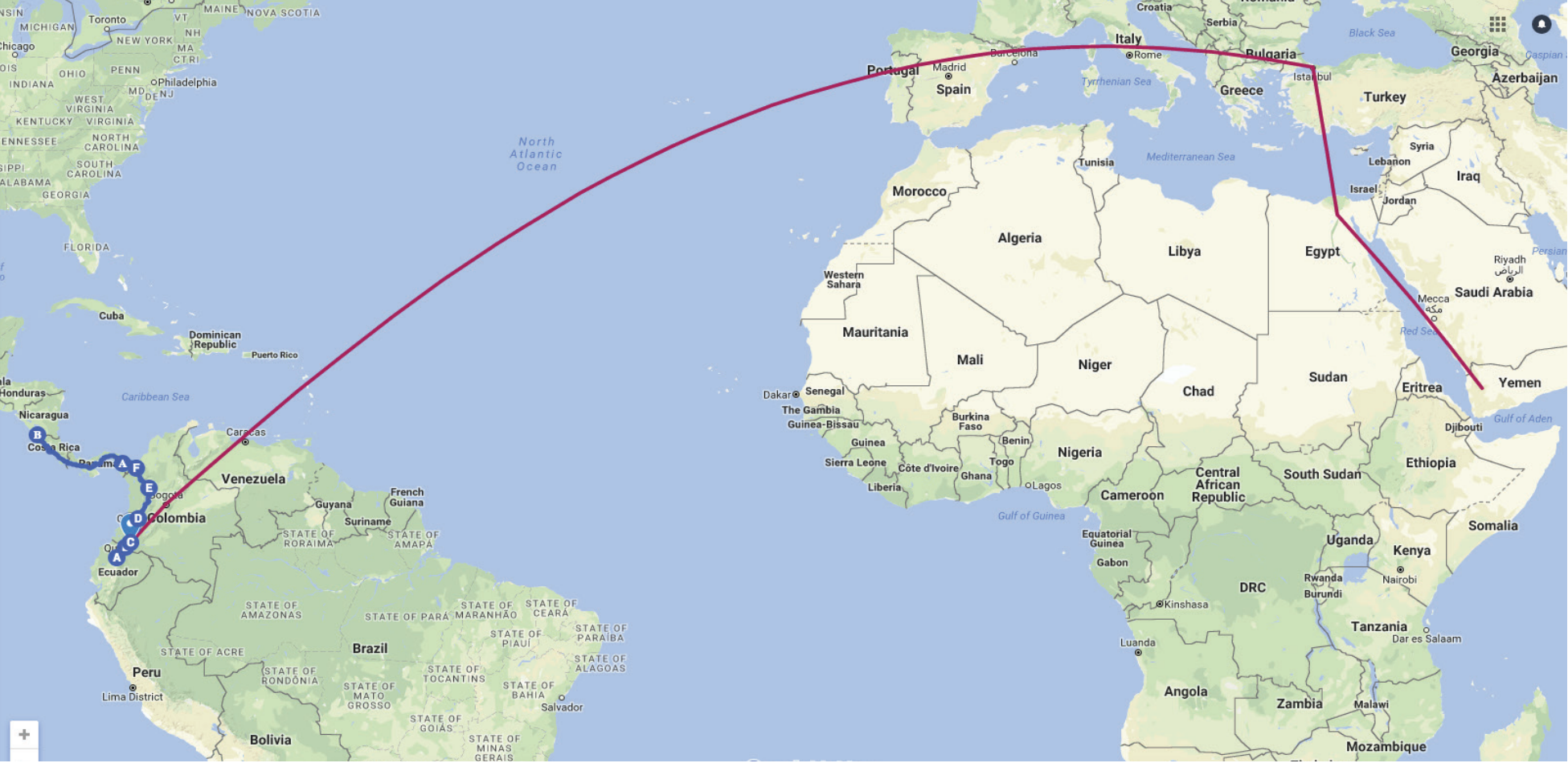
"After that, I met a Yemeni who wanted to go to Ecuador because you didn't need a visa. I was renting a place in Cairo, so I couldn't sell off the furniture, only the appliances and electronics. But while I was in Cairo, I met a former classmate who was now living in the UK. He gave me $3,000 as a gift. I booked a Turkish Airways flight, which took me from Cairo to Istanbul and then Istanbul to Bogotá and finally Bogotá to Quito. When I arrived in Ecuador, the authorities asked me if I had a hotel booking and if I had any money.
"I stayed in Ecuador for five days. A Pakistani man told me I needed to go to Tulcán to cross to Colombia. I took a bus there, and then crossed the border on foot. No one stopped me because I looked like a local. When I got across the border, I paid a taxi driver $5 to take me to the bus station in Ipiales, where I took a bus to Cali.
"In Cali, the police stopped me because I didn't have an entry stamp or visa. They took me to immigration, where they had my fingerprints and photo on file from when I transferred planes in Bogotá. They were going to deport me back to Ecuador, but I told them that I am a refugee. They decided to let me go, but didn't give me any papers.
"I went back to the bus station to buy a ticket to Medellin for 85,000 pesos, but they wouldn't sell me a ticket without papers. I went back to the immigration office and told them they needed to help me. An officer went back to the bus station with me, and I was able to buy a ticket. In Medellin, I did the same thing because I couldn't buy a bus ticket to Turbo without papers. I went to the immigration office and told them they had to help me because I am a refugee. An officer came with me to the bus station and told them to sell me a ticket to Turbo.
"I stayed in Turbo for five nights, at Hotel Good Night. Indians, other Asians, and Africans were staying there. I arranged to leave on a boat for Capurganá for $230. It left at two in the morning to avoid the police. There were three boats total, holding 50 people each. When we got to Capurganá, we had to pay $20 each for verbal directions on how to cross through the jungle. They told us it would take seven hours to climb the first mountain, then nine hours to cross the second. After we climbed the second mountain, we had to find the river and follow it. We set off, but then walked back an hour to the supermarket to buy lamps, rain gear, machetes, food, medicine, and other supplies."
This was the first of several instances throughout the interview in which Jalal refers to "Africans." It was clear from the conversation that he did not consider himself part of this group.
"I spent five days walking through the jungle. I would walk for three hours at a time and then take a cigarette and juice break. I walked by myself, but was always around other people, and 20 to 30 would pass by whenever I stopped. Most people walked in groups of three or four. I would see 150 to 180 people in the jungle every day, mostly from Bangladesh, India, and Cameroon, but also Somalis, Sudanese, Senegalese, Eritreans, Ethiopians, and other Africans. The Bangladeshis and Indians told me to throw away my passport, but I refused. My passport is my Jalal. This is how people will know me. If I die, this is how they will Jalal me. I want to be sent back if I die."
Jalal was very proud of his Yemeni passport, and voluntarily produced it to show this researcher.
"When we crossed the river, 100 percent I thought I was going to die. I wrapped my documents, phone, and keys in three different plastic bags to keep them dry. At night, I would wear double trash bags over my head and feet to keep out insects, and would try to make a basic shelter out of branches. I had a lot of allergic reactions to bug bites in the jungle, and got sick from drinking water from the river. Many people in the jungle were hungry, too.
"I met an Eritrean woman who was stuck between the first and second mountain. Her leg was broken. She couldn't go back, and she couldn't continue. No one else would help. Africans and Indians don't help people. I couldn't carry both her and her bags. All I could do was give her food. As Muslims, you cannot eat when others do not have anything to eat, so you must share with them. I also met two Indians with broken legs, who were trying to climb the mountain using their hands.
"When I made it to Panama, I met Indian [indigenous] villagers, who told me where the camp was. They wanted to call the police for us, thinking that they could give us a ride so we wouldn't have to walk the rest of the way. But when I was at Hotel Good Night, the Africans told me to avoid this first camp [Camp 1], because we would be deported. To not be deported, we had to make it to Camp 2. We went back into the jungle and walked for three or four more days following the river. We would hide from the police if we saw them.
"Finally, we made it to Camp 2, and we told them we were refugees. They searched us for weapons and held us for two days before we were taken to another camp near Meteti. They took our fingerprints and gave us vaccinations.
"I spent eight days in that camp because there were more security checks for Yemenis. There were four Americans—three men and one woman—who were screening us. Because I had a passport, my check didn't take long, but there were three other Yemenis who were younger and did not have their passports. The Americans asked if they had ever served in the military, what education they had, where they were going, and other information. These other Yemenis did not like me, because I drink alcohol and smoke. It took three extra days for the other Yemenis to be processed, and then they released us as a group to Costa Rica.
"I stayed two days in the camp [southern CATEM], where they took my fingerprints and took me to the hospital for my allergies. Other migrants had broken bones, fevers, and other injuries from the jungle. The camp felt like a prison. I would sneak out so that I could smoke and drink. There was a woman who worked there who caught me. She spoke French, English, and Spanish. I could communicate a little with people who spoke Spanish, because my bachelor's degree was in Italian. She asked me why I was smoking and drinking, and I told her it was because I want to be free. She arranged with the guards to let me pass so I could drink and smoke just outside the gate. She was a very good woman.
"The Costa Rican authorities gave us a 25-day pass, and I went with other migrants to the bus station to buy a ticket for San Jose. We slept outside the station when we got there, and then bought a ticket for La Cruz. When I got there, I shopped around town for hotels and found one for $10 per night. The taxi drivers told me about it. I did not want to go to the camp because I heard it was crowded and dirty with bacteria, and I did not want to become sick."
Initially, Jalal was reluctant to discuss why he chose not to go to the camp. It is this researcher's suspicion that this decision was due in part to the prohibition on drinking and smoking in the camp.
"Once I got to the hotel, I arranged to go to the beach [to be smuggled] for $300. I would take a five-and-a-half-hour boat ride to Honduras. In all, there were 30 people—mostly Africans—in two boats, with two conductors in each boat. I think they were from Nicaragua. They wore life jackets, but they did not offer them to us. It's an ocean, so it is very dangerous. It is not the sea.
"When the boats landed, they told us we were at the border between Nicaragua and Honduras, and that we would need to walk for 40 minutes. After walking, we met up with a group of 30 Cubans, and all of us were loaded into a trailer. We drove for two hours, but then were stopped by police. They loaded us onto buses and drove us back to the border with Costa Rica. They took our photos and recorded our names and nationalities."
Jalal was unsure whether he was in Nicaragua or Honduras when the group was apprehended.
"I plan to go to the beach again, perhaps with a different smuggler. I plan to apply for asylum in the United States, where I will be welcomed. I will go to the camp after crossing the border to the United States. The woman who worked at the camp in Costa Rica told me that if I want to apply for asylum there, I have to apply in San José. But I did not want to seek asylum in Costa Rica because we don't know the language. We don't know the situation. We don't have any information about Costa Rica. We know the United States—the United States is the country of freedom. It is democratic. There is justice.
"Today, I am getting a lot of calls and texts [via WhatsApp] from other migrants asking where I am, how I traveled, and when I'm moving on. The man at Hotel Good Night is a bad man—he is giving my number to any Somalis who pass through. I got a call from five Somalis in Capurganá who wanted to know where I was. I told them I was in Mexico, because if I said I was here [in Costa Rica], they would ask for the phone number of traffickers. Because if something bad happened... I tell them, 'No, don't come. It is dangerous for us, dangerous for your life.' If you tell people to come and they die, you will be responsible. Do you want them to be killed or die? I cannot."
We heard from Jalal that he had made it safely to the US. We were relieved of this news: the last we had seen of him was in the park in La Cruz. He reported that he had gotten drunk the night before and did not feel it was safe to be smuggled by boat around the sealed borders of Nicaragua to Honduras. When we did not see him a day later, we hoped that he felt sufficiently sober to take a very dangerous voyage.
📝 This article was originally published in a collection of biographies by the Henry J. Leir Institute at The Fletcher School of Law & Diplomacy and Tufts University.
You can Download the original collection below ⬇️