
India to the US: Three young men from the Punjab find new friendships as they are smuggled to South America and northward.
Written by: The Journeys Project
Sunny and Dharampreet are two enthusiastic young men who left their families to make something of themselves. They appeared determined to stick together, along with the rest of their group, on the journey ahead. After multiple flights through Moscow, Milan, and Brazil, they arrived in Ecuador, where they began making the dangerous journey north to the United States.
Sunny spoke first: "I was traveling alone in the beginning. Even though my first cousin is also on the same journey, he started off later. He has now reached the Panamanian camps, and I am here [in South CATEM, a temporary shelter for migrants]. I had applied for visas to many countries, including Germany, the United States (thrice), France, and even Mexico. I had worked as a salesman for three years and was earning between 10,000 and 12,000 Indian rupees per month [approximately $150–175]. At home, I have a handicapped brother. My sister is married. I eventually set off on this journey because my family was keen that I do something with my life. I was working while I was applying for visas.
"I have friends in California and Chicago—these were friends from my childhood and school. One of them is an American citizen—his parents had worked in the US for many years and then took him there when he was around eighteen. My friend in Chicago undertook this journey when he was just fourteen in 2008! Don't ask. It took him some six months to get to the US."
Dharampreet said, "I too have a relative in the US—my aunt. I do not know how long it will take from here to the US. We already spent some 22 days in the jungle. The donker [local smuggler] at Capurganá collects 25 to 30 people and then takes them across the mountains."
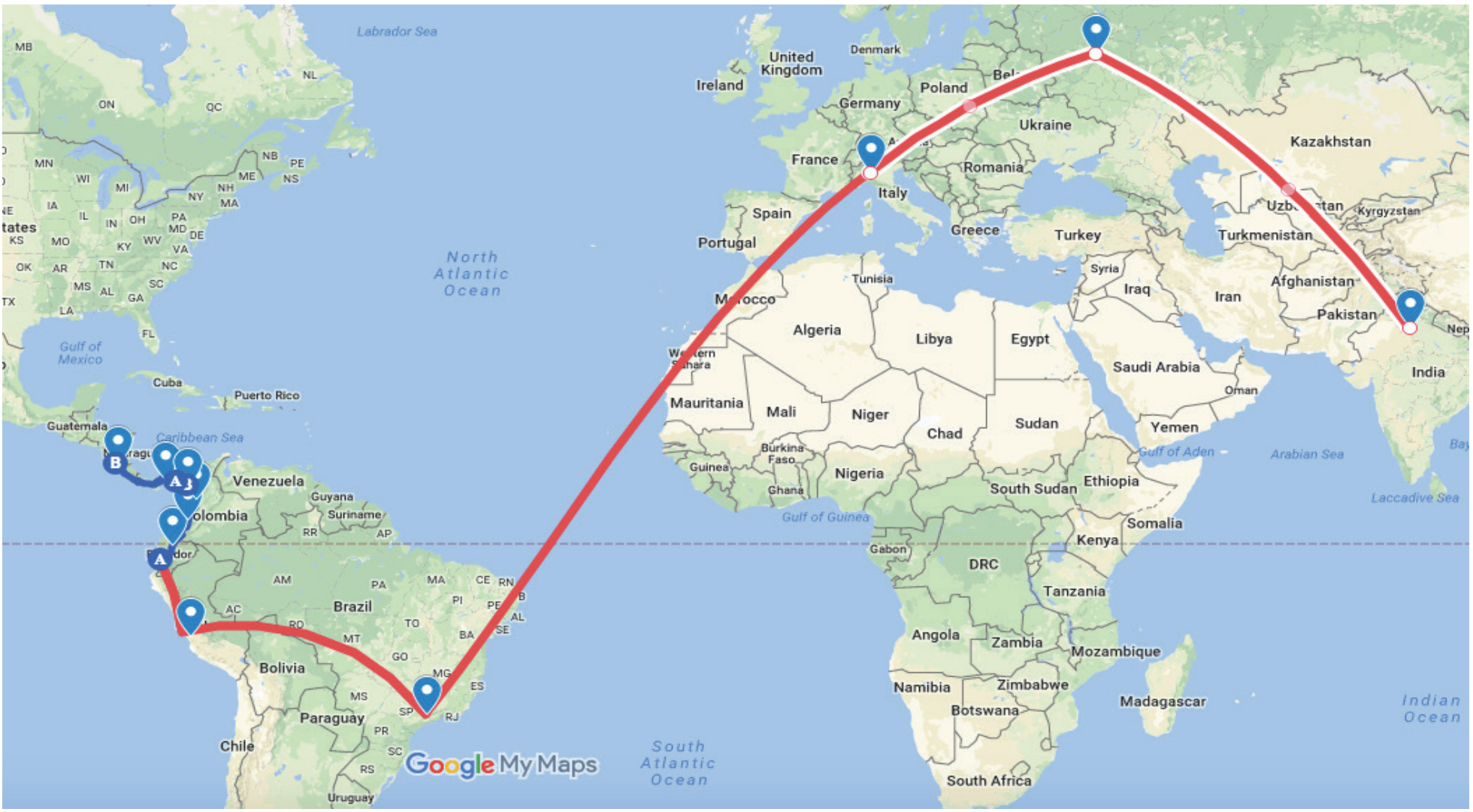
Sunny continued, "From New Delhi, I took flights through Moscow, Milan, São Paulo, Lima, and eventually landed in Guayaquil. At the airport in Peru, the police took $100 from me. They pull aside people who they know might be migrants—like me—and demand money. I have heard from other people in my group that the immigration officers in Guayaquil sometimes demand bribes of $3,000 to let you through. They know why we are here and know how to take advantage of us.
"When I landed in Guayaquil, I had a donker's number. I reached out to him and, with his help, then headed towards Tulcán, Ecuador. The donker had sent me a photo of the hotel so that I could identify it. From there, the donker arranged for me to go to Cali. We took a taxi that sped through Ecuador to Cali at 200 kilometers per hour. We reached the donker's house, from where we took an overnight bus. On this bus, the police took $30 from me. I then reached Cali. In Cali, a woman who had my photo got onto the bus and took me to her house by taxi. She gave us food and a place to shower. From there we went to Medellin, where I stayed overnight in a hotel. It was in this hotel that I met Dharampreet for the first time. There were other Punjabis in this hotel, and we soon formed a group of nine. The nine of us stayed in this hotel for three nights. We next went to Turbo and stayed there for three days. Here, we were told we would have to cross the sea. On the last night, we were taken by a very fast bus (it was moving at 120 kilometers per hour!) to the coast where we traveled across the bay to Capurganá."
Sunny said, "Once we had boarded our ship, we reached Capurganá in just a few hours. In Capurganá, we were made to stay in a shed—here we met about 25 Haryanvis [referring to people from the neighboring state of Haryana in India]. We were given two packets of biscuits, one crunchy [chips], two power energy bottles, one bottle of water, two lollipops, and four candies before we were sent off to the jungle.
"The donker took $20 per person. He first took $10 at the beginning of the jungle and later another $10 at the mountain. There was one donker in front of the group and one behind us. The first one carried a rifle as he led the way. The first mountain was very steep and took us four hours to climb. From the second mountain onwards, we started following the river. It took us six hours to climb the third mountain and three hours to get down the mountain. Here, the donker killed around four to five snakes!
"After three days, we reached the Panamanian border—the donker left us here and told us the way forward. He said he would get shot by the police if he were to accompany us. We followed the river and old package wrappers tossed along the path by previous travelers, indicating that others had used this route. We slept on the drier patches of the jungle."
Dharampreet continued, "We carried channa [chickpeas] packets from home—some in our group also carried badam and khishmish [cashew] packets. The next day, the rain was strong—so we ended up waiting until the next day before moving. On that day, we met a foreign couple that had been accosted by the mafia [armed bandits]. We gave them some of our biscuits and channa.
"We also met a Haryanvi who had been affected by polio in one leg and had lost all hope of surviving. When he asked us to convey his love to his parents, we stopped to pray for him. He had taken a loan of 10 lakh rupees [about $15,000] to undertake this journey but had given up all hope of surviving. When we met him, he had been there at that spot for four days. After giving him some of our biscuits and channa, we left. After another six days in the jungle, we met another donker who asked for $200 from the whole group. He got us to Camp 2 in Panama in eight hours. At Camp 2, they checked our bags and medicines. They make us throw away our medicines. They checked everything, including our clothes and shoes, and ask us to reveal the amount of money we had.
"We did not encounter the mafia because the mafia had killed one Indian earlier that day and the army was in pursuit. Some people drown themselves from depression in the jungle. The mafia also shot people in the leg—we heard of one person who was shot by the mafia and is still in the Panamanian hospital. This person was from an Indian group with four to five Pakistanis and one woman from Cameroon. This happened because the Indians started throwing rocks at the mafia when they started harassing the Cameroonian woman. This group took eight days to pass through the rest of the jungle.
"We did not encounter the mafia because the mafia had killed one Indian earlier that day and the army was in pursuit. Some people drown themselves from depression in the jungle. The mafia also shot people in the leg—we heard of one person who was shot by the mafia and is still in the Panamanian hospital. This person was from an Indian group with four to five Pakistanis and one woman from Cameroon. This happened because the Indians started throwing rocks at the mafia when they started harassing the Cameroonian woman. This group took eight days to pass through the rest of the jungle.
"At Camp 1, we saw two dead bodies of Indians in the river. The soldiers asked us to take them out of the river. At this camp, they did not give us any food. We had to buy food from shops outside—we got puri and dal [fried bread and lentils] for $2 to $3 in these shops. We spent six days in the first camp where we were essentially made to spend all of our money."
Sunny returned at this point after reporting that he was able to speak to his mother. He was extremely happy and took off from where Dharampreet left off: "We heard from another group that they were made to spend $3,000 in fifteen days in this camp. If you indicate to them that you have that much money, they will somehow make you spend it. They have fixed deals with the shops and get a cut from the shops outside. We were asked to pay $25 to move to the next camp.
"At Camp 3, they took our fingerprints. We stayed here for three days. Here they asked us if we had $40 (i.e., $20 for each bus ticket). We received money at the nearby Western Union. Many of the shopkeepers outside of the camp would give us use of their phones to call home to ask for money. They take a 15 percent cut of the money received."
Dharampreet continued, "Some mountains only had snakes and the children of snakes! It was terrible. The donker gave us a kirpan or talwar (sword or machete) for $4 and tents for us to sleep in. In the tents, some people stayed awake while the rest of us slept on huge tree leaves. At times, we used to feel very cold—we had, after all, been in water for seven to eight days. We were constantly crossing rivers. The bags become much, much heavier when drenched by the water. We only had two shirts and two pairs of pants. We even had to throw some of these clothes away because our bags had gotten too heavy. The mountains were very steep.
"In the jungle, everyone starts believing in God."
Sunny said, "There are videos online on YouTube—look up 'USA Donkey Punjabi Boy.' I looked up these videos before leaving India. The visa process in Delhi is extremely disturbing. I had shown them assets and savings worth $40,000–$60,000 [presumably in his bank account]. Another time, I had shown 25 lakh rupees. Yet, they never issued me a visa. This was in 2016.
"At the counters in Delhi, all they do is say, 'sorry-next, sorry-next . . .' Even old men who have no one left but children in the US do not get visas, and they have to take a similar route through Mexico to join their families. In Mexico, I have heard you can pay $200 to immigration, $200 to police, and $100 to cross the border. There were Indian donkers in Guayaquil and in Lapa near Peru. I think I have spent between $400 and $500 on police officers, and between $2,000 and $3,000 on donkers. From Quito to Mexico, I expect to be spending between $7,000 and $8,000."
Dharampreet said, "I had arranged $10,000 in total for the journey. For the tickets, I spent 2,200,000 rupees [approximately $3,200] for round-trip tickets. I had taken a mortgage on my farm, and the mortgage plus the savings financed this trip. I have a friend in the US from my village who works in a store. He had taken the journey one year ago and took four months to complete it. He had given me the donker's number. The journey I took was slightly different from that of Sunny. I took off from Delhi. I landed in Quito and then went to Tulcán. From there I went to Cali, then on to Medellin (where I met Sunny), then to Turbo, and from there to Capurganá. In Delhi, I met two other people at the airport. In Quito, we became a group of three. In Tulcan, we became five. In Cali, we became eight, and in Turbo we became nine. In Capurganá, we met sixteen Indians and four Bangladeshis. We had become a group of twenty-nine people at the beginning of the jungle [the Darién Gap].
"While in the jungle, I lost my passport in the river. I had an Aadhaar card [India's national ID card] in India but did not carry this with me. Someone told me that I should not carry any documents. I know only one other person who has taken the journey. My family does not know how bad it is. Even though I knew how bad it was before I left, I would not do it again. I didn't really fall behind in the jungle. I tried to help people along the way."
Later, when the interview expanded to include Balbir and Gatsharan, they spoke about how Sunny fell behind a couple of times and how Balbir had to carry him.
Dharampreet continued, "The Costa Rican camp is the best in terms of facilities. The Panama camp was not clean. The mattresses were extremely dirty and it was very, very hot. For very serious injuries, they used to take them to the city hospital.
"We haven't had to convert any currency anywhere. I know that Nicaragua has a small jungle, which is not as bad. I expect to gather information on the way. I have not been in touch with my friend since I got here. I lost my phone on the journey. I spoke to my family last at the Western Union in Panama.
"God has helped me find friends along the way. Whenever I met Indians on the journey, they became my friends. We met Bangladeshis on the way (in Capurganá). We haven't really interacted with Nepalis. In camps, I have had to fill out forms in English—I have been able to manage because I passed Plus 2 [Grade 12 equivalent in India]. At home, I have had to handle things because sometimes my father was not able to."
At this point, Balbir and Gatsharan joined the conversation. They mostly sat quietly and sometimes chimed in.
Dharampreet continued: "I heard there is a group of eleven Punjabi men and eight Gujarati women on the way. I have not met them. At Western Unions, it took me between one and three days to get the money. I have learned a few words in Spanish on the way. I wouldn't recommend this journey to my friends. Or, I will tell them that I cannot be responsible for any injuries or deaths that they are likely to experience and that they should do it on their own risk.
"The donkers have photos of me. That is how I have managed. Some people have a lot more information than we did. They carry maps and other information with them. I did not have Internet to use Google Maps, and not even paper maps.
"Baat hi saari paise ki . . . [Everything is about money . . .]. I had arranged for a particular budget beforehand. I am solely relying on Western Union to get money along the way. In Panama, we used IDs of Western Union employees in the shops. I carried around $3,000 from home. At the camp, I received around $2,000 from home (in one transaction). Everyone in our group (including Balbir and Gatsharan) has received money from home along their journeys."
Sunny continued: "Balbir was a national-level kabaddi player." Balbir nodded slightly and blushed. "Dharampreet on occasion fell behind—he had low blood pressure. Balbir went back with water and got Dharampreet back "on sticks" (with the help of a third person)! Balbir's brother reached America end of March after taking a similar journey.
"We have heard of the Nicaraguan jungle. We will carry between $100 to $150 to give to the mafia there. We are bound to meet mafia at least three times."
Sunny continued: "My cousin's father is already in the US. He has been there for twenty-five or thirty years. He owns a truck and has arranged for his son, my cousin, to be brought there. The son was sent back twice—he has spent already $30,000 trying to get there. His first son has already made the journey successfully.
"I had actually studied in the University of Hampton in the UK for one and a half years before dropping out. My father could not pay the fees. But I was able to work for two years using my student visa. I was getting around $2,000 per month and had a great life. I even tried to join the army—my friend, after joining the UK army, got a passport after waiting for four years. Now he has no visa issues and is getting a pension."
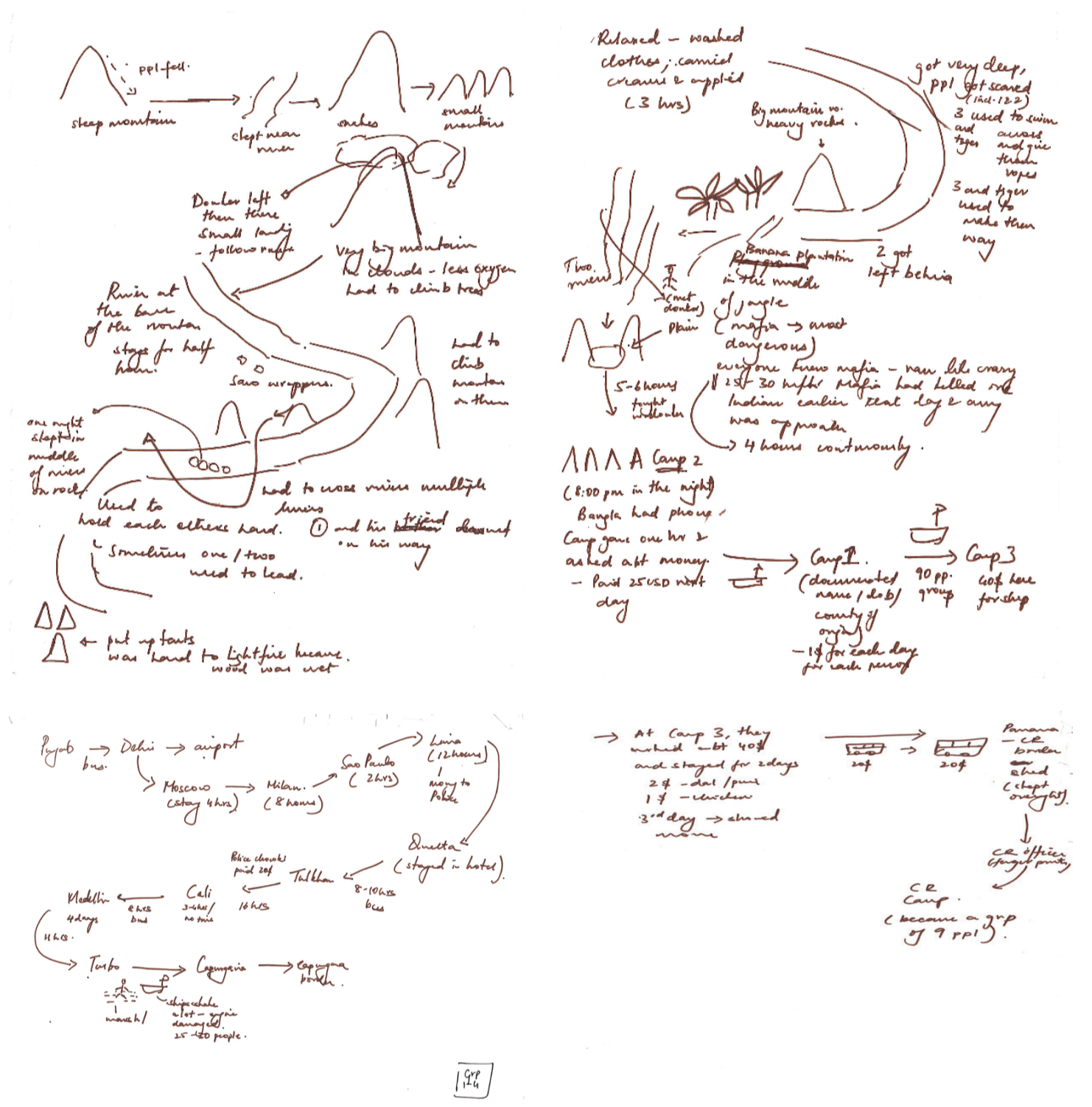
I requested the four men chart out their route. Dharampreet helped map out his journey from Delhi. All four drew maps of the jungle and the camp as they remembered them. Once again, Sunny used gestures and body language to convey his message of how they were forced to run at high speeds to escape the mafia.
📝 This article was originally published in a collection of biographies by the Henry J. Leir Institute at The Fletcher School of Law & Diplomacy and Tufts University.
You can Download the original collection below ⬇️