
Pakistan to the US via South America: A Christian man dodges religious oppression and physical perils to make his way to Brazil, then Costa Rica.
Written by: The Journeys Project
After being charged with blasphemy under local laws in Pakistan, Michael's church helped him flee the country and migrate to Brazil. With two other Pakistani men who fled for the same reason, he worked in construction for nearly half a year before deciding to migrate to the United States to seek asylum. Trying to get away from a threat-filled life in Pakistan, Michael endured even more threats on his journey to the US. He has dealt with corrupt police, armed bandits, and the dangers of a deadly jungle. As he marches toward the US, he is wary of the road ahead.
Once the government of Pakistan enacted a law on blasphemy, Christians living there felt targeted. Michael, too, our interview subject, was charged with blasphemy and experienced the wrath of locals soon after the law passed. In order to easily identify Christians, the government mandated that they write "Masi" (which denotes their religion) before their surnames. As a result, they found it difficult to get decent jobs. Despite impressive qualifications, they were relegated to low-paying work.
Michael was a devout Christian. After his church was attacked twice and having moved his family more than once, he worried about the safety of his wife and children. He needed a way to support them. He did not have enough money to go abroad on his own, so he contacted his church for support. The church then helped him leave the country.
It cost him $2,000 to get a visa for Brazil. Half of his trip to Brazil was funded by the church. He had to fund the rest—$1,500, which he did not have—so he took out a loan. He travelled to São Paulo with two other Pakistanis. When they left Pakistan, they did not know how long they would be staying in Brazil. Getting to São Paulo was not difficult, as the agent in Pakistan had gotten all the documents ready, including the visa. While in Brazil, Michael and his traveling companions worked for a construction company for seven months as laborers. They were paid 70 to 80 reais (roughly $18) per hour for their work. Even though they were making good money, they did not have enough to bring their families to Brazil. Michael's family was still on the run in Pakistan, and he was desperate to have them in a safer place. All three of them decided to go to the US and claim asylum.
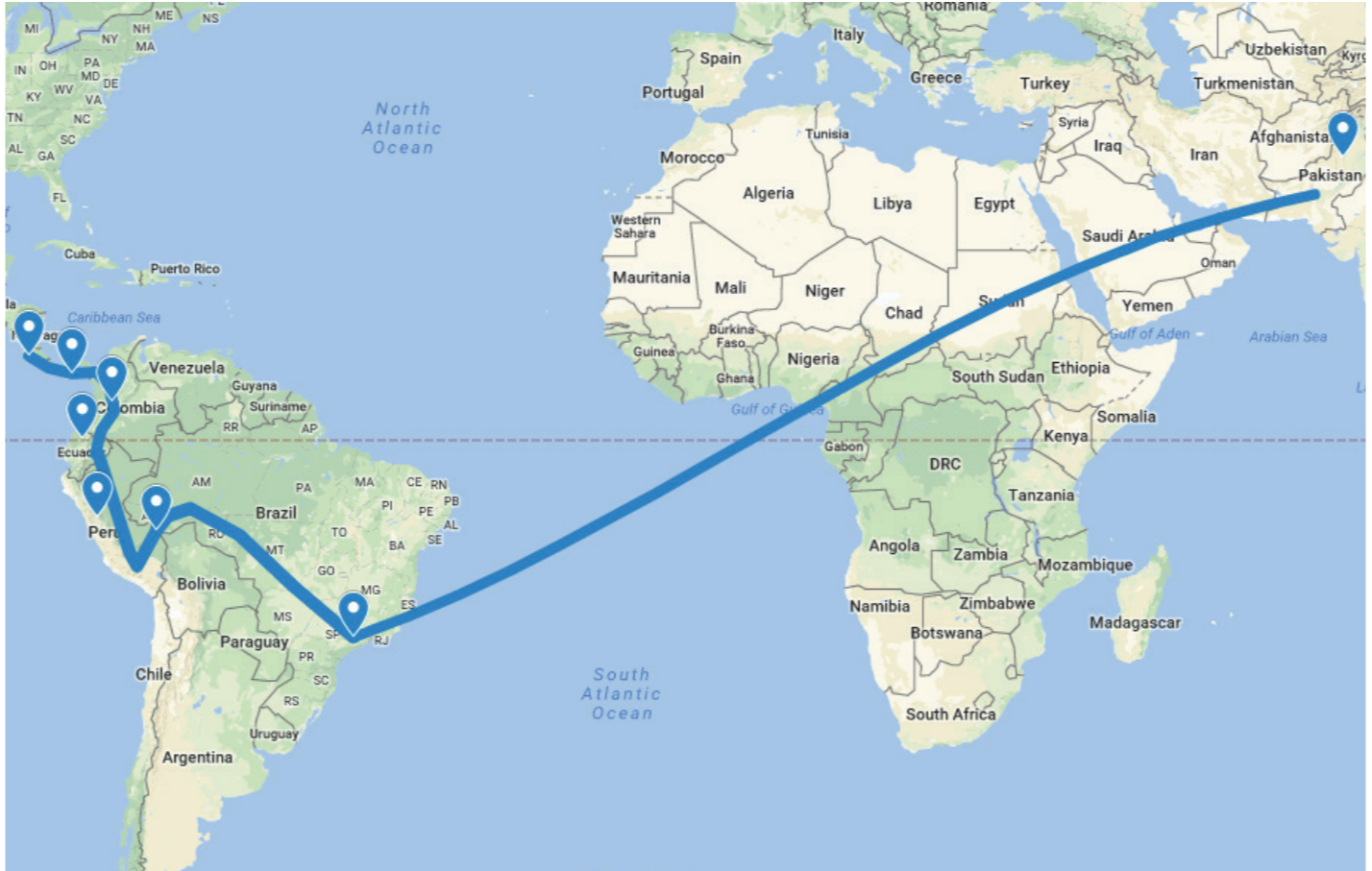
They took a flight from São Paulo to Brasília, then on to Rio Branco. The first flight cost 1,200 reais (about $300), and the second to Rio Branco cost 150 reais per person. After landing in Rio Branco, they took a taxi to Peru for $200. Since they did not have US dollars, they paid the amount in reais. After crossing the Peru border, they had to walk for some time, after which they were stopped by the police and asked for US dollars. They showed their CPF10 papers to the police and gave them reais instead. Each of them was charged 400 reais (about $100) by the police.
They then reached a bus station at the border where they exchanged all their remaining reals into US dollars. Many people at the bus stand approached them and offered to help them find the right bus to Lima. They found a microbus for $200 and got into it. After traveling for eight hours, they took another bus to Cuzco, which was part of the same fare. This ride was supposed to last eight to twelve hours. But a landslide had happened near Cuzco, so they had to spend a night while they waited for the road to be cleared. They finally reached Cuzco the next day, where they took another bus to Tulcan via Tumbes, Quito, and Ibarra for $400. At Tulcan, they crossed the border to Colombia. Immediately upon arrival, the police arrested them. They paid $300 so that the police would let them pass. They took another bus to Apartadó via Cali and Medellin, a twelve-hour ride. This cost them $600. They changed again in Medellín. From the station near the coast, they took a taxi to Turbo for $300, which was a 20-minute ride. Then they took the boat to Capurganá across the Gulf of Urabá.
Unfortunately, the boat engine stalled, forcing them to stop at Trigana. The boat was stuck in the water for twelve hours. The passengers were afraid it would capsize. They were allowed to make minimal movements, but were without life jackets, so they feared too much movement. Finally, they were able to go ashore in Trigana, a beautiful, touristy place with fancy hotels. They spent three nights, but could not afford the hotels and thus spent the nights outside foraging for coconuts and mangoes. They made their way to Capurganá, where they stayed for 15 nights. In Capurganá, they came across many people who promised to get them through the Darién Gap to Panama. A woman told them that it would cost them $80 and they would reach the first camp in Panama in a single day (technically impossible unless by helicopter, which is not an option). Another person offered food and shelter for free, but later charged them $70 for the food and for the room.
Finally, a person in a local church who seemed trustworthy told them it would cost $100 to cross the jungle on foot or $200 by boat per person. The same person offered them shelter for four nights and treated them with great kindness. They did not have enough cash with them, so they requested that their friend in Brazil send them money in their host's name. He went to Apartador to receive the money but said that he was caught by the police and had to bribe them $150. He also charged the travelers a commission of $30.
The donker (local smuggler) bought them boots, three packets of biscuits, four cans of tuna, two loaves of bread, two energy drinks, and two packs of juice in addition to fruits and tents. He told them that the journey would be three to four days long, but they were skeptical. People in the village had contradictory claims about the duration of the journey. Thus, they prepared for at least ten days by packing more food.
On day one, they walked for three hours with a donker to get to the top of the first hill, to meet other group members. They were now a group of 40. An old man and woman who were also showing the way to migrants accompanied the donker. After fording a river in the dark, they could see some people waving torchlights in the jungle. The donker informed them that these were the lights of the mafia (armed bandits), and instructed them to fall back and return to the other side of the river. The donker then took them along another route where they walked past a barbed wire fence into a swamp and climbed another steep hill, a mountain. After descending and walking for almost ten hours, they could finally sleep. This was only their first day.
After paying $20 each to the donker, the second day was equally tough. They had started their journey early in the morning to climb another mountain. On the third day, they climbed yet another mountain. Day four was similar, as they ascended and descended yet one more enormous hill (they referred to them as hills, but they are better understood as mountains). On the fifth day, after charging them each $20, the donker abandoned the migrants. He instructed them to go on their own. They forded the river again, but this time they had to hoist their bags onto their heads to keep them from getting wet. After walking for about twenty-five minutes, they encountered the mafia. This was a strategic place for the mafia to rob them. The robbery was quick, and the thieves simply stole their bags. Most of the group had put all their money and cell phones into their bags, as their clothes were soaking wet from the river crossing. Michael and his friends still managed to salvage some money by virtue of having hidden it inside the heels of their shoes and the elastic of their trousers.
They continued the journey by following the river, eating raw plantains and raw fish. While trying to cross the river, one man in their group hit his head against a rock and died instantly. The river swept his body downstream. They continued their journey and at last reached the first camp in Panama. In the first camp, they were made to sleep on the floor and were charged $1 per night but were provided no food. They then took the boat to the second camp and then buses onward to Costa Rica.
Trying to get away from a threat-filled life in Pakistan, Michael endured even more threats on his journey to the US. He dealt with the corrupt police, usurious agents, and the dangerous jungle mafia, not to mention the heat and relentless rain of the Darién Gap. He survived to tell the tale, but as he marches toward the US, he is wary of the road ahead. He expects even more threats in Nicaragua, but he knows he cannot stop now.
📝 This article was originally published in a collection of biographies by the Henry J. Leir Institute at The Fletcher School of Law & Diplomacy and Tufts University.
You can Download the original collection below ⬇️