
Nigeria to Costa Rica: A young businessman leans towards a better life in Central America.
Written by: The Journeys Project
Mathew left Nigeria because government corruption was making it impossible to conduct business. A businessman at heart, he wanted to live in a country where the government could be trusted, and hard work could earn you a fair wage. After spending seven months in Brazil, Mathew made his way northward until arriving in Costa Rica, where we met him. He was working at a local supermarket bagging groceries. One day he might attempt to make it to his ideal destination: Canada.
"The political situation in Nigeria had become very bad. One vicious man after another had come into power. They eat you," Mathew said when we asked him why he left Nigeria. It was noon in La Cruz. The northern migrant camp (CATEM Del Norte) was a few kilometers away. The tiny hilltop town of La Cruz lies around twenty kilometers south of Peñas Blancas, Costa Rica's main border crossing with Nicaragua.
After a couple of amicable conversations, Mathew had graciously agreed to share his story with us before heading to the local supermarket where he worked bagging groceries. We interviewed Mathew in our hotel's lobby, furnished with colorful wooden chairs and tables, while we enjoyed a refreshing beverage.
A young man in his late twenties or early thirties from Benin City, Mathew was well-spoken and friendly. His English was fluent. The first time we spoke at the grocery store, we used French and Spanish. He said he had picked up some Spanish during the past two years while living in Costa Rica. As for French, at seventeen he attended university in Abidjan, Côte d'Ivoire. For five years, he studied there, mastering French and working for the United Nations as an interpreter.
Back then, Mathew was hopeful that he could better his situation, and he started a business buying and selling food products back in Nigeria. He travelled throughout the country to service retail stores with his various commodities. "I am a businessman," he said with a smile. Even after his harrowing journey to Costa Rica, he remained strongly attached to that part of his identity.
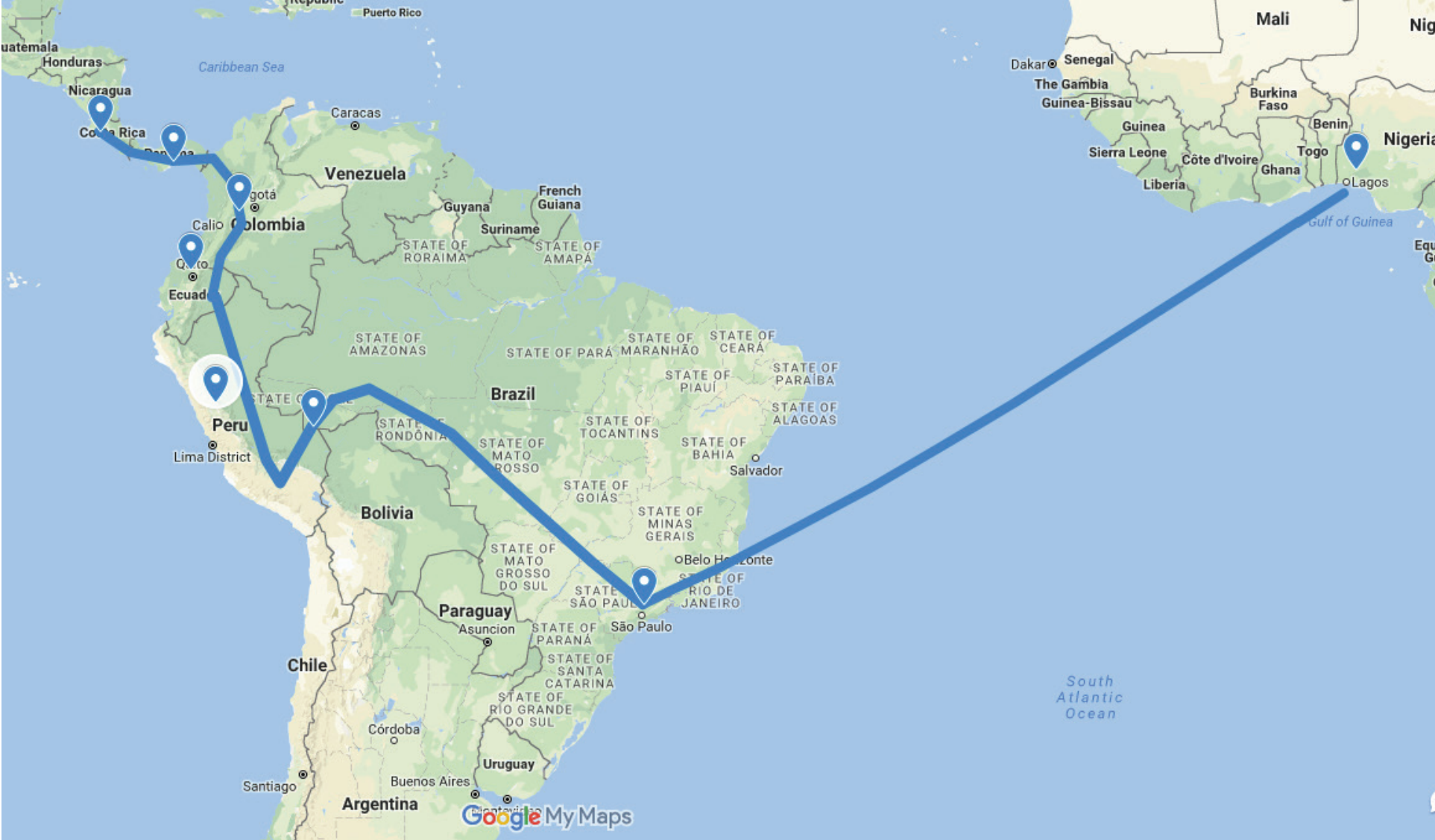
"I could not stay in Nigeria," he said. For many migrants, leaving is not a decision, but rather a necessity. Mathew prepared for his journey by setting aside savings in his bank account. He recalled, "A friend of mine was doing well in Brazil, so I called him, and he said, 'Come, it is nice here. I have a job, and you can find one too.' I had saved enough money from my business and flew to Brazil. In São Paulo, I stayed at a church guesthouse. Guests hailed from all over the world—Pakistan, Bangladesh, other Nigerians, and other Africans. The church let us stay for free. They even fed us." A Christian, Mathew greatly appreciated the church's role in helping him and other migrants. They gave back what they could, but often that was very little.
For money, he had access to his Nigerian bank account and was able to earn an income from small jobs. He even collected enough to send money home. Lacking the required paperwork for Western Union, Mathew would remit money through an "agent" in São Paulo who would forward funds directly to his Nigerian bank account via the Internet. The agent charged him 10 percent of the amount remitted.
Mathew would have liked to stay on in Brazil. During our conversations, he often referenced how he could cross the street and find the same kind of foods he enjoyed back home. He emphasized the importance of the "African community" in Brazil. He said in a humorous way, "In Brazil, if you leave your seat, an African will replace you in a minute!" He then burst out laughing and suddenly appeared younger.
His outburst left us imagining that the African community in São Paulo must be quite large. It served as a valuable resource to Mathew. The community gave him valuable advice, but mainly he saw it as a way of dealing with homesickness. It was apparent that it meant a lot to Mathew to be able to access Nigerian food at food stands, restaurants, and grocery stores. The pleasure of buying African foods was absent elsewhere on his journey.
After seven months, Mathew felt compelled to leave Brazil—the economy had dwindled, and work prospects had worsened—and conjured new plans for another journey. Though he knew of African communities in California, New York, and Texas, Mathew said his objective was to live in Canada, which he felt would be a better fit for him.
The excitement in his eyes, so visible as he spoke of Brazil and Canada, was soon replaced by a sober look as he described his journey from Brazil to Costa Rica.
"To do this journey, the traveler needs to understand there is no going back," he said. "We really did not know the route and took the journey one leg at a time. We flew to Brasilia. It is very easy to find a taxi there to take you to the border of Peru. Our taxi driver signaled his friend on the Peru side to come pick us up at the border and take us to Lima. We stayed in Lima only for a day, then traveled by bus to Quito."
Mathew learned about the journey as he travelled it, with no real knowledge in advance of the best routes. When asked how he was able to pay for things in a new country with a different currency, he shrugged: dollars, of course.
He paused and sighed as he took a sip of his drink. He described the most distressing part of his journey. "From Quito we crossed the Colombian border and took a bus to the Caribbean coast. A boat took us to the northern part of Colombia, to Capurganá, where we trudged through the Darién jungle on foot. We did not have a guide. The person who says, 'I understand this forest and can guide you,' is the person you should fear. So, we went without a guide. It took us four days. We were dizzy and lost. We started shedding our clothes. We had to wade through water and mud for great distances with nothing but heat surrounding us. My backpack felt so heavy, so I tossed it into the water, glad to be rid of the weight. In the pack were my passport and my bank card, all my money. It was a desperate journey.
"We could not stop. We lost souls in the water of the jungle. We had to move like soldiers in war. Along our march through the jungle, we came upon some women who had been lost for weeks. They could not move, so we half-dragged, half-carried them out of the jungle and left them with a fisherman so that we could move on. The fisherman promised he would feed them and give them rest. When we reached the other side of the jungle, volunteers wanted to help by giving me medicine, saying that our legs were badly cut. But I did not need medicine. I had walked with God and was not hurt."
When talking about his Christian faith, the tension in his eyes and shoulders relaxed, and he smiled with a look of relief; his faith was palpable and clearly a source of strength and perseverance. He and the group he was with then made it through Panama and to Costa Rica, mainly by bus. Some tried to cross to Nicaragua but were turned away by patrols.
Mathew is currently working on gaining residency in Costa Rica and getting the right paperwork to move to Canada. When asked about his worries, he smiled, calling us his friends, almost as if he wanted to give us comfort. He said that he believed one day he would make it to Canada and eventually be able to go back to Nigeria and see his people. He believed that his Christian faith had gotten him through this journey thus far and helped him go into the unknown, time and time again.
📝 This article was originally published in a collection of biographies by the Henry J. Leir Institute at The Fletcher School of Law & Diplomacy and Tufts University.
You can Download the original collection below ⬇️