
Ghana to Costa Rica: Fleeing violence, a middle-aged man hopes to open a phone repair shop in a sleepy border town.
Written by: The Journeys Project
Peter fled Ghana over a land dispute that led to his community physically attacking him. After flying to Brazil and traveling north to Central America, Peter is applying for a work permit and dreams of opening his own computer repair shop in Costa Rica.
"I used to have a comfortable life back in Ghana. I graduated from a technical university and worked as a computer technician. I even traveled for work, to tech conferences in South Africa and then Israel, where I prayed at the Western Wall. I enjoyed traveling, and liked to look up places where my passport could take me for free.
"I know that when you travel, you need a passport. What I did—traveling without papers—is not good. It is not good to live in a country where you don't have papers. But when I left, it was an emergency situation. They were trying to kill me.
"Ghana doesn't have problems like other countries. But there is a religious divide between Muslims and Christians, and it can be dangerous for couples who marry outside their faiths. These marriages must be performed in secret, and if the family or community finds out, they will kill you—often by poison. Sometimes it happens that a woman from the south marries a man from the north, and when she moves to be with her husband, he may try to make sure she is cut [female genital mutilation/cutting], a reason why women, in particular, flee.
"As for me . . . there is a lot of gold in Ghana. If you inherit land with gold, the most profitable thing is to sell it to the Chinese. But many people in the community do not want this and will try to prevent it. When my father died, he left me land. I do not have any other family. People in my community tried to kill me." Peter shows me a large scar between his neck and shoulder that appears to have been made by a machete. He indicates there is similar scarring on his back.
"There is no police station in my town, so there was no one to help me. I went to my pastor for advice. It's not everyone you tell your story to, but I trusted him. He told me it would be better for me to leave the country, and he gave me $1,600. I didn't have time to do things the right way. I had to leave.
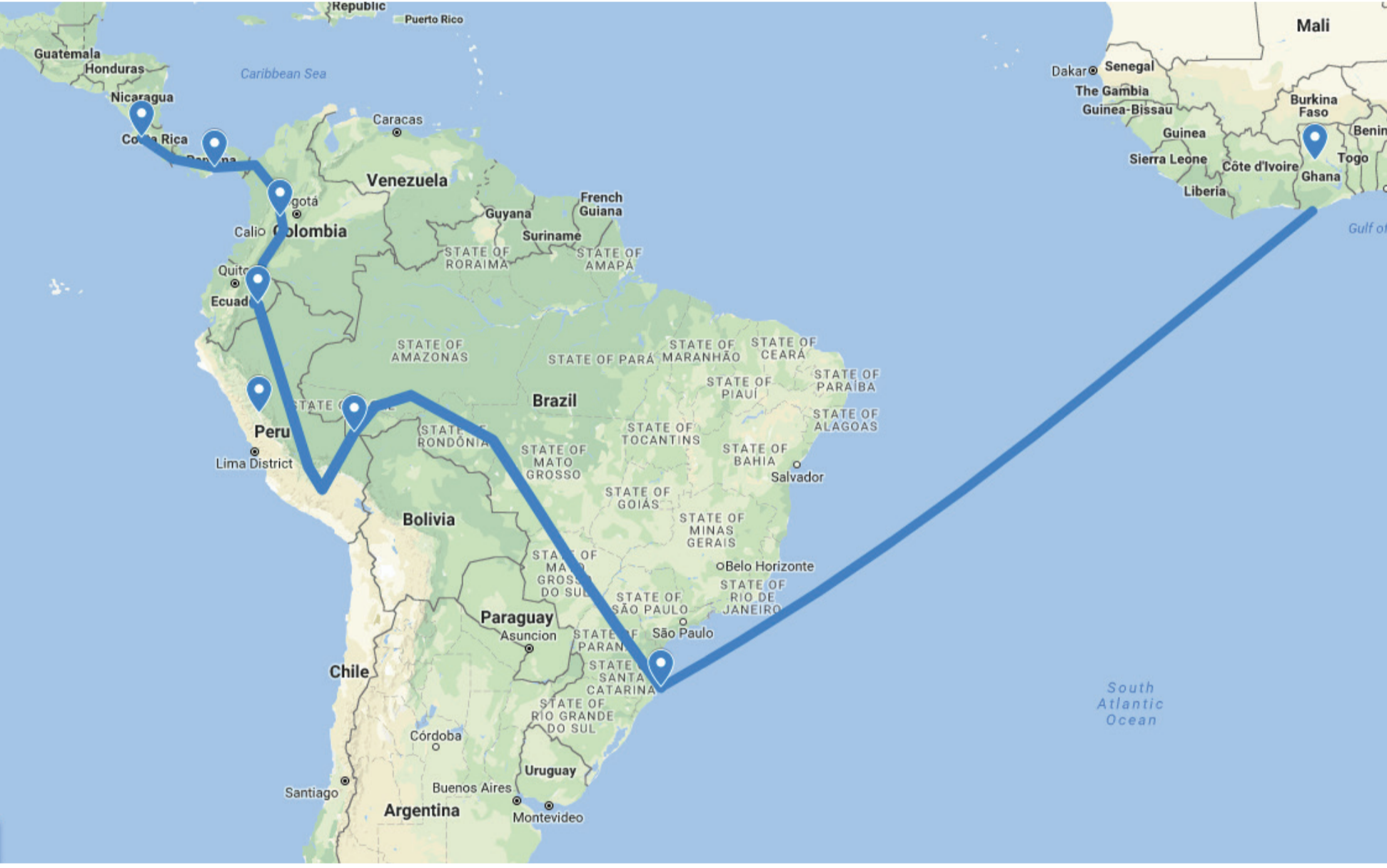
"I walked onto a ship that was going to Brazil. I had some biscuits with me. I brought a jug of water and a carton of water bottles. There were three others, two who spoke Twi. When we got close to Porto Alegre, we transferred to a speedboat that took us to shore. I don't remember how long I was on the ship.
"I traveled on a very nice minibus to reach Peru from Brazil. When I got there, I asked the driver how to get to Ecuador. The driver took me to a guesthouse, where the person there called for a taxi to take me to the bus terminal in town. But I got caught by the police. They detained me because I was undocumented but issued me a transito [transit] pass anyway. The police there didn't take any money; only the taxi driver did. But he got me to Lima, where I bought a bus ticket for Tumbes."
"It took two taxis to cross from Peru to Ecuador. In the first taxi, there was another person, which made me suspicious. There should only be the driver in the taxi. They wanted me to sit in the front seat, but I refused and told the other man to sit there instead while I got in the back. They wanted to know if I had a phone. I asked them, 'Why do you want to know if I have a phone?' I told them I didn't have one. They told me to pay $100. I did not want to give them the money, but I did not have a choice. They eventually let me out after I paid the bribe. I found another taxi and paid $60 to cross the border. Once I was in Ecuador, I took a bus from Quito to Tulcán and then took a taxi from the bus station to cross into Colombia. I would have stayed in Ecuador, but I don't speak Spanish.
"In Colombia, the person at the bus station would not sell me a ticket. I had to go to another window. When I was traveling through Colombia, I kept hoping that someone would stop me and ask what I was doing. I wanted them to put me somewhere so they would feed me. But no one ever asked.
"You have to go to the sea [Gulf of Urabá] and find someone to help you cross to the jungle [Darién Gap]. I found a speedboat. But during the trip, some people fell into the water. Others were pushed overboard. When at last we got to the jungle, it took twelve hours to ascend the mountain and four hours to descend it. The journey was not easy at all. We had to find the river and follow it to the villages. If we saw mango or papaya, we knew that a village was close by.
"The jungle is a dead jungle. If you are unlucky, you die there. At night, if you don't make a fire, the animals come. But when you do make a fire, you must always look out for thieves. If you challenge them, they can shoot you. I heard about one Cuban who was shot in the back while trying to run away from them. He survived, but then his group had to leave him behind because, so wounded, he was slowing them down.
"When I was walking in the jungle, I came across a woman from Cameroon who could not walk. Her husband was with her. They wanted to go back, but it would have been just as far. I gave them some gari [coarsely ground and dried cassava] and sugar to eat. In those situations, you have to go. You can't wait for the people who can't walk. You do what you can—like give them food—but even now, as I am sitting here, I still feel pity for them. She could have been my mother. (In our first conversation, Samuel reported that he had been accompanied by a friend, who had encountered this same woman, but did not know what had happened to her since.)
"In the jungle, crossing the water was very dangerous. Sometimes, it rose taller than you. We had to hold hands to ford the river. Remember, in some cultures men and women may not touch if they aren't related. And because of this, the women would be swept away as they crossed the river because men were not permitted to grip them tightly. (Peter demonstrated how the migrants would hold onto each other by tightly grasping each other's wrists. He slackens his grip to show how the women were held.)
"When we made it through the jungle, we went to the police. They [the Panamanian authorities] would provide shelter, but not food. There's no food on that side of the border [with Costa Rica]. To reach Costa Rica, you must take two buses—one to Panama City and another to the border. I did not have the money to pay for the bus [$45], but a friend lent me the money. He has lent me $140 so far. He had a big, heavy bag that I helped him carry. Helping people tells them that you're a good person, so that if you need something, they will give it to you. I also helped others by giving them paracetamol [acetaminophen] and water.
"At the border, we were given a free SIM starter pack from Movistar [a mobile phone service]. I like Movistar because you can use WhatsApp for free. But the water in the jungle damaged my phone, and I haven't been able to use it since. I paid a guy here in town $45 to repair it, but he has not fixed it yet. I would try to repair it myself if I had the tools—this was my job back home. I don't like being without my phone. I don't know my pastor's number or the numbers of my friends and girlfriend back home. They don't know where I am. Before my phone was damaged, they were texting me, saying that they hadn't seen me in a while, asking where I was. I had also taken pictures of my trip on my phone and wrote down where I had stayed and all of the money I spent. It's why I can't remember specific dates or locations or amounts—all of it is on my phone. There are pictures from the jungle on my phone that I want to send back home, to tell people that it is dangerous and that it is better if they don't come.
"I want to stay in Costa Rica. Here, no one will worry you. I have a place to sleep and am given food. In the camp, the Red Cross performs a lot of jobs—food distribution, cleaning and sanitation, spraying for mosquitoes—100 percent of the work. But to be frank, I do not have fun in the camp. The food rations are limited, and when people in my tent stole my food, the only thing the Red Cross could do was move me to another tent. I'm also worried about the children in the camp. I never see them in school uniforms. They should be in school.
"I appreciate all that Costa Rica has given us, but it is hard not being able to access money. I don't have documentation, so I cannot receive money through Western Union. And even if I could, the fees are very high. I can't buy credit to put on someone's phone while I wait for mine to be repaired. Normally, I like to listen to music on my phone and look at what is going on in the world and in my country. It doesn't feel good, not having access to a phone or computer.
"I would like to get a job and manage on my own. I am applying for a work permit and want to open my own computer repair business. But I want to do it the right way, so that when I have my own business, no one will hate me. Once I have my own place, I will have fun. I will go someplace and have my one beer. Only then will I have fun."
📝 This article was originally published in a collection of biographies by the Henry J. Leir Institute at The Fletcher School of Law & Diplomacy and Tufts University.
You can Download the original collection below ⬇️