
Ghana toward the US via South and Central America: A devout Christian escapes his tribe, heading to unknown lands with only his faith to guide him.
Written by: The Journeys Project
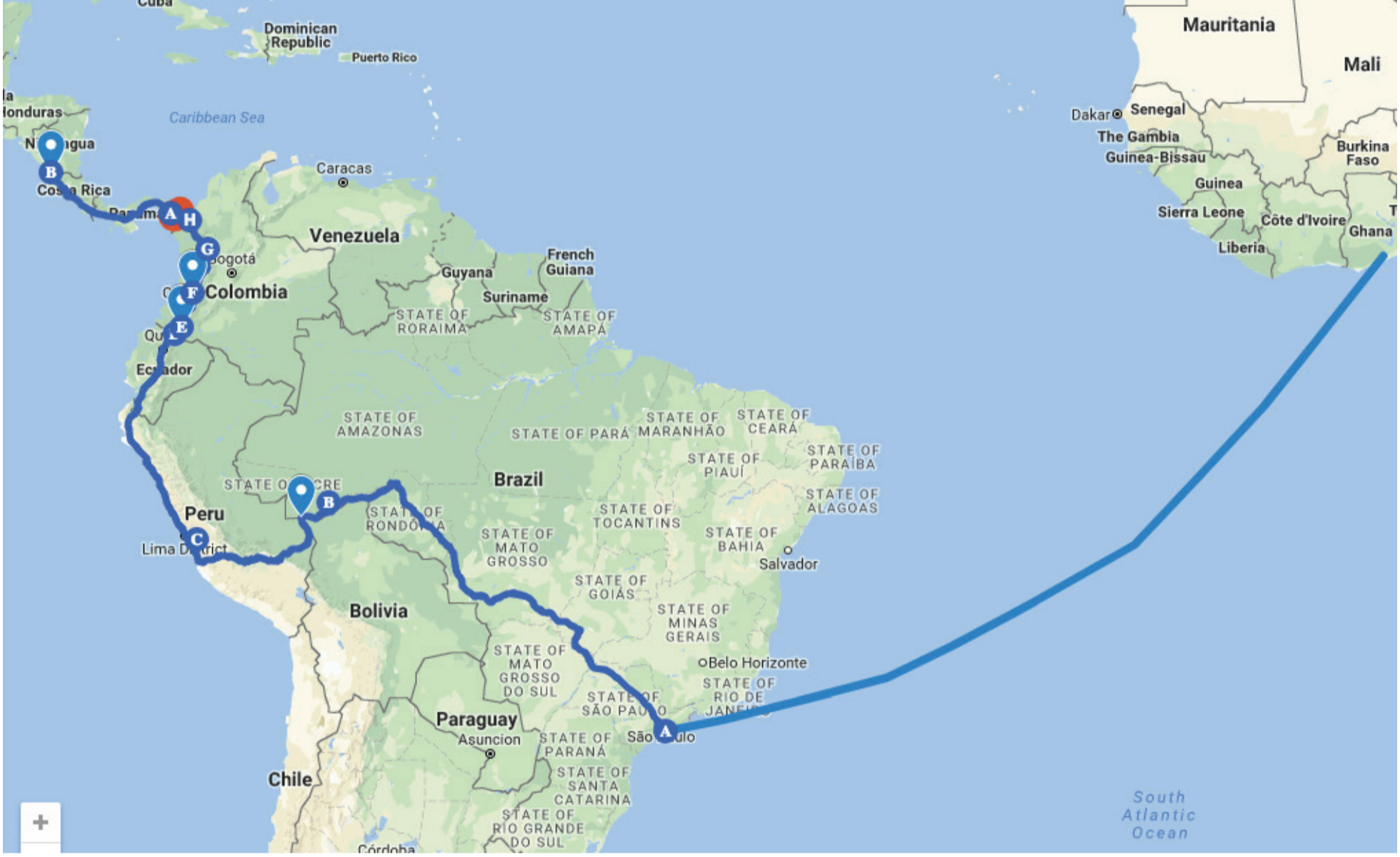
Samuel fled Ghana because of his religion. He wanted to be free to practice Christianity, but his tribe did not accept his decision to become Christian and threatened his life. After being interviewed, he continued on from Costa Rica and was smuggled by boat to Nicaragua, where he was able to continue northward. He was then detained in Mexico.
"I am from a small village in Ghana. My mother and father are from different religions. In my mother's religion, people sacrifice animals and humans in order to call the souls of the ancestors. However, I do not believe in all this. I only believe in Jesus Christ.
"I was supposed to become the chief of my mother's tribe." He used his hands to gesture a crown or a throne. "I was going to sit on a throne. People would come and give me human or animal blood, which I would have to then ritually pour on a stone. I am a true Christian, and I believe in Jesus Christ. I could never possibly believe in these rituals! When the judgment day comes, I will not be able to answer to Christ if I indulged in such practices. I became a Christian when I was young and had been attending school in the city. I sought out Christ and the Bible during this time. I followed people who went to church. I read the Bible again and again and again, until something touched me. Even though my father was a devout Christian, I inherited my mother's religion. According to the tua lineage, I belong to my mother's family.
"My mother died around twenty years ago. After her death, one of my relatives took over as chief. Eventually, it was my turn. However, I refused to take up this position because my faith did not allow me to perform those duties. They were ashamed of me because I wanted to abandon this way of life. Had I stayed, they would have killed me. They tried to accost me by force. This is when I fled to another city to escape their clutches. But there was no running away from them. They came to the city where I was and hurt me." He showed us scars on his hand and chest from a knife or machete. "I somehow escaped and ran for my life until I reached a small village. Here, God spoke to me; he told me I must run. From this village, I walked for five days and reached an area near the ocean—the Takoradi port.
"Before I fled, I owned a small store in the city. Before leaving, I sold the store and everything in it and converted the money into US dollars. I had around $3,500 with me before I left. At the port, I helped load luggage onto ships [for pay]. However, because I was not part of a union, I had to work without people noticing me. Out of sympathy, they would give me food and a little money. I worked at the harbor for about five to six months. I slept here and there, outside on benches or in front of stores. I would use paid bathrooms to bathe. Before I left, I wanted to convert the pesewas that I had collected from wages and tips into US dollars, but the amounts were too small."
"When I finally decided to leave, I snuck onto the ship one night and hid inside its hull. I only had a gallon of water and three biscuit packets with me. When I had discussed leaving with some of my friends at the port, one person suggested I put salt in the water so that I would not consume too much. I did not do this because I thought my friend was joking. Each biscuit packet had around eighteen to twenty biscuits. I was there for two days, maybe more... maybe two weeks... I do not know." (Samuel's sense of time appeared to have been affected significantly. At different points during the interview, he recollects this time spent in the ship differently.) "I did a very good job of hiding. They never found me. When the ship docked at a port, I thought I was in Africa, but I was not. I realized I was somewhere else when I got out of the ship and could not read the signage. No one understood me! After walking around for a while, I finally met another black man like me. I asked him if he knew English, and he said yes. He explained to me that I was in Brazil.
Samuel initially did not remember where he had landed in Brazil. After the interviewers listed a few ports in Brazil, he remembered São Paulo. Subsequently, he told us that it was not São Paulo, but a port near São Paulo called Santos.
"From the port, I took a bus to São Paulo, a huge city. People at the bus stop told me to go to Rio Branco. So I took another bus to Rio Branco. In Rio Branco, I met another person who knew some English. He told me to take a taxi to enter Peru. I entered Peru on my Ghanaian passport. I first went through some small towns in Peru before reaching Lima. Once I reached Lima, I took another bus to Quito, Ecuador. At all of these places, I was only able to get by with the help of God and through sign language. In Quito, God helped me find a person who spoke a little English. From Quito, I hired a taxi to go to Cali. From Cali, I went to Medellin. I passed through many borders. The police or authorities at these borders let you go after searching you. They never found anything on me, so they let me go.
"I did not stay at any of these places. I was always running. But it's true that I would have stayed in some of these places had I known the language. I wanted to stay in Medellin. I was not able to because they asked me for my documents. This one man was sympathetic when I told him, 'I cannot stop now; I am running for my life.' I never stayed in hotels because I did not want to waste my money. I used to sleep in bus terminals. The word 'terminal' is something I always understood—it is a common word in English and Spanish.
"From Medellin, I went to Turbo [on Colombia's Caribbean coast]. I stayed there for two to three weeks. I could not understand the language even there. While handling money, I did not know if I was being cheated. In Turbo, I met other people like me. They were from India, Pakistan, Cameroon, and Cuba. We shared our journeys with each other. They told me their story, and I told them mine. We were a group of seven men and one woman; each of us had traveled by ourselves in the beginning. It was in Turbo that I was first told that I would need to wade through water. I am very scared of the water. I had no option because I was told I could not just stay in Colombia. I did not have the right documents. I wanted to turn back because of the idea of facing the sea. However, they told me I would be caught and sent back across the same sea [the Gulf of Urabá]. We finally reached Capurganá.
"At Capurganá, I was told I would have to go through a jungle [the Darién Gap]. I had only carried biscuits, and they were finished in two days. This was the only food I had. I even had to throw away some because my bag was too heavy. On one of the days when I was fording the river, the water took me in. Within twenty seconds, I was completely submerged. I shouted to Jesus in my head: 'Save me, save me.' And then something told me to jump, which I did. I was able to latch onto a rock, and I stayed there for thirty minutes. My friends then rescued me from the rock. They were kind and did not just leave me behind.
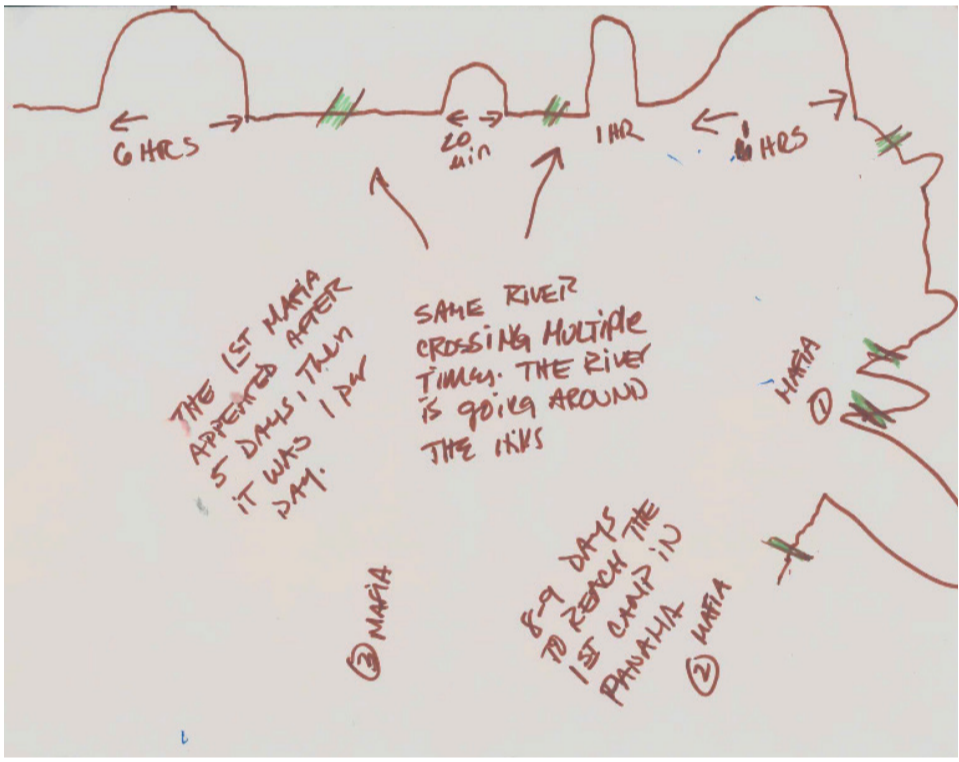
"After traveling like this for a while, we found ourselves in an area where there were plantations. Here, I was able to eat some fruit. After five days in the jungle, we encountered the mafia [bandits] near the plantation. This was the first group of mafia we met, and we would meet three more before leaving the jungle. A man in the first group pointed a gun at me because I was the only black person. They did not point their guns at the Indians. They robbed me of my clothes, money, bags, everything. I begged them to at least give me my Bible and passport. I pleaded with them using sign language. They did not pay any heed, stripped me of all my belongings, and left me with only my underwear. The second mafia group woke us up from our sleep at around 5:30 a.m. They beat me so hard, more because I was the only person in just underwear. After encountering the third mafia, we entered Panama. It took us eight to nine days to pass through the jungle. We were a group of seventeen. The faster among us, around eight of us, led the group. The slower ones followed us."
When we requested that he draw a map of the Darién Gap, he started to draw out the mountains and forests as he remembered them.
He continued, "The jungles in Panama are not like the jungles in Ghana. In Panama, they are very dense. In Ghana, the forests have thinned from cutting. In the jungle here, you can easily get lost, and it takes you six to eight hours to find the main path. You need to climb the mountains quickly; otherwise, you cannot climb them at all. When you are descending, you need to do this slowly so that you do not slip. It takes about six hours to ascend a mountain. Sometimes, it took only one hour to climb smaller hills. By the time we reached the camp, all our ankles and knees had swollen. From the first Panama camp to the second one, it took more than seven hours. I saw one dead body along the way."
Samuel often returned to the question of his faith without prompting. He recited parables or stories from the Bible to emphasize his faith and conviction. "Even if someone threatens to cut my head, if I continue worshipping Jesus Christ, I will let them cut my head. I will worship him until I die. He created everything—human beings, the earth, the air.
"The only place where I was able to drink good water was in Costa Rica. I can stay here for 25 days. After that, I will have to move. I have eighteen days left. I am always counting the days and asking God for help. Every day and every minute, I am praying that someone will take me to the next city. I will stay in any place that accepts me. I want to live in a Christian country." Upon being told that some choose to seek asylum in Costa Rica, he paused and appeared to give this consideration.
"I want to live in a place where I can find a job. I will work hard to earn money and bring my daughters and wife here to live with me." When we remarked that we did not know that he had a family, he quietly said we never asked him. "I left my wife and two daughters in Ghana. I do not know where they are or how they are doing. I want to bring my wife here . . . I do not want a second wife. My eldest daughter is sixteen, and the younger one is seven. I do not know if they are going to school or if they are getting food. I am not able to sleep because I am always thinking about my family. Sometimes I cry a lot. I have lost everything! I am not happy at all. Every time I put food in my mouth, I think of my daughters." Samuel was visibly emotional at this point. He continued... "I do not know where I am going. I am always praying to God to tell me where I will go next. I know he will guide me. He guided me from the jungle to the camps in Panama and Costa Rica. Only God knows where I will go next." Samuel talked about the story of Moses to convince us that God will show him the path. "I already know I am going to heaven. Sometimes I dream of God saying, 'Leave, leave . . .' and then I leave. I will not listen to human beings, only to God.
"I forgot all phone numbers. I only remember one number, and that is of my best friend. However, I have not been able to call home because I lost all my money, and the cheapest phone here in La Cruz costs around $70 to $80. In the camp, no one lends me a phone to call my friend. If I get a phone, I will call my friend and ask him to check if my wife and daughters are alive. He is my best friend from childhood, and he will do this for me. I do not know where my wife would have fled—my friend will search for her. I know the country code of Ghana—I keep it in my head. Once I have a phone, my stress will go down. I am only able to sleep for two to three hours every day because I am always crying. Here, you can buy a phone without documents. I can only truly express myself in Twi. I want an interpreter so that I can express myself properly. I like speaking in Twi more than English. At the camp, no one is really my friend. Even the Ghanaians—I did not know them before. One of my friends has a Movistar chip. He does not let me use it."
Upon hearing loud thunder, Samuel grinned... "That is the power of God."
We were able to secure a new phone for Samuel. Since his interview, he texted us from Tapachula on Mexico's southern border with Guatemala and later from Tijuana on Mexico's northern border with the US. He had made it around Nicaragua (smuggled by boat), through Honduras, and Guatemala by bus. He had struggled throughout Mexico. He was placed in detention, crammed with other migrants, with one dirty toilet in the cell. He found people who spoke enough Spanish to help him cross Mexico. At the time of this writing, he is looking for work in Tijuana but, once again, does not have the right documents to work.
📝 This article was originally published in a collection of biographies by the Henry J. Leir Institute at The Fletcher School of Law & Diplomacy and Tufts University.
You can Download the original collection below ⬇️