
Eritrea toward the US via South and Central America: A young man flees military conscription in his homeland, finds work in Sudan, but feels compelled to attempt a journey to the US.
Written by: The Journeys Project
Despite the fatigue from an all-night bus trip, a frail young man in his twenties from the Horn of Africa agreed to sit down to tell his story. For an hour, he carefully narrated his journey, which began more than seven years ago in Eritrea. To avoid mandatory military conscription and seek better work opportunities abroad, he first migrated to Sudan, then to Brazil, and on to Ecuador, Colombia, Panama, and Costa Rica. He plans to end his journey in the United States.
"I am from Eritrea. I have three brothers abroad and two that remain in the country with my mother. In 2010 or 2011, I decided to leave as my other siblings did before, because of the military service in my country, and the fact that there is no work and no possibility of having a family. I crossed to Ethiopia with the help of a dalal [intermediary or smuggler], and stayed in a camp near Addis Ababa. Life in refugee camps is difficult and does not offer many opportunities. You only wait and do nothing all day. I know few people that were offered a chance to be resettled to the United States or Canada, but not me."
"After three years, I decided to move to Sudan to look for a better life. I once again had to pay dalals, first to cross the border between Ethiopia and Sudan and then to be smuggled from the Sudanese refugee camp to the capital. I made it to Khartoum in a truck packed with a hundred other people. Without proper documentation, I was harassed and arrested by the police several times. Unless you pay a bribe, they will send you back to Eritrea. I have friends who were deported. They spent seven months in prison and after were sent back to serve in the military. (Military conscription is the very reason our interview subject departed in the first place.)
"In 2016, one of my brothers embarked on this same journey. He is now in the United States. He did not tell me about his plans until he reached Brazil because he did not have enough money to pay for both of us. He advised me to try this same road, and another of my siblings who lives in Germany sent me $3,500 to finance my own trip. With this money, I bought a Sudanese passport and an airline ticket to Brazil.
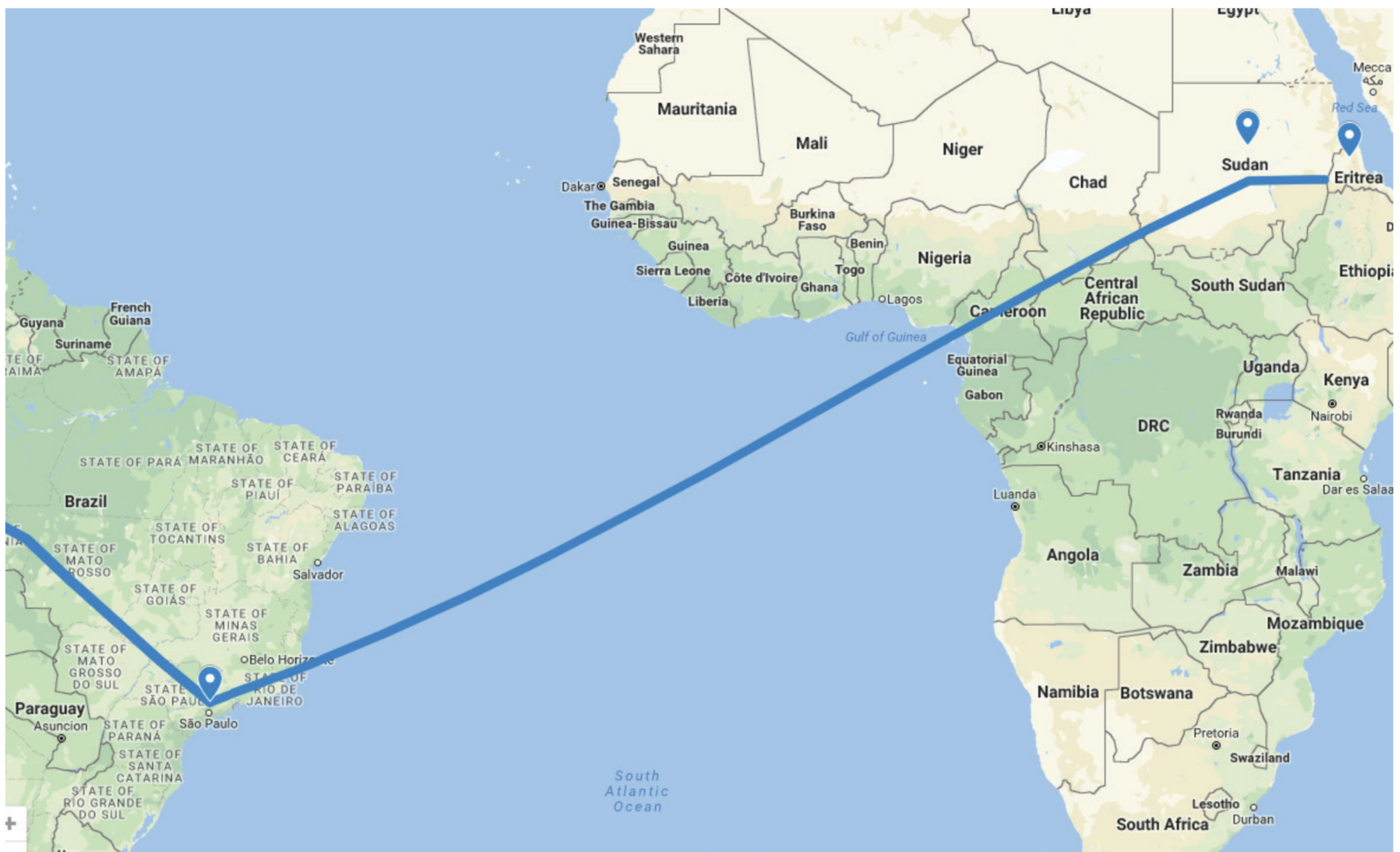
"After crossing through Brazil, Peru, and Ecuador without paying dalals and with few problems, I arrived with other Somali and Eritrean friends in Colombia. I remember that we took a bus from Medellin to Turbo, then a boat to reach Capurganá. I paid the smugglers between $250 and $300 for the five-hour journey in a boat carrying twenty other people. The crossing was very dangerous, and we all had to bail water from the boat to stay afloat.
"Upon arrival in Capurganá, two Colombian smugglers took us to a nearby house where we spent the night. The next day, accompanied by a dalal, my group that consisted of thirteen people of different nationalities started crossing through the jungle. After two days of walking and two additional payments, the dalal decided to turn back. He told us to continue alone through the mountain and after to follow the river for one day to reach the first police post in Panama. When we arrived at night, we were told by the police to wait outside in the jungle until morning. Then, when morning came, without much explanation, they told us to go back, to return to Colombia.
"On our way back through the jungle, making a second attempt to enter Panama, after two days of walking, we were caught by the 'mafia.' There were four men armed with guns and knives. They searched both the men and women one by one and took all our money, phones, and valuable items. They took shoes and clothes if they were in good condition. They tore open our bags with their knives and machetes, emptied Colgate toothpaste tubes and bottles of shampoo, looking for any hidden money. Before leaving, they fired their guns into the air to scare us.
"Exhausted and afraid, we slept in the same place where we were robbed. In the morning, we resumed our walk and met two Cubans who had gotten lost in the jungle for three days, and who had not eaten for the past seven days. They joined our group, and we continued walking. That same day, we also ran into an Indian man in his fifties who had been injured. He was sitting alone in the jungle for four days. We gave him a salve to heal his injuries and some biscuits to eat and said to him, "We are sorry we cannot help you more." The jungle is not straight. We could not carry him. For the next two days, we walked in the jungle without knowing where we were going.
"Finally, we reached a police station in Panama. I was injured in my feet and could walk no further. The police brought a wheelchair to assist me. This time, we were taken to a camp, where we stayed with Indians, Bangladeshis, and Nepali people. We were told to pay $1 or $2 to stay there and have access to food. The Panamanian immigration officers told me that without money, I could not go to the hospital. I remained without treatment for two days. I recovered without medicine.
"After they took our fingerprints and pictures, we were allowed to leave the camp. In the meantime, I received $150 from my brother in Germany through Western Union. A person who works in the camp helped get me the money, taking a 10 percent fee. With this money, I bought two bus tickets that cost me $20 and $25 to first reach Panama City and then Costa Rica.
"After crossing the southern borders of Costa Rica, immigration officials took us to a camp where we could stay for free, eat for free, and receive free treatment. They gave me a balm for my feet. I stayed only one day in that camp, the time needed to get the official papers.
"After leaving the camp, my friend fell sick with malaria. We rushed him to the hospital, and I remained by his side for three days. Yesterday, I told my friend, 'God bless you,' and I decided to continue my journey alone to the north. Every day, I had to pay $10 for the hotel and $20 for the food. I received more money from my brother in Germany. He sent me $500 and $300 more via Western Union and 'Mama Africa,' [the name given to one of the dominant smuggling rings.] Mama Africa took 10 percent as a commission. With this money, I bought a new phone, clothes, and a bus ticket to La Cruz. I arrived this morning with Nepalis and Indians. I will wait one day only for my friends who are still in Panama and in the south of Costa Rica before trying to cross to Nicaragua." (Nicaragua closed its borders in 2015, and those trying to cross face the prospect of death and imprisonment.)
"My plan is to reach the US. I don't know the rest of the journey, but when I arrive, I will ask for refugee status and would like to go to school. I like my country, Eritrea, and I am willing to go back if there is democracy, but the situation there now is difficult. I miss too much about my country. I miss especially my Sudanese girlfriend who is still in Sudan. I am not in contact with her because in Sudan, women's access to Facebook is controlled by their male relatives. Right now, I am only in contact with my two brothers in the US and Germany. In Eritrea, there is no Internet outside of Asmara, the capital. I also miss playing football [soccer].
"Overall, if I can deliver a message to those who maybe would like to try this journey, I would tell them: Don't come. The mafia and police are the biggest problems. Personally, if I had known the difficulty of this journey, I would not have embarked on it. My brother in the US told me his journey in 2016 was much shorter. It took him fewer days to reach his final destination."
📝 This article was originally published in a collection of biographies by the Henry J. Leir Institute at The Fletcher School of Law & Diplomacy and Tufts University.
You can Download the original collection below ⬇️