
Nepal to Colombia: A 22-year-old man leaves an illiterate family, threatened by political violence, to venture toward safety and a better life.
Written by: Amanda Borquaye, under the supervision of Kim Wilson
A young man from Nepal attends university in Kathmandu, a great achievement as his family members are illiterate. Heckled and threatened by political leftists, he leaves to join a friend in Kerala, a southern state in India. There he makes his plans to make his way toward the US.
Abhas stepped out of the Hostel Marcelas, a tiny, crumbling residence like so many others in Turbo, a busy industrial town on Colombia's Caribbean coast. Of the group of five Nepali migrants sitting and playing cards on that hot summer afternoon, he was the only one who responded to my greeting in Hindi and agreed to speak to me. There was a trace of nervousness in his posture, and he seemed unsure of which way he wanted to go with our conversation. For the interview itself, we settled for a nearby restaurant, and it was only after taking a small sip of lemonade that he relaxed a little. He is young and appears even younger than his twenty-two years. Fiddling with his smartphone, he listened patiently as we explained what we were hoping to learn from him. Even before I could complete my initial question—Why did you leave home?—he launched into his story, speaking in rapid, sprawling Hindi.
Abhas is from a farming family and, before his journey, lived with an ailing grandmother, his mother and a brother. They are all illiterate. His father had, according to him, been killed by members of the communist party in Nepal, and he is the only one in the family to have completed school. He was a bachelor's student in Nepal and, despite the blood toll that politics took from his family, became active in student politics at his university. He was a member of the opposition Congress Party and had suffered the inevitable consequences of not following mainstream political rhetoric. "I have been beaten up twice by the communists," he shrugged, "and one day, I learnt that they had put out a call for me to be killed. That was it for me. I immediately ran to India." He has a friend in India, and he lay low in the southern state of Kerala for a while: "My friend was very helpful. He explained that I needed to move to a place where there was greater respect for human rights. He told me that I should move to the USA, which places a high value on these rights." His friend then introduced him to one of the most crucial actors in this journey—the agent. Abhas himself has not met the agent but, following his advice over the phone, he headed to the Nepal border to collect his passport and to arrange the finances for the journey. This was in October 2018.
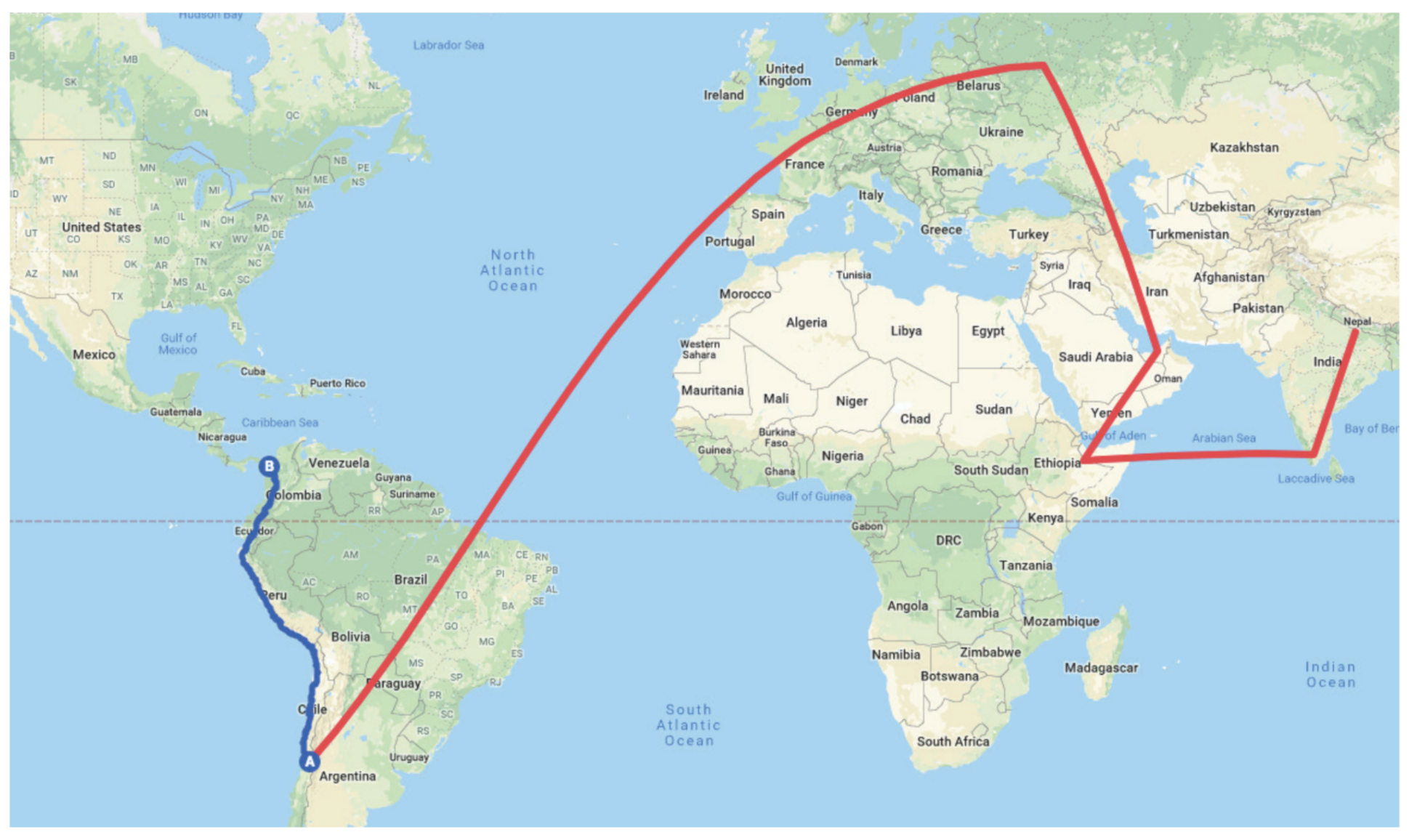
He said, "$25,000. That's how much I had to arrange. I had to sell all my land." He was a little vague about the details of how he arranged for the money. He said he was helped by friends and family, who lent him the money, and did not elaborate on the matter. "So I came back to India and then flew out from Kerala to Dubai. Dubai! It was incredibly difficult for me to convince the immigration people that I was a tourist. I had to beg and plead my case, and finally he let me through. I suspect he let me through because I speak Hindi." He did not have fond memories of Dubai, where he was unable to eat well or speak to anyone. From Dubai, he moved to Ethiopia at the advice of his agent and stayed there for a month. "At least Ethiopia has Indian food," he laughed, "I could eat!" After the month, on the instruction of his agent, he flew back to Dubai and did not linger, catching an onward flight to Chile via Moscow and Paris. He did not have a high opinion of either city and only remembers the acute stress of the journey. "The agent arranged for our visas for this whole trip," he recollected. He was joined on this leg of the journey by two other Nepali migrants who have become his friends and travelling companions.
He continued, "I had around $900 with me when I reached Chile, given to me by my agent's local handler. He also got me a SIM card." He recounted taking a bus from Chile to Peru: "The desert was endless! I was excited to see it at the beginning but soon got tired of it all." In Peru, a couple—a man and a woman—were supposed to assist them in the border crossing. They had a car, which transported all of them to the actual border. The three migrants were then asked to put their bags in the car and give $200 each to the couple as a bribe for the police. "We got out of the car and watched as the couple attempted to drive through to the other side. We were told to hide and go around the fence through a patch where it was broken. There was a park on the other side of the border, and we hid there till we saw the car emerge." They had made it to Peru.
After passing a day in a local hotel, they were to take a 16-hour bus ride to Lima. They were met by the local handler, who took them to a hotel room and locked them up, asking for $600 each for the remainder of the journey. Being short on cash, they tried to bargain it down to $550. While he was suspicious, initially, he accepted those terms. The handler then put them on a bus to a town closer to the Ecuador border. This took two hours. Abhas added that an Ethiopian migrant joined them at this point: "He tried to pretend that he was also an agent's handler. It took us some time before we realized he was lying to us (we did not know the reason) and was actually also a migrant." They reached their destination at 11 p.m., and he remembered being severely short on drinking water for most of the journey. The bus dropped them off, and a taxi picked them up and took them to a place closer to the border between Peru and Ecuador: "Three Bengalis joined us at this point. The three of us [presumably the Nepalis] were made to crouch in the trunk of the car, covered by a flimsy blanket." He shuddered as he recollected the journey: "There was so much dust. I was in discomfort." Right at the border, an agent's handler picked them up. They walked a bit, crossing a stream on foot. The border crossing was relatively simple, and a taxi picked the seven of them up. "We were then locked up in a room for five days, with nothing to do. The Bengalis took the bed. We slept on the floor," he recalled. After the fifth day, the person who had been bringing food to them on behalf of their "landlord" informed them that they were stuck so long because the agent's handler in Lima had been arrested. (Abhas confirmed that the Ethiopian and the Nepalis shared the same handler, despite having different agents coordinating their overall trip.) He demanded $20 each as payment to enable them to cross to Ecuador. After some deliberation, they decided to trust him and paid the amount. "We never saw him again," he said ruefully. "The landlord came to us the next day and said that the man was gone. He helped us board a bus. The other man just took advantage of us." They were joined by another Indian on the bus, a Gujarati man.
It was evident from his demeanor that Abhas was not a fan of his fellow Indian traveler. "He is the reason we got into trouble with the police," he said, "right after we got lunch. The bus had stopped for the afternoon. The place where we were eating had a waitress, and the only English she knew was 'I love you!' She said it to all of us. Now which one of us did she love?" he laughed. "There was free juice with our meal, but we had no time to collect it because the bus was on the move. The Gujarati man began making a fuss about leaving behind something that he was getting for free—he was so cheap!—and in the confusion, we caught the attention of some police officers who were nearby." The police made the eight migrants deboard the bus and took away all the passports and cell phones that they could access. "I had hidden my phone, wallet, and passport inside a packet of noodles and stuck it together with superglue," Abhas said, looking pleased by his innovation, "So they never got around to taking my things away." The cops meant business—they asked for $60 from each member of the group: "We had no money. The Ethiopian man lent us $180, and we somehow managed to leave the police behind." They flagged down a bus and made it to Quito by morning.
A woman who was also working for Abhas' agent met them at the Quito bus stop and handed them eight bus tickets for the next leg of the journey: "The Gujarati man gave us some trouble at this point. He refused to travel with us. This was a problem because the woman was reluctant to give the tickets to just seven of us." However, since the Gujarati was not willing to continue to Tulcan with the group, the girl eventually relented and gave them taxi fare for seven and asked them to go to the hotel at Tulcan. "At Tulcan, the Ethiopian wanted to go his separate way and asked us for his money back. By this point, we only had $90 between us and paid him the entire amount. He was very rude to us after that. I was sad—he seemed to lose sight of his humanity," he recalled.
They (the three Nepalis) soon after left for Colombia by taxi, and the border crossing was fairly straightforward. They hid in what Abhas described as "a room near a church." While he spoke affectionately of the family of the agent's handler in Colombia—"They talked to me, and were very sympathetic"—he did not have pleasant memories of the stay itself: "Eight days. We were locked up for eight days in a room with one bucket to pee in between us. It was torture." The handler in Lima was eventually able to send money to the handler in Colombia. They then took a bus at 1 a.m. to Cali, where they were joined by two Punjabis. They spent twelve days in Cali, suffering critical food and water shortages. Over this period, two more Nepalis joined their group. They moved from Cali to Medellin after twelve days, and within a couple of days (he did not specify how many), they reached Turbo.
"We are only waiting, and waiting, and waiting now," he said, in response to my question about what the plan is going forward. "We don't know when and how we will reach Capurganá. And everyone says that the journey through the forest is dangerous. But I don't know. We have been living off the kindness of others. Some migrants from India left me with $40, and that's what I've been using to sustain myself in Turbo." He sighed, fatalistic, and gulped down the remainder of the lemonade in one swoop.
“Our destiny is written on our foreheads. Whatever happens has to happen.”
Epilogue
While I was unable to interview Abhas again, he left me a series of voice notes on WhatsApp right before and after he crossed the Darién Gap. He was taken on a boat to Capurganá, where he had to pay $20 to a person he suspected was a migration officer. He tried to say that he had no money, but the "migration officer" threatened to invalidate his documents entirely. "They are all in this nexus together, I think," he said. He sounded nothing if not confident. "The smugglers took away everything from us in the forest. It was a terrible experience. I have barely any clothes, and no shoes. But I made it to a refugee camp in Panama." He does not know what the future holds, but he has promised to stay in touch.
📝 This article was originally published in a collection of biographies by the Henry J. Leir Institute at The Fletcher School of Law & Diplomacy and Tufts University.
You can Download the original collection below ⬇️