
Written by: Karen Jacobsen and Kim Wilson
Table of Contents
One of the biggest challenges facing refugees and migrants is navigating the livelihoods and financial landscape of a camp or city after they arrive in a host or transit country. This camp or city may be their intended destination or a place of transit; nevertheless they may spend several years there, and need to find a way to survive financially, support themselves and their families (including those still back home), and hopefully even thrive. We refer to this achievement as ‘financial health.’ This report is based on a study, Finance in Displacement (FIND), that explores how refugees navigate financial and livelihoods obstacles, and the strategies that enable them to manage their finances, access financial services, and attain some measure of financial health and sustainable livelihoods. We focus on two host countries, Uganda and Mexico, both with large numbers of diverse groups of refugees, many of whom have been displaced for years.
Whether refugees are able to achieve some measure of financial health is of interest to host governments, city municipalities and humanitarian agencies. Refugees who do so are able to better support not only themselves and their families, but also provide an economic boost to the places where they live. Financial health also reduces the risks for cities of having a large population of poverty-stricken, unemployed immigrants. It is therefore in everyone’s interest to promote the financial health of refugees and migrants. A better grasp of the financial strategies and challenges that enable or undermine refugees’ financial health will enable donors, policymakers, and humanitarian organizations to develop policy and programming that better matches what refugees are doing and what they are capable of.
This report explores how refugees attain financial health and what can be done to support them, but it is important to recognize that not all refugees will be able to ratchet up their livelihoods. As in all populations, only some individuals will have the entrepreneurial ability, the luck, and the resources to be successful. In addition to the ‘exogenous’ or contextual factors that must be in place to enable livelihood success, there will always be some individuals and households who will not be able to ratchet up their livelihoods because they struggle with personal or household challenges such as physical or mental health problems, disabilities, and single parenting. These challenges are more likely to affect refugees because of their displacement experience. There will always be refugees in need of targeted humanitarian assistance and extra help with supporting their livelihoods. This kind of traditional humanitarian support should be built into or alongside all refugee livelihoods programming and programming focused on financial services.
Main Takeaways
Our main takeaways about how refugees’ livelihoods and experience with financial services contribute to their financial health are as follows:
- One of the biggest livelihoods obstacles facing refugees is their lack of ID and other documents required to access government services, mobile services (SIM cards), formal employment (when they are permitted to work), and formal financial services (banks). Not having proper ID also makes refugees more vulnerable both to exploitation by landlords and employers, and to being shaken down by corrupt police or government officials. Programming and advocacy should focus on this issue, and there is already good practice in place.
- Security concerns influence livelihoods. Although the cities of Kampala and Tijuana are very different, the experience of refugees was very similar, with one exception: security concerns for both men and women. In Tijuana, women especially feared being on the street because of both Tijuana’s reputation for violence and crime, and many had direct experience of being threatened. Security concerns are a widespread problem for women refugees in many cities around the world, directly affecting their willingness to venture out of their homes or shelters to find work and a livelihood.
- Co-national networks and help from locals (the kindness of strangers) are crucial aspects of refugees’ ability to survive and thrive, especially in the early days. Local help enabled refugees to meet daily consumption needs including food, shelter, and child care; recover from financial shocks in the city (stemming from health problems or crime), and raise lump sums or take advantage of opportunities that supported the ratcheting up of their livelihoods.
- Market niches are important. Skills like languages or knowledge of the country of origin enabled brokering and cross-border trade. Talents (eg., sports or dance or music abilities) enabled refugees to find work as coaches or play professionally, and often led to wider network connections and subsequent work. Identifying or carving out market niches that are well suited to refugees is something refugees are very good at, and could be supported with programming.
- Cross-border trade and brokering activities with the sending country (and the wider region) are potentially important livelihood areas for refugees, but how refugees engage across borders is a relatively neglected area of research.
In using both formal and informal financial services, refugees vary in both their willingness to utilize services and their ability to access these services:
- Refugees’ willingness to engage with banks was influenced by their home country experience with banks (which varied by country), the attitude of the banks towards them (which was sometimes obstructive), and the refugees’ financial literacy (understanding of what banks offered). Most refugees were familiar with and already using mobile money services both for sending and receiving remittances, and for banking purposes. Most refugees were familiar with informal serviceslike VSLAs, but not all chose to utilize them.
- When refugees do try to access formal financial services, they face a range of obstacles, mainly with banks. Formal requirements around ID documents and other KYC requirements mean refugees often can’t access bank services. In some countries (like Mexico), bank staff attitudes towards refugees and migrants create additional access problems.
In the following sections, we describe our ‘theory of change’ about financial health in displacement settings, and the design of our research study, then dive into our two case studies, and conclude with some recommendations for how policy makers, practitioners and donors could support refugee livelihoods.
A Financial Health Framework Modified for Displacement Settings
We begin by explaining what we mean by financial health in displacement settings, and propose a set of indicators. Then we outline how refugees’ livelihoods unfold, and how financial services could support this evolution (bearing in mind that not all refugees are able to embark on the same path).
What is Financial Health?
The term is defined in different ways by different groups. We draw on the definition used by the Center for Financial Services Innovation (CFSI)¹: Financial health is achieved when an individual’s daily systems help build the financial resilience to weather shocks, and the ability to pursue financial goals.
The CFSI identified a set of six indicators for challenging development contexts:
- Balance Income and expenses. “Those that can successfully balance income and expenses are better able to meet their daily needs and financial obligations.”
- Build and maintain reserves. “Most individuals have diverse portfolios of assets to satisfy different liquidity needs: cash in a bank account is ready for immediate emergencies, while commitment savings plans or livestock store value for longer-term purposes.
- Manage existing debts and have access to potential resources. “The ability to borrow from others — in effect financial and social lines of credit — can help smooth volatile incomes, raise lump sums for investment, or cover immediate shortfalls in income.”
- Plan and prioritize. “Correlation between active financial management, including the length of one’s planning horizon and better financial outcomes.”
- Manage and recover from financial shocks. “Beyond an ability to meet people’s day-to-day needs, a financially healthy individual is prepared for the unexpected. This indicator assesses how well equipped someone is to manage, as well as recover from, a financial shock or emergency."
- Use an effective range of financial tools. “This indicator assesses how well an individual can access and use financial tools to acquire, move, and store funds as well as grow their assets.” (We believe that this indicator contributes to financial health but does not define it.)
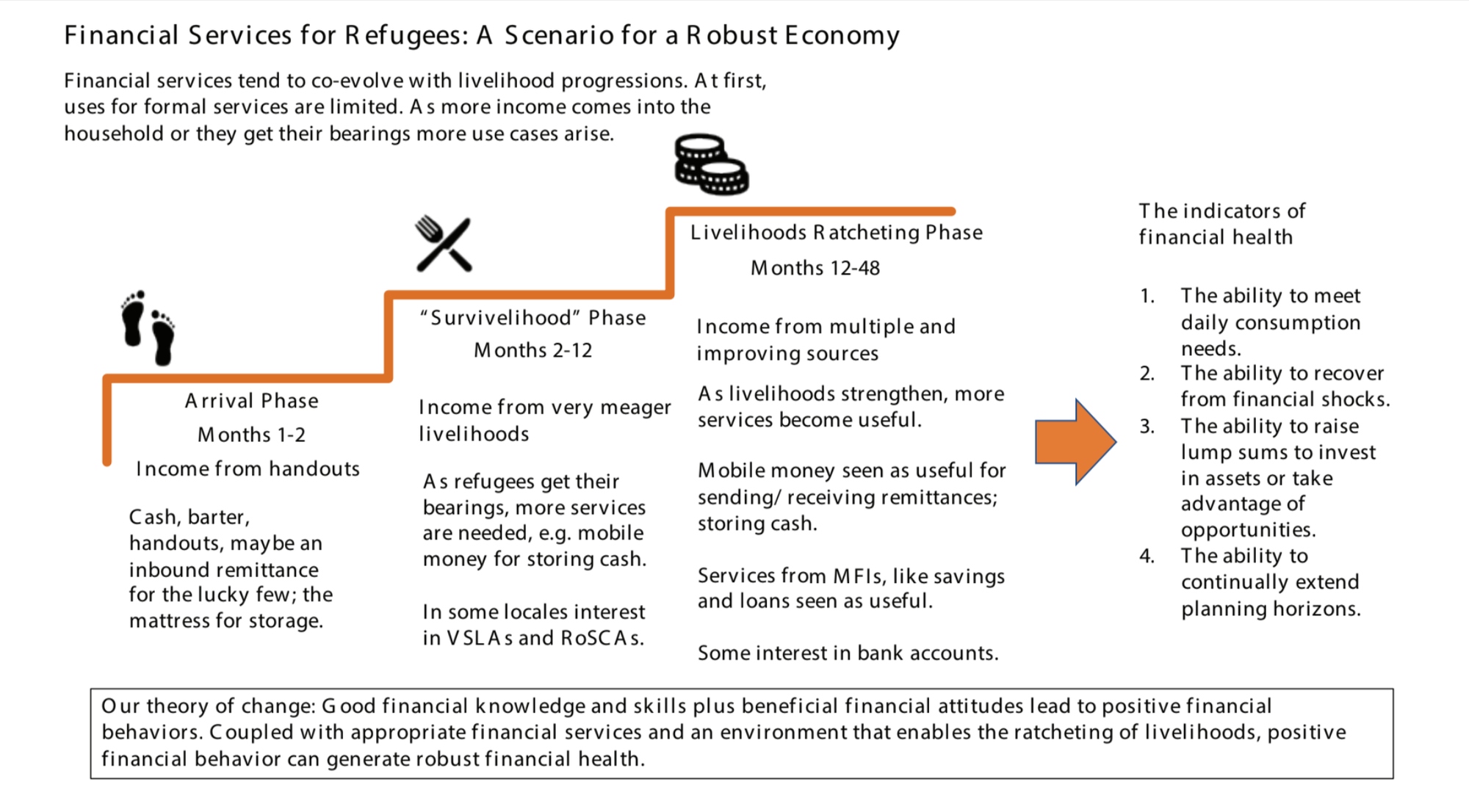
For displacement settings, we have simplified the above to yield the following indicators of financial health (See Figure 1)². Displaced people or migrants are ‘financially healthy’ when they are able to do the following over the course of four years, beginning with their arrival:
- Meet daily consumption needs, including food, clothing, shelter, hygiene, and health needs.
- Recover from financial shocks. Such recovery depends on being able to liquidate stores of value, borrow from social networks, or access humanitarian aid.
- Raise lump sums to invest in assets or take advantage of opportunities. Many refugees have been stripped of their assets before or during their journeys and hope to invest in assets that can produce income or increase safety. Lump sums can also afford opportunities such as education and training or better housing. A lump sum is more than 5% of per capita GDP, in this case, of the host country.³
- Continually expand planning horizons. As refugees or migrants move from initially dire circumstances in the first few months upon arrival, where a daily or weekly planning horizon is the norm, many stabilize and are able to adopt longer planning horizons.
These indicators could be used to explore the financial health of refugee individuals or households.
📝 This article was originally published as a report by the Henry J. Leir Institute at The Fletcher School of Law & Diplomacy and Tufts University.
Download the original report below ⬇️
Supporting the Financial Health of Refugees (Uganda & Mexico).pdf
The Evolution of Refugee Livelihoods
The livelihoods of many poor refugees unfold in a pattern.⁴ On arrival, they earn income through menial work — in cities this could be sweeping the steps of a church, selling sweets or food in the street, or washing clothes. In rural camp and settlement settings, refugees find unskilled farm work outside the camp. We call these activities “survivelihoods,” our term for menial work that shows a person’s willingness to work, but which seldom brings in enough money to support themselves or their families.
During the survivelihoods stage, refugees rely on family members, including those in the sending country or abroad (through remittances), and on the kindness of locals – neighbors, churches, shelters — for help with housing, rent, school fees, access to land, and even food. Then, after some period of time (it could be months or a year or more), some refugees are able to save a little, invest in their livelihood or procure better paid work, and, for those with connections, skills, and a sense of industry, a ratcheting up process begins that continues over several years. (See diagram below)
Not all refugees are able to ratchet up their livelihoods, and many exogenous or contextual factors must be in place to enable this ratcheting – indeed, a vast literature explores the success and failure of refugee livelihoods, as well as financial inclusion, which we do not address here. Even beyond these enabling factors, as in all populations, only some individuals will have the entrepreneurial ability, the luck, and the resources to be successful. There will always be some portion of the population who will not be able to ratchet their livelihoods because they struggle with physical and mental health problems (the latter are often higher in refugee populations as a result of their displacement experience⁵), with disabilities, with being a single parent, and with other personal challenges. For refugees, these personal challenges often affect a larger cross-section because of their displacement experience. They will always need targeted humanitarian assistance and extra help with supporting their livelihoods.
With the above in mind, we propose that, given the right circumstances and enabling factors, refugees can transition from “survivelihoods” (based on handouts and cash-based coping strategies that meet their consumption needs) to a more robust use of financial services that allows “livelihood ratcheting” where financial and livelihood portfolios expand to boost incomes and savings, reduce debt, enable remittances back home and a host of other positive outcomes. This progression reflects financial health. A person is on the way to becoming financially healthy when her financial strategies and access to services enable her to transition from “survivelihood” to “livelihood ratcheting.”
The Role of Financial Services in Financial Health
A refugee’s success in ratcheting up from survivelihoods is enabled by his or her ability to save and to have a line of financial credit, both of which are enhanced by access to financial services.
Savings enable people to recover from financial shocks and to create lump sums that promote investments in their livelihoods, without going into debt. Financial services that support savings include formal services like banks, and informal services like Rotating Savings and Credit Associations (RoSCAs) and Village Savings and Loan Associations (VSLAs). Of course, many people prefer to save on their own, by stashing cash “under the mattress,” or they diversify their liquidity (access to cash) by spreading their savings between the mattress and a savings service.
Financial credit enables people to ratchet up, but means they go into debt. If this debt is manageable, i.e., can be serviced without compromising other important activities, like food security or children’s education, or by engaging in risky activities like child brides, it is not a problem for households, and can support the ratcheting process. Formal credit services provided by banks or MFIs are supposed to ensure that their clients do not become dangerously indebted. Of course, this does not always happen, as we know from the 2008 financial crisis. But refugees have a different problem: Most refugees cannot gain access to bank credit because they are unable to meet KYC (know your customer) criteria or obtain ID documents that are required by banks. This difficulty adds to many refugees’ lack of confidence in financial service providers (often stemming from their experience in their home countries), their lack of financial literacy in some cases, and their fear of surveillance by financial institutions, government authorities, or aid agencies.
All in all, refugees' use of formal financial services either to save or to obtain credit is heavily constrained, which inhibits their ability to ratchet their livelihoods. Our case studies explore how these issues play out in different contexts.
Our study – Research Questions and Methods
Our study, Finance in Displacement (FIND), aimed to understand how migrants and refugees work toward financial health and sustainable livelihoods, and what financial services they utilize to support and ratchet up their livelihoods. Our research explored the process of whether and how refugees (and some migrants) engaged in livelihoods ratcheting, what financial strategies and services they used, and to what extent they were able to achieve financial health as defined above. Our research questions were:
- What are refugees’ main income streams (livelihoods) and expense commitments over time?
- What financial strategies do they use to manage their money? What financial services (formal and informal) support or limit the effectiveness of their strategies?
- What enables refugees to acquire some degree of financial health?
- What policy and programming initiatives could promote better financial health for refugees
We explored these questions in two countries, Uganda and Mexico. Both are host countries with large numbers of diverse groups of refugees. We chose these countries because we had good network connections in them and because our sponsoring agency, IRC, had active programs in both countries and was looking for ways to promote refugee programming in them.
We began our field research with training of the Uganda and Mexico research teams in June, 2019. The training covered informant selection, outreach, and recruiting methods. It also addressed informed consent, interviewing techniques, ethnographic observation, generating good field notes, as well as anonymizing and protecting data. Kim Wilson held weekly calls throughout the data collection process. The calls gave researchers a chance to give progress updates, share insights, and receive assistance on specific issues, which mainly involved recruiting and informed consent.
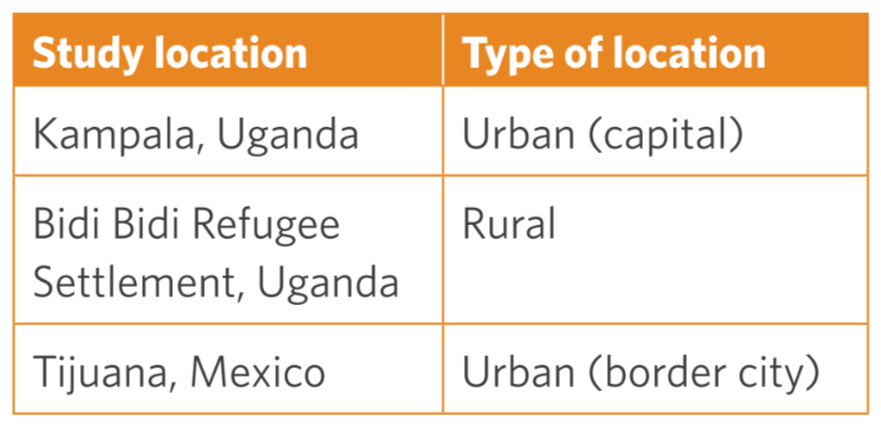
During June-July 2019, student researchers from The Fletcher School at Tufts University conducted in-depth interviews in both countries. In Uganda, they worked in two settings – a large rural refugee settlement called Bidi Bidi, and an urban setting, Kampala; and in Mexico, they worked in the border city of Tijuana. A more detailed description of the methods we used in each country can be found in the case studies. Our study used qualitative methods to explore refugees’ financial strategies and health, but our interviews generated insights that went beyond finances, illuminating refugees’ and migrants’ concerns about survival and livelihoods, and the ways in which they were supported. The qualitative research generated two sets of qualitative data, which were analyzed and written up in December 2019.
When the COVID pandemic hit in March 2020, all planned additional field research came to an end. The FIND project changed leadership at Tufts, and after consultations with IRC, we decided to re-analyze the data already collected but to re-focus specifically on financial health. For this second round of data analysis (in June-July 2020), we trained 18 Fletcher students to use NVivo software for qualitative data analysis. Our team created and revised an analysis framework (to be used for the data analysis) that was developed with the theory on financial health of refugees and our research questions in mind. Then, during the framework testing period, and as part of the training, we created a set of codes and subcodes. Through cross-coding comparison, we ensured that all analysts applied the coding framework correctly, reading through the data and assigning appropriate text and information to each code. In August 2020, our team compiled the coded data, and this report and the revised case studies were written in September-October 2020.
Case Study 1: Uganda
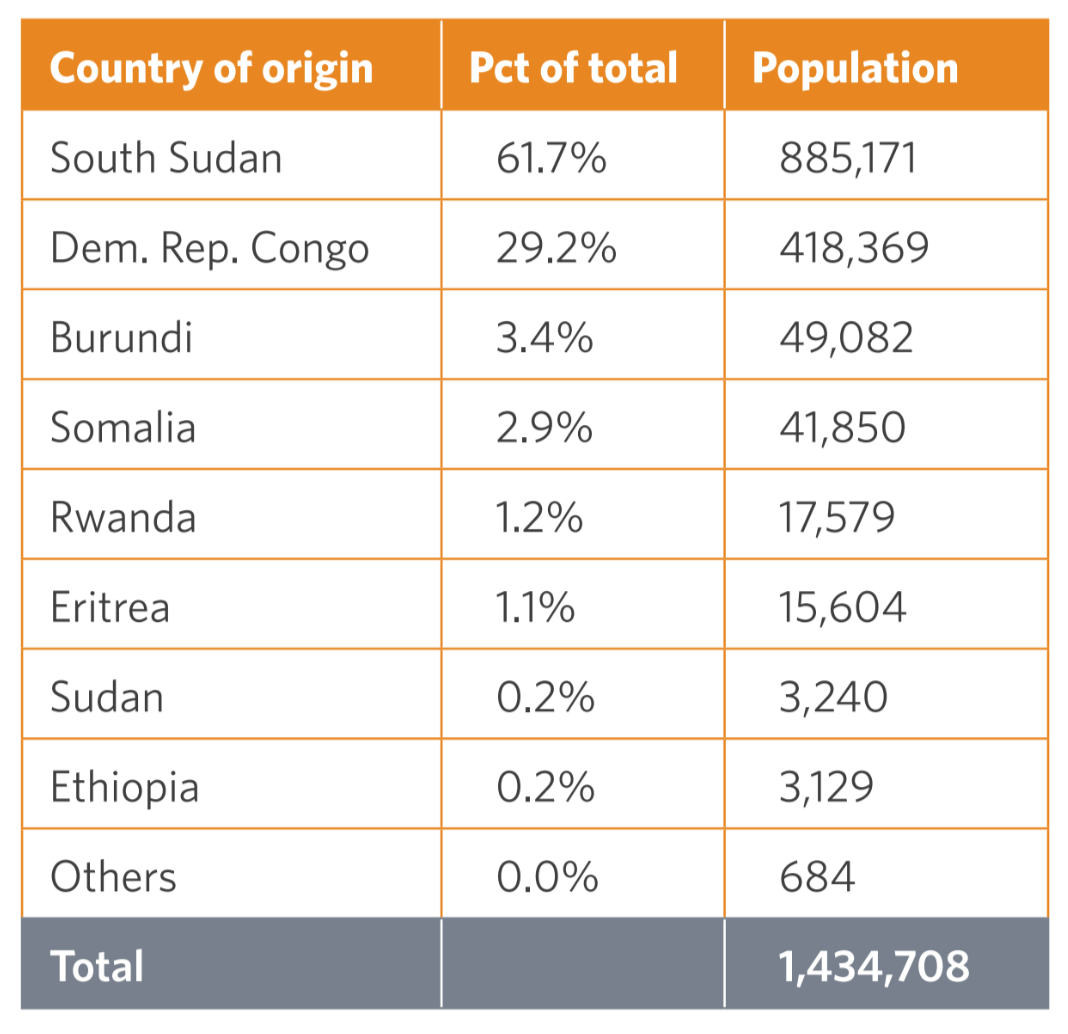
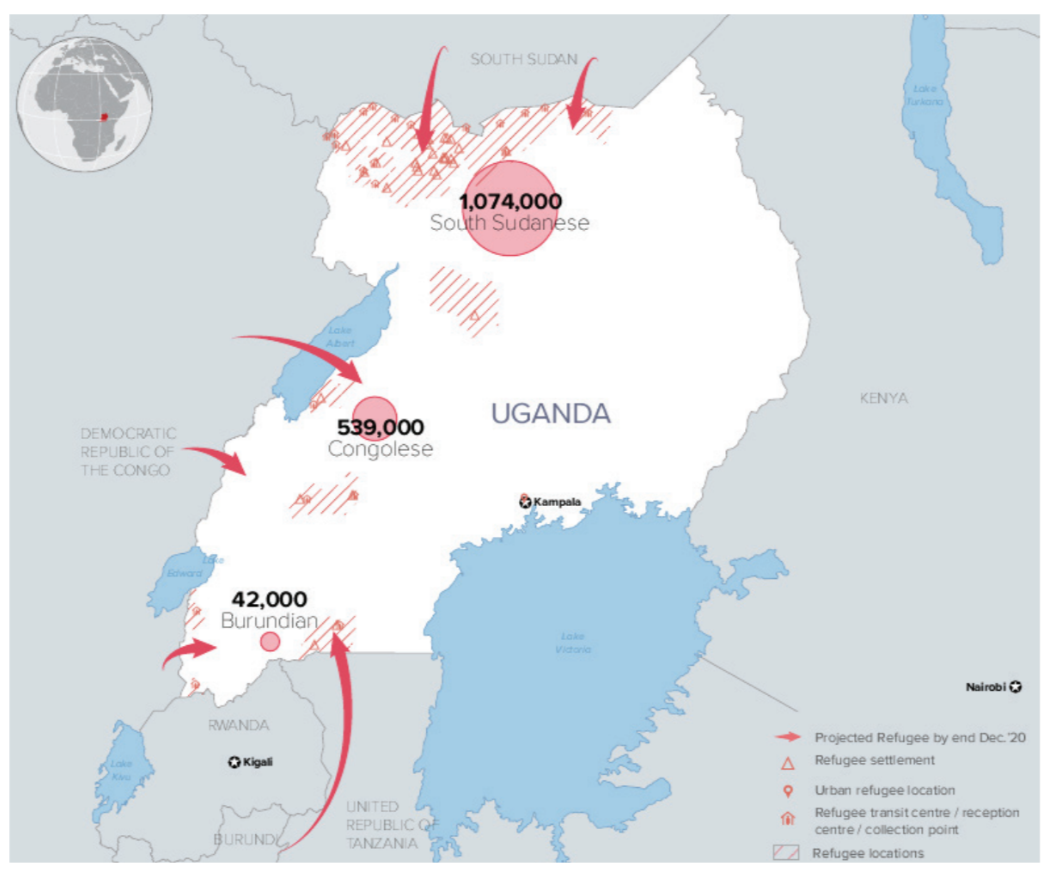
Uganda hosts one of the world’s largest refugee populations and is the largest refugee operation in Africa. As of July 2020, Uganda hosted some 1,428,961 refugees, mostly from South Sudan (882,171) and the Democratic Republic of Congo (DRC) (418,369). There are also large numbers from Burundi, Somalia, Rwanda and Eritrea, and smaller numbers from Sudan, Ethiopia and elsewhere (Table).
Esther fled Ezo, South Sudan, near the border with DRC, with her five grandchildren:
“Congo was the closest and safest option, so we ran through the bush to get there from Ezo. In Congo, we met a Good Samaritan, and we stayed with him for four months. He was not well-off. He had a shop and helped us with some food. I had worked when I lived in Ezo, and I used those skills to clean homes, sell groundnuts, and mandazi (fried pastries) to save money. After four months, we had enough money from my jobs and the Congolese Samaritan for the 30,000 shillings (USD 8.00) per person bus fare from Congo to Biyale.”
The majority (over 90%) of refugees live in rural settlements alongside local communities, but the capital, Kampala, is home to 5.8% or 83,614 (registered refugees).⁶
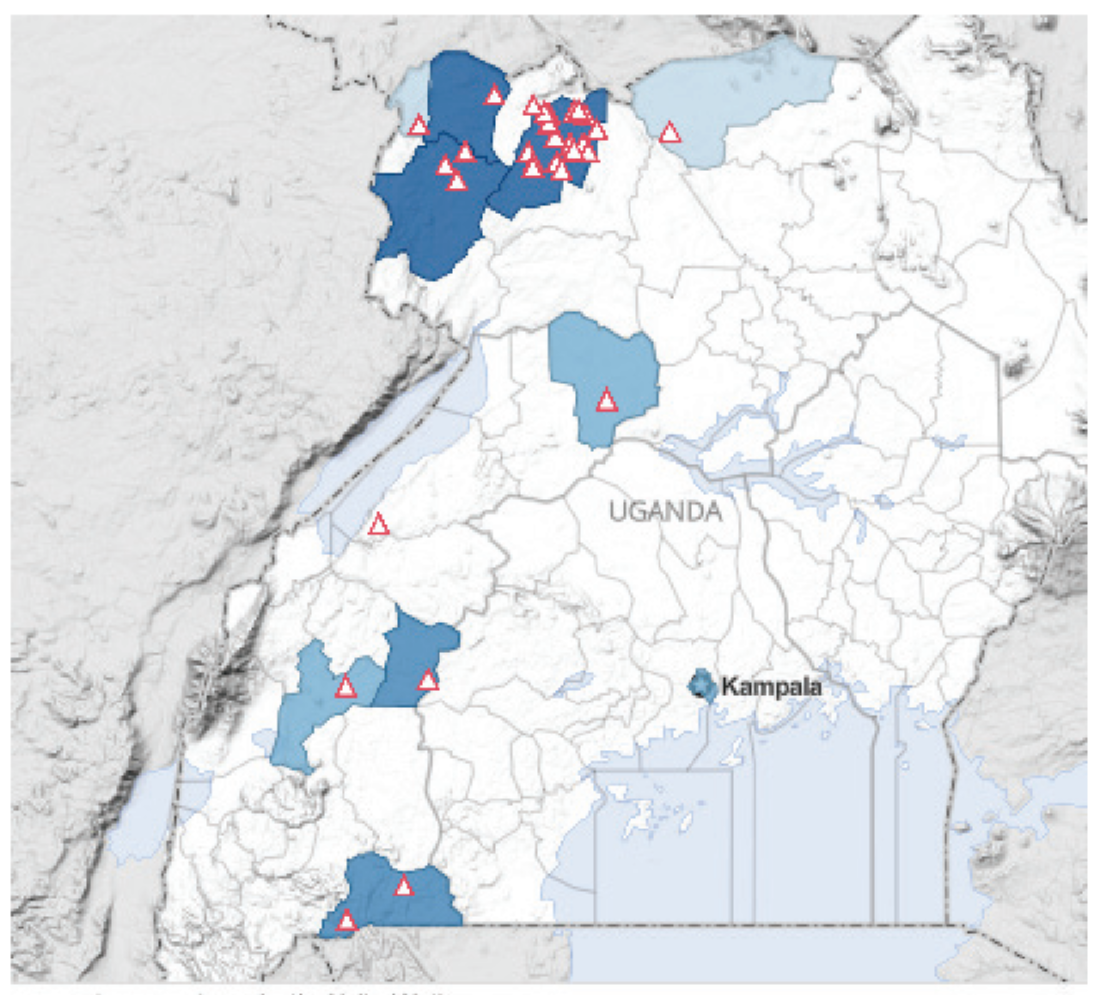
South Sudanese refugees began coming in mid-2016, when the conflict in South Sudan spread into the southern region of Equatoria, which borders Uganda. Between July 2016 and April 2017, some 600,000 South Sudanese refugees crossed into northern Uganda, and they continue to arrive. (There are also now an estimated 1.6 million IDPs in South Sudan.⁷) Most refugees live in 11 refugee settlements in rural areas. Bidi Bidi is the largest, located in Yumbe district in northwestern Uganda near the border with South Sudan. Bidi Bidi was opened in August 2016 and closed to new arrivals in December 2016, as the largest refugee settlement in the world.⁸ [see map] As of end-October 2020, Yumbe district hosted 232,743 or 16% of Uganda’s refugees – the district with the highest population of refugees.⁹ The refugees survive through a combination of food aid, cultivating land, and their own livelihood initiatives, often supported by NGOs.
Uganda’s Refugee Policy, Refugee Livelihoods and Financial Services
Uganda’s Refugee Asylum Policy and Refugee Settlement Model, together with the Refugee and Host Population Empowerment Strategic Framework (ReHoPe)¹⁰, make Uganda one of the most progressive host countries in the world. Refugees are permitted to enter Uganda without screening, and the 2006 Refugee Act and 2010 Refugee Regulations grant refugees the right to work and freedom of movement and access to land, employment, education, and healthcare.11 The Refugee Settlement Model enables refugees to live in settlements, not camps, with access to land to grow food. However, refugees have increasingly left the settlements and moved to the impoverished urban slums around Kampala, where there are few resources for citizens, let alone refugees. UNHCR provides no material support in urban areas.¹²
Refugees are permitted to work in Uganda, so UNHCR and other aid agencies have focused on self-reliance and livelihoods programs in urban and rural areas since 2009.¹³ But pursuing sustainable livelihoods in either Kampala or the settlements is not easy. Most refugees work in the highly competitive informal economy, in occupations that provide little income, social protection, or job security.¹⁴
National and local regulations constrain refugees’ ability to participate in both the formal and informal economies. In Kampala, refugees must first obtain a refugee ID in order to receive services, get work permits, and engage in formal financial activities (banks, mobile money, and remittance operators require ID as part of their Customer Due Diligence policies, as discussed below). The Office of the Prime Minister, which is responsible for refugee registration, is slow, and refugees often wait days just to meet with an officer.
At the city level, the Kampala Capital City Authority (KCCA) creates all kinds of problems for refugees. In 2011, it prohibited the selling of goods in public spaces without a license or a petty trading (hawker) permit. Hawking is a source of income for refugees, and the new regulation means refugees now have to pay bribes to KCCA officials or flee if they see them on duty, as reported by several of our respondents. In addition, registering a business and renting in a permanent location is difficult for refugees in Kampala because many aren’t able to pay three months of rent in advance.¹⁵
Both aid agencies and religious organizations support refugees throughout Uganda. Congolese and South Sudanese churches actively support their people on arrival.¹⁶ NGOs in Kampala try to promote refugee livelihoods through vocational and skills training in hairdressing, tailoring, computer literacy, and similar well- subscribed activities, despite the difficulties in accessing markets afterward and the lack of capital to start a business. However, harassment from the KCCA, discrimination from Ugandan buyers and sellers, and lack of prior business knowledge are all challenges to building sustainable livelihoods.¹⁷ Several studies have found that most refugees in Kampala (and Uganda more widely) have not secured sustainable livelihoods and that refugees continue to struggle to overcome poverty; despite engaging in multiple livelihood strategies, many are unable to cover their basic expenses.¹⁸ However, there are clearly refugees in Kampala who manage to thrive – what enables this? Our study explored the experience of several such individuals.
The livelihood context in the refugee settlements differs considerably from Kampala. A household economy study conducted in Bidi Bidi settlement in 2017 found that food aid constituted 94-97% of household food needs. Income from self-employment supplements refugees’ needs and includes construction labor, the sale of firewood, and the operation of small businesses. Poorer households tend to engage in less skilled activities such as digging latrines and fetching water, while slightly ‘better-off’ households engage in trade, small-scale businesses, and skilled construction.¹⁹ A common income source in the settlement is the sale of food aid. Poorer households’ expenditures are largely on household goods such as tea, salt, and soap, while more prosperous households spend more of their income on non-staple food item purchases, such as nuts, meat, and vegetables.
In terms of financial services, earlier studies found that refugees have more difficulty accessing credit than does the host population. A 2018 study found that only 37% of refugees had been able to get a loan (either personal, from friends/relatives, or from a moneylender) in contrast to 60% of hosts.²⁰ Personal loans and loans from friends were the most common source of loans for both refugees and hosts. In Kampala, refugees do not have access to financial services such as micro-finance loans and therefore struggle to obtain the capital they need to start businesses. Instead, refugees meet their capital needs by creating savings groups in which they can take out and repay micro-loans. These savings groups often succeed because they were created for refugees by refugees and because of the strong community trust and ties between group members; however, the groups lack sufficient capital to effect significant change in the lives of their members.²¹
Our Research Questions
Our study built on the earlier research described above to explore more deeply how refugees work toward financial health and sustainable livelihoods in the settlement and urban settings, and what financial services they utilize to support and ratchet up their livelihoods. We explored the following questions:
- What are refugees’ main expenses and what financial strategies do they use?
- What kinds of livelihoods do refugees pursue, and what enables them to do so?
- What financial services (formal and informal) do refugees use?
- Which refugees have acquired some degrees of financial health and why/how?
- What policy and programming initiatives could promote better financial health for refugees?
Methods
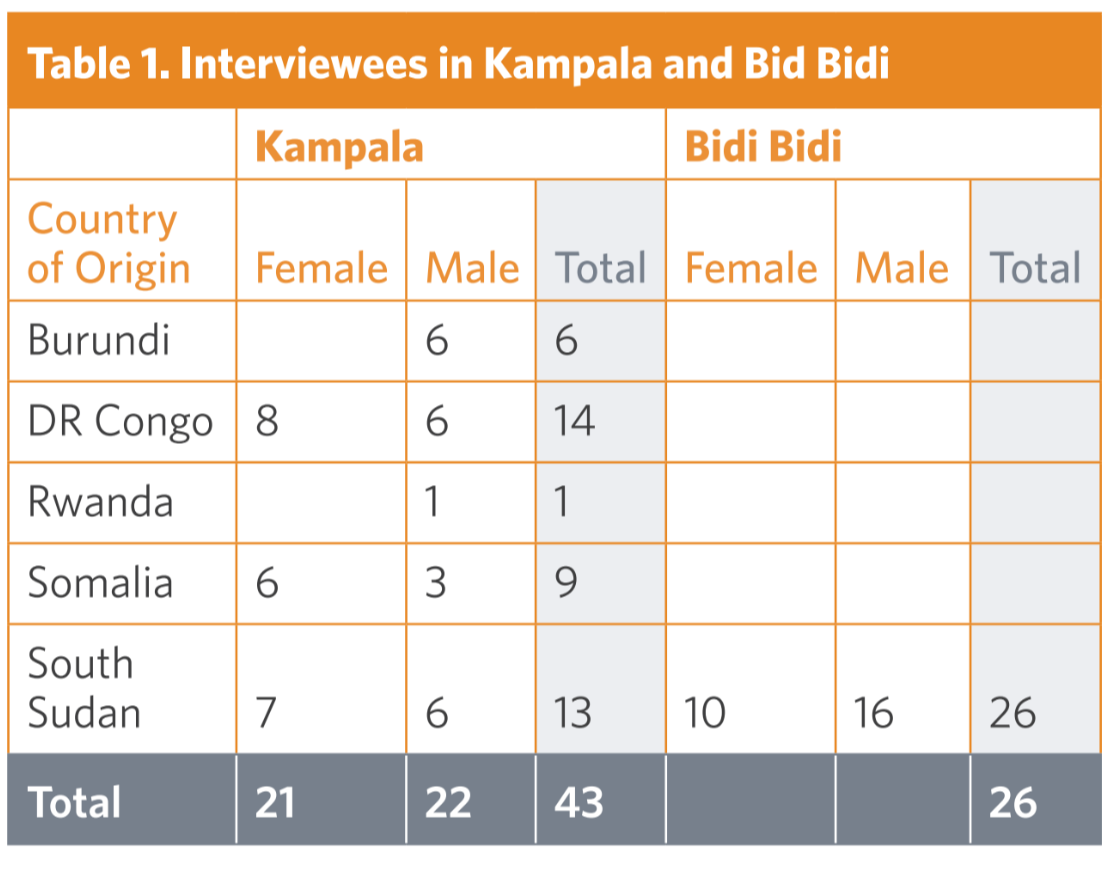
Our study was conducted in 2019 in two sites: Kampala and Bidi Bidi settlement. We conducted 71 qualitative interviews, 43 in Kampala and 26 in Bidi Bidi, as shown in Table 1. We also spoke to NGO representatives, religious leaders, and other community gatekeepers, etc., and reviewed recent research on refugees in Uganda. Participants were recruited via referrals from local organizations, such as IRC, a local microfinance institution, and smaller community-based organizations. In Kampala, we interviewed Congolese refugees in Nsambya, and most South Sudanese in an Anglican Church in Luwafu. Some participants also introduced us to their friends and family. We sampled purposively, looking for refugees with a range of nationalities, ages, genders, and livelihoods. Our respondents ranged in age from in their twenties to a few in their sixties. The sample is not representative of the refugee population of Uganda. More details of our overall methodology are in Section 3 (above).
The interviews were transcribed by our researchers in-country, and we conducted a first round of analysis in late 2019, then a second round of analysis in June 2020 (as explained in Section 3).
Our Uganda Findings
There are clear differences between the livelihoods and financial experience of refugees in Bidi Bidi settlement and Kampala. We begin with a comparison of how expenses differ in each place, then treat Kampala and Bidi Bidi separately when discussing livelihoods, financial strategies, and financial services.
Refugees’ Expenses, and Sources of Financial Support
Food
Most refugees in Bidi Bidi reside on land provided by the Ugandan government or negotiated for refugees’ use with community leaders.²² Refugees receive food rations (from WFP), including oil, beans, grains, and salt, which are supposed to be issued monthly, but food aid deliveries are often erratic and sometimes do not arrive as scheduled. Our respondents also said the rations were too little to thrive on. One man said, “The rations were meant to help us survive, not to feel full.” The rations also lack important nutritional components. Many refugees sell their food rations and buy foods they prefer, medicine, or household necessities like soap.
The refugees grow vegetables (onions, okra, eggplant, groundnuts, sesame, and chia) and grains to supplement their rations. Some local Ugandans allow refugees to cultivate their land for free but restrict them from building structures or taking possession of it. Other locals rent a parcel for USD 32 a year. Sometimes NGOs provide seeds, or refugees glean or purchase seeds on their own. Most sell a portion of their harvests and keep some for family consumption. But getting enough land for farming was a problem often mentioned by our Bidi Bidi respondents. Even though UNHCR and NGOs negotiate with the host community, it requires much effort by individuals or groups to form relationships with the hosts in order for the refugees to get the land. Without enough land to cultivate, there is not enough food to supplement the food rations, which do not properly sustain an individual or family, nor is there any cushion when a crisis hits: “In case of emergencies, I sell half of my food ration. But the challenge, later on, will be the starvation that will end the household.”
Medication
Medication is a common expense for refugees in both Kampala and Bidi Bidi. In Kampala, refugees’ children often become sick due to the change in climate compared to where they came from. In Bidi Bidi, the health centers usually have only minimal medicines such as painkillers, so refugees often use local health centers to be diagnosed and then purchase medication at pharmacies elsewhere to treat illnesses like malaria or typhoid. Some refugees lack funds to buy medicines and only treat themselves with painkillers. Medicine, while free, is scarce or non-existent in Bidi Bidi and is not subsidized in Kampala. In Kampala, local hospitals have the necessary medicine in stock, but refugees often can’t afford the treatment.
Susan came to Bidi Bidi with her sister and three children in 2016 from South Sudan. The children’s illnesses have been managed by the health center, but Susan needed to buy malaria medicine from the chemist because they were not available at the health center. She sells maize or beans to get the money to buy the drugs.
School Fees
School fees are more of a problem in Kampala than in Bidi Bidi. In Bidi Bidi, primary schools are free; however, there are costs for uniforms (USD 4.00-6.50, depending on the grade level), and a one-time exam fee of 2,000 shillings (USD 0.50) per term, per child. For the expensive uniforms (which are not required), refugees often request financial support from friends or family. In Kampala, the poor conditions of many schools mean refugees try to scrape funds together to send their children to one of the more expensive schools. This sometimes means having to pay school fees in fixed installments, a potential burden to refugees with volatile cash flows.
Rent
Rent was the biggest difference in expenditures between refugees in Kampala and Bidi Bidi. In Bidi Bidi, refugees construct their own simple housing from local materials gathered in the bush, or sometimes sell their food rations to buy nails and the bamboo.²³ There are no concerns about rent. By contrast, in Kampala, our respondents’ housing experience was typical of urban refugees everywhere: rent is the number one worry and a major expense.²⁴ Few of our Kampala respondents could afford to rent an apartment on their own upon arrival. They relied on support from family, or shared apartment expenses with friends, family, and/or roommates. Families often lived in cramped spaces, sometimes even in one room. When they first arrived, many refugees lived with friends or family for a while without paying rent, which allowed them to get a leg up and start saving towards livelihood needs (as discussed below).
Once they were in their own places, refugees could rarely afford rent without outside support, and frequently had to negotiate with landlords around late payments. Below are two examples of many stories we heard about how refugees negotiate – or sometimes beg –to delay the rent:
“I: do you pay rent every month or does your landlord let you go?
R: Landlord forgives me because I apologize to him. We have problems even this month – I called him to apologize because we don’t have money to pay him. But he is patient with us.”
“M: When you have a month with no orders, what do you do to pay for rent and school fees?
R: The only thing is crying and negotiating with the landlord… and the day you get money you pay.”
In addition to regular household expenditures on rent, food, medicine and school costs, refugees also saved to invest in livelihood assets, as we discuss further below.
In Kampala, particularly, refugees relied heavily on family and friends’ financial support for their daily survival and the coverage of basic expenses. Refugees struggled with Kampala’s high cost of living, and on arrival, many received support from NGOs and UN agencies, as well as police stations and churches. Respondents described arriving at the Old Kampala Police station and receiving protection and porridge (often from leftovers, but still appreciated), as they searched for relatives and contemplated next steps.
Churches and their parishioners from several Christian denominations acted as a social safety net for many new arrivals, helping with documentation, childcare, shelter and medical services, or English or Luganda language lessons. The churches were beacons of hope, giving refugees a destination prior to their departures. Our respondents often spoke of Archbishop Munde of South Sudan as someone who went beyond church responsibilities to help South Sudanese refugees with medical care, school fees, and even rent (see BOX).
Angela’s experience is typical of the help refugees received from Archbishop Munde of South Sudan. The Bishop provided housing for Angela and her children during the first month of their arrival in Kampala, as well as money (~USD 40) to secure an apartment and purchase bedding. Angela found occasional work washing clothes (for less than 1 USD per day), but it did not provide for her and her children’s basic needs. When she sought treatment for frequent illness, the Bishop contributed to her hospital bills and continued to support her treatment after her HIV diagnosis. Another South Sudanese woman said: “Bishop Munde knew we were arriving in Kampala from the church members, and he picked us up at the bus station in Kampala. He let all six of us stay with him and his family for six months before I was able to afford an apartment.” Archbishop Munde died in 2018. One respondent noted, “all the children dropped out of school after the Bishop’s death.”
Refugees in Kampala received help from family and friends, no matter their origins:
“I did not have any source of income. When I arrived in Kampala, I met a Congolese who took me to a church where I was given food and shelter for two months. I later moved in with a friend I had made in church, where I stayed for three months.”
The South Sudanese community in Kampala is strong – they have a South Sudanese Community Organization that gives community IDs to refugees, and holds weekly meetings. One respondent told how he relies on it to assist him if trouble should arise:
“I have not gone to the police to report that I am a refugee living here. I only went to the South Sudanese Community Organization where I was given a membership ID. In case of any issues, I can use it to identify myself. If I am faced with any legal challenge, the community leadership will oversee my case.”
It is clear that refugees need networks and communities to move from survivelihoods to sustainable livelihoods.
A fortunate few received regular remittances, often from relatives who had stayed behind. One South Sudanese man received USD 50-100 occasionally from his brother who was still driving vehicles back in Juba (South Sudan), and in return, took care of the brother’s family in the settlement. He put the money towards meat and vegetables to supplement the monthly rations and food grown on their cultivated plot. Many respondents relied on remittances for unexpected expenses, such as medical fees, but this support was irregular. Most respondents received very small amounts, often just a few dollars. For example, Mayok from South Sudan used to get about $10 from her daughter each year. However, at the time of the interview, her daughter hadn’t sent any money for months — Mayok thinks her daughter is also struggling to make ends meet. As the war in South Sudan drags on, it becomes less possible for people there to hold onto their jobs and make ends meet, and less likely they can support their relatives in refugee settlements.
Types of Livelihoods
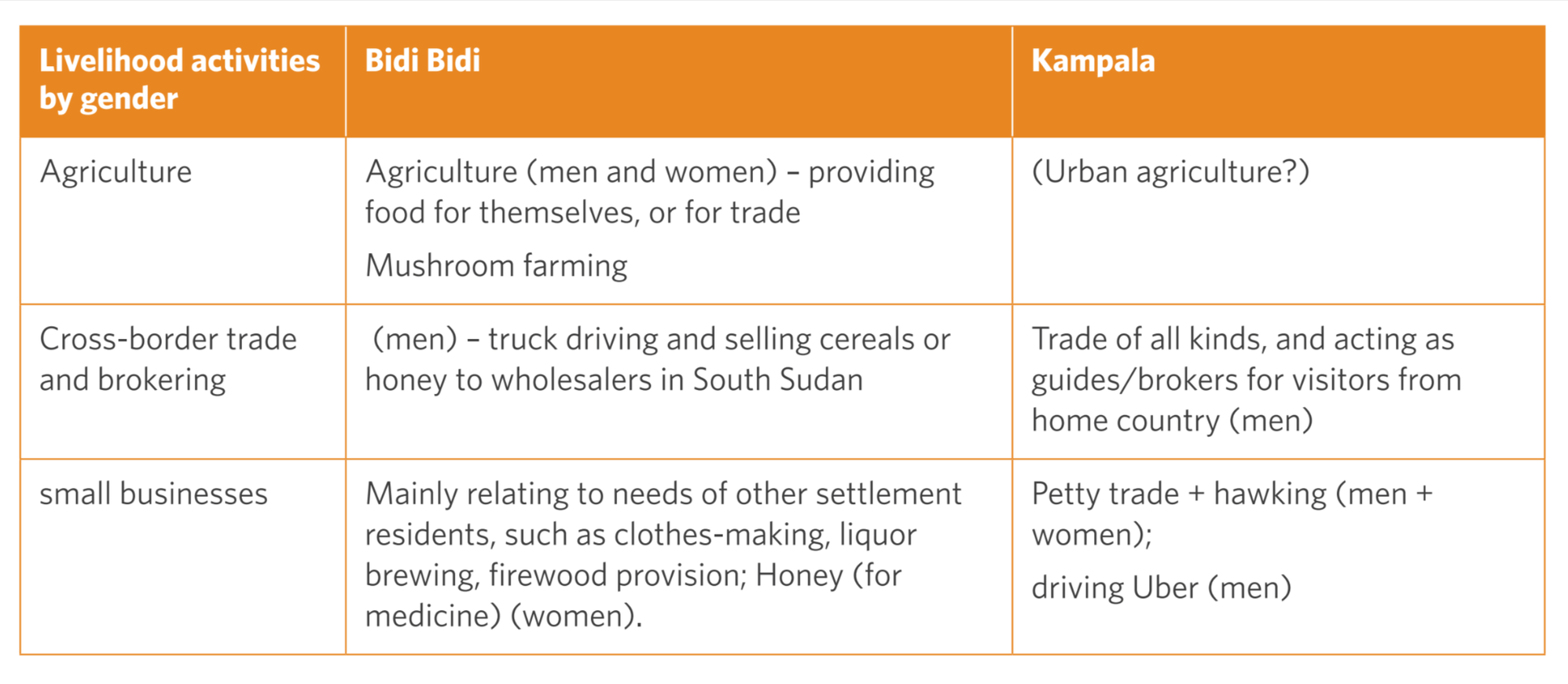
Our two sites were very different – one rural, one urban – and refugees’ livelihood activities reflected these contexts. The significant difference between the two sites was the refugees’ abilities to ratchet their livelihoods up from the level of survivelihoods. It was easier in Kampala.
Bidi Bidi
Opportunities to find paid work and other forms of income in Bidi Bidi are scant in comparison to Kampala, but refugees are resourceful in piecing together a livelihood. The following livelihood activities are found in the settlements.
Small Retail Businesses
Refugees are allowed to run businesses and are encouraged to trade with local Ugandans, but their businesses in Bidi Bidi are more modest than those in Kampala. Many refugees were able to bring cattle and other physical assets like sewing machines or brewing equipment from South Sudan, which they sold to raise capital for their businesses or to make ends meet. For example, a man brought a solar panel with him, which he sold and used the funds to purchase inventory for his alcohol business. Most small businesses relate to the needs of other settlement residents, such as clothes-making, liquor brewing, and firewood provision.
Our respondents reported livelihood expenditures on things like cloth for clothes-making, firewood for liquor brewing or cooking, or honey for medicinal purposes. Brewing is a big business in the settlements, mainly done by women. One respondent purchased special maize from locals because it produced a high-proof corn liquor of better quality than the corn she grew on her own plot of land. A batch of brew brings her USD 2.70, generating USD 8 net income per month.
NGOs provide livelihood support including training in tailoring and other services; however, the challenge for small businesses in Bidi Bidi is a lack of demand for items beyond household necessities and food. One South Sudanese refugee opened a store that offered fresh juice and food but found little demand for his items: “There is no market, no money for the people to buy items, so I plan now to close.” Some NGOS have identified market niches and are training refugees to fill them. For example, Danish Christian Aid trains in mushroom farming. One respondent was in a group that collectively farmed oyster mushrooms. Each kilogram brought in about USD 2.70. The farmers liked the process — it takes about 25 days from preparing the spores to harvesting the mushrooms. The advantage of the business is that it is not seasonal. A steady domestic demand allows them to harvest and sell mushrooms profitably throughout the year.
Cross-Border Businesses
Cross-border activities include truck driving and selling cereals to wholesalers in South Sudan. One self-organized savings group in the settlement has members who operate cross-border businesses. Kazim, a young man from South Sudan, borrowed USD 55 (at 10% interest) to purchase twenty liters of local honey from his home country. The honey is prized for its medicinal properties. A runner went to the border to conduct business on Kazim’s behalf. At the border, he bought twenty liters of honey for USD 32.50 from a South Sudanese friend still living in South Sudan. Kazim paid his runner USD 2.00 and sold the honey for USD 40, one cupful at a time. Kazim earned USD 8.00, enough to make the business worthwhile.
Employment with Local Ugandans or NGOs
In Bidi Bidi, refugees often work on farms laying bricks, digging, or pruning trees – a frequently referenced survivelihood activity that provides a way to afford basic necessities like food when rations fail to arrive
“I: What did you do during the crisis in June and July when there were no rations sent?
R: “We used to go and labor… then we can buy a little food for the children. I: Who would you labor for?
R: The natives [Ugandans} here…Farm work.
I: And how much did they pay you?
R: It depends on the work… it is always something for the day – like five, four thousand like that.
“I: What kind of work would you do for the Ugandans?
R: Just digging.
I: Digging in the field, how much would they pay you?
R: They measure as soon as you dig a big land. In a day I can work for 5,000 (USD 1.35).”
Some refugees found employment with NGOs in Bidi Bidi, but these rarely led to longer-term opportunities and resulted only in temporary income. NGOs paid a range of stipend amounts, which provided relief to families without other income. The refugees said they enjoyed NGO work, acknowledging the significance of working on a mission-oriented project. One respondent worked for Caritas for six months training people to cultivate their land. The contract expired, but when asked about good memories in Bidi Bidi, he said: “Actually that was the happiest time. When I was still working.”
Kampala
The Kampala Capital City Authority (KCCA) requires refugees who engage in hawking and other petty trade to obtain a license, but there are obstacles to obtaining it and many refugees try to operate without one. But “the KCCA is everywhere,” one male Congolese said, referring to its constant surveillance. If KCCA catches an unlicensed refugee, it can seize their goods, impose fines, or both. Many refugee street-hawkers and shopkeepers reported their constant vigilance of all matters KCCA. As a coping strategy, some sell their goods in neighborhoods away from the bustling city center, but while the KCCA is less present in those areas, they are also less profitable places to conduct business.
Cross-Border Businesses and Brokering – Leveraging Language Skills
Refugees in Kampala took full advantage of their knowledge of business and trade possibilities on both sides of the border with Uganda and their home countries (DR Congo, South Sudan, Burundi, etc). Some either engaged directly in cross-border trade:
“I asked my friends what they did in Kampala to survive. They told me about the business of sending goods back home, sell and get your money back. Most of them were dealing with clothes and shoes. I decided to deal with cereals since there was a demand in Yambio.”
English, or both, to act as brokers to help outsiders from their home countries navigate the city. Nelson is an enterprising soccer player. He receives USD 1.30 for each game played, but because the outcomes of the various tournaments are uncertain — Nelson never knows if his team will make it to the finals — his earnings are unpredictable. But football is essential for Nelson. He enjoys the game and met his two roommates in soccer matches. To create a steadier income, Nelson regularly visits the bus station in Kampala to meet businessmen from Juba, South Sudan, for whom he acts as an agent. Nelson speaks fluent Luganda and knows the market, and he helps the South Sudanese negotiate the best stock at the lowest price. A typical morning will bring Nelson USD 5.00-8.00, and as he says, “a good businessman will treat you to lunch.” Nelson has slowly built up a clientele. Many will call him in advance to meet them at the station.
Refugees try to learn English or Luganda to build sustainable livelihoods. Refugee training centers offer free English classes, and one respondent volunteered at his church, which helped him learn the language faster. He now tutors English to make some money. A young Burundian man who was part of a dance troupe in Kampala said he wanted to expand his current livelihood to include catering (in Burundi, he had worked at an Italian restaurant). He believed his inability to speak English was an obstacle because in the markets, people used English terms for weights and measures (a kilo of this, or a gram of that), and often for food as well. To help him gain market fluency, he was studying English with a local church.
Livelihoods Ratcheting
In Kampala, there was more evidence than in Bidi Bidi of refugees being able to ratchet up from survivelihoods to a more secure livelihood. Many refugees brought skills that enabled them to find work or make money, including tailoring, beading, hairdressing, language, and computer skills. They supplement their skills with free training at refugee centers like Jesuit Refugee Service (JRS) or Young African Refugees for Integral Development (YARID). Below are four examples of what can happen when the skill and ambition of refugees combined with a good dose of luck and local support enables them to succeed.
Jeannie, a single woman from the DRC, scaled up her tailoring business one sewing machine at a time:
In her early days in Kampala, Jeannie relied on handouts from friends and her sister. She cleaned houses for less than a dollar a day, not enough to support herself. Her sister had arrived in Kampala before her and began introducing Jeanie to her acquaintances, extolling Jeannie’s tailoring skills. Jeanie found work for a tailor, taking on piecemeal jobs for which she received a third of the sales price, eg., the tailor charged 60,000 (USD 16) to make a kitenge dress, and Jeanie earned 20,000 (USD 5).
Her sister was covering their rent, so Jeanie was able to save to find her own place. When she moved out, she continued doing casual labor as well as her tailoring work. She put money aside and purchased a sewing machine for USD 70. New income allowed her to save more. Her friends lent her two more sewing machines, and she hired three assistants. Her earnings allowed her to pay rent of USD 40 per month, and enroll her three children in school for a total of USD 120 per term. Jeanie beamed with pride as she related her successes.
Our next example is Hubert, who traded up his transportation assets to increase his income.
Hubert arrived from Rwanda in 2013 with no money. The friends he lived with found him a job cleaning houses for less than a dollar a day. He learned Luganda and convinced a Ugandan to let him use his boda boda (motorbike) to run errands. He earned USD 48 a week, from which he paid USD 16 to the motorbike owner. Hubert saved USD 190, which he combined with a USD 80 gift from his uncle, and purchased a used motorcycle. His income and profits picked up. He was earning more than USD 50 a week, and kept all the earnings. One day he met a man who persuaded him to register as an Uber driver. Hubert leased the man’s car for USD 40 a week, and his income grew to USD 110 a week, netting him USD 70 a week. When we interviewed Hubert, he was saving to buy a car of his own.
The last example shows how two working adults can help ratchet up each other’s income activities through careful planning and cash flow management. Once again, cross-border trading features as an important way to improve income.
Jean and Marie, a Congolese couple, arrived in Kampala in 2012, with no funds. During their first week, they relied on the Old Kampala Police Station for food. Jean worked low-paid construction jobs at first, earning USD 2.70-5.40 a day. He learnt English, which allowed him to move out of wage labor, and he began brokering construction materials across the border to DR Congo and Rwanda. Ugandan factories interested in selling to merchants based in Congo retained his services. Jean bought the materials, and trucked them to the border where his agents shepherded the goods through customs, paying duties and completing paperwork. The Congolese merchant paid the factory, and Jean got a cut of the sales. Marie would not discuss Jean’s profits, only to say the business was very successful. Marie took a cosmetology course offered by Jesuit Relief Services. The course lasted seven months, convening daily from 9:30 am – 4 pm. Marie brought her baby to class. After earning the certificate, she “walked from salon to salon” until she found an unpaid internship at the Treasure Salon.
After three months, the internship turned into a job that paid about USD 110 per month. Childcare cost USD 16 per month. Marie stuck with the job for seven months, then quit. Between the cost of childcare and the chemicals she was inhaling daily, finding new work was a better option. Marie had put some money aside. She attended courses at another NGO, Young African Refugees for Integral Development (YARID), to learn tailoring, and found a job as a seamstress in a local business. She stayed three months, then returned to YARID as a trainer. She parlayed that work into starting her own business and now has her own shop that offers tailoring services and retails kitenges (colorful fabrics for multiple uses) and children’s clothes.
She said: “At first, it was difficult. When you are working, you have to buy your materials and machines one at a time. Before I left YARID, I had had the idea of starting a business, and whenever I could get some money, I would buy a machine. When I was ready to start the business, I already had three machines, costing about USD 50 each. I would buy them second-hand.” Marie went on to start another business where she shopped online for clients— a concierge service of sorts. With the income from Marie’s businesses and Jean’s brokerage, the couple could rent their apartment (about USD 30 per month), rent Marie’s shop (about USD 40 per month), and pay USD 35 per term for her eldest child’s tuition, which increased to USD 55. Her second child would soon enter Kindergarten, with fees of USD 35 per term.
Although less common, there were cases of livelihood ratcheting in Bidi Bidi, often linked to cross-border businesses, such as David’s grain business:
While still in South Sudan, David prospered in his cereals business. From stock worth USD 1,300, he was able to generate about USD 2,700 in annual sales. He purchased grains both in South Sudan and from Gulu, Uganda. When the war in South Sudan broke out in 2016, David sent his wife to Bidi Bidi along with a sewing machine, which she used to earn money making clothes. David stayed behind to manage his cereal business. But the war intensified, and one night David lost all his stock to looters and was forced to flee. He took USD 120 he had withdrawn from his bank (Equity Bank) and headed for Bidi Bidi. In September 2017, David restarted his cereal business from the settlement. He’d stored the funds from South Sudan in mobile money, and he used USD 95 to purchase grain. His working capital is now USD 135, and he supplies cereal to three schools in the area, netting about USD 0.03 per kilo in cash.
People also used livestock to ratchet their livelihoods in Bidi Bidi:
Kadi arrived in December 2017. Formerly married to a Ugandan man, she left him and now cares for their seven children. In South Sudan, she sold cooked food and groundnuts, which netted about USD 20 a day. She was doing well. When she reached Bidi Bidi, Kadi bought five goats from other refugees who had brought livestock to the settlement. Each cost USD 13.50. Kadi then exchanged the goats for a cow, which she kept with a Ugandan man who takes care of people’s livestock. Their arrangement was that after the cow had birthed three calves, Kadi would give the herder a goat. Her cow, worth about USD165 at the time of the interview, had not yet had a calf. Kadi needed immediate income. She had some funds left after her initial arrival expenses and bought some tomatoes to resell.
But the margins were too slim to continue the business, so she liquidated her food rations and raised the funds (~USD 4.50) to cultivate a plot of land and grow chia with seeds given by Danish Church Aid (DCA). Kadi maintains good relations with local Ugandans and plans to work with them to return to her previous livelihood of growing and selling groundnuts.
Financial Services in Kampala and Bidi Bidi
As refugees’ income increases and they accumulate savings, they need financial services – including credit, a place to deposit savings, and mobile money — that will help ratchet up their livelihoods. In Uganda, the financial services industry comprises the banking, mobile money, insurance, microfinance and investments sectors, and remains dominated by the banking sector.²⁵ Informal services take the form of RoSCAs (Rotating Savings and Credit Associations) and VSLAs (Village Savings and Loan Associations).
Refugees’ ability and willingness to use formal services provided by banks and MFIs depend on their experience in their home country, and on their ability to access the services. Among our respondents, familiarity with banks varied based on country of origin. Our South Sudanese respondents had had mixed experiences in South Sudan – some complained of caps on withdrawals and inconvenient locations. The refugees from the DRC had an even worse opinion of banks, with reports of scams of one kind or another. Those coming from Burundi and Rwanda had relatively positive experiences with banks, and those from Somalia had no experience at all.
A young Burundian man said that back in Bujumbura, he had two accounts, one with a local bank, Interbank, that held 70% of his savings, and one with a regional bank, KCB, that held the remaining 30%. When violence erupted and he knew he had to flee, he could only access his KCB savings because his Interbank account had been frozen. Fortunately, a friend who worked at Interbank was eventually able to liquidate the account and sent USD 1,350 to our respondent, keeping aside USD 270 for his own escape. Refugees’ patterns of use of financial services differed in Kampala and Bidi Bidi.
Kampala
As our respondents spent time in Kampala, their perceptions of banks became more favorable as they observed Ugandans interacting with banks like Equity, but some skepticism prevailed. Opening a bank account meant refugees needed the right documents, which are difficult to get. Sometimes refugees could not prove their addresses or satisfy other Know Your Customer (KYC) and customer due diligence criteria. A few purchased fake documents. One respondent bribed a policewoman USD 32 to get a Ugandan driver’s license. He thought the bribe worth it because he needed a bank account. Bribes are thus simply a cost of doing business.
In Kampala, refugees used multiple savings strategies.
When Hubert, the Uber driver, was driving his rented motorcycle, he first kept his savings under his mattress, then opened a mobile money account. When he bought his own motorbike and his earnings increased, he opened an account with Equity Bank and continued saving there when he drove for Uber. He said, “In a good week, I save 300,000 – 400,000 shillings (USD80–110), and in a bad week, I save 200,0000 (USD 55).” He uses Airtel to send money to his mother back in Rwanda.
A Congolese respondent spoke about his growing trust in financial services: “A year ago, I would save money under my mattress. Where I come from, we do not save money in the bank.” Today, he has a bank account and is in a Chama (ASCA) with his colleagues at work. He used part of his first payout to travel to the settlement where his brother was staying and add him to his refugee file.
Refugees also use microfinance services, both for-profit agencies and those sponsored by humanitarian agencies:
As Jeanie’s income increased, she joined Ssuubiryo Financial Services (SFS), a microfinance service in Kampala. SFS agents conduct business at their clients’ doorsteps, making deposits and withdrawals as convenient as possible. Jeanie was depositing about USD 5 dollars per agent visit. She had used a similar service in DRC, so understood its basic features. She was surprised and disappointed to learn, however, that withdrawals cost money, which she said amounted to USD 5. This was not confirmed by SDS. Whatever the fee, Jeanie perceived withdrawals to be expensive. Her children were in schools requiring fees and uniforms, and she did not have as much to set aside. When she has more savings, Jeanie plans to be more active with her SFS account.
UGAFODE, an MFI supported by Accion, was keen to address the refugee market. A manager in July 2019 said UGAFODE had opened 500 refugee savings accounts, with plans to have a total of 1,240 by the end of 2019. UGAFODE’s products for refugees are the same as those for Ugandans. To reach the refugee market, UGAFODE works with volunteers who speak the various languages of refugees.
Both local RoSCAs and more formally organized VSLAs were common, and many respondents were familiar with their workings prior to coming to Uganda. Whether it was the likirimba of Burundi, the tontine or susu of the DRC, or groups fashioned and promoted by NGOs, the concept was well-known and well-understood. A Burundian, who had worked for the International Organization for Migration, had been promoting VSLAs in Burundi as part of his job. When he and his wife started running low on funds, they revitalized the model in Uganda and were part of two groups, collectively saving 200,000 shillings (USD 54) a month. Refugees used RoSCAs to fund rent, tuition, and food, and to ratchet up their livelihoods.
A group of Burundian drummers, part of the Ndere troupe, performs three times a week at Ntinda, a cultural center in Kampala, bringing in USD 5.50 each for every performance. The troupe’s income is regular, but not enough to meet all their expenses, so they do odd jobs or buy and sell goods on the side. One also plays football, earning one dollar per game. They manage their cash flow – for food and rent (their biggest expenditure at 80,000 shillings (USD 20) a month) – by making contributions to their Likirimba, the Burundian term for a RoSCA. Their likirimba had seven members. After a performance, each took 5,000 shillings (USD 1.30) from their earnings and put it in the Likirimba, generating a monthly payout of 35,000 shillings or close to USD 10.00. They make sure that early in the month their payouts are put toward rent, with the remainder put toward food.
In VSLAs (Village Savings and Loan Associations, formed by NGOs), members gather regularly to make contributions to a group fund. Instead of one member taking the payout home, as with a RoSCA, the group fund keeps accumulating. Members borrow from the fund during the year, and at the end of the year, the principal and interest are divided among the members. To understand how VSLAs supported the ratcheting process, we can look to Marie, the Congolese hairdresser who transformed herself into a successful tailor and added other businesses – selling clothing and her own beaded handbags and providing a concierge service obtaining desirable goods for customers.
Each of Marie’s businesses required loans, so she joined two savings groups: the Neema Group, started by the International Rescue Committee (IRC), and another by a local NGO, YARID. Marie borrowed from the Neema Group, but only saved in the YARID group. She believed Neema offered her a better deal. She could borrow up to double what she had saved, and at the end of the yearly cycle, she would get 90% of her interest back, with the remaining 10% going to the group. Her YARID group offered less friendly terms, Marie thought. She could only borrow half of what she had saved, and 100% of her interest was shared among the group. She was saving 25,000 shillings a week (USD 6.75) in the YARID group and 40,000 a week in Neema (USD 10.50).
Marie used her loans, which could reach more than USD 100, to manage her various businesses. Her brokering business required her to front the cash needed to purchase goods on behalf of her clients. Her tailoring and beading business required working capital to buy kitenge, beads, and sewing supplies. Both the savings and the loan features of the VSLAs gave her the working capital she needed to expand her businesses.
In Kampala, some respondents were in groups that had primarily Ugandan membership.
Rosine, a Congolese woman, was part of such a group in the Nsambya neighborhood of Kampala. The group’s ten members each contributed 15,000 shillings a week (USD 4.00) and divided the money among themselves every three months. No single person received the weekly contribution, and neither did anyone borrow from the group. Rosine used the payout of 180,000 shillings (USD 50) toward her monthly rent of 250,000 (USD 67), but she had doubts about the group. “The leaders eat the money,” she said, implying that the quarterly proceeds were not always divided fairly. Rosine put the group loans toward her business. She then turned business profits into savings. She finally got a place of her own, a studio flat that cost USD 16 a month with two months’ rent paid in advance. After two years, the group which had served her so well disbanded. Its members were resettled abroad or had moved into settlements. But the experience was a positive one for Rosine, and gave her insights into how a well-functioning group could run.
Bidi Bidi
Some businesses in Bidi Bidi use formal financial services to help ratchet their growth, but most do not see the logic in using them – except for mobile money services. Refugees use mobile money accounts like savings accounts or to access money saved in bank accounts when there aren’t bank agents in the settlement. For example, one of our respondents has an account with Equity Bank, where he receives his teacher’s salary. Since there are no Equity agents in Bidi Bidi, he transfers his salary to his mobile money account in order to access it. This method of using mobile money accounts to save is quite common in Bidi Bidi.
David, who has the cross-border cereal business out of Bidi Bidi, did not disclose his annual turnover, but implied that his earnings were not enough to justify opening a bank account or saving in his mobile money account (though he had good experiences with both Equity Bank and Airtel in South Sudan). David joined a savings group in Bidi Bidi, in which he purchased shares (at USD 0.55 per share), now worth USD 27. Last year, his payout was about USD 40. Though David’s cereal business is more vibrant than many settlement enterprises, his story underscores that for demand for financial services to take root, a need for those services must be in place.
Back in South Sudan, there was a real need for opening bank or mobile money accounts, mainly to store savings, but sometimes, in the case of banks, for credit. In Bidi Bidi, those use cases vanished. At the same time, the justification for joining a savings group surged. David was not using his savings group payouts to ratchet up his business because he did not need to do so. Instead, he used the payouts to fund Christmas celebrations and his children’s school uniforms, which he considered investments in his family’s wellbeing.
In Bidi Bidi, some residents save through their VSLAs or mobile money services, but most are unable to consistently save money. David said that since restarting his cereal business, he has never saved any money, “there is no money to save.” Even the more successful refugees in Bidi Bidi, like David, were reliant on food aid. When food aid was not delivered in June 2019, David’s family had to eat the stock they had for their business. He gave his neighbors maize on credit, which they were to repay when they got their food ration, but the missed ration was never repaid.
Sandra’s local brewing business similarly operates on the brink: "She makes 50 liters of local brew, which she usually sells over two weeks.” "When people have money, she sells the whole amount in three days, ” reported our researcher. When firewood became more scarce, Sandra had to sell maize or charcoal to buy it. She used to save money, even with her alcoholic husband (“I hide the money in a safe place where he could not find it,” she said.) But now, she has no money to save.”
Instead, savings often take the form of poultry and livestock (goats and occasionally cattle) — as they had done in South Sudan. Accumulating livestock is a way of accruing emergency assets that could be eaten if there was a delay in food delivery (many respondents mentioned the challenge created by the frequent delays in food aid) or sold if an urgent or unanticipated expense arose. Here is how some of our Bidi Bidi respondents strategized:
Angelina’s livelihood in South Sudan had been breeding and fattening chickens. In Bidi Bidi, she raised her neighbor’s chickens and for every ten she raised, she kept two. Though each could fetch about USD 2.70, she did not sell them – they were a form of insurance. When a crisis arose, Angelina could quickly liquidate her poultry for medicine or food. However, chickens are vulnerable to disease, and when poultry disease spread through the settlement in 2019, it ravaged the settlement’s chicken population.
James also keeps goats as an emergency buffer for his family and to fund his children’s education. He works as a farm laborer for nearby Ugandans who pay him 4,000-5,000 shillings (USD 1.101.35) per day to dig pits. James says it’s hard work for not much money but that there has been more work this year — the rains have been good, and the Ugandans need help harvesting. James has two children in nursery school and three in primary school. James started by investing his farm wages in ducks, about USD 4 per duckling, but his ducks perished from poultry disease, so he upgraded to goats. The first cost him USD 27, and it has already produced two kids, affirming its role as sustainable ‘insurance.’
“I: So what are you using the goats for…?
R: Yeah, the goats are for in case of a shortage of food. If they grow, I will sell them to buy food or buy clothes for my children.
I: So you will not slaughter the goats; instead, you will sell for the money?
R: Yes …it is better for me to sell them and buy something for my children.”
Emmelida, from the Kuku region of South Sudan, cobbled together funds from the cash savings she brought from home, earnings from her nephew’s boda boda business, and money from the sale of her food rations. She purchased a female goat for USD 21, which produced a kid before dying. Goats are prized animals; they are not fussy eaters and resist many illnesses. Like Angelina, she has no plans to sell it – the goat is her savings vessel, earmarked for a future emergency.
Savings groups in Bidi Bidi had mixed results. Some flourished, generating payouts and loans that helped members purchase food, medicine, and Christmas gifts. Some foundered, and others had members who foundered. Savings group loans were also used to support small business initiatives.
Two South Sudanese women joined a VSLA with 23 other members. At first, they were active participants in the group. To make their weekly contributions, they sold mandazi (fried pastries). They borrowed 20,000 shillings (USD 5.00) from the group to buy the oil and flour to make the pastries. From February to June 2019, they had saved consistently, but declining demand in the settlement took its toll on their business, and they closed it for lack of customers. With no income, the women had no savings, and thus had to quit the group.
Many refugees in Bidi Bidi found savings groups helpful for making ends meet, promoting improved food security and serving as mini injections of capital for the starting of small businesses. For example, IRC adapted a savings group into a farm model in which the proceeds from the farmed food would be subdivided among all group members:
This year IRC took over the group and introduced a farming model where the groups are given 3 acres of land to cultivate. They are given farm inputs and farming tools such as hoes and slashers. They have planted cassava in the farm and are planning to plant sim sim in between the Cassava plantation.”
Another refugee leverages loans from his savings group as a means of purchasing honey near the border to sell as part of his business. Savings groups are survivelihood enablers for many refugees in Bidi Bidi.
Analysis – Refugees’ Financial Health
Livelihoods ratcheting is an indicator of increasing financial health. So how financially healthy are the refugees in Kampala and Bidi Bidi? As discussed in our Introduction, refugees or migrants are ‘financially healthy’ when they are able to accomplish the following over the course of four years beginning with their arrival:
- Meet daily consumption needs, including food, clothing, shelter, hygiene, and health needs.
- Recover from financial shocks by being able to liquidate stores of value, borrow from social networks, or access humanitarian aid.
- Raise lump sums to invest in assets or take advantage of opportunities. Savings or access to lump sums can support education and training or better housing, as well as investment in livelihoods.
- Continually expand planning horizons. As refugees stabilize, they are able to adopt longer planning horizons.
In Bidi Bidi, businesses and livelihoods ranged from retail to farming, but the ratcheting process was not much apparent, and the refugees’ financial health hovered in the survivelihood stage. Small businesses sprouted and then collapsed because of low purchasing power in the settlement (in part because refugees have little access to cash) and the limited scale of the local economy. Faced with poor livelihood prospects, many struggled to reach the first indicator of financial health, i.e., meet daily consumption needs including food, clothing, shelter, hygiene and health needs. Bidi Bidi businesses operated on the brink of failure, and few had a savings cushion. Financial shocks or unexpected hardships — such as illness (which prevented work and required high expenditures on medicines for malaria and typhoid) or non-delivery of food aid – halted a refugee’s ratcheting process. We did see some examples of people creating lump sums or saving in the form of livestock, either of which could be used to finance assets (indicator number four). But in most cases, cash or livestock savings were used as insurance against financial shocks rather than to grow their business.
In Kampala, we observed the ratcheting process more frequently. The ratcheting process is available to many urban refugees and supports financial health. As people grew their businesses and diversified their income sources, they could manage expenses like school fees and rent. They had more funds to set aside for savings, whether in cash or other forms, and could dip into their savings to meet daily needs. Their savings acted as a buffer against financial setbacks, satisfying two of our four financial health indicators. Plus, savings provided lump sums to purchase assets (such as a motorcycle or sewing machines) that could grow incomes and transform refugees’ planning horizons into a more promising future.
But in Kampala, before the ratcheting process and subsequent financial health could take hold, our respondents had to pass through the difficult handout and survivelihood phases. Without the financial assistance of friends and charitable individuals and organizations, these refugees would never have been able to reach the phase where they could ratchet up their livelihoods. Even with support from friends and religious communities, refugees could barely meet basic needs, and for those who succeeded, community support was a major enabler of livelihoods, both in the form of financial assistance but also providing hope and comfort. Nearly every respondent had received some form of assistance from friends, family, or strangers: “Every day I get help from people I have never met before.”
Case Study 2: Mexico
Mexico’s Migration Context
Tijuana is one of the largest border cities in Mexico and the busiest border crossing in the Western Hemisphere. The San Ysidro Port of Entry, between Tijuana and San Diego, typically processes about 70,000 northbound vehicles and 20,000 northbound pedestrians every day.²⁶ Historically, Tijuana has been a springboard into the U.S., with migrants staying in the city for short periods before crossing into California. In recent years, much larger numbers have arrived, including Central Americans fleeing gang violence and livelihoods destroyed by drought, Haitians fleeing the aftermath of repeated natural disasters and political disruption, and migrants from Africa and Asia, who make their way north after landing in South American countries like Brazil.
Many of these migrants are now ‘stuck’ in Tijuana, unable to cross the border into the US after the U.S. government instated a new policy, the “Migrant Protection Protocols” (MPP) – known as ‘Remain in Mexico ’—which required asylum seekers to wait for their immigration court hearings in Mexico.²⁷ In 2018, the US government put in place a metering process which set daily limits on the number of migrants who can apply for asylum, and required them to wait at the border.54 These asylum proceedings take months to complete, and as of September 2020, the backlog is over one million cases.²⁸ Many Haitian migrants had been living and working in Brazil, and the economic recession there motivated them to migrate to the US. But applying for asylum at the US border was not an option for most Haitians who were fleeing poverty and could not provide evidence of a “credible fear of persecution” if returned to Haiti.
Tijuana is representative of many border cities, offering a perspective on how stuck migrants build new lives, and the financial strategies and services they use. This report explores the experience in Tijuana of two groups: Haitians and Central Americans.
Between May and November of 2016²⁹, Tijuana received about 8,500 Haitians and Africans.³⁰ In subsequent years, they were joined by thousands of Central American migrants. Most were seeking to cross the US border, but a large proportion (the number cannot be verified) remained stuck. They were not welcomed by the Mexican government or the citizens of Tijuana.³¹ In January 2019, the Mexican Government decided to provide humanitarian visas to Central American migrants. These visas allowed migrants to live, work, and access health and education services in Mexico for one year. However, when more than 15,000 people applied for the visa in just three weeks, the program was shut down, and the government announced it would continue to issue the visas on a limited basis. Mexico is also struggling to expand and strengthen its asylum system. From 2017 to 2018, asylum requests doubled, but Mexico’s asylum system lacks the capacity to process more than a fraction of cases.³² The system had never previously managed such a large influx of immigrants and was overwhelmed.
For the Haitian and Central Americans stuck in Tijuana, there are ongoing challenges with integration. It is difficult to get documentation. Government shelters have exceeded their capacity to absorb new arrivals, and the local population has grown fearful of the newcomers. Civil society organizations, religious institutions, and international bodies have stepped in to fill the gaps in resources and services.
Methods
Our field research training in Tijuana was supervised by Fletcher faculty members Katrina Burgess and Kim Wilson, and Dr. Aida Silva, a research professor at the Autonomous University of Baja California, also attended the training. Her role was to introduce the researchers — one a bilingual Haitian Creole speaker and one a bilingual Spanish speaker — to key informants and “gatekeepers” in Tijuana. She also familiarized them with border policies, areas where migrants and refugees lived or congregated, and the local norms and customs of the host community.
During June-July 2019, two Fletcher researchers, both women and native speakers of Spanish and Haitian Creole, respectively, conducted 33 in-depth interviews with Haitians and Central American migrants from Honduras, Guatemala, and El Salvador (see Table), as well as 13 interviews with key informants from consular offices, banks, shelters, churches, government agencies, non-profit organizations, and international organizations. Each interview was conducted in the language of our respondents and lasted one – two hours. The interviewers transcribed the interviews and then conducted an initial analysis and write-up of the data in late 2019. We did not record interviews. In our experience, refugees are concerned about any photographs or recordings where they could be identified. All respondents’ names have been changed, and some details of their stories obscured in order to protect their privacy.
We recruited our respondents through introductions from restaurant owners, NGOs, and churches. Some migrants were unwilling to talk with us, and our sample is not representative of the different migrant nationalities in Tijuana. For example, our respondents are not representative of the diversity within each migrant nationality – most of our Haitian respondents had higher levels of education. Our Central American respondents came from El Salvador, Guatemala, and Honduras (Table 2).
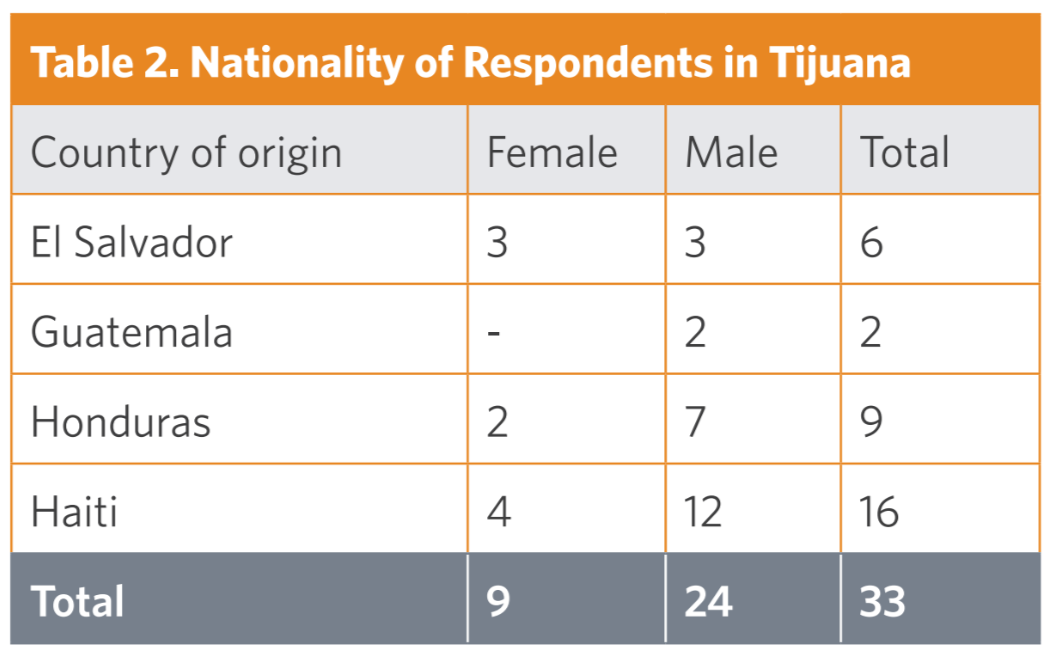
Our respondents were of working age, and mostly men (Table 3). Our (Haitian) researcher found that Haitian women were not as willing to speak to her as were men. Also, most Haitian women tended to be at home or not on the street, while men could be easily found throughout town. There were also fewer Central American women in Tijuana; the caravan had substantially more men than women, and Central American women tended to leave Tijuana (i.e., return home) at a higher rate when they could not cross the border into the US. Exceptions to this were women traveling with their partners and children.
Our Mexico Findings
We initially sought to compare the experience of Central American migrants and Haitians, but our findings suggest that when it came to expenses and livelihoods, the two groups’ experience was not that different, so we report them together. Our Haitian respondents generally had more education and different skill sets than our Central American respondents. However, our sample was not representative (i.e., population-based) and could’ve been biased; we cannot make claims about the education and skill sets of either the Central American or Haitian population in Tijuana as a whole.
Our Haitian and Central American respondents reported differences in their experience of Mexican attitudes. The new wave of Central American migrants generally experiences heightened xenophobia. The government and media portray the caravans in an unfavorable light, and the migrants who arrive with them are viewed negatively in the eyes of both locals and migrants from other countries. In an informal discussion with a local in Tijuana, we heard the view expressed that the Central Americans arriving now (particularly the Salvadorans in her opinion) were “aggressive” and showed “no humility.” She contrasted them with Haitian migrants: her Haitian neighbors, she said, are “calm." Views such as these were mentioned by several of our Central American respondents in reference to their difficulties in finding jobs and creating lives in Tijuana.
In addition to (or because of) the xenophobia, Central American migrants face hurdles in getting a job. A few years ago, employers didn’t request documents. Now, employers request documents such as birth certificates or school records, which are often impossible for migrants to acquire. Central American migrants’ lack of education was not usually a problem for finding work, but lack of documents created challenges in accessing services. Knowing what questions to ask, who to turn to for reliable information, and what resources were available to protect them from abuses were some of the challenges they faced. Their lack of education has also been used by the media and local government authorities to incite division and rejection of the migrant population, resulting in the Tijuanense view of uneducated migrants as lazy and criminal.
Migrants’ Expenses
Housing rent and the payment of bribes to authorities were two of the main expenses mentioned by our respondents.
Housing
In all urban settings, housing is the biggest expense and the greatest challenge for migrants and refugees, and in Tijuana the situation was no different. Rents far exceeded what migrants were accustomed to in their home countries. Most migrants were unable to find housing they could afford on their own in their first months after arrival, and a common strategy was to rent with family members, friends, or fellow migrants they had met on their journey or in shelters.
In addition to the cost, many landlords refused to rent to migrants, although this could be more the case with Central Americans. Though some of our Haitian respondents complained of housing discrimination based on race, most of our respondents were able to rent an apartment with few issues. The local perception of Haitians as hard-working and trustworthy made landlords more open to renting to them. However, attitudes towards Central Americans seem to be more negative, and landlords were reported to be less willing to rent to them.
Alex, a migrant from Honduras, shared his struggles to find an affordable place to live:
It was very hard to find a room because most rooms are rented out in dollars. Where are we going to earn dollars here in Tijuana? Whenever I would go looking for a room they would tell me, “It costs USD 500 a month,” or, “It costs USD 800 a month.” Wow! Where am I supposed to find that kind of money?
Samuel, from Haiti, explained that rent is the most challenging and primary expense:
Per month, I make a little over 4,000 pesos [$209]. But I rent a house for $200 a month. If I don’t work extra hours to make more money, I won’t have enough food to eat. It’s like I’m only working to pay the rent.
Bribes
In Mexico, our respondents explained how bribes related to the immigration process and documentation worked. Mexican immigration officials would ‘lose’ one or more of their payments for humanitarian or asylum applications, and then require additional payments. One migrant describes a commonly mentioned occurrence:
Immigration asks us to pay in two parts. If we pay the first part, they don’t give us the card. You hope that the second payment is all you need. But when you bring that, they say the first payment was lost. You may even have a copy of the receipt… but when they look, they say that the money has been lost. This has happened to a lot of Haitians.
Sometimes officials explicitly asked for a bribe to continue the paperwork.
Women migrants face particular challenges in Tijuana. Many are afraid to be on the streets because of the city’s reputation for violent crime and kidnapping. Women were reluctant to venture out of the shelters, which made it more difficult to find work. One of our Salvadoran respondents who sold candy on the street told how a man had grabbed her daughter by the arm:
I grabbed her other arm and started screaming. A man in a business ran over, and the man trying to take my daughter ran away. After that, I was scared to keep selling candy [...], I’m scared. What I make won’t be worth the possibility of someone kidnapping my daughter. What would I do if that happened? Here, the police does nothing. [MN05]
Others said,
I have no money, I don’t go out. I’m scared. You see really strange people here, and sometimes people steal children. To come all the way here to lose a child? No, no, no. [Woman from Honduras, MN02]
The driver of the taxi we were on was scaring us, telling us to be careful. That there were kidnappers who were taking kids away. [From El Salvador, MN23]
I don’t like it here because there are a lot of crazy people. You could be walking on the street, and someone hits you for no reason. Also, in Tijuana there are a lot of robberies. If my shop was nearer the street, I’m sure it would have been broken into already. I don’t like Tijuana, but I have to stay. [Woman from Haiti, TS12]
Even in the apparent safety of shelters, women remained vigilant, as men and women were often mixed together with little monitoring.
Jobless women relied on the help of family members and friends in the United States, and it’s possible that women migrants in Tijuana receive remittances more often than they send them. Remittances sometimes provided the funds to return home, once the prospect of asylum in the United States faded.
Women traveling with children face the added constraint of lacking childcare options, forcing them to depend on migrant shelters to cover their basic needs. In Tijuana, trusting a stranger with child care was not a viable option, as there were pervasive reports of child kidnappings. There were a few shelters dedicated to women and children, which supported women with childcare. These shelters operated well above their capacity, leaving many migrant women underserved.
Livelihoods
Our Central American and Haitian respondents engaged both in wage labor and self-employment, providing a range of services from hair braiding to construction work. Wage labor was usually low-skilled formal and informal jobs in factories, construction companies, restaurants/hotels, and domestic work. This type of work was plentiful, but unstable and didn’t pay well. There is high mobility between jobs and few opportunities to find more secure work.
Pablo, from Guatemala, said:
After working as a trash collector for three months, I got a job in security. However, that only gave me two days of the week to work. I got that job through a migrant from Honduras whom I met at Casa...[now] I work at a hotel and golf resort.
One woman from El Salvador describes the challenge of informal employment:
I began to work in the factory in April. Before that, I worked for a woman downtown caring for her children and cleaning her apartment… The work was really tough. I had to care for the two kids, do all the cleaning, do her laundry, grocery shopping… I would take my own food. She said she would pay me MEX 1,200 [US $59.62] a week. When the time came, she only paid me MEX 700 [US $34.78]. I thought maybe she would pay me the rest later.
Women migrants encountered particular problems in Tijuana, in part because of their fear – and bad experiences — of being on the streets. (See BOX: Women Migrants in Tijuana, Mexico). Leveraging service-oriented skillsets was more common among Haitians:
When you’re not 100% legal in a country, you don’t have the freedom to do a lot of things, but our community has achieved a lot of things in terms of commerce. If you notice at all the traffic light stops, you’ll see a Haitian selling something; in the market too you’ll find Haitians that have their own shop and selling things, there are also Haitians who have restaurants and barbershops; there are Haitians working in the taxis or Uber… Haitians are always fighting to integrate themselves one way or another so that they can defend their rights to eat and to live.
Even if they had several jobs (more like gigs), most of our respondents were barely able to cover their day-to-day expenses, or to save any money. It took several years to get work that matched their skills, even with the support of their networks. While a few have found financial success, most are struggling to make ends meet and save while avoiding exploitative work conditions. Our Haitian respondents reported plenty of work to be found, usually through community networks, Facebook, and word of mouth. One Haitian woman who learned Spanish before arriving in Tijuana was connected to her first job through a Haitian friend who introduced her to a Mexican who helped her find a job. Another young man found his first job through Facebook:
I was part of a Mexican Facebook group, and they posted about me, saying that I was a doctor and looking for work. They even posted my degree. Eventually I found work with a clinic.
Many drew on professional degrees and technical skills they acquired before coming to Mexico. Even those without paperwork leverage their skills:
In Tijuana, I went straight to a shelter and spent a year there. I didn’t have a temporary residence card [but I could cut hair. So I bought some clippers and went to work as a barber and lived off clients’ tips.
Jerome drew on his experience as a cell phone repair mechanic to open two electronic repair shops in Tijuana:
In Haiti, I was a college student and…repaired broken phones for people in my neighborhood … In Brazil, I found work at a telecommunications company. At first, I did mechanical work, but my boss needed someone with skills to install cameras, so I told him I could do it. They gave me 16 cameras to install to make sure I could do the work. When I installed everything correctly, they gave me the job… Then I got the idea to start an electronics repair business.
Wilson studied education and linguistics in Haiti, and worked in a factory when he first arrived in Tijuana. Then he started teaching French to his co-workers for a small fee and garnered enough of a reputation that he was referred to a private school in need of French teachers. He now teaches at the school part-time, and also gives private lessons outside of school. He said:
As a foreigner living in Tijuana, with a family and other people to support back in Haiti, you won’t get far if you don’t have any intellectual, technical, or language skills. You need contacts and references. If you have nothing to offer, nobody is going to come looking for you. If a Haitian has technical skills like plumbing, is a car mechanic, or things like that, you’ll make money. But if you go into a job where all you’re doing is putting in hours, then you don’t make any money.
Jean studied accounting and ran a business in Haiti, and used his expertise to leverage a higher-paid position in an electrical company, where he now manages the accounts:
I found this job through a student in my French classes. Her father owns the company, and she told him about me…It’s a lot of work. At the end of the year, I prepare a huge financial report for the company. I make USD 162 a week and work from 8am-4pm.
Our Central American respondents generally found work through word of mouth and being at the right place at the right time. There was high mobility among jobs, though it was common for women to engage in domestic labor in addition to factory work. Central American migrants also brought to Mexico a variety of skills that they leveraged into jobs.
Houston began waiting tables at a restaurant and worked his way up to managing thirteen restaurants in several locations:
I was offered a management position to oversee 13 restaurants in Zona Rio [a wealthy commercial area in Tijuana]. I found that by looking for maintenance jobs on the internet… My interviewer told me to try being a waiter for a week and, depending on how it goes, managing the restaurant. I accepted and worked for the restaurants for nearly 11 months.
Many migrants with professional degrees have not been able to get their degrees officially recognized and cannot be accredited to work in Tijuana. Constant, who has a business selling clothes, worked as a high school mathematics teacher in Haiti. When he presented his credentials to schools in Tijuana, he was told he would have to go back to school and get re-certified. But with a family to support, going back to school was not an option for him.
For Haitians, being able to speak Spanish was particularly important, and those who had lived in Spanish-speaking countries like the Dominican Republic before they came to Mexico and learned Spanish were at an advantage. Haitians often mentioned the importance of speaking Spanish both for jobs and to integrate into Mexican society (although some noted that many Haitians don’t want to integrate and are content to remain in their own separate communities). Jean said his lack of Spanish kept him from finding a higher-paying job sooner, and complained that employers did not check if migrants have previous work experience:
The bosses never check the level of education the Haitian employees are coming in with. They just give you a form to fill out, but it doesn’t go into detail about your previous experience. It’s like we’re a bunch of slaves who’ve come to be put to work at the lowest levels. Not knowing the language also hurts us a lot. In my first job, my boss knew about my background in accounting and my degree, but he couldn’t give me the position I wanted because the communication piece was missing.
Some migrants who are undocumented, regardless of education level, work in factories or construction because doing so provides the opportunity to gain a CURP (Clave Única de Registro de Población), a registration number similar to a Social Security number. The CURP serves as an identification card and enables factory workers to access public health insurance and health services. Factories also sometimes offered opportunities to open bank accounts for workers.
Financial Support
Their meager incomes were insufficient to cover the costs of life in Mexico, and most migrants relied on help from shelters, local organizations, or relatives in the U.S. or home countries. The average weekly salary for our interviewed factory workers was USD 70. Rent for a room or a house can be upwards of USD 100 a month, not including utilities. The cost of food, transportation, and other expenses strains a family’s monthly income of USD 280. One respondent talked about his struggle with living under such a tight budget:
I have to ask my boss for more money because I end up sending all of my earnings to my son. My boss then gives me some of his own food so I can eat […]when I don’t have enough food, I won’t lie, I buy milk and bananas, and make myself a milkshake. For breakfast. I take vitamins and saline solutions to remain healthy.
In the first months of arrival, both Central American and Haitian migrants relied heavily on assistance from friends and family for housing, to find jobs, and sometimes for financial assistance. Jorge from Honduras explains how important this support is:
Since we don’t have steady jobs, we rely on friends and family members to send us money, and that’s how we survive. [My family] sends me the money through Western Union, and I only need my humanitarian visa to access the money they send me.
John, from El Salvador, received money every month from his mother until he was able to get back on his feet:
I rented a room with the money my mom sent me. She would send me the money through MoneyGram or Western Union, and I would ask friends I made in town to help me access it without charging me.
Some migrants resorted to begging for money and food so they could feed their children. Respondents who admitted to panhandling said they had never begged before, but lacked alternatives. One respondent said he had tried to sell purses in parks, but did not have a selling permit and was threatened by local merchants. Another respondent begged because every shelter she visited was at capacity and could not assist her. Without any relatives or friends to turn to in Tijuana, these migrants often turned to good Samaritans for help instead.
Livelihoods Ratcheting
Most respondents lived paycheck to paycheck and were unable to save or boost their livelihoods, but some were able to do both. There were two paths to this livelihood ratcheting. Either a migrant had savings (either from a job in Tijuana or with savings brought from home), or livelihoods were boosted by family, friends, or networks in other countries who helped them navigate difficult periods and provided investment funds.
The savings route is exemplified by Gersan, who had been a mathematics teacher in Haiti, and used his savings to start a business:
When I left the factory, I opened my business using my own funds. I used the money that I had saved from my first job and also money that I brought with me from Haiti.
The network route to livelihood ratcheting is where Haitians differed from Central Americans. Haitians appeared to have stronger community networks, both in Tijuana and abroad, that supported them with investment funds and helped them in other ways. Central Americans tended to form networks beyond their own national communities, often including local Mexicans. For example, Jerome relied on his networks to get him on his feet when he first arrived in Tijuana, as well as for seed funds to open his first electronics repair shop:
When I first arrived, I only had USD 100 in my pocket. I called an uncle, who lent me US$50, and an aunt, who sent me US$100. My mom sent me another $350...As soon as I started working and making money, I made sure to pay them all back until I no longer owed them. It was a pleasure for me, recently, a Mexican who had lent me money had a problem and said he needed USD 500, and that I was able to help him out.
Social networks were often formed before arrival. Jean-Marc connected with a Haitian woman already in Tijuana through a Facebook group while he was living in Brazil:
I told her I was coming to Mexico and when I arrived, she welcomed me with open arms. She came to pick me up at 2am when I arrived. It’s important to stay connected with people and look for people you can connect with.
The concentration of Haitians in Tijuana allowed community and networks to form quickly and effectively. Most Haitians found their jobs through word of mouth and network connections. Some, like Samuel, took pride in helping other Haitians and building their reputation as hard-working people:
I found my first job over the internet… When other Haitians heard I had found a job in this company, they asked me to help them get one there too. I asked my bosses what they could do, and they said it was fine to bring them on. They said even if those Haitians didn’t have papers, they would talk to immigration and help to change their status to be able to work. My job took in more than 150 Haitians.
It’s likely that Haitians’ favorable reputation in Tijuana helps them find jobs when they don’t have documents. This was not the case with Central Americans. Without documentation, and struggling with a poor reputation in Mexico, it was difficult for Central American migrants to find decent work (i.e, that was secure and paid regularly) and to open a bank account, both of which were needed for livelihood ratcheting. Documentation can also help avoid being picked up by the police and being extorted (but is not always a guarantee).
Central American migrants who came to Tijuana with the caravans benefited from new host country policies offering them an avenue towards documentation. A Honduran man who had already been in Tijuana without documentation decided to take advantage of the new policy and improve his livelihood outcomes:
By the time the second caravan came, the president of Mexico said he would help the migrants by giving them a permit so they wouldn’t be in the country illegally. A friend of mine came in the caravan and told me to apply for my humanitarian visa, pretending I had come in the caravan as well. I was approved for my visa in 25 days.
Financial services in Tijuana
Savings Groups
ROSCAs (Rotating Savings and Credit Associations) or informal savings groups or money clubs are common in African and Caribbean societies, and migrants participate in them in Tijuana. For example, a Haitian susu (in Creole also called “reso,” “eso,” or “kob sol” or soldes) consists of a group of people who are willing to pool funds on a regular basis (weekly, monthly), usually with someone in charge to control the pool. An example:
A group of 26 individuals contributes $200 every two weeks. This scenario would take one full year (52 weeks) to complete, with each person contributing a total of $5200. Every two weeks, someone in the pool cashes out. The person in charge is responsible for collecting and disbursing the funds to the appropriate person, according to a roster that is set at the beginning of the event, so everyone knows exactly which week they’ll be cashing out.³⁴
Most migrants in Tijuana live paycheck to paycheck and are unable to afford to join informal savings groups. Housing costs take up most of their income, and after paying for basic needs, they barely have enough to send remittances back home to ill or elderly parents, spouses, and children. Katyana, who sells merchandise on the streets, is an example:
Mexico is only good for living day to day. I can’t save any money, and I can’t send money home either. A normal salary is USD 63. You can’t spend that money on anything if you hope to send even USD 50 back home to Haiti. I’m not able to save any money at all, and I don’t have enough money to even join a soldes.
People participate in these savings clubs for different reasons. Some find it hard to save on their own, and the savings club gives them a sense of obligation. On the other hand, there isn’t any guarantee that everyone in the pool will come through consistently or be held responsible; there’s no credit check, and the group is based entirely on trust. Our respondents expressed trust concerns — that those involved would leave with their money. Constant said:
You really have to trust the people in the group. If the person in charge leaves, you lose your money. You should keep your money at home and do a personal soldes with just yourself. Haitians are never here to stay, so you run a big risk joining a soldes.
Still, some migrants do join an informal savings group successfully. Jerome, a business owner, said:
I have a bank account, and I’m also in a soldes, where I’m paying USD 200 a week. When it’s my turn to get the money, I get up to USD 2,000, which I either put away at the bank, invest it, or save it.
Banks
Access to banks is limited to those who possess valid documents. New banking regulations in Mexico require foreign nationals to present a valid passport, their CURP, and sometimes a permanent residency card in order to open a bank account. Banks will accept temporary residency cards and humanitarian visas in lieu of a permanent residency card; however, they prefer permanent residency cards because this indicates a higher likelihood that the account holder will stay in Mexico. Migrants must also provide a Mexican phone number and email address. Most of our respondents did not have a passport and were unable to open bank accounts despite meeting all other requirements.
Interviews with bank employees indicated that possession of all required documentation could still prove insufficient for opening a bank account. If a bank employee suspected a migrant might use their account for illicit purposes, they could request further documentation in an effort to deter the migrant from opening an account. The suspicion does not need to be backed up by any evidence and was entirely at the employee’s discretion. A consular official from El Salvador said he had been denied a bank account because he “lacked credibility.” The suspicion of criminal intent can carry over once a foreign national has established an account with the bank, as was the case with Houston from El Salvador, who was denied access to his money because of his appearance:
I once sued Banamex [a Mexican bank] for discrimination. They tried to humiliate me and claim I was a gang member. I had an account with them back when I worked at the manufacturing plant. I went to withdraw money one day, and they requested my ID, so I gave them my residency card.
Then they requested my passport, so I told them I didn’t have one. They saw my tattoos and began to say I was a criminal and belonged to MS13… I pulled out my phone and called an attorney friend who works for the government […] Eventually they all had to take an anti-discrimination course and training on how to treat migrants […] They were in training for six months.
Many jobs in the formal economy required migrants to have a bank account. Therefore, restricted access to banking not only amounted to financial exclusion, but also meant migrants lost out on employment opportunities that protected workers’ rights and paid competitive wages. Some manufacturers, in need of workers, brought bank agents into their factories to help migrants process their paperwork.
Haitians sometimes had access to banks through their employers. No respondents had opened bank accounts themselves, but many had access through their employers. Samuel shared his experience:
I do have a bank account. But I didn’t get it on my own. I went to the bank and asked to open an account, but I couldn’t because they asked for a temporary or permanent residency card […] The company takes your passport, with your picture, and opens an account under your name.
Doorstep banking was a practice that benefited Haitian and Central American migrants who arrived prior to February 2018, when new banking regulations came into effect. The new regulations restrict the ability of banks to open accounts for migrants in their place of employment. Instead, all foreigners must personally request a bank account at official branches, and all are required to provide the documents mentioned previously; namely, a valid passport, their CURP, a permanent or temporary residency card, a Mexican phone number, and an email address.
Money Transfer Services
Access to money transfer services also requires a valid visa or residency card. Although most Central American migrants who arrived with the 2018 caravans were provided with a humanitarian visa, many who arrived prior to or after the caravans lacked the documents to live in Mexico legally. This lack of documentation prevented migrants from accessing remittances, and meant they had to rely on locals to send and retrieve their money. The fees locals charged for this service ranged from a flat fee of USD 2.50 to USD 7.85. Some respondents had friends who did not charge them for the favor, but this was not the norm.
Analysis – Migrants’ Financial Health
Drawing on the financial health framework we presented in the introduction, we examined four key indicators. Can refugees and migrants:
- Meet daily consumption needs including food, clothing, shelter, hygiene and health needs? Most of our respondents were able to meet daily consumption needs, but many continued to rely on charity to do so. This was particularly the case for Central American migrants who had arrived most recently. Shelters tied to religious institutions proved critical during the first few months of arrival in ensuring migrants met their consumption needs. Women in particular, faced with child care, often struggled to keep food on the table and continued to rely on shelters for their basic needs. Men, both Haitian and Central American, were more able to find employment and a place to liveafter a few months of relying on the shelter for assistance.
- Recover from financial shocks? Such recovery depends on being able to liquidate stores of value, borrow from social networks, or access humanitarian aid. For Haitians, strong networks both in Haiti and the US meant funds were available to Haitians in Tijuana. Faced with a financial setback, many Haitians could count on their relative as a buffer. For Central Americans, networks were more precarious. Some Central Americans relied on their networks in the U.S., but many had to turn to locals – their employers or religious organizations – when hit with a financial shock. Others had to start over, sometimes returning to shelters. For Central American women, a financial setback could mean having to go back to their country of origin.
- Raise lump sums (or accumulate savings) to invest in assets or take advantage of opportunities? Many migrants are stripped of their assets before or during their journeys, and have to start from scratch to create lump sums. Better-off Haitians were able to muster lump sums to start and expand businesses and to send themselves and children to school.Central Americans often struggled to put together lump sums, saving only enough to send money home or to rent a room or apartment.
- Expand financial planning horizons? In the first few months after arrival, a daily or weekly financial planning horizon is the norm, and in Tijuana many don’t progress beyond this. But those who are able to stabilize financially are able to adopt longer planning horizons. In Tijuana, migrants who found and hung onto jobs could gradually ratchet up their livelihoods from meager wages to better-paying work, allowing them to plan for their futures. Haitians who were able to slowly grow their businesses, considered putting down roots in Tijuana. Some Central Americans were also able to increase their earnings and build a life in Tijuana, but most were likely to keep their eyes set on moving to the United States.
How do migrants ratchet up their livelihoods after they come to the city, and how do financial services improve their livelihoods? Based on our qualitative interviews (so we cannot generalize about the Haitian and Central American populations in Tijuana), it seems that Haitians and Central Americans experience the same livelihood problems all migrants to urban areas confront: an initial period of low-income work as they struggle to establish their livelihoods, while trying to find affordable housing, childcare and schools for their children and decent (or any) work. Their uncertain migration status and shifting immigration policies further add to their stress. In particular, the cost and time involved in securing legal documentation to remain in Mexico, work legally, and access banking and other services are obstacles. Many migrants never go beyond what we call ‘survivelihoods’.
Some migrants, however, do manage to progress beyond basic survival. They are able to ratchet up their livelihoods and improve their economic and financial situation considerably. What enables this? One difference between Haitians and Central Americans seems to be that Haitians enjoy two things more than Central Americans: a more positive reputation with local Mexicans, and stronger ‘bonding’ social capital within their own community³⁶. In Tijuana, these two advantages enabled greater employment opportunities for Haitians compared to Central Americans. The latter struggled with a reputation as being “aggressive”, “gang members,” “drug dealers,” and so forth. In addition, the Central Americans were a much less cohesive group, lacking the bonding social capital Haitians enjoyed, and seemingly less willing or able to help each other, financially at least.
Our Haitian respondents had more education, professional training, and entrepreneurial experience compared to our Central Americans, but again, this could be a function of our biased sample. A survey of a population-based sample of Haitians and Central Americans in Tijuana would give insight as to whether the two populations are different in terms of their livelihood experience and their urban or rural background. Our Central American respondents’ general lack of previously developed skills (prior to migrating) relegates them to lower-wage, insecure, and more unstable jobs, and their income barely enables them to meet their household needs.
When it came to the use of financial services for purposes of livelihood ratcheting, both Haitians and Central Americans view access to banks as too problematic to be of much use. Bank documentation requirements together with the suspicious attitudes of the bankers were a major discouragement to both groups. When it came to savings, very few were able to use banks, and no one seemed to want to. It was easier to use informal savings groups, and some of our Haitian migrants did, but there were concerns about how trustworthy the group members were, and worries that leaders might abscond. A general view of our Haitian respondents was that it was best to rely on oneself when it came to savings, and one’s family – including those who lived back home or in the US – to provide investment funds.
Policy and Program Recommendations
This section suggests policy, programming and donor initiatives that could promote better financial health for refugees, whether in towns or in camps and settlements, and particularly for those in protracted (i.e. long-term) situations. We base our recommendations on our findings in Uganda (Kampala and Bidi Bidi settlement) and Mexico (Tijuana).
- Policy recommendations refer to actions by both the national and city governments that should be advocated for by aid agencies such as IRC.
- Program initiatives that support refugee livelihoods and financial health could be directly undertaken by IRC and other aid agencies, including national ones.
- Donor initiatives are actions donors could take to encourage/support the policy and program recommendations we are making.
In general, we believe that ‘smoothing the way’ – i.e. making it easier for refugees to pursue their own goals and engage in livelihoods the way they see fit, and ‘building on what is working’ – are effective and feasible strategies for aid agencies. In many cases, smoothing and building are more effective and feasible than introducing new programs and technologies, especially when the latter are new or very different from what is already being done by refugees and local communities. The following chart summarizes our recommendations through a financial health lens.
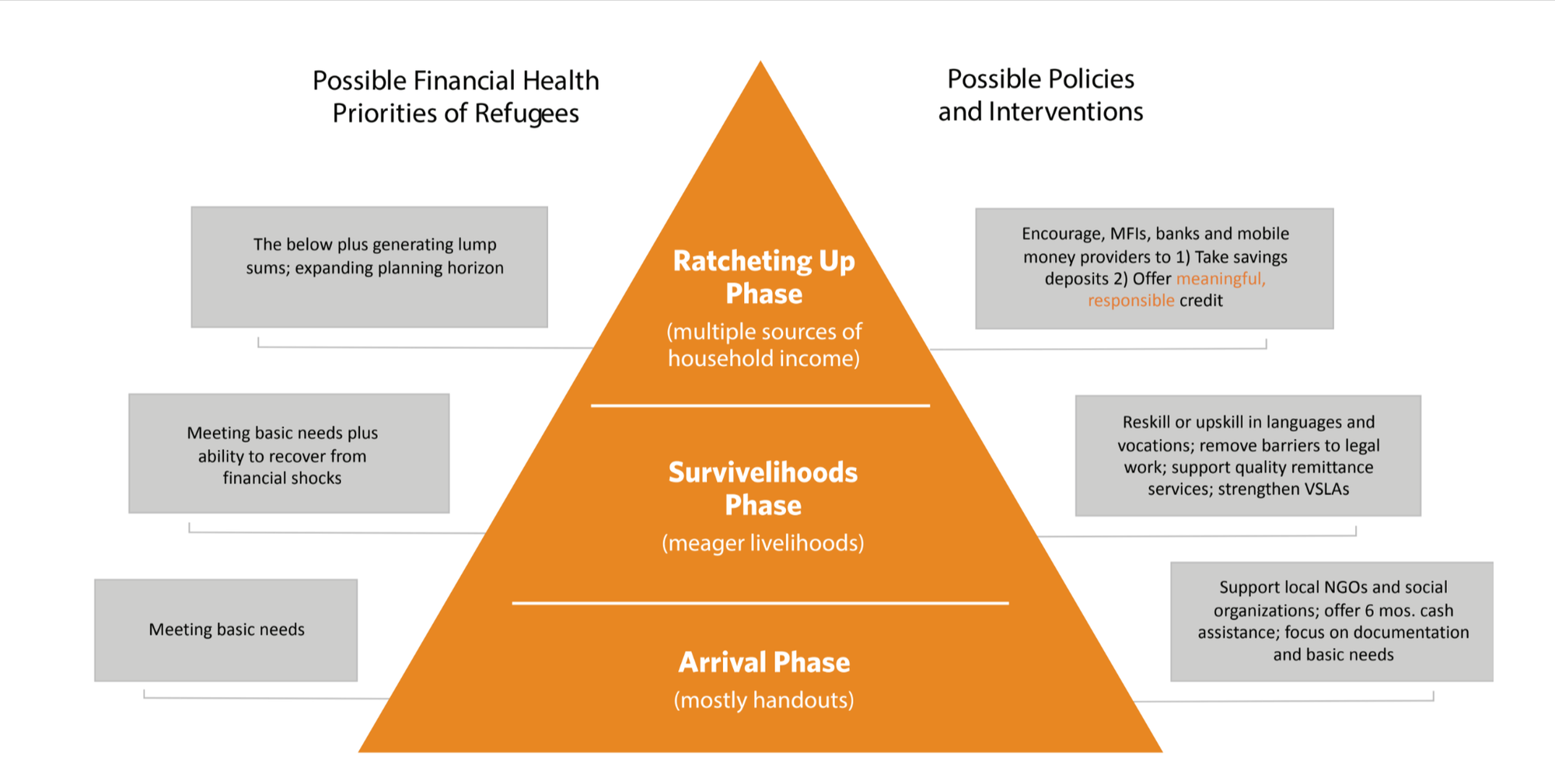
Policy Recommendations – Smooth the Way
The basic advocacy approach – at both the national and city levels – is to help government and municipality officials recognize that it is in the interests of their towns to support refugee/migrant livelihoods. The argument to be made is that migrants bring with them a variety of assets: skills, experience, entrepreneurship — and funds. Migrant entrepreneurs provide services and employment and promote cross-border trade. If migrants are blocked and unable to utilize these assets, these resources are wasted. Removing barriers and smoothing the way can help refugees ratchet up their livelihoods, improve their financial health, and allow their energy and ambition to flourish. In so doing, the city benefits too.
Based on this message, city and government officials can be encouraged (with in-kind and donor funds) to support migrants, including by expanding their access to information about immigration requirements, livelihoods and financial services; and by dismantling or minimizing obstacles to documentation and financial services. There are a variety of cost-effective and easily implementable ways to do this, as we discuss in more detail below.
A. Expand Access to Information
Many migrants, especially newcomers, rely on informal information about immigration procedures (e.g., application fees and the asylum process), about how to pursue livelihoods (sources of employment, where/how to start a small business), and financial services (how to get a bank account, or make money transfers). Their Information, often acquired through their networks, can be useful but also sometimes inaccurate. Humanitarian agencies can improve the accuracy of all kinds of information. For example, aid agencies could use social media to provide information on jobs, housing, language classes, childcare, and policy changes. The same channel could also help correct or fact-check rumors.
Police stations are often the first point of contact for arriving migrants and refugees, and police could be trained to provide information and assistance.
B. Provide Guidance and Assistance in Obtaining Necessary Documentation
One of the biggest obstacles confronting refugees in their pursuit of both livelihoods and financial health is obtaining documentation, including refugee IDs, driver’s licenses, work permits, business registrations and licenses, and re-certification for various vocations. These documents are needed to access formal work, financial services, health care, education, and housing. Removing or minimizing the barriers and roadblocks to these documents is clearly a task for the government, and doing so is not necessarily an onerous or costly task.
Obstacles and roadblocks to obtaining documentation include the following:
- Lack of good information about local regulations, necessary documentation, financial services and humanitarian assistance (see above point about information to address this);
- Bribes and fees beyond the financial capacity of the refugee. Whiles eliminating bribes might be beyond the scope of advocacy, governments could be encouraged to reduce fees.
- Complex bureaucratic requirements. Humanitarian agencies can work with municipalities and consulates to streamline the process of acquiring documentation, especially refugee IDs. Our respondents said many refugees resorte to fake IDs only because bona fide IDs were so hard to come by. One approach might be to set up mobile help desks. For example, UNHCR and the Salvadoran Consulate in Tijuana have set up such mechanisms with great success, and these efforts could be replicated and scaled up. Such touchpoints could provide interpreters if needed.
Program Recommendations – Smooth the Way
The following program initiatives could be directly undertaken by IRC and other aid agencies, including national ones. As with the policy recommendations, the idea is to smooth the way for refugees by reducing barriers, and to build on existing activities including local (host) support. We recognize that there are many freestanding livelihood programs that aim to support refugees, and there are also many flaws in these programs, but these issues have been well covered elsewhere and we do not address them here³⁵. The three issues we focus on for program attention are: supporting social cohesion, improving access to local information, and improving access to formal and informal financial services. ³⁶
A. Support Social Cohesion
One of our strongest findings is the importance of local networks in assisting newcomers with navigating their new places and helping with finding housing, child care, and employment, as well as financial support. Aid agencies should foster community among migrants and between migrants and the local hosts. Cultural fairs, information drives, festivals, musical groups, and sports are some ways to highlight the cultural and social assets of migrants to the host population and promote social cohesion. Social networks promote integration or a sense of belonging that can dissuade migrants from dangerous or illegal onward journeys, or returning to the dangers of violence or poverty in their home countries.
Local community efforts, including by charities and places of worship, are important sources of help for refugees in their early days. Many charitable organizations are funded by locals who themselves may not be well-off. Assistance to locally known and respected institutions could go a long way in helping early arrivals manage in new surroundings.
B. Expand and Improve Access to Local Information
The following are relatively simple programming initiatives that humanitarian agencies could take to improve refugees’ information about crucial aspects of their daily lives:
- Identify affordable housing opportunities. Agencies could do housing research and landlord outreach for migrants in parts of the city that have good access to jobs and necessary services. Such information could be shared through shelters and curated social media channels. A study of nine urban areas found that community-based efforts to secure adequate housing can be cost-effective and efficient at providing refugees with protection.³⁷
- Improve childcare options. The lack of affordable and safe childcare prevents many women migrants from pursuing work and gaining some independence from shelters. While it is crucial for governments or host communities to provide childcare, humanitarian agencies can fill in the gaps while working toward a more permanent solution. Humanitarian agencies can research childcare options, vet affordable options, and even provide initial subsidies to mothers in the first 3–6 months of a new job.
- Share information on exploitative employers. Many respondents mentioned bad working conditions in factories or construction companies, but lacked mechanisms to report abuses and feared retaliation if they were to report abuses. Language barriers prevented some Haitians from speaking up. Agencies could document and keep track of exploitative companies and employers, and help migrants be more aware of their rights. Aid agencies should be sure to provide welcoming and confidential spaces to disclose this kind of information, and should also provide pathways for legal protection.
- Re-skill or up-skill in specific languages and/or vocations. Skills that can be applied immediately or are “portable” or competitive are highly valued. In Uganda, refugees need to speak Luganda, and more importantly, English. In Tijuana, Haitians need Spanish. In camps and settlements like Bidi Bidi, refugees see livelihood skills that are competitive or sustainable, like mushroom farming, as important. What was not valued was training in a vocation (e.g., tailoring in a settlement) that had already reached market saturation, or soon would. Some respondents created self-styled apprenticeships to deepen skills and earn credentials. NGOs could help make these kinds of matches, perhaps providing compensation to both the mentors and their protégées. If migrants with professional degrees and qualifications could get their credentials recognized, they could upgrade their jobs and pay, and benefit the local economy and service sectors like health and education.
C. Improve Access to Formal and Informal Financial Services
Good financial services strengthen livelihoods, and in turn generate more reason to use those services. This was true for savings, loans, and remittances. In Kampala, especially, demand for credit grew as livelihoods ratcheted upwards. Small amounts of credit could help stock inventory, pay rent, or overcome other working capital hurdles. Ssuubiryo Financial Services (SFS) also demonstrated a willingness to offer savings services to refugees. These kinds of organizations fill the gaps in financial services needed for livelihood development and household savings.
Humanitarian agencies can help migrants who want information about and access to financial services of all kinds, and can support banks and MFIs to serve refugees.
- Promote financial literacy and education. Lack of financial literacy makes refugees susceptible to fraud and misinformation, and inhibits them from accessing financial services.³⁸ Financial education programs for migrants – often related to remittances — are being implemented by international organizations, financial institutions, and the governments of sending countries.³⁹ These kinds of financial education programs could easily be adapted to refugees.
- Support banks and MFIs to serve refugees. Humanitarian agencies can advocate for, and work with banks to smooth the way to opening an account and support bias training for bank staff. Our respondents fully understood the use of mobile money accounts and transfer services, and many also understood the importance of bank accounts. Helping refugees negotiate barriers would allow them to access services.
- Sensitize banks to particular issues and needs of the migrant population. Barriers to formal financial services – obtaining a SIM card for mobile money accounts and transfer services, or opening a bank account are highly country-specific and require careful local analysis, including local political feasibility, of how different types of barriers could be addressed. For example, in countries where individual banks can decide which ID they require for KYC, it is possible that refugee ID could be allowed as valid KYC by Ugandan government. In other cases, as perhaps in Mexico (we did not explore this) – government and central bank policies might be more prohibitive.
- Banks could translate marketing materials into migrant languages.
- “No Frills” savings accounts are good starting points for migrants as they require minimum documentation.
- Banks should ensure consistency about their policies on account opening and documentation. Many banks are inconsistent across different branches within the city, in determining a foreign national’s credibility for an account, and bank staff use highly subjective criteria in making determinations.
- Banks could offer doorstep banking at employer sites. Employers can serve as guarantors especially for migrants who lack the necessary documentation to open accounts on their own. A greater reliance on temporary residency documents and employment verification, could lend itself to higher bankability among the migrant population.
D. Help Refugees Set Up Informal, Safeguarded Savings Mechanisms
Migrants in shelters who lack access to formal financial services could greatly benefit from savings practices like the one established by Casa del Migrante (Tijuana), in which migrants are encouraged to save a portion of their wages during every pay period. This would allow migrants to build capital and become independent of shelters in the short term.
E. Offer Mobile Money Support for Remittances and Financial Services
For most refugee entrepreneurs, their livelihoods would not be possible without a mobile phone and a SIM card. Similarly, for struggling refugees, remittances are significant, even when sporadic or small, because even a few dollars can prevent hunger or secure medicine. Mobile phones are therefore one of the most crucial livelihood technologies available to refugees, and any barriers to their use – such as the suspension of SIM cards — have significant consequences, as illustrated in the Box, which outlines encouraging recent developments in Uganda.
F. Starting New VSLAs is Not Always the Best Role for NGOs
Many respondents are part of one or several VSLAs, and others participate in RoSCAs. Because these clubs are familiar, starting new groups may not be necessary, but helping groups to upgrade their services (e.g., from RoSCA to VSLA, or from a hobbled ASCA to a thriving VSLA) might require technical support. NGOs could assist existing groups to upgrade their operations or to link them to financial service providers.⁴⁰ For refugees who are not familiar with RoSCAs or ASCAs, NGOs should consider introducing a simpler and possibly more effective model first. ⁴¹
Conclusion
Efforts to research and support the financial health of refugees bring together two fields that are not traditionally well integrated: financial inclusion and humanitarian assistance. Increasingly, these fields are beginning to ‘speak’ to each other, and doing so is particularly important in protracted displacement settings, where refugees are stuck in camps, settlements or cities for many years without options for onward movement or return home. In these settings, humanitarian assistance increasingly takes on developmental aspects, and the tools of development, including financial ones, become relevant. Supporting refugees’ efforts to ratchet up their livelihoods is also supporting them on the road to financial health, and as noted earlier, this is a win-win situation for refugees, for host countries, and potentially for migration destination countries – refugees who are doing well are less likely to want to embark on dangerous journeys. At the same time, humanitarian assistance will always be an important component for those who cannot support themselves.
The evidence from Uganda and Mexico suggests there is good potential for supporting the financial health of migrants or refugees, and some city and national institutions, including government ministries and banks, are beginning to recognize the value of enabling financial health. Support from donors and aid agencies can help to push this recognition along.
Footnotes
Works Cited
Arevalo, S. P. et al. (2015). “Beyond cultural factors to understand immigrant mental health: Neighborhood ethnic density and the moderating role of pre-migration and post-migration factors.” Social Science & Medicine 138: 91–100.
Atkinson, A. and F. Messy. (2015). “Financial Education for Migrants and Their Families.” OECD Working Papers on Finance, Insurance and Private Pensions. OECD.
Bautista, Nidia. “The Migrant Caravan Is Straining Tijuana’s Resources, and Patience.” CityLab, December 5, 2018. https://www.citylab.com/equity/2018/12/tijuana-migrant-caravan-asylum-border-trump/577396/.
Betts et al. Refugee Economies: Rethinking Popular Assumptions. Refugee Studies Centre.
Boswell, Alan. “Contested Refugee: The Political Economy and Conflict Dynamics in Uganda’s Bidibidi Refugee Settlements.” Danish Refugee Council and Danish Demining Group. European Union, 2018.
Chan, C. S. et al. (2015). “The contribution of pre- and postdisaster social support to short- and long-term mental health after Hurricanes Katrina: A longitudinal study of low-income survivors.” Social Science & Medicine 138: 38–43.
“Convocatoria Dirigida a Organizaciones de La Sociedad Civil (OSC) Con Domicilio Fiscal En Los Municipios Que Se Indican, Para Presentar Proyectos de Inclusión Social Enfocados a La Atención Del Flujo Extraordinario de Migrantes (FM) En Tijuana y Mexicali, Baja California, Así Como En Tapachula, Chiapas; Dentro Del Programa de Coinversión Social.” Government, SEDESOL, November 11, 2016. http://dof.gob.mx/nota_detalle.php?codigo=5460711&fecha=11/11/2016.
De Vriese, Machtelt. Refugee Livelihoods: A Review of the Evidence. Geneva, Switzerland: Evaluation and Policy Analysis Unit, UNHCR. (2006).
DHS. Assessment of the Migrant Protection Protocols (MPP). 28 Oct. 2019. https://www.dhs.gov/sites/default/files/publications/assessment_of_the_migrant_protection_protocols_mpp.pdf.
Easton-Calabria, E. (2016). “‘Refugees asked to fish for themselves’: The role of livelihoods trainings for Kampala’s urban refugees.” New Issues in Refugee Research: Research Paper 277. Geneva: UNHCR.
Easton-Calabria, E. and R. Hakiza. “In the Interest of Saving: Refugee-led micro-finance in Kampala, Uganda.” Development Policy Review.
Jahns-Harms, E. and Wilson, Kim. Enterprise Development & Microfinance, 2018-09, Vol. 29 (3–4), p. 287–30.
IDMC (2015). Home Sweet Home: Housing Practices and Tools that Support Durable Solutions for Urban IDPs.
Kirbyshire, A. et al. (2017). Mass Displacement and the Challenge for Urban Resilience. Overseas Development Institute.
Idris, Iffat. “Integrated Approaches to Refugee Management in Uganda.” (2020).
Ladha, T. (2017). “Beyond Financial Inclusion: Financial Health as a Global Framework.” Center for Financial Services Innovation.
Jacobsen, Karen and Susan Fratzke. Building Livelihood Opportunities for Refugee Populations: Lessons from Past Practice. Washington, DC: Migration Policy Institute. (2016).
Krause-Vilmar, J. (2011). The Living Ain’t Easy: Urban Refugees in Kampala. New York: Women’s Refugee Commission.
Koizumi, Koichi, and Gerhard Hoffstaedter. Urban Refugees: Challenges in Protection, Services and Policy. London; New York: Routledge. (2015).
Meyer, Maureen. “Q&A: Analyzing Mexico’s Current Migration and Asylum Policies.” WOLA, 7 May 2019.
Momodu, S. “Uganda Stands out in Refugees Hospitality | Africa Renewal.” Africa Renewal. United Nations.
Onias Derilus. “Sou Sou (aka SuSu, Kob Sol, Reso, Eso) Money Savings Clubs Explained.”
PricewaterhouseCoopers. “Financial Services.” PwC. https://www.pwc.com/ug/en/industries/financial-services.html.
“Rapid Household Economy Analysis, Bidibidi Refugee Settlement, Yumbe District, Uganda.” DCA, Save the Children, 2017.
Rohwerder, Brigitte. Sustainable Livelihoods in Ugandan Refugee Settings. GSDRC Helpdesk Research Report 1401. GSDRC, University of Birmingham, 2016.
Rutherford, S. and Vander Meer, P. (2014). “ROSCAs on the rebound.” Center for Financial Inclusion [blog]. http://cfi-blog.org/2014/11/17/roscas-on-the-rebound/ (posted on 17 November, 2014).
“San Ysidro Land Port of Entry.” U.S. General Services Administration, accessed November 10, 2019. https://www.gsa.gov/about-us/regions/welcome-to-the-pacific-rim-region-9/land-ports-of-entry/san-ysidro-land-port-of-entry.
“Savings Groups For Refugees, 10 Tips for Development and Humanitarian Actors.” (2019). SEEP Network.
South Sudan | Global Focus. https://reporting.unhcr.org/southsudan. Accessed 31 Aug. 2020.
“Trump Cuts Refugee Cap to Lowest Level Ever, Depicts Them on Campaign Trail as a Threat and Burden.” The Washington Post. https://www.washingtonpost.com/immigration/trump-cuts-refugee-cap/2020/10/01/a5113b62-03ed-11eb-8879-7663b816bfa5_story.html.
“Uganda Comprehensive Refugee Response Portal.” Country-Uganda. UNHCR, September 5, 2020. https://data2.unhcr.org/en/country/uga.
UN Uganda and World Bank. “The Refugee and Host Population Empowerment Strategic Framework.” June 2017.
Van Raemdonck, L. “Comparison of Four Different Livelihood Programmes for Urban Refugee Women in Durban, South Africa: Insights from the Capability Approach.” International Migration & Integration 20, 497–519 (2019).
Vemuru, V. et al. (2016). An Assessment of Uganda’s Progressive Approach to Refugee Management. Washington, DC: World Bank Group. See also Monteith, W. and S. Lwasa. “The participation of urban displaced populations in (in)formal markets: contrasting experiences in Kampala, Uganda.” Environment and Urbanization 29, no. 2 (2017): 383–402.