
Written by: Julie Zollman and Catherine Wanjala
Table of Contents
Throughout the course of 2020, our team set out to understand the financial lives of refugees in Kenya—focused mostly on Nairobi—exploring the possibilities for financial services to support refugees’ journeys towards resilience and self-reliance. Between March and November 2020, our team conducted three rounds of structured interviews with 731 refugee participants in Nairobi and collected 30 other financial autobiographies from refugees living outside the city, mostly in Kakuma.
Overwhelmingly, we heard that refugees are limited in their pursuit of financial health by Kenya’s delays and failures to ensure foundational rights, in particular free movement, de facto rights to work, efficient issuance of status and identity documents, unhindered access to mainstream financial services, and predictable paths to permanent solutions. In such an environment, financial services can have only limited impacts on livelihood outcomes. The absence of these foundations creates specific challenges for refugees that go beyond those faced by Kenyans, who also face informality and low incomes.
Our work led us to five key findings, further elaborated in this report:
- Refugees’ financial lives are stymied by their lack of access to basic rights, opportunities, and documentation, muting the impact of financial inclusion policies. In the absence of foundational rights, financial services may help deliver cash assistance and remittances but don’t support the development of livelihoods.
- The needs and uses of financial services coevolve with progressions in or diversification of livelihoods. The financial services that refugees need early in their arrival are distinct from those they need to develop livelihoods. Demand for services shifts depending on both the stage of displacement and the opportunities available to refugees.
- Refugees are excluded from mainstream financial infrastructure and forced to use workaround solutions. In Kenya, government fears about allowing refugees to access mainstream financial services have induced aid agencies to use costly workarounds, blocked some refugees from access to useful mobile wallets, and encouraged others to register mobile wallets under false identities or by using proxy individuals to make payments. It would be preferable to incorporate refugees safely into the existing financial system.
- A modified version of “financial health” is a useful framework for our analysis. Applying the financial health framework shows that financial services are only one contributing factor to financial health. Financial health draws our attention away from the use of financial services and towards the outcomes we care about, like people’s abilities to meet their needs and invest in the future. By looking at these outcomes, we see a range of variables supporting financial health— such as strong social networks and exposure—that open new avenues for intervention beyond financial services.
- The uncertainty of durable solutions available reinforces ideas of waiting and discourages investment in skills and assets during displacement, limiting self-reliance, especially in urban settings. Given that refugees in Nairobi are frequently thwarted in their attempts to grow businesses and work in jobs that use their skills, many have placed all their hope in third-country resettlement. Their uncertainty about the future discourages them from building assets or investing in growing businesses during their displacement in the city.
This research calls on the international community to return refugee rights to the top of the agenda, particularly if there is to be any hope of progress on self-reliance. It suggests that the financial inclusion movement pay more attention to the true inclusiveness of financial services in displacement settings. We suggest a number of ways that NGOs and other partners can support the advancement of financial health for refugees in Kenya, thinking beyond financial services alone.
Facing Reality — A Prologue
Joanne, 22, Nairobi
When Joanne² and Miriam’s parents were killed, Joanne was only five years old; Miriam was seven. Their neighbor, Juliet, found the two girls and escaped with them into Burundi. Juliet had family there and was able to ensure they never slept hungry. But after several years, Juliet passed away. One of Juliet’s relatives took the girls in until he began receiving threats himself. He passed them along to his sister, Diane. After two months, she felt they would all be safer in Kenya, surrounded by other Congolese refugees. She started planning their journey. They paid truck drivers to carry them each leg of the trip and sweet-talked border officials to let them pass without documents. When they were finally dropped off in Nairobi, they knew no one and approached the first person they could find speaking their language on the phone. This generous new acquaintance took them to Kasarani to be registered with the Refugee Affairs Secretariat and then hosted them in her home for two months. She introduced them to two NGOs who might be able to help: Heshima and HIAS. Diane told the girls, then 17 and 19 years old, that they would have to split up. She couldn’t afford to take care of them in Nairobi.
Heshima helped the girls with food and rent for two years. HIAS subsequently came in with a cash transfer of KES 6,000 (~$60) per month over three months. Joanne used the money to start a small business. She would sell watermelon by the slice from 9 am–3 pm and then boiled eggs from 5 pm until late at night. Miriam would wash clothes for neighbors, bringing in about KES 300 ($3) per day. They were not growing, exactly, but were proud of having learned Kiswahili, of being able to pay their own rent, and of being able to eat three times per day—including bread with tea—which once seemed a luxury. But as Covid hit, Miriam was no longer invited into clients’ homes to do their washing. No one was out on the street buying Joanne’s watermelon. An early curfew meant no one was out and working in the evenings to buy eggs. The two consumed their business working capital. After five months unable to pay rent, they were evicted from their flat.
As the economy started to recover, Joanne begged her pastor for help, and he gave her KES 2000 ($20), which she used to start buying and selling watermelon again. She begged a neighbor to intercede with the landlord on her behalf, asking for him to allow them back into the home. And she sought out two other friends in the US, asking them to please send remittances to help them through the difficult time. They reduced their meals to one per day and cut out all the “expensive” things from their diet, including sugar, bread, cooking oil, rice, and milk.
The sisters hoped to be resettled one day, though they knew it was out of their control. If there was extra money, they said, it would go toward taking classes in computers and English to prepare. But for now, all they could do was wait. Other refugees claimed it would be easier to go to a refugee camp, but the two young women worried about their safety there, citing the 2004 attack on refugees at Gatumba refugee camp in Burundi.
As satisfying as it was to earn their own incomes, they also knew that when there were big problems, ultimately, they were on their own. Joanna recalled when she was admitted to the hospital and badly needed money.
“I called UNHCR and other NGOs, but they kept quiet. I knew then that I am in this country alone and can’t depend on the mercy of anybody.”
Sally, 25, Kakuma
Sally, while South Sudanese by nationality, has never left Kakuma. Her parents fled South Sudan for Kenya in 1992, hoping to find peace. Uneducated, they struggled to earn enough money to build a decent house and pay the fees to send their children to school just outside the camp borders, where her father felt the teachers were better trained. In order to pay the fees, her father quit his very low-paying “incentive”³ job building refugee houses with the National Council of Churches of Kenya (NCCK) and started a nyama choma (roasted meat) and changaa (homemade alcohol) business. While Sally’s twin sister was able to get a job with an NGO back in South Sudan, Sally is tethered to her only home, Kakuma, by her two small children and her lack of Kenyan government documents allowing her to move.
She dreams of seeing Nairobi someday and prays her daughters won’t spend their entire lives here.
It was not the life she chose, but she has tried to make the most of it. Her job as a teacher brought in KES 5200 per month (which is about $52, lower than the consumption poverty line in the country), and she usually saved part of that every month in a bank account. She saved until she had enough money to buy some brewing equipment of her own and start a wholesale changaa business. She also rented out her brewing equipment for extra cash. In total, she made about 3–4 times as much money from her changaa business as her teaching work. Her business income was a helpful cushion when she lost her job due to Covid-19 budget cuts. Between her income and remittances from her sister and other extended family members, the family has achieved a level of comfort. But they would gladly walk away from all of it had they a chance to leave the camp for good, a chance to build their lives on more solid, permanent foundations.
📝 This article was originally published as a report by the Henry J. Leir Institute and the Fletcher School of Law & Diplomacy at Tufts University.
Download the original report below ⬇️
Running in Place, Castles of Sand: Finance in Displacement (FIND) in Kenya.pdf
Overview: Finance without Foundations?
Between March and November 2020, our team conducted three rounds of structured interviews with 73⁴ refugee participants in Nairobi and collected 30 other financial autobiographies from refugees living outside the city, mostly in Kakuma. Across these areas of the country, home to half a million refugees, we heard stories of what it means to build a financial life and become financially healthy, both before and throughout the Covid-19 economic crisis. Many refugees’ financial experiences were the same. Refugees in Kenya are limited in their pursuit of financial health by Kenya’s delays and failures to ensure foundational rights, in particular free movement, de facto rights to work, efficient issuance of status and identity documents, unhindered access to mainstream financial services, and predictable paths to integration or resettlement.
The result is that human capital investments are often wasted. Rather than making stepwise progress towards self-reliance, refugees in Nairobi face frequent livelihood setbacks, building assets and watching them be destroyed. They are mostly running in place, just getting by, and waiting for resettlement. In Kakuma, more of our participants have been able to build livelihoods, but even those rest on foundational uncertainties that leave them feeling trapped and forgotten. The prospect of lifelong encampment and exclusion, with the only tickets out being faceless global bureaucracies or truly exceptional academic performance. Refugees feel powerless to alter the most important conditions impacting their lives and livelihoods: their location and their legal status. They have no official political representation to demand that signatories to global treaties on refugee rights live up to their commitments.
Without those fundamental rights, financial services and livelihoods programs have a limited ability to ameliorate refugees’ suffering and help build the kind of “self-reliance” that the international community, in its search to reduce the burdens of refugees on host populations, commends⁵. In such a context, accumulating meaningful savings feels impossible, as savings get diverted to solving emergencies. Investing in a business—especially through loans—feels foolish and risky. Instead of building themselves up over time, with evolving financial service needs, most refugees—especially in Nairobi— are endlessly chasing survivalist opportunities, one after another, even as they weather constant shocks, many of them tied to their partial rights as refugees, unwelcome guests in Kenya.
Background
Through the 1980s, refugees arriving in Kenya could move freely and settle at will. It wasn’t until 1991, when the Somali civil war created an influx of refugees into Kenya, that the first refugee camp, Dadaab, was established as a temporary accommodation for some 90,000 refugees. Movement outside the encampment areas required a permit, although obstacles to requesting and receiving permits led many to move in and out of camps without the requisite permission, and many continued to live in urban areas.⁶
UNHCR acted as the central service-provider, protection agency, and refugee management entity in Kenya until 2006, when Kenya enacted the Refugees Act, creating the Department of Refugee Affairs, which made the Kenyan government, not UNHCR, the party responsible for all administrative and programming matters relating to refugees. This began the transition of refugee status determinations and services from UNHCR to the Kenyan Refugee Affairs Secretariat (RAS), which only really got underway in 2014.⁷
Fleeing drought and famine, a second influx of Somali refugees arrived in Kenya in 2011, along with steady arrivals of South Sudanese refugees fleeing violence.⁸ By this time, the 1991 Dadaab camp had grown into a complex of multiple camps, with the government approving extensions of camps along border areas as the number of refugees greatly outsized the encampments. The influx of refugees coincided with Kenyan military intervention in Somalia, followed by attacks within Kenya by the militant group, al-Shabaab. Politicians accused refugee camps of being fertile recruitment grounds for al-Shabaab, emboldening a shift toward securitization of Kenyan refugee policies.⁹
In 2012, the Department of Refugee Affairs announced its current encampment policy, formally adopting mandatory encampment of all refugees, calling for the cessation of all refugee services in urban areas, and conducting sweeping refugee roundups in Nairobi.¹⁰ Restrictions on refugees’ rights continued even within camps. In 2015, Kenya implemented a new national identity card required not only to apply for formal employment, but also to gain access to financial services and mandatory SIM card registration for mobile devices.¹¹ SIM registration requirements were adjusted by law, with identification requirements posing substantial obstacles for refugees. Unable to obtain legally acceptable identification documents, refugees were prevented from accessing commonly used mobile money transfer services like M-Pesa wallets.
In 2016, the government threatened to close Dadaab and forcibly repatriate its more than 200,000 residents, but the Kenyan High Court ruled closure unconstitutional and a violation of Kenya’s international obligations. A similar threat was repeated in March 2021, with government officials threatening to repatriate all refugees in the country. A later statement pushed the deadline for camp closure to June 2022, with a plan to repatriate 15,000 refugees per month under vague terms.¹² At the same time, the government released an updated draft of its Comprehensive Refugee Response Framework (CRRF) “in full recognition of Kenya’s regional and national commitments to the protection of refugees.” The Government of Kenya, through the 2019 Kampala Declaration on Jobs, Livelihoods and Self-Reliance, committed to a number of progressive and necessary changes to its policy and legal frameworks, including strengthening freedom of movement, expanding access to labor markets and improving access to services in health, education, financial services, and markets.¹³ Such progressive public commitments existing alongside continued threats of camp closures and repatriation create significant policy ambiguity.¹⁴
At the same time, ongoing instability and conflict in the region have meant that many of Kenya’s refugees have not had the option of a safe return home. Many refugees have in fact been born in Kenya and have never even seen their bureaucratic “countries of origin.” Across the adult refugee population in Kenya, the approximate median number of years in displacement is twelve.¹⁵ While refugees wait in hope of resettlement to a third country, knowing the odds of being resettled, they became further depressed by the US’s restrictive approach to resettlement under the Trump administration. After a ten-year peak of resettlement in 2016 with 9,286 departures, departures fell by more than half in 2017 and to just 443 in all of 2020.¹⁶
Kenya’s economy is larger and more diversified than neighboring economies, but it remains a difficult place to earn a living, even for citizens with the right to move, work, transact, and own property. Only 16% of the country’s workers have formal jobs.¹⁷ Instead, most work in the informal economy, usually developing livelihoods that are a patchwork of income from agriculture, casual work, self-employment activities, and domestic remittances.¹⁸ As of 2016, median per capita consumption expenditure was KES 5,830 (~58), KES 9,723 (~58), and KES 9,723 ( 97) in core urban areas. An estimated 32.6% of Kenyans were living below the poverty line of KES 5,995 (~$60) per adult per month.¹⁹
Our project set out to better understand how refugees build financial lives under these conditions and imagine how financial services might support their resilience and self-reliance in protracted displacement, particularly outside of camp environments. We were guided by three main questions:
- What financial strategies do refugees use at different stages of displacement?
- How do refugees access financial services (formal and informal), and what is their experience at the last mile?
- What policy and programming initiatives could better integrate refugees financially into different settings?
Methods²⁰
This study was designed in partnership with collaborators at Katholische Universität Eichstätt-Ingolstadt in Germany who ran a parallel study in Jordan. We planned to conduct three rounds of in-depth interviews with 90 purposively selected refugees residing in the two countries between two and five years. We intended to sample for diversity in refugee years in displacement, nationality, gender, location, and main livelihood. The discussion guides for each interview were agreed upon with our partners, covering financial histories, livelihoods, financial strategies, and management of risk. We were guided by grounded theory principles, using generative reflection to derive insights from our conversations with refugees with the help of interviewers selected from among refugee and host community populations.
We intended to focus on refugees living outside of camps for two reasons. First, globally, more refugees are living outside of camps where, in some settings, that offers greater paths towards participation in the local economy and for self-reliance. Second, in Kenya, while most refugees (an estimated 86%) live in camps, the current policy to criminalize living outside of camps except under specific conditions is inconsistent with the government’s own commitments and with international law.²¹ We wanted to look at financial behaviors and realities of refugees living outside of camps because (a) a lot of research and attention is already paid to the camp-based population; and (b) the non-camp context is where refugees should be if afforded their full set of rights, so it is important to understand what is happening there.
Amidst the COVID pandemic, some of our initial plans had to be revisited. By the time COVID arrived in Kenya, we had completed screening possible respondents in the Nairobi area and begun our first four interviews. We had planned to also sample in Mombasa, Eldoret, and Kakuma, but COVID-related travel and fieldwork restrictions made that impossible. We instead invited all previously screened respondents in Nairobi to join the full sample and began modifying our discussion guides to better suit conversations that would be conducted by phone. That involved making discussions more structured, with interviewers typing notes for each response into Qualtrics data collection software. We also included some additional questions to track how respondents were coping with the COVID economic shock.
Midway through data collection, we sought to augment this data with two complementary activities. First, we set out to better understand the local religious and community-based institutions that our refugee respondents in Nairobi talked about in their own histories. We interviewed leadership, members, and beneficiaries of three local institutions. We also gathered a group of young refugees outside of Nairobi and trained them to write their own detailed financial autobiographies. Those who were interested were then invited to collect and write the stories of up to four others in their communities. We hired Kenyan writers to work with them to clarify, anonymize, and polish their stories both to deepen our understanding and to share with a Kenyan audience.
Sample — Overview & Profiles
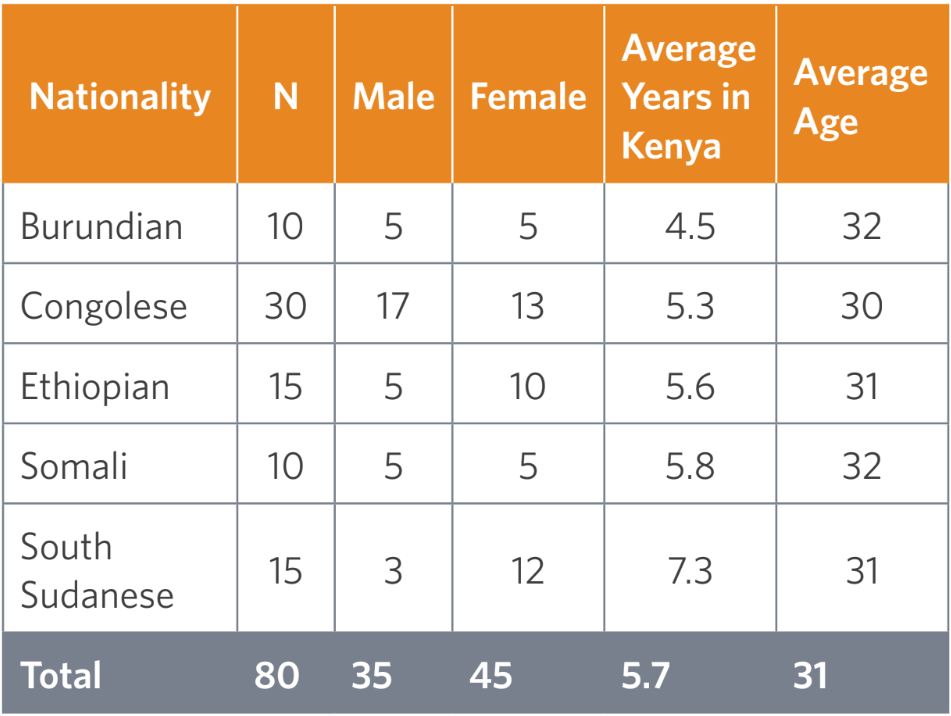
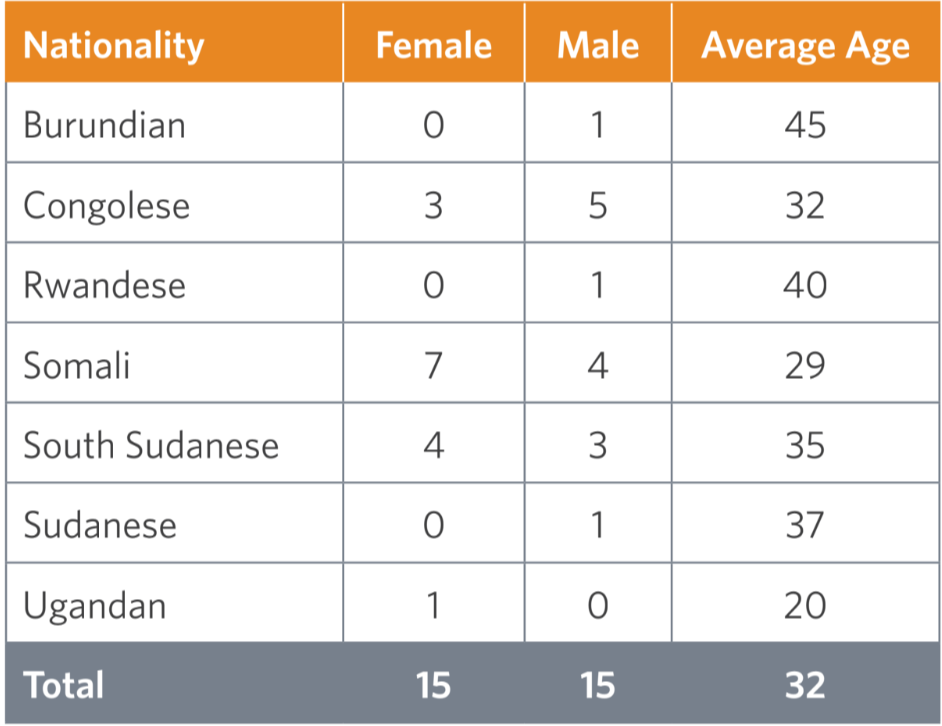
After receiving approvals to amend our approach, we began the research with 80 respondents in Nairobi in June 2020. We continued with Round Two in September 2020 and completed the third round of interviews in November 2020 with 73 respondents. A profile of our starting sample can be found in Table 1. We had a disproportionate number of Congolese respondents, followed by South Sudanese and Ethiopians, with a smaller number of respondents from Burundi and Somalia. Forty-four percent of our interview participants were male; 56% were female. On average, participants had been in Kenya for 5.7 years, though this ranged from two years at the low end to 21 years at the high end.
Many refugees in the city choose to live in areas with other refugees, which led to geographic clustering in our sample around the neighborhoods of Kasarani, Kayole, Donholm, Rongai, and Eastleigh. Our study did not have a comparison group of Kenyans from within the host community, but at times throughout this study, we reference comparisons from related and sometimes concurrent research that the authors have led in Kenya—and specifically Nairobi—since 2010, which also involved studying the financial lives of Kenyans. Choosing a comparison group for refugees is not a straightforward task. Oxford University’s Refugee
Economies study sampled from the same neighborhoods where refugees live and seems to imply refugees ought to have equivalent living standards. In reality, Nairobi residents with incomes similar to those of refugees are likely to live in lower-income neighborhoods, which refugees may feel are overly insecure or isolating. Many of the refugees in our study were living with friends or sharing a home with multiple families in order to share the cost of housing, which tended to be higher in these areas than in lower-income settlements. This shared housing is much less common among the Kenyan households in the Kenya Financial Diaries.²² Thus, considering only the immediate neighborhood for comparison presents biases we need to take into account in urban comparisons. Camp-based refugees and Kenyans in the surrounding common present a more straightforward comparison.²³
We found some similar livelihood patterns for refugees by nationality. For example, many of the Burundian and Congolese refugees identify as Banyamulenge and came to Nairobi in hopes of reconnecting with others from their tribe. They have found community through churches in neighborhoods where others from their ethnic group have settled. Many engage in high-frequency hawking of foodstuffs and vitenge printed cloth, particularly early on in their displacement. They tend to adapt their Swahili quickly and make Kenyan friends who introduce them to other forms of work like trading in second-hand clothes and shoes, supporting musical performances, and sometimes more professional work in restaurants and schools.
Our Ethiopian respondents were mostly Oromo and concentrated in Eastleigh. The women in particular struggled to learn Swahili and tended to earn a living by selling coffee and prepared food—mainly foods from Ethiopia—within their own communities. Many arrived having fled from violent personal attacks and carried with them significant trauma. They often fled home quickly and without close family networks to plug into in Nairobi.
South Sudanese respondents in our Nairobi sample were quite different from those in the camps. Many were first introduced to Nairobi as a place to go to school during protracted conflict in South Sudan. Some returned to Nairobi when violence jeopardized their adult livelihoods or safety. Still others were staying with school-going children to ensure they received an education. Many had remittance support for themselves or other housemates coming from relatives continuing to work in South Sudan. Many of these respondents paid significantly more in rent than our average respondents from other nationalities, and they were less likely to seek help from the humanitarian system.
There is a long legacy of Somali settlement in Nairobi, and most of our respondents were able to plug into those established networks in the city. Unlike for the Ethiopians, those networks typically included close family connections. In some cases, respondents were able to leverage those networks to start and grow businesses. However, things tended to be more challenging for female respondents who had previously been dependent on other family members and then found themselves thrust uncomfortably into public life. Some of our respondents relied heavily on the communal practice of shaxad, in which other Somalis—even without a personal connection—donated money for needy recipients’ upkeep. Nearly all of our Somali respondents lived in the Eastleigh ethnic enclave.
Findings
1: Refugees’ Financial Lives Are Stymied by Their Lack of Access to Basic Rights, Opportunities, and Documentation, Muting the Impact of Financial Inclusion Policies
Rather than starting off our interviews by centering financial services and behaviors, we tried to get a sense of each participant’s life and interpret their financial practices in that context. We started with a broader financial history, trying to understand key highlights in participants’ financial lives, the financial needs and behaviors at different stages of displacement, and the factors that enabled the good times and strategies that helped them endure financial challenges. Given the moment of this research— March to November 2020—we also talked about shifting livelihoods and financial strategies amid the Covid-19 health and economic shock.
1.1 Foundational Issues are Typically the Biggest Barriers to Income Generation.
Our research reinforced that the most important barriers to refugees’ achievement of their financial goals are foundational barriers. In Kenya, while legally refugees are allowed to work, very few in Nairobi actually succeed in being awarded work permits, and if they were, renewals were unpredictable.
Our respondents told us, for example:
- “I went [to the UN offices] time after time for interviews, and it took me a whole 3-4 years to get both the documents [a refugee ID card and alien card]… The process is tiresome!”
- “I tried to get a work permit, but it did not work out. I went to UNHCR, and they gave me a document to take to a Huduma Center [office for government services]. When I got there, they asked me to ask my boss to write an official letter indicating that he has given me work. When I asked my boss, he refused and said he has not yet given me a job, only that he wanted a document to know if I’m allowed to work. I went back to the Huduma Centre, and they said if there’s no letter, they can’t even start the process. I gave up.”
- “I tried to get a work permit and sent my details through RCK [Refugee Consortium of Kenya]. I have waited more than a year and have never gotten a response.”
- “I was trying to get a mandate card but couldn’t. They kept on giving me appointments for interviews. I felt fed up with their repeated interviews and decided to look for other ways that I could get this document. I approached an officer who works there and gave him $200, and within a month he brought the refugee ID card.”
- “I tried to get a birth certificate for my baby. I didn’t have the money to go to the hospital—not even to pay the fare. So, I just went to my room and forced the baby out. After a few days, I took the baby to the hospital, and they refused to help me with the birth certificate, saying I needed to say where I gave birth. When I said it was home, they said I needed to take the case to the police station. I went there, and they said they can’t help and that I should not have given birth at home. Until today, I have not gotten any support [getting this document]. When the NGO offices open again after COVID, I will go and ask for help.”
Refugees face long waits for even basic documentation that smooths the way for informal work, renting apartments, getting driving licenses, and reducing police harassment. With and without documents, refugees—especially men—encounter persistent harassment from police who demand bribes to allow them to simply exist. Refugees registered in the city are not allowed to move outside Nairobi without written permission. Doing so jeopardizes their freedom and their long-term legal status. Government resistance to integrating refugee identification into national ID systems currently denies refugees in Nairobi the right to register a SIM card in their own name, register a linked M-Pesa mobile money account in their own name, or obtain certain other documentation important for earning a living, such as certificates of good conduct, issued by the police.
Philip was a 38-year-old refugee from Congo who had been in Nairobi for ten years at the time of our study. He had some marketable skills as a French teacher, musician, sound technician, and driver. While he had been very successful in obtaining refugee documentation, by dint of his refugee status, he was denied the right to register as a teacher and so lost his job teaching at a prestigious private school. When he tried to drive for Uber and Bolt (two large ride hailing firms in the city), they also would not let him register without a Public Service Vehicle (PSV) badge, only accessible and with a specific kind of good conduct certificate only available to Kenyans, issued by the police. Legal rights NGOs have not been able to help.
Another refugee, Jean Claude, received a diploma from a Kenyan culinary institute and was offered a job at a well-known, upscale Nairobi hotel. He used a fake ID when trying to get the job, knowing he would otherwise be disqualified. When his employers learned that he was a foreigner, he lost his job. Without an ability to actually work, his investment in his skills is going to waste.
Many other respondents applied for work permits and were denied—or, even more frequently, had been waiting for many years to hear any response about their case. NGOs helping refugees go to college or vocational training often succeeded in helping refugees graduate and even get internships or attachments to solidify their learning. Often those attachments translated into job offers, which the refugees were unable to accept given legal barriers.
Of course, not all refugees had the skills to enter the very small formal workforce in Kenya. However, with nearly all of them barred from these jobs, the overall economic capacity and stability within refugee social networks can remain very low. This was particularly true among our Congolese and Burundian respondents. The low likelihood of getting a work permit made investing in formal skills an uncertain proposition and caused intense frustration, particularly when refugees followed all the proper channels and still remained helpless when it came to opaque denials of work permits. Work permits themselves are not a universal solution. They must be tied to specific employers, expire every two years, and can be expensive and time-consuming to process and track.
Unable to access formal work permits, those refugees with professional skills end up doing unrelated, informal work or working as “volunteers” through the humanitarian system. In these situations, NGOs must pay them below a government threshold to be in compliance with local laws barring them from employing refugees without work permits. This caps their wages at very low levels, even for those with professional skills.
Refugees are allowed to register businesses, though this is also a somewhat complex process. They need to have identification documents first, then register a business name and pay for a county business license (as well as a fire certificate and a wide range of other licenses depending on the business type) renewable every year. They are also meant to register for a tax identity number from the Kenya Revenue Authority, but according to local NGOs, only one person at the revenue authority is aware that refugees are allowed to register for this ID number and can help them navigate the registration process. Refugees who are unaware and don’t ask for this particular person are routinely turned away. It takes an exceptionally savvy and persistent refugee to see the process all the way through and become fully compliant—which is difficult for Kenyans as well, though they are typically held to a lower standard when it comes to enforcement.
In the camps, refugees face the same restrictions on work and business, in addition to being forcibly confined to the camps and unable to easily travel for trade or education. The few professional opportunities available are inside the humanitarian system where wages are capped for different reasons than in Nairobi. The UN system instituted a “wage harmonization” scheme to fix wages across the UN and its partners, and these wages, around KES 6000 (about $60), are poverty wages, far lower than what some of our participants made working as boda (motorbike taxi) drivers or brewing changaa (illicit brew). Further, the wages fall below Kenya’s minimum wage standards, which are KES 7240.95 for the lowest level of low-skilled laborer outside of a city.²⁴ Such wages fly in the face of UN commitments to Decent Work and also disincentivize bright and promising talent within the camps.
These barriers to foundational rights are layered on top of persistent harassment from police and discrimination in work and trade. Our female respondents reported minimal police harassment, instead believing the police targeted male refugees, expecting men were the ones with money who would readily pay bribes to be released. While refugees cited particular fear of arrest before receiving their official documentation, harassment rarely abated when a refugee had all of his documents in order. For example, one of our South Sudanese respondents and his brother used to work informally at a car wash, and they would leave work just after midnight. They were arrested more than three times for no particular reason as they walked home:
They don’t even take you to the police station; they just tell you, ‘Just give us something before we take you in.’ You personally, you know if you get inside a police station, it will be a different thing. So, if I have made KES 1,000 that day, I give them KES 500… Last time there was a meeting with refugees and the police, and I complained about this. The big boss said I should come to the station and report them. Now, if I go to the police station and report it, and then they know who I am, won’t it make my situation even worse? They can even kill you… Once they stopped us on the way home and claimed they saw my brother buying drugs. They took him to the station, beat him, and even wounded his eye. They were telling us to bring KES 20,000, and Mum said, ‘Okay, do whatever you want with him.’ After they realized these people are not playing, they said, ‘Okay, just bring what you have.’ We tried and told them we only have KES 2,000. They said no, come with KES 8,000, so we went and looked for KES 5,000. Once we gave them KES 5,500, they let my brother go.
Several also complained about wage discrimination or being cheated out of their pay because of their refugee status. This encouraged some to conceal their nationalities in business in order to demand higher payment. For example, one refugee worked as a mechanic and reported that often clients tried to underpay if they realized he was foreign. He was proud of learning to speak as a Kenyan, so that he could pass more easily. Late in the study, he had one repair job that brought in $500, and he believed that he was able to ask for this kind of money by passing as a Kenyan.
1.2 Financial Services Offer Greater Value When There’s an Income to Channel Through Them.
Without these fundamentals in place, it is nearly impossible for people to achieve higher-paying work or to safely invest in growing businesses. At very low, unstable levels of income—and in a starved opportunity landscape—finance can only do so much to support refugee self-reliance. Financial services become more valuable to refugees when their incomes grow.
For example, some refugees who could not register their own M-Pesa accounts felt that they could go without the service. However, there was high demand for the service from those who received any kind of humanitarian assistance or international remittances, many of which can now be paid through the mobile money service. They told us that receiving the money through a private mobile wallet was preferred over both over-the-counter payments and receiving through Kenyan friends who were allowed to have accounts and had all necessary documentation. The former exposed one’s receipt of funds to crowds, family, landlords, and creditors, creating fears of robbery and generating demand for immediate repayment of debts. Receiving money through a proxy recipient came with different challenges; it involved the friend or neighbor being aware of the money’s arrival and, usually, the expectation that the intended recipient pays the proxy recipient a “token of appreciation.”
Few of our respondents actively used bank accounts. Some in the city had them at one point if at some point they had a formal income. Typically, they opened these accounts at the urging of and with the assistance of the employer.²⁵ A few in the camps also had them, usually because their incentive work with humanitarian agencies required it as a mode of payment. Bank accounts were most useful for those with salaries and with the capacity to save. The latter seemed more common in the camps, where living costs were lower on average and where some had ambitions of saving to invest in businesses. That was much more difficult for participants in Nairobi who would have been satisfied with just a mobile wallet, given they were less able to accumulate significant sums of money.
Somewhat similarly, a number of respondents reported belonging to savings groups, or chamas. Typically, they joined only when they achieved some kind of relatively frequent income and thus had something to channel into a savings device that could facilitate accumulation. Those who wanted to join groups rarely had difficulty finding or starting a group, usually with others in their community with similar earnings levels and frequencies.
A few of our participants were members of NGO-facilitated groups. Some of them chose to join multiple groups in that case because the NGO imposed restrictions on the group’s rules that impeded their ability to use the group mechanism in the ways members needed. One respondent in Nairobi explained:
I am in a new ‘merry-go-round,’ [another name for chama] which I started very recently after I started my business of clothes. We are six members, and each member is to contribute KES 500 every week, and the money is given to one member of the [group]. All of the members are Kenyans, and I was introduced into this group by a friend of mine who is Kenyan. Apart from it, I am also a member of [an NGO group], in which we contribute KES 100 every Thursday of the week. This money we are going to be given back after the end so that we add it into our business capital. The reason I joined the new chama is because [the NGO] does not give any money to members, even if you are in need of money during an emergency.
1.3 There Are Exceptions When the Financial Service Is Providing Protection.
A number of our urban respondents were covered by Kenya’s National Health Insurance Fund (NHIF) with coverage paid for by UNHCR. This insurance was particularly helpful for covering the costs of chronic illnesses like diabetes and managing the expenses of inpatient care when needed. Our respondents appreciated this cover, but there was some confusion about which refugees were covered and how long that coverage should last. One respondent, for example, went to use his NHIF card and was told it was not working. He assumed that UNHCR had stopped paying but never received any communication about the issue. A number of participants also complained that hospitals frequently did not have medicine or that the medicine they needed was not covered, making it difficult to keep up with out-of-pocket payments.
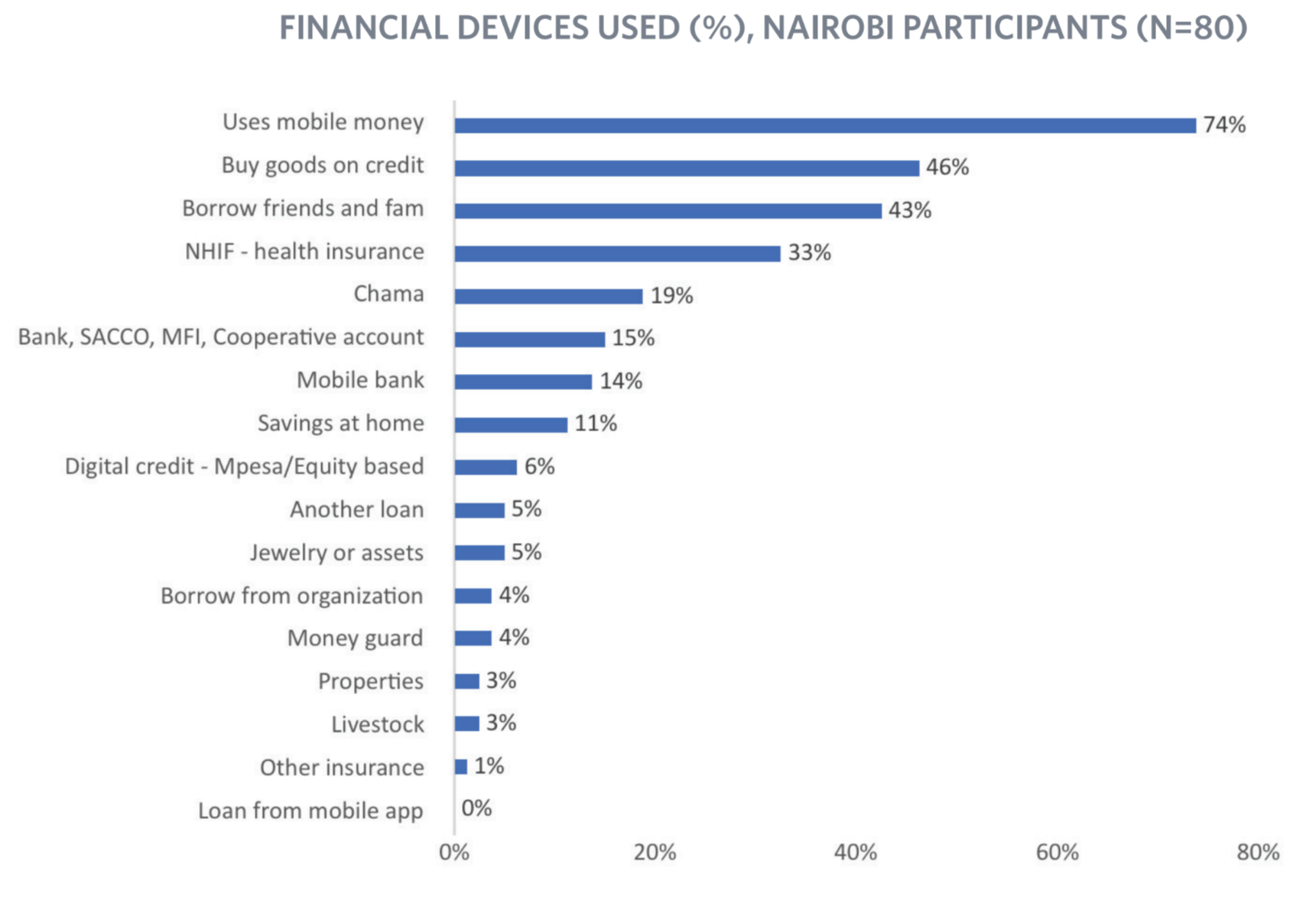
Financial services were also useful for remittances and humanitarian transfers (Figure 1). Those who have M-Pesa lines tend to receive their remittances through that channel, via World Remit and Dahabshil. In urban areas, those receiving assistance from NGOs also receive through M-Pesa, via proxies (as in 1.2 above) if they don’t have their own line. In Kakuma, food vouchers are sent through a special purpose version of M-Pesa, Bamba Chakula, which we will discuss in section 3.3.
And while it is not being used at the moment, it appears that there could be some utility in supporting very simple forms of life insurance for key breadwinners in refugee families. A number of women in our study arrived in Kenya as dependents of their spouses and in-laws, and when those breadwinners died, it instigated a period of great turmoil as the women figured out how to build a new life. Some communities provide strong social safety nets in these situations, but it is not universal, often incomplete, and typically most helpful in the immediate aftermath of a death rather than the economic recovery stage.
1.4 There Are Gaps in Provision of Foundational Inputs, Some of Which Are Being Filled by Community-Driven Organizations, but Not Enough.
More important than financial services themselves, however, are foundational inputs that help a refugee make Kenya their home. Those include basic rights and documentation as already discussed, but also assistance in meeting basic needs on arrival, finding and affording safe housing, finding work, learning Kenya’s urban systems (like transportation, neighborhoods, norms, and M-Pesa), learning Swahili and English, finding community, and recovering from trauma. Community-driven organizations, including churches, mosques, and refugee-led organizations, are doing quite a bit of work to fill these needs, especially for early arrivals. We wrote in greater depth about the work of these organizations here.²⁶
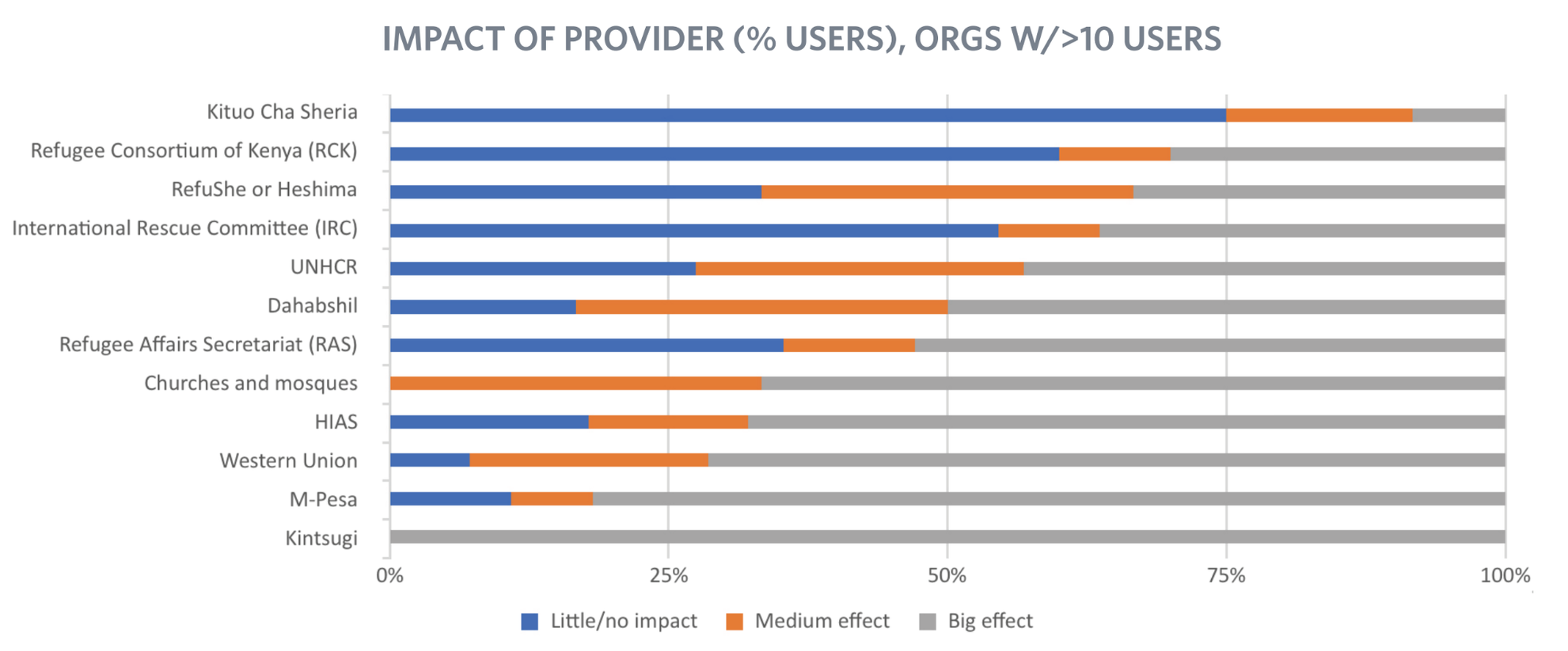
We asked our Nairobi-based participants about their usage and perceptions of service providers in their ecosystem, and an important community-based organization, together with churches and mosques, came up quite high on the impact scale (Figure 2). Interestingly, M-Pesa and Western Union are also seen as very high impact, primarily due to their roles as conduits for remittances. HIAS is also named as high impact, likely because a significant share of those who engage with HIAS do so as cash transfer beneficiaries and are often from particularly vulnerable households.
1.5 The Absence of Foundational Inclusion Makes Refugee Livelihoods Distinct from Those of Low-Income Kenyans.
Nairobi can be a difficult place to build a livelihood, even for low-income Kenyans who often articulate this daily drama as “hustling.”²⁷ But the lack of foundational inclusion creates challenges that are distinct from those of low-income Kenyans who also face limited opportunities and the uncertainties of informal work and business. This includes refugees’ lack of legal recognition and inhibitions that prevent them from planning and investing for the long term. We saw these distinctions emerge in five key areas:
- Long-term uncertainties. In our long-term work on the Kenya Financial Diaries, we observed a process of “livelihood ratcheting” where income sources expanded and generated greater income over time, where families invested in assets, such as land, housing, education, livestock, and motorbikes over time. Between 2013 and 2015, more than half of the study households experienced real net gains in per capita household income, and improvements were even stronger among households in Nairobi, where 60% reported improvements in subjective economic well-being.²⁸ In contrast, only 13% of our refugee respondents felt their economic welfare was improving before COVID. The majority – 66%—felt that their welfare was stagnant. Very few reported investing in new or growing businesses, and investments in other kinds of assets—like land and housing—were not available to them in any form or felt incredibly risky given the uncertainty of the duration of their stay in Kenya. Long-term uncertainties seem to create an orientation around short-term survival rather than the growth and development low-income Kenyans are pursuing.
- Police harassment. As already noted, refugee men face persistent harassment and extortion from the police. This is less pronounced for low-income Kenyans in the course of pursuing their livelihoods. But it is not absent completely, especially in Nairobi’s slums, where low-income Kenyans live. There, young men are routinely pegged as “thugs” and thus also become targets for extortion and extrajudicial killings.²⁹
- Distrust. The economic shock of Covid-19 was devastating in Kenya. We watched as both Kenyans and refugees fell months behind on their rent. But it was striking that none of the respondents in the Kenya Financial Diaries were evicted from their homes during that period, and nearly 1/3 (24 of our final 73) of our refugee respondents suffered eviction between June and December 2020. There are several possible explanations for this. For example, perhaps landlords in refugee neighborhoods (which tend to be higher rent than the Diaries sample) are less patient. However, some of our refugee respondents felt that landlords saw this as an opportunity to replace “foreign” tenants with Kenyans. Perhaps landlords expected that refugees would have fewer resources to draw on to get through the crisis and were less likely than others to rebound financially. Respondents believed that distrust also affected informal credit. Refugees were less “well known,” and so, they felt, treated as a bigger credit risk to friends, landlords, and shopkeepers, not to mention more formal lenders, which were only very rarely even considered an option as a source of finance.
- Thin social networks. For many (though this is less true for Somalis), their local social networks in Nairobi are not particularly diverse and tend to have a low capacity to provide financing and connections that are needed to navigate shocks, start and expand businesses, invest in education, and pursue new opportunities. While refugees were more likely than Kenyans to have a source of international remittances, for many, those could only be called upon in times of true crisis and were not particularly useful in providing connections to income-earning opportunities.
- Discrimination. A number of respondents also complained about discrimination in pay in the informal sector, in which the wages offered to refugees were typically significantly lower than those offered to Kenyans. Some Kenyans in our key informant interviews claimed refugees in the service sector (such as barbers and nail artists) deliberately undercut their Kenyan competition by offering lower prices, creating some tensions among competitors. At the same time, refugees employed by others in these same sectors were offered lower pay than their Kenyan counterparts in Kenyan-owned salons.
In combination, these factors represent a specific set of challenges for refugees that differ from their Kenyan neighbors, even those working in the same parts of Nairobi’s informal economy.
Some of our key informants and participants also felt frustrated that they were excluded from the Kenyan government’s efforts to support youth development and entrepreneurship. For example, refugees could not benefit from the government's Youth Enterprise Development Fund or Kazi Mtaani, the youth-focused cash-for-work scheme offered during Covid-19. However, it’s difficult to assess how much their access to such services would deliver meaningful inclusion and change. Many Kenyan young people also complain that such efforts are riddled with corruption, are captured by elites, and routinely fail to deliver on promises.³⁰
2: The Needs and Uses of Financial Services Coevolve with Progressions in or Diversification of Livelihoods
Our second core finding around financial services reminds us that demand for financial services coincides with the use cases and financial needs individuals face, based largely on the composition of their livelihoods.
2.1 Livelihoods Are Difficult to Build, and There Is No Linear Progression.
It may be tempting to believe that as refugees adjust to their new homes, they are able to invest in small enterprises that help them accumulate wealth and stability. Instead, we found that in Nairobi, building a stable livelihood was extremely difficult for refugees, primarily because of the lack of foundational inclusion and the other issues outlined in section 1.5 above.
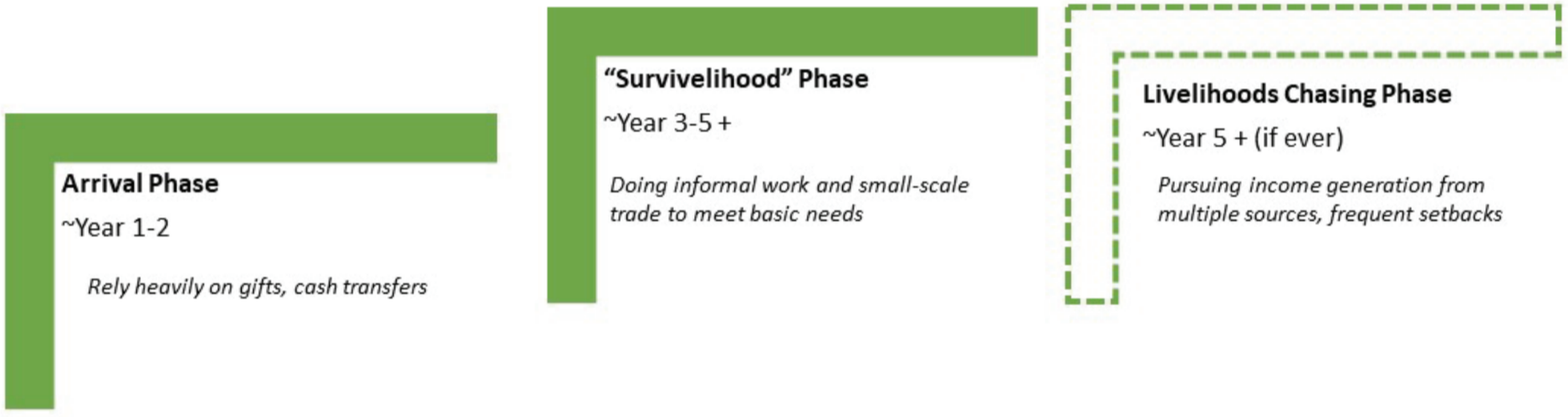
Most refugees in our study followed the kind of livelihood progression outlined in Figure 3. Shortly after their arrival in the city, they depended heavily on aid, remittances, and support from others in their co-ethnic communities. Those who arrived with some money or other assets spent those down as they adjusted to Nairobi, tried to overcome the trauma of flight, and found a place to live. Sometimes they were lucky to find a low-paying job fairly quickly, like working as a security guard informally, for about KES 6000 (about US$60) per month. As they adjusted, they would often find what we call “survivelihood” activities, where they could patch together informal work, like cleaning a church or doing laundry for others, with small-scale trade—like the sale of watermelon slices— to help contribute to shared living expenses. These kinds of work rarely left much over for savings, and refugees continued to struggle to contribute to rent and regular food expenses.
Some, but not all, refugees did graduate to being able to engage in more lucrative forms of self-employment, things like working as a barber or musician, trading second-hand clothes or shoes, hawking fabrics or bedsheets, and selling cooked foods or running small restaurants. However, for very few were these actually long-term enterprises. Instead, they frequently started and stopped because of uncertainties and interruptions—again, often relating to the lack of foundational rights and issues outlined in 1.5. So instead of getting some training, an asset, and growing a single business, refugees in the city often found themselves starting over in completely new fields after recurrent setbacks. Unlike respondents in other studies where refugees had permission to work, almost none of our Nairobi respondents experienced a ratcheting up of the quality of their livelihoods, nor were they able to accumulate any kind of significant assets enabling or reflecting increasingly large business investments. For example, in Uganda and Mexico, livelihoods could progress, and refugees and migrants could accumulate assets. They could grow incomes into a phase called the “ratcheting up phase.” In the case of Kenya, no such phase took place. Instead of ratcheting up, refugees continued to chase meager incomes. They spent their entire lives in Nairobi chasing, not building, livelihoods. Covid seemed to exacerbate that challenge.
Amos, a 24-year-old refugee from Burundi, offered a stark example of this livelihood chasing. When he first arrived in Kenya, acquaintances he found in the city helped him get an informal job as a watchman. Friends at church introduced him to an NGO that funded his study of IT. He had a good internship through the program, and they offered him a job, but he lost the job when he could not get a work permit. He began selling SIM cards. When this work took him out of Nairobi, he was arrested for traveling as a refugee without official approval and lost everything. His pastor connected him with someone who could introduce him to the business of selling second-hand shoes, but he was swindled out of his start-up capital.
Nearly every year in Nairobi, he has had to start over from scratch. “Life in Nairobi is like trading forex,” he said. “One day you have, the next it’s gone.”
This contrasted with some of the stories we heard from Kakuma, where a share of participants’ financial biographies did reflect some increasing investments over time. For example, one young man accumulated savings from incentive work to buy shop space in the camp, which he rents out for regular monthly income. An older man used his shopkeeping expertise to work as an advisor to other shops, helping them improve their accounting and supply chain practices. This accumulation appeared to be supported by the relatively low-cost environment, which lowered investment barriers and reduced monthly expenditures on things like rent. Refugees in Kakuma also appeared to face less harassment from running their businesses, though movement restrictions constrained the scale of their ambitions.
2.2 A Range of Inputs Are Needed to Build a Livelihood, and These Are Only Partly Within a Refugee’s Control.
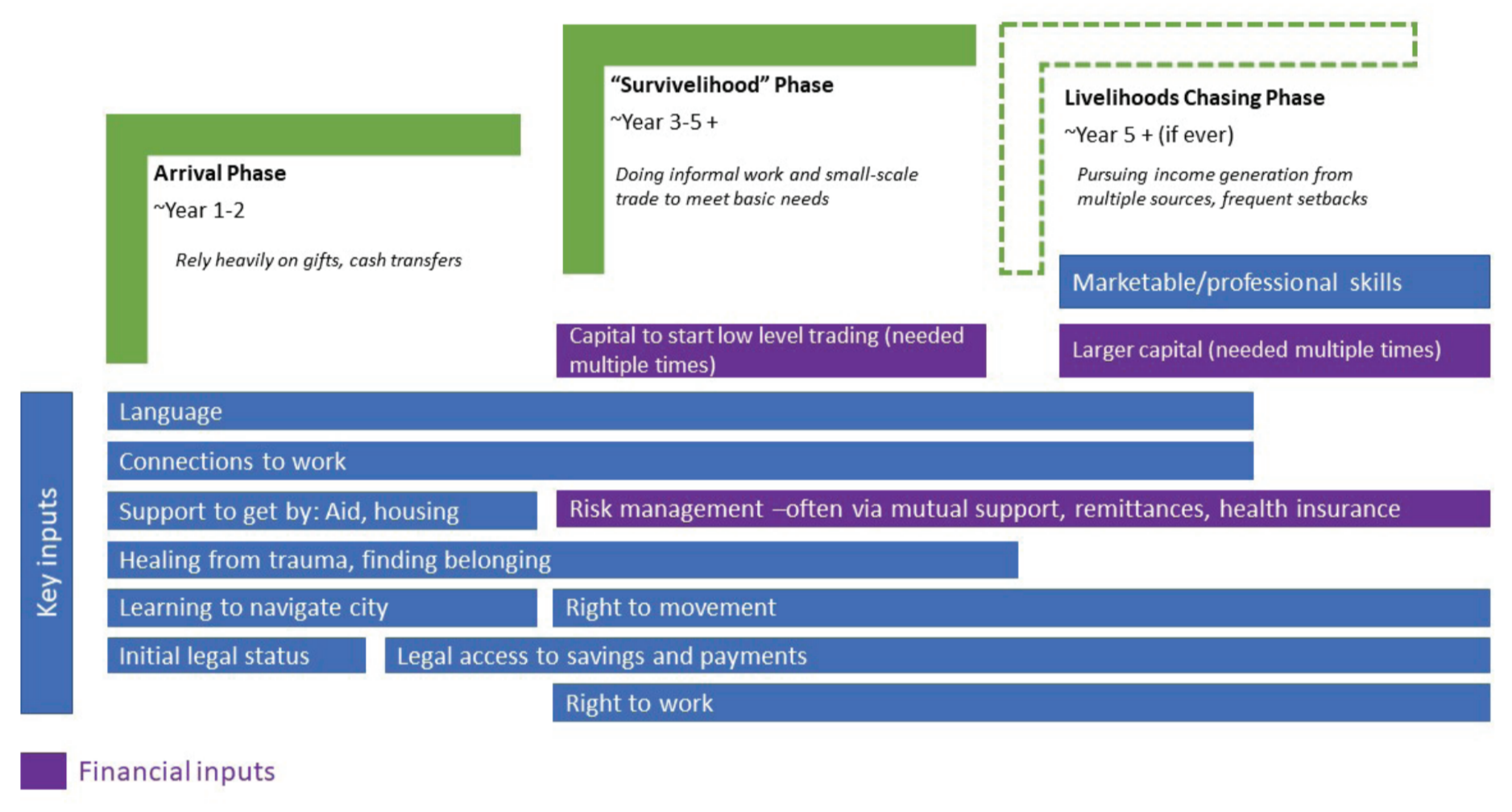
Finance was only one of many inputs that refugees told us they needed in order to build their livelihoods (Figure 4). At different stages in their livelihood progression, they needed different kinds of inputs. Early on, refugees needed quite a lot of non-financial inputs, like language skills, connections to work opportunities, direct aid, healing and security, initial legal status, and some understanding of how to navigate their new environment. Starting to work without some of these other inputs was challenging. Only at slightly later stages did refugees need startup capital and support to manage risk. Startup capital was likely to be needed more than once.
Especially in Nairobi, given the many setbacks and “start-overs” that refugees faced, this was often an ongoing need. However, especially for women’s very small-scale trading, the amount of money needed was often very little, often less than $50.
2.3 Different Financial Needs Emerge with Livelihoods Possibilities.
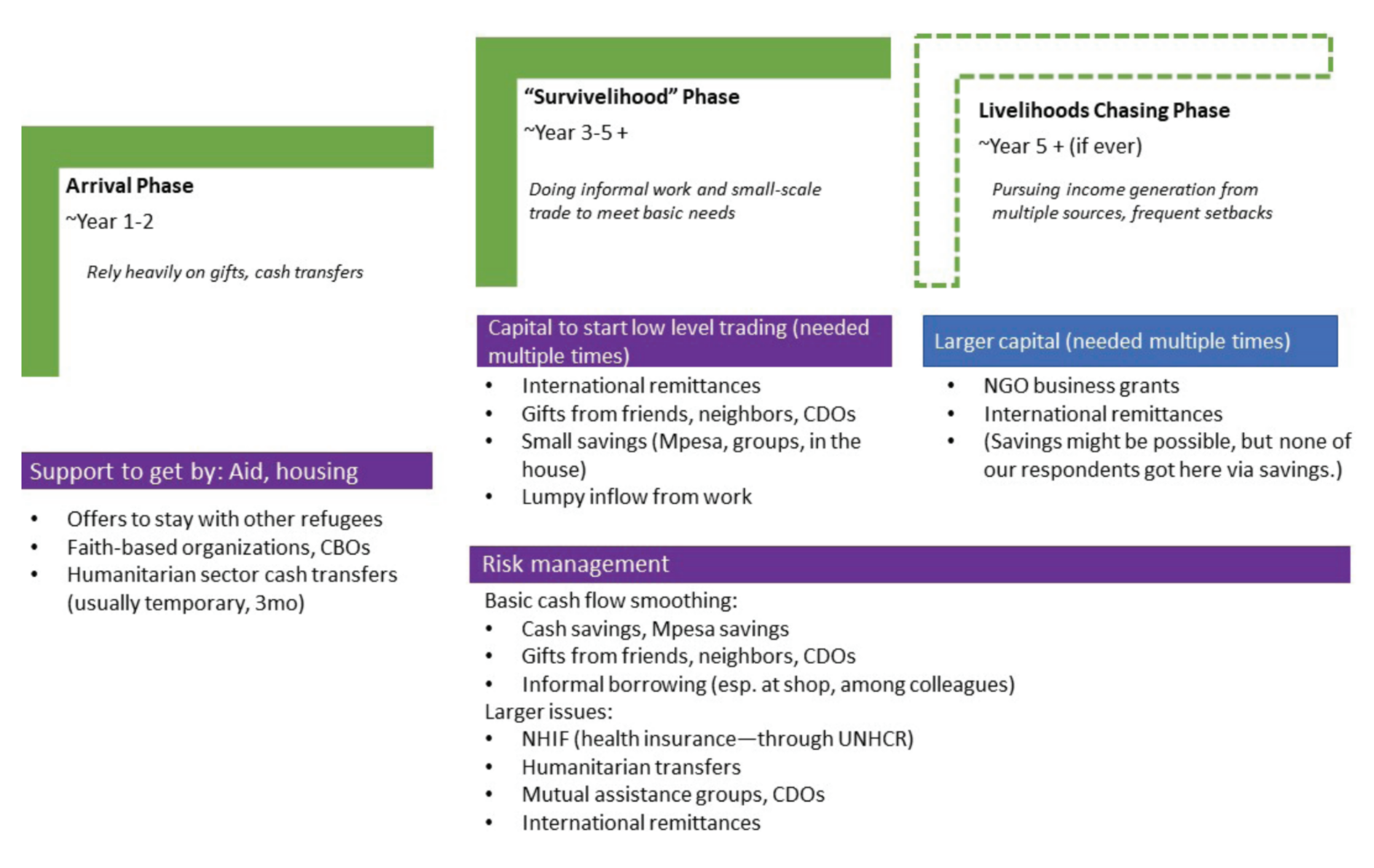
When refugees have an income stream and opportunities to invest, their financial needs change (Figure 5). They don’t need to just have a mechanism to receive money and make payments; they may have new demand to do things like save and borrow. In our Nairobi sample, for example, 19% of participants were members of a savings club, nearly all of them seeking out this kind of group when they had an income they could channel through the group in order to build up some useful lump sums. In Nairobi, people sought bank accounts only when they had (temporarily) a formal salary or other payment that an employer dictated they must channel their payments through. In contrast, we saw somewhat greater demand for bank accounts among our biographers in Kakuma, where Equity Bank had also been making a big push to open accounts. Several of our Kakuma participants opened accounts in order to receive incentive work payments, but they also continued to use them for savings when they were able to generate some profits and needed safe places to store that value. The low demand for banking services in Nairobi is directly tied to the low profitability of refugee livelihoods and the high costs of living in Nairobi that leave urban refugees with little excess cash.
3: Refugees Are Excluded from Mainstream Financial Infrastructure and Forced to Use Workaround Solutions
Although the expansion of financial service access often claims to be part of the “financial inclusion” movement, it is important not only to ensure refugees have access to financial tools, but that they are actually included in the systems already at work. Where there are already strong financial institutions in place that ease commerce and payments, provide safe savings, and provide easy access to credit, the goal for practitioners should be to extend those networks to refugees. Doing so would help solve challenges refugees face, like efficient receipt of cash transfers and remittances, while simultaneously participating in and strengthening local economies. Unfortunately, in Kenya, the government’s resistance to including refugees in its national financial infrastructure has instead led to a range of workarounds that undermine the goals of global standard-setting bodies, government, donors, refugees, and host communities.
3.1 Kenya’s Mobile Money System, M-Pesa, Covers a Wide Range of Financial Needs and Is a Critical Part of the Nation’s Economic Infrastructure Kenya Has Developed a Vibrant Financial Ecosystem.
As of 2019, 89% of Kenyans were financially included in formal and informal systems. More than 82% were accessing formal services due to the country’s vibrant agency and mobile banking systems and its famous M-Pesa mobile money service.³¹
That mobile money service now serves as the backbone of a wide range of financial services, highly valued by Kenyans and refugees alike. M-Pesa began primarily as a means to facilitate person-to-person domestic remittances. At the same time, users access mobile wallets to safely store money in a liquid form. They can transfer those funds to a number of mobile bank accounts (such as M-Shwari or KCB M-Pesa) at little or no cost. Some of those accounts offer commitment savings as well, such as the M-Shwari Lock account. Kenyan users can borrow through M-Pesa in a range of short-term loans and overdrafts that help manage cash flow and provide some business liquidity. They can pay insurance premiums and collect payouts. They can pay for utilities, receive wages, and pay suppliers all digitally. This is in addition to being able to receive formal cash assistance and support from family, friends, and social groups. Furthermore, the system is ubiquitous. It constitutes a core part of Kenya’s economic infrastructure, easing payments up and down the supply chain.
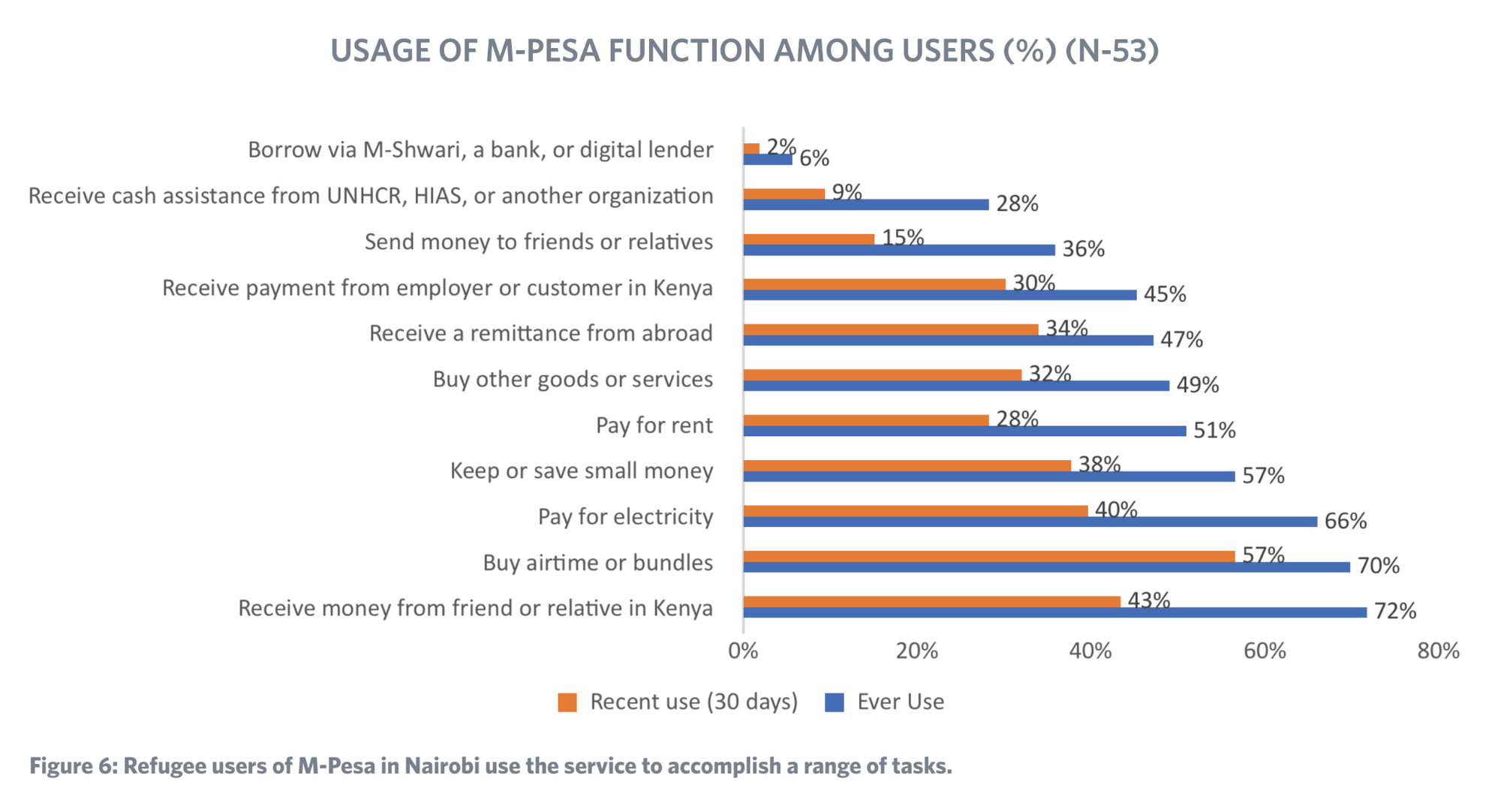
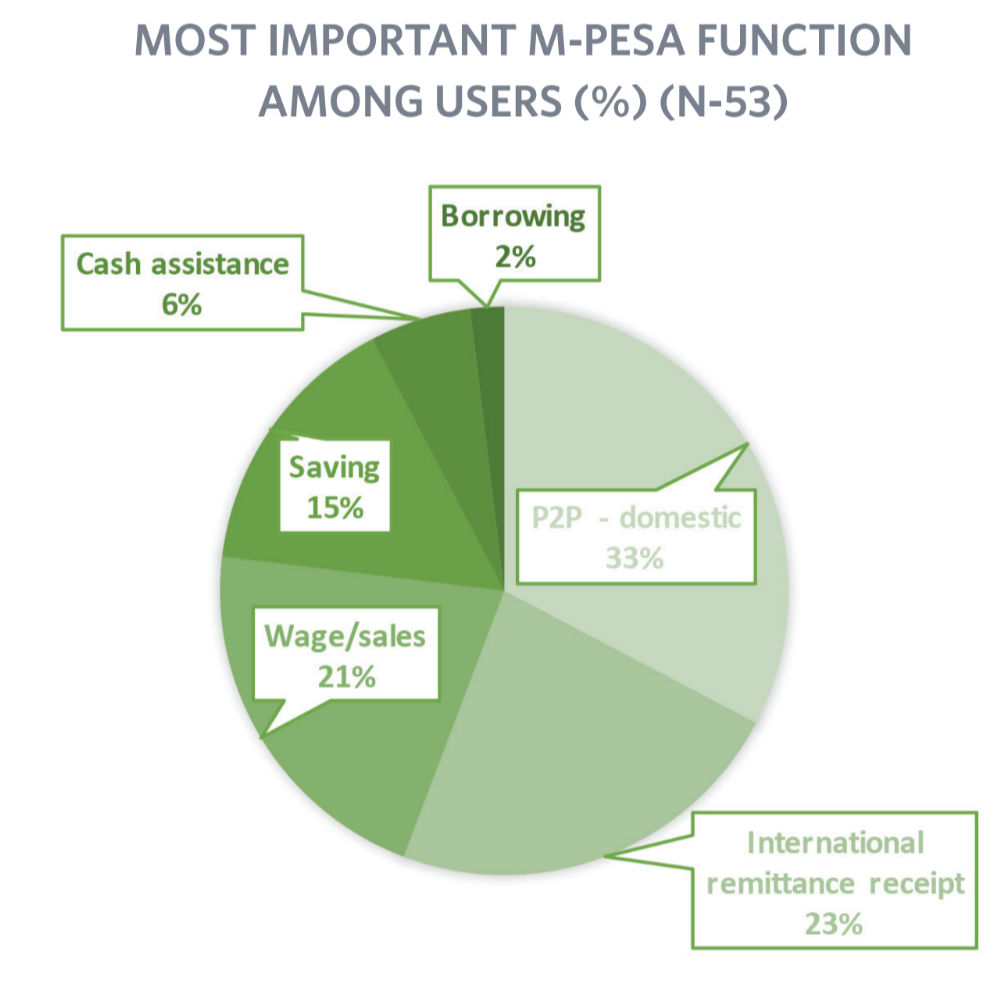
Such an important system would, no doubt, offer refugees a range of tools to help accomplish the financial tasks outlined in Figure 5. And, indeed, when we asked how refugees in our study how those with M-Pesa accounts used the system, we found it was common to receive person-to-person payments, make payments, receive remittances, and to save (Figure 6). The system’s utility increased during Covid-19, as more transactions happened remotely. Buying airtime and data bundles was the most commonly cited recent use of the system in our third round of interviews in Nairobi. But the most important function that M-Pesa serves is in helping people access social safety nets through gifts and remittances from local and international contacts, followed by the receipt of wages or payments from their clients. In other words, M-Pesa is a critical channel for income to cope with difficult periods and to build a livelihood (Figure 7).
3.2 Denying Refugees Legal Access to M-Pesa Has Negative Consequences
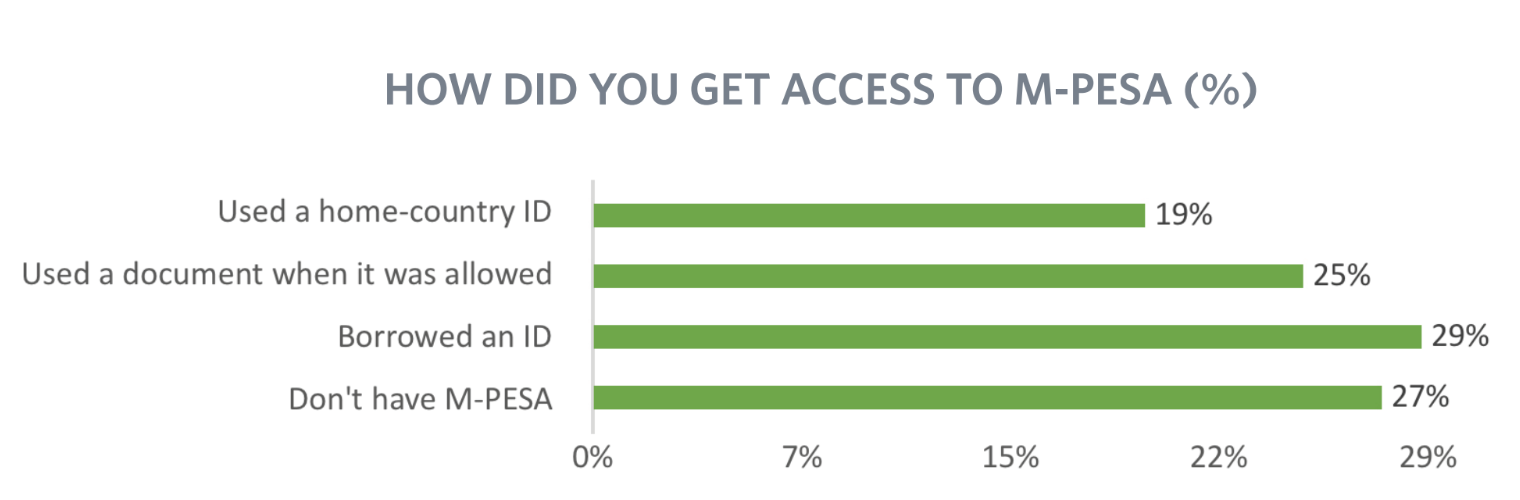
Despite its prevalent role in the Kenyan economy, since 2015, refugees in Nairobi have been barred from opening new M-Pesa accounts with their own identity documents. This new limitation was put in place ostensibly as an attempt to curb the use of M-Pesa for financing terrorism, but in reality, it has functioned as a punitive measure against those refugees who choose not to figure out a workaround. In our sample, 27% of respondents were going without M-Pesa, while 29% borrowed an ID from a Kenyan friend in order to use the service (Figure 8). Nearly half still had access to the service because they opened their accounts before the new restrictions came into effect.
Rather than functioning as a tool to combat the financing of terrorism, the policy has obscured rightful ownership of accounts. At the same time, locking refugees out of the system makes a significant share of recent arrivals lose out on a very helpful service, which they wish they could use primarily to save safely small sums of money, especially given the shared living arrangements that many of them have in Nairobi. Under current restrictions, host communities lose out on revenues from agent transactions and the potential for increased remittance flows through the system. The government loses out on the integrity of its registration databases and ability to flag suspicious transactions. Refugees lose out on a critical money management tool and the ability to connect more easily to Kenyan commerce. And donors trying to deliver cash assistance are forced to send money to fraudulently registered accounts, to proxy recipients (at a cost to beneficiaries’ privacy and their likelihood of receiving their full transfer value), or through custom-built, separate, and closed systems that entail significant unnecessary costs while reproducing exclusion.
An Ethiopian refugee in her mid-20s in Nairobi explained a bit about how it feels to be locked out of mobile money:
We envy Kenyans for being able to access mobile banking easily. We also want to enjoy the services provided by Safaricom, but we are deprived this right just because of being refugees. We would want the Government of Kenya to consider allowing us to register the Safaricom lines we have using the mandate card or refugee ID. This would help us not carry money or have money in our houses. I personally cannot save money in the house since I live with friends and cannot just put money anywhere in the house to save. Second, I would also want to borrow money from M-Shwari and KCB M-Pesa so that I could start small business and pay back on time… I know M-Pesa has a big effect here in Kenya. This is because each and every citizen uses mobile money. This has eased their way of living and they can pay any transactions. If given an opportunity, who doesn’t want this? I would be very grateful.
3.3 Allowing Only Limited-Purpose Use of M-Pesa Is Financial Encampment, Not Inclusion.
The World Food Programme sought to move its support to camp-based refugees from food distributions towards more flexible forms of support that could also help bolster local trading economies. They hoped to transition to cash transfers via M-Pesa. However, due to government reluctance to allow refugees access to fully functional M-Pesa accounts and to allow them to transact freely, the government forced them to develop and implement voucher transfers on a highly restrictive form of M-Pesa, Bamba Chakula, which did not allow for P2P transfers and limited functionality to within camp areas. The system they developed provides a SIM card with minimal functionality. It cannot send or receive calls or do any other mobile money transactions. Specialized agents had to be established to accept the vouchers.³² Rather than integrating and including refugees in the existing mobile money network and its links to the Kenyan economy, the special-purpose distribution system creates something entirely exclusive. It is essentially a form of financial encampment rather than an on-ramp to inclusive financial services.³³
4: A Modified Version of “Financial Health” Is a Useful Framework for Our Analysis
Across the multi-country FIND project, we have applied a modified version of financial health, building on work done by the Center for Financial Services Innovation and Center for Financial Inclusion.³⁴ Using this framework helps refocus practitioner attention on key outcomes and then consider the pathways that help reach those outcomes. It is then possible to see both the financial service and non-financial service inputs necessary to build better financial health.
4.1 Applying a Financial Health Model Draws Attention Back to Outcomes
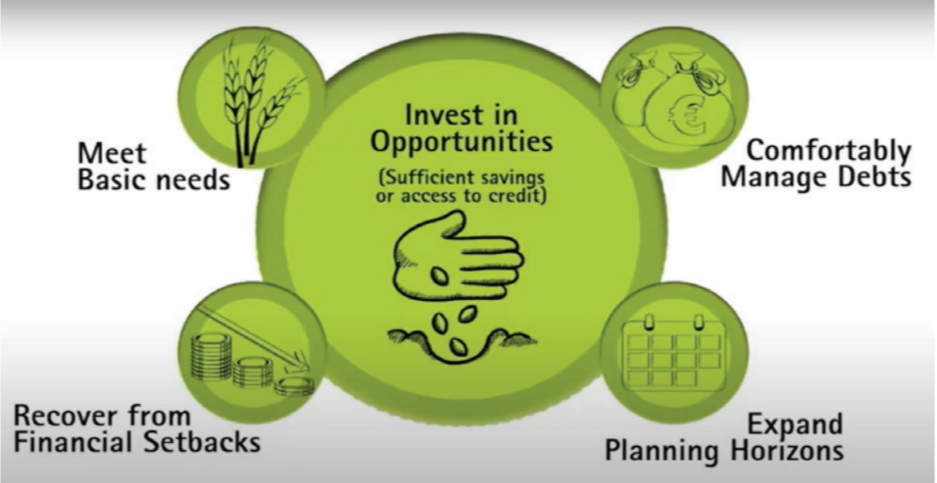
Our modified financial health framework looks at five outcomes (Figure 9) for individuals. A financially healthy person can meet their basic needs, recover from financial setbacks, comfortably manage their debts, invest in opportunities, and expand their planning horizons from short into medium-and-longer-term periods. It places financial outcomes rather than service usage at the heart of its analysis.
The refugee participants in FIND in Nairobi struggled with many of these dimensions, particularly throughout the COVID crisis when it was very difficult to even meet basic needs. At the same time, many were able to manage their debts, and some showed signs of recovering from the worst of the crisis. However, they were really struggling on being able to invest or expand their planning horizons.
4.2 If We Consider Outcomes Driven Largely by Non-Financial Realities:
One might assume that access to savings and credit would be essential to move towards those outcomes around investment and stretched planning horizons. But in reality, financial services could only play that role if more fundamental rights were in place. It was the uncertainty of their future status and their precarious legal status that stood in the way of achieving those goals.
In reality, many additional non-financial inputs shaped financial health outcomes. Our participants in Nairobi often cited the following key factors:
- Mental health & feelings of security. Refugees need to feel safe in Nairobi, to understand how to move around safely, and to overcome the paralyzing force of the traumas they carry with them in order to start working and gain an economic foundation in the city. Many of our participants told us that churches, new friends, and family already in Nairobi helped them through this major transition, and that this was key to their ability to adapt. One Ethiopian respondent who endured rape by security forces just prior to fleeing the country found formal counselling services and has since become the main breadwinner for the family. She worried that her husband’s lack of mental health care and his feelings of emasculation from losing his career were keeping him stuck, unable to adapt and assist the family in building a livelihood in Nairobi.
- Language skills. While many refugees start off working or running small enterprises targeting their own co-ethnic communities in order to expand opportunities, build stronger networks, and leverage the city’s services, refugees need to be able to communicate with Kenyans, either in Kiswahili or English. Many Congolese already arrive with some Swahili and quickly adapt. But others often struggle to learn new languages, even after many years. This can be particularly difficult for women who have less of a public life.
- Networks & connections. Social networks and connections with friends, colleagues, fellow students, and others who can be peers and guides are incredibly important. Friends help refugees figure out how to solve problems and connect them with new opportunities, which often has to happen many times, since livelihoods are constantly shifting. Having relationships with Kenyans in particular could be very helpful for dealing with police harassment and negotiating flexibility with landlords.
- Gender norms and family structures. Some gender norms stand in the way of developing these other resources. Women with extensive childcare commitments found little time and ability to run businesses outside the home. They also often had only one or two friends, typically neighbors they could associate with while confined to the home, tending to domestic responsibilities. Women from cultures where women are not expected to have public lives often felt even more isolated and never developed language skills or extensive networks. The prospect of getting out into the world and earning one’s own income became more and more intimidating to them over time.
- Luck. Luck also played a very important role for many refugees. Often, when refugees arrived in Nairobi, they looked out for anyone who could speak their language and asked for help. Sometimes, those turned into exceptionally resourceful connections. One family, for example, received a free home to live in for many months. Their host then continued to pay for half of their rent even after she moved out of the home. Some refugees’ first interactions led to jobs, healthcare, and links to humanitarian agencies that could help them get on their feet. It was also not particularly uncommon to hear about a refugee unexpectedly receiving a transformative amount of money from a remittance from an old friend or family member at just the right time, helping them get through some very difficult moments.
4.3. Social Networks Often Do Much of the Work of “Finance”
Social networks—rather than financial services—do much of the work of financial services for refugees.
Individual relationships, relationships through church, or with small refugee-led organizations provide refugees with housing support, often offering them a free or subsidized place to stay during the arrival period or during difficult times. They provide capital to start up or expand businesses. They help manage financial risk, providing food, housing, or cash (as gifts and loans) during difficult times. They help refugees sign up for available assistance as well, including health insurance. Financial services—like mobile money—can ease the flows along these networks, but the source of the funds is not from savings or formal borrowing.
4.4 What Refugees in Displacement View as Wise Financial Choices is Light on Accumulation of Assets
It was clear throughout this study that the main constraints to financial health for refugees were contextual rather than behavioral. It was the harsh, uncertain legal environment that held most of them back from ratcheting up their livelihoods over time. But that is not to say behavior does not matter at all. We asked refugees what kinds of decisions are “wise” for people in their situation.
Perhaps unsurprisingly, the idea of long-term investment and accumulation seemed out of reach and rarely made it into their comments. Instead, we heard that “wise” money management entailed starting an informal business either at home or in Kenya. Given the paucity of jobs and unlikelihood of obtaining a work permit, business was key to having a stable livelihood. Unfortunately, these wise” moves often still went bust because of an illness, an emergency that forced them to spend their capital, or due to other factors beyond their control, such as a landlord reclaiming business premises. Participants often talked about how it was helpful in Kenya to be taught the business by a local or another refugee who could show them the ropes. For many women who had previously been housewives, getting out and starting a business proved immensely empowering and eye-opening. They often wished they had the courage to start much earlier.
Other participants told us that good money managers stretched very small incomes a long way. They took some pride in surviving a financial crisis. One South Sudanese participant remarked on how difficult life was in Nairobi for everyone and said that, “The Kenyans have taught us budgeting.” An even smaller number talked about saving up in the house or in a savings group in order to start a business or dropping a wasteful vice, such as alcohol or miraa (khat).
Still, the ambitions these wise choices reflected were quite short-term and small-scale, unlike those we often hear from Kenyans with similar income levels who are more able to grow and diversify business and save and borrow for larger investments, such as land, property, and livestock.³⁵
5: The Uncertainty of Durable Solutions Available Reinforces Ideas of Waiting and Discourages Investment in Skills and Assets During Displacement, Limiting Self-Reliance, Especially in Urban Settings
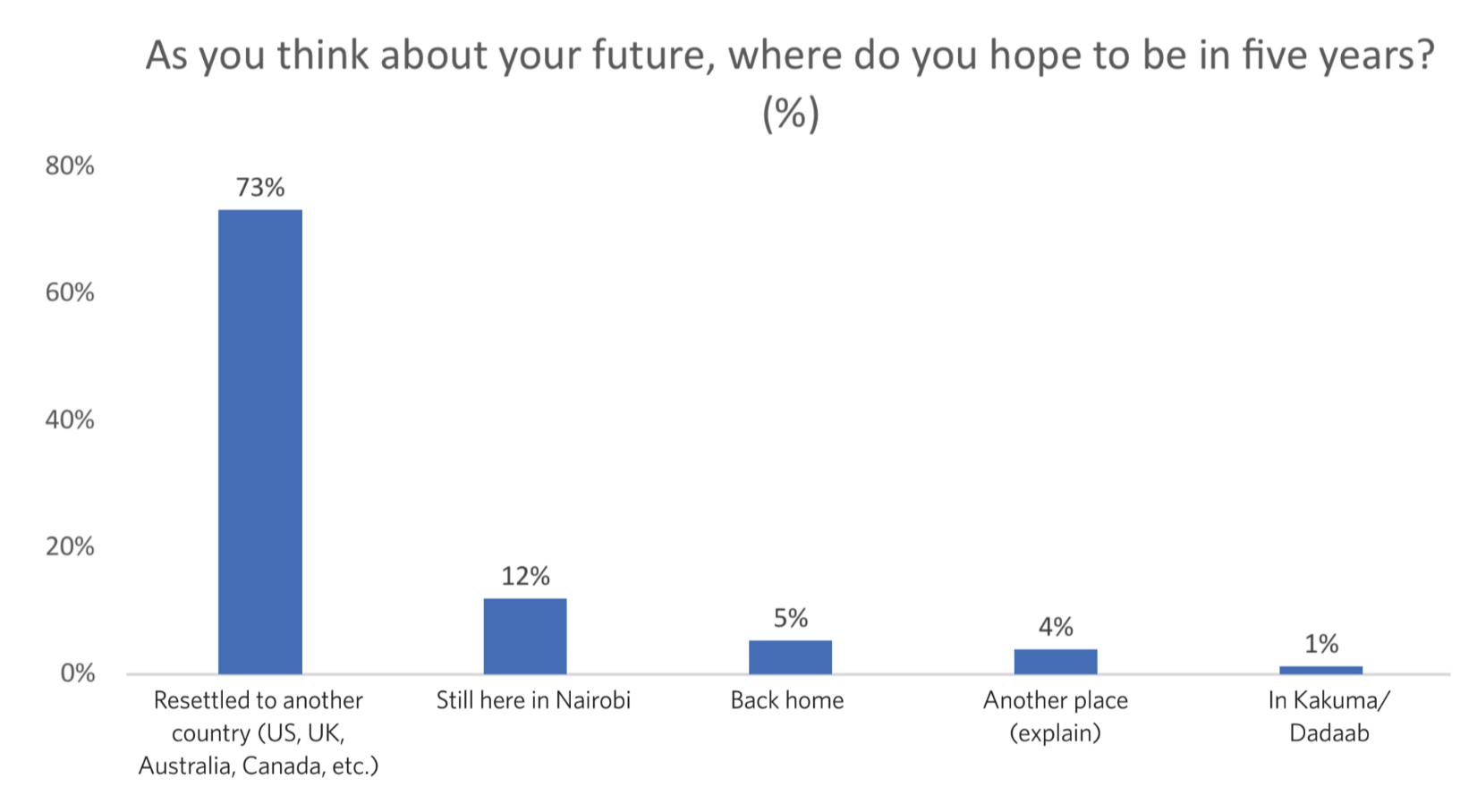
The participants in our study are uncertain about their futures. About 73% hope to be resettled to a third country, but the process feels opaque and slow. They believe that in a third country, they would be afforded full rights to move, work, and build their lives in perpetuity. In the absence of that, they feel everything is uncertain. The gains they make in their livelihoods can be quickly wiped out by legal and bureaucratic barriers. While they are mostly very grateful that their children can pursue an education in Kenya, they feel stifled in their attempts to gain a steady economic foothold in the country, especially in the city. In Kakuma, by contrast, a number of participants have been able to build and even ratchet up their livelihoods by saving and investing. While they are unable to move freely, they face fewer restrictions and less harassment from running their businesses there. Still, professionals in the camp often feel frustrated by the low cap on wages for those with professional skills, such as teachers and those with university-level education.
So, the preference for resettlement is not just about mythical ideas of prosperity in places like the US and Canada, but also about the freedom to really build a life. In fact, 12% would like to stay in Nairobi and be granted permission to remain indefinitely, preferably with full rights to work and move.
Of course, none of this is within their control. The resettlement process managed by UNHCR is slow-moving and opaque, and receiving countries set quotas— which have been particularly low in recent years—for the refugees they accept. Kenya has no clear way for refugees to become permanent residents as well. The only pathway requires seven years of work permits, which are only two years in duration and frequently denied to refugee applicants. In our conversations with local practitioners, none were aware of a single instance of a refugee achieving permanent residence. Even more ominous is the Kenyan government’s threat to repatriate the country’s refugees, a stance echoed as recently as March 2021.
5.1 Very Few Are Investing in Long-Term Businesses, Property, and Other Assets.
This uncertainty leaves many in a state of waiting, which further discourages productive investment and the ratcheting up of livelihoods, especially in Nairobi. Instead of trying to start or grow a business or purchase productive assets, like equipment for a restaurant or a motorbike to ride as a boda driver, participants seemed more interested in the kinds of work that would help them get by, wary of things that felt too permanent.
They told us:
- “I believe that before the end of next year I will be in Australia, and my life will begin.”
- “My work is only to pray and wait.”
- “I am hoping that I will be resettled in Canada and make a good living there. I have stayed in Kenya for over 10 years now and hope I will be relocated to a permanent country like Canada. I do not know how realistic my wish is, but the only thing I can do is pray and wait what my destiny holds for me.”
- “I believe I will one day be resettled even if I am not 100% sure; that is my only hope, and the only reason I keep on fighting. I know soon or later I will be resettled and have a country which I call my country where I will have all the rights just like any other citizen of any country.”
5.2 Few Are Investing in Transferable Skills, Given the Lack of Control over Durable Options.
Even those who feel very confident in their prospects for resettlement invest minimally in skills they can bring with them to their expected new homes. It seems too optimistic to invest in skills more useful in a third country, unsure of whether that dream will be realized. Of course, they also don’t fully understand the livelihood opportunities and skills they will need to bring with them. Thus, many are not only underinvesting for now, but they also underinvest for the future.
For example, one respondent was a Congolese LGBTQ young man, 26 years old. He fled DRC when his family caught him with another man. At the time, he had finished a portion of his university education. In Nairobi, he has struggled to get by. When we met him, he was working in a restaurant for KES 150 per day, but spending KES 60 per day on transport. He then moved to a barbershop where he could earn KES 200 per day. His English is not particularly strong, and he hasn’t worked on building any new skills in the past three years. Towards the end of our study, he was notified that he had been approved for resettlement in Australia, and was thrilled about his move. He expected—likely unrealistically—a smooth transition to his new life in Australia.
More livelihoods interventions in Nairobi and in the refugee camps could be built around transferable skills. In a partner study the Tufts team conducted in Dallas, Texas, we observed the extremely high opportunity costs that resettled refugees in that city face while building up marketable, recognized skills to be applied in the United States.³⁶ Their transitions could have been significantly eased by building those skills while still in displacement. Labor market assessments in both Kenya and receiving countries would be necessary to identify these opportunities, but there are likely areas of overlap around commercial driving, translation, construction, and other trades and services.
5.3 Uncertainty Cultivates Fatalism over Livelihoods.
This deep uncertainty about the future makes refugees feel they are not in control of their destinies. Why try too hard to build a life, when ultimately it is not in your control? Many of our respondents expressed a sense of fatalism and helplessness in their livelihoods, fueled by the many barriers they face and the uncertainty over whether they will ever be resolved.
Implications
Observations from the FIND project in Kenya suggest a number of implications for policymakers, advocates, practitioners, and funders in the refugee space.
Return Rights to the Top of the Refugee Agenda
First and foremost, this research forces us to confront the reality that impingements on refugees’ rights to move, work, be legally recognized, freely use M-Pesa, and access a durable solution are the most critical factors limiting refugees’ abilities to build financial health in Kenya. There simply are no workarounds to secure these fundamental rights. Making investments in skills and livelihoods is in some ways counterproductive, implicitly assuming refugees ought to be able to find a way to build financial health under completely hostile conditions. Those conditions themselves are anathema to self-reliance, which creates a situation in which refugees are constantly frustrated from running in place, and the government is constantly frustrated by what they see as a population with endless dependence on humanitarian aid.
Without conditions that give refugees the rights to move and work and the freedom and encouragement to build assets, investments in financial services will have very little impact and should probably be focused primarily on the distribution of cash assistance and on reliable, affordable remittance channels.
In addition, international agencies and governments must also adhere to their own rights-based commitments, including insisting upon Decent Work conditions among refugee workers in camp settings. The UNHCR’s wage harmonization process has capped professional wages in professions such as teaching and project management at wages that are below Kenya’s minimum wage and barely exceed Kenya’s poverty line for a single adult. Nearly all of our participants in the camps earned significantly higher wages in informal work. These caps mean that there is no upward mobility for skilled, educated professionals, many of whom have been or are likely to be stuck in the camp for more than 20 years. Forcing these professionals off of a professional course jeopardizes investments in skilled professions and the building of human capital to support both the camps and to enable self-reliance after resettlement or return.
Advocate for Access to Mainstream Services
When practitioners and funders are working on expanding financial access for refugees, the priority should be to open access to refugees to mainstream services. When creating separate, closed-loop systems, refugees do not benefit from the full range of services that might be developed. They face risks from systems with insufficient investment in maintenance and customer care. And, as with M-Pesa in Kenya, they can be blocked from mainstream economic infrastructure that encourages transactions with the broader economy, helping local communities realize some of the benefits of refugee expenditure and commerce. Closed-loop, special-purpose systems can be wasteful in building a separate infrastructure for refugees and fall far short of any kind of “inclusion” goals, even if they are quite successful in the delivery of humanitarian aid.
In Kenya, this would mean working with government partners to address their concerns about the security of allowing refugees to access M-Pesa with their own IDs, putting the country on a path to extending the service to all. Research partners could support an evaluation of this process showing the benefits and costs of moving towards this kind of inclusion, including documenting the economic returns to Kenyan businesses and the Treasury.
Support Improvements in Bureaucratic Efficiency
In support of these goals, funders and international partners should support improvements in the bureaucracy of refugee management, helping provide resources and incentives to streamline, digitize, and speed up processes such as refugee registration, status determination, ID issuance and renewals, and integration into digital government platforms like e-citizen, drivers’ licenses, birth certificates, and work permits. Delays and opacity in these processes inhibit refugees’ sense of security and their livelihoods, creating long and frequent periods of limbo for refugees. Helping manage such processes quickly, efficiently, and clearly would greatly improve refugees' lives while helping the Kenyan government ease the bureaucratic burden of hosting such a large number of refugees.
Broaden Understandings of the Inputs to Financial Health. Practitioners who promote “financial inclusion” or financial services for refugees typically do so because they hope to improve refugees’ financial health. In other words, they see such services as a potentially helpful tool in improving refugees’ financial outcomes in terms of being able to meet basic needs, manage debts, overcome setbacks, and plan for the future.
But a close look at the financial lives of refugees in Kenya reveals that financial services play just one part in reaching those outcomes. Many other inputs are equally critical. Among these are language skills, broad and diverse support networks, mental health, exposure, and feelings of personal safety and security. When we focus on the outcomes, we are able to better see which inputs really matter and imagine different ways to help support their provision.
For practitioners in Nairobi, that might mean broadening opportunities for exposure and friendship, in particular for women refugees and between refugees and host community members. Two ways to do this might be through:
- A workfare (or cash-for-work) program, which could be particularly useful for relatively new arrivals, female refugees, and Kenyans going through life transitions and economic crisis. These part-time jobs, done with consistent teams over at least several weeks, could help provide income, the dignity and exposure of a workplace, while also giving participants an opportunity to interact.³⁷ For women, this is a relatively simple and low-risk way to begin building a public life in an unfamiliar city.
- Facilitating mixed refugee-host community interactions through informal mentorships, language partners, or skill swaps between host community women and refugee women. Organizations that already help facilitate savings groups could set up group exchanges. For example, the refugee group might show a host community group how to make injera, while the hosts take the refugees on a tour of the city by public transport or teach market Swahili for negotiating vegetable prices.
Strengthen and Support Refugee-Led Institutions with New Approaches³⁸
In Nairobi in particular, we found that refugee-led organizations and religious institutions were doing a particularly good job of providing many of those key—but often overlooked—inputs that foster feelings of security, community, networks, mental health counseling, and even language skills. These institutions, typically run by refugees themselves, have a deeper, more patient understanding of refugees’ needs and have proved to be much more accessible to those in need than larger NGOs, particularly through the COVID crisis.
Funders and larger NGOs can help them expand and strengthen their work, potentially in new ways that recognize that they may not be able or interested in expanding their bureaucracies to manage funds the way that large NGOs might expect. For example, they might:
- Provide refugee-led organization staff with professional training and certification in key areas of service delivery, such as social work, counselling, paralegal services, and language instruction and interpretation among refugee and host populations. Partners could work to ensure these skills are internationally recognized credentials upfront, transferable in the event of resettlement.
- Imagine new ways of paying for service delivery, such as a “RefuCorps” akin to the United States’ AmeriCorps program. This would directly pay the wages of trained social workers, counsellors, paralegals, and language instructors who come from and are posted to refugee-led CBOs and religious organizations for a fixed duration of 2–5 years. While in the program, these professionals would also access mentorship and professional development opportunities. A parallel program could be offered to Kenyans working in these professions in other low-income and marginalized communities throughout the country.
- Small, unrestricted grants (even as small as $5,000) could be used to supplement organizations’ discretionary funds, particularly during crises like COVID, following a thorough vetting of selected institutions.
Explore New Avenues for Permanent Solutions
Our research revealed the incredible stress that refugees face around the uncertainty of their futures, whether they are living in camps or the city. Many refugees in Kenya face the prospect of long, protracted—effectively permanent—encampment, while those in the city look ahead to years of only partial recognition. All hold to the vague hope of resettlement, which is available to fewer than 1% of refugees per year and subject to wild swings as political winds change in receiving countries. Helping build refugees’ financial health in terms of being able to plan for the future requires some diligent and creative approaches to permanent solutions.
Advocates should continue to press for larger resettlement allowances in receiving countries and open channels for permanent residence in Kenya under conditions that can be favorable to host countries, like Kenya.
Another potential avenue to explore is in building skills partnerships for migration, particularly targeting refugees and host community members in Garissa and Turkana, the two counties in Kenya that host the country’s main refugee camps. A skills partnership would identify skills gaps in both counties that overlap with skills gaps in potential receiving countries in need of those skills (such as the United Kingdom, Canada, or Australia). Eligible refugees and host community members would engage in a formal training program to develop and be certified in those skills, with a portion set to assume jobs in Kenya and another portion (mixed refugee and Kenyan) to migrate abroad. This could offer new ways to build human capital in Kenya, encourage remittances, and offer a pathway out of encampment for young refugees who feel increasingly hopeless and stuck under current conditions. The Center for Global Development has promoted and documented a number of similar successful programs for migration, outside of refugee contexts.³⁹
Conclusions
While Kenya hosts a large number of refugees from across East and Central Africa, its policies towards refugees have become increasingly securitized and punitive. Effectively, refugees lack the freedom to move, work, and use mainstream finance. These legal restrictions prevent them from building financial health and self-reliance. In the absence of supporting conditions, investments in financial services for refugees are unlikely to yield gains in financial health outcomes. Refugees in Nairobi are then stuck running in place, trying to make progress but facing setback after setback in the city, where they face constant harassment, discrimination, and denial of work permits. Some of those in camps are relatively free from that harassment and are instead able to build up complementary income sources over time, but they still feel stuck, since they are unable to move and trade freely, and have very few and limited chances to leave and build a new life as professionals in Kenya or as resettled refugees abroad.
Our FIND research reminds us that refugee self-reliance in Kenya is primarily an issue of rights and freedoms. It is therefore much more of a political question than a technical one. The FIND research shows us that without significant policy and legislative reform around fundamental rights, the road to self-reliance will remain little more than rhetoric for refugees in Kenya.
Footnotes
Works Cited
Center for Global Development. Regulating Labor Migration for Mutual Benefit: Explaining the Global Skills Partnership Model. Brochure. Center for Global Development, 2020. Accessed June 30, 2021. https://www.carma.org/sites/default/files/Global-Skills-Partnership-Brochure-web.pdf.
Central Bank of Kenya, Kenya National Bureau of Statistics, and FSD Kenya. 2019 FinAccess Household Survey. Nairobi, April 2019. https://www.centralbank.go.ke/wp-content/uploads/2019/04/2019-FinAcces-Report.pdf.
Crisp, Jeff. “UNHCR, Refugee Livelihoods and Self-Reliance: A Brief History.” UNHCR. Last modified October 22, 2003. Accessed April 12, 2021. https://www.unhcr.org/research/eval/3f978a894/unhcr-refugee-livelihoods-self-reliance-brief-history.html.
Government of Kenya. Refugees Act. Act No. 13 of 2006, 2006. Accessed June 9, 2021. http://kenyalaw.org/kl/fileadmin/pdfdownloads/Acts/RefugeeAct_No13of2006.pdf.
———. The Kenya Information and Communications Act. Kenya Gazette Supplement, August 14, 2015. Accessed June 9, 2021. http://kenyalaw.org/kl/fileadmin/pdfdownloads/LegalNotices/163-Kenya_Information_and_Communications_Act__Registration_of_Sim-Cards__Regulations__2015.pdf.
GSMA. Landscape Report: Mobile Money, Humanitarian Cash Transfers and Displaced Populations. GSMA, May 2017. Accessed December 13, 2019. http://www.cashlearning.org/downloads/mobilemoneyhumanitariancashtransfers.pdf.
———. Refugees and Identity: Considerations for Mobile-Enabled Registration and Aid Delivery. GSMA, 2017. Accessed May 17, 2021. https://www.gsma.com/mobilefordevelopment/wp-content/uploads/2017/06/Refugees-and-Identity.pdf.
Hussam, Reshmaan, Erin Kelley, Gregory Lane, and Fatima Zahra. The Psychosocial Value of Employment. Cambridge, MA: National Bureau of Economic Research, June 2021. Accessed July 20, 2021. http://www.nber.org/papers/w28924.pdf.
Inter-Governmental Authority on Development (IGAD). IGAD: Kampala Declaration on Jobs, Livelihoods and Self-Reliance for Refugees, Returnees and Host Communities in the IGAD Region 28th March 2019, Kampala, Uganda (28.03.2019). Declaration. Kampala: IGAD, March 28, 2019. Accessed July 19, 2021. https://minbane.wordpress.com/2019/03/30/https-wp-me-p1xtjg-9ox-2/.
Kenya National Bureau of Statistics. Basic Report on Well-Being in Kenya. Based on the 2015/16 Kenya Integrated Household Budget Survey (KIHBS). Kenya National Bureau of Statistics (KNBS), March 2018.
Kenya National Bureau of Statistics (KNBS). Economic Survey 2020. Nairobi, Kenya, 2020.
Kituo Cha Sheria and The Attorney General. Petition 19 of 2013 - Kenya Law. Nairobi, 2013. Accessed June 9, 2021. http://kenyalaw.org/caselaw/cases/view/86236.
Ladha, Tanya, Kaitlin Asrow, Sarah Parker, Elisabeth Rhyne, and Sonja Kelly. Beyond Financial Inclusion: Financial Health as a Global Framework. Center for Financial Services Innovation (CFSI) and Center for Financial Inclusion at Accion (CFI), 2017. Accessed May 19, 2021. https://content.centerforfinancialinclusion.org/wp-content/uploads/sites/2/2017/03/FinHealthGlobal-FINAL.2017.04.11.pdf.
Ministry of Interior. Support for Host Community and Refugee Empowerment (SHARE): Kenya’s Comprehensive Refugee Response Framework (CRRF). Government of Kenya, October 2020.
Nalule, Caroline, and Derya Ozkul. Exploring RSD Handover from UNHCR to States. Forced Migration Review, November 2020. Accessed June 9, 2021. https://www.fmreview.org/recognising-refugees/nalule-ozkul.
O’Callaghan, Sorcha, Farah Manji, Kerrie Holloway, and Christina Lowe. The Comprehensive Refugee Response Framework. ODI, September 2019. https://cdn.odi.org/media/documents/12940.pdf.
Refugees, United Nations High Commissioner for. “Number of Somali Refugees Grows Sharply in 2011.” UNHCR. Last modified April 29, 2011. Accessed June 9, 2021. https://www.unhcr.org/news/briefing/2011/4/4dba949d9/number-somali-refugees-grows-sharply-2011.html.
Sikenyi, Maurice. Does Kenya’s Youth Enterprise Development Fund Serve Young People? IDS Bulletin. Institute of Development Studies, 2017. Accessed June 9, 2021. https://bulletin.ids.ac.uk/.
Staff, Reuters. “Kenyan Investigators to Question More than 40 People over ‘Massive Theft.’” Reuters, May 20, 2018. Accessed June 9, 2021. https://www.reuters.com/article/us-kenya-corruption-idUSKCN1IL0BF.
Stapele, Naomi van. “‘We Are Not Kenyans’: Extra-Judicial Killings, Manhood and Citizenship in Mathare, a Nairobi Ghetto.” Conflict, Security & Development 16, no. 4 (July 3, 2016): 301–325.
Thieme, Tatiana, Meghan E. Ference, and Naomi van Stapele. “Harnessing the ‘Hustle’: Struggle, Solidarities and Narratives of Work in Nairobi and beyond Introduction.” Africa 91, no. 1 (January 2021): 1–15.
UNHCR. Kenya Statistics Package. UNHCR, January 31, 2021. https://www.unhcr.org/ke/wp-content/uploads/sites/2/2021/02/Kenya-Statistics-Package-31-January-2021.pdf.
UNHCR, World Bank, Kenya National Bureau of Statistics, and University of California. Kenya - Socio-Economic Impact of Covid-19 on Refugees - Round 2, 2020; UNHCR_KEN_2020_COVID_Round2_v2.1. UNHCR, 2021.
United Nations. The Refugee Convention 1951, 1951. Accessed April 26, 2021. https://www.unhcr.org/4ca34be29.pdf.
United Nations High Commissioner for Refugees. “Joint Statement by the Government of Kenya and the United Nations High Commissioner for Refugees: Dadaab and Kakuma Refugee Camps Roadmap.” UNHCR. Last modified April 29, 2021. Accessed June 9, 2021. https://www.unhcr.org/news/press/2021/4/608af0754/joint-statement-government-kenya-united-nations-high-commissioner-refugees.html.
Wambui, Mary. “Kenya Revises Refugee Camp Closure to June 2022.” The East African, April 29, 2021. Accessed June 9, 2021. https://www.theeastafrican.co.ke/tea/news/east-africa/kenya-refugee-camp-closure-3381840.
Zollmann, Julie. Living on Little: Navigating Financial Scarcity in Modern Kenya. Practical Action Publishing, 2020. https://practicalactionpublishing.com/book/2474/living-on-little.
———. Shilingi Kwa Shilingi: The Financial Lives of the Poor. FSD Kenya, August 2014. http://fsdkenya.org/publication/kenya-financial-diaries-shilingikwa-shilingi-the-financial-lives-of-the-poor/.
———. Trickling Down and Climbing Up: Economic Trajectories of Financial Diaries Households Two Years On. Nairobi: FSD Kenya, 2016. http://fsdkenya.org/publication/trickling-down-climbing-up/.
Zollmann, Julie, Arokhsh Faiz-Qaisary, Kenza Ben-Azouz, Kim Wilson, and Radha Rajkotia. Financial Integration of Refugees in Dallas, Texas. Tufts University, 2019. Accessed June 3, 2021. https://www.journeysproject.org/financial-integration-of-refugees-in-dallas-texas/.
Zollmann, Julie, and Kim Wilson. Following Where Community-Driven Organizations Lead: Lessons for Strengthening Refugee Financial Integration. Henry J. Leir Institute, The Journeys Project. Tufts University, January 2021. Accessed June 9, 2021. https://www.journeysproject.org/following-where-community-driven-organizations-lead/