
Written by: Sarah Carson, under the supervision of Kim Wilson
Table of Contents
Field research is a common and often powerful piece of postgraduate training in international affairs and development. But sending students to the field also comes with risks to both students and study participants. What happens when you send five students abroad to execute Lean Research on their own? What challenges might they encounter, and what innovative solutions could they develop? And what do they learn that could be applied to similar experiences in the future?
I. Background on the Research
A research team consisting of five students from the Fletcher School at Tufts University and a Kenyan researcher was dispatched to Ethiopia, Uganda, and Mexico. Their mission? To use Lean Research principles to understand the financial and economic coping strategies of migrants, refugees, and asylum seekers, specifically those who have been displaced from their countries of origin for between 3–5 years. Migrants and refugees often have a final destination in mind but, because of political and economic circumstances, cannot reach their goal. They have to make do. This study was about how they make do.
Sponsored by the International Rescue Committee (IRC) and the Open Society Foundation (OSF), the study team¹ sought a better understanding of the stakeholders whose actions and choices shape the economic strategies of displaced people, as well as how those living in protracted displacement manage multiple (and often conflicting) policies and stakeholders. In Ethiopia, the research was conducted in Kebribeyah camp, located in the Somali region. Most refugees in this camp are from Somalia and have been living in Ethiopia for some time. In Uganda, the researchers interviewed refugees in both urban and camp settings. Conducting research in both Kampala and Bidi Bidi camp enabled the researchers to uncover interesting contrasts between refugee integration in each setting. Finally, in Mexico, the researchers were based in Tijuana, just south of the border with the United States. Unlike the other two locations, researchers in Mexico were focused on migrants rather than refugees. One of the researchers focused on Central American migrants, while the other interviewed primarily Haitian migrants.
The research methodology drew heavily on Lean Research principles developed through a collaboration between Fletcher and MIT D-Lab. The research process involved a series of qualitative, in-depth, semi-structured interviews of respondents living in situations of protracted displacement, as well as of key informants and observers. Information for this case was collected during a call held each Saturday from June 15th to August 10th, 2019. During the call, the researchers discussed their high and low moments, their surprises, their challenges, and how they might address them the following week. Ideas ranged from ways to improve logistics, recruit more effectively, and manage issues associated with a Lean approach to research (see Table: Summary of Key Changes Made During the Research Process for an overview in table form). The research team decided to document and share their experiences implementing Lean Research in the hopes of benefiting future groups of students, professors, and researchers who may undertake similar projects.
The working assumption of this research was that if NGOs, municipalities, banks and financial service providers, as well as regulators and policy makers, better understand the daily realities of displaced people, they could design better policies and products to serve them. These key findings of the research will be published in other subsequent reports. More broadly, this research was designed to help fill information gaps related to refugee and migrant livelihoods in protracted displacement and support IRC in its efforts to design more programs that are directly responding to the needs of their clients.
II. How Lean Research was Used in the FIND Project
From the beginning, the Financial Integration in Displacement (FIND) project was designed to incorporate the principles of Lean Research. Both Principal Investigators on the project were involved in the development and refinement of Lean Research and have used these techniques throughout their diverse research experiences. The students had a range of experience; while two had conducted Lean Research under Kim Wilson previously, three students were completely new to the concept. During training sessions conducted both in Medford, MA, and Nairobi, Kenya, the PIs reviewed the Lean Research approach, led the students in discussing and role-playing difficult scenarios that could arise, and conducted practice interviews using the techniques.
Below is a summary of how the Four R’s of Lean Research were incorporated into the FIND study:
Rigor: This research methodology of semi-structured, qualitative interviews had been tested and implemented successfully in several other similar contexts, particularly in the Financial Journeys of Refugees project. In the research process, the team placed an emphasis on informed consent and data protection, with the support and approval of the Institutional Review Board of Tufts University.
Respect: FIND researchers guided respondents through a clear consent process, placing the respondents’ experiences at the center. The researchers were also strongly encouraged to conduct feedback sessions with both respondents and local IRC offices, time permitting.
Relevance: The FIND study was designed to be of high value to stakeholders, particularly as protracted displacement becomes more and more common around the world. This project is one of the few multi-country studies illuminating the experiences of refugees and migrants in protracted displacement, by exploring their financial, economic, social, and civic integration.
Right-sized: In each of the four study sites (Tijuana, Bidi Bidi camp, Kampala, and Kebribeyah camp), the FIND researchers aimed to interview 30 respondents, a number which the team expected would provide a sufficient amount of diversity in experiences but would not impose an undue burden on the community. The PIs also hoped that this goal was modest enough to avoid researchers rushing to hit a quota, sacrificing Lean Research principles in the process. The team also believed 30 interviews per site were about the most they could expect to do well during the brief summer period when student researchers were available. Researchers were encouraged to be respectful of participants’ time and ensure that interviews last between one and two hours, depending on the person and the context.
III. Results from the Lean Research Experience
Overall, the Lean Research approach facilitated the team’s success during field research. One of the researchers in Uganda, who was very experienced in field research prior to this study, noted that in some previous projects she has felt that the research lacked the rigor emphasized by Lean Research. For example, she has worked on teams in which the lead investigators had failed to gain sufficient background from the literature prior to arriving in the field, which inhibited the team’s ability to conduct rigorous work on the ground.
The researcher in Ethiopia had a background in journalism, and he found the lean research experience an interesting contrast. He noted that, too often, journalists are motivated by a headline they have been given by an editor, which can lead them to ignore certain points of view. However, while conducting Lean Research for the FIND study, he was able to glean a better understanding of the context by speaking with a variety of stakeholders and seeking to include as many perspectives as possible. This approach made people actually want to speak with him because they knew he would treat their time and their stories with respect.
In Uganda, the researchers were met with similar enthusiasm from participants, and discovered that more respondents were interested in participating than they had time available to interview. Some respondents even requested a second interview. While part of this may be related to the small thank-you gifts that respondents received (approximately 2 USD per participant), the researchers believe that the Lean Research practices of balancing respect for respondents’ time with a genuine interest in their stories were the major driver.
For the students working in Tijuana, the Lean Research approach helped to differentiate them from other researchers and journalists working in this highly prominent and politicized context on the U.S. border. Several of the Central American respondents related negative experiences of working with journalists, which had left them feeling taken advantage of. A few Haitian respondents reported that sometimes these journalists had recorded conversations and taken photographs without their permission, and so they sincerely valued the consent process in the FIND study. These respondents also appreciated the fact that the researchers sought their feedback on the findings at the end of the fieldwork, another Lean Research method that helped distinguish this study from others on the ground.
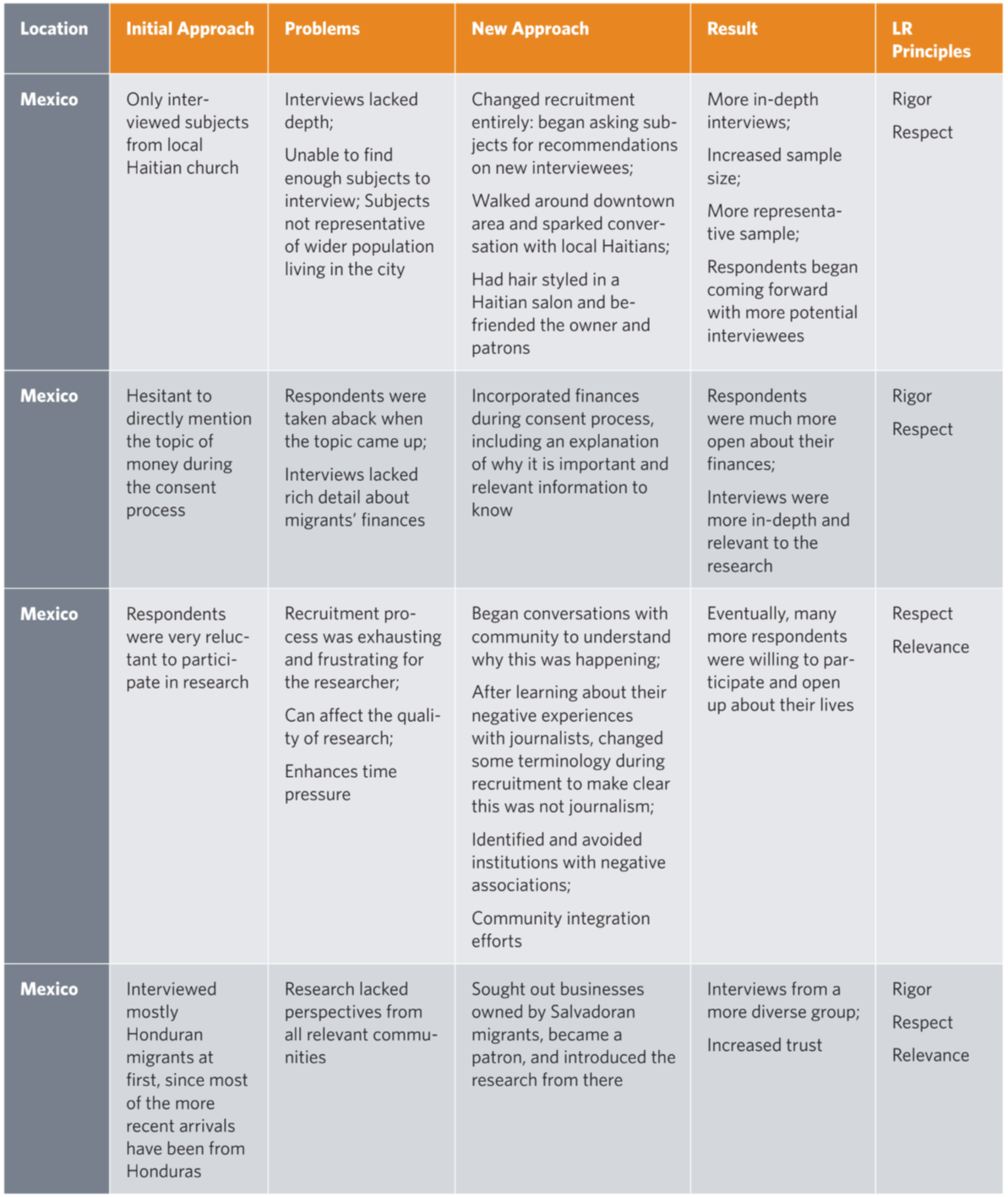
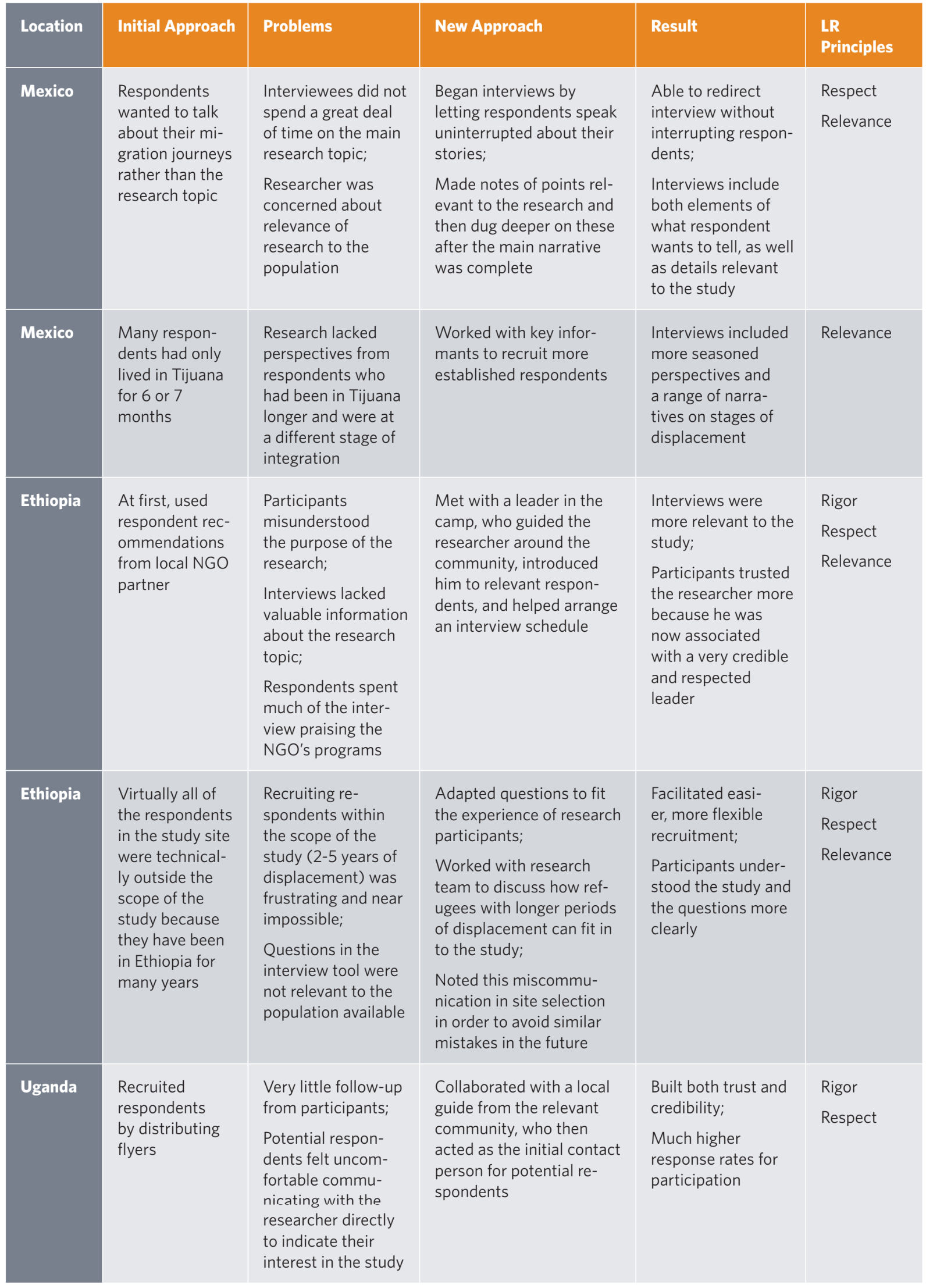
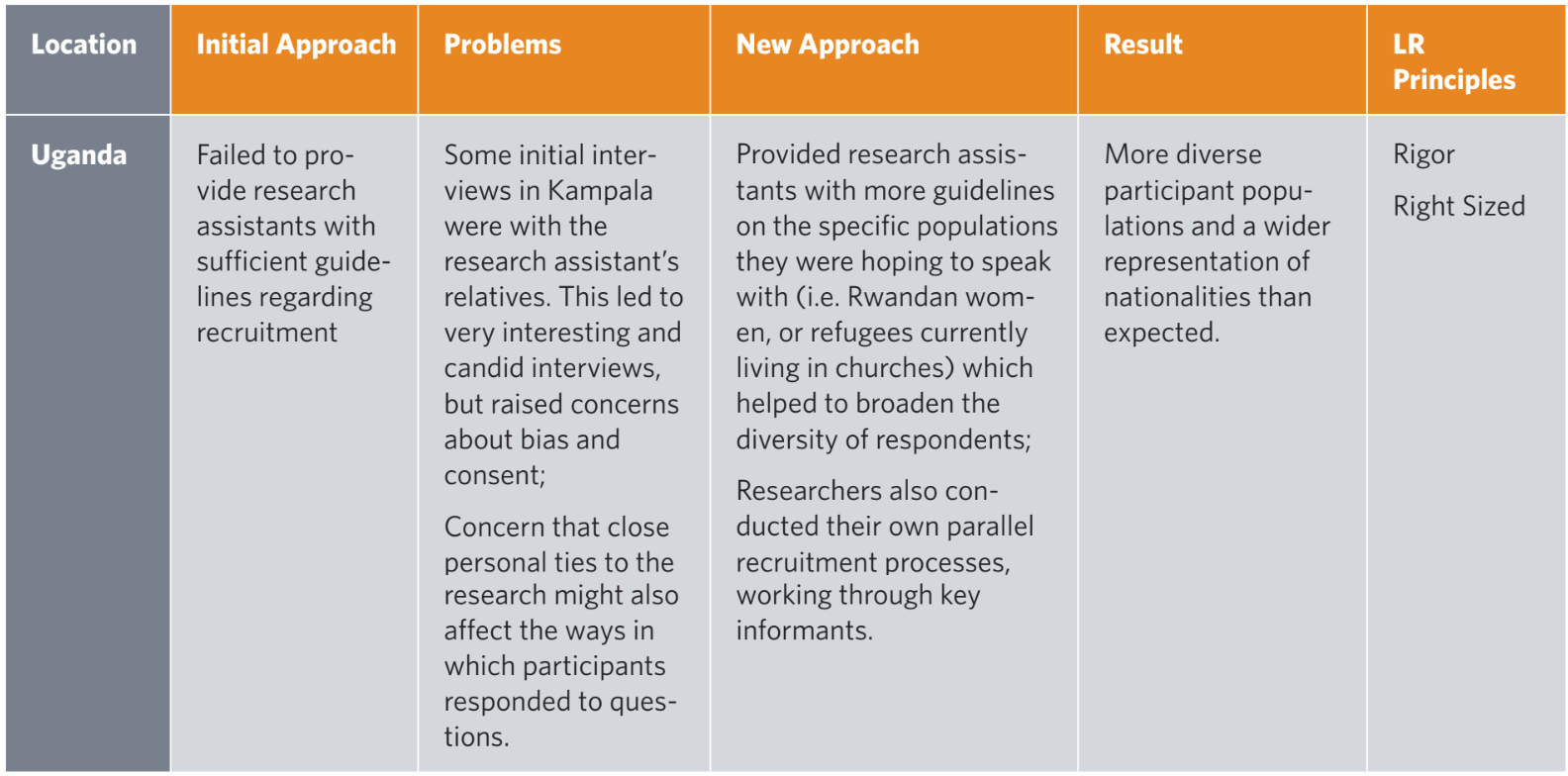
The Lean Research principles also enabled the researchers to identify issues on the ground and develop creative solutions. The table below provides some key examples from each setting of challenges that the researchers encountered and how Lean Research gave them a framework for creating new approaches that provided better results for the research and better experiences for the research participants.
Summary of Key Changes Made During the Research Process
IV. Lessons Learned from Implementing Lean Research
A. Successful Strategies:
1. Community integration helps to facilitate Lean Research
The field researchers learned that the Lean Research methodology was particularly helpful in building relationships with respondents, from the initial community integration stage all the way through recruitment, interviews, and feedback sessions. For both the Mexico and Uganda study sites, there was time built in during the first few weeks to integrate within the local community and build trust among potential respondents. For example, in Tijuana, one researcher went to a local Haitian church, where she had an opportunity to introduce herself to the congregation and explain who she was and why she was there. The other researcher gained an early introduction to an important local figure, a Honduran man who had become a leader and representative figure of the first caravan that arrived at the U.S.-Mexico border months before. This man helped her to form connections with others in the community, introducing her to other migrants who might be willing to speak with her.
2. Recruitment approaches should be tailored to the context and the participants
The students noted that recruitment strategies were most successful when they were context-specific, and an iterative approach was often most effective. This is closely related to the Lean Research concept of centering the experience of the respondents and tailoring the research to suit their needs. For example, at first, one of the researchers in Uganda tried distributing flyers with his contact information to potential respondents in Kampala. However, very few refugees were comfortable using these flyers to contact him directly. Next, he tried working with local guides who were members of these communities, which was far more effective. The guides would act as the initial contact with potential participants, which helped to build trust and credibility.
In Ethiopia, the researcher first relied on IRC to help recruit respondents. However, having an NGO select respondents created confusion among the interviewees about the purpose of the research, and many of these early respondents spent much of the interview praising IRC programs. The researcher tried a new approach after being introduced to a Somali leader in the camp, who was willing to guide him around and help to arrange interviews with respondents who fit the study criteria. These interviews were far more fruitful and relevant to the study.
In Tijuana, one researcher gained the trust of respondents by seeking out community spaces and becoming a patron. For example, in order to meet respondents from El Salvador, she spent time online researching businesses. She found a restaurant that serves a popular Salvadoran food, spent time there as a customer, befriended the owners, and only then introduced the research.
Another researcher in Mexico found that going to a Haitian hair salon was one of the best ways to connect with women and seek out female respondents. Hair salons tend to be excellent opportunities for women to connect with other women, a method that Fletcher students have used elsewhere to connect to locals as well as migrants. This researcher also found success using snowball sampling techniques, using respondents whom she had already interviewed and built relationships with to recommend others.
3. Clear consent processes and explanation of the research are important to participants
Generally, the consent process went smoothly and was very appreciated by participants. At first, some of the researchers felt frustrated when potential respondents would decline to participate or withdraw from the study halfway through. However, the research team was able to remind them that, in Lean Research, this was actually a positive result, as it indicates that they were creating an environment in which respondents felt truly able to make their own decisions about whether or not to participate. The researcher in Ethiopia also learned that the Somali refugees he met there valued the anonymity of the research. Like the other FIND researchers, he assured all respondents that their names would not be mentioned, and often even refrained from asking their names until the end of the interview.²
At first, some students felt uncomfortable asking direct questions about money and were therefore hesitant about including this aspect of the research topic in recruitment and consent procedures. This reluctance on the part of the researchers created a negative situation for study participants, who felt taken aback when these questions came up during interviews without any preface. When the students were open with the rest of the research team about how some of their own fears and anxieties sometimes stood in the way of adhering to Lean Research principles, it created space for valuable group discussions. In response, other students shared their strategies, and they brainstormed solutions together.
The FIND team encouraged students to use the consent process to introduce the context of the financial questions and explain why discussing financial matters was important for the study. With the support and encouragement of the research team, the students became more confident in bringing up topics that, while they felt uncomfortable at first, ended up not being as awkward or difficult as they feared. With the right preface, it turned out that respondents across all study locations were actually very open in discussing financial matters.
4. Lean Research practitioners should ensure that participants feel comfortable and respected throughout the research process
As the research progressed, each student developed his or her own ways of building rapport with respondents during interviews and making them feel comfortable and respected. At first, one researcher in Uganda tended to launch right into the list of questions. However, after getting to know the refugee community in Kampala, he started to begin interviews with more casual introductory conversations to break the ice before delving into the research questions. Another researcher in Kampala found that remembering to thank both the respondent and the interpreter at the start of the interview for sharing their time was important for setting the tone. She also learned that patience was a key element for showing respect to respondents. For example, she made sure to give them time to finish what they had been doing before starting the interview, and showed understanding if they ran late to an interview appointment. In Tijuana, one researcher tried to readjust the power dynamic between researcher and subject by humbling herself and emphasizing the respondents’ agency during the recruitment and consent processes. In Ethiopia, the researcher would often close interviews by asking the respondents if they had any questions for him. This helped to make the interaction more of an open, two-way exchange of information.
5. Feedback sessions with participants and stakeholders produce better Lean Research
After the interviews were completed, the FIND researchers organized debriefs with the respondents. This practice is very important for Lean Research but must be done carefully in order to ensure that respondents’ time is still respected. The two researchers in Tijuana each developed different ways to manage this challenge. One student organized a group feedback session for some of the Central American respondents. To do this, she called each respondent individually to ask for their availability, and then scheduled two different meetings. They met in a private section of a café and reviewed a handout that she had prepared with some key findings. Unfortunately, due to scheduling conflicts, the second group session was cancelled. For the other student, she found that most of the Haitian respondents she had worked with had hectic schedules, so she decided to do one-on-one feedback sessions. Some meetings were in person, while others were conducted via phone call depending on the person’s availability.
Both methods were successful and had their own trade-offs. Group sessions were more difficult to organize, but enabled the respondents to build community and lasting connections with one another. Individual sessions were easier for respondents to incorporate into their schedules, but required a great deal of time and coordination on the part of the researcher.
Feedback sessions with IRC were also very valuable. The researcher based in Ethiopia was evacuated from Ethiopia due to political instability, and therefore there was no time to debrief with participants. However, after returning to the U.S., he was still able to present his findings to IRC staff in the Addis Ababa office. The IRC staff agreed with his main findings and had a chance to offer feedback on how the research process could be smoother in the future.
6. Lean Research practitioners should ensure research is “right sized” for themselves as well as for participants
Researchers also found that conducting a study that was “right sized” for respondents also meant that it was “right sized” for the researcher. The PIs encouraged the students to build in time for rest days, typing up field notes, exploring the area, and decompressing. Some of the students’ favorite ways to relax and recharge during the recess process were watching movies, calling family and friends, exercising, dancing, and trying new foods. This downtime also helped give researchers the time they needed to process interviews and stories of displacement that were sometimes incredibly heartbreaking.
B. Challenges in Implementation
1. Recruitment can be a major barrier, especially in some communities
While all researchers faced difficulties from time to time in recruiting respondents, one of the students in Tijuana had some especially difficult barriers working with the Haitian migrant community in Mexico. After arriving, she realized that there was much more research fatigue than expected among this community and sensed their wariness about sitting down and participating in interviews. In following the Lean Research principles, she wanted to respect this understandable reluctance, but also wanted to ensure that these potential respondents had a clear understanding of who she was and the purpose of this research. To differentiate herself from the journalists who had come before, she changed some of the terminology that she had originally used, approaching interviews as mutual conversations rather than formal interviews. This change of phrase helped respondents feel more open to participating.
Over the course of the study, she also learned how to pinpoint certain institutions which had positive or negative connotations within the community. For example, at one point, she learned that many Haitian migrants have had negative associations with a well-known shelter which she had frequented in her first few weeks. After learning this information, the researcher distanced herself from this institution in order to gain more credibility. In the end, she found plenty of respondents who were willing to speak with her, but it required a great deal of community integration and up-front efforts in relationship building.
2. Research topics relevant to policymakers might not always be the priority of respondents
One unexpected challenge in implementing lean research for the FIND project was the discovery that, in some cases, the topic of the research did not always match the respondents’ priorities or experiences. In Tijuana, especially, many interviewees wanted to discuss their migration stories and their plans for crossing the border into the United States. At first, they had difficulty understanding how questions about finances were important or relevant to them, and it could sometimes be challenging for the researchers to steer the conversation back to the research topic while still respecting the respondents’ preferences.
To cope with this challenge, one researcher decided to first give the migrants the space to tell their stories as they wished, even if it strayed from the research questions. While they narrated their experiences, she took notes on points that were relevant, which he could then follow up on after the main narrative was complete. In this way, she could redirect the respondent without interrupting the flow of the conversation. The other researcher was able to relate the finance questions to a general sense of economic discontent, which was closely connected to many migrants’ skepticism about long-term integration in Mexico. In Ethiopia, the researcher had to significantly adapt many of the research questions to focus more on later stages of integration. This was necessary because, as he found soon after arriving, the majority of the camp’s residents had been living there for 20 years or more, which was far outside the FIND study’s initial scope of 2-5 years of displacement. By adapting the research to the realities of the respondents, rather than trying to fit them into the original scope, he was able to ensure relevance to the study participants and also contribute new perspectives to the study overall.
3. Working through interpreters adds a layer of complexity in implementing Lean Research
While the researchers in Tijuana were able to communicate with their respondents directly in Haitian Creole and Spanish, the researchers in Uganda and Ethiopia conducted interviews using interpreters. They soon learned that, although interpreters can be an extremely valuable source of information, managing a research team can sometimes make it more difficult to conduct truly lean research. For instance, the refugee community in Uganda is very diverse, so the researchers had to work with a number of different interpreters to ensure that they were prepared to interview refugees from different countries of origin. This sometimes caused confusion, for example, when their initial South Sudanese interpreter came from a different ethnolinguistic group than many of the other South Sudanese respondents. They also learned that the gender of the interpreter could be very important for making participants feel comfortable. Initially, when working with a male interpreter to interview Somali women, the respondents clearly did not feel free to express their opinions, and would only agree with what the interpreter had said. They decided to switch to a female interpreter, who was less experienced in research, but better at making women feel comfortable.
Researchers in both Uganda and Ethiopia sometimes had trouble with the reliability of their interpreters. There were also challenges in which locally hired recruiters tended to recruit within their own social networks rather than engaging a diverse representation of the community. (For example, a Congolese recruiter in Uganda selected mostly students from his English class.) One takeaway is that it is as important to build rapport with interpreters on the research team as it is with potential respondents. It is also valuable to train interpreters on the Lean Research principles to help them become interested in and motivated about the research. Just as student researchers should show respect to respondents, they should also create an experience for interpreters that is respectful, inclusive, and valuable for those who join their field teams. For example, are interpreters fully integrated into the project? Are they being paid and treated fairly? Are their inputs being sought and valued?
4. The “right-sized” approach developed during research design might not always fit results on the ground
One challenge is that it is sometimes difficult to determine the right size of the research before the research process begins. For example, while the PIs estimated that 30 interviews would be appropriate for each research site, in Kampala, one researcher believed that there was still more to uncover. He found that refugee experiences in Kampala were more diverse than expected, and that the true “right size” might be a larger sample in order to provide a better representation of the urban refugee community. However, he was unable to increase the sample due to time constraints, limited funding for interpreters and recruiters, and unexpected personnel changes.
5. The research process is inevitably affected by researchers’ identities, both positively and negatively
In some instances, the researchers’ own identities can present challenges to the expected methodology. One of the researchers in Mexico learned that there were some locations that previous male researchers and journalists had used but that were not accessible to her as a woman. However, at the same time, this enabled her to access new spaces that a male researcher might not be able to, like the hair salon. However, she still found herself having to do a lot of boundary setting, especially with male respondents. For one of the students based in Uganda, despite a thorough consent process that explains the purpose of the research and the benefits and risks involved, respondents and their families are still requesting assistance with the U.S. asylum process. To some extent, no matter how thorough a consent process may be, respondents living in protracted displacement seem to still hold out some hope that they might be able to use a rare connection with an American researcher to more directly improve their situation.
The researcher in Tijuana also found that her identity as a Haitian woman helped the community open up to her more than they might have with another researcher. Her connections with the Haitian diaspora have also helped her begin developing more long-term partnerships with Haitians in Tijuana. After posting about her research on a Facebook group for Haitian professionals, she connected with two women who are interested in conducting trainings for the Haitian community in Tijuana. In addition, once back in the United States, the researcher was able to contact a Haitian choreographer who expressed interest in facilitating a dance workshop in Tijuana. Her identity as a Haitian, combined with her Lean Research experience, enabled her to begin to build a transnational relationship between Haitians in the United States and those in Tijuana that may more directly benefit respondents.
6. Standards of rigor may differ across countries and institutions
Particularly in Uganda, the researchers experienced firsthand the difficulties of working with multiple standards of rigor and bureaucratic requirements. Unlike the other countries involved in the study, the Ugandan government has its own research ethics review board. The researcher going to Uganda received conditional approval from the IRB at Tufts, pending final approval from the administration in Uganda. Once in Uganda, they waited patiently while undergoing two other ethics reviews, first from a local Ugandan university, and then from the national review board. Ultimately, they satisfied the rigor standards of all three processes, but lost valuable research time in the process. However, they were still able to use the time productively by conducting observations, meeting key informants, and getting to know IRC’s Uganda-based programs. This delay also gave them plenty of time to recruit interpreters and plan out the logistics of their research.
C. Guiding Questions for Future Lean Research Projects with Student Researchers
The experience of the field researchers on the FIND project provides several valuable lessons for future implementation of Lean Research principles. Based on the findings from this project, we recommend that future study organizers consider the following questions during the planning stages to support the students’ Lean Research experience:
- Training: How will students be trained? What about enumerators and interpreters?
- Support: Will students be going on their own or with more experienced researchers or faculty? Or will it be somewhere in between, where students receive in-person mentorship during the first week or two before setting off on their own? If on their own, how will they access support to troubleshoot issues in the field, manage their own fears and uncertainties, and reflect on new approaches? What is the most helpful and effective type of remote support that can be provided in this context?
- Team-building: Will there be multiple students? Will they be in the same location or in different study sites? If students are alone, how can the research team facilitate communication and a team environment to help them feel more connected? How can the team create an environment in which students feel open to sharing aspects of the research that are difficult or uncomfortable for them?
- Recruitment: What range of recruitment strategies might students use in their specific contexts? What kind of on-the-ground support might they need to facilitate recruitment of participants?
- Time Management and Mental Health: How will the researchers’ time be structured? How will the students manage efficiency and productivity in a short period with time to write notes, reflect, and decompress? Are students likely to interact with highly vulnerable populations and be exposed to traumatic stories? How can the research team best prepare them for these realities?
- Identity: How might the students’ identities affect their Lean Research experiences? Which communities and spaces might they have more or less access to?
- Safety and Security: What are the risks involved in the study site? How will these be monitored, and what is the protocol in case of an emergency?
- Local Partners: Will there be local partners on the ground? If so, what is the expectation of the support they will provide?
📝 This article was originally published as an essay by the Henry J. Leir Institute and The Fletcher School of Law & Diplomacy at Tufts University.
Download the original essay below ⬇️