
Written by: Kim Wilson
Table of Contents
Introduction
“I have twelve children of my own, but after the war, I ended up with twenty-one children in my care.” This is the story of Nyaring, who fled South Sudan for Kampala in 2015. Nyaring and her husband’s two other wives looked after their many children.
“He had three plots of land, so we [the wives] each lived on a plot, and our children would fetch water, cut grass, and clean houses, and we survived on that money.” There, life was peaceful. “When my husband died, we all separated. He was a known person for working with activists, and he was targeted and killed.”
Though Nyaring’s departure was frantic, her destination was clear — Kampala to Bishop Munde. The Bishop had become a beacon for so many and had grown famous for his generosity. From there, she would get her bearings and make her next steps.
Like others fleeing South Sudan, Nyaring’s start in Kampala was a desperate one. The oldest child in her care was eighteen, and the youngest was five. Not only did the bishop provide shelter, but he paid for school fees as much as he was able.
Her story is similar to many other refugees whose financial and economic journeys started with help from friends, a place of worship, or friendly police.
Background
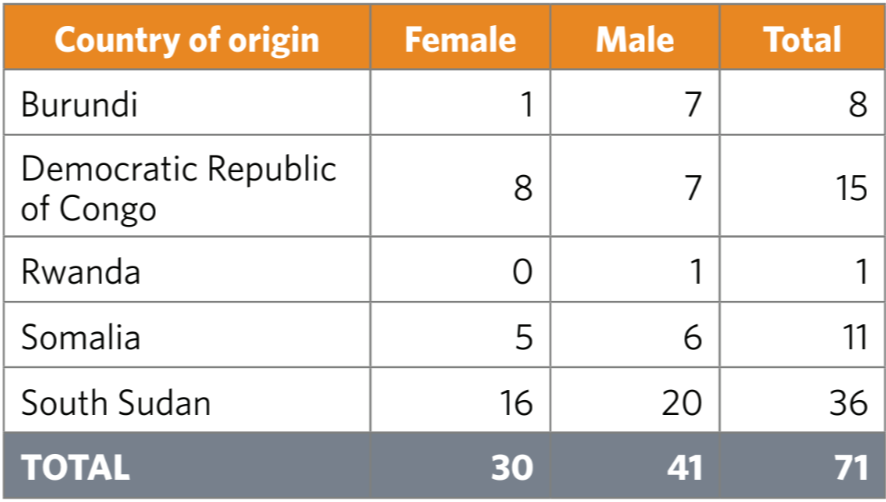
This essay is the result of 71 qualitative interviews with male and female refugees conducted in Kampala, Uganda, and the Bidi Bidi Camp in 2019. Our goal was to understand how refugees and migrants adapt economically and financially to their new surroundings. If we can understand their strategies of adjustment and integration, we can collaborate more effectively with donors, policymakers, and humanitarian organizations on sound policy and programming. Our questions were economic and financial in nature, but the interviews generated insights that went beyond money and illuminated concerns about schooling, medical services, and other forms of social support.
Uganda hosts one of the world’s largest refugee populations. According to the UNHCR, almost 1.4 million refugees were living in Uganda as of late 2019.¹ The majority are from the Democratic Republic of Congo and South Sudan, two countries that continue to face substantial violence, poverty, and disease.² However, Uganda also hosts a significant population of long-term refugees who were displaced by prior conflicts. The UNHCR estimates that more than 45,000 Burundian nationals, approximately 38,000 Somalis, about 15,000 Rwandans, and a similar number of Eritreans lived in Uganda in 2019. The majority of Uganda’s refugee population (possibly up to 1 million 1.4 million refugees in the country) has arrived since 2016, placing stress on the capacities of the Ugandan government and international organizations.³
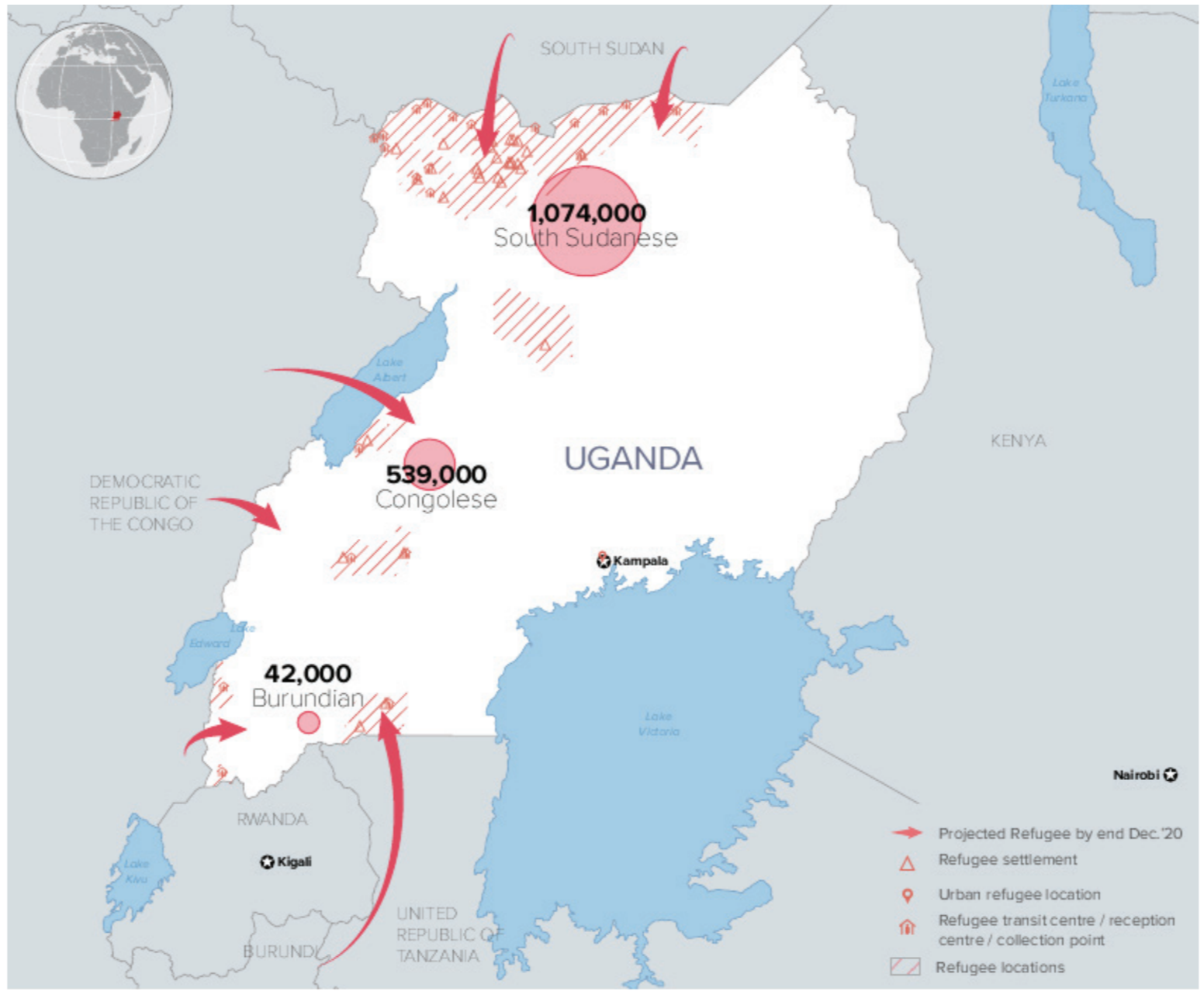
Uganda’s refugee policy is among the most welcoming in the world. In contrast to many wealthy Western nations, Uganda has an “open-door” policy towards refugees and allows them to enter Uganda without prior screening. Moreover, they grant refugees the right to free movement, land, employment, education, and healthcare.⁴
📝 This article was originally published as a report by the Henry J. Leir Institute at The Fletcher School of Law & Diplomacy and Tufts University.
Download the original report below ⬇️
Introduction to Our Findings
Peril, Separation, and the Kindness of Strangers Marked the Nature of Refugee Escapes
Refugees from South Sudan, the DRC, and Burundi were often forced to quickly leave their homes by abrupt and extreme violence. Though the approaching conflict may have been weighing on their minds for some time (most were mentally primed for an exodus of some sort), their actual partings were hasty and chaotic. Relatives who were already scattered across towns in South Sudan, for instance, lacked the time needed to coordinate their journeys. And even those who were able to travel together found themselves separated at borders by either accident or force.
Many of our respondents had family elsewhere in Uganda. In some cases, their separation was strategically coordinated, and those who ended up in the city would send remittances to those in the camps. However, more often than not, separation was done by mistake rather than strategic calculation. Naturally, the separation of families had a powerful impact on livelihoods. With households dispersed across camps and within Kampala, families knit together income streams with far-flung relatives. Many were unable to contact or find even very close relatives for years, severing key social and financial ties and forcing refugees to create new networks of support.
Our respondents frequently referenced how their escapes were defined by both frequent violence and by the kindnesses of strangers. To quote Esther, a woman from South Sudan:
“I first ran to Congo in 2014 — I don’t remember the date — with my five grandchildren. Congo was the closest and safest option, so we ran through the bush to get there from Ezo. When we fled to Congo, we met a good Samaritan, and we stayed with him for four months. He was not well-off. He had a shop — but he could help us with some food. I had worked when I lived in Ezo, and I used those skills to clean homes [and] sell groundnuts and mandazi (fried pastries) to save money. After four months we had enough money from my jobs and the Congolese Samaritan [to pay] for the 30,000 shilling (~$8.00) per person bus fare from Congo to Biyale.”
We heard this kind of story often, expressed in various ways. Because of this, we believe that fortune and charity — although unpredictable — are key factors in a successful journey.
In Kampala, Police Stations and Churches Offered Crucial Support to New Arrivals
NGOs and UN agencies provided much-needed support to new arrivals, but so did other civil institutions. Respondents described arriving at the Old Kampala Police Station and receiving protection and porridge as they searched for relatives and contemplated their next steps.
Churches and their parishioners also played a critical role in helping new arrivals adjust to alien surroundings and remained key support systems for the first several months.
In Kampala, multiple Christian denominations led bands of volunteers to assist in grassroots refugee resettlement. Procuring documentation, providing childcare, offering shelter and medical services, and giving English or Luganda language lessons are just a few of the ways churches helped recently arrived refugees. Some were more than sources of support; they were beacons of hope and gave refugees a destination even prior to their departures. Bishop Munde of South Sudan was such an example and often dispensed charity outside the domain of the diocese. A South Sudanese woman explained:
Bishop Munde knew we were arriving in Kampala from the church members, and he picked us up at the bus station in Kampala. He let all six of us stay with him and his family for six months before I was able to afford an apartment.
Bishop Munde would help with medical care, school fees, and even rent. Sadly, the bishop died in 2018 and, as one respondent noted, “all the children dropped out of school after the bishop’s death.”
Documentation and Language Skills Were Factors Key to Economic Integration
Obtaining a refugee ID was difficult for many of our respondents. The Office of the Prime Minister, the institution responsible for registering refugees, was reportedly so slow that refugees could wait days just to meet with an officer. And IDs were essential for receiving a variety of services, getting work permits, as well as engaging in formal financial activities. Mobile money operators and remittance houses required this ID as part of their Customer Due Diligence policies. We will explore documentation further on in this essay.
The Kampala City Commercial Authority (KCCA) created more obstacles for newly arrived refugees. “The KCCA is everywhere,” one Congolese man reported. He was referring to the authority’s pitiless, ever-present surveillance. If the KCCA catches an unlicensed refugee, they can seize their goods, fine them, or both. And the KCCA was not the only one doing the monitoring. Many refugee street-hawkers and shopkeepers reported their constant vigilance of all things KCCA. As a coping strategy, some would sell their goods in neighborhoods located away from the bustling city center. And while the KCCA had less of a presence in those areas, they were also less profitable places to conduct business. Respondents reported that the costs incurred for getting a KCCA license to operate, confiscation of goods, hefty fines, and intimidation are chief among their concerns.
And documentation for legal travel also proved daunting, as the following story shows:
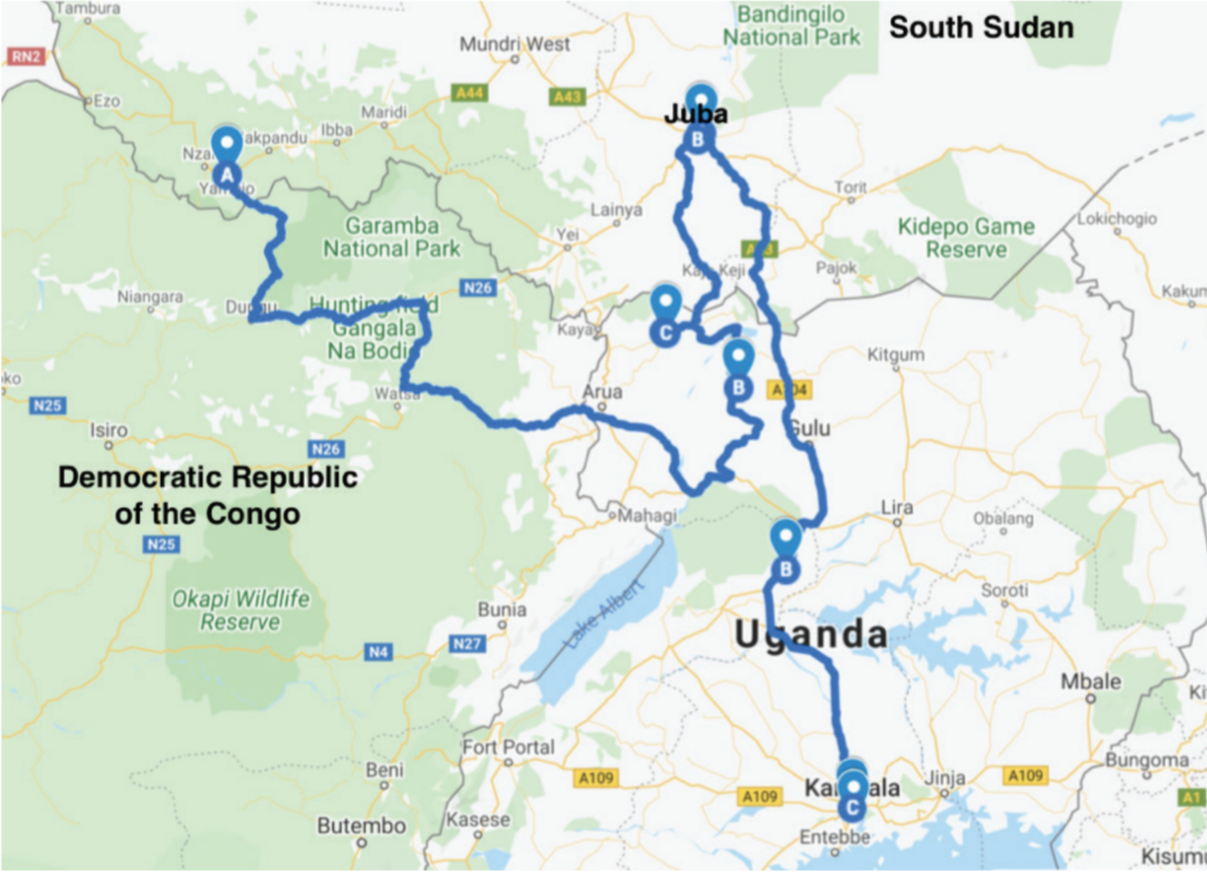
In light of his brother’s murder and unrest in his country of South Sudan, Jackson fled to Uganda, a harrowing and difficult journey. Jackson sent his wife and son to live in a safer region while he searched for work. Over the next four years, Jackson would travel through the Congolese wilderness, travel to the Bid Bidi Refugee Camp, journey back over the border to Juba, flee South Sudan once again, and eventually find some stability in Kampala. But without official identification, Jackson and his family still struggle to earn enough income to survive.
Language was also a large barrier to integration, and respondents who could take classes in English or Luganda were grateful. For example, a young Burundian man living in Kampala who earned money as part of a dance troupe told us that he wanted to earn more money by getting a second job in catering. This was a business he knew well. Back in Burundi, he had done an internship at an Italian restaurant and enjoyed it.
He believed that what blocked his ability to cater in Kampala was his lack of English fluency. While learning Luganda would have been useful, he thought that learning English was more critical to succeed. In the markets, he would observe people using English terms for weights and measurements (such as kilos and grams) to refer to things like food. To help him gain market fluency, he studied English with the help of a local church.
Earning a Living
In Kampala, Many Refugees Experienced a Slow Progression of Incremental Gains
Strategies for getting by ranged from “winging it” to intentional bootstrapping. A good example of “winging it” can be seen in Leila, a Somali woman in her twenties with four children to support. She left her husband behind in Somalia, hoping for a divorce. While she knew what she wanted to leave behind, she did not know how she might move forward. Back in Somalia, her husband provided for her every need, and she never had to work for a living. She arrived in Kampala with four children, no marketable skills to speak of, no knowledge of the local language, and knowing no one there except for a new female friend whom she had met on the bus. The companion took Leila and her children into her home, where Leila was living at the time of our interview.
Leila began her career in Kampala earning less than $1 a day washing clothes for students or cooking for them. She then parlayed that experience into working as a waitress in a hotel eatery. Her wages increased to $4 a day, and the hotel provided lunches for her children. Leila eventually got another job in a hotel that also paid $4 a day, but this was still not enough to cover tuition fees for her children. For that, a group of Somali men in her neighborhood decided to fund the cost of schooling for Leila’s children (about $19 per term per child).
Leila’s experience is similar to that of many others. There seems to be an initial stage upon arrival when refugees and migrants are processing their papers and finding their bearings. They take on menial work (sweeping the steps of a church, selling fruit in the street, or washing clothes) and then graduate to slightly more profitable work. Leila relied on the kindness of neighbors to pay her children’s school fees. This is often the case where early livelihoods are supplemented by gifts from neighbors or from relatives in the form of remittances.
What we saw in Kampala was a slow ratcheting up of livelihoods. Refugees would begin with “survivelihoods,” our term for menial work that does little more than show a person’s earnestness during which time handouts supplement their meager pay. Then after several months, the refugee would procure better-paid work, and, for those with connections, skills, and a sense of industry, the ratcheting process would continue.
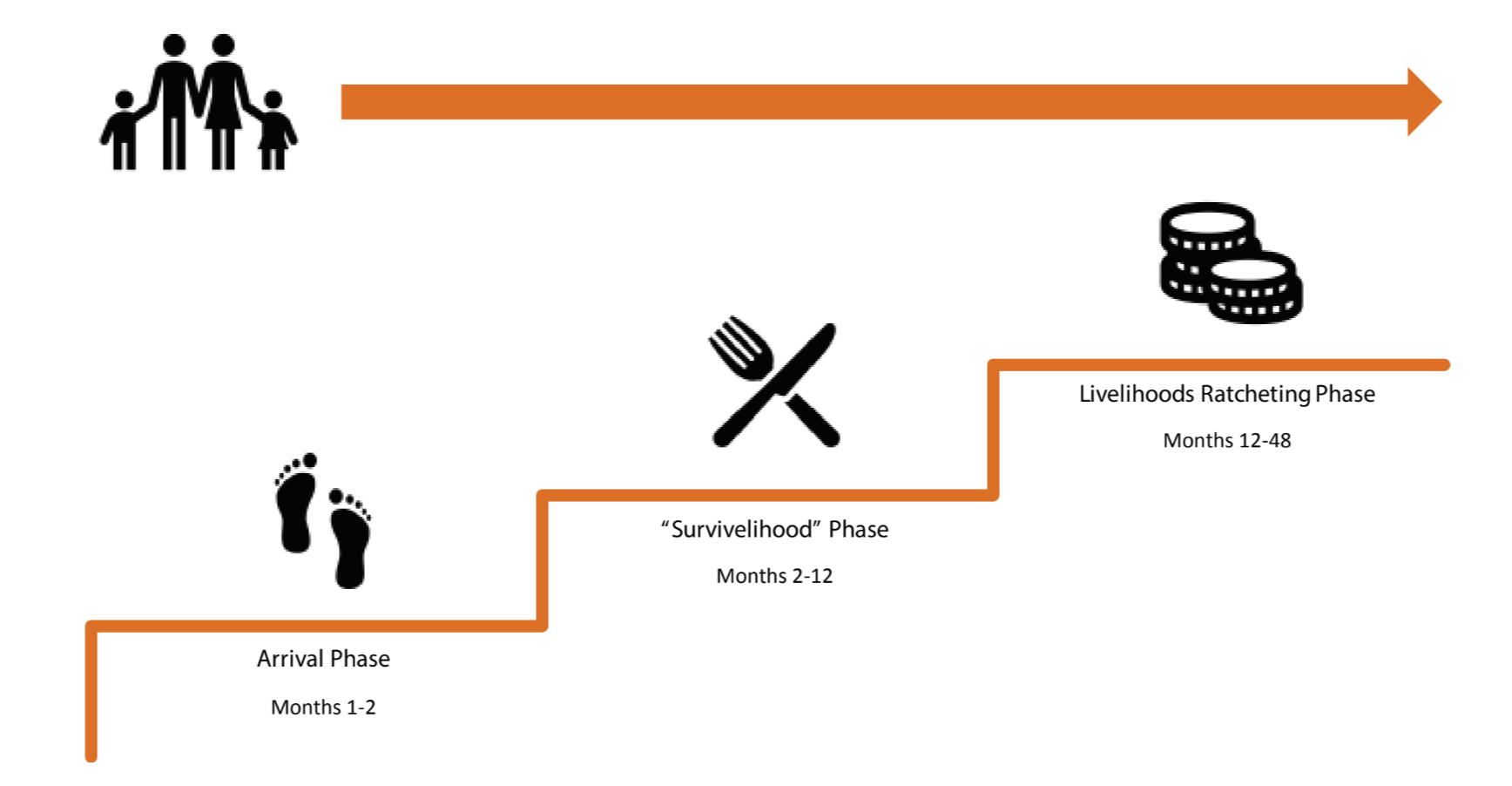
A Congolese couple, Jean and Marie, who arrived in Kampala in 2012, illustrate how two working adults might ratchet up modest activities into increasingly better livelihoods. While Jean worked low-paid construction jobs at first, earning only $2.70 - $5.40 a day, he made an effort to learn English, which allowed him to move out of wage labor to brokering construction materials. Ugandan factories interested in selling to merchants based in Congo retained his services. Jean bought the materials and put them on a lorry that transported them to the border. From there, Jean’s agents shepherded the goods through customs, paying duties and completing paperwork. This was done across the Ugandan-Rwandan border and the Rwandan-DRC border. The Congolese merchant paid the factory, and Jean got a cut of the sales. Marie would not discuss Jean’s profits, only to say the business was very successful.
For her part, Marie also experienced a ratcheting process in her own livelihood story. When she first arrived in Kampala, she attended a cosmetology course offered by Jesuit Relief Services. The course lasted seven months, convening every day from 9:30 a.m. to 4 pm. Despite the long days, Marie brought her baby to class. She was determined to earn her certificate. After completing the course, she “walked from salon to salon” until she found an unpaid internship at the Treasure Salon. That internship lasted three months and turned into a job that paid about $110 per month. In order to work, she had to find childcare. Priced at $16 per month, Marie thought the childcare was worth it, at first anyway. She stuck with the job for about seven months, then quit. Between the cost of childcare and the chemicals that she was inhaling daily, finding a new job seemed to be her best option.
During her time at Treasure Salon, Marie had managed to put some money aside. She attended courses at another NGO, Young African Refugees for Integral Development (YARID), where she learned tailoring. She soon after found a job as a seamstress in a local business. She stayed there three months before returning to YARID, no longer as a student but as a teacher. She parlayed that work into starting her own business.
Marie now has her own shop that offers tailoring services and sells kitenges (colorful fabrics for multiple uses) and children’s clothes. To quote Marie:
"At first, it was difficult. When you are working, you have to buy your materials and machines one at a time. Before I left YARID, I had had the idea of starting a business, and whenever I could get some money, I would buy a machine. When I was ready to start the business, I already had three machines, costing about $50 each. I would buy them second-hand.”
Marie did not stop there. She went on to start another business where she would shop online for an item that a client might want (such as a mobile phone) and post online to ensure that this was the item that her client was looking for. Once that was approved, she would purchase and deliver the item in person to her customer — acting as a concierge service of sorts. From the income from Marie’s businesses and Jean’s brokerage earnings, the couple was able to cover rent for their apartment (about $30 per month), rent for Marie’s shop (about $40 per month), and $35 per term for her eldest child’s tuition (which would increase to $55 in the next year). Her second child would soon enter kindergarten, which would cost a tuition of $35 per term. We will see later in this case study how Marie used her savings groups to help her finance her various endeavors.
Marie and Jean represent an economic stratum interested in making a prosperous life in Kampala. Their departure from the DRC was due to a family conflict, not due to violence or human rights violations. Still, they arrived in Kampala with no funds, and during their first week, they relied on the Old Kampala Police Station for food; officers would serve refugees whatever food was left over from their meals.
Perhaps it was their parents, though they had long since been estranged, that predisposed them to success. Marie’s father was a respected customs officer and her mother was an accountant for an American NGO.
Single Men, Unburdened by Family Duties, Can Also Do Well in Kampala
How did single men fare? Again, if they came with skills and a mindset for doing well, they did well. Chris, a Congolese who arrived in Kampala in November of 2017, had been a computer science student back in the DRC. A family struggle over a land inheritance put Chris in danger. He quickly fled his home and arrived in Kampala with an old laptop, but no money. While sharing a house with three friends, Chris found someone who wanted to learn basic computer skills and paid him enough money to teach him to cover food and contribute to the rent. Chris also enrolled in English classes and put his language skills to use as a volunteer at his church. He began to gain fluency. While improving his English, Chris was able to save enough funds for an $80 advance (three months’ rent) on an apartment. He also received a request from a friend in the DRC to help get some materials printed, a task which brought Chris $135, an amount that seemed like a windfall.
Meanwhile, Chris’ English proficiency continued to advance. He started to volunteer at a refugee center as an English instructor. Some of his students offered to pay him if they could find a more convenient place to meet, which they did. At the same time, Chris worked at a cybercafé providing computer instruction. With money saved from his combined earnings, he invested $135 in online courses to upgrade his software skills.
Through his language skills, his knowledge of computers, and his persistence, Chris was able to land his current job. He now works as an English teacher at Soccer Without Borders, a local NGO.
Many of our respondents found the process of “ratcheting” to be a long and arduous one. Refugees who had fewer marketable skills, had never been exposed to prosperity back in their home countries, had small children to care for, or were in poor health did not progress as much. Despite these challenges, in some instances a simple ratcheting process was still evident. We heard cases where refugees would begin selling a few candies or vegetables on the street and transition to hawking jewelry. Or, just as common, they would begin working as a tailor operating sewing machines and then over time create their own tailoring businesses.
Sweeping floors in an eatery could turn into a job bussing tables or, even better, waiting on customers. James, a South Sudanese, is an example of a refugee experiencing small incremental gains in earning power. He arrived in Kampala in 2016 after a three-day journey on foot to Yei in South Sudan. From there, he connected with other South Sudanese and hitched a ride by truck to reach the DRC and then, finally, Uganda. James found work easily enough, but it was low-paying, earning him less than $1 a day. He now buses tables and fills in as a waiter for $1.65 a day. He has been able to supplement this income with what he earns by playing soccer. For each game, he is paid $1.35, but he can only count on playing a few games a month. James stretches his money by sharing an apartment with friends, one of whose family back in South Sudan remits the bulk of the rent via mobile money.
The Ratcheting Process in the Bidi Bidi Camp Is Less Evident than in Kampala
Bidi Bidi, a massive camp that houses more than 280,000 South Sudanese refugees, sprawls across a large swath of land in northern Uganda. Refugees in Bidi Bidi are allowed to run businesses and are encouraged to trade with local Ugandans. Many were able to bring cattle and other physical assets, which they sold to either raise capital for their businesses or to make ends meet. One example of this is a South Sudanese man who had the vision to bring a solar panel, which he sold at the camp. He took the funds and purchased inventory for his retail alcohol business.
The opportunities to find paid work in Bidi Bidi are scant in comparison to Kampala, but residents are still resourceful in piecing together a livelihood. Kadi from South Sudan offers a good example. She arrived in December 2017. Formerly married to a Ugandan, she has since left him and has sole responsibility for their seven children. In South Sudan, she operated a business where she cooked food and prepared and sold groundnuts. She had a talent for numbers. She netted about $20 dollars a day by cooking food and earned another few dollars by selling. She was doing well.
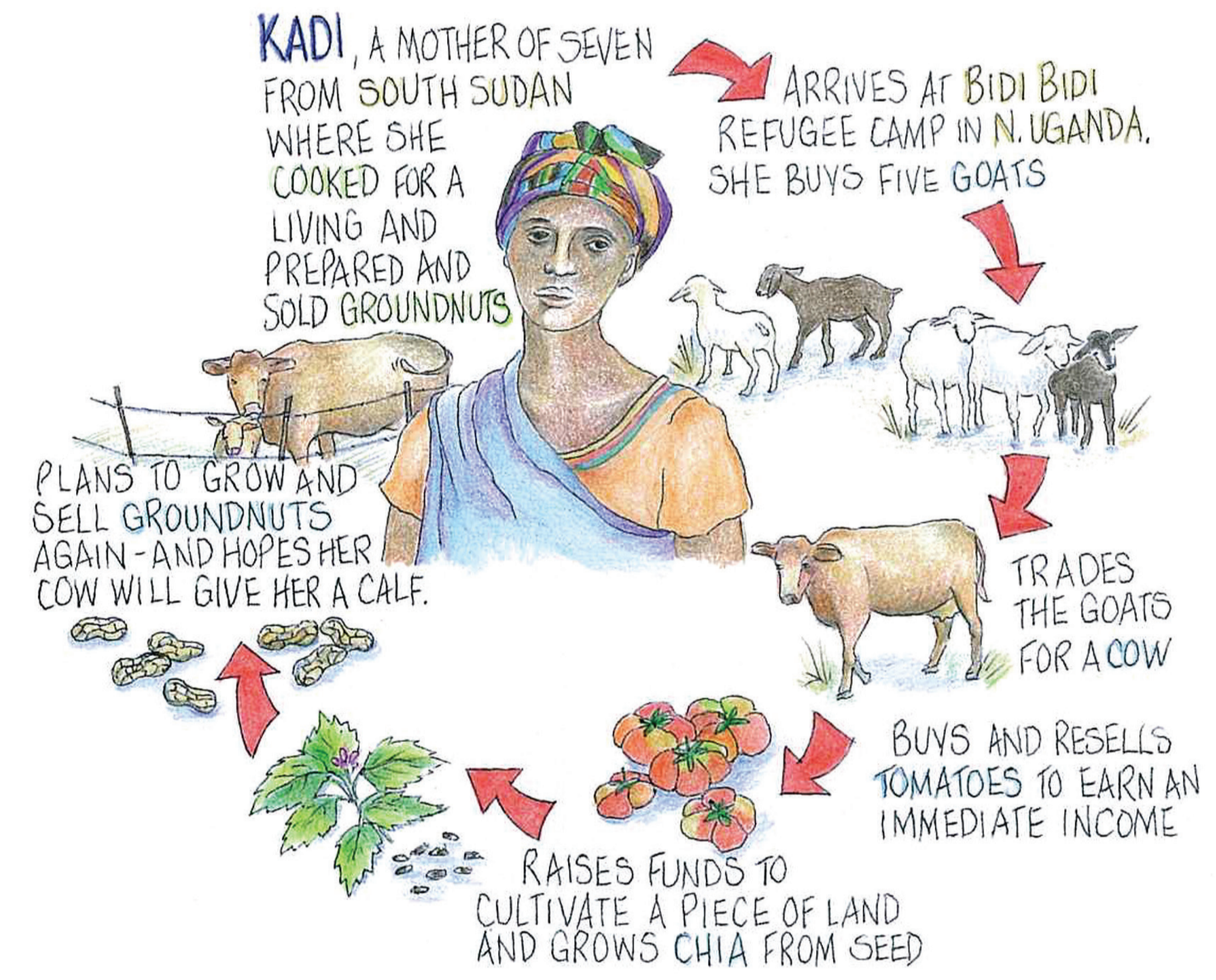
As soon as she reached the reception at Bidi Bidi, Kadi bought five goats from other refugees who had brought livestock with them to the camp. Each cost $13.50. When she entered the camp, Kadi exchanged the goats for a cow. She had been quick to make friends with local Ugandans, who sold her the cow. A Ugandan man explained that he would take care of people’s livestock for them—including Kadi’s cow. The arrangement was that when a cow gave birth to three calves, the owner, in this case, Kadi, would give the man a calf. Her cow, worth about $165 at the time of the interview, had yet to bear a calf, but Kadi was fully anticipating the event.
After the livestock exchanges, Kadi needed to bring in an immediate income. She had some funds left after initial arrival expenses and bought some tomatoes to resell. But soon others copied her, and the margins became too slim to justify her continuing the business. By liquidating her food rations, she was able to raise the funds (~$4.50) to cultivate a plot of land where she grew chia with seeds given to her by the Danish Church Aid (DCA). Kadi works hard to maintain good relations with local Ugandans and plans to leverage these relationships to return to her previous livelihood of growing and selling groundnuts.
Brewing was a big business in the camps, and women were meticulous about operating them. One told us of how she purchased special maize from locals because it produced a high-proof corn liquor with a far better quality than did the corn she grew on her own plot of land. A batch of brew brings her $2.70, generating roughly $8 of net income per month.
Other livelihoods in the camp included various forms of retail and working the land for local Ugandans. Many NGOs gave livelihood support that included training in tailoring and other services. DCA branched into training on how to farm mushrooms. One respondent was in a group that collectively farmed oyster mushrooms. Each kilogram brought in about $2.70. The farmers liked the process (which takes just 25 days in total) because the fungiculture business is continuous rather than just seasonal. A steady domestic demand would allow them to harvest and sell mushrooms profitably throughout the year.
While businesses and livelihoods in Bidi Bidi ranged from retail to farming, the ratcheting process that was common in Kampala was difficult to find in the camp. Businesses sprouted and then collapsed, with most respondents citing the low purchasing power of camp residents as the reason for business failure.
Security Issues, Particularly for Women, Impeded Livelihoods and Enrolling Children in School⁵
Many single women lived in fear for their own safety and that of their children. We heard numerous reports of violence that had taken place on their journeys and in their new neighborhoods. Rape and child kidnapping were common enough to keep women constantly on edge.
For example, one of our respondents, Halima, voiced her fears about what could happen to her children should they leave the house. She had three children, all girls, none of whom were enrolled in school. While many respondents did not enroll their children in school because they couldn’t afford the fees, Halima could, indeed, afford the fees.
She received a monthly remittance of $100 from her sister in Europe. She used the money for rent and food, but continued to keep her children out of school even though she could afford the tuition. “They may be raped on the way to or from school,” she said.
Halima was not the first respondent we interviewed who feared rape for her children or herself. Many women like Halima who experienced sexual violence avoided accepting even lucrative work that required spending time alone.
Eunice, a Burundian, sheltered in a church for three years. She struggled daily to provide enough food for the children in her care, and was selling cassava leaves to support her family. One day, a fellow Burundian acquaintance offered Eunice a portion of flour that she could use to cook for her family. When Eunice arrived at his home, the man raped her. She reported the case to the police, but the man had fled and could not be found. A month later, Eunice learned that she was pregnant by the rape. Devastated, she struggled to make ends meet by relying on church donations. She opened a makeshift kiosk outside her living quarters and sold vegetables, earning less than $1 a day. She calculated that a more traditional job would be difficult to perform while she was breastfeeding.
Collectively, these experiences resulted in several strategies for single women. First, finding shelter that is secure even if it costs more (adding to the burden of earning extra income to support higher rents). Second, taking on jobs that limit physical vulnerability (for example, not working alone). And third, walking children to and from school (further curtailing livelihood options) or pulling them out of school altogether.
Household Roles Shifted as Refugees Grappled with New Realities
As researcher Cate Wanjala clarifies in her essay, “Shifting Roles in Refugee Livelihoods,” household members take on different roles from those they held in their countries of origin. Back home, women either did not work (as was often the case for many Somali and South Sudanese refugees) or, if they did (as was the case with many refugees from the DRC), their incomes were supplemental, leaving the “man of the house” as the sole or main breadwinner.
In Uganda, a different story emerged. Women often found themselves as the primary earner. They immediately understood that if they did not make a wage or run a business, they could not put food on the table. They quickly abandoned any concerns about taking on work that did not match the skills they had honed back in their home countries. Men, on the other hand, were more determined to put their hard-won skills to use. But doing so in brand new surroundings proved difficult. Shifting roles caused men to either become idle or to eventually take on jobs that they felt were beneath them.
Role changes not only redistributed work along gender lines but also along age lines. Minors often had to step in and take on jobs (like street hawking) that they otherwise might not have done back home. Working long hours precluded them from schooling, and thus, from the credentials that might be needed to take on better-paid work.
Over time, it was common to see all members of the household working in some fashion, and mostly they did so while physically separated. Families would split up so that camp distributions, not available in the city, could be garnered while city-dwelling members could earn wages not available in the camps.
Cross-border Businesses Emerged in Both Kampala and Bidi Bidi
We have already mentioned a few instances of cross-border commerce — construction materials to the DRC, printed material to the DRC, and different kinds of brokering.
Brokering can be a mainstay for those who have learned the local language, English, or both. An enterprising soccer player, Nelson, is an example of this. He receives $1.30 for each game he plays, but the outcome of the various tournaments is uncertain. Nelson never knows if his team will make it to the finals, making his earnings unpredictable. But football is essential for Nelson. He enjoys the game and met his two roommates in soccer matches. He also knows that he needs a steadier income. During most weekends and during many weekdays, Nelson visits the bus station in Kampala to meet up with businessmen from Juba, South Sudan. Because Nelson speaks fluent Luganda and knows the market well, he makes for an attractive agent. The South Sudanese appreciate his language skills and his ability to negotiate for the best stock at the lowest price. A typical morning will bring Nelson $5.00–$ 8.00, and as he says, “a good businessman will treat you to lunch.” Nelson has slowly built up a clientele. Many will call him in advance so that he can greet them at the station.
Other kinds of cross-border businesses have materialized as well. Truck driving is one, and selling cereals to wholesalers in South Sudan is another. Even in Bidi Bidi, cross-border businesses are blossoming. For example, there is a self-organized savings group in the camp with twenty members. Many have cross-border businesses.
Kazim, a young man from South Sudan, had recently borrowed $55 (at 10% interest) to purchase twenty liters of local honey from his home country. The honey is prized for its medicinal properties. A friend of Kazim’s went to the border to conduct business on Kazim’s behalf. There at the border, he was met by a third South Sudanese friend (still living in South Sudan) who sold him the twenty liters for $32.50. Kazim then paid his runner about $2.00 for the effort. He sold the honey for $40, one cupful at a time. When all was said and done, Kazim earned $4.50, enough of a profit to make the business worthwhile.
In Bidi Bidi, Liquidating Food Rations Was a Nearly Universal Livelihood Strategy
Bidi Bidi distributes plots of land on which refugees can grow vegetables and grains to supplement their monthly food rations. Local Ugandans also established informal relationships with camp residents where refugees would crop the land for free but were not allowed to build structures on it or take possession of it. Other locals would rent parcels for ~$32.00 a year.
Residents cropped onions, okra, eggplant, groundnuts, sesame, and chia. In some cases, NGOs provided seeds and in others, residents gleaned or purchased seeds on their own. Most sold some portion of their harvests, keeping aside what they could for family consumption.
When food rations arrived, they did so monthly and included oil, beans, grains, and salt. Most respondents agreed that the rations were too little to thrive on. To quote a South Sudanese refugee, “We learned that the rations were meant to help us survive, not to feel full.” Not only were the rations not enough to abate the hunger of Bidi Bidi residents, but they also lacked important nutritional ingredients. Between their own vegetable crops and the rations provided, families might make do, but we could not find families that actually did so based on their crops and rations alone. Most sold their rations the same day they received them. They took the cash and purchased other foodstuffs, medicine, or household necessities like soap and laundry detergent.
Developing Financial Strategies and Leveraging Financial Services
In Kampala, Savings Were Often Deployed to Support the “Livelihoods Ratcheting” Process
By and large, the refugees we interviewed saved substantially. One of our respondents, Hubert, has a story that highlights this trend. In 2013, when he first came to Kampala from Rwanda, he arrived with no money. His friends found him a job cleaning houses, earning him a meager $.80 a day. He was able to room with friends during these early days and, while doing so, put himself through training in the local language. Eventually, Hubert convinced a Ugandan to let him use his boda boda (motorbike) to run errands.
He earned about $8 a day (or $48 a week), of which he would set aside $16 to pay the owner of the motorbike. Using multiple savings strategies, Hubert had been able to set aside $190. That sum, combined with an $80 gift from his uncle, allowed him to purchase a used motorcycle for $270. His income picked up and so did his profits. He was earning more than $50 a week and could now keep all his earnings. His business built gradually until one day he met a man who persuaded him to register as an Uber driver. Hubert did just that and then leased the man’s car for $40 a week. His income grew to $110 a week, netting him $70 a week. When we interviewed Hubert, he was saving to buy a car of his own.
Refugee women proved to be excellent savers as well. One of our respondents from the DRC, Jeanie, had an experience in Kampala that gives us insights into this. Like many women, Jeanie began her life in Kampala by relying on handouts from friends and her sister. Once she found her footing, Jeanie began doing household chores for less than $1 a day, not enough to support herself. Her sister Davina (who had arrived in Kampala earlier) began introducing Jeanie to her acquaintances and praised Jeanie’s tailoring skills as she did so. Soon, Jeanie was offered the opportunity to work for a master tailor. For every piecemeal job she took, she would receive a third of the sales price. For instance, if the master tailor charged 60,000 schillings ($16) to make a kitenge dress, Jeanie would earn 20,000 schillings (~$5). Because her sister was covering their rent, Jeanie was able to put money aside to save for her own place. When she moved out, she continued doing casual labor as well as tailoring. Again, she put money aside to purchase a sewing machine for $70. New income from her tailoring allowed her to save again. Her friends lent her two more sewing machines, and she was soon managing a team of four. Her earnings allowed her to not only pay her rent of $40 per month but also to enroll her three children in school for a total of $120 per term. Jeanie beamed with pride as she told us of her success.
In Bidi Bidi, Savings Options Were More Limited than in Kampala and Often Took the Form of Saving in Animals
Camp respondents who did save money often did so through Village Saving and Loan Associations (VSLA). Some of the more prosperous businesses used mobile money services. But all too often, most respondents felt they did not have the means to actually save. Even those who liquidated their rations would put their cash to use immediately, often to buy foods that they preferred over the rations that they received. In the camp, people saved their resources in goats, ducks, and chickens. This practice was nothing new to them. A female respondent, Angelina, described how back in South Sudan she would save her resources through breeding and fattening chicks.
In Bidi Bidi, she continued the practice by raising her neighbor’s chicks. For every ten chickens that she raised, she would keep two. Though each could fetch about $2.70, she never sold them for profit. They were for emergency purposes only. When a crisis arose, Angelina could quickly liquidate her poultry for medicine or food.
Other respondents also earmarked their poultry and livestock for emergencies. They would also save the animals for medical needs and food shortages. But chickens were especially vulnerable to sickness, and a poultry disease spread through the camp in 2019, killing many of the camp’s chickens.
Goats were seen as prized animals. They are not fussy eaters and seemed resistant to many illnesses. Emmelida, a female respondent from the Kuku region of South Sudan, explained that she cobbled together funds from the cash savings she brought from home, earnings from her nephew’s boda boda business, and money from the sale of her food rations. Combined, these funds allowed her to purchase a mother goat for about $21. Before dying, the goat produced a kid. Emmelida looks after the current goat and, like Angelina, has no plans to sell it. The goat is strictly earmarked for a future emergency.
A farm laborer, James, detailed how raising goats created an emergency buffer for his family and a fund for his children’s education.
“I work as farm labor for some nearby Ugandans. They give me 4,000–5,000 shillings (~$1.10–1.35 USD) per day of work, and we are usually digging 8 by 10-meter pits for them. It’s very hard work for not much money. There has been more work this year — the rains have been very good, and the Ugandans need more help harvesting.”
With two children in nursery school and three in primary school, James was eager to save up for expenses. Though no tuition is charged in the camp, there are costs to contend with: uniforms range between $4.00–6.50, depending on the grade level, and there is a one-time exam fee of 2,000 shillings (~$.50) per term per child. James started his savings process by investing his farm wages into raising ducks, about $4 per duckling. Sadly, the ducks perished due to poultry disease. James feared that future ducks would face the same fate, so he upgraded to goats. His first cost him $27 and has already produced two kids.
In Kampala, Livelihood Options and Use of Financial Services Co-evolved
Both Jeanie’s story and Hubert’s story would have been difficult were it not for a range of financial services.
When Hubert, the Uber driver, was driving his rented motorcycle, he hid his savings under his mattress. As time went by, he opened a mobile money account into which he began depositing savings. When he bought his own motorbike and saw increases in his earnings, he was motivated to open an account with Equity Bank and continued saving as he drove for Uber. He said, “In a good week I save 300,000 – 400,000 shillings (~80–80–110), and in a bad week I save 200,0000 schillings (~$55).” He now uses Airtel to send money to his mother in Rwanda.
Jeanie, the tailor we referenced earlier, also saw her own process of income ratcheting matched by a need for financial services. In her case, she availed herself of Ssuubiryo Financial Services (SFS), a microfinance service in Kampala. SFS agents conduct business at their clients’ doorsteps, making deposits and withdrawals as convenient as possible. Jeanie was depositing about $5 dollars per agent visit. She had used a similar service in the DRC, so she understood its basic features. She was surprised and disappointed to learn, however, that withdrawals cost $5⁶, something that was completely unexpected for Jeanie. With her children now in expensive schools, she did not have as much to set aside. When there is more income and thus more to save, Jeanie plans to be more active with her SFS account.
Many respondents told stories of how good financial services strengthened their livelihoods, which in turn generated more reason to use those services. This was true for savings, loans, and remittances discussed elsewhere in this study.
In Bidi Bidi, Livelihood Options and Use of Financial Services Co-evolved, but the Process Was Less Certain and Less Dynamic than in Kampala
Though some larger businesses in Bidi Bidi used more formal financial services to help ratchet up their growth, many owners did not see the logic in using them. David’s cross-border grain business offers a good example.
David sold cereals back in South Sudan, and the business prospered. From stock typically worth $1,300 at any given time, he was able to generate about $2,700 in annual sales. He purchased grains from South Sudan but also from Gulu, Uganda. When war broke out in 2016, David sent his wife to Bidi Bidi along with a sewing machine, which she later used to earn money in the camp. David stayed behind and continued to manage his cereal business. But David lost all of his stock to looters and was forced to flee. He took money he had previously withdrawn from his bank ($120 from Equity Bank) and headed for the Bidi Bidi Camp.
In September 2017, David started a cereal business in the camp. He took $95 from the funds that he had withdrawn in South Sudan (then later stored in mobile money) and put it toward purchasing grains. With working capital of roughly $135, he now supplies cereal to three schools in the area and nets about $.03 per kilo, all in cash.
David did not disclose his annual turnover but implied that, while he was in fact earning money, it was not enough to justify opening a bank account (though he had a good experience with Equity Bank in South Sudan) or saving in his mobile money account (though he had a good experience with Airtel in South Sudan). David did join a savings group in Bidi Bidi, in which he purchased shares (costing $.55 per share) that are now worth $27. Last year, his payout was about $40.
Though David’s cereal business is more vibrant than many camp enterprises, his story underscores this: in order for demand for financial services to take root, a pressing need for those services must be in place. Back in South Sudan, there were real use cases for opening bank or mobile money accounts, mainly to store savings, and sometimes, in the case of banks, for credit. But in Bidi Bidi, those use cases vanished. At the same time, the justification for joining a savings group surged. David was not using his savings group or its payouts to ratchet up his business as he did not have the need to do so. Instead, he used them to fund Christmas celebrations and his children’s school uniforms, which were, in his mind, investments vital to his family’s wellbeing.
Respondents Found Both Banks and MFIs Useful and Would Like to Be More Connected to Them
Familiarity with banks varied based on the countries of origin of our respondents. Many from South Sudan had mixed experiences with banks there. Some complained of caps on withdrawals and others of inconvenient locations. Those hailing from the DRC had an even worse opinion of banks, saying that many banks had become caught up in scams of one kind or another. Those coming from Burundi and Rwanda had relatively positive experiences with banks, and those from Somalia had no experience at all. As they spent time in Kampala, their perceptions toward banks changed, growing more favorable as they observed Ugandans interacting with banks like Equity.
Still, some level of skepticism persisted. A young Burundian man confided that back in Bujumbura, he had two accounts: one with a local bank, Interbank, that held 70% of his savings; one with a regional bank, KCB, that held the remaining 30%. When violence erupted and he knew he had to flee, he was able to access his KCB savings.
His Interbank account had been frozen. Fortunately, a friend worked at Interbank. The friend liquidated the account and sent $1,350 to our respondent, keeping aside $270 for his own escape.
However, accessing a bank account meant that refugees needed to produce the right documents, which were often difficult to get. Sometimes it was impossible for refugees to prove their addresses or satisfy other KYC and customer due diligence criteria. A few admitted to purchasing fake documents. One managed to bribe a policewoman with $32 to get a Ugandan driver’s license. He thought that the bribe was worth the cost because it allowed him to open a bank account, which he very much needed.
UGAFODE, an MFI supported by Acción, was keen to address the refugee market. A manager for the firm in July 2019 said UGAFODE had opened 500 refugee savings accounts at that time with plans to have a total of 1,240 by the end of 2019. UGAFODE’s products for refugees are the same as those for Ugandans. The only difference in reaching the refugee market is that UGAFODE makes a concerted effort to work with a string of volunteers who speak the various languages of refugees.
Remittances Were Typically Uncertain, Sparse, and in Small Amounts, but for Those Receiving Them, Were Deemed Vital
Many respondents would go to great lengths to receive remittances. An extreme example comes from a young Somalian who described what his mother had to go through:
“We have relatives, some living abroad, but they don’t help us because we are Muslims. They told my mum, if she wants their help, she should convert to Christianity. My mum converted and joined a church in the camp. She would leave in the morning and come back very late at night. It caused problems between my parents because my father did not understand why she couldn’t pray in her house and had to leave for all those hours every day… Even after conversion, she was still not getting help from the relatives.”
A fortunate few did receive regular remittances, often from relatives who had stayed behind. A South Sudanese man explained that his brother was still driving vehicles back in Juba. He would send about $100 a month to our respondent in Bidi Bidi. In return, our respondent took care of the Juba brother’s family in the camp. He would put the $100 toward the purchase of meat and vegetables to supplement the monthly rations and food grown on their plot.
Others could rely on family to pay for more expensive items such as school fees. But, while helpful, even this kind of support dwindled, leaving families to face unpleasant choices. A South Sudanese respondent explained:
“I have an uncle in Juba who used to send us money to help with school fees. He used to send 150–200,000 shillings [~$40.00–54.00] every two or three months by mobile money. He does not send so much now... four of my five children are in school, but I cannot afford the school fees, which are about 50–65,000 shillings [~$13.50–17.50] per term. They will not go to school next term.”
A far more common story included very small remittances, often worth just a few dollars, but whose arrival was most welcome. Typically, the money was put toward medicine or doctor fees. Medicine, while free, was scarce or non-existent in Bidi Bidi and was not subsidized in Kampala. The few dollars from a remittance — put toward the purchase of crucial medicine or food — were seen as life-saving sums.
In Both Kampala and Bidi Bidi, RoSCAs and VSLAs Filled Key Financial Gaps
RoSCAs (Rotating Savings and Credit Associations) and ASCAs (Accumulating Savings and Credit Associations) – specifically VSLAs (Village Savings and Loan Associations)⁷ – flourished in Kampala and, to some extent, Bidi Bidi.”
First, let’s discuss RoSCAs, which were a life-support system for some. RoSCAs were used to amass funds for rent, tuition, and food. A group of Burundian drummers, part of the Ndere troupe, shared their experiences with us. They performed three times a week at a cultural center, Ntinda, in Kampala, and brought in $1 per game. What helped them manage their cash flow (and buy food or pay rent, one of their biggest expenditures) were the contributions they made to their Likirimba. Likirimba is the Burundian term for a RoSCA, and theirs had seven members. Each day that they performed with the troupe, they took 5,000 shillings (~$1.30) from their earnings and put it toward the Likirimba, generating a payout of 35,000 shillings or close to $10.00. Since their biggest expense was rent at 80,000 shillings (a little more than $20 a month), they would make sure that early in the month their payouts were put toward rent, with the remainder put toward food.
As for VSLAs, members gathered regularly to make savings contributions to a group fund. Instead of one member taking the payout home, as in the case of a RoSCA, the group fund kept accumulating. Members borrowed from the fund during the year, and at the end of the year, the corpus consisting of principal and interest was divided among the members.
To understand how VSLAs supported the ratcheting process, let’s turn to Marie, the hairdresser who had transformed herself into a successful tailor. Marie at the time of our interview was managing multiple businesses: tailoring, selling clothing, and making her own beaded handbags. She also performed the service of locating desirable goods for customers, purchasing those goods on their behalf, and then delivering them to their doorsteps. At one time or another, each of her businesses required loans. To meet her borrowing needs, Marie joined two savings groups, one started by the IRC (International Rescue Committee) and another by a local NGO, YARID. She would borrow from the Neema Group (the one formed by IRC) but would only save in the YARID group. She believed Neema offered her a better deal. She could borrow up to double what she had saved, and at the end of the yearly cycle, she would get 90% of her interest back, with the remaining 10% going to the group. Her YARID group offered less friendly terms, Marie thought. She could only borrow half of what she had saved, and 100% of her interest was shared among the group. She was saving 25,000 shillings a week (~$6.75) in the YARID group and 40,000 shillings a week in Neema ($10.50).
Marie used her loans (which could be more than $100) to manage her various businesses. Her brokering business required her to front the cash needed to purchase goods on behalf of her clients. Her tailoring business required her to buy kitenge and notions before she could turn them into clothing that she could retail from her shop.
And her beading business required her to purchase materials in advance of a sale. She reported that both the saving and loan features of the VSLAs gave her the working capital she needed to expand each of her businesses.
Some respondents were part of groups that had a primarily Ugandan membership.
Rosine, a Congolese woman, was part of such a group in the Nsambya neighborhood of Kampala. The group’s ten members would each contribute 15,000 shillings a week ~$4.00) and then divide the money among themselves every three months. The group was an interesting blend between a RoSCA and an ASCA. While no single person received the weekly contribution, neither did anyone borrow from the group. Rosine was grateful for the payout of 180,000 shillings ($50) and applied it to her monthly rent of 250,000 (~$67), but she still had doubts about the group. “The leaders eat the money,” she said, implying that the quarterly proceeds were not always divided fairly.
Rosine felt qualified to comment on the group’s practices as this was by no means her first savings group. When she arrived in Kampala, she started out like so many others, washing clothes. Since she shared an apartment with several other Congolese, she did not have the burden of paying rent and could put extra funds toward savings. After about two years, her financial ratcheting process finally began. She put her savings towards a street hawking business. She started out with a limited selection of cheap goods but gradually progressed to jewelry, a more profitable stock to sell.
During this time, Rosine had joined an informal savings group with an all-Congolese membership. Her goal was to put the group loans toward her business. She would then turn business profits into savings. She wanted to live in a place of her own, which she finally got. Her first flat, a studio, cost roughly $16 a month with two months’ rent payable in advance. After two years, the group which had served her so well had disbanded. Its members were resettled abroad or had moved into camps. But the experience was a positive one for Rosine, one which gave her insights into how a well-functioning group could run. Groups also played an important role in Bidi Bidi, but with mixed results. Some flourished, generating payouts and loans that helped members purchase food, medicine, and Christmas gifts. Others failed. Two South Sudanese women, referring to themselves as co-wives, had joined a VSLA with 23 other members. At first, they were active participants in the group. To make their weekly contributions, they sold mandazi (fried pastries). They borrowed 20,000 shillings (~$5.00) from the group to buy the oil and flour to make the pastries. From February to June 2019, they had been able to save consistently, but a declining demand for goods in the camp soon took its toll on their mandazi business. They closed it for the lack of paying customers. With no income, the co-wives had no savings and had to quit the group.
Other members in Bidi Bidi found groups useful. One clever member, Abdo, convinced his group, made up of South Sudanese, to invite a Ugandan to join. The group had been planting onions, eggplants, groundnuts, and sesame on the Ugandan’s land. They harvested 110 kilos of onions at 3,000 shillings (~$.80) a kilo and five bins of groundnuts at 20,000 ($5 per bin). They dried and cut the eggplant for their own consumption. Having leased the land for $32 a year, they thought it a good idea to bring the Ugandan owner into the group. They were happy to share the profits with him in hopes he would reduce the lease expenses or remove them altogether.
What is clear is that local RoSCAs and more formally organized VSLAs were common and many respondents had become familiar with their workings prior to coming to Uganda. Whether it was the likirimba of Burundi, the tontine or susu of the DRC, or groups fashioned and promoted by NGOs, to many the concept was well-known and well-understood. A Burundian who had worked for the International Organization for Migration had been promoting VSLAs in Burundi as part of his job. When he and his wife started running low on funds, they revitalized the model in Uganda and were part of two groups, collectively saving 200,000 shillings (~ $54) a month.
Conclusion
Removing Barriers to Earning a Living and to Accessing Financial Services May Be a Far More Effective Strategy than the Creation of Special Programming
Barriers to getting good work include the ability to secure proper refugee IDs, driver’s licenses, work permits, and business registrations, as well as licenses required for various vocations. Removing these barriers would require an understanding of the pathways involved in obtaining these documents and any roadblocks that might continue to separate the refugee from the desired credential. Roadblocks might include language fluency, literacy, bribes, fees that might lie beyond the financial capacity of the refugee, convenient access, childcare, and so on. Gender and ethnicity might factor in as well. If barriers to a steady ratcheting up of livelihood could be removed, refugee energy and ambition might quickly flourish.
Similarly, removing barriers to financial services would allow refugees to access services as they saw fit. Our respondents fully understood the use of mobile money accounts and transfer services, and many understood the importance of bank accounts. Removing the barriers — often in the form of documentation requirements — could go a long way to helping refugees procure SIMs or open bank accounts.
Re-skilling or Up-skilling in Specific Languages or Vocations Were Seen as Valuable
Skills that could be applied immediately or were seen as “portable” were highly valued. These included skills in Luganda, and more importantly English, as well as livelihood skills that were competitive or sustainable (the example of mushroom farming in a camp being one). Other skills were also seen as important, and refugees did not understand why their learning had to be limited to one skill. They enjoyed learning multiple skills and often traded on them simultaneously. What was not valued was training in a vocation (e.g., tailoring in a camp) where that vocation had already reached market saturation or soon would.
Some of our respondents had created self-styled apprenticeships to deepen skills and earn credentials. NGOs could help make these kinds of matches as well, perhaps helping to compensate the mentors as well as their protégées.
Mobile Phones and Mobile Money Are Crucial to Supporting Livelihoods and the Use of Financial Services
None of the cross-border businesses described would have been possible without a mobile phone and a functional SIM card. This was true for local businesses as well. The suspension of SIM cards would have consequences. The Uganda Communications Commission (UCC) in October 2019 suspended the use of refugee-owned SIMs.⁸ The UCC claimed (and our research supports this) that refugee cards could be easily forged. However, because communication is essential for many refugees interested in earning an income, a better policy would be to offer refugee ID cards that are easier for refugees to get. Our respondents who resorted to getting fake IDs did so only because bona fide IDs were so hard to come by.
Though Remittances Were Scarce, Sporadic, and Often Small, They Should Not Be Dismissed as Insignificant
If uptake and usage are the watchwords of the mobile money and remittance sectors, relevance should be the watchword of the development and humanitarian sectors. Steady usage is a good metric for making a business case for mobile money, banking, or remittance transfers. But when money is limited, as is the case with many refugees, then steady usage is a poor metric. If refugees can be seen as an incremental market versus a core market, then metrics for a business case can frame the sustainability of the core market, and metrics for an incremental market can take on a humanitarian agenda.
Larger remittances provided rent money to secure safer housing, especially in Kampala, and for school tuition; smaller amounts were vital to health. Even a few dollars could prevent hunger or secure medicine. Here again, the government’s suspension of refugee SIM cards could bring harm, especially to those in camps who suffer from poor health services (including a lack of medicine) or whose food rations are often disrupted or, in some months, fail to arrive altogether.
The Inefficiency of Shipping Food and then Liquidating it Was Not Lost on the Refugees
In Bidi Bidi, UN agencies, NGOs, and the Ugandan government might do well to convert its food rations into cash distributions (or bank-led or mobile money-led digital transfers), as has been done in other camps in Uganda.⁹ It’s possible that a lack of financial infrastructure is preventing cash assistance, but these issues could be addressed by helping bank and mobile money agents and cash transport companies prepare for such a program. It’s also possible that these agencies lack confidence in local markets to meet camp needs, in which case a mix of cash and food distributions might be a way to phase in cash assistance.
The Prevalence and Acceptance of VSLAs and Other Similar Programs Suggests That Starting New VSLAs May Not Always Be The Most Supportive Role for NGOs
Many respondents were part of one or several VSLAs and others participated in RoSCAs. Because these clubs were so familiar, starting new groups may not be necessary, but helping groups to upgrade their services (e.g., from RoSCA to VSLA or from a hobbled ASCA to a thriving VSLA) might require technical support where NGOs assist existing groups to upgrade their operations.
Microfinance Institutions Need Support and Some Have Already Demonstrated an Interest in Serving Refugees
In Kampala especially, demand for credit grew as livelihoods ratcheted upwards. Small amounts of credit could help stock inventory, pay rent, or overcome other working capital hurdles. Ssuubiryo Financial Services (SFS) also has demonstrated a willingness to offer savings services to refugees. These kinds of organizations might well fill the fissures in financial services needed for livelihood development and household savings.