
Cuba to Costa Rica via South America: A determined Cuban man is forced to cross the Darién Gap twice after Panamanian authorities send him back to Colombia.
Written by: The Journeys Project
With 13 Cubans, Omar left the island on a plane and landed in Guyana before finding his way to Brazil by bus and Peru by boat. From there, he made his way to Panama before being caught by authorities and sent back to Colombia, forcing him to cross the Darién Gap a second time. His plan is to go to Honduras—where his family awaits him—and eventually make his way to the US.
"Can I get the time?" the young man asked with urgency. The owner of the bakery said it was a quarter to three. I asked the owner if he knew him. "No, he's one of the migrants staying at the hotel next door. He spends his day here usually," he responded. I approached the young migrant, introduced myself, and told him about the research we were conducting. He agreed to an interview as he waited for a man who would help him access money from Western Union. This is his story.
"I don't need a pseudonym. Tell them my name. Let them know who I am. I am Omar Perez Ivañez. I was born in Cuba and have lived there my entire life. Life in Cuba is very hard. Everyone there is a government puppet. My dad and brothers could no longer stand it and left for Honduras in 1998, and now I'm trying to follow in their steps. I tried really hard to make it back home, but the government made it impossible for me to stay there. I used to work in construction and agriculture. I even rented my house out to make some money on the side, but last year the government revoked many of the rental licenses as a measure of economic reform, and I became unable to make ends meet.
"I visited my dad once in Honduras and was able to see what life was like outside of Cuba. There is no comparison. Besides, my son lives there now. The time I visited my father, I fell for a Honduran woman, and now we have a son together. That is another big motivator for me to leave the island in search of a better life. I need to care for my son.
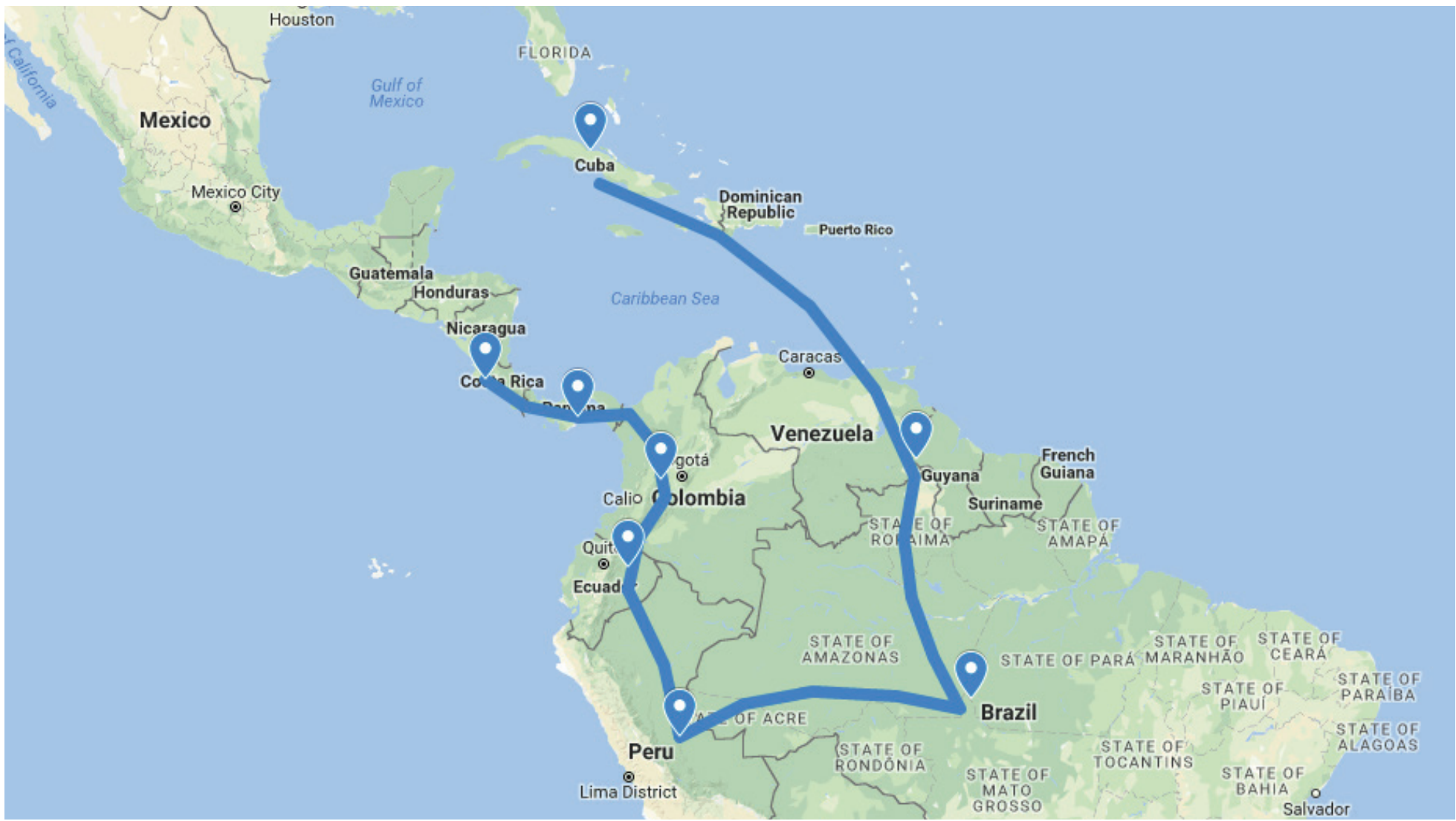
"My journey to Costa Rica was treacherous. I, along with 13 Cubans, left the island on a plane and landed in Guyana. From there, we took a bus to Brazil and then a boat to Peru." (They likely traveled from Manaus to Iquitos, as that is a common journey among locals. It typically takes three days.) "We rode a bus from Peru to Ecuador and another bus to Colombia.
"Colombia was difficult to navigate, given the corruption and extortion that take place in that country. I damn those people every day for the pain and suffering they put me through. There is so much I wish I could express, but after three days without food and an exhausting journey behind me, it is difficult to relive those haunting memories.
"Eventually, the others and I managed to get on a boat that took us to Capurganá. Once in Capurganá, we came across four Syrian men who had been lost in the Darién Gap for ten days. Two were elderly and too tired to continue the mountainous journey through the tropical jungle. Another had suffered serious injuries on both legs and feet and could no longer walk. The fourth man made the difficult decision to leave his group and join ours.
"The Syrian man shared his story with us and explained that his group, while lost, had reached out to the indigenous people who reside in the jungle. Initially, the natives had agreed to helping the Syrian migrants navigate the jungle; however, this kindness was only a façade. After guiding them for a few miles, the natives turned the migrants in to the Panamanian police, who deported the group and forced them to repeat the journey once more. Our group of 14 spent 17 days in the Darién Gap. Seventeen days in that jungle is far too long for anyone to remain sane.
"Once in Panama, we found a taxi driver who offered to drive us to Panama City for $300 each. Four of us—myself included—paid the man what he requested, only to watch him drive away with our money. He left us with nothing. We shook off the anger and borrowed money from others in the group to take a bus to Panama City and another to David. Regrettably, I was caught in Panama City and sent back to Colombia. Panamanians are offered $50 to rat you out. Those bastards have no soul!"
"I repeated my journey again on a boat to Capurganá and crossed the Darién Gap for the second time; though this time, I was alone and had no money. Once in Panama, I stayed at one of the shelters offered to transiting migrants. They had no food, or at least none I could afford. A kind truck driver gave me $20 to continue my journey. Again, I took a bus to Panama City and, this time, managed to get on the bus to David. Once in David, there were many cabs offering to drive migrants to the border. My friends had warned me these cabs could cost anywhere between $80 and $220. I managed to get one for $80, paid for with money I gathered along the way. That night, I slept in Paso Canoas on the Panamanian side of the border and then found another cab to take me around the border into Costa Rica in the morning.
"My plan is to stop by Honduras, work for a while, and eventually make my way into the US. Migrating used to be simpler for Cubans, as we could just go straight to the US. Nevertheless, when this immigration policy was scrapped, so were the chances of a humane route into the US. Now we are left with this: a journey out of misery that costs many their lives and cost me my sanity."
📝 This article was originally published in a collection of biographies by the Henry J. Leir Institute at The Fletcher School of Law & Diplomacy and Tufts University.
You can Download the original collection below ⬇️