
A young Venezuelan woman and her father rely on prior entrepreneurial skills and creativity to build a new livelihood in Colombia – but their situation remains rocky.
Written by: The Journeys Project
Estefania flees abuse to build her life anew in Colombia with her parents and baby girl. Relying on her dad’s experience making artisan mirrors in Venezuela, they have saved up capital to launch this business in their new neighborhood. This has helped them scrape by, but inflation and the costs of a growing family still make it hard to hold down housing. Frequent bouts of instability, coupled with obstacles to accessing higher education, have made Estefania’s outlook on her future in Colombia quite bleak.
“I wanted to give her a better future,” Estefania said, nodding in the direction of her 7-month-old daughter, Angelina, in her lap. Eighteen-year-old Estefania arrived in Medellín in 2021. She fled a devastated economic situation and an abusive relationship in Venezuela. Her ex-boyfriend forced her to stay at home, trying to isolate her from her family. One day, Estefania got out and went to her sister’s home. She called her father, who was living in Colombia at the time. “I can’t stand this, being mistreated,” she exclaimed. Her father assured Estefania that he would help her get out.
To afford the trip to Colombia, Estefania had to sell her few personal belongings from her parents’ old house – her bed, her hair straightener, and an air conditioning unit. Once her dad sent the rest of the cash to pay for the bus ticket, Estefania left in secret. She was four months pregnant at the time.
As a minor traveling alone, Estefania ran into complications leaving Venezuela. She didn’t have the parental permission documents that she needed to exit, so she traveled via the trocha, an informal border crossing. When she got to the Colombian border town, Estefania’s aunt took her in for several days until a humanitarian aid agency helped pay her bus fare to reunite with her parents.
When Estefania arrived in the safety of her parents’ home, she was in dire need of rest. Her pregnancy was high-risk, and she began receiving threats from her ex-partner. Fortunately, several months later, Estefania gave birth to a healthy baby girl – Angelina.
Raising a baby meant new costs. Estefania had her parents’ support, but things were very tight. She started selling gum on the street. “It made me embarrassed,” she said, explaining that people would often give her money out of pity and not actually take any gum. Although it was uncomfortable, through her gum sales, Estefania made about $4.50 USD a day – “a very good income.” The gum sales were just the first step.
Estefania and her dad dreamed of starting up a business like he’d had in Venezuela, selling artisanal glass mirrors. After a few weeks of gum sales, they had saved up enough to buy the first raw materials to make two decorated mirrors. “We sold gum to save up the capital we needed to buy the mirrors.” With their first $9 USD in savings, they bought discarded glass, crushed it, and used the glitter to decorate two frames.
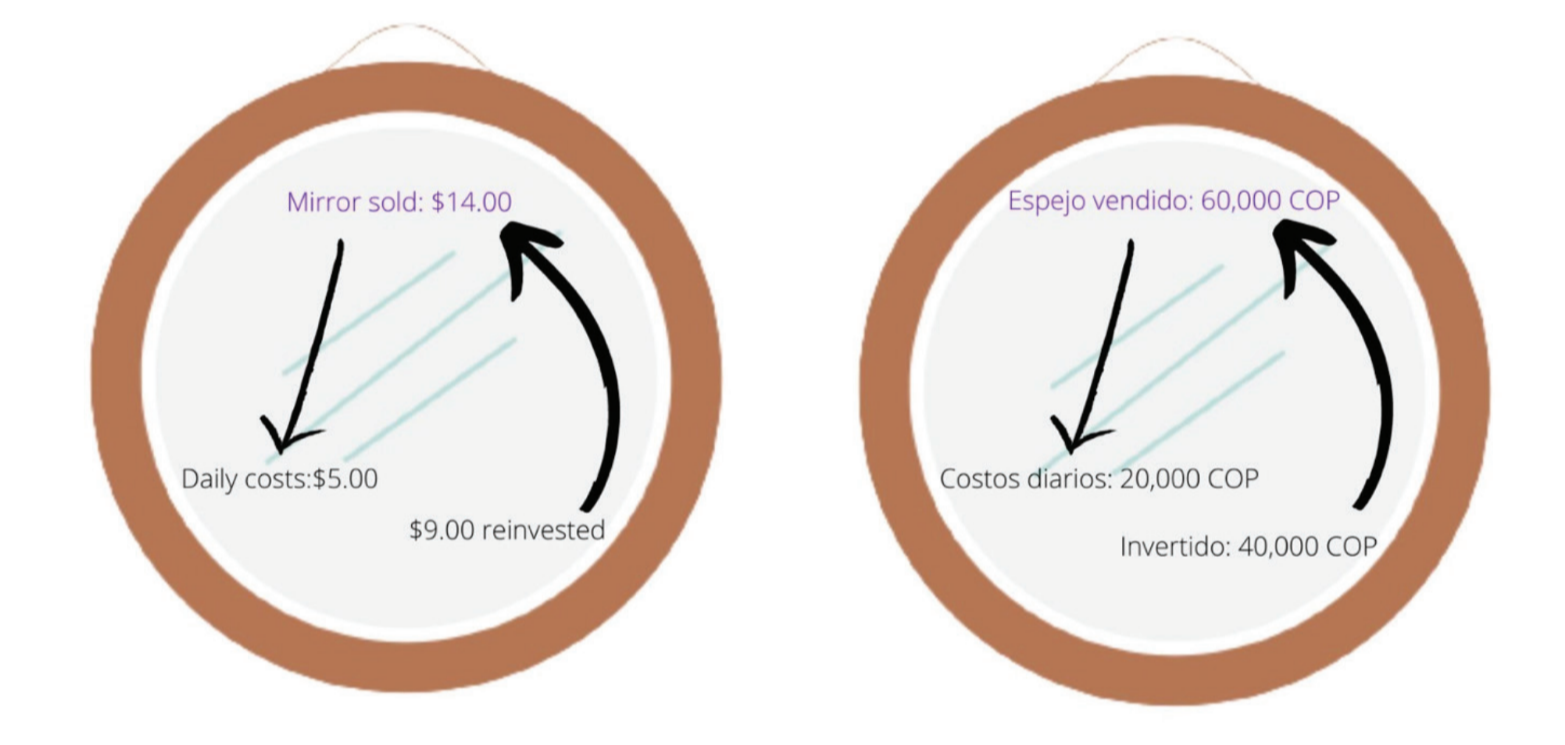
With their first products in hand, Estefania and her dad went out to try their luck on the streets. “We sold them like hotcakes. People loved them!” The mirrors were different from what people were used to, which Estefania credits to her dad’s creativity. Today, she and her father continue selling mirrors. They sell each one for $14 USD. Of this, they keep $9 USD to reinvest in materials for the next set of mirrors, and $5 USD goes towards their other daily expenses.
Despite the novelty of their product, sales today in 2022 still aren’t easy. Estefania and her dad don’t have a car or bike, so they walk everywhere, each carrying four mirrors. Some days, they have to walk miles into the city center to sell their wares. On really bad days — like when it rains — they simply can’t make a sale. To complicate things further, when they’re really tight on cash and can’t afford to buy formula for Angelina, Estefania must stay home to breastfeed her. On these days, her dad goes out to sell on his own, limited by the number of mirrors he alone can carry.
During these tight times, the most stressful expense for Estefania’s family is paying rent, followed by rising prices of food and diapers. In just one year since Estefania arrived in Colombia, she has already lived in four different places. Their first home was just a single room. Once Angelina was born, “it was way too small” for all four of them, and they moved to their second apartment. Not long after arriving there, they couldn’t make rent, and their landlord evicted them. They called the city’s helpline and were referred to a shelter. It was a highly volatile and unsafe environment for Estefania and her newborn baby, so after two months there, they moved into their current home. They’ve been there for several months now but are still struggling to pay rent, which means that Estefania’s dad sometimes needs to negotiate with the landlord. Two months ago, for example, sales were low, and they didn’t have cash when rent was due. Estefania’s dad asked for two more weeks so that they could try to make some more sales. In that time, he was able to pay $35 USD of the $58 USD that they owed for rent.
Despite constantly struggling to meet their financial needs, Estefania’s family refuses to buy food on credit from the corner store, or to take loans from the infamous prestamistas, or loan sharks. The only loans that they occasionally take out are from neighbors. She explained, “Money that isn’t your own is dangerous. Prestamistas are bad people; they can hurt us.” Estefania believes that it’s better to have a rough day, even forgo a meal, than get mixed up with them.
Instead, Estefania’s family finds other ways to limit expenses. For now, they don’t send remittances to Estefania’s older siblings in Venezuela. They also save on transportation by walking everywhere, and their rent and utilities are relatively cheap because they live in a low-income neighborhood with few public services.
They’ve also been able to save on some, but not all, medical costs. Since Angelina was born in Colombia and is a citizen, she has state-subsidized health care. Estefania’s dad does too, which he got access to through his PEP¹ migration status when he arrived in Colombia several years ago. As for Estefania and her mom, they still don’t have health insurance. Despite recently receiving a new migration status called PPT², it’s been hard to get enrolled in the Colombian health system. Estefania explained that it requires a complicated online enrollment process. This is a big barrier for them, since they don’t have internet at home or an extra $0.70 USD on hand that it would take to use a cyber-cafe.
For now, Estefania keeps busy helping her dad with their mirror sales. Although her external demeanor is light-hearted, at times the sting of closed opportunities often seeps through. In Venezuela, she finished high school, but was never able to get her diploma. She desperately needs this to pursue higher education and many jobs in Colombia. She sighed, “I don’t have an outlook for the future here.” What she needs, she insists, is not another course or certification – but her degree.
📝 This article was originally published in a collection of biographies by the Henry J. Leir Institute at The Fletcher School of Law & Diplomacy and Tufts University.
You can Download the original collection below ⬇️