
Ethiopia to Greece: An Ethiopian protester walks, motors, and flies his way to Turkey, then, heckled and beaten, moves on to Greece.
Written by: The Journeys Project
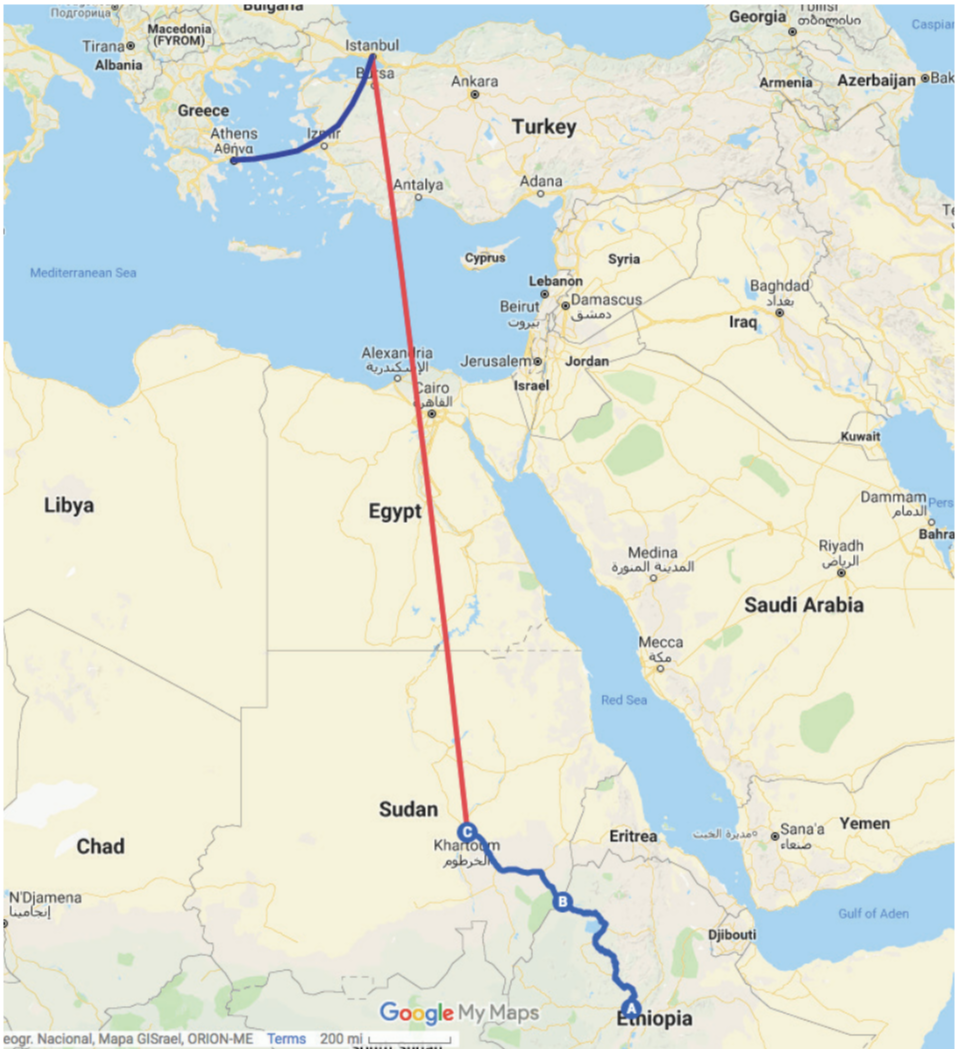
A well-to-do Ethiopian taxi driver, Salah, finds that he is a political target. He stays in hiding with family and friends until he believes he is putting them in grave danger. His sister helps him organize his crossing to Sudan on foot under the cover of darkness. His Ethiopian smuggler then transfers him to a local passer who ferries him to Khartoum. After obtaining a fake passport and visa, he flies to Turkey, where a local smuggler—the man in the black dress—takes him in and encourages him to leave Turkey for Greece. He likes and trusts the smuggler and decides to take his advice. Throughout the journey, Salah's sister has been coordinating with smugglers, then paying them when Salah has successfully completed each leg.
"I am from the capital of Ethiopia, Addis Ababa," Salah said. "It means 'new flower.' I was a taxi driver for four years there, and my family and I are from there. I know the capital well. I left my country in June 2016 and arrived in Turkey in July 2016. It was very quick. I left in a hurry and didn't have time to plan much."
He showed me a nasty scar—he had been shot slightly below his chest on the left side, and we could very clearly see the bullet's trace.
"I spent three months in the hospital," he said. "I was a part of the opposition party 'Ginbot Sabat.' We were in an anti-government demonstration and they shot me and other people. Too many people were injured; too many people died. Demonstrations are still happening, and there is still violence.
"Three months in a hospital bed. As soon as I went back home, the government started looking for me to put me in prison. They were looking for me every day to intimidate. I lived with my parents, and every day the police were coming to find us, so we had to move from one friend's house to another. In the end, I told my parents I should be on my own because they were very tired.
"I went to the bank, withdrew all my money, and asked my sister to keep it. I had money from my taxi job—about 300,000 Birr [$12,000] in my bank account. I was making good money and was working full time.
"I wanted to go to Sudan. I called my friend who lives in Germany, and he gave me the phone number of a smuggler, and I contacted him. There were two smugglers, actually, one from Sudan and one from Ethiopia, but they communicated with each other. The first smuggler, a go-between, was very afraid because the work is illegal.
"We were communicating discreetly for two weeks— we talked on the phone three times. I was always the one calling him. I told him this is an emergency—that's why I want to meet with you. The smuggler was afraid the first time, so a friend of his called me and said that he would meet me that same night. I went where we were supposed to meet, but the smuggler did not show up. After three days, I called him. Same thing happened. And finally, the third time it worked; he showed up. I had sent a picture of my face so he recognized me. I met the real smuggler after two weeks. We discussed the travel—I told him: 'I have money and everything. Whenever I can leave, I'm ready.' The smuggler said okay. He asked for $1,200 to go to Sudan, to which I responded: 'Okay, anywhere but Ethiopia.'
"After three days, the smuggler gave me an appointment near the stadium. He had arranged for me to leave with a car. I had an agreement with the smuggler that once I arrived in Sudan, my sister would give him the money. I had told my sister. In the car, there were two other Ethiopian men. They had the same political issues.
"Someone working for the smuggler drove us to Metama (near the border of Sudan). The driver told us to get off, and he left us in a small house there. He told us to wait for a Sudanese man. When the Sudanese smuggler came, we crossed the border at night with him by foot. We walked for four or five hours. Then we took a car to Khartoum.
"Along the way, the smugglers communicated through so many different channels. We don't know who the local passer is, meaning the person who actually shepherds us from point A to point B, beforehand.
"The driver didn't leave us for a second until we arrived in Metama. But I liked the smuggler [local passer]. He was okay.
"The Sudanese smuggler called the Ethiopian smuggler when we arrived. Then the Sudanese smuggler gave me a phone to call my sister so she would pay him. I think she met one of them in person, but I'm not sure who or how she paid. In Khartoum, I had to stay in the smuggler's house for ten days without going out. I heard an Ethiopian had been deported from Sudan to Ethiopia. I tried to collect information, and when I realized it was too dangerous to stay there, I told the smuggler I wanted to leave.
"I said I wanted to travel to another country, farther away. I wanted to go to Turkey and stay there. The Sudanese smuggler put me in contact with a Turkish smuggler. I didn't speak with the Turkish smuggler, just with the Sudanese. He asked for $2,000.
"I stayed in the same house for four more days. And then the smuggler gave me a fake passport with a visa to Turkey." (He didn't know what type of visa it was.) "To go to the airport, I had to go to a square in Khartoum and look for a man in a white dress. I was told the Turkish smuggler in Istanbul would be wearing a black one. I took a direct flight to Istanbul. And didn't have any problem with security.
"I exited the airport and found the man in a black dress and went with him to the car. A Somalian woman was inside. She spoke only English, not a lot of Arabic. Same process: I call my sister, and she pays. We did not speak a lot so as to not put her in danger.
"The Turkish smuggler driving took me to another smuggler's house in Istanbul in the Aksaray area. There were eight or ten other people, including three women. I stayed there for ten days, but I left the house on the second day to go to church. On my way back, Turkish men hurled insults at me, then beat me. They told me not to come back to the church."
Salah showed me the marks they did to him on his cross tattoo on his arm.
"When I was back in the smuggler's house, I told the story to the smuggler. He advised: 'This country is not good for you. If you have money, you must leave.' I still had cash, but I hadn't told the smugglers—I had $1,500 that I was hiding in my socks. So at that point I had to tell him I had money. I said I only had $1,100 so I could keep $400 at least. He said, 'OK.' I had to pay $1,100. I gave all the money to the smuggler right away because I trusted him. We had a good relationship. Even if I didn't trust him specifically, I trusted the system. If you trust one of them, you trust the whole network.
"In the evening, a small van came in front of the smuggler's house in Istanbul. On our way, we stopped at different houses to take on other people. This journey lasted six hours. I didn't know where I was going. I arrived and saw we were on the coast. There was a boat and about sixty other people from different countries. It was night. I had a bag with me. Things went smoothly. Halfway from Lesvos, the protector boat, the UK ship, came to take us here.
"Since then, I cut all contact, even with my sister. I don't want to put her in danger. Money is not too important here. I have everything: a place to stay, food, a bit of money. If I really need money, I will ask my family."
📝 This article was originally published in a collection of biographies by the Henry J. Leir Institute at The Fletcher School of Law & Diplomacy and Tufts University.
You can Download the original collection below ⬇️