
A Case Study of Parque La Carolina: Quito, Ecuador
Written by: Madsion Chapman, under the supervision of Kim Wilson
Table of Contents
1.0 Introduction and Roadmap
Two young Colombian women sit next to a small iron pushcart topped with four heavy, five-gallon tubs of coconut and tamarind juice. A year ago, their farm was raided by the FARC.¹ One narrowly escaped sexual assault and both fled their home to escape retaliation. Here in Parque La Carolina (Quito, Ecuador), they have been selling juice all day. Both wear ragged caps to protect themselves from the fierce mid-afternoon sun. They take a break under the light shade of a scrubby bush and dig into juicy hamburgers from a nearby food stand. All around them, other, largely Afro-Colombian women shout "Coco! Tamarindo!"
A half-mile away, a group of young Ecuadorian and Venezuelan men faces off in the final moments of an intense fútbol match. Sweat streams from their foreheads as they call out to compatriots on the sidelines, pumping up the growing crowd. Yet they never take their eyes off the ball for long. They play like something important depends on it. Whether it is only for pride or for something else is unclear.
A few meters away, a young girl skips across neatly trimmed grass and falls into her mother's waiting embrace, bemoaning that her father forgot to buy sandwiches for lunch (again!). Near a small lake with paddleboats, a mime from Venezuela approaches people strolling past. His silence and his theatrical movements disguise the Venezuelan accent that would reveal his country of origin. The mime waves at a man and woman resting under the shade of a nearby tree. The man returns the greeting and grasps a cart full of rice to sell, proudly wearing a cap embroidered with the Venezuelan flag. A group of young people spot a friend from Venezuela and join him for lunch. They gab away with news of weddings, jobs, roommates, paperwork, and partners. A local indigenous woman, licensed to sell goods in Ecuador, makes a sale. It is one of the few that she will make today.
Down the road, a mother from Venezuela breastfeeds her baby and stops a street vendor to buy a chicha, a traditional cold refreshment from her hometown. Everywhere, hawkers and vendors shout out the names of their wares (Ice pops! Cotton candy! Coloring books! Hats! Spicy mangoes!), while the smell of fried food is carried into the street by a sporadic breeze. A band strikes up a merengue, a genre of music typical in the once-bustling cities and towns of Venezuela— a country that has seen more than five million people flee since 2016. Growing socio-economic distress, hyperinflation, and political violence have forced Venezuelans across borders to find refuge across Latin America. Of these, Quito is a particularly popular destination.
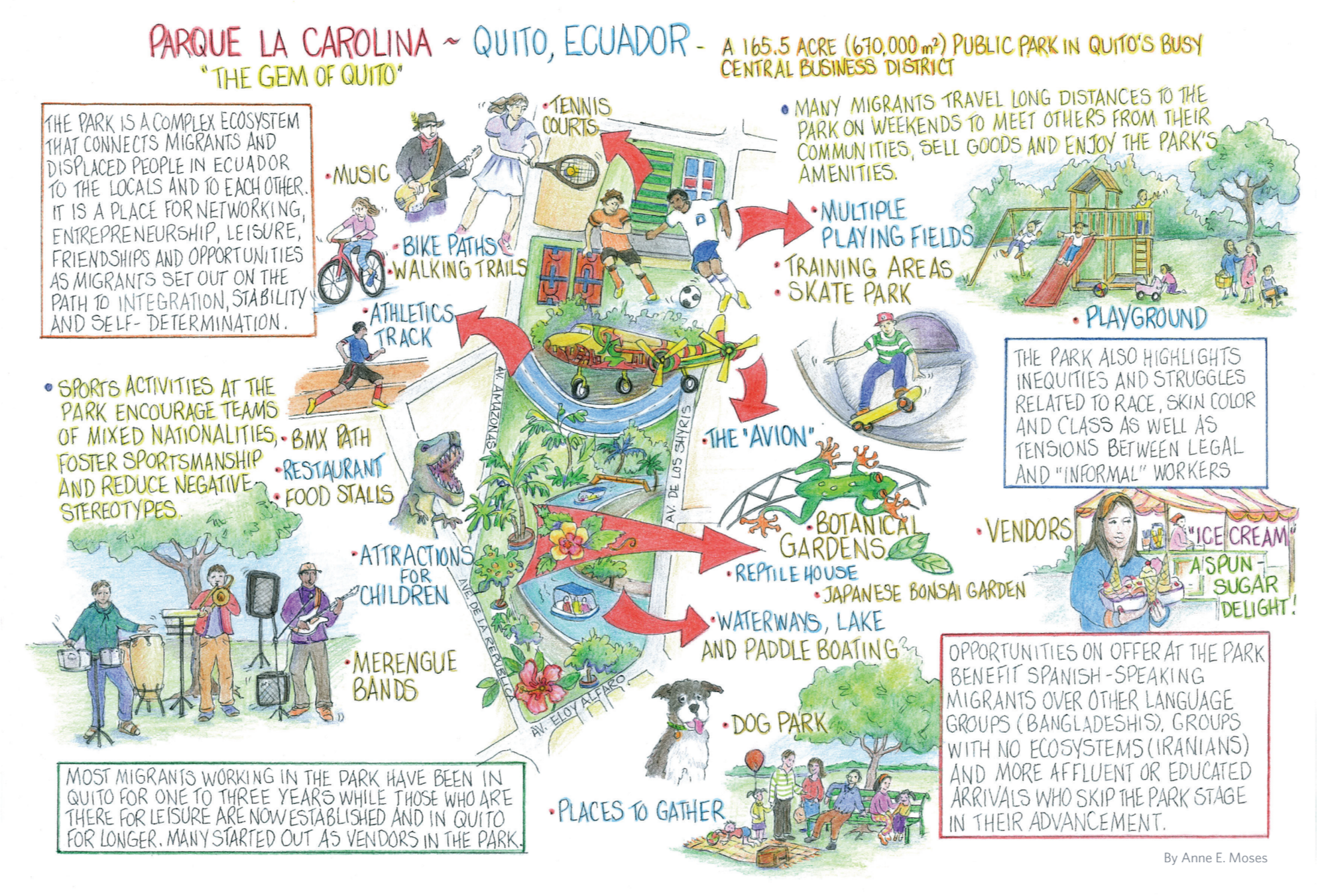
These people described here have one key thing in common: Parque La Carolina. Here, they work, spend leisure time, connect, and gather information. "La Carolina" contains a complex ecosystem that links migrants in Ecuador to the local population. It serves as a hub where entrepreneurship, friendship, migrant integration, and networking occur daily. Displaced people grow businesses that help launch them into more stable work in legal, registered businesses in the "formal economy." Local citizens both befriend and revile the migrant community. In doing so, many discriminate against other Ecuadorians whom they assume to be foreigners due to their skin color, customary dress, or race. Within La Carolina, migrant and local populations mingle symbiotically, discriminate, and compete. Understanding the multiple uses of Parque La Carolina and the people who spend the weekends there offers an important window into a much larger migrant-host ecosystem in Quito.
Importance and Relevance
The following essay explores key elements of the Parque La Carolina ecosystem ("the ecosystem") through a series of stories collected from migrants and Ecuadorians interviewed over the course of one weekend in January 2020.² The research team then engaged in "kitchen-table reflexivity" amongst each other to analyze these conversations and make sense of important themes.³ The research team also asked park-goers to help identify which vendors might be from another country so we could later approach them for an interview.⁴ Finding individuals with a migration story was surprisingly easy, as everyone in La Carolina seemed to be connected to migrants in some way.
Our research suggests that the park represents a microcosm of the city. It is a place where migrants and locals interact, information travels by word-of-mouth, and fledgling businesses grow or fail. Migrants and locals exist within park "territories" where, within a limited patch of ground, migrants know and understand the social hierarchies that define and constrain them. Our study finds that public spaces such as La Carolina provide essential gathering places that serve as launching pads for self-employment and small business activities. Yet these same spaces reveal deep inequities between migrants and hosts that are as much about skin color and tell-tale accents as they are about poverty, social cohesion, and access to "formal" and "informal"⁵work. The ecosystem creates a space for migrants to connect with each other and with Ecuadorians, to begin ratcheting up their livelihoods,⁶ and to enjoy affordable leisure time. Yet which activity an individual engages in is largely dependent on their circumstances prior to displacement and their demographic profile.
This essay contributes a research methods perspective to the growing literature on area-based approaches to humanitarian and development programming (see Sanderson 2019; Sanderson and Sitko 2017).⁷ It also adds to the well-established literature on social cohesion and host-migrant relations (see Porter et. al. 2008; Kindler et. al. 2015; Strang and Ager 2010; Suter 2012).⁸ Finally, we demonstrate the utility of an ecosystem-based, qualitative research methodology for understanding a "slice of life" in complex urban environments.
This essay begins by mapping the park and providing an overview of where park denizens spend their time.⁹ It then details who occupies the ecosystem, what they do, and their motivations. We then dive deeper into the resources that the park provides its users, as well as how people working in the park ratchet up their livelihoods and strengthen social cohesion. We will analyze challenges within this ecosystem, especially as they relate to competition for resources, high levels of migrant and local host poverty, and the specific struggles that race, skin color, legal documentation, and social class present. We conclude with a brief review of those excluded by the ecosystem and posit why this may be. Finally, we offer recommendations for programming and future research based on these findings.
2.0 Mapping the Ecosystem: Parque La Carolina Background
Parque La Carolina ("Carolina Park") spans 670,000 square meters in the center of Quito's bustling, central business district. It includes grassy open spaces with scattered shady trees, multiple recreational courts for sports such as tennis, basketball, and fútbol,¹⁰ and miles of paved walking paths. Often described by travel websites as "the gem of Quito," it is a relaxing public space where people can escape the hectic pace of city life. In addition to athletic courts, the park includes an American football field, a ceviche restaurant, bike and BMX paths, a lake for paddle-boating, a Japanese botanical garden, a dog park, and an aquatic park. A large airplane ("el Avion") in the center of the park invites the admiration of onlookers. For museum lovers, a reptile house offers yet another diversion. Parque La Carolina represents much more than a park: it offers a hub and a meeting place for the young and old and is filled with vendors selling sweet fruits, salty snacks, and refreshing beverages. Saturdays and Sundays receive the most foot traffic as friends connect and make plans for the weekend. Many respondents indicated that they spend many, if not most, weekends in the park for work or for leisure. Most migrants we met had lived in Quito between one and four years. Those in the park for leisure had resided in Quito for a comparable or longer amount of time and were more established. Some leisure-goers had previously launched small enterprises in the park and had since moved on to other ventures.
2.1 Mapping the Ecosystem: Who and What
The majority of migrants we met in La Carolina were Venezuelan, but we also crossed paths with Colombians. Many Venezuelans had pursued higher education in Venezuela and had once worked in professional jobs such as software engineers, business managers, or English teachers. However, migrants are rarely able to validate their professional and academic credentials in Ecuador. Instead, they found that they could transform their hobbies and side ventures from Venezuela into profitable livelihoods in La Carolina.
Consider Charlie, for example. Charlie was an English teacher in Venezuela before he fled a collapsing economy and a political system that he could no longer believe in. When he and his wife fell on hard times in 2015, they supplemented his salary by opening a cosmetics and tattoo salon. But it was not enough. Charlie and his wife worked to keep up with their expenses and endured harassment from Venezuelan authorities. Despite these challenges, Charlie found time in his packed schedule to follow his true passion of community theater. When Charlie arrived in Quito and needed to pay for his wife's medical expenses, he was unable to earn an income as a teacher because his credentials did not transfer to Ecuador. Yet Charlie was undeterred. He turned his passion for theater into a business by using the same entrepreneurial spirit that had sustained him and his wife in Venezuela. Now, Charlie works as a mime and has fully captured the market for comedy in his section of the park.
Food sales also provide opportunities for migrants to earn money in heavily foot-trafficked areas. Charlie introduced us to two of his friends, a man and a woman, also recently arrived from Venezuela. The man sells fried rice (chaulafan, a traditional dish) for $1 USD per bowl and makes approximately $35 USD on weekends. His companion sells cigarettes and sweets from a stadium-style tray slung around her neck. She makes $15-30 USD on a good, sunny weekend day but makes as little as $5 USD on a bad day. On weekends, she frequents the park. During the week, she sells her wares in the middle of the road to stopped cars.
2.2 Mapping the Ecosystem: Motivation
For most who work in the park, park-based businesses are a stopgap until they find more stable work. Respondents shared their goals to ratchet up their livelihoods and gain legal status. The man who sold chaulafan wanted to find a job with predictable income while earning at least $400 USD per month. With this money, he hopes to bring his family to Quito from Venezuela. His female companion was forced to leave her children behind in Venezuela and hopes to use the income she earns by selling cigarettes and sweets to bring them to Ecuador. She also wants to get her paperwork in order so that she can obtain a cedula¹¹. The cedula would allow her to get her university degree from Venezuela validated and would open up better job opportunities for her. Charlie, who enjoyed displaying his talent for theater in the park, wants to teach English again. He also wants to become nationalized as an Ecuadorian citizen. For everyone we spoke to in La Carolina, Venezuela was in the past. Their future was in Quito, and the park would be their launch pad to a better life.
3.0 Snapshot of an Ecosystem: Public Spaces for Work and Play
Parque La Carolina is a place of both work and leisure for migrants and locals alike. It is central to both Quito and the lives of those who frequent it. Though Charlie lives closer to other large, well-attended parks, he takes the bus for more than an hour and a half to perform in La Carolina. He was not the only person we spoke to who travels for up to two hours to spend time in La Carolina on the weekends. Venezuelan. So, why are people willing to travel so far to go to La Carolina?
Because of its central location in Quito, free entertainment, and myriad public services, Parque La Carolina has become the heart of Quito. Not only does it provide ample space to claim territory for selling goods, but for those who know their market, it offers opportunities to innovate and attract new customers. La Carolina also nurtures a self-help community, where co-nationals meet to share culture and a taste of home while developing social networks that allow them to look after each other. For those who work in La Carolina, it offers a pleasant atmosphere and community. And for those who spend leisure time in La Carolina, it provides free or low-cost public amenities that make life a bit more bearable. The following sub-sections explore these themes in greater depth.
Meeting Place for Local and Migrant Integration
Charlie emphasized that he does not want to return to Venezuela. Quito is his home now. As a mime in La Carolina, he can observe and practice Ecuadorian behaviors that make him feel like he belongs. Charlie has even abandoned his Venezuelan accent for an Ecuadorian one. Not all migrants hope to integrate by assimilating into their host country, passing as a local, and intentionally erasing their past. However, Charlie identified one lesson that the Venezuelan migrants in La Carolina could all agree on: the park acts as a microcosm of Ecuadorian society. As a result, it presents a ripe place for migrants to grow familiar with the customs and cultures of their host country.
This process of observation and learning is not one-sided. Within the La Carolina ecosystem, locals and migrants share what they have in common and develop a mutual understanding of each other. One young mother, Minnie, comes to the park for leisure. She works as a housekeeper for a family that pays her above the minimum wage and helped her daughter enter the public-school system. Because of this financial security, Minnie is able to use the park for leisure. Her daughter loves its installations, color, and music. Spending time there with her daughter brought Minnie the unexpected joy of making Ecuadorian friends as her daughter found and became inseparable from new playmates—without even asking where they were from.
Similarly, the athletic fields provide opportunities for mixed Venezuelan-Ecuadorian teams, which sometimes include Cubans and Colombians. On the fútbol field, teammates from different backgrounds collaborate and compete. This fosters sportsmanship and helps dismantle the negative stereotypes of migrants that are pervasive in the Ecuadorian media. However, this open-mindedness only goes so far. A young fútbol spectator named David noted that even during friendly competition, Ecuadorians can be closed off. David struggles to identify with people from the indigenous areas of Ecuador, who spend time in La Carolina but are often less visible than their non-indigenous co-nationals. Though he enjoys meeting Ecuadorians, David mostly visits the park to meet with his growing group of Venezuelan friends. Over time, David has created a close-knit Venezuelan community that he can retreat to on Sundays— his only day to rest during his twelve-to-thirteen hour-per-day workweek.
Self-Help Communities, Social Networks
Everyone knows someone in the park, even if only casually. Our interview with Minnie was interrupted by multiple friends who stopped to greet her and ask about her children. Minnie beamed and told us that many of her friends from Venezuela visit La Carolina every weekend and that they meet and chat when they do. We also spoke to a young mother named Roberta whose children zoomed playfully among the trees while we talked. As she spoke, she stopped a friend of hers pushing a street cart full of chicha. They had met in the park during Roberta's second week in Ecuador. When she is financially stable enough, Roberta buys chicha to help her friend. Her loyalty to this vendor has since become second nature. Roberta unknowingly contributes to the Venezuelan self-help ecosystem that links the migrants to each other. However, this closed system notably does not extend to every expatriate. Minnie informed us that while self-help does occur, a sense of class divide permeates even the Venezuelan community. As a result, vendors and leisure-goers rarely interact beyond simple transactions. Roberta and the chicha vendor are an exception to the rule.
José, the man selling chaulafan, noted that self-help within La Carolina extends beyond social interactions. If necessary, migrants from Venezuela also support each other with work. This includes helping each other to find and maintain an income stream, but also to watching over a friend's cart, stall, or stand should they have to leave temporarily. These networks of trust feed into the decisions that migrants make about how to present themselves. José, for example, proudly wears a cap with a large Venezuelan flag embroidered onto it (in case anyone had doubts about where he was from). Yet his hat also serves as a signal to other migrants — that he was part of the "in" community of compatriots that formed one large self-help group. The flag is both an emblem and a personal advertisement.
Information serves as another self-help commodity in La Carolina. Migrants arrive in the park during various stages of their migrant journeys, and as a result provide each other with critical information on how to adjust to Quito. This includes how to get a cedula, which international organizations provide which services, where to attract the most customers ("the Avion"), and which jobs are available through various contacts. Word-of-mouth between two old friends, often via WhatsApp, reaches a much larger audience if one of them works or spends free time in the park. For those who are in Quito without family, La Carolina offers emotional support as well. José and Margarita communicated honestly about their living situations with each other, feeling less alone with each friendly chat. While José struggled to make rent, Margarita's situation was even more fragile. She could become homeless. Yet her "home," she knew, could be the park — a place where people knew her and would look out for her if something were to go amiss.
Launch Pad: Ratcheting Up Livelihoods
For those who work in the park, the ecosystem rewards starting small and ratcheting up a business until one can "graduate" from working in the park. Graduation typically occurs upon hearing about a job or opportunity via the word-of-mouth networks within La Carolina. Josephina and Juan's experiences illustrate this graduation phenomenon. Both come from Venezuela, where Juan received his degree in mechanical engineering, and Josephina attended university. Both initially experienced challenges in obtaining their cedulas and certifications. Josephina overcame this obstacle by starting her own business. She did not have much capital. In fact, she only had 10 USD to invest. With this, she bought chocolate boxes and pretzel sticks as starter materials (materia prima) for a new candy-making business. She also bought a bain-marie for melting chocolates and creating confections. In a heavily foot-trafficked spot, Josephina set up shop and started making chocolate-covered pretzels. Juan eventually joined to help her. A friend offered freezer space in which the chocolates could quickly harden, and after only one week of operation, Josephina made 100 USD. Though she never made more than 25 USD per day, she was able to put money aside to buy an attractive sign. She even earned enough to cover her rent and utilities without worry.
As her business thrived, Josephina could spend more time talking to people about professional opportunities and searching the newspapers for job advertisements. Josephina finally found an online, computer-based job as a teacher and left the chocolate stand behind. Yet that stand was a critical first step in her path to greater financial stability, and allowed her and Juan—now her husband—to get a head start in Quito. Josephina joined David under the shady tree to watch the fútbol game alongside Juan. As we sat and talked, a rotating cast of friends jumped in to say hello and contribute to the interview. Josephina and Juan knew more than one person on the team— they knew the whole team. Due in part to the park, Josephina and Juan have an extended family of compatriots that they can lean on. behind. Yet that stand was a critical first step in her path to greater financial stability, and allowed her and Juan—now her husband—to get a head start in Quito. Josephina joined David under the shady tree to watch the fútbol game alongside Juan. As we sat and talked, a rotating cast of friends jumped in to say hello and contribute to the interview. Josephina and Juan knew more than one person on the team— they knew the whole team. Due in part to the park, Josephina and Juan have an extended family of compatriots that they can lean on.
4.0 Challenges: Competition, Race, Colorism, and Poverty
Just as La Carolina fosters an environment that helps inhabitants ratchet up their incomes, it also reflects the deeper inequities and prejudices of Ecuadorian society. This especially impacts indigenous, dark-skinned, and Black Ecuadorians. The ecosystem largely excludes these groups. Contrasting Black local and Black migrant vendor experiences highlights this exclusion.
Discrimination, "Othering," and Skin Color
Selena had been selling juices in Parque La Carolina for ten years when we spoke to her. When she first started selling juice, she could make up to $80-100 USD on a good day. The park, she noted, has changed significantly since she started. She recounted how she experienced more mistreatment since "foreigners" started selling items at rock-bottom prices in the park without permits. Now she only makes 40 USD per day even on the busiest Sunday. Yet her frustration with the cut in sales pales in comparison to the real issue. Selena has been increasingly targeted by the police and park authorities for selling illegally.
In La Carolina, migrants tend to sell their wares without the required permits. Generally, lighter-skinned Venezuelan migrants "pass" as Ecuadorian and face less scrutiny from municipal officials. Selena, a Black Ecuadorian with a "coastal" accent, cannot pass. Despite her Ecuadorian citizenship, her skin color and accent cause the authorities to target Selena as a Colombian. They harass her for selling without a license while her light-skinned Venezuelan colleagues are able to sell without incident. When the police bother her, she tells them that she has initiated the process of legalizing her business. This typically gets them "off of [her] back".
Her situation resembles that of Marianna and Mariclara, two sisters from Colombia who arrived in Quito after fleeing sexual violence and FARC raids on their farm. They were unaccustomed to city life, but they did know how to make coconut and tamarind juice. A few women in their shared guesthouse taught them to pour the juice into reused plastic bottles. With the money they earned from selling the first few bottles, they were able to buy an iron pushcart and gallon-sized tubs. On a good day, they make up to 30 USD from their cart. On other days, they earn less than 1 USD, which they share. Yet sellers have saturated the market for juices, and tensions run high between migrant and local women of color. Many local Black women resent their new competition because of the discriminatory impact it has had on their own businesses. The other juice sellers even called the municipal police on Marianna and Maria Clara. This threatened the sisters and made them "feel like dogs" or worse, like a radio ambulante (an ambulance) — always rushing from one emergency to another. Work remains scarce, and racism touches every aspect of their lives, but not only for them. According to Marianna, "being Black in Ecuador is bad, but being an immigrant is worse."
Tensions Between Formal and Informal Workers
The tension between sellers like Selena and migrant vendors such as Marianna and Mariclara is based not only on skin color, but on legal business registration. Our interview with Rosita, an indigenous woman from the largely indigenous nearby town of Otavalo, underscores this challenge. Licensed by the city, Rosita works selling traditional artisanal hats and scarves. During our interview, she was wearing her typical Otavalenian clothing, including the long woolen wrap skirt, a choker necklace of golden beads, and a brightly colored knitted belt. She displays her license with a prominent blue lanyard and wears a blue vest, visible from afar, to proudly indicate her status as a licensed seller.
Getting her license was no easy feat. Though Rosita has been selling in the park for eight years, she has only had her license for two years. To get this license, she banded together with other unlicensed park vendors to break what she called the "mafia" of existing vendors that had an unofficial hold on the licensing process. Finally, she and the other vendors were able to work with a now-defunct organization to complete the licensing paperwork (though this practice is in itself illegal). Licenses can be obtained for free through a city-run lottery system. It was also expensive to get her license. Between city fees and the fee to the agency that helped her fill out the paperwork, she owes 580 USD. A payment plan with the city helps her pay it off, but the debt has hampered her for two years.
Rosita believed that having a license would give her business legitimacy, attract customers, and keep the authorities away. She hoped that the expensive and cumbersome process would be worth it. Yet her license only allows her to sell her goods in a spot pre-approved by the municipal government. Her spot is hidden in the far end of the park, away from prime selling locations with heavy foot traffic such as those near "el Avion." Though she frequently sells outside of her allotted spot, she has found that Ecuadorian vendors have needed to unite to defend their territory. Migrants, she believes, take up the "best spots." Together, she and her Ecuadorian colleagues work to "intimidate" the "foreigners'' out of these spots. Tensions continue to rise between those who work "formally" and those (frequently migrants or darker-skinned Ecuadorians) who do not.
Rosita ruefully observed that Ecuadorian food vendors must compete with migrants who sell food at much lower prices. She found it impossible to believe that they could sell at prices far below cost without the food itself somehow being "corrupted" or "dirty." She has called the municipal authorities multiple times on migrant vendors. Yet doing so increases her risk of being exposed for selling outside of her licensed territory. For Rosita, her badge is now a symbol of defiance. Even when she's outside her area, it shows the authorities that she has the right to sell. As we spoke, the afternoon sun was reaching its zenith. Soon it would be time to fetch her son before the "foreigners'' overran the park. She wanted to be nowhere near them.
Legal vendors alerting the police or authorities to migrant sellers (or those darker-skinned people who they perceive to be migrants, such as Selena) worsens the already precarious livelihood prospects for "informal" vendors. Charlie recalled that before he became a full-time mime, he sold food in a park closer to his home in Los Chillos (on the far outskirts of Quito) without a permit and got caught. The 860 USD fine was so large that it is impossible for him to pay. Without a cedula, he cannot set up a monthly payment program as Rosita did. A municipal worker advised Charlie to wait for two years for the fine to expire or to return to Venezuela without paying. Both options put Charlie and his wife at risk, but Charlie would never return to Venezuela. He continues to work informally, with a possible fine threatening all he has worked for: teacher recertification, eventual naturalization, and quality medical care for his ailing wife.
These examples illuminate the constant tension between those working legally in the park through formal channels and those who take risks to sell informally because they have no other choice. While the park environment breeds opportunities for social cohesion and ratcheting up livelihoods, it also poses threats based on class, skin color, and indigenous status. These threats can reinforce negative images of migrants. They also hinder integration for those who demographically do not "fit in", or who find themselves caught on the wrong side of the law.
5.0 Who is Excluded?
Not all migrants in Quito form part of the ecosystem. Non-Spanish-speaking migrants living in Quito were notably absent from La Carolina. However, we observed that these migrants create and occupy ecosystems of their own. The following section briefly analyzes who the La Carolina ecosystem "leaves out" and posits why. It then identifies an alternate case study for future research on migrant ecosystems in Quito: La Plaza Foch.
Who Is Left Out? Why?
Non-native Spanish speakers and middle-class migrants are notably absent from La Carolina. Often, these two categories overlap, as most of the Indian, Bangladeshi, and Lebanese migrants we met migrated primarily for economic reasons. Almost none of these migrants were forcibly displaced. As a result, many of these "extra-regional"¹² migrants arrived with existing connections and jobs obtained through strong diaspora communities. Some were able to access family wealth to establish businesses in Quito quickly. Most had ample time to plan their journeys and to carefully select their destinations. For example, one migrant who owned a successful Lebanese food franchise was able to leverage existing connections from his father's multinational business to set up a new enterprise in Peru before travelling to Ecuador. He arrived in Quito with supplier contacts, capital and local assets, and the ability to speak fluent Spanish. For him, starting a Lebanese restaurant was a breeze.
These "excluded" or "extra-regional" migrants did not suffer acutely from documentation challenges. In many cases, Ecuador has an agreement with their countries of origin to provide free or low-cost work visas. But these policies shift over time and offer no guarantee of long-term residency.
La Plaza Foch provides an alternate example of what a migrant ecosystem in Quito might look like. Notably, the "Foch" ecosystem appears less centered on migrant-local social cohesion and more on self-help. Sid, a migrant from India, had already traveled extensively throughout Ecuador on vacation before settling in Quito. During this time, he was able to observe business opportunities available in town. With a loan from his family, he leased a restaurant space in the Plaza Foch, a heavily trafficked area bustling with food, music, nightlife, and clubs. When we met Sid, he was putting the finishing touches on his bright and cheery Indian restaurant. Using his background in graphic design and computers, he designed the space himself. He already had loyal patrons who came from the larger Indian diaspora community in Quito, who were able to share referrals and references across the community. Sid noted that with this initial success and access to startup capital, he has had little need to interact with local Ecuadorians. He hires co-nationals to staff his business and works with Indian suppliers. As a result, he continues to struggle with Spanish and hopes to make Ecuadorian friends so that he can eventually integrate into his new community.
The Bangladeshi community is another example of how new ecosystems emerge amongst "excluded" non-Spanish-speaking groups in Quito. The Bangladeshi community also occupies "La Plaza Foch" ecosystem, where they have formed a robust self-help community oriented around family, culture, and national pride. With names like Aladdin and Turkish Dream, dozens of restaurants that dot the plaza advertise kebabs, shawarma, rice plates, and other Middle Eastern street foods. These restaurants also sell fast food like French fries and hamburgers. Interestingly, few are owned or operated by people from Turkey, but rather by Bangladeshi migrants. The menus are all similar, with some specialties here and there that set them apart. Yet what these restaurants have most in common is a small, inconspicuous green flag with a red circle in the center, often tucked in the corner of the restaurant sign - the flag of Bangladesh.
We met Manik, Johnny, Moban, and Shaan in one of these restaurants. They jostled and joked like brothers, though they were only co-workers. According to these men, there are approximately 25 Bangladeshi migrants in Quito. Together, they make a family away from home. Each of them came to Ecuador because they knew someone who arrived before. Some were additionally motivated to leave by problems between political parties or because of their dislike for the government. Each hired a smuggler for approximately $20,000. Yet this costly investment soon proved worth it as they had found economic security immediately upon arrival. Nearly everyone finds a job in a Bangladeshi restaurant because of the close-knit network in Quito. Community members help each other just as an extended family would. Each week, the entire group of 25 enjoys supper together, rotating through the restaurants of their community. They share stories and news, speak of home, make social connections, and operate the "Bangladeshi Club," a savings club to which they all contribute. Any member can write the group leadership and request a grant if they fall on hard times.
6.0 Conclusion and Recommendations
Conducting qualitative research in urban areas (especially with migrants, who may live in dispersed, hard-to-reach areas or ethnically segregated communities) challenges academics and practitioners alike. However, the ecosystem (or "micro-ecosystem") approach offers one way to understand a "slice of life" where diverse groups of migrants and locals interact. This approach also allows researchers to consider which groups are excluded and to study the "micro-ecosystems" that these excluded groups create. Through analysis, we can understand and address the root causes of this exclusion and seek to adapt programming to foster social cohesion not only between migrants and locals, but between migrants from different backgrounds. Plazas, parks, and other public spaces are hubs for cross-cultural integration. They are also spaces for humanitarian and development programming to take root. As mini-market systems, public ecosystems offer opportunities for organizations to help jump-start small businesses, offer entrepreneurship training, or give small cash grants to ratchet up nascent livelihoods. These spaces offer opportunities for educational outreach and support for business certification and legal documentation. By starting from an ecosystem and expanding outward into neighborhoods through an area-based approach, researchers and development practitioners have the opportunity to better understand nuanced collaborative and competitive migrant-local dynamics. In doing so, humanitarian and development organizations can find their own natural role within these living, changing ecosystems.
📝 This article was originally published as a report by the Henry J. Leir Institute at The Fletcher School of Law & Diplomacy and Tufts University.
Download the original report below ⬇️
Shared Universe: Ecosystems in Public Spaces & Migrant Livelihoods.pdf