
Written by: The Journeys Project
Table of Contents
Finance in Displacement – Jordan
“I have trust in God. Allah will help us.” “We rely on whatever [work] God sends us”. These were common reactions from refugees when we asked how they cope with the uncertainty of their incomes as they struggle to build their livelihoods in Jordan. Many turn to God as they struggle with the everyday stress of putting food on the table, buying medicine for their elderly parents, meeting the needs of their children, and most of all paying the rent at the end of every month. They dread the time when the landlord knocks on the door for the rent, and they try to take a detour on their way home to avoid the corner shop where they have outstanding debt from buying groceries on credit.
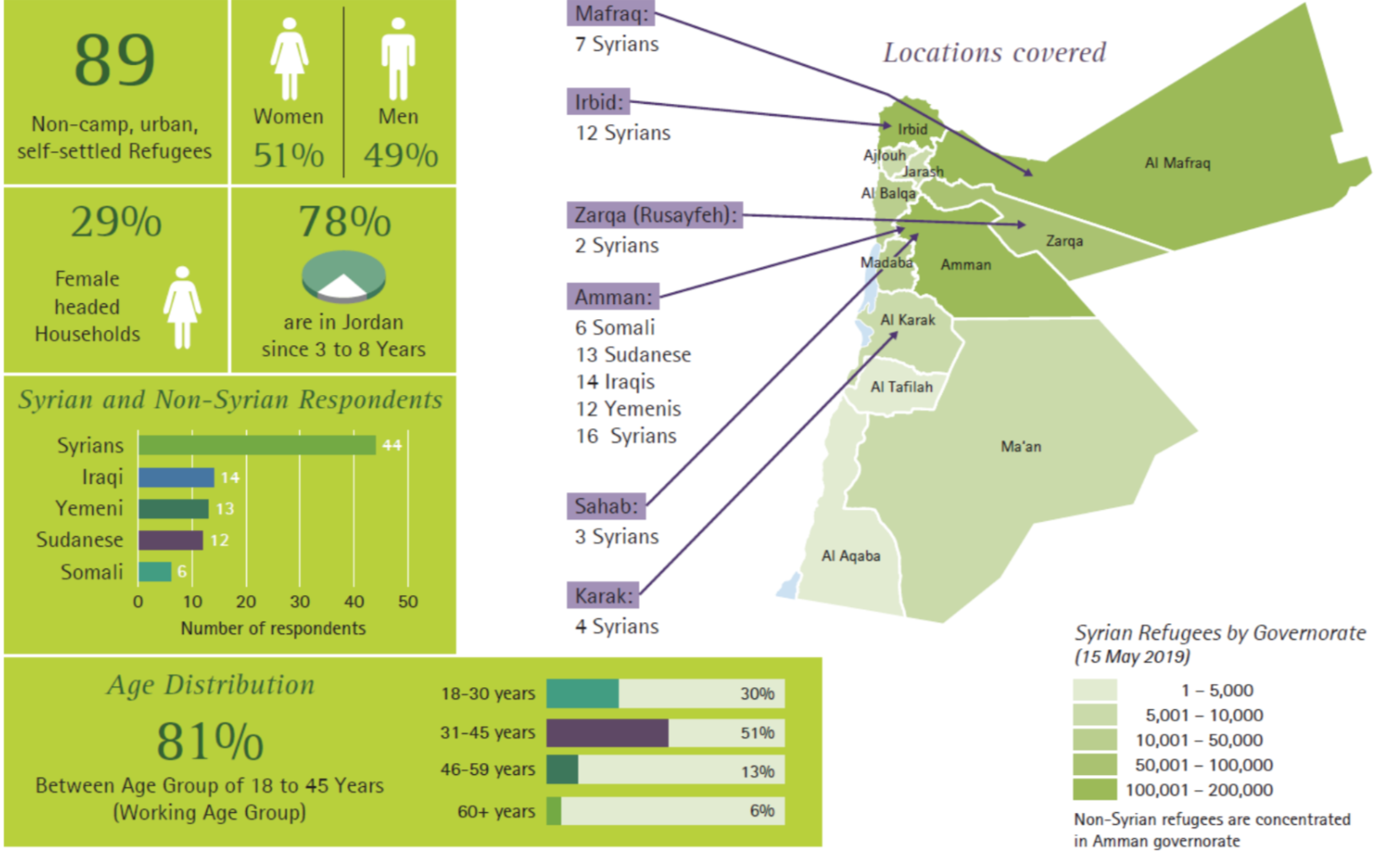
This essay brings together early insights from the research conducted under the Finance in Displacement (FIND) project in Jordan¹. Between September 2019 and December 2020, we completed three rounds of in-depth interviews with over seventy refugees and asylum seekers in Jordan (a total of 234 individual interviews²) to understand their financial lives in displacement (see Figure 1 below with an overview of the sample). These interviews have tried to capture the strategies that participants use to perform various financial tasks during different stages of displacement, especially after they arrived in Jordan, probing their financial stressors, coping strategies, approaches to household financial management, and access to and use of financial services. It also explores the ecosystem of refugees to better understand their access to services, relationship with organisations, and the role of social networks and friendships.
Diving Deeper into Financial Journeys
The most powerful exercise that we did with participants was to map their financial journeys since their arrival in Jordan. We asked them to plot their financial ups and downs on a graph (see Figure 2 below), with the two axes representing the time since their displacement and their corresponding financial situation. Referring to their graphs, we then discussed their livelihood stories, financial challenges, and coping strategies with the purpose of understanding the factors that constrained or bolstered their financial outcomes.
The financial journeys differ based on gender, household configuration, access to cash assistance, strength of social networks, and most importantly on nationality, where the non-Syrians³ (the research covers Iraqi, Yemeni, Sudanese, and Somali) face further challenges as they are excluded from humanitarian programming and face difficulties in accessing labour markets. Each participant’s journey and their challenges are unique. Looking at the big picture, we can see that four types of journeys are most common (as illustrated in Figure 2 below).
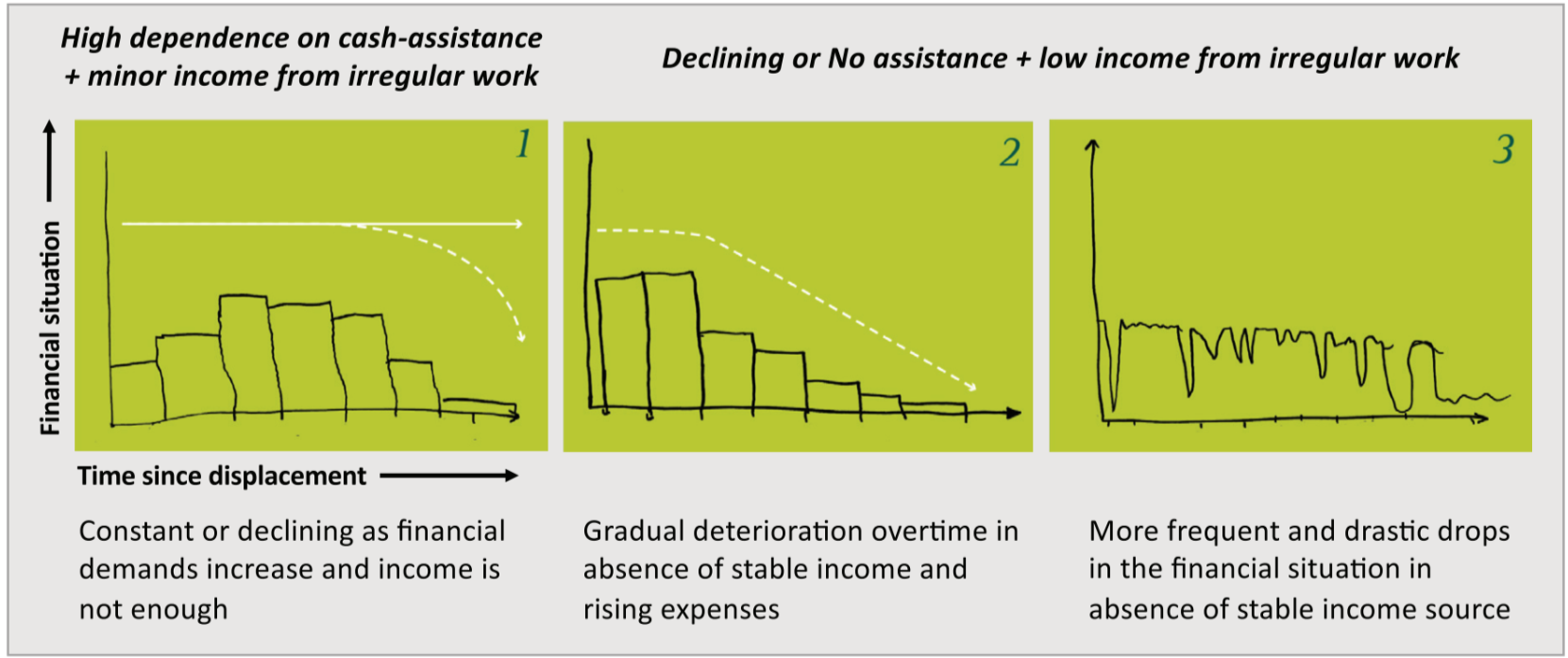
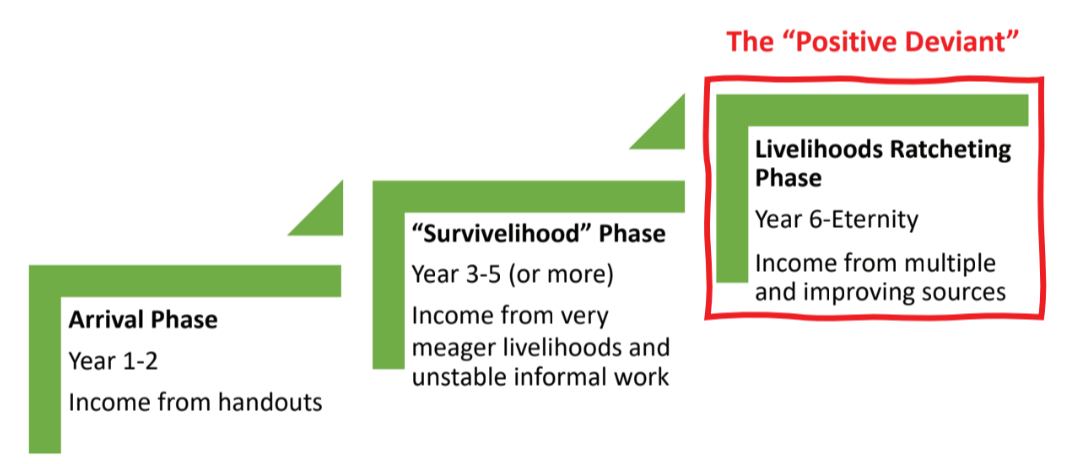
Cases 1, 2, and 3 in the illustration above belong to the majority who are stuck in what we can call the “survivelihood phase,” where income from mostly menial work is not enough to cover basic needs and has to be supplemented by handouts (from humanitarian organisations or private donors) and borrowings from friends and families. The notion of survivelihood refers to the situation or phase of high external (financial) dependence for marginalised groups such as forcibly displaced persons, where they experience no or slow progress in their livelihoods for a relatively long period of time.
For most, this phase has lasted for longer than the initial stage after arrival. They face difficulties in finding stable jobs or starting businesses, and experience rising costs of living, increasing family size, and rising childcare and health expenses. Sometimes there are incremental gains with a better job or some aid, and they might be able to meet their financial needs, pay off debts, and even save a little. However, these gains are not sustainable as jobs remain unstable and those gains are lost in the event of an external shock. Many respondents said that 2019 had been a difficult year for them and that they see things going from bad to worse. Their financial situation has deteriorated further as they struggle with finding jobs amidst rising unemployment and growing new debts while remaining unable to afford basic needs of food and housing.
Case 4 in Figure 3 below shows “positive deviance”⁴, where we see a gradual “ratcheting up” of livelihoods. Over time, these respondents found better-paying jobs, started profitable businesses, improved their professional capacities, and leveraged their strong social networks.⁵ However, as we see in the graph, there can be dips as they face legal issues or losses in their business, job loss, or they can see their livelihoods plateau due to their uncertain legal status and future in Jordan. Before we could see the impact of Covid-19, around nineteen of our participants were experiencing progress of varying degrees. This means that they were able to grow their business or move to better-paying jobs, save aside money to provide the much-needed cushion for financial shocks, and accumulate small amounts of lump sums to make investments in business or capacity building.
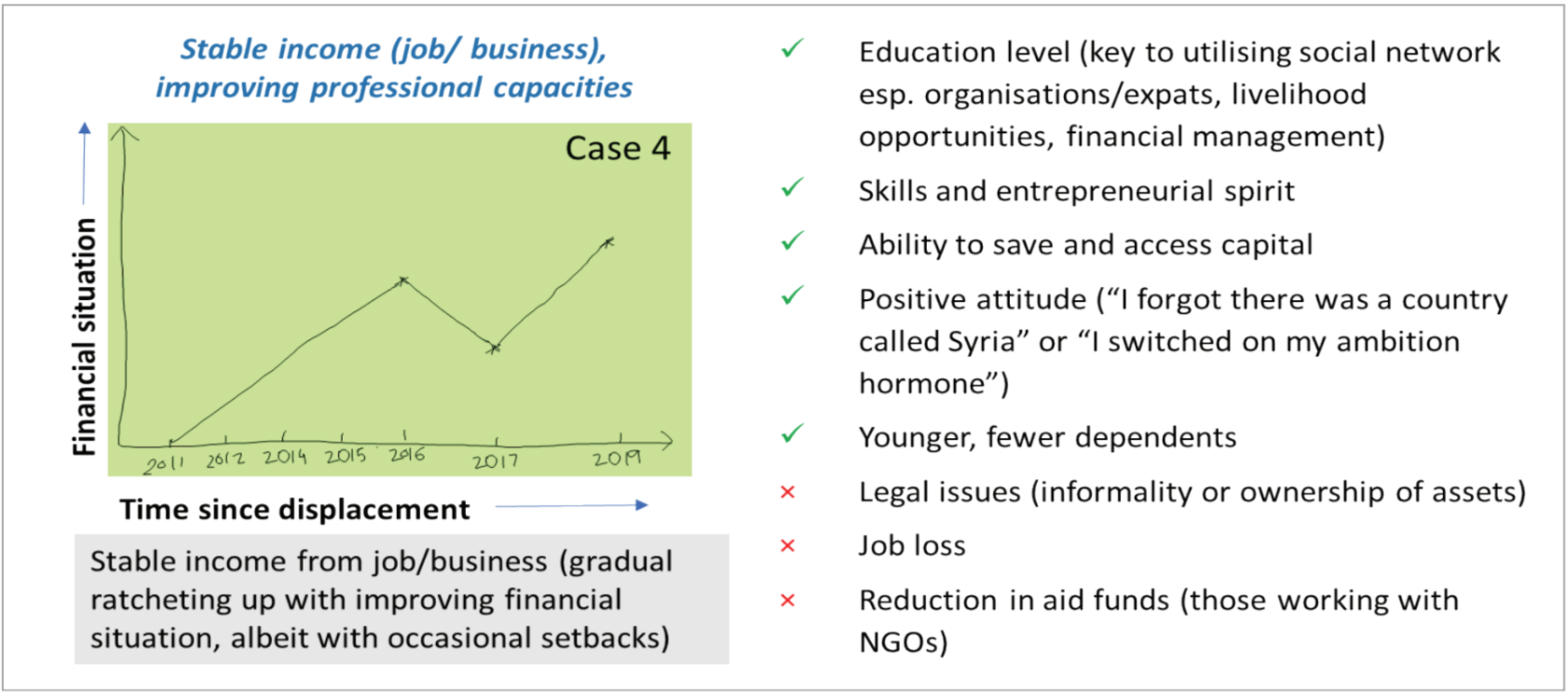
We noticed that these participants were highly entrepreneurial, taking the risk to invest in new businesses or capacity building, diversified their income streams, built strong networks with co-nationals and Jordanians, and exhibited financial prudence within the household. Despite all these positive traits, these entrepreneurs are met with many roadblocks on their way to self-reliance. For Syrians, this could be due to the inability to work in certain “closed” sectors, the need to have Jordanian partners to start a business, or the inability to access certain documents such as the driver’s license (the ability to drive can greatly improve their mobility, which is a major constraint in Jordan given the high transportation costs). The non-Syrian refugees, on the other hand, suffer as they are excluded at the foundational level, where they face challenges in accessing legal work permits in Jordan and are excluded from refugee-focused programmes such as for vocational training.
Refugees in a Perpetual Loop of Survivelihood
Even after being in Jordan for many years, nearly 85 percent of Syrian refugees remain under the poverty line (USD 96 per individual monthly)⁶. Though similar figures are not available for refugees from other nationalities (i.e., “non-Syrian” refugees), they are likely to be even more vulnerable as they receive little aid from humanitarian organisations and are not able to access work permits, are mostly engaged in unstable informal work, often under exploitative conditions.⁷ We see that the financial journeys of refugees are most prominently affected by their nationality, and therefore, it is important to look at participants from different nationalities separately, largely grouping them into Syrians and non-Syrian groups. It is important to note that there are significant differences even among Iraqis, Yemeni, Sudanese, and Somali refugees.
Syrians: The ‘Privileged’ Refugee Group, Yet Failing to Ratchet Up Their Livelihoods
Even after many years of support, we observe that Syrian refugees are still struggling to establish robust livelihoods (see Figure 4). Families that receive monthly assistance (multi-purpose cash assistance or food coupons or both) are heavily dependent on it to meet the basic needs of rent and food. All or most of the monthly cash assistance goes into paying the rent, which could be anywhere between 100 and 150 JOD (roughly 140 to 210 USD).
“Seriously, we don’t know where the money goes. I hate the end and beginning of the month, the first 10 days of the month, I hate them. It is all about repaying debt, rent, and bills. The moment we get the money, nothing is left.”
—Female (head of HH), 36-year-old, Amman
The remaining costs are either covered by debt or through informal work, which brings in only a minor income. The FIND interviews and other research show that income and expenditure are below the minimum expenditure basket (MEB)⁸ needed for refugees to live a dignified life.⁹ Consider this in a family with a large number of dependents (older members or children) or where family members suffer from chronic diseases (diabetes and heart diseases being extremely common) or are differently abled—the pressure of child care and health costs depletes family finances.
Iman is one of our most outspoken Syrian female participants, and we have learnt so much from her. Iman is 45 years old and lives with her family of seven in a small town in Jordan. She lives with her husband, three sons – Mohammad (25), Ashraf (19), and Sami (22), who is differently abled, one daughter (16), and Sara (who is married to Mohammad). Sara and Mohammad recently had a baby. The presence of three men of working age might indicate that the prospects of the household are moving towards some degree of self-sufficiency; however, this is misleading. After three rounds of interviews (each lasting two hours) with Iman to understand their livelihood and financial situation, it is clear that they remain stuck in the “survivelihood” phase even after eight years in Jordan (they arrived in 2012). They feel comfortable socially in the small town, where they have managed to make good friendships with both Syrians and Jordanians. But Iman is not happy with their financial situation – “As long as we still need to keep borrowing money to meet basic needs, the situation is not improving for us.”
Iman’s husband works as a painter (painting houses and buildings) on an irregular basis. He worked in the same sector in Syria as well, even employing other workers. His work was regular until the war. They had their own house, a motorcycle, and some savings, which they used when their income stopped when the war started. In Jordan, he only finds intermittent work during the summers, and construction work stops in the winter. Iman estimated that in the summer of 2019 he earned around 400 JOD (~560 USD) and almost nothing during the winter. She described winter months as “very tough” when expenses rise, income is low, and they are unable to meet even the basic needs, piling on more and more debt.
Iman says,
“We feel 80 percent comfortable here. The remaining 20 percent shortfall is because finding work is really hard here. The payment is not good. This is a small area, and there are no job opportunities for my husband and children. There are workers… from outside… Egyptian workers who take over work. My husband and sons get tired. My husband is old. He cannot open a shop - he does not have the money for it, and if he does open one, there will be complaints [to the labour department] as he needs a licence and a work permit, and a lot of extra expenses. This is why I am upset.”
Mohammad, the eldest son, works in a car repair shop earning only 4-5 JOD a day for only three days a week, making barely enough to support his new baby. He had started to help his father so that they did not have to hire another person, but recently had to stop because he suffers from joint pain. Iman’s other son, Ashraf, used to work at a car wash in the area, but he hated his job and quit. He signed up for informal education for dropouts, but did not attend his online classes and quit that too. Iman worryingly shared that Ashraf is going through a very tough time, as he is not able to finish his education or find an appropriate job. Iman’s daughter recently received a scholarship to study at an academy, so she is attending classes now. The scholarship covers transportation, and once she completes her training in hospitality and nutrition, she will receive a certificate.
Her youngest son, Sami, is differently abled, and Iman cares for him. Because of this, she cannot work full-time. There are additional expenses because Sami needs adult diapers. She usually buys them on credit from a nearby mini market run by a Jordanian who has been understanding of her situation. Last time we spoke to her in November, she had 420 JOD, or around 590 USD, outstanding (the highest ever) to the shop for diapers and groceries.
At different times, Iman has tried to contribute to the household income. She cannot work full time because she has to care for Sami. When her husband suffered an injury in 2014-2015, she worked as a house cleaner for six months and described this as her “lowest phase” because she never imagined she would work as a maid. But her work helped to buy food for her family, and she hid her tears from her children. In 2018, she worked a short stint as a researcher where she received 10 JOD for each home visit and earned 50 JOD (~70 USD) in total for the assignment. The most well paying job has been the Cash for Work (CfW) projects with the municipality, which she has benefited from twice in the last few years. Her wages on these projects have been higher than average, around 350 JOD a month (~490 USD). Iman tried to apply again in 2020, but things were delayed, and then Covid-19 happened.
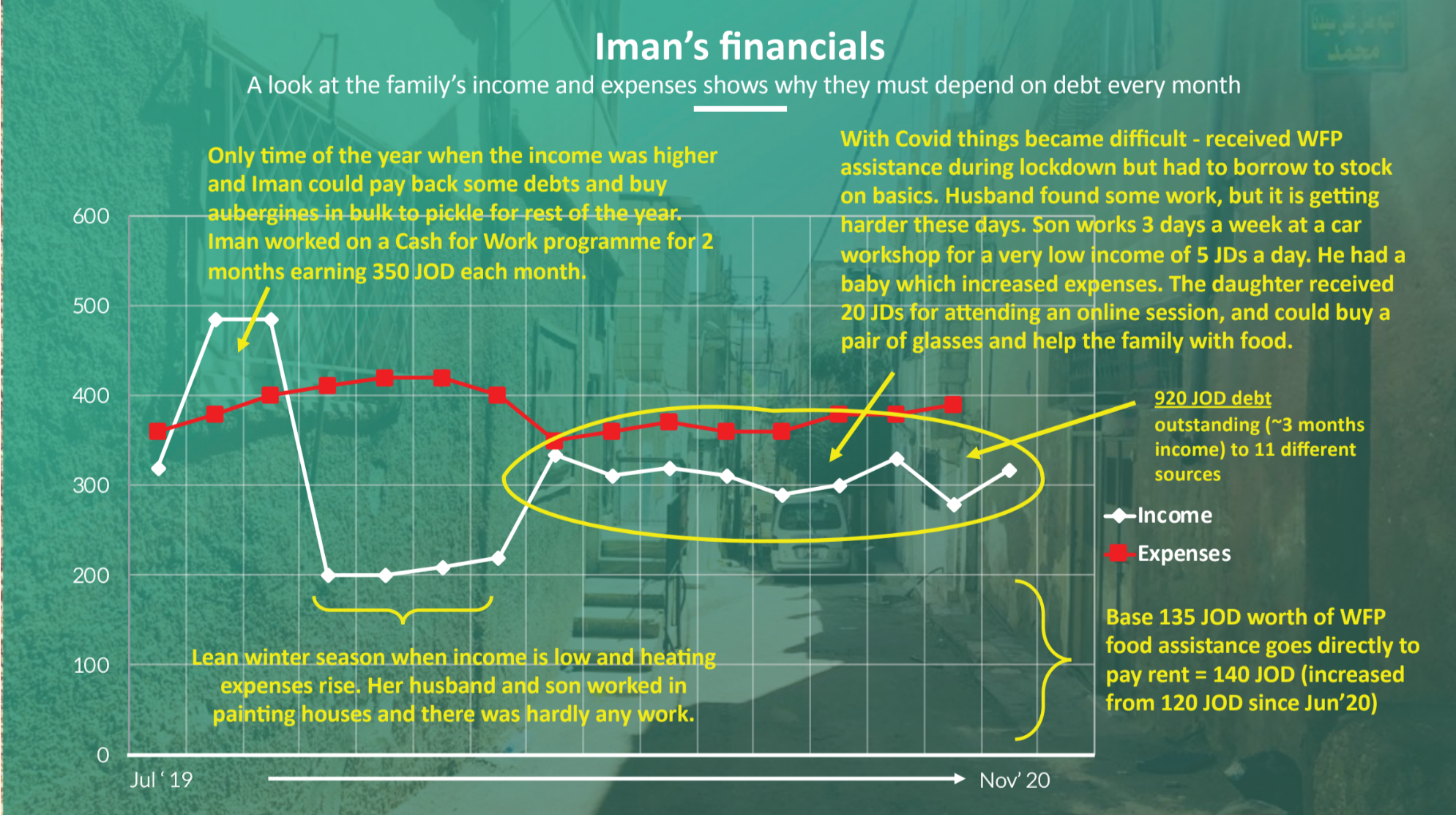
When we spoke to her in October 2019, she had started working on the CfW project and was planning to use the extra money to buy food.
“Ever since we started using WFP food assistance to pay for rent, we all had iron deficiency and anaemia. Both my daughters and Sami have anaemia. I get them iron from the health centre.”
But her salary of 700 JOD (~990 USD) instead went into repaying debts. After the first salary of 350 JOD (~490 USD), she had only 50 JOD remaining after paying back debts. When she had her second salary, it was the eggplant season, which is when people buy large quantities of eggplants and store them at home. So, she bought them. She also gave her daughter-in-law 50 JOD to pay for one of the instalments for her teeth braces and gave her son 50 JOD to pay for yet another instalment on a phone he had bought.
Considering everything described so far, a rough estimate of their income (including the WFP coupons and charity food boxes during the COVID crisis) amounted to approximately 3800 JOD for the year between July 2019 and 2020. That amounts to only around 40 JOD (~USD 50) per month per capita. A little more than half of their monthly income goes into paying for rent and utilities, leaving little wiggle room for groceries, medical bills, internet, and phone recharge. As a result, at any given point, they are under debt to meet these basic monthly needs. At the time of our third interview with her, she still had 920 JOD of outstanding debt to eleven different sources, which is a little less than three months of income! And remember that none of the income sources, apart from WFP assistance, is consistent throughout the year, winter being the leanest season. Moreover, only 245 JOD of these loans are from friends and family; the remaining is from shops (mini-market, phone shop, dentist, bakery) or for rent, all of which come with pressure to repay shortly.
“I always make it a point to save two JOD every time my husband gives me an amount like 10 JOD from his daily wage for house expenses. I don’t tell anyone and keep it in an old purse in the closet. This way I save up to pay electricity and water bills. It doesn’t always work, as we have many unpaid bills”.
In our last interview with Iman, she gave a very clear idea of what she “dreams” to achieve. Here is her wish list:
- She wants to own property so that they do not have to pay rent anymore and so that they feel stable in Jordan. They could sell their land in Syria, but her in-laws still want them to return. She wants to make a decision regarding this in the next few years because going back to Syria is not an option. She is open to being resettled to a third country, which could give them better opportunities.
- She wants her son to open his own car shop, where he can also let his younger brother work. If she manages to work at the municipality on the CfW project again, she can use that money to open a shop for her son.
- She wants her daughter to study and work and mentioned that marriage is not a priority for them.
- She wishes for her husband and sons to find permanent jobs, so they feel more stable financially and psychologically.
- She hopes the Jordanian government would allow them to access work in other sectors, and says “don’t give me fish, teach me how to fish”.
- She wishes that some entity could cover the expenses of her differently abled son, as was the case in Syria, but understands that it is difficult for Jordanians as well.
- Lastly, she wants to have a better outlook for their future and to have a secure legal status in Jordan so that they do not fear deportation.
Many of these wishes might not come true in the near future; for instance, Syrian refugees are not allowed to own property in Jordan. The government has committed to open new sectors of work for Syrian refugees, but only gradually¹⁰. Starting a business for Syrian refugees, especially when it is not a home-based one (which will be the case of a car shop for her son), entails its own challenges, most importantly finding a Jordanian partner for legal registration.¹¹ COVID has set everything back, and the economic growth in Jordan has greatly suffered. Many research participants reported being laid off as Jordanian nationals are being prioritised for existing jobs. We hope most of Iman’s wishes are fulfilled, and new possibilities open up for them to find peace and stability, wherever she lives.
There are many such stories of Syrian refugee families, struggling to find their financial foothold in Jordan despite being supported through various programmes for the last eight years. Women-headed households with children face similar or even greater challenges. Many of them depend on aid from humanitarian organisations, but there are some who do not receive any regular cash assistance and depend on informal debts, help from natal kin to meet basic needs, or charity, as income from work remains unsustainable.
Non-Syrians: The ‘Unwelcomed Guests’ are in a State of Limbo as all Doors to Self-sufficiency Remain Closed
While Syrians are allowed access to work under the Jordan Compact, other nationalities, mainly Iraqi, Yemeni, Sudanese, and Somali, that we cover in our research are not included in the compact. They are not allowed to work to earn a living and support themselves. An overwhelming majority do not qualify for resettlement, or their resettlement has been on hold for years (especially after Trump slashed resettlement quotas in 2017¹²). With the majority of donor funding reserved for Syrians and Jordanians, most of the international NGOs continue to shut their doors to these refugees.
Non-Syrian refugees live with the constant fear of being arrested by the police or being deported back to their home countries, which remain unsafe. They continue to work illegally, in exploitative conditions, and in fear of being detained for what a participant described as “stealing their own living”. They cannot apply for formal work permits because this means they must give up their UNHCR recognition (and the protection it offers, which is highly valued). In addition, Yemeni and Somali’s cases are further complicated by their uncertain legal status (explained further below). For Sudanese refugees, things have changed since the 2015 protests¹³, and they are perceived as troublemakers. Our Sudanese participants shared how they know others who went to the ministry to apply for work permits and were deported back to Sudan after security checks. Moreover, many of the non-Syrian refugees arrived in Jordan on medical visas, and this prevents them from working, even with UNHCR recognition.
Abbas, the 33-year-old Yemeni living in Sahab (the industrial hub close to Amman), shared the challenges he faces in Jordan without the right to work.
“It does not matter for me. If we found a ticket to Turkey, we would have gone illegally. Better than staying here in Jordan. Because there is no attention from organisations for us, the Yemenis. They care about the Syrians, and resettlement is for them. There is everything for them - visits, salaries (cash assistance). But we, the Yemenis, are forgotten.”
With no support and no possibility of integration, the only feasible plan in the view of these unwelcome refugees is to travel to a country that offers them protection, and where they could work to support their family and educate their children for a better future. That is their Plan A and, for most, the only plan possible. On more probing, some said that the last resort is to move to another country like Turkey or Egypt where they can work. But that requires money, which they do not have. Plus, they would sacrifice all the waiting they have already done in Jordan in the hope of being resettled. They do not seem to have the courage to undertake the risk given the uncertainty of success. A world of possibilities lies outside of their host country and is far from accessible.
For the Iraqi participants that we interviewed, most of whom arrived after 2014, their only plan is resettlement. Many of them came to Jordan with the intention of applying for resettlement, often encouraged by relatives living abroad (e.g., Australia). Fatema, for instance, is a 65-year-old widow who lives with her four daughters (who are all in their 30s and 40s). They have faced financial challenges in Iraq since her husband died in 2002. She had a small, home-based business, and her daughters worked as teachers and engineers. However, with the clashes in Erbil and the financial crisis in the country, they stopped receiving their salaries. They came to Jordan on a visa and had to sell their gold to finance their journey and support themselves during their initial months in Jordan. They came directly to the Marka area where they had a cousin, and he helped them understand the neighbourhood. They were able to adjust quickly because they spoke Arabic. During their first few months in Jordan, they would go to church—a lot—which has been a constant source of support since their arrival. One of her daughters even works at the church factory, which is their only source of income. They are comfortable where they live and feel that people are nice to them. However, the only challenge is financial, especially because they cannot obtain work permits and can only get jobs in the “black market” with long working hours and little earnings.
Another one of her daughters, who is a computer engineer, has applied for many jobs without success because there is no demand for qualified refugees given the high unemployment among Jordanian youth. They are waiting for resettlement to Australia, where they have relatives. They have been rejected once, and when asked if she has a plan in case the resettlement does not work out, she said, “No. We might have to apply through the UN. Wherever it is, we go.” They do not want to go back to Iraq, where they do not feel safe in the “masculine society” that is hostile to Christians. Like many others, they perceive the resettlement process as unfair because they see other families being resettled while they feel they need it just as much, if not more.
Similar to Fatima, all Iraqi participants without exception are stressed by the low level of economic activity in Jordan and the lack of opportunities for Iraqis who generally have a high level of education. This reinforces their wish to resettle.
Yemeni, Somali, and Sudanese refugees face an even more precarious situation because of their legal status. Many of them entered Jordan on medical visas and are not recognised as refugees by the government. To add to this, many Somalis arrived on Yemeni passports and are registered with the UNHCR as Somalis. Due to this ‘dual nationality’ issue, they fear approaching the government to access any services and prefer to live hidden lives, avoiding any interaction with the authorities. Many of the Yemenis, on the other hand, have stayed in Jordan for years with a pending decision on their refugee status by the UNHCR. Their appointment for the UNHCR refugee status determination (RSD) process or renewal of the UNHCR certificate remains pending. This means that many of them do not have UNHCR protection in case they are caught by the police for working illegally.
Jakeem, a Yemeni refugee, is one of our youngest participants at 22 years old. He was in high school when the war started in the Sadah governorate (a stronghold of Houthis) where they lived. In 2014, they had to move to the capital city of Sanaa but could not continue with school as the war started. The Houthis asked him to join the army, but he did not want to join and was desperate to leave. His stepmother had thyroid cancer, and they decided to take her to Jordan for treatment. They got a medical visa and tickets for her and Jakeem, who accompanied her to Jordan in 2016. They thought that they would stay for a month or two. But the situation in Yemen got worse with killings and airstrikes. His father called him and told him not to come back. At some point, the airport in Sanaa was also closed, and they could not go back. Jakeem’s father was killed in the war, and his brothers escaped to southern Yemen.
They ran out of money in a few months, and Jakeem had to look for work. He worked at a bakery but was arrested when the labour ministry officials came for inspection and he was forced to sign a ‘pledge’ to not work again in Jordan. That is when other Yemenis in the area recommended that they register with UNHCR. They depended on Jakeem’s income from informal jobs and support from other Yemenis. In 2017, his stepmother, who was registered as a separate case with UNHCR, started to receive the monthly assistance. Ever since then, she has helped with rent and food expenses. Jakeem travelled back to Yemen after that to get married, and because of this, UNHCR did not renew his certificate. His appointment for the renewal has been pending ever since.
His expenses have increased since he got married. Earlier, when he worked for a few months, he could save some money. He could live closer to the factories, sharing a house with other Yemeni men. But now he cannot do this. And finding work has become harder due to the stricter work permit requirements and frequent inspections. When we met him in June 2020, he told us that he found work in a juice factory for four months. He stayed in Sahab. His income was 180 JOD a month, and rent was 100 JOD. But after work permit restrictions became stricter, he was laid off in February 2020 because he did not have a work permit. They had to move back in with his stepmother because they could no longer afford their rent.
With Covid-19 movement restrictions in place since March 2020 and the resulting economic impact, finding work has become impossible. A month before we met Jakeem, he and his Yemeni friend were arrested by the anti-narcotics bureau when he went to visit his friend, looking for a job opportunity cleaning apartments. As they were cleaning one of the apartments in the building, the police came and arrested them. They were interrogated for two days and beaten during the questioning. They were released only after their drug tests came back negative.
“This was the first time such a thing happened to me. I have not left my house since then. I was not psychologically well. I stopped going out. Especially after the crime in Zarqa, the police are on the streets all time conducting ID checks and looking for people.¹⁴ I have been home since then. I do not leave unless I need to go to the supermarket to buy things for the house.”
Jakeem has no savings after months of unemployment. He and his wife depend completely on his stepmother’s UNHCR and WFP assistance, a total of 200 JOD or 280 USD for a family of five (at some point the two children of the stepmother had joined them in Amman). The financial help from a Yemeni lady who was supporting her mother has also declined. Her stepmother had an interview with the Canadian Embassy for resettlement, but there has been no news on that. Once her stepmother is there, he hopes that he can join her in two or three years. His plans are already based on the very slim chances of being resettled in Canada:
“I do some research on Canada online. I try to learn more about its cities, borders, and type of work available there. The first thing I want to do there is study. After a year, I would try securing a job, and after that look for better jobs.”
He knows that there is only a 50 percent chance that this dream will come true, but he has faith that God will provide.
“I think I waited a lot, but I always say Inshallah (God willing), in a year or two things will get better. I was patient all this time; I can wait more. Even if I have been waiting, I still have to patient.”
We hope that his wait ends soon, and that he can achieve his dreams. Here is a wish list from Jakeem, none of which seems unreasonable:
- He would love to study again at the university, but one of the requirements to do so is to provide the educational certificates that he left behind in Yemen. He likes programming and gaming, like any other young boy his age. But he does not have the resources to learn.
- He would like to gain new skills. So far, he has only had jobs where the supervisor would tell him exactly what to do, like operating some machines in the factory or cleaning a restaurant.
- He would love to learn a new language. English would help him when he resettles, hopefully to Canada.
- Most importantly, he wishes to be able to secure a monthly income to pay for things like the rent, which is his most difficult financial burden.
- He hopes to have more access to jobs and to have a permit to work so that he does not have to constantly worry about Ministry of Labour inspections.
- And last, he would like to have clear information about his UNHCR file: when his documents will be renewed and why his wife cannot be added to his file. This clarity will help him make decisions for his future, because if he will not be recognised in the end, then he should try to obtain a work permit as a ‘migrant’ worker and give up on receiving refugee protection.
Conclusion
No matter what nationality a refugee belongs to, they find it difficult to expand their planning horizons given the uncertainty that they face. Looking through these stories, we see that there are more factors constraining their “financial health” than those that are enabling.¹⁵
Non-Syrian refugees in Jordan face issues at the very basic level where they do not have the basic right to work, face discrimination, and have little support from NGOs. Syrians, on the other hand, face meso-level challenges where they have only restricted access to certain labour market areas, struggle with getting work permits or registered businesses, and lack access to basic enabling documents such as a driver’s license. As a result, the organisations supporting them are working in a small, constrained space, and the result is evident – despite so many years of programming to build resilience, refugees in Jordan are still far from this goal and from their dreams.
📝 This article was originally published as a report by the Henry J. Leir Institute at The Fletcher School of Law & Diplomacy and Tufts University.
Download the original report below ⬇️
Navigating 'Survivelihood' Why Refugees in Jordan Plateau too Soon.pdf