
Written by: Maria Teresa Nagel, under the supervision of Kim Wilson
Table of Contents
Smuggling doesn't happen in your face, out in the street like it used to. It is more intricate and refined now. It is all part of a long chain.
—Hotelier in La Cruz¹
Introduction
There is limited research describing the smuggling industry and its actors, particularly in Central America. Our study hopes to address this knowledge gap by disclosing how human smugglers lodge their clients and the role hotels play in the smuggling ecosystem.
This essay focuses on original research conducted in Costa Rica in 2018, where a study team interviewed 71 extra-continental migrants hailing from Africa and Asia in two border towns: La Cruz and Paso Canoas. We also include research from Jordan, Greece, and Turkey conducted in 2016 and 2017² and research from Colombia conducted in 2018, as well as the research of Gabriella E. Sanchez along the Mexico-Arizona border³ and Peter Tinti and Tuesday Reitano in the Mediterranean.⁴
The essay begins by providing a brief overview of the two border towns where interviews in Costa Rica were conducted. The following section offers possible reasons for hotel engagement with the smuggling industry based on the socioeconomic context of the towns. Next, the focus turns to how hotels received payments for their patrons and from whom. The last two sections connect interview-based evidence collected on the hotels in La Cruz and Paso Canoas with trends in global migrant smuggling to identify patterns of criminality.
Border Towns: A Socio-Economic Story
"Smuggling activities, far from being criminally organized or a threat to the stability of the nation-state, were efforts on the part of the working poor to improve the quality of their lives through the creation of alternative forms of income."
— Gabriella E. Sanchez, Human Smuggling and Border Crossings
La Cruz
As shown in Map 1, eleven miles south of the main port of entry between Nicaragua and Costa Rica lies the sleepy town of La Cruz. Established in 1969, La Cruz is a surfers' and nature-lovers' paradise.⁵ With a population of 9,195, this rural town's economy runs on tourism, cattle ranches, farming, fishing, and migration.⁶ Cattle ranching, fishing, and agriculture make up 37 percent of La Cruz's economy, and the service industry makes up another 53 percent.⁷ Despite its variety of income sources, La Cruz' incidence of poverty is 57.3 percent, 36 points above the national average (21.7 percent), making it one of Costa Rica's poorest districts.⁸
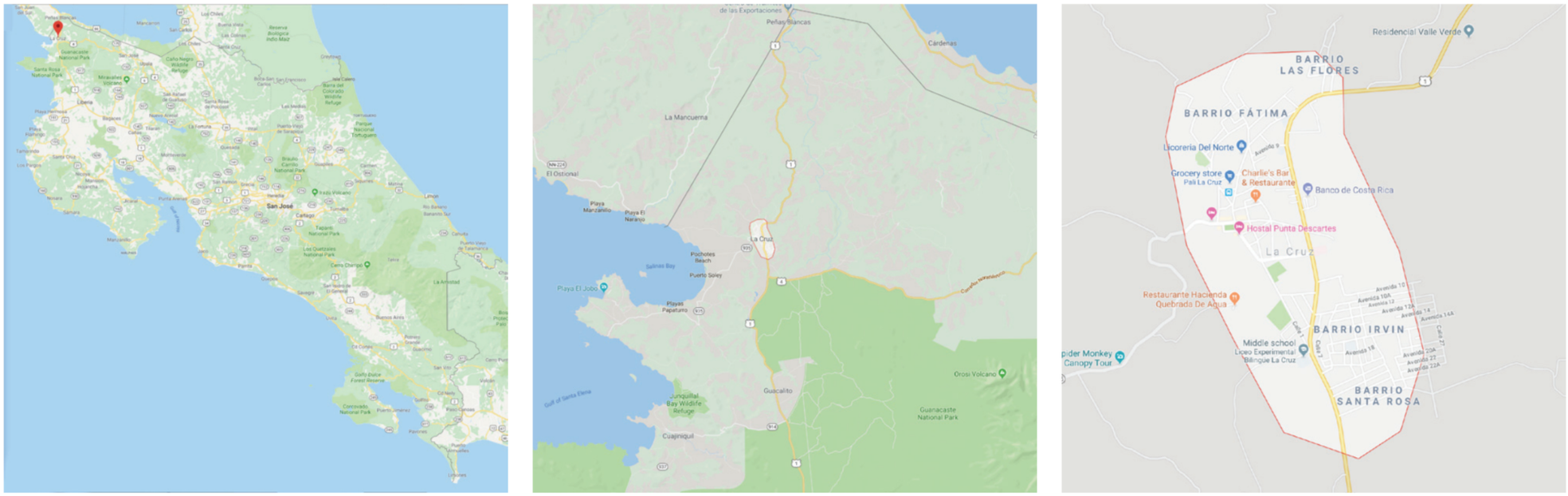
According to Costa Rica's National Household Survey (Encuesta Nacional de Hogares or ENAHO), La Cruz did experience a significant drop in poverty between 2014 and 2016, from 33.3 percent to 23.6 percent.⁹ However, there were no reported increases in productive activities or in social welfare programs in 2014 or 2015, either of which could help explain the reduction in poverty. ENAHO attributes the ten-point drop to a difference in methodology in the way survey results were captured during both years.¹⁰
An alternative explanation is that the informal economy of La Cruz, boosted by substantially larger flows of transiting migration, which peaked in 2015 and 2016, contributed to the reduction in poverty. Prior to these flows, La Cruz relied on Nicaraguan labor, tourism, and a constant flow of regional migrants. Increased restrictions in Europe, a weakened economy in Brazil, and policy changes towards Cubans in the US pushed African, Asian, Haitian, and Cuban migrants to forge a route towards North America through Costa Rica. This inevitably exposed La Cruz to new migration actors offering alternative sources of income to local entrepreneurs.
Baker in La Cruz:
"Migrants are great for business. They come in here, and they spend money, and that's good for us business owners. Sometimes it's hard to communicate because they speak in their languages. But I speak in poor English, and they sometimes speak in poor Spanish, and we figure out. That's how we communicate."
Throughout town, shop owners struggle to make ends meet and now rely on migrants for business. For hotels, lodging migrants in transit has become essential to their income stream. Across the street from the town's bus terminal and a block away from Western Union sits a ten-bedroom hotel that caters almost exclusively to transiting migrants. A narrow and short alley leads to a rusted and always open gate: the hotel's entrance. All the rooms are located to the left of the entrance, with an unkempt courtyard dividing the guest rooms, a kitchen and laundry room, a garage, and the owner's home. The hotel's location is hard to miss, even by migrants who don't read Spanish. Its prime location is its main method of attracting new lodgers, and the lodgers themselves help bring in guests.
Eritrean migrant:
"I took a bus alone from the south to San Jose and then to La Cruz with a group of Nepali migrants. When we arrived at the bus station in La Cruz, the Nepali migrants were met and taken to the hotel across from the terminal. A half Yemeni, half Somali migrant that stays in the hotel saw me at the bus station and brought me here."
This same hotel is also an eleven-minute drive from Salinas Bay, where migrants take a boat to the Nicaraguan-Honduran border. Since Nicaragua closed its borders to extra-continental migrants moving north in 2015, these journeyers have been left with no choice but to pay for ocean transport to bypass Nicaragua entirely. Salinas Bay used to be a hub for fishing, one of La Cruz's most important sources of income. However, many fishermen saw in migrants the opportunity to increase their income, and residents of La Cruz say drug trafficking and human smuggling have begun to replace fishing.
Employee, juicery in La Cruz:
"This town has changed a lot. You don't see any more fishing because all of that is now drugs. Many fishermen were scared out of the water, and the ones that remained became millionaires. You see them now with their big houses and their fancy cars. That's not from fishing; they don't fish anymore. It has probably been about a year ago now since the black ones [smuggled migrants] stopped drowning out in the ocean. You would see it on the news a lot. They would wash up... One time a kid washed up too. It was very sad."
Even for residents outside the hotel industry, large migrant flows have offered an opportunity to earn supplemental income by lending their homes as temporary refuge.
Hotelier in La Cruz:
"In the La Cruz community, most people are tolerant. We're accustomed to migration in the region. It's a business. Smugglers will give [homeowners] $5,000 to house five migrants in their house for a week. The police know what's happening, but maybe they're related to the smugglers, or they know it would only create more problems if they tried to crack down."
Key informants, as well as local business owners, reported that many houses rented and owned by smugglers are used to accommodate migrants in transit. Locals also claimed many were unable to help migrants or report criminal activity for fear of retaliation.
Employee, juicery in La Cruz:
"Last year, when the OIJ [Judicial Investigation Agency] started raiding places, that's when it got really ugly. They caught a bunch of police officers that were part of the coyotes. Things have changed a lot in Costa Rica, you can't even trust cops any more. Many have been caught in the smuggling business so people are afraid to speak out for fear that the cops will rat you out to the bad guys. And now for any little thing they can link you to the smuggling network. We can't even help [migrants] take money out anymore."
Assisting migrants with accessing their money through Western Union has also become a source of income for locals. Many transit migrants are traveling without valid forms of identification. Since formal money transfer agencies are required to verify the identity of both the sending and receiving parties, the lack of valid identification documents prohibits transit migrants from receiving money from friends and family. Locals have stepped in to help these journeyers, for a fee, by lending their identity as the receiving party. This fee typically consists of 10–15 percent of the total money transfer. However, new regulations imposed by the municipality prohibit locals from facilitating money transfers, rules that have slowed but not halted the illegal retrieval of remittances.
Restrictive regulations have extended beyond money transfers. Taxi drivers in La Cruz and Paso Canoas expressed fear of transporting migrants. Peers had been charged with smuggling and were facing anywhere between three and five years in jail. To prevent sharing their peers' destiny, taxi drivers expressed having to verify the immigration status of passengers before providing them with service. They believed this to be discriminatory against immigrants but also against themselves, as bus drivers are not held to the same standard. Immigration police clarified that the act of driving a migrant in transit was seldom the problem. Instead, the infraction was committed when taxi drivers would charge migrants an amount that exceeded the standard price for the trip. Regardless of what constituted a smuggling crime for taxi drivers, many preferred to avoid transit migrants altogether, while others continued to profit from journeyers.
Paso Canoas
As shown in Map 2, Paso Canoas is an international city that straddles the Corredores canton in Costa Rica and the Chiriqui province in Panama. The Costa Rican portion has an estimated population of 11,527, with 68 percent between the ages of 15 and 64.¹¹ Paso Canoas' economy relies on palm oil extraction and migration. With very few sources of employment, the incidence of poverty in Paso Canoas is 27 percent,¹² ranking it among the poorest areas in the country.
Locals reported that a nearby factory had closed in 2013, representing a major blow to an already poor town. Maderin Eco, as it was popularly known, was a subsidiary of the colored-pencil manufacturing giant Faber-Castell. For a few years, extraction of melina and pine in Costa Rica—the two woods used in making colored pencils—had become increasingly costly, and by early 2013, Maderin Eco could no longer justify production in Paso Canoas. Despite multiple attempts to negotiate wood costs, Maderin Eco was unable to reach a deal with the Costa Rican government. After 17 years in business, Maderin Eco closed its doors and left 120 people unemployed.¹³ Since then, locals report that drug trafficking has spiked, and youth have resorted to petty crimes.
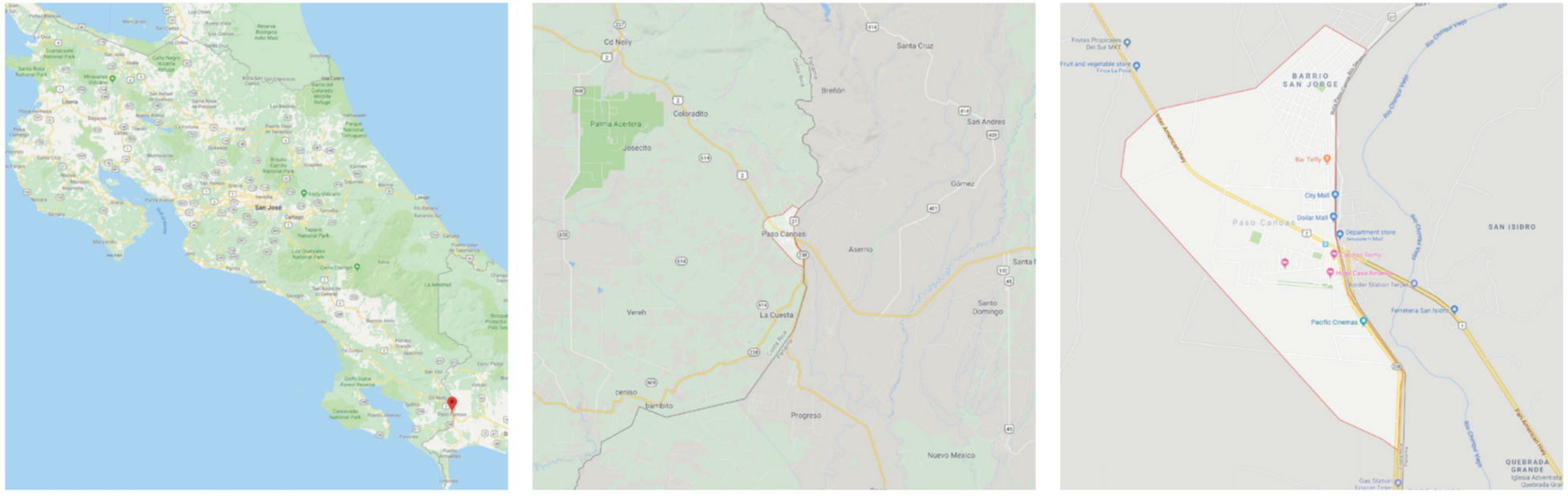
A dynamic border town, Paso Canoas experiences a daily exchange of goods and services between Panama and Costa Rica. Although the tax-exempt market located between the two countries serves a constant flow of customers in search of cheap goods, it is the underground market that drives Paso Canoas' economy. Drugs,¹⁴ weapons¹⁵, petroleum gas¹⁶, cigarettes¹⁷, and even plantains¹⁸ are smuggled from Panama to Costa Rica regularly.
For local entrepreneurs, migrants present an important source of income. Much like La Cruz, Paso Canoas has come to rely on the increased flow of extra-regional migrants in need of food, clothing, shoes, transportation, and lodging. Throughout our interviews, only one hotel admitted to lodging large groups of migrants in transit. This dedicated hotel was also skillfully located a short walk from the bus terminal, five minutes from Western Union, and across the street from customs and border control, where migrants spend the first few hours of their time in Costa Rica.
Motivation to Serve the Smuggling Industry
"With this kind of money in play, border communities themselves have become invested in the migrant-smuggling trade, recruited by vicious smuggling gangs."
— Peter Tinti and Tuesday Reitano, Migrant, Smuggler, Savior
The connection between relying on illicit business and the economic hardship that plagues both La Cruz and Paso Canoas is an easy one to make. The research of ethnographers like Shaylih Muehlmann¹⁹, academics such as Gabriella Sanchez²⁰, and agencies like UNODC²¹ supports the claim that economic hardship leads to criminal activities.
La Cruz and Paso Canoas are among the poorest districts in Costa Rica. A study conducted by the Costa Rican Institute on Drugs (ICD) and the State of the Nation Program (PEN) in 2018 found that districts that ranked highest in incidence of poverty and unemployment also ranked high in drug seizures and homicides.²² Further, cantons with the lowest index of social progress²³ were located along the borders. It is no surprise then that increasing unemployment would make Paso Canoas and La Cruz ripe environments for human smuggling as well. Indeed, for poverty-stricken towns, providing services to criminal networks is a way out of hardship.
Local perceptions of why people are involved in smuggling varied: some respondents believed locals were aiding people in distress. Others saw smuggling as an opportunity to increase their incomes. And still others saw local smugglers as part of larger criminal networks.
Hotelier in La Cruz:
"Some people think coyotes are bad people, but others think they're actually helping. They're providing a service to people who otherwise might take a more dangerous route. The whole situation is a big error of humanity that has caused many deaths of people from many countries."
Regardless of their true motives for lodging migrants, hoteliers were quick to "other" smugglers. They distanced the illicit activities of smugglers from their own role in the ecosystem. They explained, in what sounded like a well-rehearsed speech, how migrant smuggling in the country operated, what the costs for migrants were, and how vicious the coyotes²⁴ could be. In contrast, the hoteliers described themselves as benevolent proprietors providing shelter, food, and protection from coyotes at an average rate of ten dollars a night.
Payments to Hotels
"I charge ten thousand colones per night, and that includes three meals. But if people can't pay that, I have 15 mattresses where they can sleep for free."
— Hotelier in La Cruz
Though the estimated earnings for migrant smuggling in the Central America–Mexico–United States corridor alone total more than seven billion dollars a year²⁵, the hoteliers we interviewed did not seem to be making a great profit from lodging migrants. The average price per night in Costa Rica was ten dollars, a price that often included food. The average rate for hotels did not vary much in the region. Migrants reported they were lodged in hotels in Colombia and in Ecuador for the same price. Nonetheless, income generated from lodging migrants is sufficient to help hoteliers in Costa Rica cover fixed costs and to find migrants as a viable, if not attractive, market.
Hotelier in La Cruz:
"I charge $10 a night to foreigners, and I charge $14 to nationals, since I know these people [migrants] barely have the money. Running this is tough because you barely make do. I should charge migrants more since they're here all day consuming water, electricity... Whereas a national will just stay the night and leave the next morning. However, migrants can't afford to pay more. They look for me because I can offer a good price."
In Turkey, Tinti and Reitano found that many hotels also made little profit from migrant guests and, as in Costa Rica, they often served solely as a gathering spot for migrants awaiting instructions from their smugglers. In these instances, hotels received no income, as migrants did not rent a room or purchase food.²⁶ In her research, Sanchez found the projections for income generation corresponding to migrant smuggling are likely mistaken, and that the profits gained from local smuggling activities are relatively low.²⁷
Methods of payment for hotel services varied by the guest's geographic origin. Africans and Indians typically paid in cash, whereas Nepalis and Bangladeshis reported negotiating an all-inclusive travel package prior to departing their home country. In the case of the latter group, migrant families would pay smugglers—typically referred to as agents or brokers—in installments as the migrant progressed in their journey. When the journeyer successfully reached a predetermined waypoint, their family back home would deposit money into the smuggler's bank account to fund the next leg of the trip.
For his part, the smuggler would ensure that his migrant clients had few out-of-pocket payments to make along the way. Using credit cards, cash, and money transfers, and working through their network of local passers, smugglers paid hotels up front for their clients' food, lodging, and (sometimes) local transportation expenses. Migrants considered this a convenience as they could avoid the vulnerability of carrying cash and the expense of converting it into local currency.
A hotelier in La Cruz said he would receive calls from smuggling agents in Dubai wanting to reserve a block of rooms. The agent in Dubai would secure the rooms in Costa Rica with a credit card. Other times, agents would make the booking online, again paying with a credit card.
Hotelier in La Cruz:
"The other [thing] we noticed [was] that the men who came from Asia had coordinators, whereas African groups always have a small child and always travel in pairs. The Nepalis and Indians had each arranged for their journey at a cost of about $10,000 to $20,000. The bosses would pay from far away. They would call us up and pay by card or book it online."
We were unable to confirm whether all upfront payments to hotels were covered with credit cards or whether a formal or informal money transfer system was used as well. A store owner in La Cruz reported that a popular informal money transfer system is thriving in the city of Liberia, about an hour from La Cruz. This system is run by a group of Colombians.
Store owner, La Cruz:
"No, to receive money, we often do it through the Colombians. They ride motos [motor cycles] around the plaza in the city of Liberia. It is easy to find them. Any taxi driver can point them out. You tell them, 'my relative in the US wants to send me money.' They ask, 'what city, what phone number.' They then consult their contact list and call someone that lives near your relative and they arrange to pick up the cash. Then the US contact calls the Colombian in Liberia and says, 'The money is here. You can give your client the cash.' They charge about 10 percent of the total amount for the service. You can request the funds in dollars or colones. The money transfer agents—let's call them Coyotes de Plata [Silver Coyotes, he says laughing], that is not what we call them really, I am just calling them that with you—also are moneylenders."
There is no evidence the Colombian-run money transfer system is connecting international smuggling agents to hoteliers in La Cruz. However, this informal transnational system could aid in mobilizing money without reliance on formal banking.
Indians, Africans, and Haitians generally covered hotel costs in cash, but only when they had it. When they didn't, hoteliers admitted to lodging them on credit. The hotel eventually would be paid when a guest received a remittance or was able to earn money locally. Occasionally, money failed to come through at all or arrived in amounts too small to cover the negotiated price. Hoteliers recognized that reducing or foregoing payment was the cost of doing business with migrants, a clientele prone to low or uncertain flows of money. Often in advance of lodging a guest, and when suspecting that guest would not be able to afford the going rate, the hotelier would discount the price. Some business was better than an empty room or bed.
Hotel owner in Paso Canoas:
"A lot of the migrants come from Africa. They stay here. I let them not pay until they receive money from Western Union. I only charge them five dollars a night."
A hotelier in La Cruz expressed that lack of payment was not a deterrent to helping migrants. Many guests would call him weeks or months later to say they had made it to the US, and that, to the hotelier, was payment enough.
Like other locals, hotels facilitated money transfers to migrants at a cost. Migrants often lacked the documents needed to receive legal money transfers. They reported their documents were either stolen in the Darién jungle, or they had been forced to dispose of them upon arrival in South America by their smuggling agent. In one case, a migrant said he mailed his documents to his anticipated address, in hopes of retrieving them later. Either way, they had insufficient identification to receive a remittance through Western Union or MoneyGram. To help migrants retrieve their funds, one hotelier, Mamma, charges a 10 percent fee for each money transfer she facilitates. She instructs migrants to have their relatives send the funds in Mamma's name and then accompanies the migrant to the transfer office. There, she produces her own documents to collect the transfer.
Eritrean male in Paso Canoas
"At this hotel, I received more money from my brother in Germany, $500 then $300 in order to buy a new phone and clothes and have enough money to continue. I received the first transfer through Western Union and a woman called Mamma that works in the hotel."
Money transfers are a significant hurdle for migrants in transit, since carrying cash along the journey can endanger their lives by exposing them to theft and violence. As expressed previously, most extra-regional migrants lack official identification documents, forcing them to rely on locals to retrieve their money. In the best cases, migrants are forced to pay a fee for locals' help. In the worst cases, migrants lose the entirety of their transfer when those aiding them run off with the money.
A Link within a Larger Network
"At every step of the way, a person just came and found me and told me what to do next. Which hotel to go, which bus to take or anything like that. I don't have any money. Right now, I have $100. Some people here will get the money for you and charge a commission. They are always outside the hotel and find you. You don't have to do anything."
— Nepali migrant
Across the street from customs and border control in Paso Canoas, a large, homemade, blue banner hangs under the official name of a hotel. The banner reads "Hotel Asia." Inside, Bollywood music plays loudly, and dozens of South Asians fill the hotel's restaurant and bar. The matron of Hotel Asia, known as Mamma by migrants, has managed to turn her hotel into a little Asia of sorts, offering milk tea to her patrons and adapting the traditionally meat-centered Costa Rican cuisine to fit the culture of her current flow of guests.
This adaptation to the clientele is common practice for hotels providing lodging to transiting migrants. Nepali migrants told of being taken to various hotels along their journey where they were fed "a proper Nepali meal." Brazil, Peru, and Costa Rica were just some of the countries where the lodging included in their package offered them culturally appropriate fare. These same adaptations can be found elsewhere. In 2016 in Izmir, Turkey, hotels have been known to cater to specific populations, such as Iraqis.²⁸ Similarly, interviews carried out in Juba, South Sudan, showed smugglers knew to take Eritreans to a hotel that catered almost exclusively to their compatriots.²⁹ One hotelier in La Cruz opened his personal kitchen to guests, allowing them to cook the food they sorely missed. He expressed fascination with learning from different cultures, trying new foods, and learning to cook with new ingredients.
Hotels in Paso Canoas and La Cruz cater to the current migrant flow. In 2014, this meant specializing in attracting Cubans. A year later, Haitians and Africans were their specialty. Now their patrons are primarily South Asian. For a hotelier in La Cruz, the list of nationalities also included Ecuadorians and Peruvians, as the hotelier has been lodging transiting migrants for seven years.
Beyond access to money transfers and ethnically appropriate music and food, the hotels identified as lodging transit migrants in Costa Rica offered journeyers some additional services. Mamma, for example, offers migrants free health services by following instructions provided by a local retired doctor.
Retired doctor:
"She will often call me in a whisper and say 'Dr. I have three migrants that are ill. What should I do?' She really cares for them."
In Colombia and Peru, hoteliers offer migrants anonymity and security by hiding these journeyers behind their walls. Both South Asian and African migrants shared stories of being locked away in rooms in Lima, Peru, with only a bucket to relieve themselves, and being heavily monitored by hoteliers in Turbo, Colombia, unable to leave without their hosts' permission.
Conversely, some migrants described situations where hoteliers in other countries tried to take advantage of them by offering additional services at prices well above what they could afford.
Ghanian male in La Cruz:
"When we got to Lima, we went to a hotel, where a second guy told us he'd take us the rest of the way to Ecuador and to Colombia. He wanted to charge us $500 to go to Colombia, but I didn't trust he could take us that far. I said I wanted to only go to Ecuador, and he got angry. He said this would cost us $300 and we said it was too much and he said we needed to leave hotel. He'd deport us by calling the police. He then changed his mind and charged us $200, which got us to border of Colombia."
It is difficult to disassociate hotels chosen by smugglers from the smuggling industry, since these hotels serve purposes beyond room and board. They are often key connection points for local passers interested in shuttling migrants along an established route. Some migrants, especially those who purchased an "all-inclusive" package for their migration to the US, reported that smuggling agents would confirm their identity through photos sent to them via WhatsApp or Viber. Upon confirmation, agents would take these migrants to predetermined hotels. Migrants not traveling on an "all-inclusive package" would receive photos of approved hotels from agents they had made contracts with along the way. In order to find smugglers and make a contract with them, migrants turned to other migrants in their group, taxis, or hotels.
Observations of a team member:
"He had been given no information from his agent back in Nepal or by any other sub-agent he had been in touch with since coming to America. He did not seem to have a clue about what comes next after he arrives at any destination. He is met by a person who has his photo and then is taken to a hotel or given a bus ticket where he meets another man at the next destination and so on. He had no bigger picture and did not know where the US was."
Despite evidence of conducting business with smugglers, hoteliers claimed no association with the smuggling industry, explaining instead they were simply in the business of lodging paying customers. Hotels that admitted to lodging large groups of transiting migrants hastily and emphatically informed us they were not affiliated with smugglers and, in fact, served as a haven to protect migrants from coyotes.
Hotelier in La Cruz:
"I have coyotes come here all the time and offer me lots of money just so that they can recruit here. I always say no, because I don't want to get into trouble. They can do their business outside of these premises. I see and hear lots of things, but in this business, you better keep your mouth shut."
Given the legal implications of becoming part of the smuggling ecosystem, most hotels have chosen to avoid lodging transit migrants altogether. One such hotelier in La Cruz had decided to stop serving this population after growing tired of breaking up fights and attracting unwanted attention from locals and the police. Nevertheless, he has found that breaking away from smugglers is complicated.
Hotelier in La Cruz:
"We also decided to remodel the place, which brought the rates up and made it so they could no longer afford to stay here. It was interesting to observe, though. They knew to come here specifically. The coyotes are still coordinating the smuggling from this street corner. So we worked to change the face of the hostel so that fewer smugglers were coming in and out of here. We're still trying to change it."
Smuggling and Trafficking in Costa Rica
"The regularization of migrants... will guarantee national security, the protection of human rights and will avoid human trafficking and migrant smuggling."
— Epsy Campell, Vice-President and Chancellor of Costa Rica
The smuggling industry in Costa Rica is a growing phenomenon. The increasing demand to facilitate migrant mobility, coupled with rising local economic disparity, has made an already highly-transited corridor a smuggling paradise. Foreign smuggling networks operating in Costa Rica require the participation of locals to facilitate and coordinate logistics. Hotels in this scenario become key actors by providing a place of rest, waiting, and planning.
The United Nations Office on Drugs and Crime determined in its 2013 situation report that transnational organized criminal networks were apparent in the organized travel plans of migrants transiting from their country of origin through various borders across the region.³⁰ Invariably, the hoteliers interviewed in this study were aware of their patrons' involvement with smugglers, and in many cases, the hotels received payment directly from smuggling agents. Nevertheless, the nuanced relationships between hotels, lodgers, and smugglers make it difficult to categorically declare hoteliers are smuggling actors.
Hotels have been a critical partner for governments and international organizations in the reduction of human trafficking, but not so in combating migrant smuggling. In fact, efforts to train hotels on identifying and reporting migrant smuggling crimes are non-existent in Costa Rica, and linking hotels to the smuggling industry is a low priority for criminal investigators. The complexities of transnational organized crime have often been disregarded. In their place, rigid definitions and understandings of human trafficking and human smuggling have been produced.
Unfortunately, the division between these two crimes is a blurry one at best. First, smuggling often crosses into the realm of trafficking when facilitators abuse their power, seek further gains through exploitation, or bond their "clients" through debt by threatening to hurt migrants or their families until the debt is settled.
Hotelier in La Cruz:
"I listened to their conversations and as I understood it, when the migrants got to the United States, they would work for free to pay off the debt [they owed the smugglers, money lenders and family members]."
Second, human trafficking and human smuggling can be perpetrated by the same individuals along the same routes, increasing the risk of migrants falling prey to trafficking.³¹ Lastly, both crimes share similar routes and activity spaces, including restaurants, private homes, and hotels, increasing the difficulty of identifying the crimes.
Human trafficking and human smuggling are not unique in their overlap. Drug trafficking may also be performed by those engaged in human trafficking or human smuggling, and it too shares some of the same routes. In recent years, the profits associated with human smuggling have far surpassed those of drug trafficking, inviting both industries to merge.
Costa Rican Migration Police:
"The smuggling networks started to arrange themselves so that more people would have to use their services... the network in Costa Rica was very well organized and... connected with people in the US and Brazil. They also started to form alliances with drug and weapon traffickers."
Conclusion
"The goal, therefore, should not be to limit migration, but to untangle the aspirations of people who wish to migrate from the worst elements of the smuggling industry, which facilitates and encourages their movement illegally, and often puts migrants at risk."
— Peter Tinti and Tuesday Reitano, Migrant, Smuggler, Savior
Research on the role of hoteliers within the smuggling industry is sparse. There is interest, however, in understanding how smuggling actors operate and their motivations for engaging in the industry. Our interviews showed that hoteliers chosen by smugglers to lodge their clients could be seen as actors in the smuggling ecosystem.
In the short run, the income generated locally through smuggling activities may be responsible for an improvement in the economic wellbeing of border towns, but in the long run the overlap between smuggling and other crimes may translate into increased violence, insecurity, and corruption. As Costa Rica takes measures to reduce these outcomes, hotels along the borders could contribute a wealth of information.
📝 This article was originally published as an essay by the Henry J. Leir Institute and the Fletcher School of Law & Diplomacy at Tufts University.
Download the original essay below ⬇️