
Written by: Heather Kunin, under the supervision of Kim Wilson
Table of Contents
Social networks¹ have long been recognized as playing a pivotal role in migration, with multiple studies examining, among other phenomena, the role of social networks in predicting the decision to migrate and choice of destination, as well as in impacting migrant's chances for integration.² Social network analysis (SNA) is a methodology for visualizing and interrogating relationships among actors and is highly applicable to a field where social networks are considered "one of the fundamentals of the migration process."³ Until recently, this discipline has been woefully underutilized within migration studies, although this is beginning to change.⁴
The "Financial Journeys of Migrants and Refugees" study in Costa Rica was set out with the broad aim of understanding how migrants from Asia and Africa fund and finance their journeys as they move through Central America northbound to the US and Canada. Central to this endeavor was developing an understanding of the social networks underpinning a migrant's journey, which offered insight not only as to how trips are financed, but how the process and experience of the journey plays out. Social network analysis is an inherently quantitative endeavor, which has placed limits on our ability to perform SNA using the information derived from the extensive qualitative interviews captured in our field notes. However, as Prell (2012) notes, such qualitative data provides a rich complement to social network data, as a means of surfacing themes and trends for further dedicated SNA study as well as deriving a more nuanced understanding of a given network.⁵ What emerged from our fieldwork are preliminary insights grounded in SNA that regard individual migrant actors within networks, as well as the migrant networks themselves.
Individual Migrant Actors: Brokers and Bottlenecks
A common line of inquiry within SNA is determining actor "centrality" within a network. The more central an actor is, the thinking goes, the more important their role in the network. One key measure of centrality is "betweenness," or the number of times a given actor sits on the shortest path between two others in a network. The more frequently an actor is positioned as the intermediary between two others, the more central they are to a network.⁶ But occupying such a central position within a network can be a double-edged sword, as that actor may serve as either "broker," one who facilitates access to another actor or actors, or "bottleneck," one who blocks access.⁷ In the course of our fieldwork, we encountered migrants who literally served as brokers for local smugglers at specific points in their journeys. We also met with a migrant who posed an implacable information bottleneck for those in transit. Were it possible to construct the full networks in which these individuals were operating from available data, they would likely show a high degree of betweenness centrality.
Brokers
Migrants travel with varying levels of financial resources, with many needing to figure out how to finance their trips one leg at a time. One way migrants have managed is by negotiating a reduced fare with a smuggler in exchange for recruiting other migrants who are able to pay in full. We met with two such entrepreneurially minded individuals—David and Precious, both from Cameroon.⁸
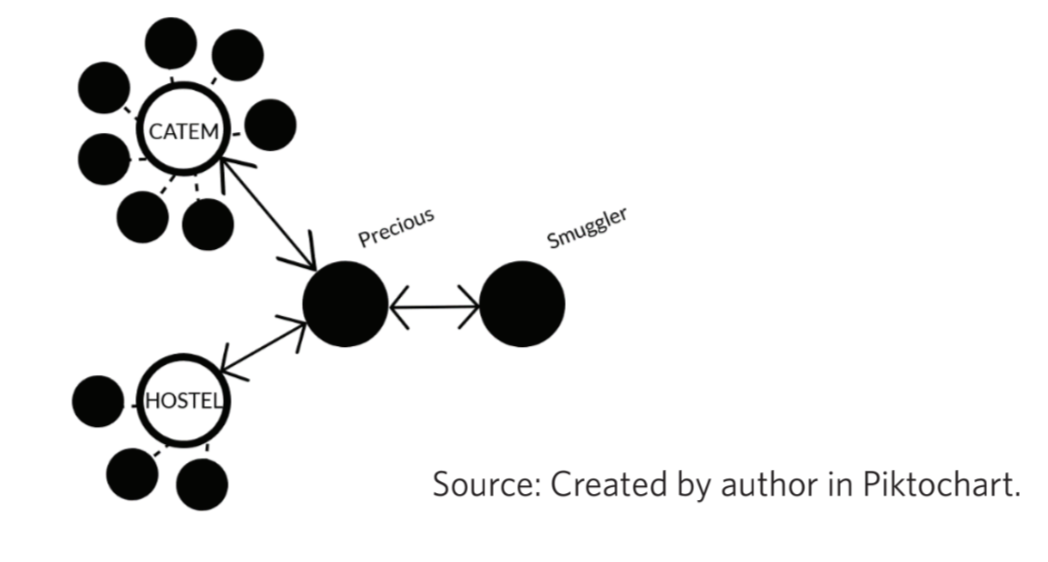
David served as a broker while in Turbo, Colombia, after someone posing as an agent made off with the last of his cash. Stranded and short on funds, David struck up a relationship with a "boatman" and arranged for a discounted ride across the Gulf of Urabá provided he brought in 10 migrants who could afford the full cost. In fact, he brought 16, which not only guaranteed him his discounted fare to Capurganá, but also resulted in the waiver of another smuggler-imposed fee for entering the jungle after disembarking from the boat. The foray of Precious into brokerage was actively in progress when we met her in La Cruz, Costa Rica. Illustrated in Graphic 1, she had made contact with a smuggler, and, in exchange for a reduced fare for passage to Honduras, she brought in 15 other full-paying customers from Angola, Cameroon, DRC, Ethiopia, and Eritrea. These migrants were recruited from both the northern migrant encampment, referred to as a CATEM in Costa Rica, and a hostel popular with migrants located across from the central bus station.
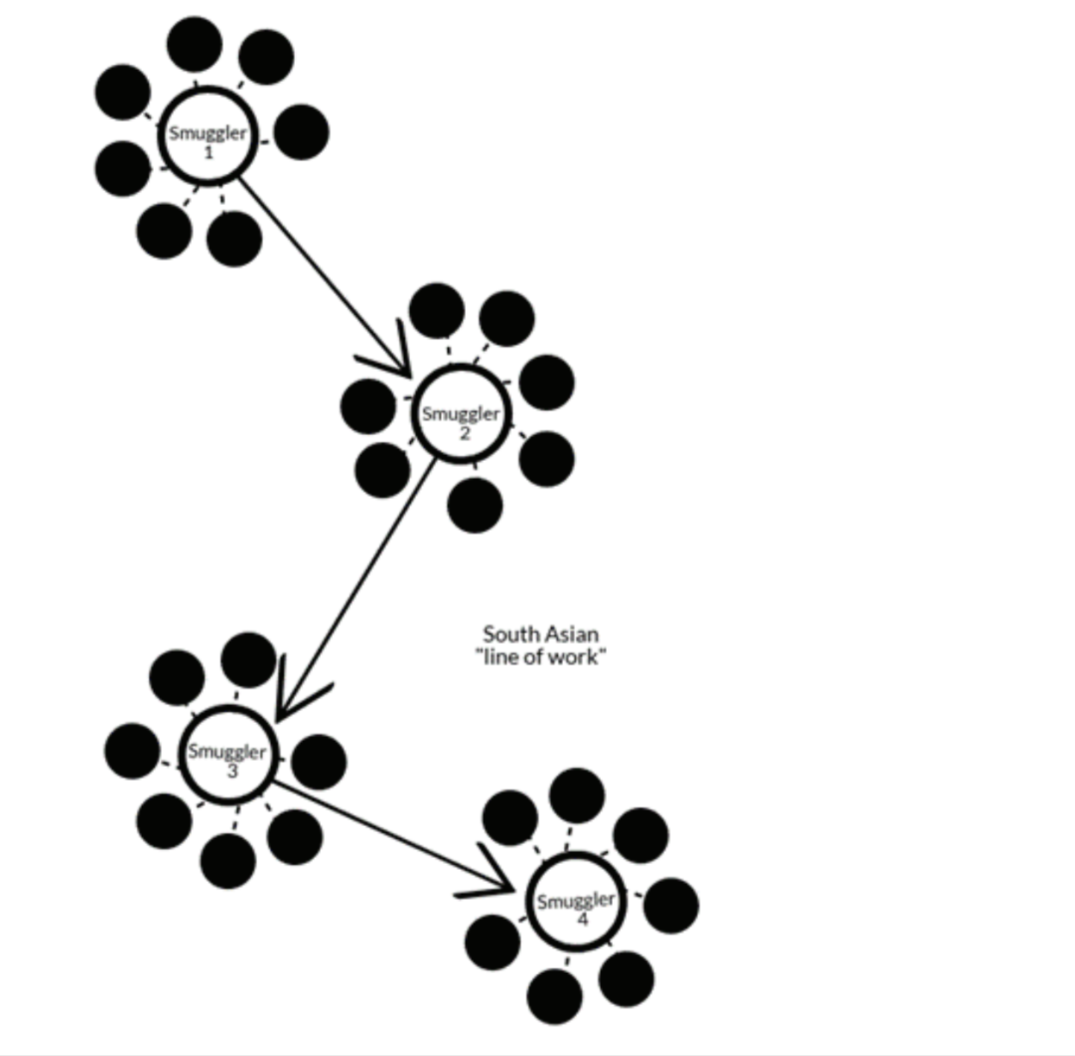
That the brokers we encountered were both Africans is unsurprising given what we learned of smuggling “lines of work” from Alonzo DeSoto, a senior official with the Costa Rican immigration police in La Cruz. These lines of work tend to segment by nationality, with South Asian lines, represented in Graphic 2, generally better organized and travel pre-arranged in the country of origin. Migrant groups are typically formed early in the journey—often in Delhi—and then travel together through the rest of the trip to the United States. Essentially, each group forms its own network, which is then repeatedly handed off in its entirety from pre-arranged smuggler to pre-arranged smuggler. For smugglers in the African line of work, however, there are no guaranteed client networks. Migrant groups must be recruited on a constant, ad hoc basis.
Serving as a broker simultaneously places migrants in a position of power and vulnerability. As gatekeepers to smugglers, other migrants must go through them in order to reach their destination. However, this sets up brokers as potential lightning rods for backlash from other migrants, smugglers, and local authorities. While in La Cruz, we heard grumblings about Precious, with some migrants questioning whether she was inflating the price in order to pocket the difference, or if she had lied about the timing of their anticipated departure so as to secure her own spot. While these questions resolved themselves when Precious and her other recruits successfully reached Honduras, such resentments have the potential to turn ugly.
Further, brokers risk taking the fall for smugglers and their larger networks—DeSoto elaborated by sharing how a Haitian migrant in the northern CATEM, who they jokingly call a smuggler, under the law "is in fact a smuggler. He recruits for them." Despite being a "model resident" of the CATEM, with a Costa Rican–born daughter, this man "knows the nightlife of the [smuggling] networks. As a Haitian, he gets along well and introduces Africans to the network." Were he to be caught and prosecuted, he could be given a 15-year jail sentence. This puts immigration authorities like DeSoto, who are tasked with going after smugglers, in a difficult position:
"I know it sounds ugly . . . I want to help him, but hey, he has a daughter. I would rather have him in the CATEM than seized by the authorities on the outside. So we try to keep him inside."
This is easier said than done, however, as registered migrants have broad freedom of movement, including coming and going from the CATEM.
Bottlenecks
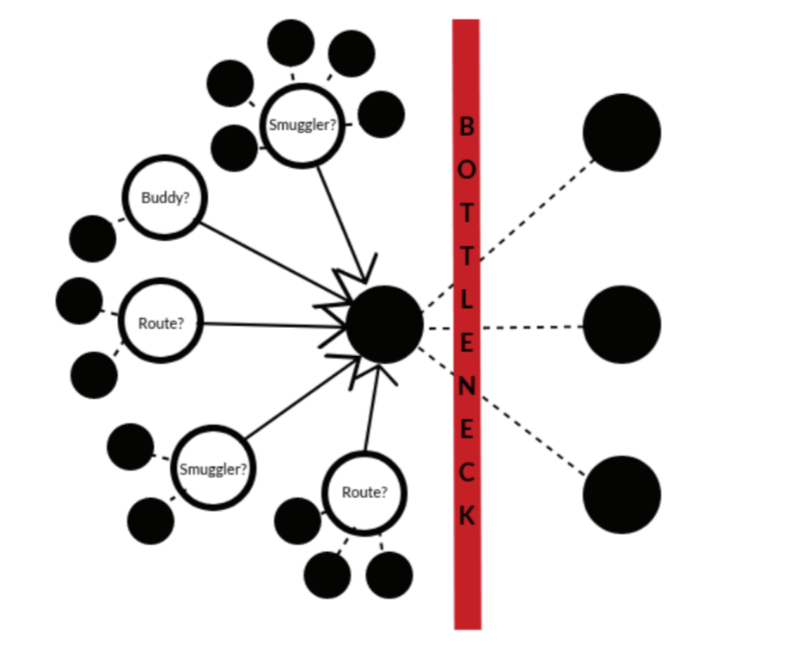
While in La Cruz, we met with a gregarious, Somali-Yemeni migrant who was happy to spend hours talking to the research team about his journey, politics, and life. However, this willingness to share only extended so far. His phone was being inundated with WhatsApp calls and texts from other Somalis who had been put in touch by a hotelier he had previously befriended in Colombia—"a bad man," according to the Somali-Yemeni. "He is giving my number to any Somalis who pass through." As shown in Graphic 3, these Somalis were asking for connections to smugglers in Capurganá, as well as other information about how to travel.
Such information can prove critical to the relative safety and success of a migrant's journey. Very few migrants had a clear understanding of what to expect from their journey, either in transit or at their destination. This was particularly evident with regard to the Darién Gap—many migrants said they would not have come if they had known how difficult and dangerous it would be. Migrants who had some understanding of what lay ahead, or who were escorted by knowledgeable guides, generally entered the jungle better provisioned with shelter, food, and water. Others walked in blind.⁹
This Somali-Yemeni migrant had successfully traversed the Darién Gap. He had previously managed to talk the Colombian authorities into actively helping him pass through the country—no small feat when the same authorities were repeatedly said to have harassed and extorted migrants. Upon arrival in La Cruz, he had quickly discovered the cheapest accommodations and made arrangements for onward travel. He even kept an eye out for new arrivals at the bus station across the street, and took under his wing a young Eritrean man shortly after the youth disembarked from the bus.
To all appearances, he was exactly the right person to go to for information—someone who could share learned wisdom from having been there, done that. Yet this man was adamantly opposed to sharing this information, as, perhaps paradoxically, he felt that it would only result in putting others in harm's way. As he explained, "If you tell people to come and they die, you will be responsible. Do you want them to be killed and die? I cannot." However, the question remains of what happens to the Somalis whose calls and requests for information go unanswered. In becoming a bottleneck to a trusted smuggler or to information for maximizing safety, his worst fears may possibly be realized.
Migrant Networks: Birds of a Feather and Social Capital
"Extra-continental migrants" covers a broad swath of the world, and understanding what the networks of and among these migrants look like can provide clues as to how they form, maintain, and value ties. Overwhelmingly, the migrant networks encountered in Costa Rica were characterized by the homophily principle, or as McPherson et al. (2001) describe, the "birds of a feather" phenomenon.¹⁰ This was particularly striking in the clear schism between South Asians and Africans, with South Asians typically traveling using private modes of transportation and staying in separate hotels or private homes apart from others. Within this broad division, migrant subgroupings usually formed according to nationality, although subgroupings were also reportedly formed according to language and to a lesser extent, caste, religion, and regional affiliation (e.g., West Africa, South Asia).¹¹
The highly homophilous nature of these networks has profound implications for information and resource sharing throughout the journey—forms of social capital¹² that migrants can leverage as they seek to manage and maximize their individual journeys. Drawing on Putnam's (2000) concept of social capital,¹³ nationality therefore appears to take the form of "bonding" social capital, which reinforces strong ties among homogeneous groups, while language has the potential to serve as "bridging" social capital, which can create weak ties across heterogeneous groups. While bonding social capital can provide a measure of protection to migrants during their journey, it also means that any pooled information and resources are unlikely to extend beyond the group. This can be to the group's detriment if they run out of resources, as well as to the detriment of others unable to access resources by managing their own journeys outside the defined bonds of social capital. If they are unable to leverage some form of bridging social capital, then what is already a risky journey becomes even more precarious.
Understanding who the "central" network players are and the shapes of the networks themselves are useful starting points for targeted intervention. Collaborating with brokers and mitigating bottlenecks can greatly speed the dissemination of information, while pinpointing how groups are organized and maintained can help identify who is left out of these networks and therefore at increased risk in their journey. Of course, these insights capture the state of a network at a point in time—but, by their nature, networks are dynamic. Using these preliminary findings to expand the study, both to an earlier point along the journey as well as to the destination country, can provide further insight as to whether actors maintain their centrality, and networks their shape, over time.
📝 This article was originally published as an essay by the Henry J. Leir Institute at The Fletcher School of Law & Diplomacy and Tufts University.
Download the original essay below ⬇️