
Written by: Kim Wilson, Madison Chapman, Charlie Bentley, Maria Teresa Nagel, and Conor Sanchez
Table of Contents
Introduction
In 2018, the General Directorate on Migration, Costa Rica, processed the entry of 8,963 migrants in Costa Rica, most traveling north to the US or Canada. Of this number, 5,759 came from countries in South Asia, 58 from countries in the Middle East, 260 from countries in West Africa, and 2,342 from other regions of Africa. Most migrants came from India (2,931) and Bangladesh (1,533). Of the total 8,963, 13 percent were female, with most of these women coming from Angola (149), Cameroon (272), Haiti (201), and DRC (322).¹
While in the past years, some excellent journalism at The Fletcher School, Tufts University, captured individual migrant stories, mainly of men, we believed there was room to capture the patterns of multiple types of migrants, including women.
This report summarizes the studies we conducted in Costa Rica and Colombia in 2018 and 2019. It also draws on key informant interviews in the US. In total, we interviewed 87 migrants and refugees.
Where possible, we conducted interviews in the native languages of our respondents: Arabic, French, Hindi, Nepali, Bangla, English, and in some cases Spanish. We also interviewed members of the communities hosting these refugees and migrants, including shopkeepers, hotel owners, financial service providers, retailers, and NGO representatives, as well as local authorities and other informed citizens, including academics.
While interviews were semi-structured in the sense that researchers followed guidelines, the interactions between researchers and respondents unfolded more like conversations. A vibrant back and forth marked the most fruitful exchanges. Sometimes, respondents eagerly drew maps of their experiences.
Other times, they only wanted to talk.
Some interviews took place over the course of days, but a typical encounter took place over several hours. All subjects voluntarily gave their time (and patience) and seemed to enjoy disclosing what had often been lengthy, expensive, and terrifying experiences. Many commented that they appreciated being able to talk in their native languages without the interference of a third-party interpreter. Some wished we spoke their local or family language, like Twi, versus their national language, like English, but we did the best we could.
The team worked hard to record details of the initial segments of the respondents’ journeys. Why did subjects leave? How did they prepare? What were the first steps of their journeys? The recollection of these details was often murky. The research team surmised this was owed to two things. First, their reasons for leaving included a mix of religious or political persecution bound up with aspirations for securing a better economic life. Subjects were reluctant to disclose information that would harm their chances for asylum in Europe, the US, or Canada, and surely disclosing economic goals would diminish those chances.
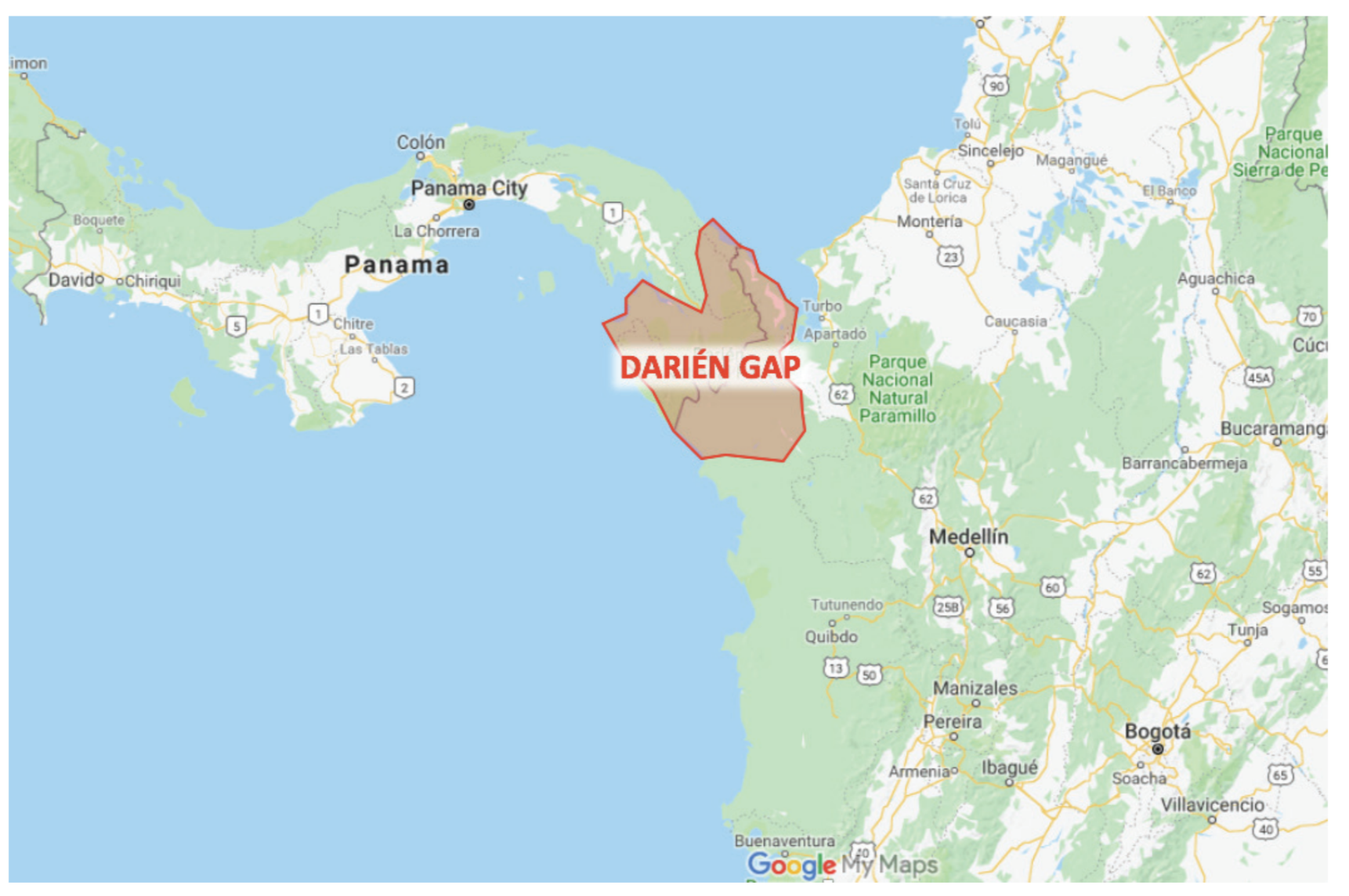
Second, the memories of their crucibles overshadowed earlier steps in their journeys. In Costa Rica, crossing the turbulent Gulf of Urabá in unseaworthy boats followed immediately by a journey across the mountainous, thickly jungled, and gangster-ridden Darién Gap loomed large in respondents’ memories.
As one of our researchers observed in Costa Rica: “I felt as though we were intercepting marathon runners on mile eighteen; all they could remember was the hardship of their most recent, grueling mile while anticipating the trials of the next.”
With heartfelt thanks to the Dirección General de Migración y Extranjería de Costa Rica, the Costa Rica Mission for the International Organization for Migration (IOM), the Policía Profesional de Migración de Costa Rica, The University for Peace, The Leir Institute (Tufts University), The Hitachi Center for Technology and International Affairs (Tufts University), and the Carnegie Corporation of New York, we present our findings.
A final note: we did not have permission from our university to press for details surrounding sex work or trauma. The reader will see large omissions on these topics.
Kim Wilson, Senior Lecturer
The Fletcher School, Tufts University
We use various terms to denote the basic roles that different people played in the clandestine journeys of migrants. But these smuggling terms are ultimately too clean. A myriad of actors performed small and large duties, some illicit, others operating in the shadowed regions of the gray economy. As one migrant said, “The road may stop, but the economy is there.”
Smuggler refers to any member of a global smuggling network or to a local guide operating independently.
Kingpin refers to the lead person or persons managing an organized conspiracy of migrant smuggling. The migrants and refugees we interviewed had never met their kingpin.
Recruiter refers to smugglers whose main job is to recruit migrants and refugees for their smuggling services. Recruiters appear at the beginning of a smuggled journey or at any point along the way.
We use interchangeably guides, handlers, and passers to refer to people based in-country who either work for the kingpin or for a local group or gang. These are the people shepherding—if that is the right word for cajoling, pushing, and prodding—migrants from one waypoint to the next.
A donker or donkey is a guide. It is a term coined by South Asians. Donkers take people from Capurganá through the Darién Gap. Its etymology is unclear.
We use migrant, traveler, and journeyer interchangeably and sometimes refugee. Each term refers to people moving from their country of origin to their country of destination, often permanently. Refugees are a subset of the migrant group, and some of those whom we interviewed had gained refugee status in countries like Ecuador or were seeking asylum in Costa Rica.
1. The Other Migration: Executive Summary
In 2018 and 2019, a team from Tufts University and the University for Peace interviewed 87 migrants whose home countries were in South Asia, West Africa, the Horn of Africa, and the Middle East. Of the 87 interviews, which took place in Colombia and Costa Rica, more than 75 percent were with men. Our team included native Nepali, Bangla, Hindi, French, Arabic, and Spanish speakers.
1.1 The Availability of Funds is a Key Determinant of Safety, but so are Other Factors
Money Made Available Before and During the Journey
Having the resources to secure a plane ticket was the difference between a dangerous journey and a partially safe one. More funds meant access to a superior smuggling package. The ability to access remittances en route was crucial to a journey’s forward advancement as well as its safety.
Gender and Age
Women spent more on health products and lodging and appreciated the shelters established in Costa Rica, as did men. We did not interview elderly migrants but did interview some over 40 who struggled more than younger travelers, particularly in places like the Darién Gap.
Literacy
Even if a migrant had some degree of literacy before departing their home country, they faced “sudden illiteracy” when moving through western South America. They coped by moving in groups or becoming completely dependent on their smuggler.
1.2 Reasons for Departure, Routes, and Costs Vary Widely
The reasons for departure varied and included religious and political persecution, indefinite military conscription, and local and domestic violence. For men, a quest for adventure was also a reason. In South Asia, men had been groomed to migrate through a mix of overt social pressures and subtle family expectations. While migrants claimed “credible fear” as a reason for departure, on the whole, they would not “settle” for a destination country that did not match the difficulty of the journey or their families’ aspirations. Economic opportunity was a theme that tied most journeys together.
The most common ports of entry to the Americas were Brazil, Ecuador, Peru, and Guyana, with some reporting entry in Bolivia and Chile. We categorized journeys into three kinds: heavily smuggled (Nepalis and Bangladeshis), moderately smuggled (Indians, Pakistanis, Eritreans, and Ethiopians), and lightly smuggled (the rest of Africa). The costs of the journey depended on the degree to which the migrant was smuggled. Costs ranged from a low of $1,750 (Ghana) to a high of $40,000 (Nepal).
1.3 Migrants from South Asia are Heavily Smuggled
For heavily smuggled journeys from Nepal and Bangladesh, smugglers asked migrants to pay them in installments at several waypoints during their journey. The migrant’s family would deposit funds in the smuggler’s bank account, breaking their payments into smaller deposits, presumably to evade detection by law enforcement and regulators. To receive an installment, local passers were motivated to do anything to get the migrant to the next waypoint. The migrant could be injured, sick, or exhausted, but the passer would keep urging them forward.
We learned in the US that one way Nepalis would repay their debt to moneylenders and family was by saving up through a dhikuti system and then forwarding saved funds via the hundi. Both the dhikuti and the undi are informal financial systems. We did not learn where the moneylenders are located. We also did not learn how smugglers knew whether a family was good for the smuggling fee. Naturally, the family back home would serve as a form of human collateral, but that appears insufficient to satisfy the risk-reducing smuggler.²
1.4 Migrants from Africa are Moderately or Lightly Smuggled
Except for Eritreans and Ethiopians, Africans had a very different kind of journey. A measure of smuggling or fixing took place in West Africa, as migrants made their way to Nigeria, Ghana, or South Africa from countries like Cameroon. Assistance came from priests, family members, and third parties (“travel agents”) who would purchase plane tickets for a fee ($500 or less) or for free.
Africans tended to travel in groups of two to five that would grow in size or diminish based on the exigencies of particular stretches of the route. Once reaching South America, West Africans would patch together financial portfolios that included remittances, payment for odd jobs, and gifts and loans from local and fellow travelers. Frequently, migrants from the Horn of Africa and West Africa would engage local passers to help them make their way from Ecuador to Costa Rica.
1.5 Financial Irregularity in Money Transfers Renders Regulations Meaningless and Burdensome
Strategies concerning which documents a migrant should carry diverged widely. Some hid or jettisoned their forged or legitimate passports. Others carried them only to have them stolen in the Darién Gap. Lacking a passport made receiving remittances through money transfer agencies challenging, as “Know Your Customer” regulations demand that clients show an identification document. Locals, including hoteliers, would use their own identity documents to receive funds on behalf of the migrant and charge 10 percent or more as a fee.
📝 This article was originally published as a report by the Henry J. Leir Institute at The Fletcher School of Law & Diplomacy and Tufts University.
Download the original report here ⬇️
2. Policy Implications
2.1 Migrants Plan to Seek Asylum in the US on Grounds of Being Persecuted in Their Home Countries, but Other Reasons May Be More Pressing
The refugees and migrants we interviewed had various reasons for traveling to the US: violence, persecution, poverty, and permanent military conscription. Nepalis feared the Maoists or the earthquake (though Maoist activity has faded, and the earthquake happened in 2015). The Christians feared the Muslims, and the Anglophones feared the Francophones. Many feared the prevailing political party in their home countries.
But most admitted at some point during our interviews that the US was attractive for economic reasons. In fact, it was difficult to find anyone who had truly departed based on fear of persecution alone. Their overriding interest may have been economic, but they honed their stories to be more acceptable for US border interviews.
Policy Implications
- Recognize that people move for many reasons, all of which can be valid. But, because of existing immigration laws, certain motivations become more voiced—by migrants themselves—than others. Migrants quickly learn which narratives resonate best with the state authorities who determine their futures.
- Migrants may move economic motivations to the bottom of their spoken list, despite their financial situations having become increasingly dire over the course of their long, expensive journeys. Skilled and unskilled migrants, once screened, should be eligible to apply for a work visa, without having to seek asylum (and clogging US refugee-processing pipelines).
- Guest-worker visas proposed by many but championed in particular by Lant Pritchett³ are a powerful poverty alleviation strategy. But, more than this, they help countries like the US address labor shortages.⁴
2.2 Formal Finance is Important Before and During a Journey, but Some AML/CFT Guidelines are Ineffective
For migrants coming from Nepal, banks were very much a part of their journey. Family members would deposit funds into the smuggler’s bank account, smurfing (a form of money-laundering) amounts as they did so. Clearly, some Nepal-based banks are overlooking AML/CFT⁵ guidelines.
But, more importantly, AML compliance is amiss and a mess at the “last mile.” This directly impacts refugees and migrants who, lacking documents familiar to agents at MoneyGram and Western Union, cannot access their funds. Instead, they must bribe agents or locals to receive the transfers on their behalf. Such activities create three problems: First, migrants cannot get their money without paying an exorbitant fee and waiting for days. Second, locals become involved in criminal activity, with agents themselves becoming scofflaws of “Know Your Customer” (KYC) rules, and third, KYC procedures—highly burdensome for remittance companies to comply with—are clearly not working.
Policy Implications
- AML/CFT requirements for transferred amounts under $1,000 should be relaxed, or
- MoneyGram and Western Union should supply migrants with an easier ID procedure (e.g., allow the use of the temporary secret question that they allowed in the past), or
- IOM and various governments should create an identity corridor: A migrant could register for a temporary, three-month ID that they might get in Ecuador (almost all extra-continental migrants pass through Ecuador). This would allow them to move from country to country, get their transfers, and perhaps enjoy easier border crossings. (Since many migrants are robbed of IDs in the Darién jungle, the ID might need to include a digital component.) A multi-country ID would allow law enforcement generally to be able to track migrants.
2.3 Social Grooming Causes Men to Take Expensive, Dangerous Journeys
Migrants hailing from South Asia (India, Nepal, and Pakistan) admitted to feeling pressured into migration. This pressure was particularly acute for Nepalis. Their families, poor and often illiterate, would hear of how well a male cousin was doing in the US. The migrant would feel shame if he did not make the same journey.
Those we interviewed knew nothing about how difficult the journey would be prior to departure. To amass the funds needed for door-to-door smuggling services (up to $41,000), families sell assets such as land and jewelry and, we surmised, take on a great deal of additional debt.
Policy Implications
- Educate families of migrants on the dangers of migration. Such education can be difficult and expensive; however, here mass media may be effective. Many South Asians we interviewed bonded with fellow South Asian travelers through a shared interest in Bollywood films. Introducing migration narratives into staples of South Asian entertainment, like Bollywood films, may help to alert families of migrants to the dangers of the journey.
- Crack down on banks that receive smuggler deposits or team up with banks to trace smugglers. Since migrant families are making deposits in the thousands of dollars, a well-trained bank teller would find it suspicious that a poor person would be depositing so much money in another person’s account.
2.4 Men and Women Face Distinct Financial Challenges and Expenses, as well as Identity Challenges, Throughout their Journeys
Men and women migrants took on different expenses during the journey, with women sometimes paying more to feel safe and dignified. Some women reported spending money on health products throughout their journeys in ways that men did not. Others said that they felt unsafe sleeping outdoors for fear of physical assault. They budgeted to sleep indoors every night they could (although this was impossible in the Darién Gap).
Men and women both expressed experiencing identity crises as a result of migrating. Women, while emboldened by their journeys, said that it was a journey better suited to men and that they frequently felt vulnerable and out of place. Men described their journeys as “emotional torture.” Both men and women who were separated from their children cited communicating with them as a primary goal while traveling and potential future family reunification as a goal for survival.
Policy Implications
- At key waystations, provide “dignity kits” for women and men with grooming products to help relieve the strain of travel. For women, ensure access to sanitary products. Where reusable products, such as menstrual cups, are offered, women should be on hand to train migrants in how to use them.
- At key waystations and at ports of entry, bus stations, and docks, provide free Wi-Fi access so that migrants can connect with family members. Put signs and information about Wi-Fi in a variety of languages. Transit towns or those temporarily hosting large numbers of migrants could provide public Wi-Fi hotspots for migrants.
- Prioritize psychosocial support services both at key waystations and in temporary camps along the journey.
2.5 Livelihood and Work Options in Transit Countries are Highly Valued by African Migrants
For many Africans, working during the journey is key to moving along. Once initial funds had been depleted, or stolen, many found themselves stuck in a country of transit. They were unable to afford food and lodging, much less transportation to continue north. In some cases, they are able to call home and request money from family. But, if traveling without this option, they are left pleading for odd jobs or hoping for gifts bestowed by local Samaritans.
Today, no country in Central or South America offers temporary work permits for migrants in transit. Work permits would steer migrants away from the informal economy, where exploitation is rife. Work permits would also allow governments to collect more taxes that could in turn fund support services to migrants and their host communities as well as keep better track of migrants.
Policy Implications
- Issue temporary work permits for people in transit, something that could be done in connection with issuing temporary IDs.
- Officials in ports of entry could collect information on migrants’ skills and, in partnership with the country’s labor authorities, allocate labor in needed sectors.
2.6 Most are Not Seeking Asylum in Transit Countries, but Many do not Know Asylum is an Option
Unfortunately, few travelers in transit countries understood the benefits they would receive upon becoming asylees there. Of those who were informed, Africans showed the most interest in beginning the process. But many, including Africans, saw countries along the journey as not on par with the US or Canada. Living in the US. would confer a status that transit countries could not. Most migrants spoke some English, making asylum in a Spanish-speaking transit country less desirable. If employment options were accessible along with language programs, perhaps more transit countries could serve as final destinations.
Both transit countries and migrants might benefit from accessing forms of protection complementary to asylum, such as humanitarian visas. Often, countries offer no protection to migrants who are ineligible for refugee status under the 1951 Refugee Convention. Failed asylum seekers are then forced to rely on smuggling actors to continue their journeys, perpetuating illicit services and the crimes that go with them.
Policy Implications
- Communicate in further detail—and in their native languages—the possibilities for asylum and other visas on humanitarian grounds. Posters in migrant languages (English and French at the very least) could assist and would be especially effective in temporary camps and bus stations along the journey.
- Some countries, such as Costa Rica, have dedicated hotlines to receive asylum information. The mobile numbers for these hotlines should be made available through the posters mentioned previously.
2.7 Because of Language and “Sudden Illiteracy,” Travelers Have No Idea Where They Are
Migrants were perpetually lost. Most did not speak Spanish and while apps like Duolingo at times were helpful, many faced a “sudden illiteracy.” Bus and ferry schedules, border crossing instructions, and maps were in Spanish. This illiteracy was frightening and forced some to cling to their smugglers. Others coped by asking directions from strangers, which was often incomplete or misguided.
Policy Implications
- At key waystations, place important information in the languages of migrants.
- Communicate features of mobile apps that can help overcome geographic confusion and language barriers, such as map route planners, text-to-speech features, digital dictionaries and translators, and real-time photo translators.
2.8 Hotels Function as Safe Houses and Hoteliers Act as Fixers and Money Agents
Employees of hotels chosen by agents to lodge migrant clientele often interact with smuggling networks. This was most evident in the lodgings of South Asian migrants. These hoteliers are better informed than their guests of the steps ahead. They offer safety from identification and deportation by government authorities. To keep migrants out of view, hotels limit their mobility and exposure to outsiders.
But for all their tailored, helpful, and licit services, hoteliers are often linked to illicit services. Hotels serve as recruiting grounds for smuggling agents. Hoteliers also, somewhat illegally, facilitate money transfers for those lacking the right documents. This last service comes at a cost to the guest—at least 10 percent of the amount of the transfer.
Policy Implications
- Amend tourism accommodation regulations. Rules governing tourism accommodation in most countries fail to include compulsory training in the detection and reporting of migrant smuggling and hoteliers’ legal obligations to report criminal activity.
- Enforce regulations through training and monitoring.
3. People (Why and How Refugees and Migrants Travel)
3.1 People Leave for a Mix of Reasons, but Once Migration Begins, Many Won’t Settle for “Lower Status” Countries
The people we interviewed reported many reasons for their departures. We did not rank reasons by most mentioned because hours and even days of interviews rendered what had been initially primary reasons as secondary and vice versa.
Grinding poverty, lack of educational or occupational opportunities, religious and political persecution, domestic violence, disputes over ancestral land, war, permanent military conscription, natural calamities, social shaming, gendered exclusion, a chance for a better life, a chance to re-join family members, and an impulse to see the world—these were the main reasons cited. But, after hours of interviews, economic opportunity prevailed as the overriding reason migrants were headed to the US or Canada. One Nepali man said,
"People take this risk to make life easier. People take this risk to make life easier. If we go to Qatar, we can earn $200, but the money after deductions is less than $50. This is not enough and life there is extremely hard, too. People who have completed master’s degrees are on this trip. A candidate of a political party is with us. Why do you think all of us are here? Because there aren’t any opportunities in Nepal. If we come to the US and make a life there, at least our kids will have a better future. US is the country that gives the opportunities. "
While economic opportunity was foremost in the minds of respondents, young men from Asia and Africa had other reasons, too. They were quick to point out their thirst for adventure and eager to tell tales of courage. “From my room in Takaradi,” a young Ghanaian man told us, “I could see the port and all the boats coming and going. I knew they were going far abroad, somewhere that I could go. I told my friends about these boats, and even if we did not know where they were going, we were ready to take the risk.”
He ended up a stowaway in the hull of a ship bound for Brazil.
Even in instances where migrants initially said that persecution was their primary cause of departure, they admitted that seeking asylum in any destination other than the US was unacceptable. In fact, migrants could seek asylum, or residency at least, in countries such as Brazil, Ecuador, or Costa Rica. Some had even gained refugee status there. But for most, those countries were unattractive.
Three reasons underpinned the lack of allure. First, their national language is Spanish, something that compromised the possible livelihoods of African and Asian migrants equipped with other languages, including English. Second, the general health of transit economies makes prospecting for decent livelihoods in them difficult, especially when taking into account language deficiencies. Third, the status that these transit countries can confer does not match migrants’ own perceptions of their journeys. Their journeys were fraught with danger, filled with narrow escapes, requiring large measures of wit and resilience. Their journeys deserved a reward, a social boost, a congratulations-for-making-it-this-far, things transit countries can not offer.
I have done my Bachelor’s in law,” one male South Asian told us, “and hopefully I will get a job in the US. All of us have at least some status so we will not settle for nations like Panama. We made this journey to go to the US and we will get there.”
Escaping the consequences of debt was another reason for departure. Clearing old and potentially threatening obligations was intertwined with the hope of prosperity. A Ghanaian man, having taken a circuitous route via Cuba, Brazil, and Peru, to Ecuador and then north, explained what he was dodging back home.
When my wife got married, she started getting sick and it was one problem after another. I was the one taking care of family. We went from hospital to hospital. That’s when things got hard, with money going out but not coming in. I had to borrow money to take care of my family and to establish my business. I bought some cameras and other camera equipment. But then I had to sell everything because there were too many expenses. The time came to pay back the money I borrowed but I didn’t have it. When someone is threatening you… it happened to my brother who was stabbed in the eye and killed… you leave. I had to leave the country to make money to pay back this man. I didn’t want him to kill me for nothing.
The women we interviewed from Africa departed for a mix of reasons. A Cameroonian relayed her story that flickered from domestic violence to the ill effects of black magic (blindness) to her activism as an Anglophone and finally settled on her duties as a mother of three. As her reasons started to gel, they collected another theme, the chance for a better life. The more we conversed, the more it became clear that, while all the mentioned reasons were important, the most important was a chance to earn money and send it home.
Often stories drifted, morphed and reversed course before hardening into a final version, one that might be presented at the US border. During the early segments of our interviews, departure stories included family feuds, gang threats, blood spilt over land disputes, sorcery, animal sacrifice, grinding poverty, businesses losing money, lack of educational opportunity, lack of work, a quest for adventure, and the unescapable shame that young men would have faced had they balked. But as our interviews progressed in time, initial stories evolved into new ones—UNHCR-ready ones, US-border-ready ones. They featured jailed gurus and bombed churches, aggressive Maoists, and belligerent Francophones. The revised histories that emerged over the course of hours or days would better fit checklists prepared by border authorities. Below the leitmotif of credible fear, even in the most practiced stories, we could detect a genuine search for a more prosperous life. In the end, migrants wanted work.
3.2 The Roles of Shame, Expectations, and Social Norms Loom Large: Able Young Men are Groomed for Migration
Most male respondents referenced political or religious persecution as their main reasons for departure—at least initially, as discussed above. But further conversation revealed that leaving home for a better life was a rite of passage, or at minimum, a family obligation. Some were curious to explore the world and relay their adventures to family and friends (via WhatsApp and other social media). This was particularly true for young, single men, regardless of continent or region of origin. Others said they had no choice but to migrate, the glories of adventure absent from their dreams. As men of the family, it was incumbent upon them to soldier toward a better life and send money home.
Nepalis revealed with intensity the pressure to complete their journeys. If they showed lack of interest in migrating, family members would shame them into departure with various nudges and taunts: “Your cousin made the journey” or “Our neighbor’s sons made the journey,” the implication being, “Why can’t you?” If not spoken nudges and taunts, then unspoken.
Some African and South Asian men admitted that they had not been prepared for such difficult journeys but had no plans to face the embarrassment of a return. Return would mean defeat, and a humiliation that they might endure for years. We did hear of an exception to this when a young Burkinabe, Aziz, reported through WhatsApp that he had made it as far as Mexico, only to be deported to Burkina Faso. There, Aziz texted his former traveling companions, still in Mexico, that he enjoyed a hero’s welcome for his efforts. We had no way of knowing whether this was true or was his way of saving face with his former traveling companions.
Though male respondents said in absolute terms that they would not publicly advise anyone to make a similar journey, they also made clear that they would not communicate this advice to family and friends considering their own journeys. A Nigerian man, Mathiew, headed toward Canada and working for a stint in Costa Rica, told us that he would caution any fellow Nigerian deciding to make the same journey to reconsider, in fact, to refrain. Mathiew’s travels had been too fraught with danger. He did not want others to undergo the same horrors. When we took a video of Mathiew (with his permission), during which we pointedly asked him to share his warning to those contemplating a journey similar to his, he looked straight into the camera and said: “This is a long journey, difficult, but is very much worth the trouble. It is hard but you can do it.”
3.3 To Survive, Often Migrants Travel in Groups, but Not Always, and Even Those Who Travel Solo Tend to Travel in Groups at Some Stage
Besides the Nepalis we met (who were smuggled as a group from Delhi), and to some extent Indian migrants, most groups of travelers were not permanently bound to one another. They formed, disbanded, and reformed along the journey, collecting new members as they shed others.
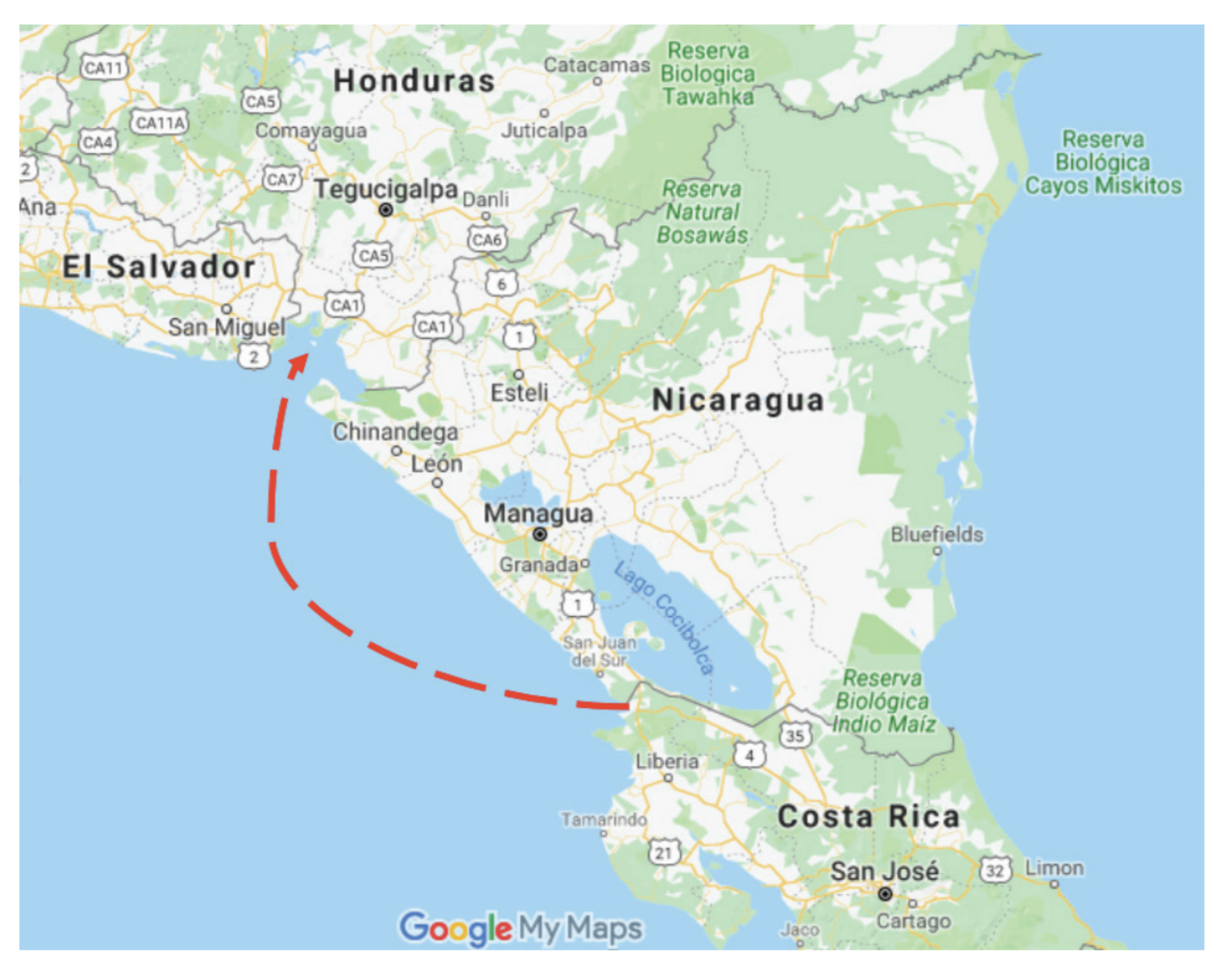
As they sought to make specific passages, larger South Asian groups divided into smaller ones. For example, in the Darién Gap and onward through Panama and Costa Rica, a South Asian group might include more than 60 members. But in Nicaragua, their smugglers would downsize groups to match the capacity of the fishing vessels that would smuggle them to the Nicaraguan border with Honduras. Once ashore, smaller groups would reassemble into larger ones.
A pair of Indian men from Haryana state described their group. The initial two had completed their studies at Kurukshetra University in 2007 and were from the same caste. In Delhi, they met another Indian, also from Haryana, whom they had not known from before. The three decided to travel together. Their group offered safety and the ability to brainstorm next steps and split tasks:
In Ecuador, we met Indians every day. This is where we found out about donkers (smugglers). In Quito, we became a group of three. In Tulcán, we became five. In Cali, we became eight, and in Turbo we became nine. In Capurganá, we met sixteen Indians and four Bangladeshis. We were a group of 29 people at the beginning of the jungle.
They continued to describe how traveling in groups allowed them to negotiate better prices for transport or save money on expensive lodging by sharing a single room. More than that, traveling together was a way to enjoy a shared culture.
South Asians tended to stay in hotels that featured South Asian food, even if the owner was not South Asian. One hotelier in Costa Rica described her joy in serving groups of Indian migrants.
These kids go through migration and then they are free. They come here, shower, tend to their wounds and dance. They are so much fun! Then they leave. They play their music and then start their dancing. They sleep all on top of each other like married couples. Not because they’re gay, but because they fall in love like brothers given their shared experience in the jungle.
African migrants would also travel in groups, but their groups would continuously change membership as they moved north from Brazil or Ecuador. African groups tended to be smaller than their South Asian counterparts, fewer than five members—the number of travelers who might share a taxi. West Africans tended to stick together as did migrants from the Horn of Africa, sometimes coalescing along the route.
If smuggled, migrants would be grouped together by their smugglers, without migrants having a say in group structure. In these instances, which occurred often, migrants might start with people from their country of origin but as they moved through South America would take on members from other origin countries. Smugglers might mix South Asians with Africans, if that was expedient, or separate them, if that was expedient.
Men and women sometimes journeyed alone. They would pair up or coalesce into larger groups during specific passages, such as through the Darién Gap. Solo travelers included single women and single men, pregnant women, women with children, and whole families. In the jungle, groups would form into columns for long stretches, then dissolve into small units as they approached mountains or river crossings. A Yemeni man who walked alone in the Darién observed 150 to 180 people coursing through the jungle on any given day (this was before the rainy season). He noticed groups of all sizes.
In the Darién Gap, most migrants, even those traveling solo, joined up with others in groups formed by donkers, the name given to local guides. And some who did not have donkers still found groups to travel with. A Cameroonian woman explained:
I left Brazil with a Cameroonian guy and his older brother. It was the three of us traveling together. We went by bus and it took about a week to reach the border of Peru. In Lima at the bus station we met up with another group of Africans, including a Ghanaian and a Togolese. We had not known each other previously. There were about seven of us traveling together to Ecuador by bus.
Princess, the name this migrant gave herself, had arrived in Brazil alone, joined various groups along the way, then teamed up with a fellow Cameroonian, “The Prof,” to cross the Darién Gap. The pair came upon a woman in the jungle with a broken leg. The Prof felt compelled to return the injured woman back to Turbo. He told Princess that getting her to a hospital was the right thing to do. He then pivoted away from Panama and back toward Capurganá, carrying the injured woman in his arms. This left Princess in search of new fellow travelers.
I found a group of “blacks” and “whites.” The blacks were a group of five who were a family from Cameroon. The whites were from Ethiopia. They were traveling as a group of ten. I wished I hadn’t joined them. I could not see [she is legally blind] and the whites wanted to move faster. The blacks began to hate me. “Go, go, faster, faster, move, move,” they would say. “You are blind.”
Princess finally made it out of the jungle but traveled alone through Panama and Costa Rica. From there, she made a failed attempt with yet another group to travel overland through Nicaragua. When we interviewed her in Costa Rica, she had made individual plans to be smuggled by boat in an effort to bypass Nicaragua. We later learned that she had completed the journey, largely alone, as far as Mexico.
3.4 Ingraphicacy (Inability to Read Maps) and Illiteracy Impede Travel and Turn Migrant Journeys into Nightmares
Many respondents could not read maps; to them, digital map applications were useless. Instead, they relied on locals or fellow travelers to guide them.
Those who could read maps struggled with Spanish and a continually changing set of landmarks—unfamiliar cities, towns, bus stations, and ports, all to be temporarily memorized. Some who had taken years to work their way through the western countries of South America had learned Spanish. They had taken on odd jobs, learning the language as a strategy and a consequence. But most were seeing Spanish on signs, maps, menus, and bus schedules for the first time. A Cameroonian man said that his favorite food was rice, and he had not eaten it for months. Because he could not sufficiently articulate “arroz,” the word for rice in Spanish, he could not purchase it. He lamented that he spent far more money on other, less satisfying foods simply because he could name them.
Those who were heavily smuggled often had no idea where they were. They could recall which countries they had traveled through, but not specific places. “We were taken from Peru [through Ecuador] to Colombia. I cannot tell you the places. It was all a jungle kind of place,” a Bangladeshi man told us.
3.5 Most Migrants Only Understood the Costs and Perils of Immediate Travel, not of Subsequent Travel Farther Ahead in the Journey
Respondents had been in contact with travelers downstream. Lagging travelers would follow the step-by-step instructions dictated to them by leading travelers, who were perhaps a day or two ahead in the journey. Through programs like WhatsApp, travelers would receive varied advice: “Look for this hotel,” “receive your remittance through so-and-so at the front desk,” “meet this guide,” or “take this bus.”
But migrants did not comprehend the full implications of each journey segment. For example, they might know they would need to take a taxi to the border between Ecuador and Colombia, but not know they would need to ford a stream or take a horse to steer around the official border crossing. Only upon arrival at a new destination, when instructions would be given by their guide or local smuggler, did they know what to do.
Many were perpetually lost. For example, a pair of African men interviewed in Turbo, Colombia, had heard about the jungle but had assumed they were nearing the Amazon jungle, not the Darién Gap. The Darién Gap is a thousand miles north, as the crow flies, from the Amazon rainforest. Their misinformation was so extreme that they believed the jungle they were about to behold was lined in gold; they would collect gold as they walked.
They were not alone in the chaos of Turbo. Many travelers were learning for the first time about the risky crossing by boat over the Gulf of Urabá to reach Capurganá, and once in Capurganá, about details of the Darién jungle.
Asians, whose journeys were highly brokered, were passed from guide to guide, never knowing the string of passages that would form the complete journey. As one Nepali said, “I followed the same route to Costa Rica as most people. I had no idea about the journey or what I had to do when I got anywhere.”
3.6 Gender Factors into Journey Safety, but Women Often Shrug off Their Particular Vulnerabilities
Fewer than 25 percent of our respondents were women. We owed this to two things: First, fewer women made the journey than men (13 percent of migrants recorded by the government in Costa Rica were women). Second, those who had made the journey did not want to risk being identified as an informant, ruining their chances of reaching their destination.
Overall, men were more inclined to speak with us. Their willingness suggested that putting their trust in strangers had paid off before. Some had come to serve as interlocutors for their group, whether it had been newly formed along the way or established early on in their journey. Women, on the other hand, tended to be quieter and would keep to themselves, perhaps because they felt they had more to lose in sharing details of their journeys or because the men in their group had already developed a habit of doing the talking on women’s behalf.
In one instance, we interviewed a group of four migrants—three men and one woman. While the three men spoke openly with us, the woman remained silent, keeping her back turned to the interviewer. Women who did talk to us spoke very matter-of-factly, stoically. Rarely did they mention risks associated with their health or carrying children, even babies, with them.
Some described the extra financial burdens associated with migrant womanhood, such as spending precious funds to buy menstrual products. Many were still responsible for supporting children back home. This was true for men, too. After requesting asylum, they would figure out how they could be rejoined with their family. Parenthood was their joy and their burden.
A woman who called herself Superwoman said that from a distance—from Ecuador—she liquidated her savings back in Cameroon. Over the phone, she guided her mother to use her PIN and bank account. Once funds were withdrawn, Superwoman felt at ease knowing her daughter could be educated in a part of the country far from the aggressions of Cameroonian Francophones.
Both men and women recalled moments at the hands of corrupt police in Colombia, in violent seas while crossing the Gulf of Urabá, and during the long days and nights in the Darién Gap, with its rivers, snakes, jungle cats, and a menacing brew of gangsters. Women underplayed their own Olympian grit. This was in direct contrast to their male counterparts. The men went into great detail about how difficult the journey was, explaining how much they had overcome, repeating that the journey required extreme strength and willpower. Some men reported that it was “a man’s journey,” even within earshot of women who had made the same journey.
There were exceptions. The admiration of Nepali men for Nepali women was unmistakable. Most agreed that the journey was more suited to men, but clearly, women had the strength and mental stamina to survive the worst stretches. But even in acknowledging the prowess of women, men often relegated the accomplishments of their female fellow travelers to special circumstances or to luck. In one breath, three Nepali men voiced amazement at the woman who made it through the jungle, and in the next, called their journey a miracle. Vikramjeet, a Punjabi Indian, sought inspiration from female travelers, saying, “If the Nepali woman has made it thus far and is still going strong, I shouldn’t be crying over my worries.”
On the whole, women and men appeared to lean simultaneously into and away from traditional gender stereotypes. Men suggested that the journey made them feel less of a man because they lacked control over their safety and surroundings. One young Cameroonian man, Johnson, went so far as to say that before in Cameroon he was seen as a “business tycoon,” capable of doing and having anything, but now he was “nothing.”
During our interviews, men seemed to will themselves, often unsuccessfully, away from an instinct to cry. At the same time, they characterized their journeys as “emotional torture.” Women, meanwhile, treated their journeys as yet another hurdle to jump. Though many said that it was a journey for men, they never expressed doubt in their own ability to complete it. When they spoke of their own strength, they did so in direct comparison to men. Superwoman, for example, said that “anything that a man does, I always do it… Women are not scared, and they have big hearts–they can do anything. That’s me.”
Despite their composure, women did suffer in their travels. Health and safety were constant worries. Women had to consider where they would sleep and whether they had money for lodging, as they felt they could not sleep in public spaces as men did. Others commented on the ordeals of the trek itself, especially passage through the Darién Gap.
Men and women respondents both described the difficulties women faced. Men complained that women slowed them down. Women complained that men left them to rot in the jungle after a fall.
Social and cultural norms did not improve migrants’ situations in navigating gender. A Ghanaian man, Peter, recalled, for example, being a link in a human chain that had formed at a river crossing in the Darién Gap. Peter was the sixth man in the chain of chiefly West African men with a Ghanaian woman at the chain’s tail. Peter said that just before her was another Ghanaian man, Sam. In one stretch, the river surged and began to pull the woman away. When Sam, the next-to-last link in the chain, attempted to grab the woman, his customary norms turned into instinct. Under no circumstance, Sam had been taught, could he touch a woman who was not his wife or immediate relative.
In that crossing, Peter said, Sam had no choice but to encircle the woman’s forearm, but without touching her, a near-impossible task. Peter curled his own large hand into a cylinder and wrapped it around a soda straw on the table where we sat. He showed us how Sam’s hand had slid like a wide shaft around a slim pipe. The woman slipped through Sam’s grip and was swept downriver, never to be seen by the group again. Peter was visibly shaken by the experience. He promised us that “I am only half as shaken as Sam. He will be permanently traumatized.”
4. Routes, Modes of Travel, and Lodging
4.1 Brazil is the Most Common Port of Entry, Followed by Ecuador, Peru, Guyana, and Bolivia
Migrants or their smugglers selected countries as entry points based on their ability to get visas.
Many African and some Asian respondents had entered through Brazil, either because they knew they could acquire visas easily there or because they had heard they could convince airport customs and border officials to let them pass through. Many had planned on Brazil being a final destination, hoping for steady work. But, as work prospects dried up there, migrants began to head north.
An informant in Costa Rica elaborated on Brazil’s history and its importance in extra-continental migration. The construction of the World Cup and Olympic infrastructure demanded cheap and plentiful labor. Haitians had been welcomed in Brazil, under an informal, bilateral relationship that had spanned decades. In search of work and able to pass as Haitians, Africans also surged into Brazil.
Other migrants entered through Ecuador, since the country’s 2008 constitution accommodated an “open door” policy for foreign visitors. Not needing a visa to enter the country made Ecuador a key destination for migrants wanting to travel north. Today, they apply at the border or a port of entry and receive a tourist card valid for 90 days. The government has restricted visas for some countries—many are the countries of origin of the migrants we interviewed— but the 12-X visa, as it is called, is still available. (See Ecuador Explorer—the site migrants referred to— for detail.)
Brazil was a stopping point for many Africans. They would enter through São Paulo and, via church affiliates or other local networks, find lodging and work. When economic prospects diminished, they moved on. But initially, many had no plans to leave Brazil, certainly no plans to move north to the US. A Nigerian native told us that Brazil, when work was plentiful, was an ideal place to live. He was nostalgic for the friendships and the food. That all changed when the Brazilian economy sagged. Migrants from South Asia and West Africa who were living there moved north.
A few entered through Guyana. Two detailed their river journeys through Brazil with a junction in Manaus, before taking a string of buses to Peru, Ecuador, and then north.
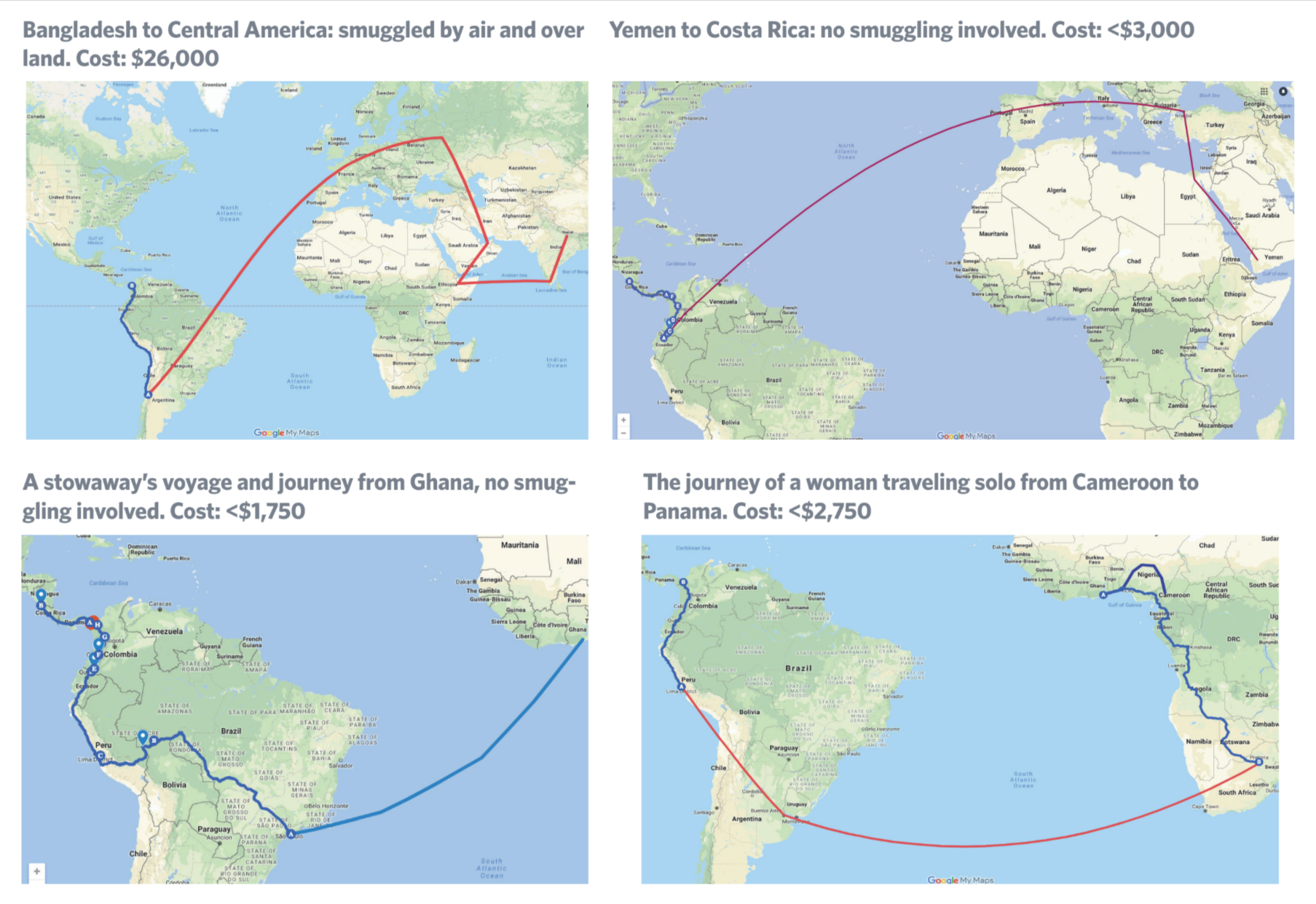
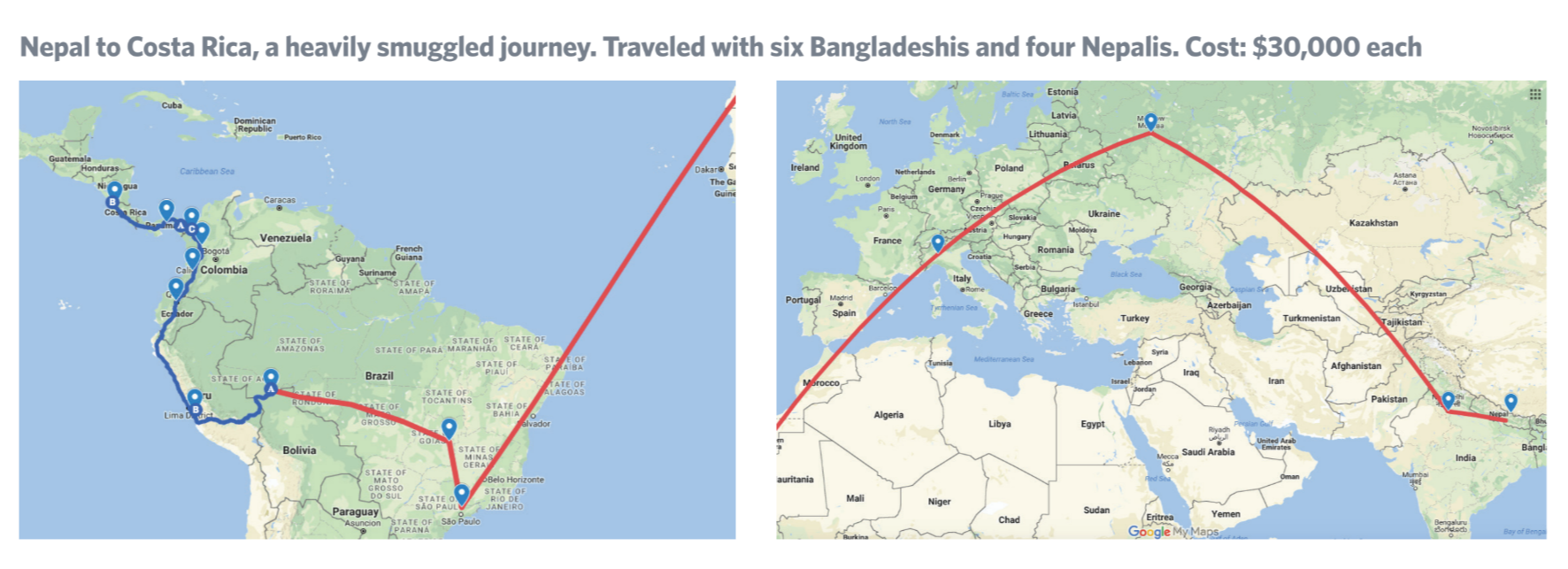
Following are five route maps that illustrate the kinds of journeys experienced by migrants.
4.2 Transatlantic Routes Vary but Converge in South America
From South Asia, migrants pursued various routes. Nepalis tended to meet up in Delhi at the behest of their smugglers. From there, they took flights to Europe, then went overland to Brazil or Ecuador (with some inexplicably going to Moscow first). Bangladeshis tended to travel first to Dubai, then onward, again to Brazil.
Tech-savvy, educated, and well-dressed Indians, appearing economically better off than Nepalis or Bangladeshis, made their own travel arrangements to Ecuador, then followed the same routes as other extra-continental migrants.
Those from eastern Africa traveled to Europe or to South Africa before reaching South America. Ghanaians were able to fly directly to Brazil. Congolese and Cameroonians would go to Ghana, Nigeria, or South Africa before departing to South America by air.
Though a few traveled by ship to Brazil, as stowaways or passengers, most respondents took flights to São Paulo, Quito, and in some cases, Lima and La Paz. Those whose original port of entry was São Paulo took a combination of buses and taxis to reach Peru, and another combination of buses and taxis to reach Colombia. One respondent reported riding horseback across the border between Ecuador and Colombia.
In Ecuador, whether arriving by air or over land, routes converged as a single route north that included Tulcán, Medellín, Turbo, Capurganá, Camps 1, 2, and 3 in Panama; Panama City; Paso Canoas in southern Costa Rica; and La Cruz in northern Costa Rica. The greatest distances were covered by bus or taxi, except for the notable sea crossing from Turbo to Capurganá, the trek through the Darién jungle, and the voyage bypassing Nicaragua.
4.3 A Spectrum of Perils Makes Crossing the Gulf of Urabá and the Darién Gap the Most Terrifying Stretches of the Journey
Migrants faced barbarous gangsters, paramilitary, guerrillas, authorities, and imposters. Nowhere were they more present than in the Darién Gap and Nicaragua.
Except for transatlantic stowaways who spent days and nights in total darkness, migrants said that crossing the Gulf of Urabá in rickety skiffs and ferries began the most terrible legs of their journeys. The voyage could last up to nine hours. Facing the Caribbean, the gulf tosses up rough seas. Some said that while aboard, they imagined their own deaths. Others actually reported witnessing loss of life; boat captains were unconcerned when turbulent seas rocked passengers overboard.
Serdio, a Ghanaian, recounted his boat journey across the Gulf of Urabá, from Turbo to Capurganá. He said more than 20 migrants, all men, were packed into a small skiff. Ocean swells rocked and shook the fragile boat as the driver sped along. The journey was so turbulent that some of the men cried or screamed, others clasped hands, and others sang aloud for comfort or distraction. He didn’t believe he was going to survive.
Some boats docked in Capurganá, a fishing village, where passengers could disembark onto the quay. Others, though, landed in breaking surf near the village, terrifying migrants who could not swim.
Serdio described docking in Capurganá as chaotic and unnerving. A thicket of local authorities, undiscernible in title or station, barked commands at passengers in Spanish, a language they couldn’t understand. They gathered their belongings and, following other newly disembarked crowds, were whisked away into the back roads of Capurganá, given no time to process their terrifying ocean journey.
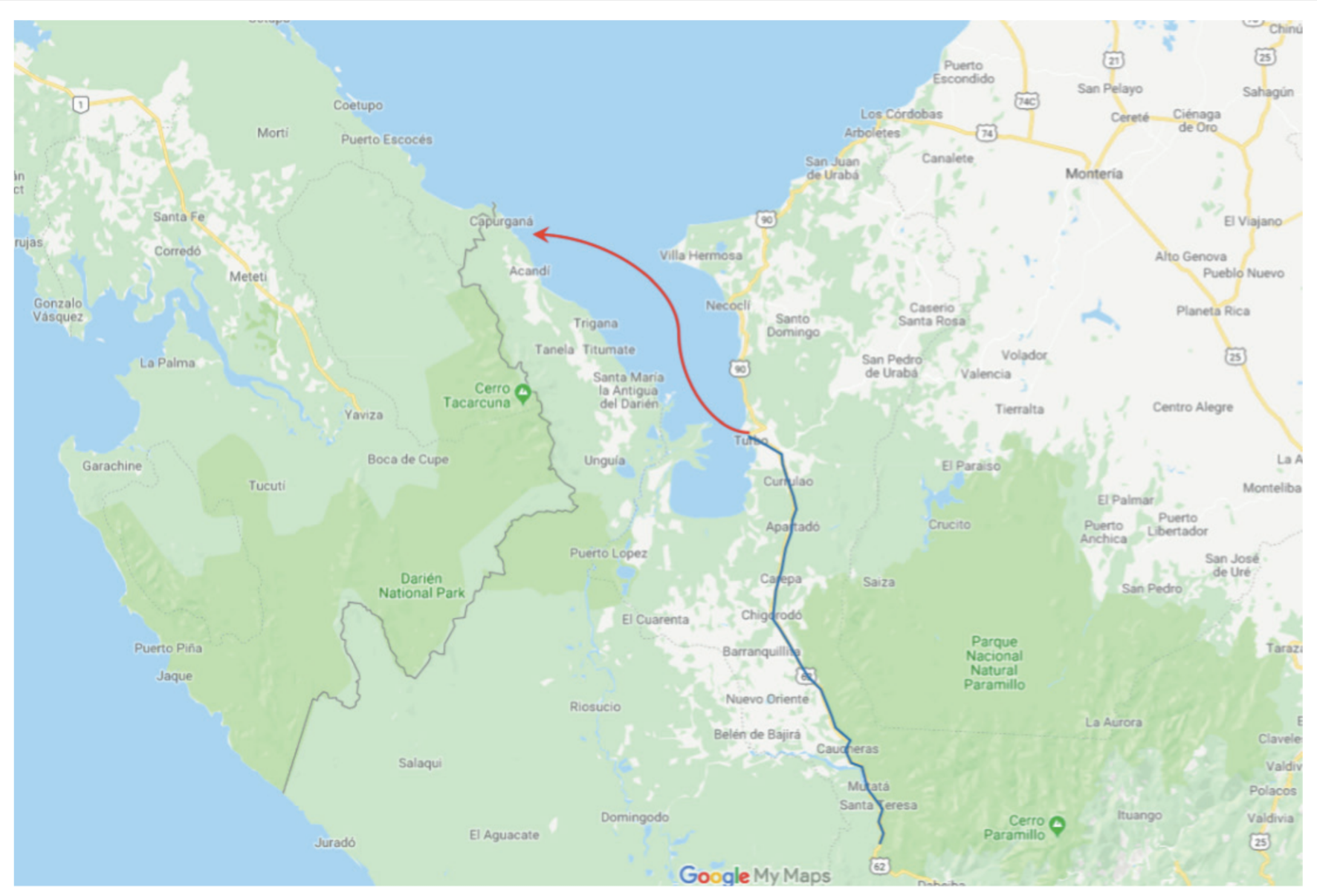
Immediately following the ocean crossing came the trek through the Darién Gap, an expanse of rivers, mountains, swamps, and rainforest that links Colombia to Panama. To hear migrants describe it, the jungle sucked them in at the edge of Capurganá and spit them out at Panama’s Camp 1. Inside the Gap is chaos.
“I met an Eritrean woman who was stuck between the first and second mountain,” said a male Somali. “Her leg was broken. She couldn’t go back, and she couldn’t continue. No one else would help. I also came upon two Indians, both with broken legs. They were trying to hoist themselves over the mountain using their hands.”
In preparation for the walk, travelers purchased water and food packets as well as gear—boots, tarps, tents—in Capurganá. In many cases, smugglers supplied migrants with these items.
From Capurganá, they hiked directly into the jungle, some with guides and some on their own. The journey lasted between four days and three weeks; most reported 6 to 14 days. Dangerous river crossings, steep scrambles up and down slopes, and crawls over massive boulders were daily ordeals. They encountered completely unfamiliar fauna, from snakes to jungle cats. One reported seven jaguar sightings (calling them “tigers”).
Migrants had become trekkers. They made their way by following the debris—discarded water bottles, food wrappers, diapers, and clothing—of those who had walked before them. They said that the heat, the intensity of mountain inclines, and the ferocity of the rivers, particularly during heavy rains, forced them to shed their belongings as they moved. They stumbled on rocks and crashed headfirst down mountainsides, with any unessential weight a liability. Extra possessions were quickly tossed.
A group of Pakistanis said that they knew that the guides could make it through the jungle in a day or two (this was confirmed by others) but purposefully made the trip last longer. The donkers, as these guides were called, charged $20 per day, payable in the morning of each new day. It was in their interest to make the journey last as long as possible. Migrants complained that they were traveling in circles, needlessly hiking over mountains when they could have walked around them, and just as needlessly fording the same river at multiple points. They felt trapped, dependent, and unable to shake their donkers.
The worst part of the Darién journey happened toward its end, when the mafia, a rogue’s gallery of paramilitary gangs, local thugs, traffickers, guerillas, and so-called guides would attack. The mafia hunted migrants for their money, but felt free to take their mobile phones, passports, toothpaste, and deodorant. One Ghanaian, having been stripped at gunpoint three times, exited the Darién in his underwear.
Few emerged unscathed and many suffered from serious wounds, broken limbs, multiple infections, snake and insect bites, and waterborne disease. Those who made it told of others who had fallen along the way, starving and stranded. Leaving people along the trail was not something migrants had counted on. Some were traumatized by having to uncharitably press forward, circumventing injured travelers.
4.4 Traveling Either Through or Around Nicaragua Is a Close Second to the Darién Gap in Terms of Troubled Journeys
Facing the Pacific, La Cruz, Costa Rica, is a staging ground for ocean passages bypassing Nicaragua. We interviewed migrants who had attempted voyages on fishing vessels near Pochotes beach but had been returned to La Cruz (due to engine malfunctions, rough seas, or vigilant patrols). We also learned via text messaging that some migrants had completed their passage from Costa Rica to Honduras. While fraught with danger, they preferred this route to crossing overland through Nicaragua, which some had already attempted, only to be returned.
Those who had tried their luck overland, hidden in trucks and buses, had been apprehended by border patrol, police, and a welter of gangs. Some returnees we spoke to had been shot, had seen others shot, or had been robbed and brutally beaten.
4.5 Places of Lodging Vary From Smuggler Safe Houses to Hotels, Churches and Mosques, and Shelters
The governments of Panama and Costa Rica had set up various camps and temporary shelters. There, migrants could prepare food, take a shower, and in some cases get health care.
Churches and, at times, mosques provided shelter and food. Some offered basic health care. They would also help migrants retrieve remittances from relatives in the US, back home, or elsewhere. (One particularly tricky remittance involved a Nepali in Iraq sending funds to her Nepali husband in Costa Rica.)
Smugglers also sheltered migrants in their own safe houses, where they would crowd numerous migrants into a single room.
Like churches and guest houses, hotels provided shelter and often food as well as other services that catered to a migrant clientele. Foremost, hotels facilitate money transfers at a cost. Migrants often lack the documents they need to receive legal money transfers. Hoteliers have those documents, but in their names. One hotelier, Mamma, charges a 10 percent fee for each money transfer she facilitates. She instructs migrants to have their relatives send the funds in Mamma’s name and then accompanies the migrant to the transfer office. There, she produces her own documents to collect the money. This is common practice.
Beyond shelter, food, and money-transfer services, hoteliers might offer other kinds of help. Mamma, for example, provides migrants free health services by following the instructions of a local retired doctor. “Mamma,” the doctor told our team, “will often call me in a whisper and say, ‘Dr. I have three migrants who are ill. What should I do?’ She really cares for them.”
Mamma offers other services, too. In fact, she has managed to turn her hotel into a little Asia of sorts, offering milk tea to her guests and adapting the traditionally meat-centered Costa Rican cuisine to fit the vegetarian tastes of her current flow of South Asian visitors.
Travelers were appreciative of hotels that catered to their customs. Nepali migrants told of being taken to various hotels—by their smugglers—along their journeys, where they were fed “a proper Nepali meal.”
4.6 The Duration of Travel Depends on Smugglers’ Packages, Available Funds, Document Requirements at Various Borders, and the Number of Borders Crossed
The length of time migrants spent on the road varied widely. Those traveling on deluxe smuggling packages made it to Costa Rica in a matter of weeks. Others took years to make the journey as far as Central America.
Those taking years often did so because their destinations had shifted. They would first travel from a country like Eritrea to a country like Sudan, thinking they might eventually move to a country like Germany, following an older brother or another family member. But, once in Sudan, the availability of fake documents would allow the migrant to imagine other destinations, such as Brazil. And once in Brazil, if work was good, they might stay for months or years. When work dried up, after conferring with other transplants, they might set a new destination, which was typically the US.
If during the journey from Brazil to Ecuador, funds ran low, they would stop and work odd jobs, both to pay their immediate expenses and to save up for northbound travel. This meant the journey to their final destination might last years.
5. Smugglers and the Experience of Being Smuggled
5.1 The Migrant Experience of Being Smuggled Varies by the Degree to Which Migrants Are Smuggled
Migrants face a full spectrum of smuggling experiences. We categorized these experiences broadly: heavily smuggled, moderately smuggled, and lightly smuggled.
Heavily Smuggled
Heavily smuggled journeys are coordinated by kingpins who manage regional networks of smugglers who, in turn, coordinate local passers. This smuggling system provides door-to-door services, but with many legs of the journey still experienced in great discomfort. For example, Indians and Nepalis connected in Delhi via their smuggler. They then flew to South America via a combination of stops in Russia, Europe, or Middle East. After landing in Brazil or Ecuador, a network of smugglers would shepherd them through Colombia, Panama, and Costa Rica, around Nicaragua to Honduras, and then to Guatemala and Mexico.
During these journeys, migrants were never at a point during which they were not being smuggled. Smugglers arranged migrants’ documents and lodging, provided food, procured trekking gear for the Darién Gap, and even supplied a spending allowance. But such five-star smuggling services did not guarantee a migrant’s safe entry to the US or freedom from the terrible risks of specific passages.
Plus, this door-to-door system created its own risks. Because of a “guarantee system” in which the smuggling network was compensated only when the migrant reached specific waypoints, smugglers were incentivized to move migrants to those waypoints, even if the migrants were sick, exhausted, or injured.
We did not encounter any Africans who were heavily smuggled, though key informants in the US claimed that, in fact, many Eritreans, Sudanese, and Ethiopians are smuggled this way. (And the lead author’s research in the Mediterranean confirms that people from the Horn of Africa escaping to Europe can be heavily smuggled.)
Moderately Smuggled
Moderately smuggled journeys are those where certain legs of the journey are managed by smugglers and others are managed by the migrants themselves. These journeys are piecemeal. We met Indians who had arranged their own passage to Ecuador, often paying for expensive round-trip tickets in order to acquire Ecuador’s tourist visa. But once in Ecuador, they hooked up with a network of smugglers who would help them move as far as Costa Rica. Smugglers would secure bus tickets, lodging, and documents. Indians who were only moderately smuggled (some were heavily smuggled) spent far less on their trips than heavily smuggled Nepalis or Bangladeshis did.
We encountered West Africans who did the opposite. They engaged “travel agents” in Nigeria and Ghana to help them exit the continent, and once in Brazil, managed their movement north on their own.
Moderately smuggled Africans complained little about their experiences within Africa, but bitterly about their experiences in South America. The exception was Brazil, where they felt well-treated. Like lightly smuggled migrants, they experienced racism, discrimination, and extortion. They also mentioned how Spanish-speaking South Americans were overly focused on money, something they were not used to in their African home countries, or in Brazil: “Everything costs something here—nothing is free.”
Smugglers often shared the same local handlers, meaning migrants who began their journeys in Ethiopia were handled by the same South Americans as migrants who began their journeys in Nepal or India. Groups would collect or cast off members depending on the circumstance. This left some migrants never knowing whom they would be traveling with or whom they could trust. The mystery could be unnerving. One Nepali said that an Ethiopian migrant who was meant to connect with their group to move north at first posed as their passer. He never learned why.
Lightly Smuggled
Lightly smuggled journeys include instances where migrants arrange for their own travel, lodging, and documents but rely from time to time on local guides or passers. Some Africans moving north from Brazil, for example, could enter that country on a legitimate visa, but when it expired, they felt obliged to move on. They managed their own passages, usually by bus, taxi, boat, or foot. For lightly smuggled travelers, the only segments for which they would purchase smuggling services were at the entrance of the Darién Gap and at the border between Nicaragua and Costa Rica.
Like migrants who were heavily or moderately smuggled, lightly smuggled migrants also experienced difficult journeys. They were left to read signage, bus schedules, and eatery menus without assistance. They negotiated bribes as well as licit and illicit journey segments on their own or with groups of equally bewildered migrants. They never knew what awaited them during the next leg of the trip and depended on next-step instructions dictated by migrants farther ahead. The WhatsApp voice messaging service was their preferred form of communication. If they lost their phones, which by Panama many had, they stumbled onward. They relied on guesswork, grit, and the kindness of strangers to get them through the next legs.
5.2 Smugglers Rely on Technology to Do Their Work
Smugglers had systems of identifying their human cargo. Migrants who were heavily or moderately smuggled said that whether they landed in Ecuador, reached Turbo, or traveled through Costa Rica, their local passers would know who they were. The migrant’s digital photo had been forwarded to the passer by another member of the smuggling network. Migrants said that they faced a wall of cell phones as they emerged from Costa Rica’s southern shelter. Local passers were flashing images at them so that the right matches could be made.
Smugglers also sent digital images to their migrants, most often photos of their hotel, but also of particular buses and embarkation points. Zero-rating plans, which are common throughout Latin America, allowed migrants to use data on essential apps like WhatsApp and Facebook at no cost. Telecommunications companies like Claro and Movistar provided services throughout the region, allowing customers to keep the same number across multiple borders. This enabled smugglers to stay in contact with their migrants throughout the journey.
5.3 Hotels Are Important Sources of Information and Hubs for Connecting Migrants to Smugglers, but with Caveats
In Colombia and Peru, hoteliers offer migrants anonymity and security by hiding them behind hotel walls. Both South Asian and African migrants shared stories of being locked away in rooms in Lima, Peru, with only a bucket to relieve themselves. They were also heavily monitored by hoteliers in Turbo, Colombia, unable to leave without their hosts’ permission.
In La Cruz, in northern Costa Rica, a small hotel called Casa de Los Vientos serves as a staging ground for South Asians moving to Honduras by sea (bypassing Nicaragua). The hotelier told the research team that he bought the hotel a few years back when it was a smuggling hub. Even after upgrading the hotel into a tourist guest house and banishing smugglers from his open-air lobby, South Asians still gather just outside on the sidewalk. We observed and conversed with a group of 23 men from Haryana state in India, all neatly dressed. The one who spoke English was clearly in charge. When our researcher asked him where they were going, he said, “That is most confidential.” Then several cars arrived, driven variously by men and women, and ferried the Indians to Salinas Bay.
The hotelier said that despite his efforts to dispel smugglers, his hotel is still a landmark orienting migrants heading north. They take their photos in front of the hotel as proof of reaching a specific waypoint. The digital photo serves as a signal from the passer to the kingpin that this group is ready for the next leg (presumably so the local passer can get paid).
5.4 Finding Smugglers, Whether at a Journey’s Inception or Along the Way, Is Easy
In La Cruz, Costa Rica, near the border of Nicaragua, migrants detailed their experiences with smuggling. The smuggling brokers we heard about were both African. This was not surprising. A senior official with the Costa Rican migrant police explained roles and divisions of labor taken on by different nationalities. South Asians, he explained, were generally better organized, and travel was arranged in the migrant’s country of origin. Migrant groups typically formed in Delhi and would travel in these groups, more or less, for the rest of the trip. These groups would then be repeatedly handed off in their entirety from prearranged smuggler to prearranged smuggler.
We learned from migrants themselves that Indians, Nepalis, and Bangladeshis found their smugglers in different ways. Some smuggling rings in Nepal directed their recruiters to approach young men from their same town or village. In Bangladesh, parents of migrants could easily find brokers to arrange their sons’ journeys. An interview conducted with an immigration attorney in New York City showed that Nepalis traveled in groups. They were facilitated by Nepali passers stationed along the route in South America and Central America.
For those whose journey was piecemeal, finding smugglers along the journey was also easy. Several young Indian men explained that YouTube was a handy source for understanding smuggling practices. As an example, they showed us a video of donkers (local smugglers) taking migrants through the Darién Gap.
We mentioned how travelers from West Africa made their arrangements though priests, friends, fixers, and legitimate travel agents. When they reached South America, they engaged smugglers on an as-needed basis. Their journeys were not tightly coordinated in the same way that South Asian journeys were. They were arranged one leg at a time, sometimes with the assistance of smugglers and sometimes without.
An informant in Costa Rica explained that Eritreans, Somalis, and Nigerians were the masterminds for African journeys through South America.
On the northern border of Costa Rica, smuggling networks have reshaped themselves. Nicaragua’s rejection of extra-continental migrants in 2015 created ample room for new smuggling networks to emerge, mainly to bypass Nicaragua in fishing vessels. Mama Africa, a popular smuggling network, moves both African and Asian migrants. Mama Africa’s phone number was plainly visible on the mobile phones of the migrants we interviewed. But there are competing networks, too. All recruit at the hotels and in the shelters.
In the CATEM del Norte, a temporary migrant shelter in northern Costa Rica, recruitment is done in the shelter itself with the approval of the authorities. An informant explained:
The migrants get to the CATEMs and ask others what to do. The older CATEM residents advise them on who they can trust. Enzo [a permanent feature of the shelter, we learn] knows a lot about this. He knows the night life of the networks. As a Haitian, Enzo gets along well and introduces Africans to the networks. He does it discreetly. But the fact is that we joke with Enzo that he is a smuggler. He recruits for these networks. Enzo by the way is the guy that we call a model resident of the CATEM. He has a Costa Rican daughter. If he is caught smuggling, then it is 15 years in jail for him. I would rather have him in the CATEM than seized by the authorities on the outside. So, we try to keep him inside the shelter.
On one of our last days at the shelter, a group of Pakistani men offered us a slip of paper with no fewer than five mobile numbers scrawled on it. They told us this is the beginning of a list of smugglers that they have contacted. Would we like to contact them? Our Costa Rican informant said he knows the numbers. Their owners call him frequently to bribe him. While he politely refused the bribes, he did quietly permit their recruitment outside of the shelter. The migrants, he explained, came to the shelter to move on. Were Nicaragua’s borders open, they could pass freely. But, now, the best option is to skirt its shores under cover of darkness.
5.5 Journey Failures and Interruptions Caused by Deportation, Injury, and Other Setbacks Seldom Deter Migrants and Refugees
Journey failures were common. “My cousin’s father is already in the US,” an Indian migrant told us. “He has been there for 25 to 30 years. He has a truck and has arranged for his son to be brought there. The son has been sent back twice—he has spent already INR 20 lakh ($30,000) trying to get there. His first son has already made the journey, successfully.” Our respondent was still hopeful that he would make it to the US, but went on to recite the failed journeys of other relatives.
We encountered failed journeys before migrants ever made it to the US. Many were deported in Nicaragua, its borders shuttered to extra-continentals. A Nepali migrant, Gorkha, relayed his story. Hidden inside a truck, Gorkha was discovered and apprehended by Nicaragua’s mafia, his term for a collection of bandits and crooked police. The mafia was armed when they apprehended Gorkha. When he refused to follow instructions, they shot him. The wound was so serious that Gorkha had to undergo two surgeries to repair the fistula.
After two months in Nicaragua, one in the hospital and one in detention, the police unceremoniously dumped Gorkha at the Costa Rican border. In great pain, he limped to the other side. He contacted his smuggler in La Cruz, Costa Rica, who insisted that Gorkha try again to move north. The smuggler pressured Gorkha to proceed. He had his reasons. The smuggler would only be paid by the kingpin if Gorkha reached the next waypoint—Mexico. And Gorkha’s family would only pay the kingpin after Gorkha communicated that he had reached Mexico. Panicked by the thought of another terrifying experience in the hands of Nicaragua’s mafia, Gorkha explored leaving by boat. But he was in too much pain to contemplate the trip. His family reluctantly paid for his ticket to return to Nepal.
Gorkha was an exception. His story tells of just what brutality a migrant will endure before finally giving up. Nearly all others we met were continuing to move north despite the consequences. Only three were opting for asylum in Costa Rica. None had considered asylum in Honduras, Guatemala, or Mexico.
6. Journey Costs and Modes of Payment
6.1 Costs for the Journey Range Widely
Prices vary due to the various smuggling packages on offer, a lack of pricing transparency, the negotiating skills of the migrant, the number of borders crossed (with bribes at each one), and luck.
Nepalis who were highly brokered reported that their journey costs, including all smuggler fees, ranged from $16,000 to $41,000. Indians might expect to pay less, but we were not able to get specific amounts. Many simply said, “My uncle made the arrangements” or “My father made the arrangements.” One Indian we interviewed, who insisted he had not been smuggled, had already spent spent $40,000 to get from India to Costa Rica. The costs from Bangladesh ranged from $15,000 to $26,500. One Bangladeshi broke down his two-part journey this way: $14,457 from Bangladesh to Brazil; $5,200 from Brazil to Mexico. A pair of Nepalis reported higher numbers to reach South America via a smuggler: $30,000 from Nepal to Ecuador.
Except for stowaways who spent very little, at least until Costa Rica, the Africans we interviewed spent from $1,700 to $6,000, and country of origin did not account for the differences. Some had budgeted $10,000 for the entire journey (to the US), carrying some of the money while they held the rest in reserve with family in Africa. The migrants would tap the reserves as money transfers along the journey.
Africans who had budgeted lesser amounts ($1,700–$2,300) found themselves running out of money. They had not counted on outsized bribes to authorities in Colombia (up to $500), or on the payments demanded by guides in the Darién Gap ($20 per day or more). Confirming the African experience, one Indian noted that his group of South Asians had to pay $500 just for directions in the jungle.
Even the price for being ferried across the Gulf of Urabá swung from a low of $25 to a high of $300, a swing that was not determined by country of origin or on the quality of the boat, but solely on migrants’ negotiating skills.
A key informant in Costa Rica described how bribes were so pervasive that they had to be accounted for in a migrant’s budget. There were other costs, too, that migrants found surprising. For example, a Nepali in Ecuador was approached by a policeman. Instead of apprehending the migrant, the officer offered him an Ecuadorian refugee card for $1,700. The migrant refused the offer but walked away, puzzled by its bearer as well as its expense.
6.2 The Method for Paying for Smuggling and Legitimate Travel Services Varies, Depending on the Region of Departure
Nepalis and Bangladeshis paid their smugglers in installments, using a bank or local agent. Payment was linked to their safe arrival at a pre-determined waypoint (for example, Ecuador, Costa Rica, or Mexico). This served as a kind of guarantee for migrants. Only upon delivery to a specified location would the smuggler, or agent as they were referred to, receive compensation. A male Nepali described how his parents paid for his journey and how they were instructed to smurf—smurfing being a form of money laundering—their deposits.
We did not pay any agents along the way. We just contacted our family members who deposited money in the bank account of our agent in Nepal. I had to deposit $15,000 before reaching Delhi. After leaving Delhi, I had to deposit $2,000 and then, upon reaching Costa Rica, another $4,000. All I had to do was inform my family members and they took a bus to the nearest bank, a threehour ride, and then deposited the money in the smuggler’s account. Since the amount was big, my family members had to make five separate deposits into the account.
Western Africans paid travel agents in cash, with the term “travel agent” taking on multiple meanings, from procurer of tickets to fixer of local passers. Migrants would pay fixers directly; a typical fee for arrangements from Africa to Brazil might cost $500. When migrants could not pay travel agents directly, a friend would pay on their behalf. Travel agents, in turn, would purchase tickets and arrange for visas. Nigeria was mentioned as a hub for smuggling Africans. The most popular destination for Africans was Brazil, where legitimate temporary work or tourist visas were available. Not all parts of their trip required smuggling services, but for those escaping countries like Cameroon without the proper paperwork, engaging smugglers was essential.
Travelers from the Horn of Africa made different arrangements. Our respondents were few and their descriptions murky. But Ethiopians and Eritreans did appear to be heavily smuggled. A key informant in Costa Rica told us that Eritreans were themselves expert smugglers. In the US, an Ethiopian key informant mentioned that his US peers who had made the journey through South America had been heavily brokered, their smuggling kingpin based in Central America (this was never verified). Like the South Asians, Ethiopians would pay smugglers in installments.
6.3 Methods for Paying for Travel and Lodging Also Vary, From Cash to Credit Cards
Indians, Africans, and Haitians generally covered hotel costs in cash, but only if they had it. When they didn’t, hoteliers admitted to lodging a guest on credit. The hotel eventually would be paid when a guest received a remittance or was able to earn money locally. Occasionally, money failed to come through at all or arrived in amounts too small to cover the negotiated price. Hoteliers recognized that reducing or foregoing payment was the cost of doing business, their migrant clientele prone to low or uncertain cash flow. Often, in advance of lodging a guest, and if suspecting that guest would not be able to afford the going rate, the hotelier would discount the price. Some business was better than an empty bed.
Smugglers would pay for lodging on behalf of Nepalis. A hotelier in La Cruz said he would receive calls from smuggling agents in Dubai wanting to reserve a block of rooms. The agent in Dubai would secure the rooms in Costa Rica with a credit card. Other times, agents would make the booking online, again paying with a credit card.
6.4 Paying Local Smugglers Is Highly Negotiable and Can Come With Guarantees and Even More Expenses
Segments of the journey that required smuggling or some kind of guided assistance could be negotiated. But it was always an unpleasant experience. A friendly South Asian told us,
When we got to Lima, we went to a hotel, where a second guy said he’d take us the rest of the way to Ecuador and to Colombia. He wanted to charge us $500 to go to Colombia, but I didn’t trust he could take us that far. I said I wanted to only go to Ecuador, and he got angry. He said this would cost us $300 and we said it was too much and he said we needed to leave the hotel or he’d deport us by calling the police. He then changed his mind and charged us $200, which got us to the border of Colombia.
Migrants could haggle at the edge of the Darién Gap for passage through the Gap, but promised prices rarely held. The guides held guns and therefore had the power to extract more money as migrants moved along.
Migrants could also barter for the passage across or around Nicaragua and at the border crossing between Ecuador and Colombia. But finessing the final price required a spate of back-and-forth negotiations. One Cameroonian woman said,
I let my smuggler know that we had been returned from Nicaragua. He seemed to have this information already and promised that without paying more, I could try again. He told everyone who had paid $330, that they would have to pay another $80. He asked me to pay another $150 (for a total of $300), but I said no. I would only pay $50 more. When we met up to make the crossing attempt, he said that I would have to wait because he had customers who were willing to pay more. He was very nice and said, “Don’t worry, I will take you, just not tonight.” That was last night and I will try again tonight.
But good bargaining skills deployed by one migrant could be a cause for alarm among others. The research team heard grumblings about the specific negotiation just described. Some migrants questioned whether the Cameroonian was inflating the price in order to pocket the difference, or if she had lied about the timing of their anticipated departure so as to secure her own spot. While these questions had resolved themselves by the time she reached Honduras, her strategies had had the potential to backfire and ruin her trip.
7. Funding and Financing the Journey
7.1 African Migrants Tend to Amass Money by Selling Assets and Receiving Gifted Funds
To amass funds for departure, West Africans, particularly those from Ghana, described in detail selling land, gold jewelry, and businesses. Sale of assets was often on the fly, and migrants often felt they had not been able to get a good deal. One Ghanaian reported selling his business for $3,500, but had he the time, he could have sold it for more. Another described how he had to sell his mother’s gold jewelry, the most prized possessions of the family, for a mere $4,000.
Relying on family for funds was typical for migrants departing from West Africa. A woman from the Democratic Republic of Congo had been able to garner the $5,000 she budgeted for her trip from family members. Others relied on gifts from their church. One Cameroonian woman said, “The bishop in Nigeria told me that Brazil would be a better place for me. He arranged and paid for my bus trip to Lagos and my flight to São Paulo. I took only US dollars with me.”
Those from the Horn of Africa told of their varied experiences in amassing funds. The diaspora located throughout Europe and the US played an important role (e.g., $3,500 from a brother in Germany or funds from an uncle in the US). A colorful Yemeni-Somali reported his creative approach: in Cairo, readying himself for passage to South America, he liquidated his landlord’s furniture and appliances.
7.2 Asian Migrants Sell Assets but Also Take on Debt (or Their Families Take on Debt)
South Asians—with the exception of a few Pakistanis who relied on their church for funds—sold assets and took on debt to finance their journeys. Nepalis and Bangladeshis described the sad affair of selling family jewelry and land to amass money. Jewelry, in particular, had significance beyond its financial value. It was passed down from one generation to the next, as was land. One young Nepali man told us,
There were four of us from Nepal who started the journey together. All of us were deported when we reached the first camp in Panama, so we had to try again. Even in the second time, six were deported. I have spent around $16,000 already. I managed to collect $7,000 to $8,000 myself, and the rest was collected by my brother-in-law. Now I have lost all that money. I had to take a loan from different people to get that money.
Indian migrants, economically better off, did the same as Nepalis but sold their businesses as well. Because the journeys from Nepal and Bangladesh were highly brokered (i.e., migrants were heavily smuggled), they were expensive. Door-to-door service costs up to $41,000 (the first border being Kathmandu and the last being the US). An informant in Nepal said that many journeys are financed by the Nepali migrants themselves. They had earned comparatively good incomes in places like Dubai and Qatar. The work, though, was so grueling that they did not want to return. This was confirmed by some of the Nepalis we interviewed. Their brokers would take their passports and make them “work long days in unbearable heat.” They returned to Nepal with spare cash and decided the best investment would be to get to the US.
But what about the Nepalis whose stories did not add up? They had come from poor families in the hilly areas of Nepal. Their land and jewelry could not have equaled the 40,000 smuggler’s fee. Informants in the US have presented another story. Dev’s story, paraphrased here, somewhat completes the circle.
When he enters the US as an asylum seeker, the migrant must post a bond of a value between $5,000 and $15,000. This adds to the migrant’s financial burden. Usually, a relative in the US posts it for them so they can begin work immediately while waiting for their asylum case to be heard. They receive an EAD [Employment Authorization Document] and a social security number. They can work legally and pay taxes. They work 12-hour days for seven days a week and can earn up to $3,000 a month. But they still have taken out loans for their journey that they must repay.
Here again, a relative or group helps. Nepalis in Queens, New York, explained to Dev how their traditional dhikuti system operated. Each month, Nepali immigrants would make a contribution to the dhikuti of, typically, $1,000. If there were 20 members in the dhikuti (20 was the most mentioned number), then one person would receive a $20,000 payout.
This would continue until each member of the dhikuti had received his $20,000 payout. Then, the dhikuti would start afresh. “In this way,” Dev explained,” the Nepali immigrant can pay off his debt.” He said that to send money back to Nepal, they would use the hundi (a system of informal payment transfer).
While hearing how Nepalis paid down their debt was interesting, we could not pinpoint the exact source of the loans. We heard mention that entrepreneurs in Nepal and the US were financing these journeys, but we have not been able to confirm this. A hotelier in La Cruz reported:
I listened to their conversations [with each other and on the phone], when migrants got to the United States, they would work to pay off their debts [they owed the smugglers, money lenders and family members].
We also never learned how smugglers knew that the families were good for the total package. If a total package was worth $40,000, how did the kingpin know that families would be able to pay for all the installments? Did they hold their money with a third party (a common practice in Afghanistan)? Or did the smugglers know the financiers?
8 Financial Portfolios en Route: Sources of Funds
8.1 Financial Portfolios Differ by the Degree to Which Migrants Are Smuggled
Migrants and refugees assembled financial portfolios that reflected their status as a person on the move. These portfolios resembled those of stationary populations only in part. Other properties were particular to migration. Sources of funds not only included cash on hand but also payments made on the migrant’s behalf. Table 2 summarizes the common sources of funds categorized by the degree to which migrants were smuggled.
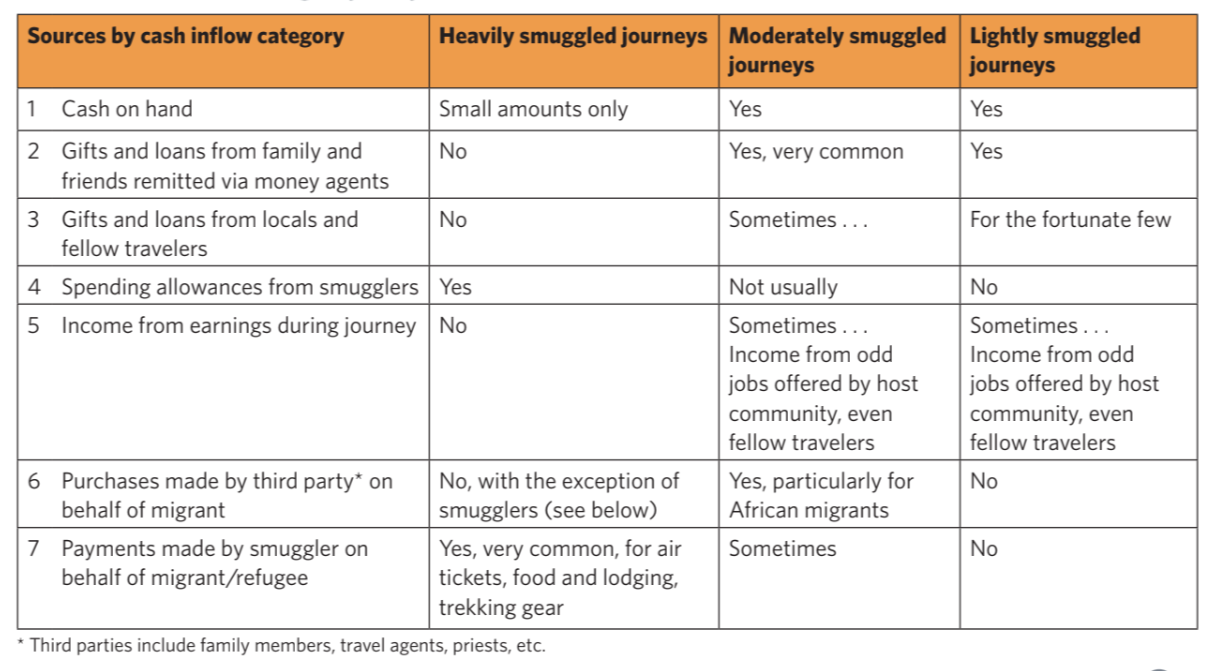
8.2 For West Africans, Stopping to Earn Money Contributes Significantly to Their Financial Portfolios
Before entering South America, migrants had worked as photographers, teachers, accountants, sociologists, and business owners. Some were property owners, tending to farms and livestock or selling various kinds of merchandise out of their homes. In many of the interviews, it also became apparent that these jobs had clearly formed an unshakeable part of their identities. Their work gave them pride and a sense of satisfaction in being able to contribute.
Their departure from home often thrust migrants into job markets that rarely permitted them to utilize the skill set they had acquired back home, though it did resolve their immediate need for money. Most jobs presented themselves in the informal sector, under the table, off the radar, and highly unregulated. Sometimes conditions were dangerous, and their payment was unguaranteed. Very often, tasks were physically demanding and even injurious.
They resorted to a combination of formal and informal labor along the way. “Sometimes you have a good Samaritan who gives you something that should have been a cost,” one Cameroonian told us. The ability of migrants to access local labor markets throughout their journey varied from country to country. There were clearly countries that stood out as places where migrants struggled (Colombia) and others where they were able to put their skills to use (Brazil).
Brazil was routinely mentioned as a place that provided migrants access to paid work. A group of Pakistani men said they found work there easily upon arrival. Others used their networks to seek out opportunities. “God bless, Brazil,” one Ghanaian said during an interview in northern Costa Rica. “There, I met a politician who helps strangers from Africa, who fought to get me a job. At first, I worked for a chicken company, but that didn’t pay very well. Then my boss said she had a cousin who worked for a telecommunications company in Porto Allegre. He came and drafted on the blackboard how the work is going to be and what the pay is.” The Ghanaian said it was a good job that provided him with two prepaid credit cards—one for food and another for other expenses. They also provided a reward card for hard work. Though nudged to leave his country after experiencing political strife, a Nigerian man admitted that he chose to go to São Paulo in the first place after a friend living in Brazil told him how easy it was to find work there.
Another Ghanaian, a man in his mid-thirties, described how throughout his journey, which took him first to Cuba and later to Guyana, he had to adapt and perform jobs he had never done before. After two months in Havana, where he found no work, he went to Guyana, where someone at a local mosque helped him find work with a Chinese gold-mining company deep in the jungle. He was there for two weeks, working long hours and performing dangerous duties, but he was never paid. He decided to leave and returned to the mosque to tell the man what had happened. The man advised him to go to Brazil, where he secured a fairly steady and profitable job working as a trash collector in the southern region. He stayed with the job for nine months. It was tough work, requiring him to maintain a light jog throughout the entire day, but he saved enough to bring him all the way to Costa Rica.
8.3 Small Gifts Patched Together With Other Funds Form an Important Part of Migrant Portfolios, in Instances Where Migrants Were Lightly Smuggled
Migrants, especially lower-income ones, were grateful for the gifts they received along their route. Some came from family back home or in the US in the form of remittances. Those hailing from West Africa named relatives, friends, and priests as generous contributors to their journeys who sought nothing in return.
But in addition to these gifts, money originated from fellow travelers and perfect strangers. Gifts came in the form of money and useful things—mobile phones, food, clothing, and bus tickets. For instance, a Ghanaian man running low on cash received $140 from a Cameroonian, not as a loan but as a gift. We heard of gifts as high in value as $600 coming from fellow migrants. These also came from locals, who admired these gritty travelers, pitied them, or simply felt they were in a place to offer help (speculations made by those we interviewed). A Cameroonian woman in Costa Rica proudly displayed her smartphone. The money to purchase it was given to her by a woman, taken by her story, whom she had met at a bus station. A Cameroonian man was deeply grateful when a Costa Rican police officer gave him $21, the amount he needed for bus fare.
South Asians also told us of receiving money, as gifts, from other South Asians traveling with them, and sometimes immediately upon meeting them. An Indian man, Prem, spoke of a Bangladeshi man, Iqbal, whom he met in the camps in Panama. After Prem washed Iqbal’s clothes, Iqbal offered to pay Prem’s expenses as far as Costa Rica. “It was not in payment for washing the clothes,” Prem insisted. Doing Iqbal’s laundry was simply a friendly gesture, not a transactional one. That is how Iqbal got to know Prem.
Sharing food was part of so many stories. If someone received a remittance, they would celebrate by offering to make dinner or share a mid-day meal. Because most Indian staples—rice, lentils, and spices—were cheap and easily found in shops near hotels and guest houses, underwriting the cost of big meals, cooking together, and then offering the food to fellow travelers was a frequent affair.
Though gifts were often small, many said they were crucial, enabling them to eat or take the next steps in their journey. Gifts from fellow travelers or locals could not alone fund their Latin American journeys but were key to filling in gaps.
Those who received lodging, food, health care, and essential items from NGOs and churches also appreciated the charity. These were an indispensable part of their journey. These gifts gave them a chance to rest, heal, mend their clothes, and plan for the next steps.
8.4 For Heavily Smuggled Migrants, Smugglers Help Remove the Risk of Theft by Supplying Migrants With a Cash Allowance
Those whose journeys were heavily brokered seemed less at risk of losing all their cash. Smugglers would dole out money at stages of the journey, giving strict instructions for its use. Naturally, there was flexibility. The money was not always sufficient to complete a journey’s many tasks. A Nepali venturing north from Chile described how he used the $900 allowance handed to him by smugglers.
- $200 for a bribe to the border police in Chile
- $20 for the hotel in Peru
- $550 to a smuggler’s local handler in Lima
- $20 to the man posing as a handler at the border of Ecuador, who vanished with the funds
His landlord rescued his group and helped them board the bus. After spending money on bus and food, he was left with only $30. He had yet to bribe the border “cops” between Peru and Ecuador. An Ethiopian, being handled by the same smuggler, paid $180 on behalf of the group. From there, his trip and funds were coordinated by a ring of handlers, and he had no more out-of-pocket expenses.
But his smuggled journey ended in Capurganá—at the edge of the Darién Gap. From there, he was on his own.
Another Nepali said that it was in Capurganá where his local smuggler passed him money: “We were given $250 by the agent in Capurganá. Also, before our second attempt (he was turned back once by the mafia), the agent gave us $250.”
8.5 Uses of Funds, Like Sources of Funds, Vary by the Degree to Which a Migrant Is Smuggled
Uses of funds varied according to migrants’ priorities, their financial status in their countries of origin, and the smuggling packages they had purchased. Table 3 summarizes how migrants used their money as they moved through South America.
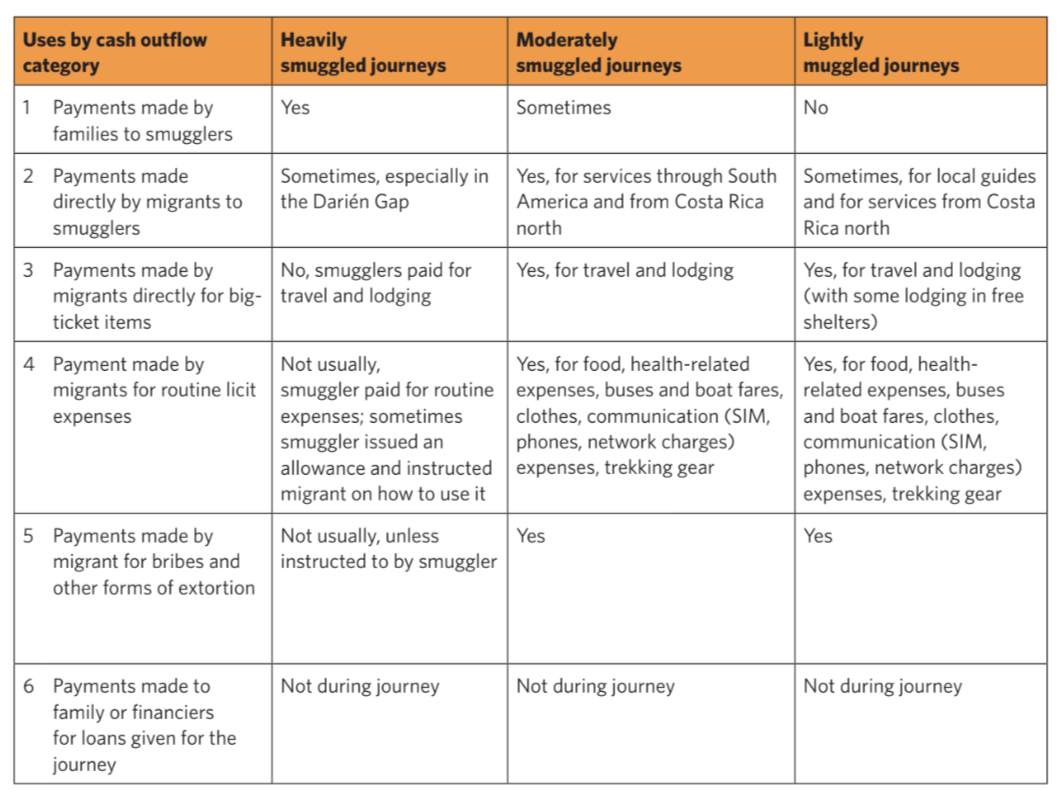
8.6 Bribes Are a Special Cost, Sometimes Surprising, Often Confusing, and Always Requiring Money Management Skills
Without the right visas, border entry bribes were wildcards. Some migrants made it through on as little as $20, while others had to pay hundreds of dollars. Women had widely differing experiences. A few managed to get by with very few bribes, while others felt targeted; they believed they paid higher bribes than men, a complaint that was never confirmed.
Migrants reported that, once within national borders, Colombia was a particularly risky country for travel. Police could easily identify Asians and Africans making their way on buses or waiting in bus stations. One Indian said he spent a total of $500 on bribes to police. Another said police were in relentless pursuit of their money: “The Colombian police checked the elastic in our shoes and cut open our pockets.” Another reported being “made to get naked” after being apprehended on a bus.
Even bus tickets cost more for migrants than for locals. A Sudanese traveler told us of his harrowing trip through Ecuador and Colombia, fleeced by bus drivers, taxi operators, and police:
I traveled to Tulcán alone and then crossed the border to Colombia on foot. At the border, I met a taxi driver who demanded $100 to take me to the bus station or else he would call the police. I paid. I arrived to Ipiales at 11 p.m. and attempted to purchase a ticket for a bus departing at 1 a.m., but was prevented. I did not have the right documents. Another taxi driver offered to buy me a ticket for $70, when the real cost of the ticket was $15. Ten minutes after the bus was underway, the police stormed the bus. I was held in a cell with three Indian men for five days. We were fingerprinted, told that if we wanted to enter Colombia, we needed a visa, and were deported back to Ecuador. I paid $7 for a bus back to Quito, where I stayed for seven days.
Once I crossed the border to Colombia, I again ran into the problem of not being able to purchase a bus ticket without papers, so I attempted to hitchhike outside the station. A bus driver picked me up for $50, for what should have been a $15 fare.
Shortly after getting on the bus, the police raided it and were looking for migrants. I hid with my luggage in the lavatory and pretended no one was inside when they knocked on the door. In total, the police raided the bus four times over 15 hours as I made my way to Cali. Each time, I would hide with my luggage in the lavatory. No one on the bus alerted the police. When I reached Cali, I gave a local $10 extra to buy a bus ticket for Medellin. In Medellin, I paid another local $10 extra to buy a $20 ticket to Turbo.
But again, migrant experiences varied. There was no single migrant experience of bribes or extortion. Some said they could negotiate with the police and were able to pass through the entire country, spending as little as $20 on bribes.
How bribes were paid was both direct (money paid to the person seeking a bribe) and indirect (money paid to a third party). A male Cameroonian explained how a surrogate agent worked:
In Cali, Colombia, I visited a migration office where I stood in line to receive a transit visa. When I got to the front of the line, they told me I was ineligible and sent me outside. A few minutes later, I was approached by a child on a bicycle who had a picture of me standing in line inside the migration office. I gave the child some cash who returned minutes later with a transit document.
8.7 Converting Money Means Converting to the Dollar, Not to the Local Currency
Each border brought with it a new currency. Crossing from Brazil to Peru meant switching from Rais to Sols. Moving north, the currency would shift to the US dollar (Ecuador), the peso (Colombia), the US dollar (Panama), and the colón (Costa Rica). And every other border north of Costa Rica would also demand the use of a new currency.
But migrants said that once they converted their money into dollars, which they did early on in their journeys, they could use US dollars throughout. The migrant economy in some towns was so robust that shopkeepers posted their prices in dollars, even when the dollar was not the official currency. Migrants would pay in dollars but receive their change in local cash, and found small amounts of local cash useful. The problem was that they were rarely in a place for long enough to fully comprehend the value of each country’s currency.
8.8 Helpful (or Corrupt) Locals Assist With Money Transfers, at a Hefty Price
Migrants often lacked the documents required to receive a money transfer. Formal money transfer agencies such as Western Union and MoneyGram did not recognize temporary transit passes issued at various borders. And, even if migrants had the documents, agents would not accept them. We believe this was for two reasons. First, agents did not know their corporate internal policies, and it’s no wonder. We had the chance to examine 90 pages of internal policy guidelines for a formal money transfer service and found the instructions for migrant IDs buried on page 67. In Costa Rica, government officials claimed that their 25-day transit pass was a document adequate to receive a transfer. But migrants said that they were turned away when attempting to use this document. Second, and most importantly, recognizing temporary travel documents as proper ID meant missing an opportunity to profit.
Whether in Colombia, Panama, or Costa Rica, migrants said that money transfers were frustrating, confusing, and a losing proposition. Blocked transfers and extortion had become standard by-products of receiving overseas remittances. So had outright theft. Without acceptable ID, migrants were held hostage to local actors.
Typically, migrants would try their hand at receiving funds from the US, Europe, the Middle East, South Asia, and East and West Africa using their own names as transfer recipients. Then, when the Western Union agent rejected them, they would search for and find a local to receive the funds in their name. More often than not, the local would magically appear: “They are always outside the hotel and find you. You don’t have to do anything.”
Migrants would text instructions to relatives to resend funds in the name of the helpful local. For their services, locals charged between 10 percent and 20 percent of the transfer amount. This fee was in addition to the fees the sender was already paying.
Transferred money by many was deemed crucial to the journey. A male Indian clarified:
I had arranged a particular budget beforehand. I am solely relying on Western Union to get money along the way. In Panama, we used IDs of Western Union employees in the shops. At the camp, I got around $2,000 from home (in one transaction). Everyone in our group has received money from home along their journeys.
Besides Western Union agents, we heard about hoteliers and ordinary citizens helping migrants to receive their funds. Mama Africa and Mamma, popular smuggling operatives in Costa Rica and beyond, would take in migrants at Costa Rica’s southern border. Because migrants had often been stripped of their money in the Darién Gap, Mama or Mamma— we never learned if these were the same or different women—would help them secure money to pay for lodging (of course, at their own hotels and guest houses). The fee was 10percent.
Outright theft of remittances was always a possibility. Many told us of how they were conned. Here is just one report:
Finally, a person, our host in a local church in Turbo, Colombia, who seemed trustworthy, told us that it would cost $100 per person to cross the jungle on foot or $200 by boat per person. We chose to walk. Our host offered us shelter for four nights and treated us with great kindness. We did not have enough cash with us to pay him, so, at his instruction, we requested that our friend in Brazil send us money in our host’s name. Our host went to Apartadó (near Turbo) to receive the money, but said that he was caught by the police and had to bribe them $150. He also charged us a commission of $30.
The Panamanian camps where migrants crowded after their trek through the jungle housed a thicket of money transfer facilitators. There was always someone, migrants reported, hovering nearby to take their money. Again, the charge was 10 percent.
8.9 Informal Transfers (Hundi and Colombian Versions Thereof) Are Referenced, but Not in Detail
We did hear, but were never able to confirm, the use of informal transfer systems. A Costa Rican shopkeeper’s description was vivid:
Oh, to get money, migrants go to Liberia, about an hour from here by bus. They go to the plaza where they can see the motos [motorcylces]. These motos are operated by the Colombians. The Colombians are the experts at getting and sending money. You want money from your brother in New York? No problem. The Colombian on the moto has a list of numbers, and he will find someone in New York. That person can come to your brother, take his money, and then call it in to the Colombian in Liberia.
While no one corroborated his story in Costa Rica, we were able to find a number of informal money operators in East Boston, also Colombian.
The informal system of the hundi, operating much like the system just described, was referenced by Nepalis in the US who used it to transfer money to Nepal. We also heard it being used in Costa Rica. One Nepali researcher on our team heard a smuggler on his mobile phone demanding his payment be made by hundi.
8.10 The Constant Possibility of Theft and Graft Makes Migrants Hyper Alert and Motivates Them to Hide Their Funds in Creative Places
We have discussed how migrants are subject to police extortion as well as to the clutches of local mafias grifting through the Darién Gap and southern Nicaragua. Migrants, lacking Spanish conversancy or a sense of geography, expressed their helplessness in the hands of smugglers, cheats, and con artists. Several said they had developed a kind of sign language, not readily understood and often conveniently misunderstood. One said, “While handling money, I never knew if I was being cheated.”
The skills migrants could deploy were no match for the native cunning of corrupt police, complicit local guides, and the designated bandits within the mafias, all speaking rapidly in a language that migrants couldn’t parse.
However, loss of money could be experienced indirectly as well. Certain migrant groups were targets of scams where local extortionists compelled them to purchase goods near the camps. South Asians, Indians in particular, felt exposed, presumably because they were seen to be more wealthy than other Asians and Africans. One described how camp officials forced an Indian group to remain in the Panamanian camps until they had spent $3,000 in the local shops. This was a common story.
Hiding cash was a continually improvised activity. Migrants devised numerous places to sequester their money. Migrants hid dollars in the soles of their shoes, their walking sticks, in the lining of their belts, in the cuffs or waistbands of their trousers, and inside the chargers of their cellphones. One couple said in the Darién Gap, they tucked money inside their baby’s diapers. A Nepali journeying through Peru described in detail how he had “hidden [his] phone, wallet, and passport inside a packet of noodles and stuck it together with superglue.”
We heard of only one instance where migrants (a group) used Forex or prepaid cards as a strategy to minimize theft. And that was solely within the borders of Ecuador. How they obtained their cards was unclear.
8.11 Some Smugglers Fully Cheat Migrants of Their Funds
Migrants had to heed the possibility of being cheated by guides, smugglers, and impostors. Locals would masquerade as smugglers, then vanish with migrants’ funds.
A Cameroonian, David, shed light on how easily migrants could be robbed in this way. Almost immediately after arriving in the coastal town of Turbo, David set about finding a fixer to help him cross the Gulf of Urabá. He quickly found someone charging $2,200 to take 11 people at $200 a head to Capurganá. (We later learned some migrants had finessed $25 a head.) He signed up to go. On the night the 11 were supposed to embark, a man approached them at the docks pretending to be their agent. He collected their money, then ran off, never to be seen again. For two weeks after the con, David had to wait for a money transfer, all the while accumulating food and lodging expenses.
If migrants did not speak Spanish, their plight worsened. Migrants reported that local smugglers—many supposedly already being remunerated by their kingpins—would press them for more money. Refusal to pay meant being locked in their rooms (one reported he was locked in for 12 days), left to fend for themselves, or beaten.
An informant with the migration police in Costa Rica elaborated on the deception:
Beginning in September 2016 and into 2017, there were thousands of people in the North CATEM [the temporary shelter]. Smugglers would take hordes of them in boats into the sea. After four hours at sea, the smugglers would drop them at a nearby location in Costa Rica and tell them it was Honduras. They would take some $1,500 for just this trip. They would also have to pay $200 for bribing the military officers in Nicaragua. In this manner, the Nicaraguan military officers became very rich—they were otherwise getting a $100 salary. Corrupt officials are also involved in this. They usually “pre-receive” their bribes from smugglers prior to the actual smuggling event.
9 Identity Documents and Identity Reshaping
9.1 Migrants Receive a Blizzard of Advice and Experience Ensuing Confusion About Which Documents to Carry or to Hand Over
Though some migrants gained entry to South America without papers, most we interviewed had passports, at least in the initial stages of their journey, even if they had purchased fakes.
Depending on the advice of smugglers, their countries of origin and the rumors of fellow travelers, migrants hewed to different theories about what to do with their passports. Following is a range of contradictory responses:
- A Yemini wrapped his passport in plastic protection—three layers—and carried it with pride, despite advice from fellow travelers that he should have dis- posed of it. (He since made it to the US.)
- An Indian threw away his passport in Ecuador, and another threw his away in Colombia. Another gave his passport to his smuggler in Ecuador to be mailed to him in Mexico. And another was told to “dump your passport after arrival in Bolivia.”
- A Nepali was instructed to “tear away” his passport as he boarded the boat for Capurganá. Another said that some in his group were told to bury their passports in the ground in Capurganá while others were told to give them to their smugglers.
- A Haitian left her passport in Brazil with family members.
9.2 Those Who Keep Their Passports Face the Consequences of Passport Theft, Loss, or Destruction and Even Deportation
Those who did keep their passports faced a host of risks and penalties. They reported that the mafia in the Darién Gap stole them, or they lost them while fording rivers in the jungle. Others said their documents became waterlogged and useless.
A Nepali traveling with other Nepalis and Indians made it through the Darién Gap only to encounter Panamanian authorities:
The Punjabis tried to implicate us in the first camp in Panama and got us deported. One of their friends could not make it to the first camp and they blamed us. The Punjabis accused us of killing their friend and the army deported us. We had never even met or seen the person we supposedly killed. The Punjabis also collected the passports of some of us and handed them over to the Panamanians. They even accused us of being false Nepalis and claimed that we were hiding our identities.
9.3 Lack of ID Drives Migrants Underground, Prevents Legitimate Money Transfers, and Lures Locals Into Criminal Activity
Whether through loss, theft, destruction, or misguided advice, many migrants did not have their passports.
This report has already detailed the cost migrants had to bear when receiving remittances. In summary, if they lacked the kinds of documents that agents working for Western Union or MoneyGram found acceptable, they would have to bribe a local to retrieve transfers on their behalf or would bribe agents directly. The cost of the bribes varied between 10 percent and 20 percent for each transaction. Migrants faced the prospect of losing their entire remittances, if locals chose to abscond with them. As one migrant said: “I feel scared and skeptical about who I can trust. I don’t have a passport so I need someone to pick up money for me from Western Union, but I don’t trust anyone.”
This begs the question of the efficacy of a body of standards known as AML/CFT (anti-money laundering/combating the financing of terrorism). To comply with these standards, financial service providers follow a set of procedures called Know Your Customer (KYC). These procedures are supposed to establish the facts and the behaviors of a specific customer. What do we know about the individual? Is he or she committing fraud or likely to commit fraud, or worse?
The AML guidelines inform the specific policies of financial service providers. But compliance is expensive and a major deterrent to financial inclusion, where financial inclusion is a key focus of many governments, including Colombia, Costa Rica, and Mexico. Financial service providers will shy away from serving low-income clients because of the burden of regulation.
What does this mean for migrant remittances? KYC procedures are clearly not working, a fact with several implications. First, non-compliance excludes migrants from receiving their remittances at a fair price or in a reasonable amount of time. Second, it does not establish the correct customer whom the supplier is supposed to “know.” Third, it lures locals, who otherwise might be law-abiding citizens, into criminal activity. They have become part of a clandestine network of smuggling and trafficking. These facts imply a need for KYC reform, which we discuss in the Policy Implications section of this report.
9.4 Some National Identities Are Modified During the Journey
Migrants took on different national identities during their journey. Cameroonians would feign being Nigerian to experience safe passage. South Asians admitted to taking on different national identities if advantageous to do so, and it often was: transit countries had varied policies favoring one group over another. Similarly, Haitians would masquerade as Africans and vice-versa. An informant in Costa Rica explained that in the wake of construction surrounding the Olympics and World Cup, Brazil was eager to be rid of its low-cost labor. Through various strategies the country was able to nudge both Haitians and Africans out. Costa Rica had a more lenient policy regarding Africans than Haitians, even unofficially.
If you look at the statistics, of the 30,000 people that migrated through Costa Rica, most will say they are from the Congo. That is because in Haiti you speak a French and Creole that is similar to French spoken in the Congo. From that great number maybe 15 percent are actually from the Congo. We found this out when they [the migrants] got to the northern shelter and wanted to be grouped with the Haitians. The Haitians are like most people from the Caribbean; they like to party, but travel alone. The Congolese would keep their floors cleaned, would pray, and eat different food. We had trouble asking the Haitians to cook for the Africans or vice versa. Conflict developed around food, and that was when we realized that the majority of migrants were Haitian. There would be 300 Haitians against 100 Africans. We had to start fostering a sense of community in this shelter by actually separating Haitians and Africans.
10. Conclusion
While migrants from Asia and Africa are a trickle in the stream of migrants that flows north from South and Central America, their journeys are important. Some are bona fide refugees. Others have left desperate circumstances and hope to seek asylum in the US. All are coming in search of work and plan to work hard.
We chose to understand and write about their journeys because few others were. Compared to the travel of South and Central Americans moving north, the journeys of Africans and Asians are hidden. These migrants face special dangers. They are identifiable in a crowd and easy to target for extortion. They pay much higher prices than locals do for the exact same things. Unable to bargain in Spanish, they are at the mercy of gatekeepers who crop up at every turn: government authorities (many on the lookout for easy bribes); local profiteers; and networks of smugglers, guerillas, and con artists.
And by comparison to South and Central American journeys, African and Asian journeys are expensive. They must pay enormous sums—as much as $30,000—just to get to South America. Those who pay less suffer the consequences. They patch together their travel with money from every possible source. They work odd jobs in a language they don’t know. Some are reduced to begging at borders. They beseech friends and family in the US, back home, or in Europe to send funds via legal means, only to face multiple hurdles in trying to comply with the law.
Additionally, migrant journeys are gendered, and therefore men and women have different needs that are currently not being addressed. A common need, however, is access to information on asylum and other visa options in countries of transit.
While the journeys of all migrants ought to be safe, orderly, and regular, to use the parlance of the UN, without government intervention, many will never enjoy the promises these adjectives impart. Destination countries like the US and transit countries like Colombia and Panama, in coordination with the UN, have a moral obligation to remove the special risks for Asians and Africans. They can begin by acknowledging that migrants will continue to come to countries with flexible visa policies. From those countries, like Brazil and Ecuador, migrants will move north. Currently, and unnecessarily, many legs of their passage are made with the help of smugglers.
Issuing an ID in Ecuador useable in South and Central America is a good place to start. If digital, the ID would also help authorities better understand the movements of migrants. Putting signage at bus stations and borders in English (ideally in French and Hindi as well) could also assist in safe, orderly and regular journeys. While Spanish is the lingua franca of locals, it is not the most familiar or shared language of extra-continentals. Many Africans and Asians speak and understand at least some English. Those who do not pair up with those who do.
Strategic placement of signage in English could go a long way. Instead of learning the various ciphers specific to a clandestine network, migrants could find, in English—or even better in their native languages—directions to safe hotels, eateries, and border crossings. Signage could also highlight mobile apps as map route planners, text-to-speech features, digital dictionaries and translators, and real-time photo translators. Wi-Fi hotspots at ports of entry, docks, and bus stations would also go a long way.
And finally, the Darién Gap poses a set of risks not felt by those who never journey through it. Inside the gap, an unholy mess of terrors awaits Asians and Africans. Trauma counseling for men and women who have lived through it might be enormously helpful. These are people who plan to come to the US and we know first-hand that many do (they told us so). They come with skills, physical strength, and an Olympian stamina. Why wouldn’t we want them also to come with a mind at peace?