
Written by: Aastha Dua and Subin Mulmi, Under the Supervision of Kim Wilson
Table of Contents
Introduction
The authors observed the South Asian identity play out in interesting and diverse ways among the migrants interviewed. The dynamic between the general populations of these countries—oscillating between brotherly love, jealousy, and rivalry—was reflected in full, as if in a microcosm, among the South Asian migrants traveling to America in their interactions with each other. This essay is an attempt to describe this dynamic, culled from the interviews that were conducted by the authors with the migrants and from their own observations in the CATEMs (Temporary Care Centers for Migrants) and the surrounding areas in Costa Rica.
The partition of India into India and Pakistan in 1947, and the subsequent partition of Pakistan to form Bangladesh in 1971, has led to a fascinating interplay of stereotypes among the nationals of these three States (Singh, 2007). Add to the mix the linguistic similarities between Indians, Pakistanis, and Nepalis and the commonality of culture between Bangladeshis, Indians, and Pakistanis, and we find ourselves in a melting pot of strikingly similar yet dissimilar peoples, cultures, and ideas. When these people, cultures, and ideas converge in a small space with heightened danger, their differences and similarities come to the forefront and dominate how these vulnerable people interact while heading towards a common goal.
The migrants had just arrived from Panama to Costa Rica with vivid and traumatizing memories of crossing the Darién Gap. Most of their stories centered around those riveting memories. While interviewing South Asian migrants, the authors also attempted to understand the dynamics between them. Since Indians comprised the majority, the authors thought some statistics on the number of migrants arriving in the US from South Asian nations could provide pertinent context for stories shared by the migrants.
*Note: For the purpose of this essay, the term “South Asian” includes Indians, Pakistanis, Nepalis, Bangladeshis, and Sri Lankans.
South Asian Migrants in Numbers
The number of Asian Migrants coming to the US has recently increased (Pew Research Center, 2016, p. 12). Asians comprised 13 percent of unauthorized immigrants in 2014 (Pew Research Center, 2016). The number of unauthorized Indian immigrants increased from 350,000 in 2009 to 500,000 in 2014 (Pew Research Center, 2016).
According to the Center for Migration Studies, India and Pakistan are among the top 25 countries from which unauthorized immigrants are arriving. Table 1 illustrates the number of unauthorized immigrants into the US in the years 2012 and 2015 (Center for Migration Studies).
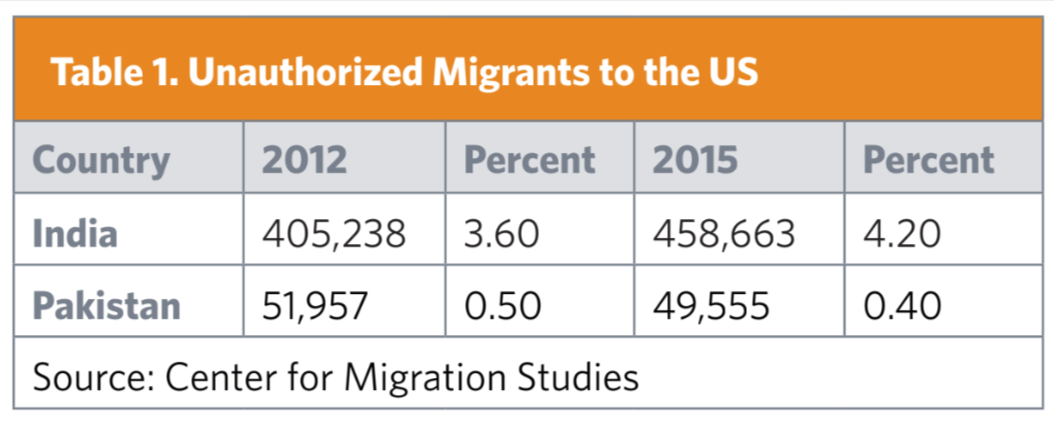
The total number of unauthorized immigrants staying in the US coming from other South Asian nations could not be found, but the number of individuals granted asylum affirmatively or defensively from South Asian nations indicates that the number of unauthorized immigrants staying in the US from countries like Bangladesh, Nepal, and Sri Lanka is also quite significant. Homeland Security’s “2016 Yearbook of Immigration Statistics” reveals the numbers found in Table 2.
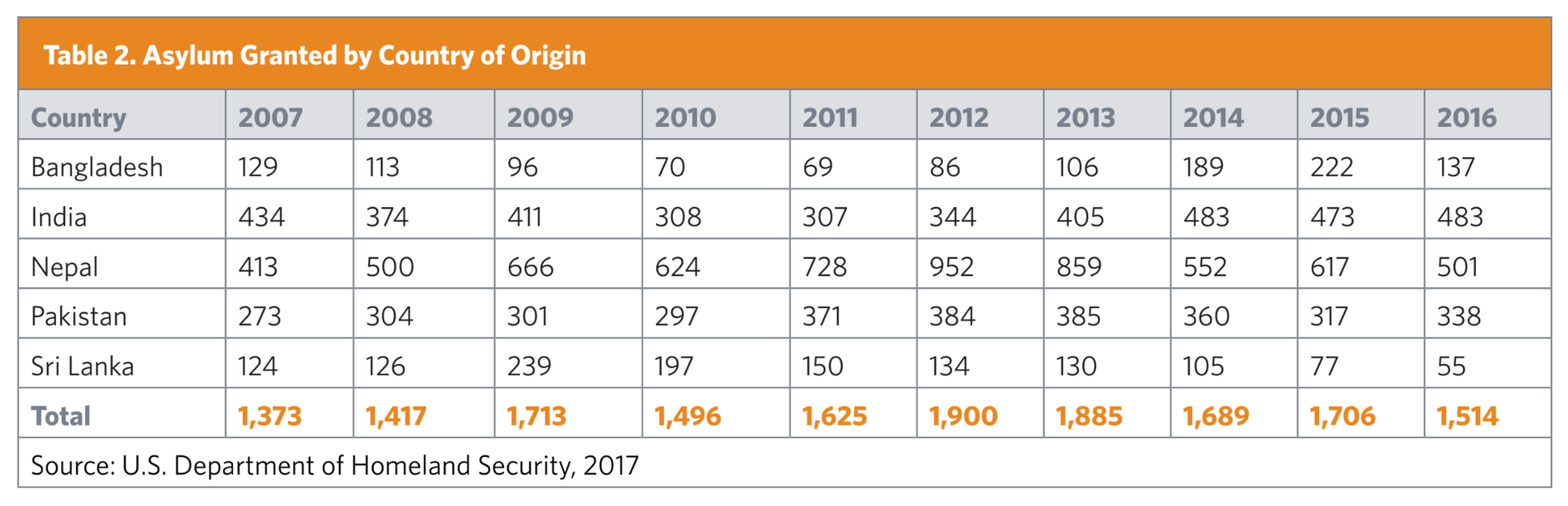
It cannot be assumed that all the unauthorized immigrants staying in the US from South Asian nations have claimed asylum. However, all the migrants interviewed by the authors stated that they intended to claim asylum after they reached the US. Despite a huge difference in the number of unauthorized immigrants coming from India and countries like Nepal, Pakistan, and Bangladesh, it is surprising to see increasing numbers of people from Nepal receiving asylum each year since 2008. There is not a vast difference between India and Pakistan or Bangladesh.
Another interesting statistic is the number of individuals apprehended at the border, which is again provided by the “2016 Yearbook of Immigration Statistics” and shown in Table 3.
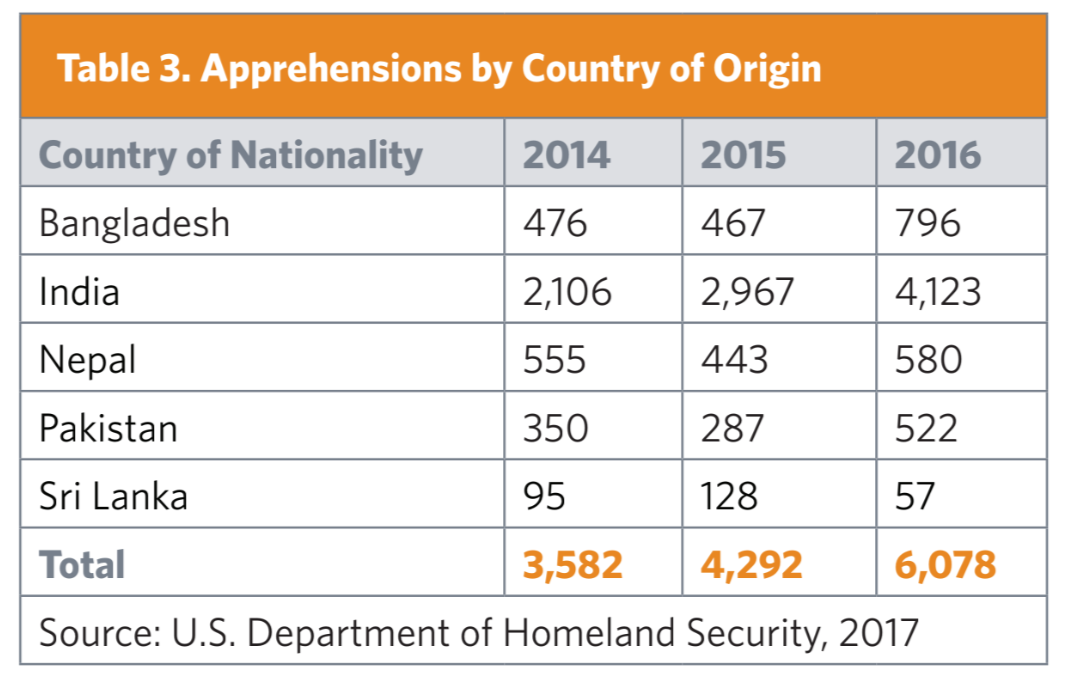
The table shows that the number of South Asian immigrants is increasing every year. Indians comprise the majority of South Asians, and the number of migrants from Bangladesh, Nepal, and Pakistan over the years has been similar. The authors, however, met a higher number of Nepali migrants in Costa Rica than Bangladeshi or Pakistani migrants. In fact, on the first day of the interview, there were 12 Nepalis, 6 Bengalis, and 40 Indians out of the 60 migrants present in the South CATEM. The stories these migrants shared about how they formed groups, bonded with each other along the way, and also had some misunderstandings provided context and color to these numbers.
Formation of Groups
The authors observed in the CATEMs and through subsequent interviews with migrants from different nationalities that the migrants from South Asia generally travelled in groups. Such groups were either formed by the agents right before they took the first flight from their country or during the journey. The groups that were formed during the course of the journey usually did so on the basis of nationality and, on some occasions, on the basis of language.
Interestingly, all the Nepalis interviewed by the authors had their groups formed by their respective agents. Such groups were formed in Delhi and in-
cluded people from different South Asian nationalities. The agents stationed along the way had already planned the route, so these people had to stick to
their own group. An interview conducted with an immigration attorney in New York City shared with a co-author that the reason Nepalis traveled in groups is because these agents stationed along the route in South American and Central American nations are also Nepalis. This explains why the Nepali migrants are extremely scared to share details about their agents (Panthi, 2017) and also why their trip is extremely organized and well planned.
The Indians, however, had a different story. Most of them travelled alone without agents from their country and met people along the way. The three Pakistanis that the authors met also travelled without agents. Persons who were travelling alone quickly formed groups when they met people from the same nationalities. This usually happened in one of the transit hubs, such as on the boat from Turbo or in the jungle itself. Some Indians shared harrowing stories of having to spend days alone in the Darién Gap without any assistance.
A migrant from Haryana, India, said,
I spent almost six and a half days in the jungle. It was okay in the jungle, and I was not scared because I found a group of people in the boat also from Haryana, of the same age group and of the same caste. They were almost 15 of them, and then we travelled through the jungle together.
Another migrant from Punjab, India, shared,
I spent 20 nights in the jungle, and those were extremely scary nights. I spent the first five nights all by myself. I could not sleep for those five nights, and then I met some other Indians. Then it had become easier for me as I became habituated.
Indians in the journey, the undisputed majority of people traveling, relied on each other for emotional support. However, in the rare cases when Indians were traveling alone, they found camaraderie and company from other quarters. The same Indian migrant, before reaching Capurganá, had travelled with the Bangladeshis. This is what he had to say:
The first few weeks in Brazil were enjoyable as I had money and I could spend it the way I wanted. I did not know anyone there, so I did not know how to find work. After a few weeks, I came in touch with a Bangladeshi group who were trying to go to the US. I spent some time with them. They even hosted me in their place in Rio Branco. I just followed them as I did not know what to do next. We had no real issues crossing the borders at Peru, Ecuador, or even to Colombia. There were guides who showed us the way. They charged a lot of money just to show us the directions. Some of them even charged us $500 just for showing the direction. After reaching Capurganá, the Bangladeshis left with their group, and I was alone. I was still grateful to them as they looked after me for more than a week and offered food.
Obviously, both migrants were able to quickly bond with the other Indians that they met in the jungle. It helped that most Indians traveling belonged to the same area in the north of the country (Haryana and Punjab) and spoke the same language (Hindi, Punjabi). The emphasis given to caste by the first migrant here is interesting to note, but it seems to be an exception, as many Indians from different castes were seen travelling together without any major issue and bonded with each other along the way.
Commonalities and Camaraderie
The stories shared by the migrants about how they bonded while crossing the Darién Gap are particularly fascinating. In some instances, people able to communicate in Hindi (Punjabi Pakistanis, Indians from Haryana and Punjab, Nepalis, and some Bangladeshis) were able to put aside their differences (for the most part) and stick together through the forest, helping each other out and seeing each other through. Despite having very little to eat for themselves, the migrants shared food with other people who had been stranded on the journey or were trying to heal from the wounds caused by the treacherous path. An Indian migrant who travelled in a group consisting of other Indians said,
We met five boys who were there for 13 days. We walked only during the day as it was not visible in the night. We slept on the stones. We also helped the . . . Somalis. . . . We helped an Indian boy who had fractured his leg. We also helped a Bangladeshi by sharing food with him. . .
A Nepali migrant stated,
There was a Nepali woman travelling with us, and we literally had to drag her from the river to save her life from drowning. We had to save three people from drowning. Also, there was a Bengali guy whose leg was injured and could not walk. We gave him all our biscuits. He said that he was there in the river for ten days.
A Pakistani migrant had grouped with Indians. This is what he shared with the authors:
In the jungle, we met a group of around 40–45 Indians, and you know how it is; immediately we became like brothers and then travelled together the rest of the way.
Commonality of Language
The commonality of language played a crucial role in unifying migrants from South Asia. Indians from Haryana and Punjab, Nepalis, Pakistanis, and some Bangladeshis had varied levels of proficiency in the Hindi/Urdu language. As a result, they easily interacted with each other and sought help when required. The popularity of Bollywood seemed to have definitely helped in bringing people together. Many South Asians belonging to regions where Hindi is not spoken were still able to use a spattering of Hindi words only because they have grown up watching Bollywood movies all their lives (Sharma, 2011).
A migrant from Bangladesh said,
When I got down from the bus stand in Quito and started walking, I immediately bumped into an Indian selling some silver items on the road. I speak some Hindi because I love Bollywood movies. When I told him my story, he told me to come and live with him, so I went to his house, and he gave me some space in his room. I found work working in a restaurant again, washing dishes. I did this for one and a half to two years.
The Nepalis and Bangladeshis were able to understand Hindi, but they could just as well communicate among themselves in Nepali or Bengali and exclude Indians from their conversations, which they often did. The Nepalis in particular expressed their dislike for some Indians openly to the authors, requesting the authors not share this information with the Indians.
Food and Entertainment
Another commonality between the South Asian was food. Rice, dal (lentil soup), and curry are staple foods for Indians, Nepalis, and Bangladeshis. The authors observed that the food made in the South CATEM in the three instances when the authors visited comprised rice, dal, and some form of curry. A Nepali migrant had complained about the portions, specifically saying that the portion was not enough for South Asians who love to eat a lot of rice. It was interesting to note that the person used the term“South Asian” and not just “Nepali.”
After spending a night in the South CATEM, many South Asians moved on to the northern part of Costa Rica, but some stayed for an extra day in Pasa Canoas in a hotel called Hotel Asia. When the authors went to the hotel to interview some migrants, they found that the hotel constituted migrants only from South Asia. It offered South Asian food and organized an entertainment session for the migrants every night by playing Bollywood songs. After the dreadful Darién and the tormenting nights at the Panamanian camps, this entertainment session offered them the much-needed enjoyment they sought. This became a stage for them to bond with each other, blurring the lines of nationality and celebrating their common identity.
Biases Against Other Groups
The South Asians also bonded because of their biases against other groups of migrants, Africans in particular. Though many South Asian migrants could not distinguish the nationalities of African migrants and regarded all Black migrants as Africans, they seemed to have a common opinion on them.
An incident to note was a fight between a Somali migrant and an Indian migrant in the South CATEM, right in front of a co-author. As the migrants stayed only for a day and a half in the South CATEM, they took turns to cook and clean. The Indians had cooked the previous night, and the Nepalis had cleaned after them. Similarly, on that particular day, the Nepalis had cooked. After everyone had eaten, the Indian migrant kindly requested one of the Somali migrants to clean up. The Somali guy refused, and the Indian asked aggressively, to which the Somali guy swore at him in English. The Indian migrant immediately put his hand on him, and in no time everyone gathered around to break up the fight. Another Indian migrant who had been interviewed already told the co-author that he felt that all Africans had a criminal mindset and did not deserve any kindness. According to him, the same Indian guy had helped the Somali guy and his friend to cross the river to the first Panama camp and had been together till Costa Rica. More than this, it was interesting to see that the Nepalis sided immediately with the Indians and complained about the Somalis, saying that most Africans making this journey are criminals. Many South Asians seemed to have this mindset about the so-called Africans.
Since most South Asians kept their distance from the African migrants, it was interesting to find three Pakistanis in the North CATEM bonding so well with some African migrants. A French-speaking migrant from Congo was playing Ludo (a South Asian board game) with the Pakistanis and had apparently mastered the tricks of the game already. These three Pakistanis, on the other hand, despised the Indians and felt no affinity towards the Nepalis and Bangladeshis. Even within the group of Indians, Nepalis, and Bangladeshis, rivalries existed. In particular, the tenuous enmity between these groups was observed and analyzed by the authors in more detail.
Rivalry Between Indians and Nepalis
The Indians and Nepalis, at least on the outside, seemed to co-exist without any kind of infighting. Indians in particular had nothing negative to say about any specific Nepali or the Nepali group in general. In fact, some of the Indians felt that the Nepalis were the most helpful people. On the other hand, none of the Nepalis expressed a strong hatred towards the Indians, but they did share stories revealing a dislike for them. A group of Nepali migrants in the South CATEM complained about the indiscipline of the Indian men. One of the authors observed this phenomenon, and during the orientation of the migrants in the South CATEM, right before they were handed their asylum documents, some of the Indian men reluctantly followed the instructions, which annoyed the Nepalis, who just sat down and followed every word that was said.
A migrant from Nepal describing his displeasure of the Indians said,
It is more difficult for the Indians than us. These Indians are too much at times, as they are not disciplined. Us Nepalis, we are very obedient. We do as we are instructed, but these Indians do not listen to anyone. This is why even in the camps in Panama, whenever they met Nepalis, they said, “Oh yes, Nepalis, very good.” I even slapped an Indian guy at Capurganá for swearing at us using abusive languages on mothers and sisters.
The Nepali migrant’s story shows that despite being able to understand Hindi, the Nepalis still did not fully understand the undertones and intricacies of the language. The Indians seemed unaware of this shortcoming, as they thought the Nepalis had a level of proficiency in the language similar to theirs. Foul mouthing in Hindi, using “languages on mothers and sisters,” is quite common and, to a certain extent, “acceptable” and “inoffensive” to many Indians but not so much in Nepal, and unsurprisingly, the Nepali migrant took offense.
Another interesting incident took place in Panama. A Nepali migrant shared that his group of Nepalis and Indians were falsely implicated by Punjabis in the first camp for murdering an Indian man on the way and were thus deported from Panama to Capurganá. The Punjabis, however, did not blame the Indians in the group who had travelled together with them but put the blame entirely on the Nepalis.
Other Rivalries
Special emphasis needs to be given to the relationship between Indians and Pakistanis. A rivalry that has grown to be (in)famous in recent decades plays out in different ways between political and apolitical peoples (Paul, 2006). This is especially true for Pakistanis and northern Indians (such as those traveling in these circumstances from Haryana and Punjab) due to shared cultures, traditions, languages, and foods. The authors found instances of both political and apolitical relationships between the groups traveling together.
Although Indians and Pakistanis would appear friendly to each other given the challenging circumstances, the authors found in an interview with the owner of Hotel Asia that Indians and Pakistanis in the hotel were constantly at each other’s throats and could not stay together peacefully.
A story that illustrates the friendly rivalry between the persons of these two nationalities is as follows:
A Pakistani migrant said,
Let me tell you a funny story about the Indians. So the Indians that we were traveling with had some cashew nuts and almonds they had brought from home, but they never shared them with the rest of us because they are really expensive. Then one day when we were in the jungle, the mafia caught us. You know how it works? The donker [local smuggler] takes us through the jungle and then leaves us one day before the end of the journey, and then the mafia comes. There were two men with big guns, and one was hiding in the tree with an even bigger gun.
He hides in the tree just in case any of us decide to attack and overpower the two mafia men. Anyway, so the mafia came and took everything from us, including the bags of the Indians with all the food. Then we went and hid near the river, waiting for the mafia to leave so we could go back and see if anything was left behind. Some Africans went back to find the bags, and they found the bags with the cashew nuts. So that night, we had lots of cashew nuts! You see, Indians don’t like to share. They hide their own stuff, and finish everybody else’s.
Other examples of small rivalries and one-upmanship were observed by the authors in the South CATEM as well. In one morning in the South CATEM, a dispute was brewing between a group of Indians and a group of Bangladeshis over the number of eggs that could be cooked per person for breakfast. Generally, one group would cook for everyone in the CATEM and another group would clean up after, but because of a dispute the previous night where there was not enough food for everyone, in the morning people were milling about in their groups and refusing to cook for everyone. Eventually, a group of Indians decided to take a proportionate number of eggs from those available and cook only for themselves, which led to a war of words between a representative of the Bangladeshis, and accusations about stealing more eggs than was proportionate were being thrown about. One of the authors was asked to intervene and mediate between the two groups.
Persons who could not speak Hindi or any of its variants (some from Bangladesh, Sri Lanka, etc.) usually were not included in the bigger group and had thus formed their own groups. Some rivalry ensued between these groups. For example, the authors heard from an interviewee a typical retort from an Indian migrant:
In the jungle, there was a fight between some Indians and some Bangladeshis. These Bangladeshis were wearing “dhotis,” and the Indians called them “saari vaali girl” (“a girl wearing a saree”), and then there was some argumentation and also a little fight between the two groups. The Indians beat up the Bangladeshis and were telling everyone this story!
Conclusion
These stories illustrate the interesting dynamic between persons belonging to South Asia. The authors interviewed persons from India, Pakistan, Nepal,
and Bangladesh during the study and marveled at the way certain commonalities—in particular language—bring people together. Given the massive numbers of South Asians travelling to the US through South and Central America, their interactions were inevitable. While some embarked on the journey together from their home countries, some of them met along the way. Throughout the journey, they formed groups and bonded based on those commonalities, providing each other emotional and physical support to overcome the gruesome journey.
With the Indians dominating the number of migrants and with the Hindi language being the common factor for most South Asian migrants, the assimilation centered around them. The Nepalis and Bangladeshis sided with them not just because of their shared language but also because they shared similar biases toward non-South Asian migrants.
The Indians were largely unaware of the underlying displeasure towards them from Nepalis and Bangladeshis, which rarely came to the forefront, but when it did, was in the form of minor scuffles or physical confrontations. The rivalry between the Indians and Pakistanis, however, was more apparent.
All persons that the authors interviewed spoke Hindi with varying proficiency, but just the fact that it was spoken at all broke the ice between the persons and enabled sharing and connection at a level that would have been impossible if the interview had been conducted in another language, such as English.
In conclusion, though, the authors found that despite some minor skirmishes between the migrants, at the end of the day, they seemed to appreciate the presence of others from their own part of the world and were largely able to put aside their differences when help was required by any of them. At moments of extreme anguish or extreme enjoyment, their national identities were shadowed by their common South Asian sensibilities.
📝 This article was originally published as a report by the Henry J. Leir Institute at The Fletcher School of Law & Diplomacy and Tufts University.
Download the original report below ⬇️