
Financial Integration in Displacement – Quito, Ecuador
Written by: Dani Douglas, under the supervision of Kim Wilson
Table of Contents
Executive Summary
A team of researchers from The Fletcher School of Law and Diplomacy spent nine days conducting ethnographic fieldwork in Quito, Ecuador, as part of the Financial Integration in Displacement (FIND) Project. Through conversations with 25 migrants, government officials, and humanitarian professionals, we found that five main actors provide the bulk of humanitarian assistance to migrants in Quito: the Hebrew International Aid Society (HIAS), the Norwegian Refugee Council (NRC), the UNHCR, the Ecuadorian Red Cross, and Quito community members.
Each offers a unique form of support to meet the particular needs of migrants of various legal statuses and at different points in their migration journeys. Each simultaneously relies on the others for referrals and outreach to the Quito community. This report shows that interconnectivity between actors makes up the "humanitarian ecosystem" of Quito and that the model of collaboration between international and local actors is essential for migrant-hosting cities.
Introduction
Ecuador has seen migration ebb and flow in and out of the country. It has historically had some of the most liberal visa policies in South America, but the country's stance has begun to shift due to an influx of Venezuelan migrants and economic reliance on remittances from Ecuadorian expatriates.¹ Amidst this context, our research team spoke with 25 migrants, government officials, and humanitarian professionals in January 2020. This was a period immediately after millions of Venezuelans migrated into Ecuador, during the government's initial push to phase out its universal visa policy,² and before the Coronavirus pandemic, which closed borders across the globe.
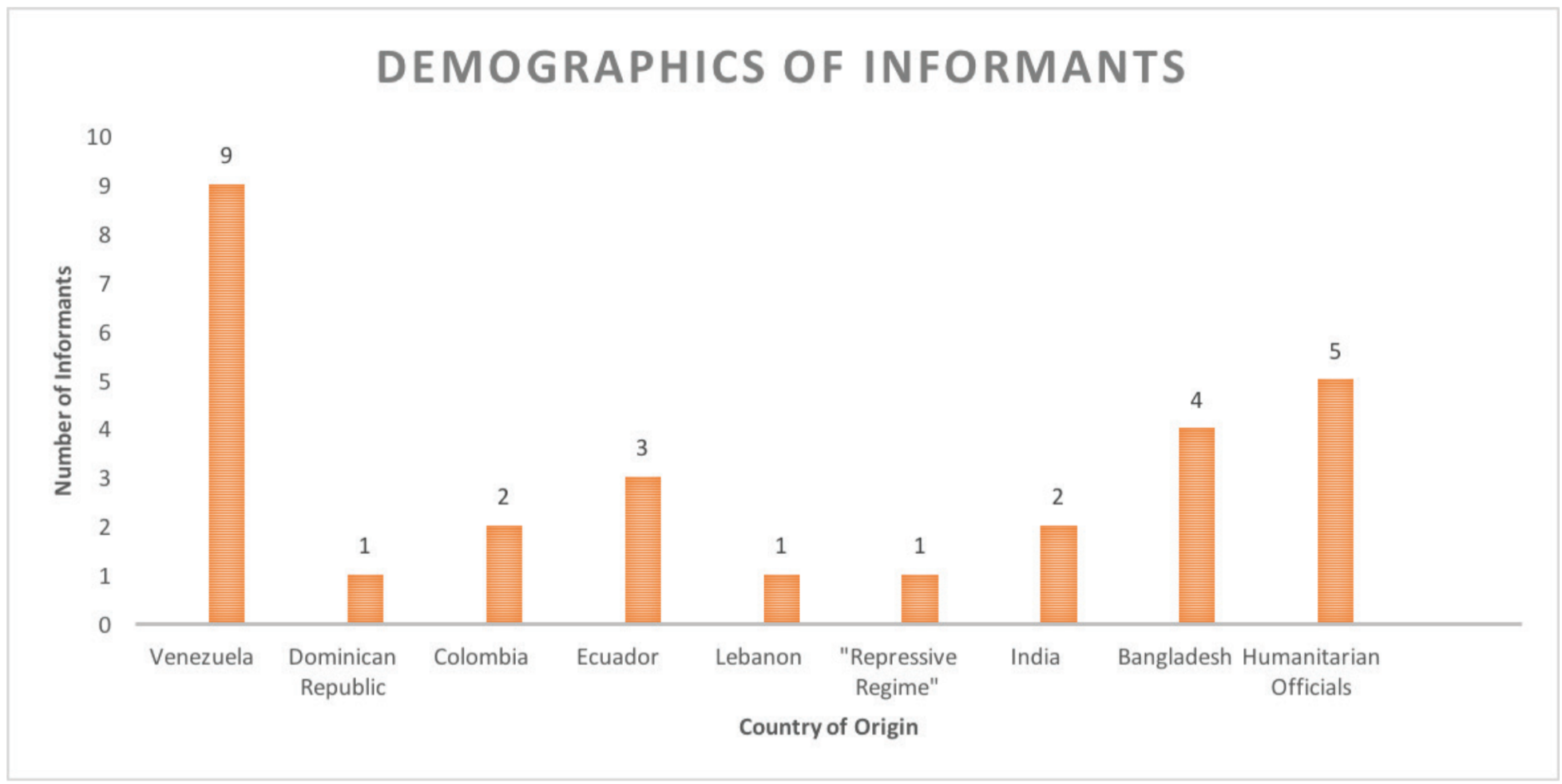
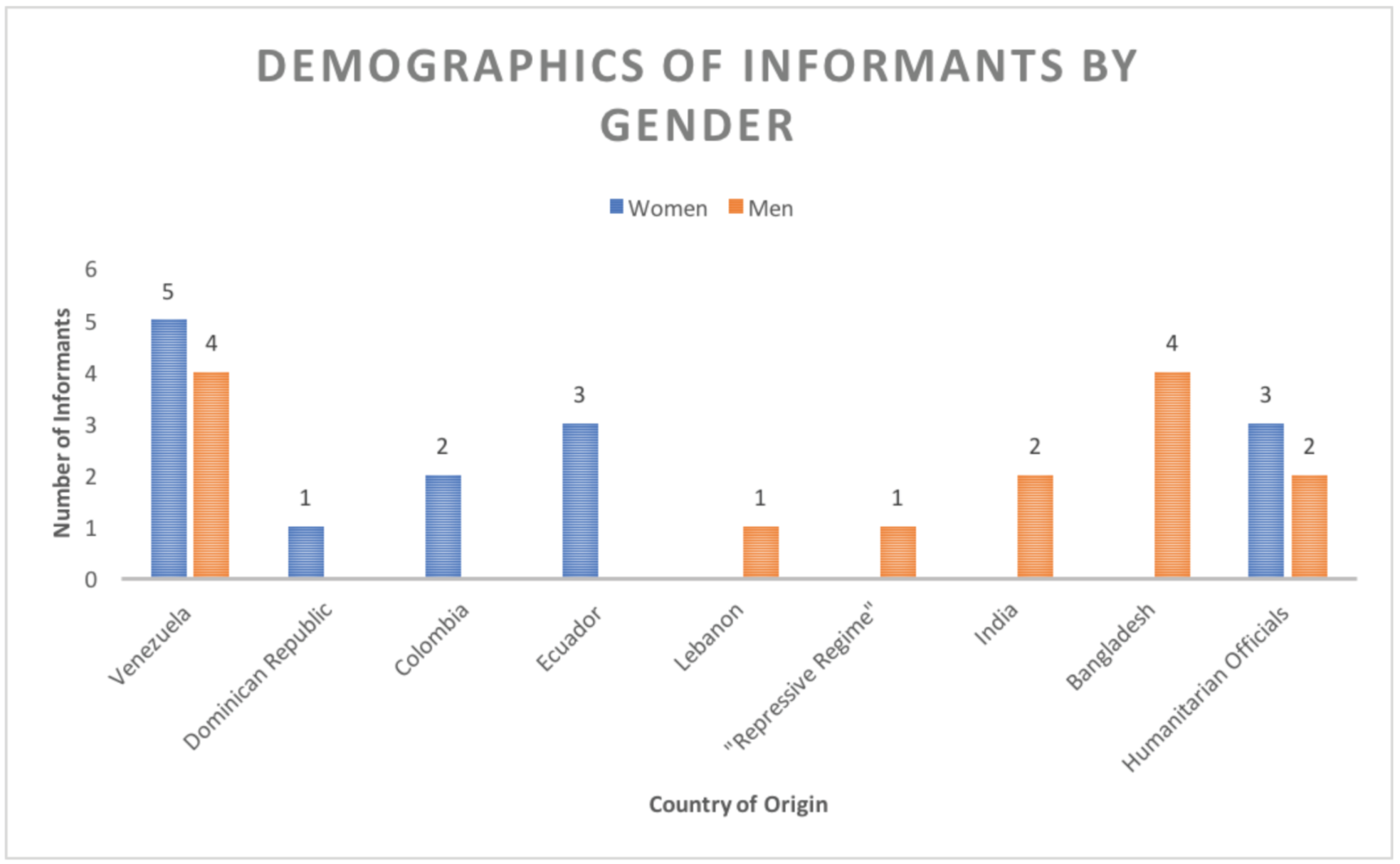
In our many conversations with migrants, the same grouping of aid organizations was repeatedly discussed: the Hebrew International Aid Society (HIAS), the Norwegian Refugee Council (the NRC, which respondents often mistook for the Norwegian Consulate), the UNHCR (ACNUR in Spanish), and the Ecuadorian Red Cross. The more people that we interviewed, the more we learned about the role that churches and Ecuadorian citizens play in facilitating integration and about whether these roles have positive or negative implications.³ In short, these agencies form an ecosystem where each has a specific role in supporting the migrant populations of the city.
This report explores the role that these five main actors — HIAS, the NRC, the UNHCR, the Red Cross, and Quito community members play in the complex, symbiotic "humanitarian ecosystem" of Quito. The report emphasizes how different actors play distinct roles based on how long migrants have been residing in Quito, and how interagency collaboration and outreach are of the utmost importance to ensure that adequate service provision is offered within cities like Quito that host growing populations of migrants. These formal and informal partnerships bolster protection efforts in the city and exemplify an important humanitarian policy lesson: agencies and individuals in migrant-hosting cities do not work in silos but are interconnected through word-of-mouth referrals, information sharing, and the communities they engage with.
The Context of Migration
There are three migration-driving events that have shaped the context in which contemporary migration to Ecuador occurs. First, after the 1998 national economic crash and subsequent adoption of the U.S. Dollar (USD) as the national currency, nearly one million Ecuadorians emigrated (primarily to the U.S., Italy, and Spain).⁴ Remittances continue to play a major role in the Ecuadorian economy and brought in over three billion USD in 2018.⁵
Second, in early 2000, the United States began a military aid program, Plan Colombia, to address the decades-long conflict between the Colombian government and the FARC (Revolutionary Armed Forces of Colombia). The resulting escalation of the conflict pushed armed groups into rural areas and displaced thousands of Colombians, drastically increasing the number of refugees fleeing to Ecuador.⁶ Violence began to decrease in 2014 as the Colombian government began peace negotiations with the FARC and the entry of refugees slowed.
Third, almost as soon as the forced migration from Colombia slowed, 385,000 Venezuelan refugees (out of over 4.8 million Venezuelan refugees globally) fled to Ecuador for economic and physical safety.⁷ Over 1.2 million Venezuelans have traveled through Ecuador since 2015 intending to reach other destination countries.⁸ Many chose to stay in Ecuador or had their plans curtailed by regional geopolitics. To date, the vast majority of Venezuelan migrants do not have regularized status in Quito. Only around 13,500 have filed asylum claims, and fewer than 7,000 have recognized refugee status.⁹
Ecuador is widely considered to be one of the most migrant-friendly countries in South America. In Article 41 of its 2008 Constitution, Ecuador recognizes the principles of human mobility and universal citizenship along with the right to seek asylum.¹⁰ Furthermore, it was a leader of the 2018 Quito Process, a joint regional declaration that aspired to keep entry to South American states accessible for Venezuelans.¹¹
Along with other Latin American states, Ecuador has increased border restrictions due to economic and security concerns.¹² Before August 2019, anyone could enter Ecuador without a visa. Yet in August 2019, Ecuador tightened restrictions for obtaining a visa. Those from countries such as Cuba, Bangladesh, Cameroon, and India now need a visa to enter the country.¹³ These changes also made it so that only Venezuelans who were in Ecuador before July 26, 2019, are eligible to regularize their status through a two-year emergency humanitarian visa (Visa De Residencia Temporal De Excepción Por Razones Humanitarias, or "VERHU"). This costs 50 USD per application and requires Venezuelans to show their passport and criminal record.¹⁴ Before this change, the most affordable visa option (the UNASUR visa) was far more cost-prohibitive at 250 USD per application. All these changes have left many in need of guidance and assistance in navigating the humanitarian aid structure of Quito. And with more and more migrants coming to Ecuador, it is becoming only more complicated to navigate.
Referrals and Outreach: The Humanitarian Ecosystem of Quito
Demographic shifts in the populations migrating into Ecuador frame the way that humanitarian service providers serve different populations. Officially, the Ecuadorian government offers refugee status to those fleeing persecution based on race, religion, nationality, political belief, or membership of a social group in alignment with the 1951 Convention on Refugees. Additionally, because Ecuador is a signatory to the South American regional Cartagena Declaration of 1984, the country offers refugee status to those who have fled generalized violence and mass human rights abuses, among other circumstances. However, none of the migrants we interviewed had their refugee status officially recognized by the government of Ecuador. While a number of our interviewees were economic migrants who had come to Quito for business purposes (namely those from India, Bangladesh, and Lebanon), many others were asylum seekers from Venezuela and Colombia who were receiving assistance from international organizations, civil society groups, or friends. Many of the services in Quito are structured to provide assistance based on vulnerability and not legal status.
Our respondents underscored how different agencies play a greater role in their lives depending on how long ago they have been in Quito. This assistance ranges from immediate legal assistance to cash transfers in the first six months to food aid and housing assistance in their first year of living in Ecuador. Together, these various agencies and their services form the humanitarian ecosystem of Quito.
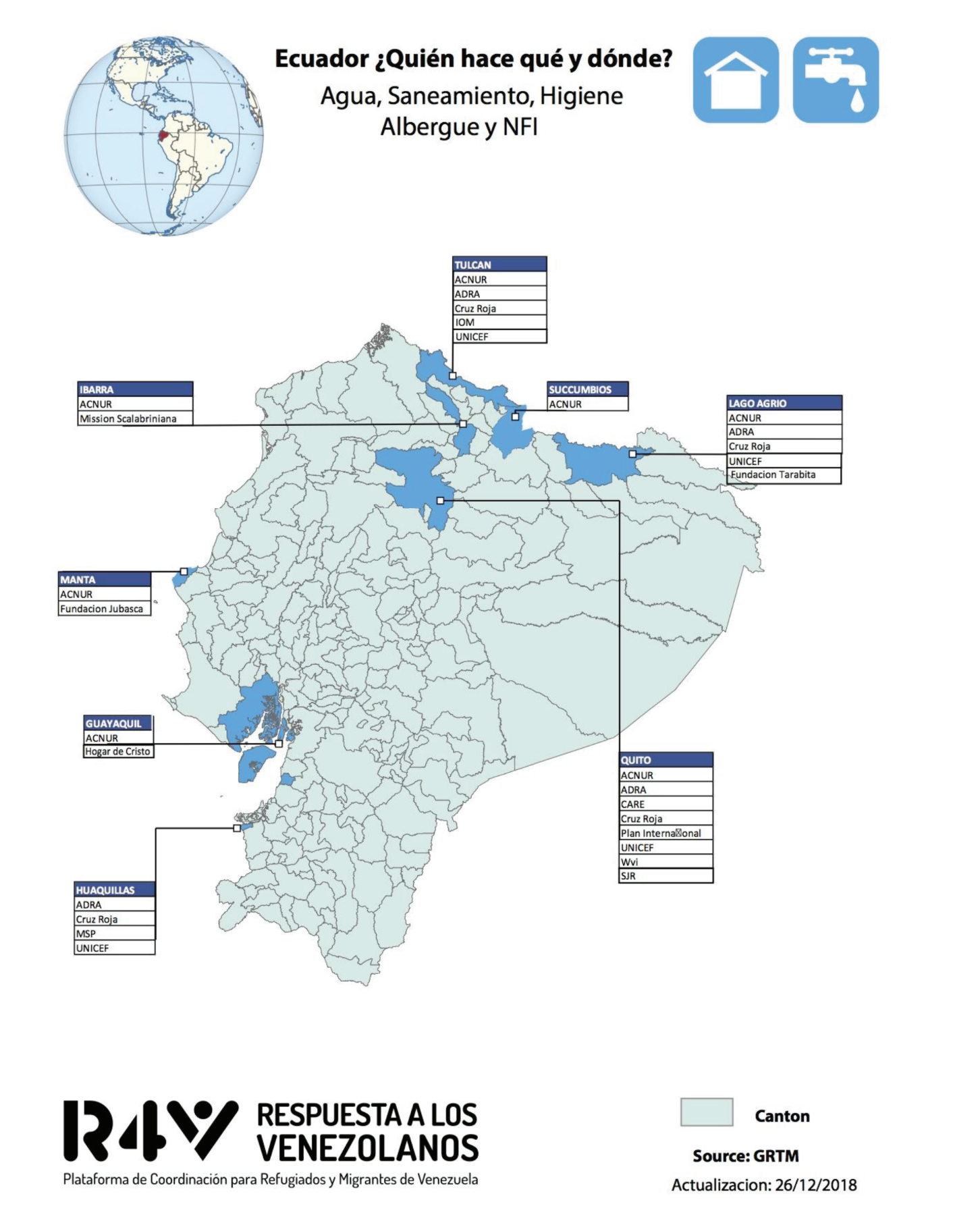
The term "ecosystem" is used to describe "a dynamic structure of interconnected organizations that depend on each other for mutual survival."¹⁵ Matthew Mars and Judith Bronstein define ecosystems as "social structures in which units are linked by loose or tight ties that enable or enhance the interactions and exchanges among diverse organizations and actors."¹⁶ In the case of Quito, amidst changing ebbs and flows of migrants with different needs from numerous countries, the humanitarian organizations and civil society actors that support newcomers work together. They do so through referrals, communication, and word of mouth to provide legal, health, financial, and social support services. The following sections detail how these organizations define their roles and how migrants in Quito utilize their support.
Ecuadorian Red Cross
Upon crossing Ecuador's border with Colombia, several of our Venezuelan respondents were first met by the Red Cross, which offered them large, silver-aluminum blankets to keep them warm. Representatives from the UNHCR ("ACNUR" in Spanish) were also present, providing food and sanitation kits to families. When describing their experiences in Quito, the migrants we interviewed did not mention the Red Cross at any point other than their entry.
However, Vanessa Rosero (the National Livelihoods Coordinator at HIAS) stressed how heavily HIAS relies on the Red Cross for sharing information on the different services that they offer. Since the Red Cross is located on the key borders where migrants cross, HIAS supplies it with information on the specialized financial and psychological support that HIAS offers and encourages the Red Cross to offer referrals to it. In short, the outreach structure for certain types of services is through, as Ms. Rosero noted, boca a boca (word of mouth).
UNHCR
"Marianna" and "Mariclara" are two asylum seekers from Colombia. During our interview, they told us how the UNHCR gave them a small amount of cash assistance to get them on their feet, some food, and a hotel to stay in before referring them to HIAS. "Rosa," a Venezuelan restaurant owner in the La Florida neighborhood of Quito, guided us through the journey that she and her children took from Venezuela. She spoke of the "blue hands and the world" (the logo of UNHCR), which gave her family a food and sanitation kit as she crossed the border. After hearing from other migrants who described this support from the UNHCR during their entry, we met with UNHCR Officers Maybritt Rasmussen and Maria Elisa Eguiguren, who are, respectively, the Program Officer and the Long-Term Solutions and Financial Inclusion Officer.
Rasmussen and Eguiguren explained that there have been two distinct periods of UNHCR's role in Ecuador. Between 2003 and 2010, the UNHCR focused on providing support for Colombian refugees, and between 2010 and 2017 the organization shifted focus to programs supporting self-reliance and economic inclusion into host communities. Like much of the aid distribution in Quito, the UNHCR entered the scene in 2000 to assist Colombians displaced by the FARC. The UNHCR helped the Ecuadorian national government develop its asylum system in response to the arrival of these Colombians. When the early Colombian cases were flowing into Ecuador, it was clear that many of these migrants qualified for refugee status under the 1951 Refugee Convention. In 2008, with UNHCR support, the Ecuadorian Constitution began to utilize the Cartagena Declaration. The Cartagena Declaration, which was created in 1984, is an agreement signed by countries across Latin America that enables states to offer refugee status to migrants based not only on political and identity-based persecution, but also on generalized violence, human rights abuses, and economic strife.¹⁷ This definition of "refugee" enabled more widespread economic integration for migrants in Ecuador by providing more people with the legal right to work.
Given the large number of outreach and community projects in border areas and in Quito, the UNHCR uses field officers from its own agencies and from others to network information to migrants. For example, the UNHCR utilizes its contacts in HIAS for assistance with food, school, and networks of support; the NRC for legal aid; and Casa de Refugiados Matilde for short-term housing. Overall, there is an aid network in Ecuador of nineteen to twenty groups. When it comes to the services offered for migrants, Ms. Rasmussen claims that "Quito is the Latin American Dream."
This type of collaboration and outreach is essential because while Colombian refugees and migrants were primarily consolidated in Quito and along the Northern border, Venezuelans are dispersed throughout the country. Outreach is particularly important, the officers noted, because of the false information that is often circulated through WhatsApp on subjects such as how to get paperwork and what services are offered by whom.
Hebrew International Aid Society (HIAS)
HIAS was repeatedly brought up in our interviews as providing the most helpful assistance that many migrants received. Numerous Venezuelans discussed relying on HIAS for financial support during their first six months in the form of cash assistance, psychological counseling, job training, and flip phones. "Luz," a 40-year-old mother from Venezuela, says that it would have been impossible to feed herself and her 10-year-old son without the 30 USD per month food cards that HIAS supplied during their first six months in Ecuador. "Charlie," a 55-year-old Venezuelan man who works as a mime, explained that although he and his wife are in Quito illegally, they were able to make medical appointments during their first six months because of HIAS's assistance. However, they began to face more challenges once their temporary humanitarian visa expired.
In an interview, Vanessa Rosero, the National Livelihoods Coordinator at the HIAS office in Quito, explained that the organization provides protection for those of "high and middle vulnerability" to promote self-sufficiency. HIAS has been in Ecuador for seventeen years and has fifteen national offices. HIAS provides psychological, social, humanitarian (water, shelter, hygiene) and financial support during a migrant's initial six months in Ecuador. "HIAS is one of the most complete service providers," Ms. Rosero explained. In particular, HIAS focuses on economic inclusion during various stages of migrants' integration into Ecuador. Initially, HIAS offers financial assistance through cash transfers. But this assistance shifts towards job training and entrepreneurship workshops over time.
In collaboration with the UNHCR and Conquito (Quito's economic promotion office), HIAS offers support through a graduated model to ensure that all of its clients in extreme poverty are able "to eat three meals a day, earn a sustainable livelihood, have savings, and become integrated into the community," within eighteen months. One of the biggest challenges for migrants, Rosero explained, was adjusting to the constantly changing developments and working collaboratively with so many different actors to avoid the duplication of activities.
Norwegian Refugee Council (NRC)
During our initial interviews, we became curious about the role that the Consulado de Norwego ("The Norwegian Consulate") plays in helping so many migrants with legal aid and asylum case support. Through conversations with government and humanitarian officials, we concluded that it was not the Norwegian government providing aid, but the Norwegian Refugee Council (NRC). We then met with Lillia Granja, the Legal Services Coordinator at the NRC office in Quito.
While HIAS has been present in Ecuador since the early 2000s, the NRC began operating in Quito in 2007 to provide services for Colombian asylum seekers, refugees, and migrants. However, the flow of Colombian migrants into Ecuador slowed in 2014 and slowed even more precipitously following the 2016 peace accord between the Colombian Government and the FARC. Following this decline in migration, the NRC's staff and resources shrank, but once again grew in 2017 to accommodate the rising demand in support for Venezuelans. They now receive 300-400 Colombians in their offices for services annually, as opposed to far higher numbers in the early 2010s. "As the Colombian numbers shrank, the Venezuelan numbers grew," Ms. Granja told us. The NRC is present in fourteen cities in Ecuador with offices in six provinces.
The NRC focuses on four types of service provisions for migrants of "vulnerable" and "extremely vulnerable" status: information counseling, legal assistance, regularization support, and rights (concerning education for children, livelihoods, shelter, and protection). They share information on visa regularization and debunk false rumors about legal processes. In addition to legal services and information counseling, the NRC offers cash-based intervention services in the form of financial assistance for visa processing; materials and unconditional cash transfers to support children entering school; payment for shelter or hotels for those in transit; and conditional cash transfers for HLP (home, land, and property). In the case of unconditional cash assistance, the NRC finds that some individuals have sent that money back to their home country, but in all other cases they found that the cash assistance was used for its intended purpose.
When it comes to outreach and information that the NRC needs to be dispersed on a massive level, they enable the UNHCR (one of their lead donors), UNICEF, and HIAS to use their platforms to disperse this information. "It's not the greatest, but it has worked," Lillia said of this system.
Community and Peer Support
Not all of the migrants we spoke with relied on international humanitarian organizations for support. In many instances, friends already in Quito, churches, and members of the community provided the support that they needed.
"Lucia," an Ecuadorian woman in her early 60s, described how she has been renting out rooms in her house to Venezuelans, Colombians, and Cubans for the past ten years. She says she allows anyone to rent if there is a vacancy – except for Cubans because they caused her "a lot of problems". She says she would never ask for immigration papers because it is "not her place." Although she sees herself as their mother and wants her space to be a home for them, she does not allow residents to speak to each other because she has had issues in the past when "they become friends."
"David," a Venezuelan in his early thirties who arrived in Quito five years ago, said that the Catholic Church and local nuns have become essential in providing immediate relief and support to the growing numbers of Venezuelans in Quito. However, the Church does not provide aid unconditionally. Upon arriving, the Church distributes mattresses, a place to sleep for a few nights, and some food for those who seek it. When people like David get to a point where they are more stable, the Church tells them to pay it forward by helping new arrivals. More recently, others like "Luz" who arrived in the past few months found that the churches do not provide assistance. Luz was told, "There are poor non-Venezuelan children too, and we have to look after our own first."
Migrants from countries outside of Venezuela and Colombia (including India, Bangladesh, and the Dominican Republic, who came with more wealth than other asylum seekers) discussed how their friends provided them with financial support. When speaking with a group of Bangladeshi men at a small restaurant they owned, they said that if anyone in Quito's tight-knit Bangladeshi community needs assistance, they write a letter to the "Bangladeshi Club." This is a savings club where every week, members all put money into a joint bank account. As long as they continue to contribute money, they can use the "Club" as a form of insurance if they are ever strapped for cash.
Conclusion
This report offers a glimpse into how five key institutions in Quito interact with and serve migrants. These agencies have similar clientele but provide distinct services to individuals at different points of their migration journeys. While these international agencies have similar mandates across the globe, how they interact in Quito and across Ecuador is unique given the history of Colombian refugees and the developing situation for Venezuelans. While the UNHCR serves as an umbrella agency with the power to distribute funding and information, HIAS serves as the primary financial support system; the NRC as the arm of legal aid; and the Red Cross as the immediate care provider and hub of information on the borders. The Quito community (in the form of local churches and residents of Quito) facilitates word-of-mouth spreading of information on access to services and offers informal aid.
Although there are other service providers in the city, the international and local players discussed play the largest role in the day-to-day lives of our informants. The lessons learned from Quito show that without any one of these actors, newcomers to Quito would not be able to have all needs met. It is through multi-stakeholder partnerships that protection efforts are bolstered.
📝 This article was originally published as an essay by the Henry J. Leir Institute at The Fletcher School of Law & Diplomacy and Tufts University.
Download the original essay below ⬇️
Footnotes
Works Cited
Blouin, Cécile; Berganza, Isabel; and Freier, Luisa Feline. “The spirit of Cartagena? Applying the extended refugee definition to Venezuelans in Latin America.” Forced Migration Review 63 (2020): 64-66.
Coordination Platform for Refugees and Migrants from Venezuelan (R4V), “Response for Venezuelans,” accessed April 10, 2020. https://r4v.info/en/situations/platform.
Jokisch, Brad D. “Ecuador: From Mass Emigration to Return Migration?” Migration Policy Institute, 24 October 2014. https://www.migrationpolicy.org/article/ecuador-mass-emigration-return-migration.
Mars, Matthew M, and Judith L Bronstein. “The Promise of the Organizational Ecosystem Metaphor: An Argument for Biological Rigor.” Journal of Management Inquiry 27, no. 4 (2018): 382-91. https://doi.org/10.1016/j.orgdyn.2012.08.002.
Miller, Sarah, and Panayotatos, Daphne. “A Fragile Welcome: Ecuador’s Response to the Influx of Venezuelan Refugees and Migrants.” Washington, D.C.: Refugees International, 2019. https://www.refugeesinternational.org/reports/2019/6/17/a-fragile-welcome.
Ministerio de Relaciones Exteriores y Movilidad Humana de Ecuador, “Acuerdo Interministerial No. 0000003,” (2019). Retrieved from http://www.ecuador.org/nuevosite/documentos/acuerdo_ministerial_0000003.pdf.
Ministerio de Relaciones Exteriores y Movilidad Humana de Ecuador. “Banco de Preguntas Frecuentes: Emisión de Visa De Residencia Temporal De Excepción Por Razones Humanitarias, VERHU, para población venezolana (proceso de regularización a nivel nacional).” Accessed 10 April 2020. https://www.consuladovirtual.gob.ec/web/guest/preguntas-frecuentes.
Partnering Resources. “Mapping Business Ecosystems.” Partnering Resources. Accessed 10 April 2020. https://partneringresources.com/wp-content/uploads/Tool-Ecosystem-Mapping-Short-Format.pdf.
Pugh, Jeffrey D., Jiménez, Luis F., and Latuff, Bettina. “Welcome Wears Thin for Colombians in Ecuador as Venezuelans Become More Visible.” Migration Policy Institute, 9 January 2020. https://www.migrationpolicy.org/article/welcome-wears-thin-for-colombians-ecuador.
Selee, Andrew, and Bolter, Jessica. “An Uneven Welcome: Latin American and Caribbean Response to Venezuelan and Nicaraguan Migration.” Washington, D.C.: Migration Policy Institute, February 2020. https://www.migrationpolicy.org/research/latam-caribbean-responses-venezuelan-nicaraguan-migration.
UNHCR and Signatory States. “Quito Declaration on Human Mobility and Venezuelan Citizens of the Region.” 4 September 2018. Retrieved from https://data2.unhcr.org/en/documents/details/68099.
UNHCR. “UNHCR in Ecuador: Information.” UNHCR, July 2013. https://www.acnur.org/fileadmin/Documentos/RefugiadosAmericas/Ecuador/2013/UNHCR_in_Ecuador.pdf?file=fileadmin/Documentos/RefugiadosAmericas/Ecuador/2013/UNHCR_in_Ecuador.
World Bank. “Personal remittances, received (current US$) - Ecuador).” Accessed 10 April 2020. https://data.worldbank.org/indicator/BX.TRF.PWKR.CD.DT?locations=EC.