
Written by: Kim Wilson and Roxanne Krystalli
Table of Contents
Project Overview, Research Questions, and Methods
The Financial Journeys of Refugees investigates what money and financial transactions can reveal about the journeys and experiences of forced migration. We examine money as a key node of the displacement experience: fueling transactions among formal and informal actors along the way; determining livelihood options; shaping or restructuring kinship networks; and coloring risks, vulnerabilities, or protective forces available to refugees. Our inquiry highlights these transactions and the power dynamics that unfold among refugees as well as between refugees and formal or informal authorities.
Four specific areas of inquiry emerged during this study:
- How do refugees gather, move, store, spend, and make money along the journey of their displacement? How do their strategies lead to enhanced risk and/or self-protection along the way?
- How do financial transactions structure relationships among refugees, as well as between refugees and formal or informal authorities, such as smugglers, informal money transfer agents, and formal banking systems?
- How does the humanitarian system—and, in particular, cash assistance to refugees—shape the aforementioned financial transactions and relationships?
- What are the roles of refugee identity—in terms of gender, ethnicity, religion, and family status—and the documentation of that identity in shaping financial transactions, relationships, vulnerability, and coping strategies?
We pursued these questions in a qualitative study that unfolded between July 2016 and April 2017 at multiple sites in Greece, Jordan, and Turkey. We interviewed 120 refugees and 33 key informants and conducted observations at refugee camps and shelters, informal refugee settlements, money transfer offices, and other locations. This executive summary—and the full report it accompanies—are one of many outputs associated with this research project, all of which are available at the Henry J. Leir Institute for Human Security website.
The significance of the above questions is threefold. First, inquiries about money on the move provide an entry point to exploring the risks refugees face, their coping strategies, and their relationships with formal and informal authorities. In this case, money—and the ways in which refugees amass, move, and spend it—is a window into understanding structures of power, access, protection, and vulnerability.
Second, to the extent that financial inclusion literature and practice engage with refugees, they do so “in terms of integrating customers into an existing digital or formal financial structure,” without focusing on the financial tasks that refugees must perform in order to survive. This study sheds light on the diversity of these experiences and the needs to which they give rise along the way.
Third, while refugee integration into economies and markets is slowly receiving attention as refugees arrive at points of resettlement or their aspirational destinations, to date, little attention has been paid to financial portfolios, transactions, and relationships along the way. Being “in motion”—as opposed to displaced and stationary—is a part of the humanitarian process that needs to be understood more fully.
Summary of Findings: Financial Portfolios of Refugees
Even the most sudden displacement requires financial and logistical preparation—and when that is not possible, refugees face intermittent journeys, with long pauses between stints of movement and possibly higher risks along the way. Preparations include selling land, livestock, and other assets; borrowing money from within kinship networks; making arrangements with smugglers and money transfer agents; and liquidating assets, where possible.
Costs of transit varied greatly among refugees, depending on the route, the timing, and political developments that affected the accessibility of certain routes, family configuration, and other factors.
Paying for smugglers remained the largest, most significant cost of transit. Refugees who participated in the research framed smugglers not necessarily as criminal actors but as essential to their transit and paying them as a livelihood choice they made to facilitate their passage.
Rarely did the funds refugees gathered in advance of their displacement suffice for financing the entire journey. Refugees thus resorted to a combination of formal and informal labor along the way, as well as to borrowing money, where possible. The lack of sufficient funds to pay for the next leg of a journey was most frequently cited as the reason some refugees were “stuck” in the country in which our research team met them.
Summary of Findings: Financial Relationships on the Move
A number of intermediaries are essential for completing the financial transactions that underpin displacement. These include smugglers, money transfer agents such as Western Union, Hawalas and Hawaldars, and sarafs.
A key component of refugees’ financial relationships with smugglers involved the terms of payment and, particularly, the timing. Refugees who employed a pre-pay system risked losing money when the smuggler failed or refused to transport them to the destination to which they had originally agreed.
Few refugees were able to negotiate a “post-pay” system, whereby the smuggler was paid only after successful transit. More common was the “pay-as-you-go” system, whereby refugees’ family members in the country of origin would release a payment to a member of the smuggling network as soon as the refugee successfully completed each leg of the journey.
The financial transactions involved in smuggling suggest a network of formal and informal, licit and illicit systems. An example of the convergence of the systems is some refugees’ purchase of insurance or use of “guarantee schemes” to ensure that the smuggler provided the services agreed.
Social networks and kinship finance are essential for financing refugees’ transactions and shaping relationships. Some refugees even benefitted from “pay it forward” schemes, whereby those who financed the refugee’s journey did not expect to be repaid, knowing that social norms would ensure that the refugee would assist someone else in the future.
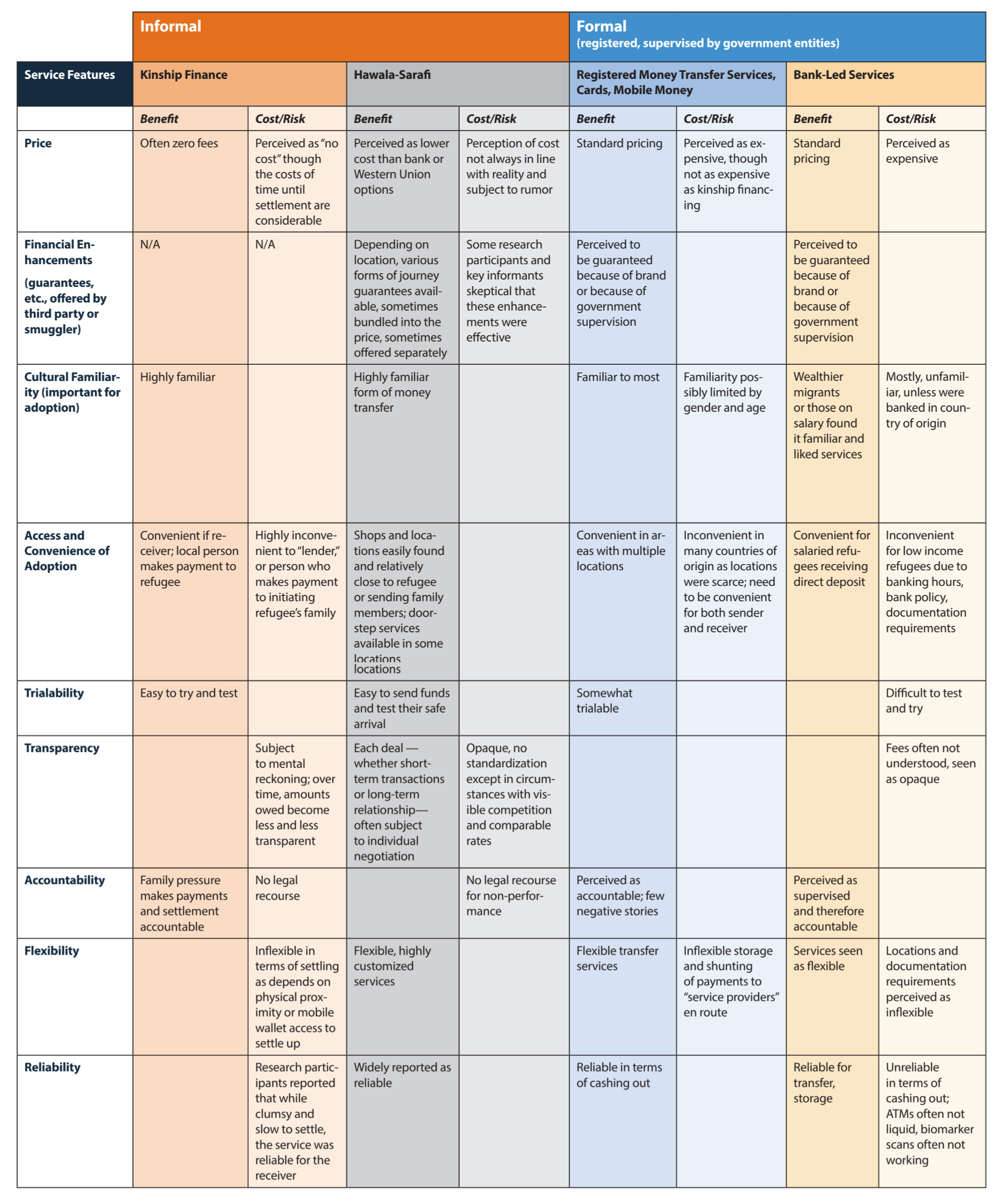
Though some refugees attempted to use banks and/or formal money transfer operators such as MoneyGram or Western Union, many shared their perceptions that those systems were less accessible to them than more informal arrangements were. This was at times due to insufficient documentation to satisfy identity requirements, fear of discrimination or harassment, or lack of interaction with the formal financial sector prior to displacement.
Summary of Findings: Humanitarian Assistance as Part of Refugees’ Financial Portfolios
Modes of distribution of humanitarian assistance varied among agencies, including in-kind aid, physical cash, physical vouchers and coupons, electronic vouchers and coupons, and cards and e-wallets.
From the perspective of the NGOs we interviewed, key factors for consideration in terms of the mode of assistance included ease and safety of distributing assistance; traceability of refugees’ spending as a way to comply with donor requirements; ease of reloading or redistributing assistance; ease of imposing conditions on how the assistance could be used; and the existence of a path to refugee financial inclusion.
Key factors affecting NGOs’ perspectives on cash assistance included efficiency and scale; familiarity and comfort levels; considerations of financial inclusion; dignity of and flexibility for end users; and traceability and conditionality of funds.
Key factors affecting refugees’ perspectives on cash assistance included flexibility, familiarity, ease of use by different family members based on gender and age, and the dignity the form of assistance may have made possible, particularly when compared to other forms of assistance.
Refugees cited fears of losing eligibility for humanitarian assistance as a reason to avoid using licensed financial institutions for money transfers between themselves and family members or smugglers. Though the alleged linkages between money transfer agents and humanitarian organizations were unconfirmed, refugees nonetheless believed that NGOs could trace their transactions through money transfer agents.
Rumors of such linkages drove refugees towards more informal money transfer arrangements. They believed that less formal institutions were less likely to report their transactions, including deposits from casual labor or remittances from relatives.
Summary of Findings: Identity on the Move
Who one is and the ability one has to prove it turns out to be two of the thorniest problems for a refugee¹. Identity is linked to who can gain permission to work or travel or access systems of protection and assistance. It determines which experiences different systems prioritize over others and how refugees interface with bureaucracies of care.
Identity refers both to one’s own self-identification and its political connotations, as well as to its documentation.
Refugees remarked on their national origin, religion, gender, age, and family status as having been both sources of vulnerability and potential assets during transit. Refugees recurrently noted their perception that humanitarian agencies, legal systems, state security forces, or other actors affecting the refugee experience privileged certain identities over others.
Some refugees were able to highlight certain aspects of their identity—or, indeed, to transform into more favorable subjects—that were perceived to be favorable to the system. For those who could not, identity became a way in which numerous systems created and enforced hierarchical regimes, which they were powerless to change except through deception.
In terms of the documentation of identity, refugees remarked that, at times, not having documented identity allowed them more flexibility in navigating the complex systems of assistance, protection, and care. At the same time, lack of documented identity precluded some refugees from accessing services, particularly in the formal financial system.
Various actors—from money transfer agents to interpreters—assisted refugees in informally navigating identity requirements in order to access the services they needed.
Opportunities for Further Research
- The role of social networks in shaping the refugee experience. Subsequent studies can shed light on how refugees forge and maintain social networks—often cross-border and cross-nationality—while in transit.
- The financial journeys of refugees traveling alone. Much of this research focused on refugees fleeing alongside families or neighbors. Refugees traveling alone appeared to differ significantly from those traveling in groups in ways that merit further research.
- The evolving role of formal financial institutions. As protracted displacement and refugee transit continue, it will become increasingly important to trace whether and how refugees’ interactions with formal financial institutions change over time.
- Host community perspectives. Host community perspectives would complement this analysis, particularly considering the challenging financial journeys many residents of host communities faced in the countries of study.
- The social networks of smuggling. Smuggling is a key node through which to understand refugees’ financial journeys and overall experiences. Further research could examine the social networks of smugglers, including the role of gender and ethnicity in shaping smuggler-refugee interactions.
- Discrimination and harassment of refugees. This study has shown how both the fear of and the reality of discrimination and harassment shaped refugees’ behavior in their financial journeys.
- Longitudinal research on the experiences of refugees over time. Tracing these experiences over a longer time can reveal insights on the evolution of financial journeys, particularly in situations of protracted transit or uncertain resettlement.
Introduction: Research Questions and Overview of Study
The church bells near Piraeus Port in Greece ring every hour to the tune of Manos Hatzidakis’ song “The Children of Piraeus.” Made iconic through Melina Merkouri’s performance of it in the movie Never on Sunday, the song extolls the magic of the port and of the children “who will grow up to be brave for Piraeus’ sake.” At the crescendo, Merkouri sings: “As much as I search, I cannot find a port… like Piraeus.”
For the refugees who sought shelter at the port in 2016, Piraeus was a more reluctant temporary home than the song would suggest. One port worker who gave our research team directions said the refugees were located at hangar 13 and under a bridge, “across the ships to Crete.” On the walk to hangar 13, we pass a sinking vessel named Panagia tis Patmou (The Virgin Mary of Patmos), the protector of ships.
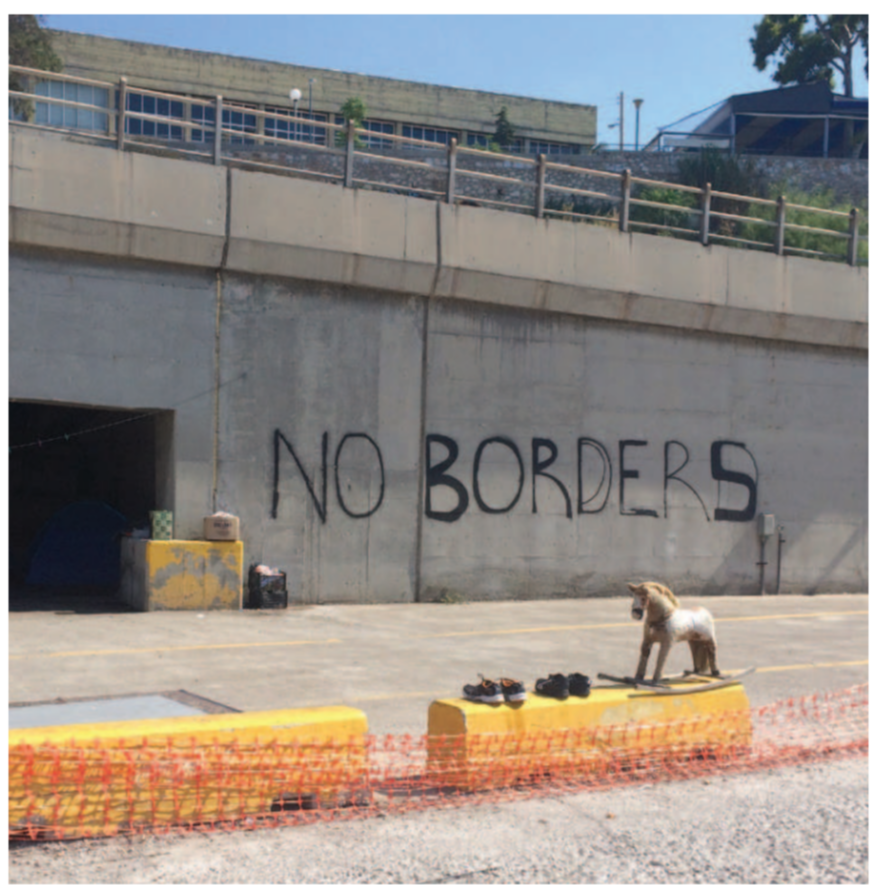
The contrasts in the imagery we encountered appropriately represent the tensions at the heart of this research. On one side, we observed tourists, in white linen and straw hats or denim shorts and backpacks, rolling bags off the cruise ships to Crete. Across the way, a wooden rocking horse toy and two pairs of children’s shoes sit at the edge of an informal tent settlement for refugees, underneath graffiti that reads “No Borders.”
This research project investigates what money and financial transactions can reveal about the journeys and experiences of forced migration. The overwhelming refrain in response to our questions about what refugees brought with them on their journeys was “just the clothes on my back.” It would be a misreading of this project to assume that any discussion of money or assets among refugees negates the vulnerabilities and risks they face along their journeys or disputes their needs for humanitarian and legal assistance or protection. Rather, we examine money as a key node of the displacement experience, fueling transactions among formal and informal actors along the way; determining livelihood options; shaping or restructuring kinship networks; and coloring risks, vulnerabilities, or protective forces available to refugees. Our inquiry highlights these transactions and the power dynamics that unfold among refugees as well as between refugees and formal or informal authorities.
Four specific areas of inquiry emerged during this study:
- How do refugees gather, move, store, spend, and make money along the journey of their displacement? How do their strategies lead to enhanced risk and/or self-protection along the way?
- How do financial transactions structure relationships among refugees, as well as between refugees and formal or informal authorities, such as smugglers,² informal money transfer agents, and formal banking systems?
- How does the humanitarian system—and, in particular, cash assistance to refugees—shape the aforementioned financial transactions and relationships?
- What are the roles of refugee identity—in terms of gender, ethnicity, religion, and family status—and the documentation of that identity in shaping financial transactions, relationships, vulnerability, and coping strategies?
We pursued these questions in a pilot qualitative study that unfolded between July 2016 and April 2017 at multiple sites in Greece, Jordan, and Turkey. Exploratory research in Denmark informed the project, but has not been included in the write-up of our findings at this stage. The significance of these questions is three-fold: First, inquiries about money on the move provide an entry point to exploring the risks refugees face, their coping strategies, and their relationships with formal and informal authorities (Jacobsen 2005, Collins et al. 2009). In this case, money—and the ways in which refugees amass, move, and spend it—is a window into understanding structures of power, access, protection, and vulnerability.
Second, to the extent that financial inclusion literature and practice engage with refugees (El Zoghbi et al. 2017, Hansen 2016), they do so “in terms of integrating customers into an existing digital or formal financial structure,” without focusing on the financial tasks that refugees must perform in order to survive (Wilson and Krystalli 2017, p. 2). As we have written elsewhere, “refugees are not a homogenous block of consumer interests—a market—but a diverse group of people living in urban neighborhoods and formal or informal camp settings. They have far-ranging experiences with cash management, digital technology, and banking, and varied consumer interests” (Wilson and Krystalli 2017, p. 4). This study sheds light on the diversity of these experiences and the needs to which they give rise along the way.
Third, while refugee integration into economies and markets is slowly receiving attention once refugees have arrived at a point of resettlement or aspirational destination (Bevelander and Pendakur 2014, Bakker et al. 2016), to date, little attention has been paid to financial portfolios, transactions, and relationships along the way. Being “in motion”—as opposed to displaced and stationary—is a part of the humanitarian process that needs to be understood more fully. We explore movement not merely as a process of getting from point A to point B, but as a way of life for months or years. It becomes a way of being, and shapes economies (formal and informal) and relationships that surround them.³ By shedding light on those experiences, we examine the implications for humanitarian actors, financial regulators, and other agencies that engage with refugees during their transit.
The rest of the analysis proceeds as follows: Chapter 1 discusses the research methods, including our use of terminology and considerations related to research safety and ethics. The four subsequent chapters correspond to research questions. Chapter 2, which corresponds to the question on how refugees gather, move, store, spend, and make money along the way, provides an in-depth look into the financial portfolios of refugees. Chapter 3, which corresponds to the research question on how financial transactions shape relationships with formal and informal actors along the way, examines the modes through which refugees pay smugglers; the financial intermediaries along the way; and the role of kinship-based, informal, semi-formal, and formal financial systems.
Chapter 4 examines the role of humanitarian cash assistance in refugees’ financial portfolios. Chapter 5, which corresponds to the overarching research question on identity and its documentation, sheds light on how refugees navigate who they are, who they are perceived to be, and who they can prove they are in their constant attempt to access systems of protection and assistance. In Chapter 6, we outline questions for further research.
In addition to this paper, we are releasing a number of outputs related to this research project. These include, among others, (1) a compendium of fieldnotes, aimed at both serving as a teaching tool and providing a less-edited, less-fragmented account of refugee narratives; (2) topic-specific briefing papers, including a discussion of the implications of this research for policy and practice; (3) brief online videos summarizing study findings; (4) an opinion essay on inancial inclusion for refugees; and (5) blogs summarizing findings for different audiences.
📝 This article was originally published as a report by the Henry J. Leir Institute at The Fletcher School of Law & Diplomacy and Tufts University.
Download the original report below ⬇️
Financial Journeys of Refugees: Evidence from Greece, Jordan, Turkey.pdf
Chapter 1. Research Methods, Dilemmas, and Ethics
Knowledge is socially made, and the power dynamics of research shape both the refugee experience and its narration through refugees’ own stories and our retelling of them.⁴ In this chapter, we discuss the terminology we use, our methodological principles and practices, the timing and profiles of our research sites and participants, and some of the ethical dilemmas that underpinned this research.
1.1 Terminology
A tension in this research project reflects the politics of naming and recognition that we are investigating: What do we call our research participants? Labels in the literature have included “refugees,” “migrants,” “immigrants,” “displaced people”—each carrying different meanings and symbolic power (KhosraviNik 2010). We have chosen the term “refugee” because that is the word our research participants overwhelmingly used to describe themselves—as well as the term by which humanitarian actors referred to them. In this context, “refugee” does not necessarily refer to someone who has the formal, legal recognition of this status.
The politics of labeling also complicate the framing of the spatiality of the refugee crisis. Labels have included “the Mediterranean refugee crisis,” “the European refugee crisis,” or “the Syrian refugee crisis” (Linden-Retek 2016). We are conscious that this is not a single crisis that unfolds in a discrete, bounded geographic region. For this reason, we focus our analysis on the specific sites of research, where possible, rather than constructing an imagined, cohesive space of a singular crisis.
1.2 Methodological Principles and Practices
Our methodology reflects key tenets of feminist research (Wibben 2016, Lykes and Coquillon 2007) and interpretivist social science. As articulated by Lisa Wedeen (2013), these include a
- commitment to understanding how knowledge is situated and entangled in power relationships;
- curiosity about how categories are socially manufactured, not existing “always already,” waiting to be discovered;
- ejection of strictly individualist assumptions in favor of a recognition of more complex social relationships and modes of agency; and
- close examination of language, symbolic systems, and meaning-making. To apply these commitments, we relied on the Lean Research approach for conducting research in vulnerable settings (Armstrong et al. 2015).
The Lean Research Framework articulates principles and practices for conducting rigorous, respectful, relevant, and right-sized research in vulnerable settings.
Throughout our analysis, we acknowledge that refugees do not merely exist; they also have to do refugee-ness. Like all narratives—and especially narratives of injury and vulnerability (Brown 1993; Jones 2009), stories of displacement invite and require performance (Wedeen in Schatz 2009; Jones 2009). Performativity here refers to the iterable practices (Derrida 1998) that “constitute individuals as particular kinds of social beings or subjects” (Wedeen 2013, p. 88). Both in this methodology section and throughout the report, we note the ways in which these performances shift across contexts and audiences (Scheper-Hughes and Bourgois 2004).
1.3 Overview of Research Participants
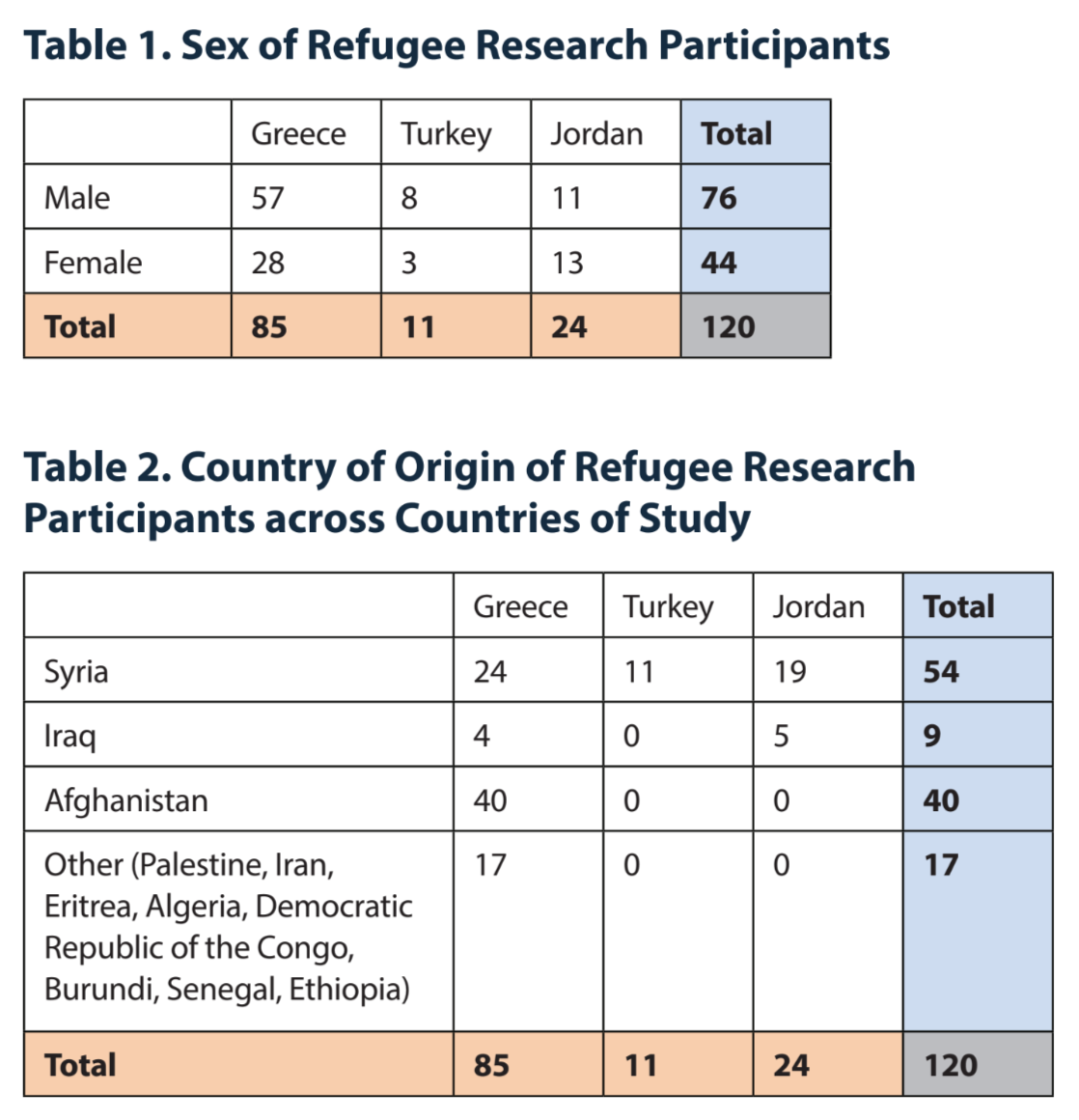
The breakdown of refugee research participants by sex and ethnicity across our three country sites can be seen in Tables 1 and 2. Consistent with our approved research protocol, we did not interview children, defined in our countries of study as individuals under the age of 18. As the tables indicate, we deliberately did not limit our refugee participants to certain points of origin or ethnicities (e.g., Syrian refugees) and, instead, engaged with a diverse group of participants who mirrored the languages spoken by our interpreters and research team (see below). This engagement highlighted important themes regarding perceived hierarchies within and among refugees, discussed in Chapter 5 of this report. In addition to the refugee research participants, we engaged with 25 key informants, described in the next sub-section.
1.4 Overview of Research Locations
Collectively, refugees viewed our three countries of study differently, seeing some primarily as countries of transit (Greece) and others as temporary destinations that sometimes evolved into more permanent places of settlement (Jordan, Turkey, and—to an extent—Greece).
In all three countries, members of the research team interacted with refugees in a variety of settings, including refugee camps (e.g., Elliniko camp in Greece) and informal refugee settlements (e.g., under the bridge in Piraeus Port in Greece). Members of the research team also engaged with refugees who had dispersed within urban or semi-urban areas without being part of a formal or informal refugee settlement (e.g., certain refugees in Sanliurfa, Turkey; Amman, Jordan; and Athens, Greece).
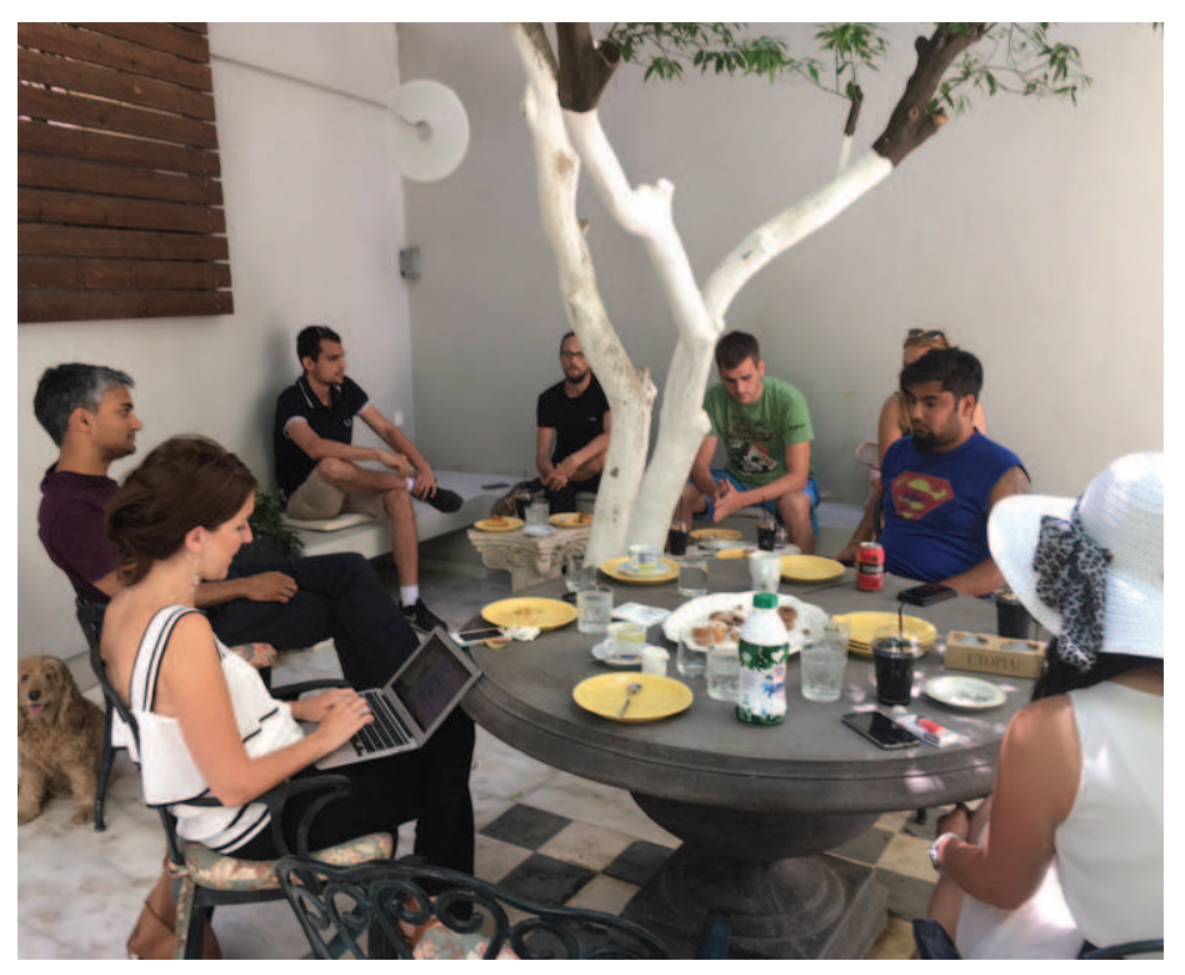
The numbers of research participants across our sites were uneven, reflecting the availability of funding, research team members, interpreters, and time. Acknowledging the value of refugee testimonies even at sites at which we were able to collect few narratives, we have opted to include all three country cases and highlight gaps and areas for further research, where relevant. Each refugee testimony is cited in connection to the country in which the interview took place. Elements of refugees’ experiences varied depending on their location and the juncture in their journey, and we note any variations in the analysis.
1.5 Research Timing, Analysis, and Subsequent Fieldwork
The timing of interviews affected the narratives we were able to access. The first cycle of fieldwork took place in July and August 2016. By July 2016, many of the formal border crossings to Central and Western Europe had closed or passage through them had slowed considerably. This meant that many of the people we interviewed who had previously considered themselves to be in transit were now fairly immobilized in the country in which we encountered them (Digidiki and Bhabha 2017, Brooks 2016). As one key informant said in Greece in July 2016, “There is no money here. Most people don’t have the hope they can leave Greece at this point. If you have money, you are already gone.” A different key informant in Greece in July 2016 echoed, “Accurately speaking, nobody is in transit [in Greece] anymore. The formal border is closed. Some—few, not many— have accepted that this may become their country. Most people still want to leave and think they will leave.”
A preliminary analysis workshop by the research team in September 2016 identified areas for further inquiry. We pursued some of these during subsequent fieldwork in Jordan and Greece between December 2016 and April 2017.
1.6 Engagement with Research Participants
The primary modes of engagement with research participants included interviews with key informants and refugees and observation at the above sites. Key informants consisted of personnel interacting with refugees in numerous professional capacities. These included the delivery of humanitarian assistance, facilitation of money transfers, provision of legal services and counseling for asylum, and offering of other programming to support refugee integration into communities. Certain key informants had also supported state agencies in verifying refugee registration information, and thus shed light on the eligibility requirements for receipt of certain types of assistance. The engagement with key informants reflected a feminist commitment to “studying up” (Nader 1972) and exploring the narratives of those with power to shape refugees’ experience, instead of placing narrative expectations squarely on refugees who experienced various forms of vulnerability throughout their journeys (Theidon 2012).
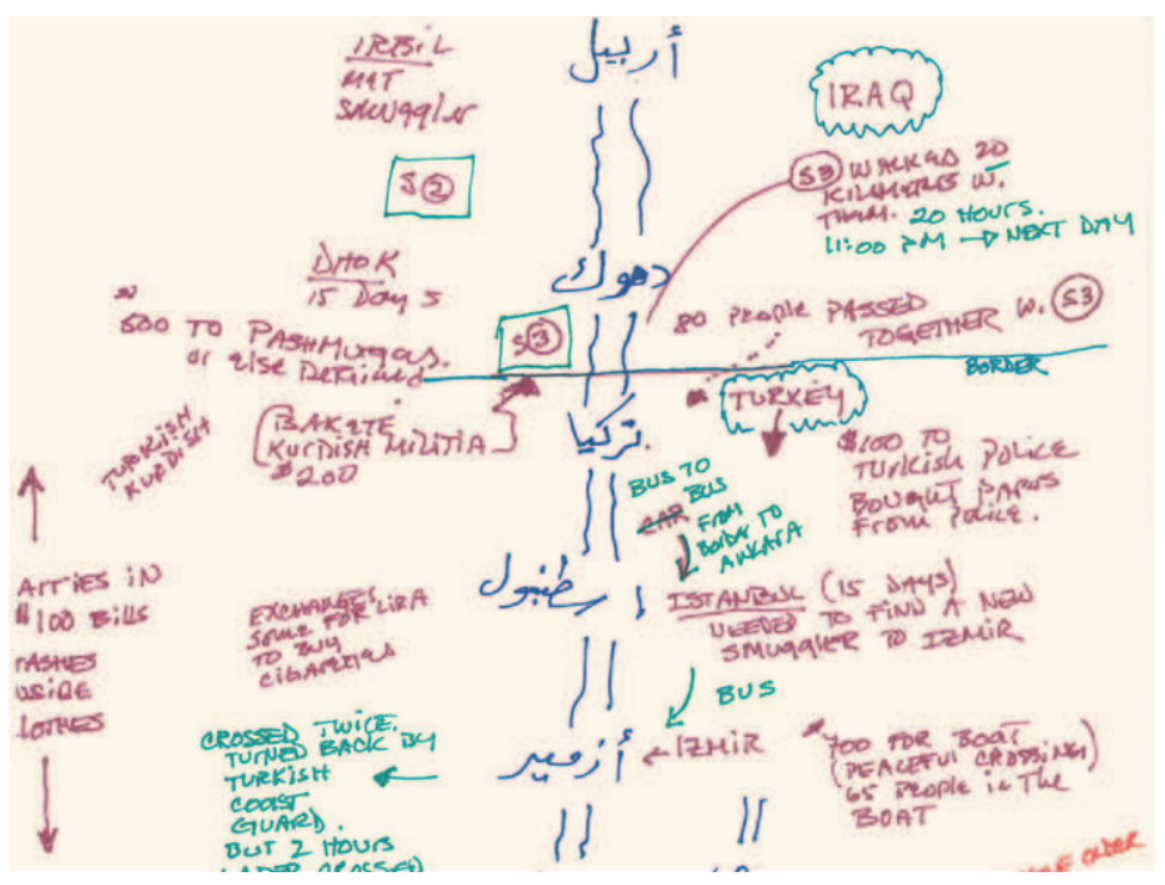
Engagement with refugees primarily consisted of semi-structured interviews as well as observation of settlement sites. Certain refugees also participated in mapping their journeys, drawing on participatory cartography methodologies from Robert Chambers (2006) and Elisabeth Wood (2003). The maps provided entry points for conversation on points of risk, vulnerability, and protection in refugees’ journeys, as well as their interactions with authorities. As maps are useful not only as entry points of conversation but also as analytical tools, some are displayed as illustrations throughout this report.
During observation, we noted, among other factors, the physical setup of the site, the available facilities, the presence of humanitarian actors or other professionals and their interactions with refugees, the ease of movement between the settlement and other areas in which refugees spend time, and the ways in which refugees organize their daily lives during displacement. Members of the research team also had the opportunity to observe selected non-governmental organization (NGO) focus groups and meetings with refugees at field sites. Reflections from those events, particularly with regard to hierarchies of humanitarianism, are included throughout the analysis.
1.7 Effects of Gender, Ethnicity, and Language on the Research Process
Our research methods affected the narratives to which we had access. For example, it was often difficult to talk to women alone, without the presence and/or permission of male family members or other men in the women’s network (such as neighbors). Many of the stories of women were often mediated through the presence of men, who at times dominated the conversation or answered on women’s behalf.⁵ As we remarked in our earlier discussion of luid performances of refugee-ness across contexts, the narratives that refugees feel comfortable producing for researchers may differ from those they feel compelled to perform in front of other refugees (even when—or especially when— those are their family members, neighbors, or acquaintances). We sought to address these issues by engaging with female research participants in women-only spaces, or in gender-segregated community groups, as well as by talking to women who were traveling alone or in groups of other women and by noticing the shifting dynamics and narratives. The languages our research team members and interpreters spoke—Arabic, English, Farsi/Dari, Greek, Turkish—affected the narratives to which we had access.
1.8 Editing and Analysis
As Helen Bassini writes, “The qualitative feminist research journey is messy, non-linear, and inductive” (Bassini in Wibben 2016, p. 181). We used an inductive approach to code data both at our formal analysis workshop with our full research team and during subsequent opportunities among the co-authors of this paper. Where possible, we have opted to quote extensively from the stories of refugees themselves. Consistent with our approved research protocol, we have chosen to abstract or omit entirely certain identifying details pertaining to people’s identities or to places. We have also chosen to quote from the field notes of our research team in situations where quoting a refugee directly is not possible or where the researchers’ observations provide additional context.
Throughout the write-up process, we paid close attention to narratives themselves as a financial resource and a form of financial performance.⁶ Chapter 5 explores how refugees felt compelled to produce shifting performances of need or vulnerability depending on what the particular system (whether kinship finance, humanitarian protection, or other) expected of them. In examining these narratives and performances, we explore not only the stories refugees produce, but also the systemic pressures, expectations, and inequalities with which they are engaging.
The process of editing and analysis has prompted us to reflect on the politics of knowledge production. Echoing Malkki (1995, p. 56),
The problem of representation is, at this point, tied to that of representativeness. For ethnographic generalizations are inevitably supported with citations of particular events and utterances. But which particularity is to be privileged? Which specific statement will be quoted? Does one always omit “freak utterances,” comments that were heard only once, in favor of recurring statements?
We wrestled with Malkki’s questions and acknowledged editing as its own form of instrumental fragmentation—indeed, of violence—to the narratives of refugees. While we acknowledge the necessity of putting narratives in conversation with each other and of making selective choices about how to pair refugees’ voices with our own analysis of them, we have also sought to preserve the integrity of refugees’ stories as holistic narratives in themselves. To that end, complementing the release of this paper, we will be launching a series of lightly edited ieldnotes. These consist of refugee narratives edited for security (i.e., removing identifying information) and told in the voices of the refugees who shared their stories with us.
Finally, throughout the write-up, we note tensions between what emerged as common stories versus exceptional narratives. As we discuss in greater depth in Chapter 5, we build on research by Didier Fassin and Mariella Pandoli (2010), Miriam Ticktin (2011), and others to illustrate how the humanitarian system operates under a logic of exception and “how compassion acts as a form of policing, choosing a few exceptional individuals and excluding the rest” (Ticktin 2011, p. 127). This system of exception shapes the narratives that refugees share with researchers, humanitarian agencies, legal groups, and other key actors in the migration crisis. The political economy of trauma (James 2004) rewards certain scripts of exceptional hardship over other, more common narratives. In the context of our research, this tension took many forms: When discussing their strategies for liquidating assets into cash prior to their journeys, the most common narrative among refugees involved the sale of livestock, homes, and household appliances, as we discuss in Chapter 2. In the case of one research participant, however, it involved the sale of a child; in the case of another, it involved encouraging a daughter to marry earlier to both make the household smaller (thus reducing its financial needs) and to use bridewealth as an asset that could finance migration. Illustrating the range of refugee journeys, while being mindful of the reinforcement of particular narratives at the expense of the marginalization of others, has remained a challenge throughout the research and analysis process.
1.9 The Ethical Dilemmas of Refugee Research
Throughout this chapter, we have discussed some of the ethical dilemmas we have faced and some of our strategies for engaging with them. Though a fuller discussion of the ethical dilemmas this study has raised is the topic of a separate publication, and this theme has already received extensive attention in the literature (Jacobsen and Landau 2003, Mackenzie et al. 2007), three additional dilemmas are worth briefly highlighting here.
First, we navigated concerns around access and “research fatigue” (Pascucci 2017) due to an oversaturation of researchers, journalists, and humanitarian practitioners, all asking questions to the same groups of refugees. This was coupled with perceptions among refugees that participating (or refusing to engage in) a study may affect their access to humanitarian assistance, protection, or other benefits. These dynamics were further exacerbated when refugees were asked to repeatedly narrate experiences of physical violence they or their loved ones suffered in their home countries or along the journey of migration (Theidon 2012). As Elissa Helms writes in her exploration of the obligations that we impose on victims of violence to narrate the harms they suffered, “Sometimes allowing victims to remain silent and anonymous is a way to allow them to reclaim dignity and a sense of self” (Helms 2013, p. 240).
We attempted to engage these concerns in a number of ways. These included:
- opting not to conduct research in areas in which large research studies were underway (such as Zaatari refugee camp in Jordan);
- receiving feedback on the relevance and respectfulness of our initial study approach from humanitarian practitioners, researchers, and interpreters who worked in our geographic and thematic research areas;
- iteratively revisiting our semi-structured qualitative interview protocol at the end of each day to incorporate refugees’ and interpreters' feedback on our approach;
- accessing all sites independently of the practitioner organizations that supported the research, knowing that being seen in any affiliation with them might affect refugees’ willingness to participate in the study; and
- opting not to ask direct questions about the violence that may have motivated refugees’ light from their point of origin, or that they encountered along the way, and clarifying this to all potential research participants. Where stories of violence—physical, structural, and systemic—emerged in the research process, we documented them accordingly herein.
Second, we remain aware of how the process of research and documentation may undermine coping strategies that are essential to refugees’ survival. Here, too, we follow Malkki (1995, p. 51) and Feldman (1991, p. 12):
I would emphasize that in all of this, the success of the fieldwork hinged not so much on a determination to ferret out “the facts” as on a willingness to leave some stones unturned, to listen to what my informants deemed important, and to demonstrate my trustworthiness by not prying where I was not wanted. The difficult and politically charged nature of the fieldwork setting made such attempts at delicacy a simple necessity; like Feldman, I found that “in order to know, I had to become expert in demonstrating that there were things, places, and people I did not want to know.”
Finally, the political economy of suffering⁷ that governs storytelling in vulnerable settings (Fassin and Rechtman 2009) affected both refugees’ willingness to participate in our study and the narratives we accessed during our engagement. We acknowledge that power imbues research relationships—in this case, visibly unequal power. In the end, we were—and remain—part of the hierarchies that elevate certain narratives while marginalizing others. Rather than denying this subjectivity and power, we have attempted to explicitly convey it through our writing.
Chapter 2. The Financial Portfolios of Refugees: Amassing, Carrying, and Spending Money on the Move
Money is an essential component of refugees’ journeys, not only for financing daily expenses (such as food, shelter, diapers, etc.), but also for facilitating relationships with key actors along the way, as we examine in depth in Chapter 3. In this chapter, we begin by exploring the main sources of funds that refugees use to finance their journeys. A key finding is that even the most sudden displacement requires financial and logistical preparation—and when that is not possible, refugees face intermittent journeys, with long pauses between stints of movement and possibly higher risks along the way. Preparations include selling assets, withdrawing any available cash from accounts, borrowing money from kinship networks, and setting up financial mechanisms to access funds along the way. After discussing these preparations, we take a look at the costs of these journeys, acknowledging that costs varied widely over time and from refugee to refugee. Finally, we examine refugees’ strategies for gathering money during their transit, such as borrowing (profiled in depth in Chapter 3) and working along the way.
2.1 Prior to the Move: Financial Preparation for Departure
Though the exact moment at which a person embarks on the migration route is usually triggered by a defining, often sudden, event, these journeys require financial and logistical preparation. The majority of research participants articulated having considered leaving their point of origin before the incident that led to their eventual departure.
These preparations consisted of:
- liquidating assets to secure cash to carry during the journey;
- depositing cash with kinship networks to transfer to refugees during transit;
- soliciting or borrowing cash from kinship networks to finance transit, where possible;
- collecting outstanding debts; and
- identifying smugglers and money transfer agents, where needed, and negotiating terms and insurance policies.
In liquidating assets to secure cash, research participants narrated selling land, homes, or livestock, when possible:
We all sold things, whatever we could… We just wanted money immediately to pay to leave.
—Syrian woman in Greece
We sold everything: refrigerators, washing machine, everything. Sold the house, closed the bank account. Liquidated. Anything to get here.
—Iranian woman in Greece
It was a black day when I had to sell my wife’s gold.
—Iraqi man in Jordan
When preparations for departure where protracted, as was the case with some research participants fleeing Afghanistan or certain African countries, they may have lasted years:
In Nigeria, you cannot sell your family’s land because it belongs only to the family. If you sell it to someone else, both will have problems—it’s the bad eye of the ancestors. So, there is a dawlet system that allows us to lend land in exchange for money. People can borrow your land if they give you money, but they cannot build a house on it; they can only bring in their animals, harvest crops. My brother lent the land to a cousin for two years, and he used that money to go.
—Nigerian woman in Greece
By contrast, when preparations had to be brief due to imminent departure, as was the case with some research participants fleeing Syria, sales took place over a matter of days and often resulted in substantial losses over what peacetime sales could have been:
I sold my house for €5,000, but I believe before the war it would have been worth €50,000. I sold my motorbike for €1,000 and borrowed €4,000 from my brother.
—Syrian man in Greece
For those who were not able to prepare extensively and had to leave suddenly, financial readiness depended on the possibility of borrowing money from family members and friend networks (either at the country of origin or after arrival in other countries). Sometimes, this involved even borrowing money from strangers:
We were running when we left, and we did not have a chance to bring anything. We just took our ID cards and passports. Our livestock, possessions, everything we left behind was lost. We left with only our clothes. At the airport, good people offered us money for tickets.
We went to people that we know to get help, saying that we wanted to come to Jordan. Those people bought tickets for us. We did not know anyone in Jordan. We came and immediately applied to UNHCR. We asked Iraqis that we know what to do.
—Iraqi man in Jordan
The journeys of refugees who had less time to prepare financially (or who had fewer assets to liquidate) were often more staggered and characterized by long pauses along the way to find work and secure a temporary livelihood to finance the next leg of the journey. As one key informant said about refugees who were stuck in Greece without being able to move forward in July 2016, “Refugees who are still in Greece haven’t found a smuggler or don’t have money to pay him. In that case, you look for agricultural work. It’s not like Turkey, where it’s relatively easy to find labor for refugees. Because of the financial crisis, both the laws and the jobs are harder here.” Refugees themselves reported having to pause their onward journeys towards Europe to amass more cash to finance them. An excerpt from a researcher’s fieldnotes regarding a conversation with an Afghan man in Greece elaborates:
His family sold a house to pay for the trip. He brought 500 dollars with him for water and food along the way. “That was not enough. I had to work. There was no work in Iran for people like me. Too dangerous. ” He stopped in Turkey for 8 months, where he worked construction.
—Researcher’s fieldnotes from a conversation with an Afghan man in Greece
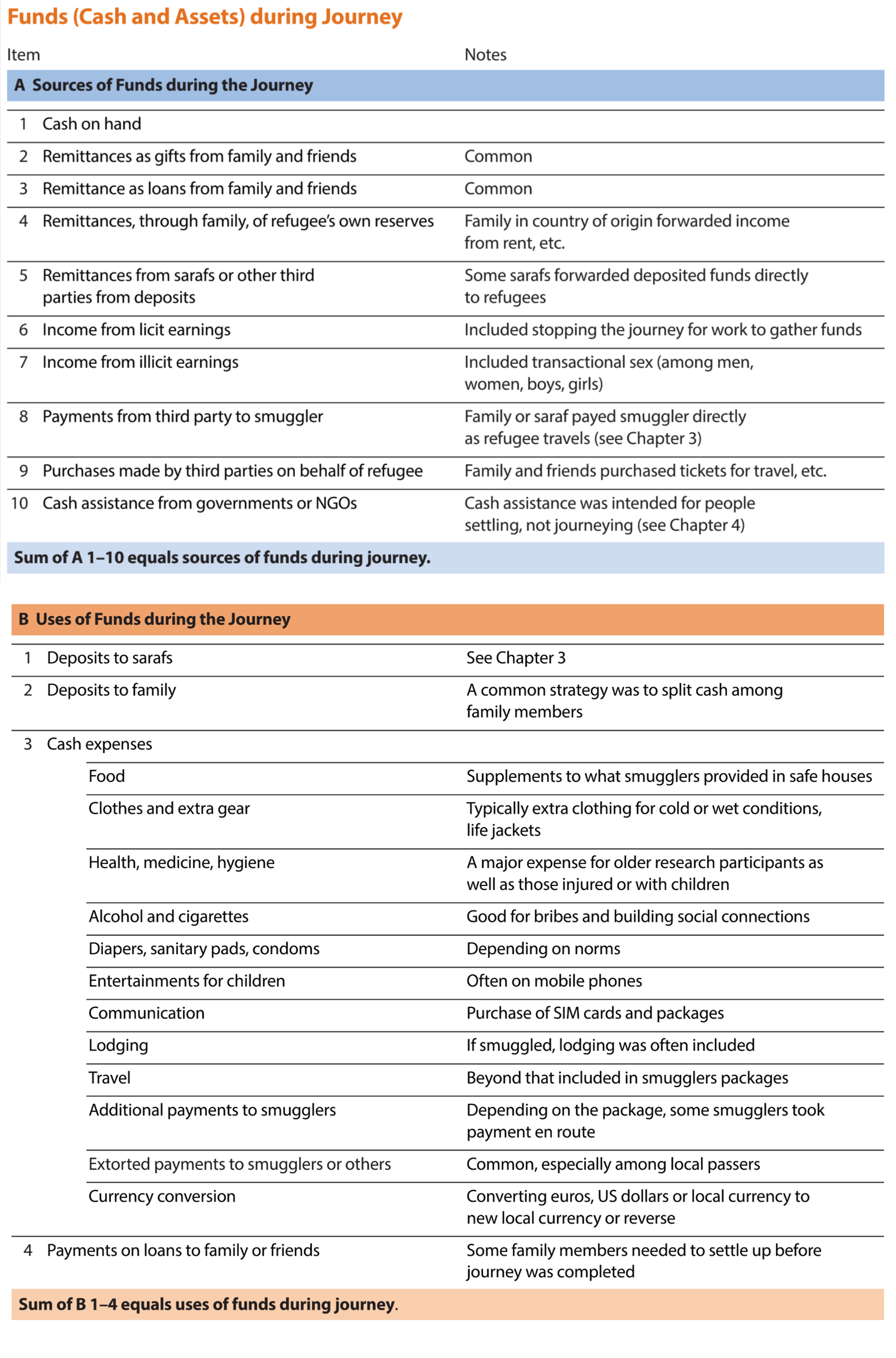
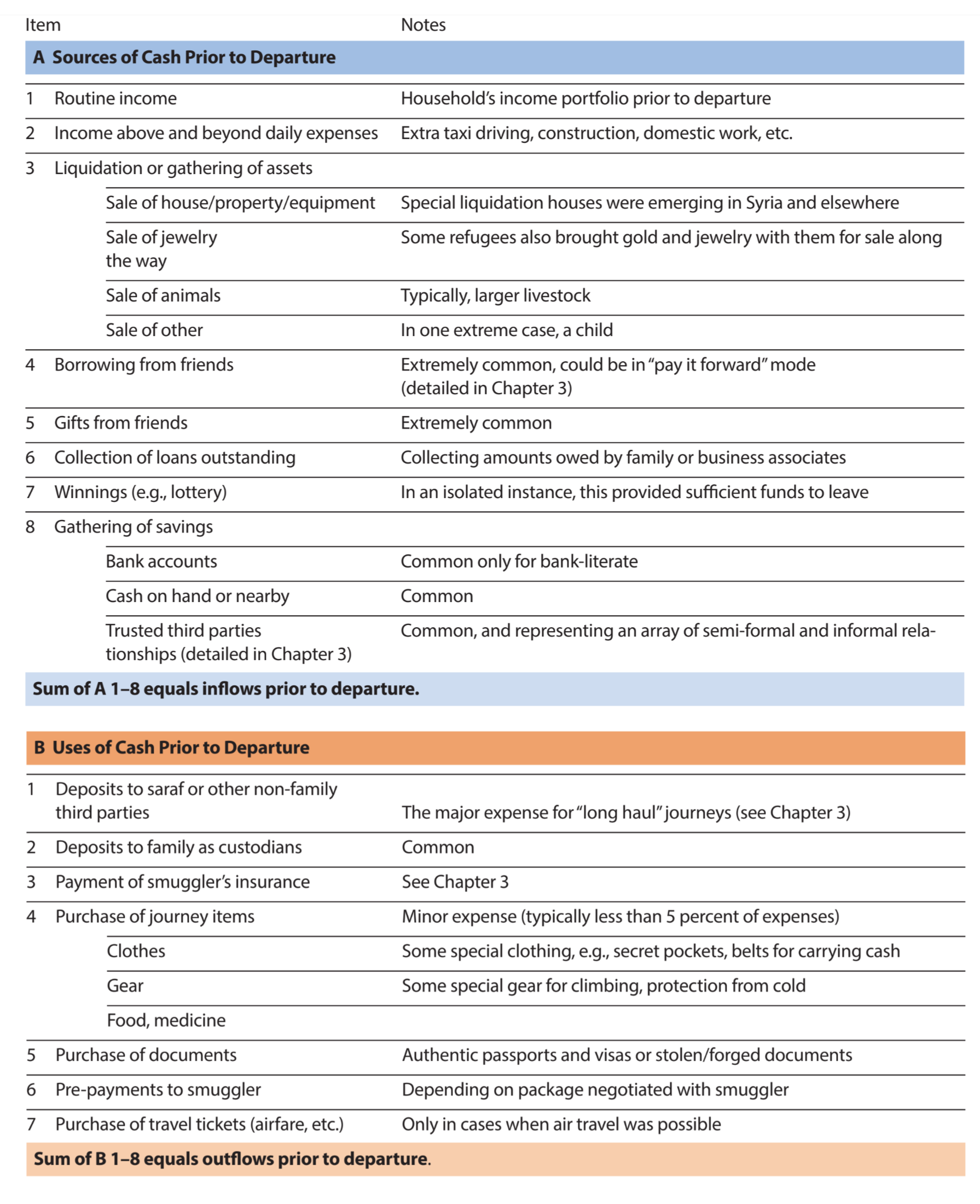
If one were to analyze a refugee’s cash flow from an accountant’s point of view, our field notes in aggregate could be represented in the form of a “statement of sources and uses of cash.” Table 3 below summarizes the funds gathered prior to departure, as well as their uses. Subtracting item B from A would indicate the funds available for the journey itself.
2.2 Costs of Transit
How much money does a refugee need while on the move? In over 100 conversations with refugees, we found no cost structures identical. Instead, the cost of moving from a refugee’s country of origin to Europe fluctuated, as did the costs of moving through countries of transit, some of which became countries of endured settlement or “reluctant destination” over the course of our study. Key informants affiliated with the Balkan Center for Migration and Humanitarian Activities, which tracked monthly costs of border crossings, confirmed this fluctuation in prices. Even over the time of our research (July 2016-April 2017), prices varied by thousands of Euros from month to month. Factors that affected the price luctuation included (1) family status, including how many children were part of the group; (2) territories people had to pass through and who controlled them; (3) mode of travel, such as the combination of taxis, trucks, planes, or feet needed to cross borders; (4) documents refugees needed smugglers to procure or replace for them; (5) political developments that facilitated or foreclosed certain routes of passage. As one key informant said in Greece,
When we say the borders are closed, we mean the formal border. As soon as the formal border [from Greece to elsewhere in the Balkans] closed, the smugglers were in great business. Golden jobs! The prices vary, and they fluctuate depending on these events. To give you an example, this week it seems to cost 1,800 euros to get from Greece to Austria. But this depends on who has to mediate, who is helping along the way, whether you’re taking trucks or taxis or walking, whom you have to bribe. There is all-inclusive smuggling, and smuggling à la carte, and everything in between. Problem is, you don’t know what you’re getting.
—Key informant in Greece
We deliberately did not initiate direct conversations with refugees about the amount of money they carried with them or their costs during transit. However, as refugees began to volunteer this information themselves during our conversations about preparing to flee, we discovered that discussing money on the move was a less contentious topic than we had anticipated. Many refugees—particularly men, as we discuss in Chapter 5—were happy to shed light on the transactions underpinning their experiences of forced displacement. Some had kept detailed records; others recalled from memory. This information is significant because the amounts of money refugees were required to spend during their transit corresponded to financial preparations they had to make prior to departure, kinship networks they leveraged before and during their transit, and risks they faced along the way. Below, we preview some indicative costs for various routes.
From Afghanistan to Turkey or Greece and Beyond.
For those who had to endure the hardships of travel largely characterized by trucks and buses, a trip from Afghanistan to Greece could cost $7,000. If Turkey (rather than points in Europe) were the destination, the cost could lower to $2,000 per person or less. A refugee from Afghanistan describes such a journey to Greece:
My children are seven years old, five years old, and three years old—all boys. The whole trip from Afghanistan to Greece lasted two and a half months. One of the most frightening legs of the journey was crossing from Iran to Turkey, across the Zagros mountains. It was 15 hours by foot. A loose boulder fell on my husband, crushing his foot. Some young Afghan men, traveling alone, helped him by spraying some “soccer spray, ” getting him up and helping him limp through the climb.
Often, along the journey, people would ask us for things. Give us your phone. Give us your money. We had no idea who these people were or if we should pay attention to them, and frequently we did give them money just to get rid of them. The problem was not our smuggler; it was everyone else. We were constant targets.
We had only one main smuggler, elder smuggler, from Kabul to Van, but were passed along by 25 different local smugglers all across Iran. We made no payments to these smugglers—only to the elder, and only then when we reached Van. It cost €2,000 to travel from Afghanistan to Turkey (Van).
—Afghan woman in Greece
Refugees’ ability to negotiate prices was also critical in determining costs. In areas in which smugglers were ubiquitous and prices more transparent—for example, in Nim - rooz Province in Afghanistan, border crossings between Syria and Turkey, or ports in eastern Turkey—refugees could choose a smuggler based on price. However, in areas in which smugglers were fewer or not as identifiable, a good price depended on an individual’s ability to negotiate. As one Afghan key informant noted, individual negotiating skills were key to getting a good deal: Jor amad was key, meaning the way in which parties come to terms with one another. Each arrangement appeared bespoke, even when travelers had time to shop for the best deal. Pricing was somewhat consistent in places where there existed an informal “office of transactions,” a physical place where a refugee may visit and obtain prices. Research participants reported such places in Athens, the Turkish western seaboard, and parts of Syria. Pricing was also more consistent when competition was apparent.
The following are three legs of a journey and costs of each.
From Afghanistan to Greece, typical costs for traveling via truck, buses, cars and boats in winter of 2016 ran something like this: $1,500 from Afghanistan to Pakistan; $1,000 from Pakistan to Iran (just crossing border); $3,500 from Iran to Istanbul; $1,350 from Istanbul to Athens (via bus, boat, and ferry), for a total cost of $7,350. Smugglers provided food, safe houses, and transportation.
—Afghan man in Greece
Smuggling represented the single largest cost of the refugee journey, and fees included travel, shelter, food, documentation, and bribes. Though smuggling itself is discussed in greater detail in Chapter 3, a researcher’s fieldnotes from a conversation with an Afghan man describe how he allocated costs between travel-related expenses and cash-on-hand:
It costs 10,000 Afghan dollars (equivalent of about $200) to get to the border of Iran per person. He said this is a less formal part of the journey—in his group, only 4 of 17 made it across the border without getting sent back. On the border between Afghanistan and Iran, he said “smugglers line up like a taxi stand—you just get off the bus and choose one. ”… He said he had no passport because it would have been too expensive to get a real passport. He reports that it cost about 500–500–600 to get across the border into Iran, plus he carried another $200 of pocket money. He stayed in Iran for only about 10 days, then crossed to Turkey for about $1,500, which was the price of being smuggled at the time. He stayed in Turkey for a few months, working in construction, but he didn’t get paid properly. He was never able to save money, only to live day by day. His original plan was to save enough money in Turkey to pay for a smuggler into Greece by himself. Because he was not able to save enough, he called his family, and they pooled more money together and called the same smuggler that had gotten him into Iran, and they paid him $1,600 to get him from Turkey to Greece. He brought about $300 with him to Greece.
—Researcher’s fieldnotes from conversation with Afghan male, Greece
The ratio in this story, of roughly 15 percent cash for day-to-day costs versus smuggling costs of 85 percent, held true for most interviews, even though the total costs changed markedly based on the distance traveled, the duration of the journey, and mode of travel.
Families could find better prices, but their hardships would multiply. An excerpt from a researcher’s fieldnotes describes part of a family’s particularly punishing journey. It cost $3,500 per person in hard cash, but cost considerably more in adversity.
From Kabul, they traveled for 24 hours by bus, passing through Kandahar. They were afraid, having heard that Daesh stops buses along the way looking for Shias passing through. They spent two nights in a border town, and then made the journey across the border into Pakistan. This journey took them 28 hours, sometimes by car and other times by foot. There were about eight families traveling together, along with 13–14 single men. In Pakistan, they were sometimes followed by the police, but once they reached the smugglers’ safe houses, the police no longer bothered them. The safe houses in Pakistan belonged to families who had some connection to the smugglers. They had no food that first night and just enough cash to buy some bottles of water and some cookies that they gave to the younger travelers. The smugglers had advised them not to carry cash, because of thieves, and they were not allowed to leave the safe house to access their money through a saraf [money middleman— see Chapter 3].
After spending the night, they departed at 8 AM to make the journey into Iran. This involved a 13-hour trip, once again traveling by car and foot, mostly through desert. They traveled at high speeds in the back of large, open-top vehicles—every inch was packed, and the vehicle carried 70–80 people. The young men sat around the perimeter of the vehicle, holding onto dear life at dangerous speeds, and the women and children sat towards the middle, holding onto their young children. The men sitting at the perimeter sometimes fall out of the vehicle and are left behind in the desert.
From Syria to Greece and Beyond.
Though a shorter journey end to end, departing Syria for Greece could also be expensive—up to $2,500 per person in the spring and early summer of 2016—with the major expense entailing movement across variously controlled territories within Syria itself. The few who were able to drive to the border to Turkey at Idlib reduced their costs to being smuggled across a single border.
A typical trip from Damascus to Greece in the spring of 2016 could range from $1,000–$3,000, depending on how many internal borders were crossed in Syria. Each major segment was cut into smaller segments based on which areas were controlled by Syrian forces and pro-government militias, by Daesh, or by opposition forces, foreign and domestic.
Routes through Africa.
For routes through Africa, costs again varied, with country of origin and route dictating aspects of costs but not accounting for all variations in pricing. An Ethiopian described his multi-legged, broken journey to Turkey:
I went to the bank, took all of my money out, and asked my sister to keep it. I had money from my job— about 300,000 birr [$12,000] in my bank account. I wanted to go to Sudan. I called my friend who lives in Germany, and he gave me the phone number of a smuggler. I met the real smuggler after two weeks. We discussed the travel—I told him: “I have money and everything. Whenever I can leave, I’m ready. ” The smuggler said okay. He asked for $1,200. To go to Sudan only, to which I said, “Okay, anywhere but Ethiopia. ”
Someone working for the smuggler drove us to the border with Sudan. The driver told us to get off, and he left us in a small house there. He told us to wait for a Sudanese man. When the Sudanese smuggler came, we crossed the border at night with him by foot. We walked for four or five hours. Then we took a car to Khartoum. The driver doesn’t leave us for a second. The Sudanese smuggler called the Ethiopian smuggler when we arrived. Then the Sudanese smuggler gave me a phone to call my sister so she would pay him. I think she met one of them in person, but I’m not sure who or how she paid.
In Khartoum, I had to stay in the smuggler’s house for ten days without going out. I heard an Ethiopian had been deported from Sudan to Ethiopia. I tried to collect information, and when I realized it was too dangerous to stay there, I told the smuggler I wanted to leave. I said I wanted to travel to another country, farther away. I wanted to go to Turkey and stay there. The Sudanese smuggler put me in contact with a Turkish smuggler. I didn’t speak with the Turkish smuggler, just with the Sudanese. He asked for $2,000. I stayed in the same house for four more days. And then the smuggler gave me a fake passport with a visa to Turkey.
—Ethiopian man in Greece
2.3 Beyond Smuggling: Other Uses of Funds on the Move
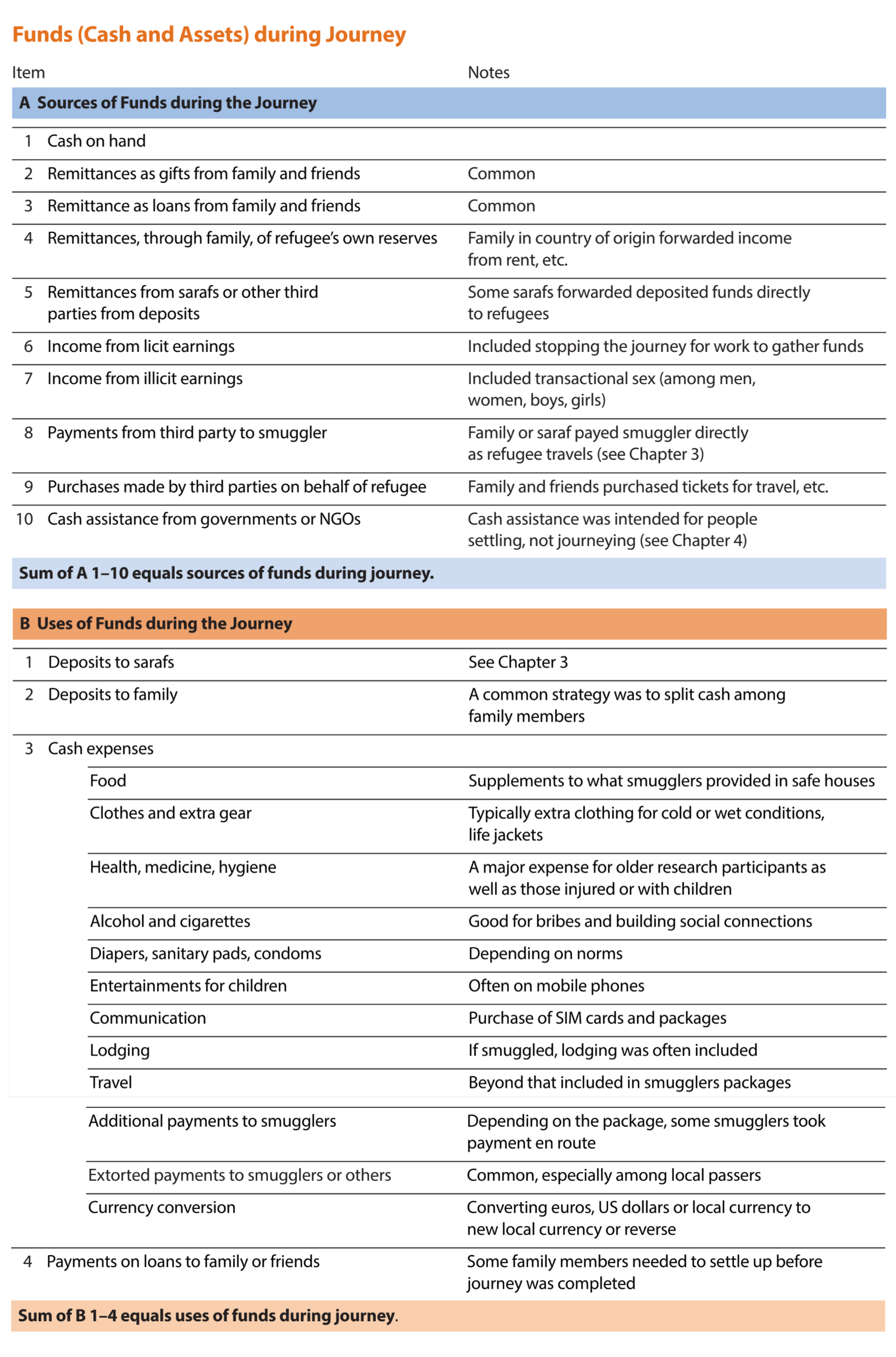
Having reviewed the ways in which the price of smuggling is a key cost of the financial journeys of refugees, we now turn to the rest of their expenses. A summary is provided in Table 4. Costs varied, depending on the individual experiences of refugees, as well as their family status. For example, refugees fleeing with young children reported spending money on diapers and baby food, as well as medical care along the way. Similarly, refugees who were injured during transit reported issues both with amassing funds (often because they could not work at the time) and with unforeseen expenses.
We note some interesting silences regarding spending and costs along transit routes. Specifically, in none of our conversations with refugees did spending on their own entertainment come up; insofar as entertainment or leisure was mentioned, it was always with reference to refugees’ children (for whom they occasionally bought new toys or clothes).
Key informants at times expressed skepticism regarding the acceptability of refugees’ use of money towards what these key informants perceived as indulgences. One key informant in Greece expressed dismay at the idea that refugees had used humanitarian cash assistance (discussed in Chapter 4) towards haircuts, and another key informant felt similarly about adult women using cash assistance to buy new clothes. A key informant who had worked with refugees throughout the Balkans echoed dissatisfaction with the idea of refugees buying themselves computers or hairdryers. These dynamics are worth examining for three reasons: First, they suggest a hierarchy of legitimacy in others’ imaginations of refugees’ needs—and that hierarchy may shape the narratives that refugees feel they can produce to describe their own spending habits on the move. Second, key informants’ attitudes regarding refugees’ “allowable expenses” reveal imaginations of dignity, vulnerability, and need and are, thus, instructive for understanding how refugees are expected to perform their plight. Third, as many of these refugees enter phases of protracted displacement and as “transit” becomes an indefinite state or a new norm for some of them, additional attention will need to be paid to their forms of leisure, entertainment, and construction of a life beyond survival.⁸
2.4 The Special Cost of Bribes
Bribes took on a major role in most journey narratives. This is not unique to the context of our study; from urban refugees in Kenya (Pavanello et al. 2010, Campbell 2006) and Mauritania (Lindstrom 2003) to journeys of Central American migration (Brigden 2016, Galemba 2017), people on the move frame bribes as a livelihood strategy or a strategy for facilitating passage and ensuring self-protection.
Among those reported to have solicited or accepted bribes from refugees are police, border guards, smugglers, and camp residents. Depending on the risk the refugee faced and the relative power of the briber, the cost of bribing varied. A Congolese woman reported having paid a $2,000 bribe twice, once to get released from prison and once when police searched her suitcase at an overland border crossing in East Africa.
After the investigation in September, the police saw I was innocent and re - leased me. When I got out, I told myself, “I can’t work here anymore. There are no other jobs. I have to leave. ” My lawyer too said I should leave, turn the page. I sold my house with the help of my lawyer for cash. It was a beautiful home. I put the money in my luggage. In Goma, I stayed in a hotel for two weeks. I knew no one there so I wasn’t hiding. I was going out to shop. After ten days my lawyer called me: “The bank is still after you. They’re saying the money you have is not the house’s money and that you didn’t sell the house. It’s the bank’s money, ” they say. “You have to leave. ” I bought a bus ticket to go to the border. I had my luggage with the cash inside with me. At the border, they checked us, and they saw I had all that cash. I had to justify why I had so much money. I said it was my money, that I sold my house, but they didn’t believe me. They arrested me and put me in jail for four days. I called my lawyer and they released me, but I had to give them $2,000.
—Congolese woman in Greece
Though this is a unique case, the necessity of bribing to secure passage, release oneself from prison, procure documents, or ensure relative safety recurred throughout the refugee narratives we encountered. As an Eritrean woman shared in Greece, “I had to pay $5,000 to go from Asmara to Khartoum. It is so dangerous to leave Eritrea that it is very expensive to corrupt the guards.” Bribes to reduce jail time when police caught refugees trying to find smugglers to lee were common, especially in Turkey:
You see the same people in jail again and again—we are all making the same journey. If you bribe the police, maybe they won’t throw you in jail, or they will let you out of jail faster. And sometimes, nothing happens. The police catch you trying to leave, but nothing bad happens.
—Afghan man in Greece, narrating his experience in Turkey
Some bribes were part of an intricate system that involved police and were bundled into the price of the journey. A refugee described his experience in Turkey:
In Istanbul we started looking for sea smugglers. Every smuggler was giving us diferent prices. I started having expertise in this. Even in the streets, some people approached us “selling paradise [a ticket to Greece] for 500 euros. ” One of our friends in France recommended an Algerian smuggler: The smuggler had “ten years of experience” and put us in contact over the phone. We went to his house. It was big. He has a Turkish residency. He works with the Turkish people, with the police. He said: “Don’t worry the Turks work with me… I make you pay only 500 euros. Don’t tell your friends. ” We got along very well. He got us passports and took care of everything for us. The smuggler told us a policeman would come to us and that we should do whatever he told us to do and not speak to anyone else. The policeman did approach us at a corner—we pretended to know each other—and he asked each of us to follow him one by one to diferent restaurants where he would take money from us—his payment. We had to give him 100 Turkish liras. Once we had all paid him, he said, “If you’re with me, the police won’t speak to you, ” and we followed him to the public bus stop.
—Algerian man in Greece
None interviewed seemed surprised about the requirement to pay bribes for various services. Many spoke of needing to “hasten the process” or “find a way.” Some planned well in advance for the eventuality of paying a bribe. A researcher’s fieldnotes reveal how a research participant in Jordan prepared in Syria for the eventuality of bribes along the way:
The family lew into Amman then traveled to Irbid by bus. All they had with them were their documents, some clothes, and a special drink from Syria (didn’t specify) that she [the refugee] would use to “bribe” guards at various points.
—Researcher’s fieldnotes from conversation with Syrian woman in Jordan
Finally, bribes were not absent from camp settings—even among refugees themselves. A key informant in Greece relayed that in one camp, after an NGO digitally loaded up cash assistance onto refugee-held debit cards each month, certain camp residents would tax each aid recipient the sum of €10, or about 10 percent of their aid, in exchange for “protection.” These camp residents would be refugees themselves with no formal power, but with perceived informal authority among other refugees, particularly in terms of guaranteeing security. Gretchen Peters (2009, p. 132) describes a similar scheme in Afghanistan, wherein “shopkeepers, like farmers, could expect to hand over about 10% of their monthly take, either in the form of cash or commodities.”
2.5 Making Money on the Move
Until this point, we have reviewed how refugees prepared financially for their journeys, and took stock of their sources and common uses of funds. We now turn to refugees’ strategies for making money while on the move. Most of our research participants were not able to finance their journeys exclusively through the assets they gathered prior to departure. Instead, they had to piece together a financial strategy while on the move, which combined laboring, borrowing, and attempting to safeguard cash from being lost or stolen and/or stretching their cash assets to last as long as possible. The strategies we encountered included
- scrambling (scrambling for cash from relatives in the form of loans or gifts),
- swapping (switching out one asset for another while on the move or in preparation, such as selling gold for cash).
- squirreling (storing or hiding money from others, such as by sewing it into clothes).
- stretching (making what little money they had last till the next grant, or transfer), and
- shunting (directing payments via third parties to smugglers).
In this section, we focus on scrambling and swapping. Other sections of this report detail squirreling, stretching, and shunting.
A. Harvesting Income from Immoveable Assets
Some research participants had relatives in their country of origin who forwarded the income earned from immovable assets at home. One such research participant reported,
We sold one house for about $100,000 to get money for our journey. We did not have to borrow; the second house is being rented for $300 a month.
—Afghan man in Greece
Certain research participants from Syria, in particular, reported that relatives at home were forwarding money from jointly held businesses still functioning in their hometowns or from liquidating property and equipment. What was not clear from our interviews was how long assets back in a refugee’s country of origin could continue generating income. Conflict and the threat of destruction or seizure, as well as continued liquidation, would surely deplete assets; this area requires further research over time. Notably, this strategy of harvesting income from immoveable assets was only available to refugees of particular social classes who had access to those assets in the first place, which does not accurately reflect the experiences and backgrounds of many of the refugees we met transiting our countries of study.
B. Selling Assets: Swapping an Asset for Cash
Many of our research participants traveled with assets to be sold along the way. The asset most cited for stowage and sale was gold:
They brought gold and money with them when they crossed the border. His family traveled irst to Beirut by car. His father drove with them to help see them through the checkpoints on the way. They passed 7-–8 checkpoints in which soldiers were heavily armed, not like the quick security checks that they had known in the past. They spent four hours driving. At the airport, they said goodbye to his father. His father gave him cash and gold to carry.
—Researcher’s fieldnotes from a conversation with a Syrian man in Jordan
Research participants discussed the sale of the gold they carried:
In Homs, she and her family stayed in a hotel for the night (with more than “one million other people” in the same room). There were no blankets, so she covered her children with her coat. They stayed in Homs for one week, and she sold her gold for cash there. Her husband’s annual bonus had paid for the first bus ride, and now they were low on funds. They attempted to travel to Jordan again, this time a different route. They went back to Damascus, then from there to Zabadani and then to Lebanon. With the gold she sold, they paid for a car for the family to Beirut (they slept in the car the first night). From Beirut, they traveled to Tripoli. Their relatives were very poor, and could not house them, so the family stayed overnight in a storeroom.
—Researcher’s fieldnotes from an interview with Syrian woman in Jordan
C. Rotating Savings Clubs
Some Syrian refugees reported a model of informal and rotating savings clubs with family members. In such clubs, each member would deposit an agreed-upon sum over a given cycle. During each week of the cycle, a designated member would receive the entire pot. This would repeat until each member had received the pot. The club allowed members to gather a more useful sum of money to fund a special purchase or to pay larger expenses such as rent.
While this type of system is common outside contexts of armed conflict or forced migration (Ardener 1995), research participants reported that it was challenging to keep these clubs together in times of displacement. Uncertain income streams and frequent movement and relocation of club members made holding the clubs together difficult:
Inside her home, her family participates in their own jama3eh [savings club]. Everyone who can contribute financially puts money in weekly, and it gets paid out to individuals on a rotating basis so they can use the lump sums to pay for personal expenses. She says jama3ehs aren’t super common outside families because there’s always the risk that someone will exit it (move) and no longer contribute/take the money with them before the circle is finished. This insecurity/people always on the move is making most refugees hesitant to use this system.
—Researcher’s fieldnotes from interview with Syrian woman in Jordan
D. Licit Wages and Livelihoods
Research participants often could not travel in a continuous, unbroken journey. Instead, they traveled in fits and starts, their available cash and income opportunities defining stops along the way. Refugees not only had to earn income to pay their living expenses, they had to save up for their onward journeys. Those onward journeys did not come cheaply, but often included the expensive services of smugglers. As a result, refugees took up a range of temporary employment as a strategy for gathering funds. While a detailed exploration of the legality, politics, and practicalities of refugee labor is beyond the scope of this report, we provide a few illustrative examples in this section.
In Iran, they stayed in Shiraz for about seven months to earn money for the next part of their journey—she stitched goods that were sold in the market. Her uncle sold their house in Kunduz, and they waited until he sent the money to them in Iran. Once they earned enough for their next journey, they found a smuggler for $800 per person to cross to Turkey.
—Researcher’s fieldnotes from interview with Afghan woman in Greece
Not all stops were planned and foreseen at the beginning of a journey. Emergencies arose that required refugees to halt their movement and gather more funds. Key informants and refugees cited medical crises as a reason to stop and earn an income. A research participant described her trials getting from Syria to Greece:
We have been in this camp for four months. It took us ive days to get from Deir ez-Zor to Turkey. We had to use a smuggler to get out of Syria because we traveled through areas controlled by Daesh and “the system.” I traveled with my sister, her husband, and her two children, then me and my daughter, and our uncles. There were 10 children in the whole group, and 20 of us altogether. My sister and her husband and children stayed in Turkey because their daughter was sick. I waited for four months there because my daughter was sick too, but decided to keep moving with her after she got better. She is two years old. During the four months, I worked in a factory for a Turkish boss.
—Syrian woman in Greece
E. Illicit Wages and Livelihoods
Women reported that they often did not have the social or cultural permission to work in agriculture, domestic, or construction jobs. Refugees of all genders and ethnicities also reported lacking either the working permits or the skills to obtain regular wages.
Some of the men and women who fell outside the quotas and constraints of the formal workforce often fell through the cracks of assistance systems as well.⁹ They had few alternatives to earn money. Some turned to transactional sex in exchange for cash, which is discussed in greater length in Chapter 5.
F. Blended Income: Formal and Informal
Rarely did research participants who worked only work in the formal sectors. Their opportunities changed as they were able to get work permits, place themselves in a location with good job prospects, or upgrade their skills through training. The following example, told in the participant’s own words, illustrates a remarkable journey from Syria to Turkey via a northern country. We provide his long narrative below (edited for security and brevity), as it illustrates a circuitous journey, the uncertainty and patchiness of his income, and his constant financial shuffle.
I left Syria in late 2012 when my job ended after the start of the uprising. I was arrested twice for participating in the protests. The organization laid some of us off, as my job required me to travel between cities and they could not guarantee our security. I faced trouble at checkpoints, so decided to travel. Turkey wasn’t my destination. I decided to try to go to a northern country. I wanted to go to a university there. I studied the language.
I carried the money on me. I waited for 16 hours in Beirut and didn’t leave the airport because I was worried about my stuff. I flew from Beirut to Istanbul airport, then on to the country. I kept my money on me the whole time.
I brought winter clothes, but didn’t end up needing those because the best way to fight cold is layers. I brought my ID, certificates, passport, military service book. I worked in a bakery when I ran out of money. He paid us daily wages. I got bored, and had to leave the dorm. So I used my remaining money to buy a tent and a hiking backpack.
After a month in the country, they asked me to leave because I was active in a protest movement. They gave me two weeks’ notice to leave the country. I saved up money and bought a ticket to Istanbul.
I was paid cash for day labor and spent that money on a daily basis. I spent as earned to get some food. I had been able to save money working as the bouncer. I saved $500. I used that to buy the ticket to Istanbul, some $180. I met an American there, part of a missionary group. He helped me buy the ticket online using his credit card. I paid him in cash. We are still friends on Facebook. He liked my hiking experience; we were friends. Working on the farms in the towns wasn’t that easy. There were times when I would not find a job for a few weeks. I would use the job to buy bread and mayonnaise. There was one incident when I could not find work for four weeks. I hunted for food with a Swiss army knife.
All my money came and went on the trip. I started the trip broke and earned enough money for each day. I remember when I left Syria, I had $1,800 on me. This was a lot of money for me. It was my savings from the work I was doing. The possibility of losing it was too much. If I’d known how to wire it to a safe account and pick it up there, I would have, but didn’t know how to do that. Even when I was in one place, it was hard for me as a foreigner to open a bank account with a residency permit. By the time I had been there long enough, the money was gone. When I flew to Turkey, the authorities stamped my passport and let me in.
I slept on a bench in front of the Blue Mosque for three weeks, looking for an apartment I could afford. I found a room for 150 Turkish lira per month, with only a mattress and a chair. On the bench, I was completely ignorant. I blocked out the existence of other Syrians. I didn’t want to introduce myself to anyone else because I didn’t trust them. I kept my cash with me on the bench, in my socks.
I enjoyed the apartment with this old guy. He confused English and Russian, combining them to talk to me. I started looking for a job because my $300 was running out. I ate one meal a day; sometimes I forgot because I got used to low food consumption. I started posting on Craigslist to teach Arabic, English, and other languages. I asked if market shops were hiring. I found Craigslist through looking for vacancies on Google. I saw that you could post there that you were looking for a job.
—Syrian man in Greece
G. Mixed and Changing Portfolios
Families had multiple sources of income, and their income portfolios shifted over the trajectory of their periods of transit. The financial shuffle was constant, piecemeal, and ever-changing.
This research participant’s scramble began before he started his journey and continued in Lebanon, Egypt, and Turkey:
My friend had rented an apartment. It was awful, but it was ready. To get there, we—my wife, toddlers, and me—went by car to Lebanon, then lew to Egypt. My cousin bought the tickets online for me. He also sent 500 to me in Egypt through Western Union. My friend in Saudi did the same. My sister gave me cash. Another friend gave me $250 in cash. A friend in a difficult situation offered to give me $200 in cash. His brother carried the money to my brother who gave it to me before I left. We had about $3,000 on us. My wife hid the money in her clothes. I had some daily money in my pocket.
I applied for jobs, didn’t get any, so I used the time to learn the transportation system. A couple of months later, a friend with a company was settled, so we resumed the work that I had been doing in Syria. I started the online job again. Then a professor who’d been my teacher at university offered me an opportunity. Later, my cousin who was also in Egypt told me about a customer support company in Egypt. So I worked for that company, fulltime. I had three jobs. After three months I was so exhausted, I resigned from the technical support job.
—Syrian man in Turkey
Not only did he knit together an income from far-flung sources, he knit together multiple ways of getting paid:
For one job, I used Western Union from Dubai, got the transfers in US dollars. Later, the brother of that friend, who lived in Egypt, sent the money through a bank transfer. I had opened a bank account with an Egyptian bank. I only used the bank to receive the transfers, I did not store any money there. For the other job, my brother in Syria received the money in person. Payment was always delayed. We’d get the money six months after finishing the work. The money was paid in Syria, and it stayed there. My family in Syria used that money.
—Syrian man in Turkey
Even after being settled in a place for a while, some saw their financial shuffle as a hardship—an obstacle to creating a productive enterprise or steady income stream. A Syrian family living in Jordan recounted their constant dance to patch together income. The portfolio of cash grants, wages, rental assistance, and business income changed over the course of their journey and stressful attempts to resettle.
A Syrian neighbor of theirs in Zaatari had helped arrange for her son to work in a small town nearby, and then they could move there, and her other children could attend school. In that town, her son worked and earned a monthly salary (in cash). The son’s employer offered them to rent his house, and he could work it off through his salary. She did not use a bank and just used the cash from her son’s work to pay for day-to-day expenses. They stayed in that town for 10 months, at which point her husband was able to join them, through a stroke of luck. From there, they made the decision to leave and come to Irbid. Now, the family receives 40 JD[JOD or Jordanian dinar]/month in food coupons from International Organization for Migration, and they received one-time aid from a German organization (283 JD) and from a local organization (200 JD), and from CARE (130 JD). They also received rent assistance once from a Norwegian organization, for the house they’ve lived in for one and a half years and share with many relatives. She clearly had these numbers memorized and listed them off to me. She now works by cooking and selling food out of her home.
The family’s biggest expense is rent (100 JD/month), and her husband recently had a heart attack, so he is unable to work. Her son still works on and off for cash under the table, but it’s rarely enough to make ends meet.
—Researcher’s fieldnotes from interview with Syrian woman in Jordan
H. Making Money on the Move: Interrogating the Silences
Once again, we note the importance of paying attention to the silences in narratives of forced displacement. Begging, stealing, or other forms of complicity in violence against travel companions did not appear in any of our research participants’ narratives about their own livelihoods, though research suggests they are survival strategies for refugees in other contexts. These strategies were only foreshadowed in vague terms, and always with reference to other refugees (as opposed to refugees’ own experiences).
For example, certain Syrian refugees made reference to North African refugees stealing, drinking, and causing disturbances in camps in Greece. These framings are highly gendered (attached most commonly to men) and ethnicized/racialized (attached more commonly to darker-skinned refugees, often from African states). The absence of references to stealing and participation in other illicit activity as a livelihood strategy does not necessarily suggest that the activity did not take place; rather, it may be indicative of which financial narratives refugees felt were acceptable to share regarding their own experiences.
2.6 Carrying and Storing Cash: “This Is Why Mums Tell You Not to Touch Money”
Having established the centrality of money—particularly in cash form—exploring how refugees attempt to keep their money safe during the journey is worthwhile. The most common strategy involved relying on their own bodies and on gendered perceptions of which bodies are less searchable and less likely to be coded as threats (Wilcox 2015).
As we showed earlier, a Syrian man in Greece stated, “My wife transported the cash. In our culture, it is wrong to rob a woman or to hold her at gunpoint. Because of this, she was always the guard of the money.” An Afghan man in Greece echoed this sentiment by pointing to his wife’s chest and saying, “Here is my bank, where we keep our valuables.” The same man shared that he had wrapped $2,000 around the waists of his children, who were also less likely to be searched.
When male refugees carried money—particularly when they were unaccompanied by female family members—they also secured it in parts of their body they thought would be less likely to be searched. An Afghan man in Greece stated:
I carried the cash deep in my pockets… In a special pocket in my underwear. This is why mums tell you not to touch money.
Debriefing meetings with our interpreters at the end of each day of research often included a segment on moments they felt uncomfortable translating or moments during which refugees had appeared shy to share something with female research team members. One day, these moments pertained almost exclusively to the creative mechanisms refugees used to carry cash:
The Syrian man said he carried $900 in cash. The interpreter asks him how, and the man appears embarrassed to discuss in front of me. He chats only with the interpreter instead, who later tells me: “There is a special pocket in his underwear, but he did not want to discuss in front of the lady. ”
—Researcher’s fieldnotes in Greece
Though highly resourceful, these strategies also carried risks for refugees, including money being lost, destroyed, or stolen along the way, particularly during portions of journeys that involved precarious sea crossings. For large sums, such as the amounts needed to pay smugglers, refugees used a variety of financial mechanisms, profiled in depth in the next chapter.
Chapter 3. Financial Relationships on the Move
While the previous chapter shed light on the sources and uses of refugees’ funds during their transit, this chapter turns its attention to the actors involved in the transactions underpinning migration, the power dynamics among them, and the ways in which refugees attempted to minimize financial risks to themselves or navigate challenges along the way.
Table 5 provides a brief overview of key actors and terms that recur throughout the chapter. Pronunciations and terms for these actors varied among research participants, and spellings vary in the literature.
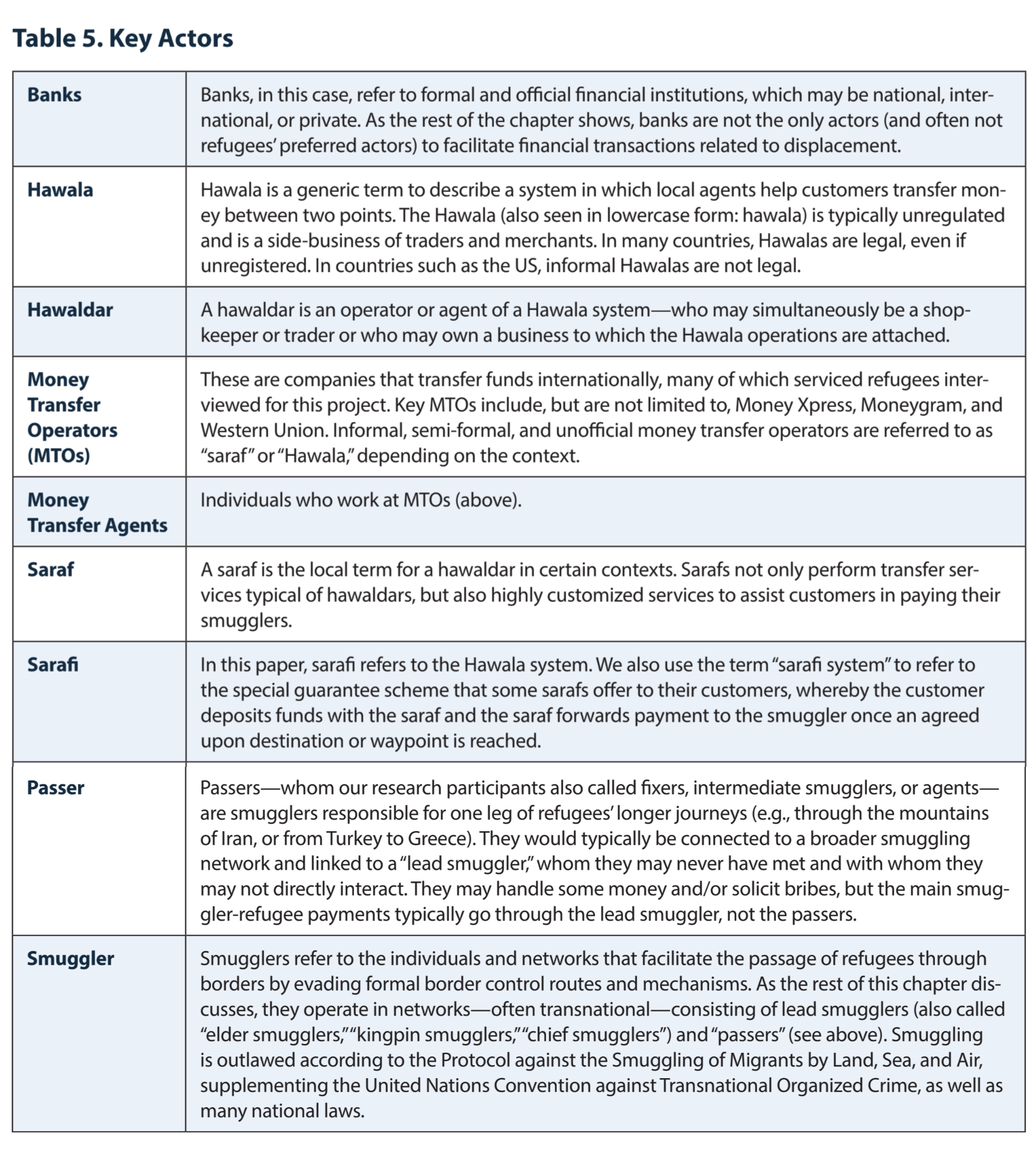
Extensive literature exists on the central role of smugglers in facilitating refugees and migrants’ journeys in the Americas, the Mediterranean, and beyond (Sanchez 2017, Mandic 2017, van Liempt and Doomernik 2006, Spener 2004, Brigden 2014). A detailed analysis of smuggling networks at our countries of study goes beyond the scope of this paper. Rather, we focus on the financial transactions that governed refugee-smuggler interactions, the ways in which money served as both a protective factor and a source of vulnerability in these relationships, and the strategies both refugees and smugglers employed to navigate formal and informal financial systems and secure payment. Prior to delving into this analysis, we offer a brief overview of how refugees described finding smugglers and establishing relationships.
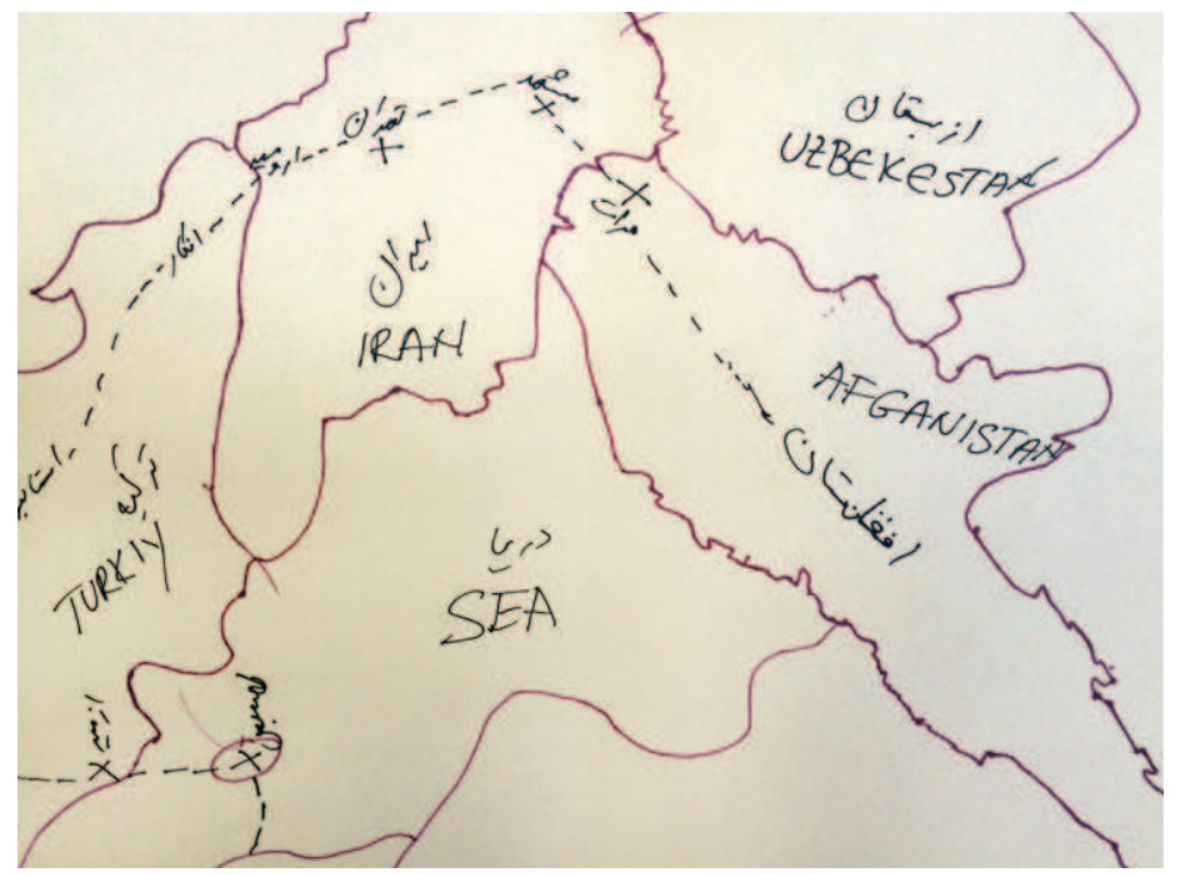
The securitization of discourses and practices surrounding migration has altered both the framing of certain actors, such as smugglers, and refugee interactions with them.
Rebecca Galemba notes “the securitisation of migration shifted the discourses, rumours, and practices surrounding migrants at the Mexico-Guatemala border, which offers a lens towards understanding the changing brokerage and perceptions of migrant (im)mobility” (Galemba 2017, p. 2). Following Galemba, we depart from an analysis of smugglers as criminal actors and smuggling as a criminal activity (though they can be both, depending on context and jurisdiction). Instead, we examine refugees’ interactions—specifically, financial transactions—with smugglers as an essential node for understanding the ecosystem of forced migration. As the rest of the chapter will show, this is not a story that unfolds merely “in the shadows” (Nordstrom 2004), and it involves interactions and crossovers between formal and informal, licit and illicit actors and networks.
3.1 Brief Overview of Refugee-Smuggler Relationships
A. Finding Smugglers and Establishing Relationships
A key theme across our research sites was the often repeated “you just know who is a smuggler” in refugees’ descriptions of how they made initial contact with smugglers. Recommendations from relatives and friends who had made the journey earlier were key. Along the way, refugees reported finding smugglers in camps and informal settlements, or at well-known points in a city where other refugees directed them to go in search of a smuggler. An excerpt from fieldnotes in Greece details the search:
He is trying to leave Athens in the next few days. He said he has heard it costs about 2,000 Euros to leave Athens and that he spent most of the money he made in Turkey already, so he is a little worried. He came to this location [where the interview took place] to see if he can find a smuggler or someone who can connect him to work. When I ask how he knows who the smugglers are, he says, “look around, it’s easy. Who do you think they are?” When I ask why this location, he says, “we asked around at the camps – people know. Since the border closed, the smugglers are rich. They make it easy for you to find them. ” He said there is one particular person he is looking for because some families he met along the way have used him. “He’s a famous smuggler; many families have used him, I trust him. ” But he hasn’t seen him in the past three days, and he is concerned.
—Researcher’s fieldnotes in Greece
B. The Networks Within Which Smugglers Operate Vary Along the Routes
Some smugglers, particularly on the Afghanistan-Turkey route or routes through East Africa, accompanied refugees along the entire route, or would trade off with smugglers within the same network. In that case, a “lead smuggler” would oversee the transactions and hand-offs, and intermediate smugglers or “passers” would pass refugees from one to the other until they reached their destination:
By the way, the smugglers communicate through so many different people. There are many channels. We don’t know who the guy who shepherds us from point A to point B is.
—Ethiopian man in Greece
From Afghanistan to Pakistan, he traveled with the assistance of one smuggling network, led by a single elder smuggler. Along the way he was passed like a baton from many of the elder smugglers' workers. “I never saw the elder smuggler and can’t be sure if he is Afghan. ”
—Researcher’s fieldnotes from interview with Afghan man in Greece
In other cases, particularly from Syria to Turkey, smugglers would merely accompany refugees to the border or help them cross it, leaving them alone to navigate their next steps outside that context.
C. Managing Risks and Vulnerability Along the Smuggling Network
While financial risks and transactions are discussed in greater detail below, it bears mentioning other points of vulnerability that refugees encountered in their relationships with smugglers. These included:
- Losing the ability to contact smugglers. This happened when smugglers changed phone numbers, when refugees lost their phones or the smugglers’ phone numbers, or when smugglers or refugees were temporarily imprisoned. Numerous refugees emphasized the significance of being able to stay in touch with smugglers. As one Syrian man in Greece said, “The first thing you do is you buy a phone. You need a phone. You need it to connect with people—agents, smugglers. My phone was stolen in Turkey, and I thought, this is how I’m going to die.” Having to change smugglers because the previously arranged ones were not within reach represented both financial and personal risks to many refugees and resulted in being stuck in transit.
- Having to switch smuggling networks. In general, refugees described a preference for using the same smuggler—or staying within the same network of connected smugglers—for as long as possible. This appeared to be most feasible for refugees on the Afghanistan-Turkey route. According to many refugees, Turkey was a breaking point in this chain, after which individual legs of the journey had to be negotiated piecemeal (Turkey-Greece, Greece-onward in the Balkans, etc.). This, in turn, represented risks to both financial and human security, as we discuss below.
- Maltreatment by smugglers. As Mandic and Simpson (forthcoming) discuss, refugees often discussed being maltreated at the hands of state forces (police, border patrols) in harsher terms than they cast their interactions with smugglers. As long as smugglers were paid promptly according to the terms agreed, refugees described these relationships as having the potential to remain fairly amicable. The success or failure of financial transactions—whose terms smugglers changed unpredictably at times—often defined smuggling relationships. Other forms of maltreatment by smugglers included changing the terms of agreement, particularly about how many people would board boats from Turkey to Greece. At times, smugglers yelled, pushed, or threatened people to get on the boats so that they would not be detected by police on the shore. As one Syrian man said in Greece, “The boat was for 25 people, and there were 55 on it. The smuggler said no more than 30, but there were almost double that. My wife tried to not get on the boat because she was worried about the boy, but the smugglers stand on the shore and yell at you. Sometimes they pull a gun and tell you to just get on the boat. You just get on the boat.”
D. Understanding Smuggling Through a Gender Perspective
“Trafickers see money, not gender,” articulated one key informant in Greece in response to a question about how gender may have shaped relationships with smugglers. However, our research suggests that interactions and transactions with smugglers, as well as the ways in which smugglers attempt to gain leverage over refugees to ensure payment, were rife with gendered meanings.
The smugglers our research participants encountered were male, and arranging these journeys was frequently an exchange between them and male family members. A woman commented on how this impacted her experience:
The smugglers aren’t used to dealing with women. But they take our money like other people’s money. They sometimes tried to talk to my son, but I said “no, you are dealing with me!”
—Syrian woman in Greece
When we asked about female smugglers, research participants expressed surprise. “A female smuggler? That would be like a black polar bear,” remarked one key informant. Additional research is needed to understand why the smuggling network in our countries of study appears to be dominated by men. Research from other contexts, particularly in Central America, can help form some preliminary hypotheses (Sanchez 2016, Vogt 2016). We hypothesize that it is consistent with men’s control over key domains of formal and informal power, and the ways in which particular men are networked within those communities (Ahmad 2011, Nordstrom 2004). Moreover, when women do participate in smuggling (even in less visible or public roles), it is worth researching the ways in which they strategically leverage certain perceptions of femininity to facilitate their work (Sanchez 2016). We further hypothesize that women’s active and visible involvement in smuggling would attract attention, in part because of frames that render women’s participation in illicit and underground activities more transgressive than men’s (Gentry and Sjoberg 2015).
The gendered nature of rumors that we were able to access about female smugglers corroborates these hypotheses. Two key informants and a refugee in Greece discussed rumors of a female smuggler in the Balkans, “who is tougher than the men.” This woman is allegedly married to a police officer. A different rumor articulated by a key informant in Greece suggests there is a “Balkan woman with a foreign husband and a father high up in the government” involved in smuggling. These rumors place women at the nexus of powerful formal and informal networks in ways that could enable their participation in smuggling. They are also telling of how women are imagined and constructed to behave within illicit and informal networks.
Despite their reported absence from the leadership of smuggling networks, women reportedly participate as facilitators in support roles, such as connecting refugees to male smugglers or pointing refugees in the right direction. A refugee in Greece commented on this distinction by saying, “There is a difference between the smuggler who actually moves people and the contact or the agent. That’s like the PR for the smugglers. They are an advertisement for the smugglers and get a cut of the money.” Further research is needed to understand how gender intersects with other factors of these women’s identity and social positioning—such as their family status and their role within the community—in ways that affect the participation of certain women in informal and underground economies.
E. Family Status Is Key for Understanding Interactions with Smugglers
Refugees discussed that family status matters in making arrangements with smugglers. An Afghan refugee in Greece commented that his group’s journey was slowed down by having too many children in the group. This man was the only adult male, alongside two women and nine children en route to Europe. He said, “We were stuck for four nights in Iran… Smugglers do not make as much money off the children, so it was not as lucrative for them.”
Smugglers leveraged family separation as a way to ensure that they get paid. An Afghan man in Greece shared:
When we were getting closer to Turkey, the smugglers were worried that the younger boys in particular would flee without paying them, so they had the guards stay up to make sure that nobody left at night. They separated the men and the women. They had the single men call their families, and then they would beat them so the families could hear and promise they would make the payment.
—Afghan man in Greece
3.2 Different Models for Financial Transactions with Smugglers
Research participants reported various methods of paying their smugglers. Refugees, smugglers, and financial middlemen negotiated with two categories of risk in mind. Refugees naturally were concerned with performance risk—that the smuggler would not safely transport them to the agreed final destination or waypoint. Smugglers were concerned with payment risk—that refugees would not be able to make full payment for their smuggling services. Table 6 illustrates the range of payment methods in use to reduce the two risk categories. Throughout this section, the “demand side” refers to the refugees’ side of the transaction, while the “supply side” refers to smugglers’ considerations. While we found evidence for both crude and sophisticated payment methods, not all methods were available to all refugees. In some instances, only one form of payment was an option.
We show throughout this section that the financial transactions underpinning not only interactions with smugglers but also the entire journey of refugee transit entail movements between formal and informal, licit and illicit, legal and illegal systems, networks, and processes (Dufield 2001, Nordstrom 2004). Financial transactions with these actors do not exclusively take place underground or in informal spaces; rather, they intersect with the formal financial services sector before diverging from it once again in favor of more informal networks. We note these movements throughout the analysis.
A. Prepaying the Smuggler Directly or Through Kin
In this instance, the refugee pays in full directly to the smuggler for the entire journey or parts of a journey prior to departure. We found this was often the case when crossing the Aegean by boat from Turkey to Greece. It was also very common within Syria and when crossing the Syrian border to Turkey.
Often friends and family would make payments on behalf of the refugee, either because the refugee lacked sufficient funds or because a family member was more proximate to the smuggler:
In Turkey, I found a smuggler in Istanbul through the hotel I was staying in. The smuggler had many names; I do not know which was his real name. I spent two months in Turkey before leaving. I was in contact with my cousin, and he paid the smuggler € 15,000 by giving money to someone in Iran who then gave the money to the smuggler. When I met the smuggler, he had already been paid.
—Iranian man in Greece
This method of prepayment clearly places the refugee at risk. When asked about fears along the journey, one responded:
It is the fact that you don’t have a choice but to trust a smuggler who is a criminal, and you always have to fear that he will rob you or not honor the deal and not get you to your destination. —Syrian man in Greece
B. Post-Paying the Smuggler Directly or Through Kin
On the opposite end of the payment spectrum are various forms of post-payment: paying for the journey in whole or in part after the journey had been completed. While this may reduce performance risk for refugees, they also ran the risk of becoming “human collateral,” as the smuggler sought to assure payment:
At the time of our meeting, [name redacted] had called from Quetta, Pakistan. He had reached this Pakistani city after spending one night in Kandahar. From there, they had gone to Iran. When I called a couple of days later, he had reached the Turkish soil, but he was fuzzy on the route. His brother said: “He and I are both illiterate. ” He meant they are not well-versed in geography. The family had some financial problem, and it took them a few days to put together the $1200 negotiated price. His brother said that for the past four days [name redacted] was locked up outside Istanbul. He will be released as soon as the smugglers get the money. When I called, he had just given the money to a representative of the smuggler.
—Key informant in Greece
We heard of the many harms endured by refugees who were unable to make their payments expeditiously. One research participant narrated:
From Zahedan, I traveled with five other men, just like me. We were passed from smuggler to smuggler in an unbroken chain from one border to the next. I paid for the smuggling services after they were successful. Once I arrived in any predetermined destination, I would have funds wired by my parents directly into my smuggler’s bank account. I did this just as I crossed the border into a new country.
When asked what would happen if someone failed to pay, he continued:
That happened to others, but not to me. I saw the boys get their ears cut off for lack of payment of their smugglers’ fee.
—Afghan man in Greece
C. Pay-as-You-Go System for Smugglers
Many families and individuals paid for smuggling services at various points in their journey, particularly in instances in which smugglers were not connected by a network. This was especially common for Syrian refugees:
My trip [from Syria to Greece] cost about €10,000, or €2,500 per family member. This included all costs, including smuggling services… It took us ten days to cross Syria alone… We had seven different smugglers and made seven different payments.
—Syrian man in Greece
When asked if he felt at risk carrying all those funds to make the payments, he told us his wife transported the cash: “In our culture it is wrong to rob a woman or to hold her at gunpoint. For this reason, she was always the one to guard the money.” We delve into the theme of how refugees leveraged perceptions of masculinity and femininity to carry and move cash in greater length in Chapter 5, as well as earlier in Chapter 2.
D. Post-Paying Smugglers Using a Financial Third Party: The Sarafi System
The more-traveled a route, the more varied and transparent the payment options appeared. For example, along the well-traversed routes leading from Iran and Afghanistan to Greece, refugees referred to the “sarai system” or “guarantee scheme.” This method involved a rich range of variations, but at its core, the system included a kingpin smuggler, local passers, and financial middleman or “sarai.” After locating a lead smuggler, the refugee would negotiate a price for travel, a destination for the travel, and, if needed, travel documents. Refugees would also negotiate a mode of travel based on their budgets. Once a price was established, the refugee located a financial middleman. In many cases, refugees found their own saraf, but often smugglers had already identified a saraf. Fieldnotes from a conversation with two Afghan women in Greece describe one interaction:
They found the smugglers by word of mouth, and the smugglers told them which saraf to use. They gave all of the money they had to the saraf, and the combination of the name and account number they used for the interactions was called “ramz”. The smuggler told them not to carry any money along the way. So every time a payment needed to be made, they contacted the saraf, gave the “ramz” and he would release the money to a smuggler.
—Researcher’s fieldnotes from conversation with two Afghan women in Greece
The sarai system not only made payment to smugglers convenient, bypassing the need to carry large sums of cash, but also it served as a form of guarantee. The example in which the saraf already knows the smuggler puts the refugee at greater risk than if the refugee chooses the saraf.
Culturally longstanding business relationships take precedence over one-off relationships. However, often the refugee does not have a choice. Either way, a third-party saraf offers a buffer between the risk of non-performance potentially experienced by the refugee and the risk of non-payment potentially experienced by the smuggler—as well as buffering the risks of carrying cash along the way. Releasing payment upon completing a successful journey seemed to at least partially insure the refugee. An Afghan man describes traveling with his family from Turkey to Greece:
We left by boat late at night. I had a flashlight and kept flashing it so that others would notice our boat. Once we reached Greek territory, the Greek police saw us. They came to our rescue and transferred everyone from our boat to a ship. I had put money with the saraf, and he released it once we reached each of our destinations. The smuggler had people in each location who transferred us along our assigned routes. The smuggler doesn’t get paid if anyone was deported—only if the destination is reached.
—Afghan man in Greece
This research participant called the saraf a do’kon, which means a store or shop. The research participant also had a bank account in Afghanistan, but he preferred the saraf’s services to the bank’s when it came to making payments.
Many refugees from Afghanistan and Iran referenced the sarai system. These deposit-and-release services had sprung up both in countries of origin and along the route.
Sarais could be easily found across Afghanistan, as well as in Greece, Turkey, and (we were told) as far as Germany. One refugee traveling with his family from Mazir-e-Sharif described his financial journey thus in a researcher’s fieldnotes:
He arrived in Istanbul from Mazar-e-Sharif with his youngest son, daughter, and wife by plane. He found a smuggler to get visas and tickets to Turkey costing $5,500−$5,500−$6,000 per family member. The actual cost of the Turkish visa is $60, he said, but it is almost impossible to get one. So he paid almost USD $24,000 for all four visas and tickets. Everyone in the family was together in Istanbul. He found another smuggler in Istanbul from among many smugglers there. Some were Turkish, some Afghan, some are Tajik. He found an Afghan smuggler – but stated the actual mastermind smugglers are Turkish (they also speak Dari). He deposited money (which he brought with him in cash) in a saraf in Istanbul for the future payment to the smuggler.
He paid 1,800 Euros per person (for 7 people in total) to be transferred from Istanbul to Samos island. The smuggler transferred them in a van that its 14 people but had 28-30 people. From Istanbul, they were brought to a different, smaller city. There they spent 45 days – food and accommodation were found and paid for by the smuggler. He decided to wait for as long as needed: “The ocean waves were not good, so I used to check the intensity of the waves on my cell phone every single day”. When the waves were not as strong, the smuggler transferred them from the small city to the boat with 24 other people. At their first attempt, they arrived on the island of Samos. After reaching Samos, he requested his saraf to release €12,600 to his smuggler for payment of all family members (€ 1,800 per person).
—Researcher’s fieldnotes in Greece
The sarai system was also used by refugees stranded in Greece to receive funds from relatives. One refugee in a camp in Greece reported that her husband would send her small amounts of money through a saraf in Athens. To receive her money, she showed the owner of the store—the saraf—her name and a code that her husband had texted her. At first she travelled to the store once a month to fetch her cash, but then the process became even more convenient: The saraf started traveling weekly to the camp, bringing cash to the refugees’ doorsteps. The additional costs were the fare from Athens—€7, an amount that the residents of the camp gladly paid—as well as fees charged by the saraf. Travel to and from Athens sometimes took a long time, so this doorstep service was highly valued.
While some refugees were able to release payments to their smugglers at the completion of an entire journey, others released partial payment upon reaching each way-point. Banks (whose role we discuss in greater length below), as well as sarafs, could be involved in a payment circuit that includes a refugee, a kingpin smuggler, and local smugglers. A refugee described his use of both the bank and sarai systems:
From Afghanistan to Pakistan, I traveled with the assistance of one smuggling network, led by a single elder smuggler. I would call the elder as soon as I reached a major waypoint. At the first two waypoints (entry to Pakistan and entry to Iran), I called my family and gave them a four-digit code. The family knew that this code meant I was okay, and they called the elder, giving him the code. This signaled to the elder that everyone was satisfied that I had made it to the intermediate destination as planned. My parents then paid the elder by transferring cash from their bank to the elder’s bank account. After the second waypoint, they no longer used the code system. I would simply call my parents and tell them to transfer funds to the elder. The elder would then send the next smuggler to transfer me to the third waypoint. From there, no more payments were made in Iran, and I was simply smuggled from person to person. In Turkey, the smuggling network changed.
—Afghan man in Greece
He went on to say that he had tried to move north, this time using the services of a saraf in Athens. He prepaid through a local shopkeeper. He deposited €2,000 with the shopkeeper and an additional €100 fee for a total of €2,100. But the refugee had not negotiated a “guarantee scheme” with this particular smuggler, so the shopkeeper paid the smuggler anyway, even when the refugee was caught at the border and returned to Athens.
3.3 Written Contracts, Guarantees, and Consumer Insurance Policies
We heard of a range of supply-side and demand-side guarantees that would either protect the service provider (the smuggler or the saraf) from non-payment risk or the refugee from non-performance risk, or both. Most arrangements between refugees and sarafs were verbal, but not in all cases. A key informant reports (all names have been changed):
Shuja, someone whom Ajmal knew, knew the smuggler. Shuja, speaking on behalf of the smuggler, had asked Ajmal to find anyone that he trusts and “freeze” the money with them. He had also recommended one money exchanger in a Kabul neighborhood. When Ajmal showed up with the representative of the smuggler, the saraf wrote, signed, and stamped a letter acknowledging the receipt of the money as an “amanat” for three months. Ajmal, who has worked in admin and finance for the past 10 years, insisted to put some concrete terms in this letter: for example, what is the money for, the name of the person traveling, destination, conditions for release of installments, etcetera. For the saraf, it was either amanat (less formal) or no deal. Amanat means when you trust something with someone. In this case, putting the money in the saraf’s trust.
—Afghan key informant
The letter served less as a contract and more as an acknowledgement of receipt of the deposit. In some instances, smugglers themselves wanted guarantees of payment beyond the assurances of a saraf. Houses and other assets were used as collateral, sometimes without the knowledge of asset’s owner:
He had had enough and did not want to continue on the journey. So he let his cousins go. They had not left their money —$1,450 per person all the way to Turkey—with just anyone. Instead, they had given their uncle’s house in Kabul as a zamanat, or guarantee, to the smuggler. The uncle says he did not know that his house was used as a collateral.
—Researcher’s fieldnotes from interview with an Afghan man in Greece
We also heard of various forms of insurance whereby, for a small fee (typically $50), a smuggler would guarantee a successful journey and, if not successful, the intermediary would issue a refund. An excerpt from a researcher’s fieldnotes in Greece elaborates:
In order to pay for the smuggler to Greece, the refugee was instructed by the agent who he found on Facebook to go to a “security point” at a store and give the money to a Turkish guy. But then the agent didn’t trust the guy in the store and instead took him around the corner to a different shop and took the money directly.
The money was $600, and the agent gave the refugee a password, which was to serve as insurance that if, for some reason, the smuggler wouldn’t take him or he didn’t make it to his destination, he could use the password to get his money back, except for a fixed sum ($50) that would go to the smuggler/ agents (like a hotel cancellation fee).
One key informant later called this scheme a “false guarantee.” The schemes were designed to make refugees feel like they had some insurance if the journey failed—but, according to this key informant, the smugglers would often keep the money regardless. While some key informants were skeptical that refunds were actually made, we did hear of success. One research participant was completely satisfied with his refund and reported such “insurance policies” are commonplace in Athens:
Really, I did not care. My heart was not in it. I paid the smuggler €3,700, and he got the papers and the ticket [from Greece to Germany]. I went to the airport, and they saw that my papers were a forgery and I was turned away. I felt no conflict, no bad feeling. I went to the Maktp (The Office of Transactions), and they gave me my €3,700 back minus €50 for the cost of the insurance. The smugglers are gambling! They lost on me, but on that same day, they probably had many successes.
—Syrian man in Greece
We heard many more examples of insurance contracts purchased directly from the smuggler or from a third party. Fieldnotes from a different conversation with a research participant elaborate:
The refugee didn’t want to pay the smuggler because he didn’t trust him, so he decided himself to use an “insurance” person, as he called it, to safeguard against the smuggler trying to steal their money without actually transporting them. They gave their money to the “insurance agent,” who gave them a code, a shifra, and then this would be used to pay the smuggler only if they made it across. Once they arrived safely in Turkey with the smuggler, they gave the shifra code to the smuggler, who then called the insurance agent and collected his money.
We asked this research participant what would happen if they give the smuggler a fake receipt or shifra to try to cheat the smuggler out of his payment. He said it’s not possible because the insurance agent has the correct code to which to compare it.
Sarafs and smuggler insurance agents run risks beyond payment risk: reputation risk and legal risk. Their reputation as trustworthy businesspeople (in businesses that are attached to, but separate from, these refugee-specific financial transactions) is valuable and worth protecting. Many sarafs have venerable family histories, noted for their reliability as traders. In this context, reputation is a valuable form of social capital.
Souring relationships between sarafs and smugglers represented a further risk. One saraf confided to a key informant that his business in financing the journeys of refugees was waning because “the trust has been broken.” Refugees who had, in fact, reached their destinations had their families deny this and demand their money back. This put the saraf at grave risk with smugglers who trusted him.
Risks associated with breaking laws also weighed on certain sarafs in ways that surpass some of the risks that smugglers faced. Smugglers—whose locations, physical cell phones, phone numbers, and SIM cards are in constant flux—are difficult to track. By contrast, sarafs in countries of refugee origin have fixed addresses and thus are easily traced. According to a key informant, a sign in the Sarai Shazada neighborhood in Kabul warns that involvement with qachaq-e-insan—smuggling—is illegal. So while sarafs may be duped by families failing to reach their agreed-upon destinations, they have no legal remedy available. They must choose between disappointing refugee families or disappointing smugglers. In either case, the “trust is broken.”
3.4 The “Three Tries” Approach
A key informant in Athens described a system he called “three tries,” popular among refugees as well as smugglers, which may or may not include a financial middleman. In this scheme, a smuggler agrees to procure plane tickets and documents (forged or stolen) for three separate, sequential trips. He only procures the tickets and documents for the second trip if the first fails, and for the third if the second fails. He (overwhelmingly “he,” as discussed earlier) has calculated the costs so that he makes a large profit if the refugee travels successfully from Athens onward to Europe on the first try. He still makes a profit if the second try is successful. But on the third try, if the refugee does not make it, the smuggler loses money.
This was not the first time we heard of such a guarantee scheme. This research participant described his experience with such a guarantee in place between Turkey and Greece:
On the twelfth day we were set to go to Chios. The smugglers took us to another big house with people from everywhere. They start with the families, with the women and children. When it was the single men’s turn, they put us in a closed van from which you couldn’t see the outside. They told us not to smoke, and to turn off our phones so we could not attract the marine patrol or police before they let us out. We were in the forest, a few kilometers from the sea. There was nothing around us, just trees. They gave us four Zodiacs [rafts] for fifty men that we had to inflate and told us which way to go. But before we started inflating the Zodiac, the gendarmerie caught us. There were men coming from behind us on the ground and a helicopter. Two guys had smoked cigarettes, and I think that’s how the gendarmerie caught us. The trip failed. They held us all and seized the four Zodiacs. The smugglers had lost a lot of money. But the gendarmes released us later that night because they knew the smugglers weren’t with us. We went back to the house that night. We knew we had the right to two more attempts without paying more.
—Algerian man in Greece
He went on to describe his second and third attempts. Of his last attempt, he relayed success:
We walked back to the smuggler’s house and stayed there for two days this time. We knew this would be our last chance; many people had no more money. There was a new group of refugees in the house. One of them was a very good sailor. We went with him, and this time there were no problems at all.
The informal and highly customized nature of the sarai system tended to make its inner workings opaque and, from time to time, its contracts less than secure. A Syrian in Turkey described his brother’s passage to Bulgaria in 2011:
Sometimes people were caught in Bulgaria or Hungary. These were unattractive destinations. Whether or not the smuggler got the money depended on the contact; sometimes they would renegotiate. Some smugglers were honest and agreed that they wouldn’t take all the money because the person had not gotten to the destination. Most of the smugglers wouldn’t take the money if a person died. The sea route was more dangerous but also cheaper.
—Syrian man in Turkey
3.5 Crowd-Funded “Pay-It-Forward” Schemes
An emerging payment strategy blended a “pay-it-forward” ethical contract with the concept of crowdfunding. In this scheme, the refugee traveling incurred no debts. Instead, family and friends paid smugglers by gathering funds and readying them for transfer as soon as the refugee reached his or her destination (or soon after). An Eritrean woman discussed her experience:
I spoke to my parents and told them I wanted to leave. I called my Eritrean friends in Sudan. One of them arranged everything for me. She looked for a smuggler… I didn’t have to sell anything: my husband’s family, my family, all our friends in other Arab countries sent money to my friend. I didn’t arrange anything. My friend told me I had to meet a driver at 3 pm a week later, in Asmara. I stayed home for a week and waited. I had about $200 only with me. I didn’t take clothes with me—only something to eat. I knew nothing about what would happen. In the car, there were four other women. The driver was nice. He didn’t speak or anything. He brought us to Khartoum—the driver knew everything about the border, and he went through a secret way. Maybe he paid police. I don’t know. When I got to Khartoum, I called my friend and told her I had arrived. She paid the $5,000 to the smuggler, and I went to her house. I spent three months in Sudan, not working. I was very afraid of the Eritrean security in Sudan. I knew people who had been sent back from Sudan, so I was hiding. I realized I couldn’t continue like this forever.
—Eritrean woman in Greece
She then explained that a second round of crowdfunding took place to get her to Turkey and onward to Greece:
I talked to my friend about going to Europe. She helped me to get to Europe. I am not sure if it was the same smuggler. My friend took care of everything for me. She told me she needed to collect $5,500 to go to Istanbul and then an additional $1,500 to go to Greece. In April I got a passport with a tourist visa to go to Turkey… They locked me up in the house for two weeks until they had received the money from my friend. My friend needed more time than the first time [Eritrea to Sudan] to collect the money because she needed to contact relatives and friends in Israel, America, from all over the world. About twenty people participated in funding my journey.
Other Eritreans echoed this blended crowd-funded “pay-it-forward” model. According to one,
We Eritreans are very supportive of one another because we know the hell that Eritrea is. Also, Eritreans know how bad smugglers are. We know very well that they will abuse and rape women if they don’t get their money. So people feel pressure to give. Your relatives and friends cannot leave you to die. That’s why we have become very fast and good at sending money to each other over the decades.
—Eritrean male in Greece
When the researcher asked a follow-up question about whether refugees were expected to pay back the people who help them, the research participant responded: “No, no, no, not at all. But if my Eritrean friend asks for my help, I must give. I will give back this way. It’s a collective system. All Eritreans understand each other on this.”
Syrians in Turkey also went to great lengths to tell us how they would reimburse family members for financing their journeys. Family members and friends had helped them amass enough money to complete various stages of their journeys, and they felt obliged to repay. A Syrian man recounted the “pay-it-forward” instructions of his creditors:
For the first few months, I was testing the waters with my work and trying to get a sense of regular expenses. Then I started to pay back the money I owed to people all around the world. I started to allocate money for the people I needed to return money to. My salary was better than before, so I could keep aside money to pay my debts. I had paid some debts in Egypt but not all of them. I kept the money aside in my mind. To pay back the debts, I started with my friend in Saudi who had sent me $1,000. A mutual friend of ours came from Saudi to Turkey, and I paid him. My cousin in Dubai came to Istanbul by chance, and I gave him the cash. My friend who had been in a desperate situation and had given me money said he didn’t want it back. Some others said they did not want it back. Both of them said, “Pay it forward, if you want to. ” I can’t remember how I made my first transfers to Syria. I never did it the official way, through Western Union or anything. I transferred to my brother and sister the same way I do it now. Which is through friends who want to move money to Turkey.
—Syrian man in Turkey
Table 6 summarizes the modes of payment described throughout this section
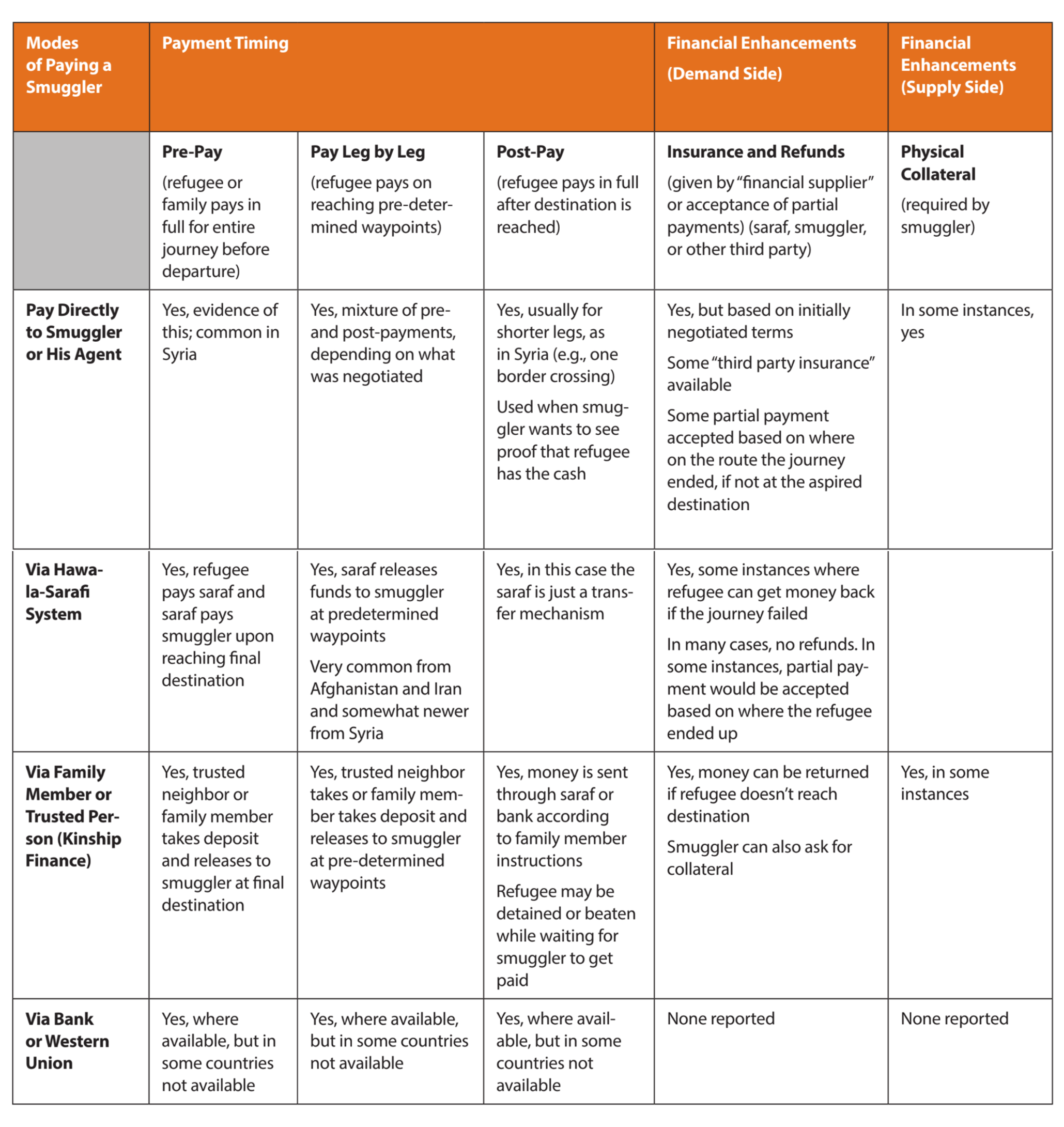
3.6 Kinship Finance: The Role of Friends and Family
A key theme that emerged in the analysis is the significance of kinship networks, both for amassing the necessary funds and for facilitating the actual transactions. In this section, we examine these networks in greater depth, exploring the roles of friends and family in sending and lending and of the Hawala system.
Family members still in the country of origin, as well as those settled at the country of aspirational destination, reportedly send money to refugees directly and indirectly. As described earlier, they often pay smuggler fees directly to the smuggler or through a saraf. They also will send money to refugee family members to help them manage local expenses.
In shorter-haul journeys, for example from Syria to Jordan or Syria to Turkey, where some extended-family members and friends may be able to cross back and forth, transactions became maze-like, their terms of settlement murky, and the collection of debts outstanding and aggravating. In those cases, borrowing and outstanding debts become a critical concern in managing the financial portfolios of refugees on the move:
I remember when my sister and her friends were facing situations where a lot of people owed them money, and they had to work to keep track of it. Think of yourself: say you’re trying to get money to me. You trust Katie [name changed] to give me the money, and she trusts that you will pay her back. I receive the money, but I’m outside the situation. But between you and Katie, if you’re outside Turkey and you cannot make the transfer because you are seeking asylum and you can’t pay right now for whatever reason, Katie may have a lot of people owing her money. She has to follow up on it and keep track of it, and it’s complicated with exchange rates. With Turkish lira and Syrian pound fluctuating like they are. Then you have to resolve these issues amongst yourselves. People may feel like they are losing because of the exchange rate or that they need their money and cannot get it.
Also, the agreements are verbal. A friend might ask for $250, then $150, then $25. She might recollect differently from you. Nothing is written down. Between friends, even distant friends, it’s not part of the culture to write down amounts. Although my old boss used to message me on Facebook, saying, “I have sent you X amount, ” then I would reply when I got it.
With family, relatives, a lot needed cash, they wouldn’t write it down. My sister and her good friend were in a situation where the friend borrowed thousands of dollars from my sister. She wanted to pay back in installments. She [the friend/borrower] was in Gaziantep and used to send money up with individuals. My sister had to go all over Istanbul to meet with these people. It was a real burden for her.
—Syrian man in Turkey
The refugee went on to emphasize the problem of mental reckoning. Keeping mental records of transactions is often disastrous, usually for the lender. The refugee just referenced described the situation of a co-worker:
A colleague in our office loaned money to many people, just small amounts. He loaned amounts he could afford to lose, but he realized it had added up. For $200, people need time to get the money together; they say they will pay you next week and then they do not. These people weren’t his great friends to start with, people forget what they borrowed and that they borrowed. Fifty Turkish lira is small. When you remind someone that they borrowed that they act like you are ridiculous.
—Syrian man in Turkey
But, when comparing the services of family to those of a transfer agent, the same refugee stated: “With friends and relatives, you sleep better at night, even if they screw you.” Another refugee from Syria based in Jordan echoed this sentiment:
Fifty Jordanian dinar is nothing here, but it goes a long way in Syria. Money transfer agencies are robbing us. One hundred dinar is 100,000 Syrian pounds if you simply exchange it in Jordan. If you try to send it, however, they take 38,000 pounds out, and you can only send 62,000. All the money transfer agencies have similar high rates. I learned that I’m losing a lot of money using their services, so I’ve made connections between families across borders instead.
—Syrian man in Jordan
This refugee went on to explain how the workaround system functioned. Where families were split across the Syrian-Jordanian border, and a Syrian in Jordan wanted to send money home, the refugee in Jordan physically would give the money to another Syrian refugee residing in Jordan. That refugee would call their family back in Syria and ask them to physically give an equal sum to the first refugee’s family back in Syria. But the bookkeeping quickly became complex. After a few transactions, one can easily see how the Syrian family in Syria could be owed a lot of money from their Jordanian-based relatives. This matter becomes further complicated when currencies change. A different Syrian in Jordan explained:
Now, there are problems with currencies as well. In Jordan, they’re still using the old Syrian currency (hard cash), but in Syria there is a newly printed currency from Russia, and they can’t use the old currency anymore. This could be a problem if family in Jordan was taking old currency and physically sending it to family in Syria—useless once it gets there.
—Syrian man in Jordan
From the borrower’s perspective, they were inclined to settle their debts and were grateful to family for the loans. After borrowing from multiple friends and family to finance his journey, this refugee was left with many debts:
I stayed in Gaziantep for one month with a friend. When this friend left for Germany, I moved to Sanliurfa to stay with a family member. After that, I started to search for the work—because now I have debts after this long year.
—Syrian man in Turkey
Beyond individual sending, lending, and receiving, we also heard of examples of rotating savings and credit associations, generically called ROSCAs by the development community, and locally called game’ya. In a game’ya, about ten or so members, often from the same family, gather to regularly contribute identical sums to a group pot. Each week or month, depending on how often they meet, a different member takes home the whole pot. In this way, individuals can save up lump sums for special purchases or for expenses like paying rent in ways that are difficult to save for alone. A Syrian female reported that Syrians are commonly participating in the game’ya in Sianliurfa, Turkey. According to her, in Syria, she would put 11,000 Syrian pounds (25 USD) in the game’ya pot each month. Her group consisted of ten to twelve people, but groups could be as small as five or as large as twenty. Research participants in Jordan remarked that game’ya were often used, typically only among family members. They explained that in situations of displacement, they did not necessarily know neighbors well enough to trust them.
3.7 The Hawala System and Comparisons to Formal Banking Institutions
While some families developed “mirror image” financial relationships to move money across borders, many research participants preferred to use registered and unregistered Hawala networks (called sarafs, sarfs, and other names). The Hawala refers to a system in which local agents help customers transfer money between two points. The Hawala is typically unregulated or loosely regulated. Some countries, like Afghanistan and Jordan, require registration; others do not. Often the Hawala is a legal side-business of traders and merchants. To the person using the Hawala, it appears much like Western Union but may require fewer forms of identification.
We already described the sarai systems that enable refugees to release payments to their smugglers over time. These same systems come into play to enable sending and receiving payments to and from friends and relatives. Fieldnotes from a conversation with a Syrian woman in Turkey read:
From the time she started working in Turkey, she was sending money back to her family in Syria: “at first not that much, and after a while more. ” She says it’s “pretty easy” to send money and has always used the same method and dealer: “In Raqqa, there’s a shop, with the same branch in Urfa. I give them the amount plus 5 to 10 TL (2 to 3 USD), and they transfer it. ” She also provides the name of the person who will receive the money; that person will then be able to pick up the money “on the same day. ” Fees depend on the amount being sent (she pays 5 to 10 TL because she usually sends a similar amount); for example, a 1000 USD transfer has a 50 TL (16.60 USD) fee – a rate of about 1.6%. She says she has never had any problems sending money this way; she has a lot of trust in the shop because the owner is related to her. Her family lives in a Daesh-controlled area and receiving money from Turkey or other countries is not a problem.
—Researcher’s fieldnotes from interview with Syrian woman in Turkey
Though many research participants said they would be glad to use more formal systems (e.g., banking or registered money transfer operators), they felt the price was too high or the experience inconvenient:
I send money to my family in Syria, but there is no way I could do it through an official system. Western Union can be used, but the Syrian government will give them the money in Syrian lira and for a bad rate. They will lose a huge amount of money. The way we do it, the way most Syrians do it, is I give the money to someone here, they call their relative or coworker in Syria, and that guy gives my family the same amount of money there. Confirmation is on the phone in the same moment.
—Syrian man in Turkey
However, some of our own fact-checking called this perception into question. When we compared informal money trading prices in Athens in July 2016 with the prices of registered services such as Western Union or MoneyGram, we found that the formal prices were actually lower than the reported Hawala prices. As such, it is possible that word-of-mouth rumors spreading among refugees drive behavior more than the actual facts of the market.
Fears that interacting with the formal banking system would lead to diminished eligibility for protection or assistance also figured into refugee narratives. A female refugee from Syria interviewed in Turkey carefully detailed how her friend in Germany sent money to Syria. According to her, most Syrians in Germany transfer money back to family in Syria. They resist banks not only because of their perceived steep fees, but also because they prefer to keep their transfers out of view of the German government. They fear the German state would cut its support if they learned they were sending money home. Instead, her friend transfers money through a Pakistani agent. The agent charges €7 for the first €100 transferred and €3 for each additional €100. Another agent charges €14 for the first €100. Our own research in 2016 indicated the costs of using the Hawala in Syria varied, anywhere between 0.03 percent and 10 percent of the transaction (Beechwood International 2015, pp. 6–9). We found that rate could climb even higher.
Traditionally, Hawala services have arisen from trades that generated cash deficits and surpluses and various account debits and credits between traders (Cassara 2000). A Syrian woman in Turkey says: “Some Syrians have also set up businesses importing (under the table) goods like clothes and cosmetics from Syria to Germany and then selling them to Syrians who are uncomfortable shopping in German stores or unhappy with German products. There are Facebook groups that advertise and say how to buy these products.” These businesses would bring about trades that would result in imbalances of cash. Offering individuals money services is one way to reconcile those imbalances.
In many instances, particularly in Jordan, the informal Hawala was operating literally in the back of a registered money transfer operation. If the customer had proper identification, they could choose to route funds through the more formal option; if not, they could go to the back of the store and use the informal option. In Turkey and Syria, the cellphone shop was often the locus of Hawala activity:
To send money to Syria, I used a shop. Same in Lebanon; it’s always a shop that has contacts or family in another country where his relatives also have a shop. At the office in Turkey, the person who works there has in-laws and relatives across the border in Syria. I would give him the money, didn’t matter how much it was, could be $2,000 and he’d only take 10 Turkish lira [$4]. You’d write only the recipient’s name on a piece of paper, and give the phone number of the person who would hand over the money in Syria. I’d call my family, my father, and give him the number, and a code number assigned to the Hawala, I would be number 459, and the next guy is 460. And then my dad would go, give him the number (459) and his name and the amount and get the money. I found that guy in the shop through a friend.
I sent from another Hawala in another part of Turkey—also the same type of shop. It was the same system. The difference between these and my first guy was that these could send to anywhere in Syria where the other guy would only send to Kurdish areas. He had some Arab customers, though, who would send money to their Arab relatives.
—Syrian man in Turkey
Another benefit of using the Hawala system is its “trialability” as well as its “observability,” two features noted for their power to rapidly diffuse uptake of services, including financial services. Diffusion of Innovations author Everett Rodgers (2010) notes that the ability of a user to test an innovation without great cost or risk (“trialability”) and the ability of the user to observe outcomes (“usability”) greatly influence the pace at which a service will be adopted. A Syrian refugee in Turkey echoed this idea in his own words:
In my experience, it is a man that does the transfer in Syria. In my family, my father goes to pick it up, and my sister goes with him as an extra pair of eyes… My cousin gave me their info, I considered it for two months, decided to try once with a small amount. It instantly went through. I handed them the cash. He called his guy. My dad was there. I talked with him. He said he had received the money right there.
—Syrian man in Turkey
Refugees reported that while the Hawala networks were based on trust, hawaldars went to great lengths to ensure the right receiver was in receipt of the transfer, and they were creative about identity (discussed more fully in Chapter 5):
To make a hawala transfer, he gives the office the name of the receiver. When the receiver goes to pick up the money, “he should show his ID – they take a photo – and if I say you didn’t give the money to my brother, they will have a photo of his ID. ” Information is sent via Skype or WhatsApp, and there are no official receipts. In general, money can be picked up within 30 minutes or maximum three to four hours; receivers can show any form of Syrian ID. The sender does not need to show any ID. “It’s a good treatment. I know you, you know me. ”
—Researcher’s fieldnotes from interview with Syrian man in Jordan
However, despite the flexibility and convenience of the Hawala system, research participants did note disadvantages as well:
The disadvantage of the system is that it is volatile. If the person is not trustworthy, you can lose the money. There is no guarantee, there are no signed papers. This is because it’s an unofficial system. People only use it when they’ve gotten very positive feedback from a trusted source.
—Syrian man in Turkey
3.8 A Reflection on Clearing and Settling Accounts in Informal and Semi-formal Systems
As the narratives show, a good measure of patience is required by family members to wait out long periods between a payment to friends of family and the moment of debt settlement. This is true as well for informal money traders. This is a kind of patience experienced by generations of business people in countries that have used the Hawala outside the refugee experience as well.
Certain countries in the global North/West have reached a near simultaneity in the functions of executing, clearing, and settling a transaction. Digital payment systems make the separate functions of clearing and settling appear to happen instantly. One swipes a card, and within hours their bank has debited the account. But, in fact, clearing is simply an agreement to the terms of a transaction—what is owed to whom at what price. Settlement occurs when an individual debt or a set of debts is reconciled. In the global North/West, financial institutions seek to shrink the time between initiating a transaction and settling it. The party owed has no appetite for risk and demands to be paid as quickly as possible.
In contrast, many traders in the informal sector are not seeking instant settlement. They have the patience to wait—for months and years—from the time they agree on the terms of a transaction (clearing) to the time debts are reconciled (settlement). Unlike formal traders, informal traders do not view each and every transaction as a profitable moment. It is across great expanses of time—even years—that informal traders, including financial traders like the sarai, harvest their gains.
A well-tended relationship, then, is tantamount to profit, and thus an important financial strategy for money traders. Individual deals must serve the larger relationship, and not the other way around. Acts of forging and preserving a relationship require great measures of flexibility and trust, qualities that the formal sector has in less abundance than the informal sector. The formal sector, regulated and bureaucratized, frames out trust and relational value, while framing in the particulars of any given transaction. Certain transactions may not bring transactional value but may offer relational value.
Johan Mathew writes in Margins of the Market, Trafficking and Capitalism across the Arabian Sea (2016, p. 148),
Sustaining a relationship was often more important to long-term economic health of a trading concern than a good price on any particular transaction. This was an investment in relational value, which could yield returns for a buyer or seller in future transactions.
Mathew’s analysis raises questions about how refugees can maintain sociality across dispersed, vast areas. His observation could also easily sum up the patience exercised by Hawala brokers who, for extended periods of time, endure the financial uncertainty that takes place between clearing transactions and settling them. It could also account for a lack of patience, if not outright irritation, experienced by family members facing the challenges of kinship finance, where months could pass between the moment of clearing and the moment of settling. They would not have the business interests in mind that a veteran money trader would to cultivate a potentially profitable relationship over the long term—and, as we noted earlier, when refugees are lending or borrowing with other refugees—unsettled debts can lead some to get temporarily stuck in place.
3.9 The Role of the Formal Financial Sector
The preceding sections highlight the informal and semi-formal (and often underground or kinship-based) networks that facilitate transactions between refugees and smugglers, as well as between refugees and their family members at different locations. As we have discussed throughout the analysis, the informal, underground, and occasionally illicit networks do not exist in a vacuum. Rather, refugees—as well as other actors, such as smugglers, sarafs, and hawaldars—move continuously between the informal networks and the formal financial systems, such as money transfer operations and banks. In this section, we discuss some of the ways in which these actors interact with the formal financial systems, and elaborate on their perceptions of benefits and risks in using the formal and informal systems.
A. Use of Money Transfer Operators by Refugees
Most research participants reported having used money transfer operators (MTOs).
This included both internationally recognized brands—such as Western Union, Moneygram, and Money Xpress—and locally registered money exchange houses, particularly in Jordan.¹⁰ For those with documentation such as a passport or a work permit, experiences were generally positive. They reported that services were “quick and hassle-free.” In Greece, Western Union access points were located near camps, a convenience for those receiving funds from relatives.
Probably the biggest barrier to receipt of funds through MTOs, often referenced in jest, was lacking money to receive, not the instrument of receipt:
If you had money before, you have money now. Someone sends to you, you have ways. If you didn’t have money before, though… the registration paper that you get if you register in Greece is fine. Or you borrow a passport. Papers aren’t the problem. Not having money is the problem.
—Palestinian man in Greece
B. Barriers to Use of MTOs
Documentation
Providing suitable ID could present an obstacle to refugee users of MTOs. In Chapter 5, we discuss in greater length both this challenge and refugees’ strategies for overcoming it.
Pricing
Whether real or perceived, refugees often saw prices for using Western Union and other similar services as high when compared to sending funds via a Hawala or friends and family. As we saw earlier, when we compared the pricing of the regulated brands of Western Union and Money Xpress, we found them often lower than that reported by refugees. Prices also varied market by market. If refugees had used the services in one country and paid a high price, they mentally carried that same pricing with them to the next point, even if the prices were comparably lower there. According to a key informant,
Western Union and Money Xpress are known for being a credible fast way to transfer and receive money, but on the other hand, their fees are considered expensive and are proportional to the sum being sent. Despite restrictions imposed on Syrian nationals in terms of sending and receiving money through banks, or being eligible to open a bank account, it is not convenient to use services such as Western Union when moving money due to the high cost. (For example, it costs about 40 dollars to transfer a 1,000 dollars from Turkey to Germany through Western Union.) Thus people resort to unofficial money transfer agents because it’s cheaper and more flexible. Large numbers of non-Western Union or Money Xpress money transfer agents have emerged in response to the need of moving money from and into Syria.
—Key informant in Turkey
Some complained bitterly of the fees and the cost of currency exchange. The perceived prices of these services were unreasonable enough that refugees boomeranged back into kinship finance:
Money transfer agencies are robbing us. One hundred Jordanian dinar is 100,000 Syrian pounds if you simply exchange it in Jordan. If you try to send it, however, they take 38,000 pounds out, and you can only send 62,000. All the money transfer agencies have similar high rates. I learned that I’m losing a lot of money using their services, so I’ve made connections between families across borders instead.
—Syrian man in Jordan
Familiarity
As with banks, many refugees were not familiar with Western Union or related services. Their grievances, often framed as complaints about “hassles,” could easily be interpreted as grumbling over being required to learn something new, an effort they were not willing to make in an environment that already held too many unfamiliar tasks:
Western Union is a hassle, whereas saraf keeps your money… releases it easily using a code, and everyone knows about it.
—Afghan man in Greece
At this point in our research, we can only hypothesize that familiarity is a critical factor in deciding which service to use, not a foregone conclusion, despite protestations of hassles. Age, gender, educational status, and participation in formal banking prior to becoming a refugee may well be influences here. A Syrian man in Turkey narrated:
My mom didn’t want to use Western Union because she didn’t want to pay the fees and didn’t want to go through the whole process of traveling to the agency, filling out the form, showing her ID, and having me do the same on this side. Sometimes the system is down, and so you have to wait or go elsewhere. Sometimes the recipient does not have his ID on him, so he can’t get the money. A friend had his name spelled wrong, his father used a different English transliteration, and they wouldn’t let him take the money. Calling a guy is much easier.
—Syrian man in Turkey
Others seemed less hesitant. Fieldnotes from a conversation with a Syrian woman in Jordan showed one woman’s willingness to use more formal systems:
Her only other experience with transfers/Western Union came when she inherited properties from her father, which she sold and transferred the profits to her. She said all she needed was a copy of her passport, and it was a very simple process, simple and fast.
—Researcher’s fieldnotes from interview with Syrian woman in Jordan
Fear of Becoming Ineligible for Aid
Research participants in Jordan, Greece, and Turkey in various ways communicated a fear that use of Western Union may lead to a halt in their humanitarian assistance. They believed that MTOs could match their activities with information supplied by aid agencies offering cash and other forms of assistance. Once aid agencies learned that the refugee in question was receiving funds of any sort, refugees feared that they would be disqualified from further assistance. Fieldnotes from an interview with two male Syrian refugees in Jordan shed more light:
Friends of this refugee’s aunt and uncle sent money to their family through friends who were visiting Jordan. The refugee says that when his family did use Western Union, they did it through a Jordanian friend and used his name because if they did it in their name, aid they were receiving from UNHCR would be cut off. He also says that sending/receiving money can cause other problems with the Jordanian government. They become suspicious of you, he says, and this can lead to arrests. When they did use Western Union, they encountered “trouble” (which they didn’t clarify) from the Jordanian government, which is why they switched to the family and friends.
A Syrian participant in Jordan discusses receiving a few money transfers from contacts in Saudi Arabia to help make ends meet. He says it’s very easy to receive a transfer; all you need is your ID. He says that since he is not registered in the iris scanning system, he isn’t worried about having his assistance cut off. This is a bad situation, he says. People who receive help one time and get all assistance cut off is not just. Transfers are usually for “one time” help with emergency medical expenses, etc., that are time sensitive. They are very helpful, he says. Syrians could easily manage lending and sending, he suggests, but cannot do so because they are afraid it will affect the aid they receive in Jordan.
—Fieldnotes from conversation with Syrian male in Jordan
Importantly, refugees’ fears in the use of MTOs pertained not only to the receipt of funds from others but also to the remittance of funds to those back at home:
He says that he started to transfer some of the money he was making as labor back to his family in Syria. He says that UNHCR discovered this and cut off his coupons and monthly financial support as a result. He doesn’t know how UNHCR knew he was doing this, and says they never provided him with an official reason for stopping his assistance. He suspects that UNHCR has connections within the money transfer offices, and they monitor the clients to see who overlaps with the UNHCR beneficiary list. He had heard this might happen from other relatives, and was disappointed that when he actually tried, “this came true. ” Originally, he had sent money back to Syria through family and friends going back and forth, but over time fewer people were making that journey, and this forced his hand to use the transfer office.
—Fieldnotes from interview with Syrian man in Jordan
The key insight here is that, regardless of whether these links between MTOs and aid agencies exist (which the research team was unable to investigate as part of this research project), the rumors and perceptions drive refugee behavior—and they often drive it away from systems that are perceived to potentially lead to ineligibility for humanitarian assistance.
C. Refugees’ Use of Banks
Banks did play a part in the lives of some refugees. However, for most, the barriers described above with reference to MTOs were even more severe in the context of banks.
Banks played a role in the day-to-day lives of refugees in several instances: (a) if they were receiving a salary for labor performed while displaced and their employers channeled payments through a bank; (b) if they were earning a good income through informal labor and needed a place to store funds; or © if they had become accustomed to using a bank back in their country of origin.
Not all three conditions needed to be in place to satisfy the opening of a bank account. But even if a refugee wanted to open an account, doing so could be painful. Often the policies—interpreted in multiple ways in various branches of the same bank—were confounding to refugees, both because of their stringent documentation requirements and because of bans on sending money to specific countries:
I sent money to my brother in Germany. I was in Turkey and had a bank account there through my job. Western Union agents are in banks. Some banks are familiar with the Turkish government ban on Syrians sending or receiving money. Some wouldn’t be. Sometimes the same bank had different regulations in different branches. Some would refuse to send money, others would do so gladly.
—Syrian man in Turkey
NGOs, with support from organizations like the Better Than Cash Alliance, were encouraging formal account use as part of a broader “financial inclusion” agenda. Yet, despite the welcoming nomenclature, this agenda was driven largely by a supply ecosystem, particularly NGOs, not by users. A refugee who had been given a job at an NGO teaching other refugees how to use banks, food vouchers, and ATM services did not use such an account herself. In her case, it was because her funds were not sufficient to warrant its use. Below are the researcher’s fieldnotes from that conversation:
Many of the Syrians she interacts with in this role are from the country, rural areas have absolutely no experience using banks in Syria, let alone Jordan. She says teaching them how to navigate these services is complex, and sometimes she will even accompany people to the banks to make sure everything goes smoothly for them. For Syrian refugees to open accounts (outside of official work-affiliated accounts), it is a complex process, which often requires a lot of paperwork (proof of various certificates from Syria, which many families do not bring with them). For her own salary, she is given a monthly check, which she cashes at the bank, but does not have an account herself. She has no need for a savings account, she says, as there is nothing to save.
Many went to great lengths to open an account, as they did not trust local informal agents. One Syrian refugee in Turkey described the waiting time between sending and receiving as a “nightmare.” He went on to describe his trials as a Syrian trying to open an account in Turkey:
I thought it would be easy to open an account in Turkey. I asked a Dutch friend what she’d recommend. She said ING was good. They said they didn’t allow Syrian accounts. I pushed back, wrote a letter of protest at the counter. I’m sure the teller shredded it right as I left. I went to another bank, they explained that private banks were legally not able to open accounts for Syrians. I went to Yapikredi, and they said that their bank is only for Turks. Then I asked Turkish friends where I could open an account. They said Zirat Bank or Is Bankasi. I opened an account at Zirat. The process was smooth. They needed my address, passport, and tax number. After a while, they imposed restrictions on Syrians because of counter-terrorism laws. Many Syrian colleagues had the same trouble… This law has been an obstacle for me, but I have been able to receive bank transfers. For a while, I had to take my salary in cash, then I could get transfers again.
Here’s my experience with banks in Turkey:
1. Not every bank lets Syrians open accounts.
2. Syrians cannot send money.
3. Syrians cannot receive money over a certain amount without going in to justify the amount and state purpose of it.
It’s a drama for us, makes us impatient.
—Syrian man in Turkey
Other Syrians residing in Turkey described a similar situation. They went to great lengths, including hiring a fixer, to try to open an account, ultimately to great frustration. Lack of documentation was reported to be the problem:
They are nice, so they make it sound like a universal problem, not just for Syrians. For my main bank account, where I receive my salary, I applied once for a credit card, with the ixer at work. They needed him to get a document from municipality in my area proving my residence. It turned out that my apartment is registered as offices, not a residential apartment, so now I’m waiting for my landlord to do it. He’s in Saudi, so it’s delayed. I tried again; they said they would let me know in a few weeks. Immediately after leaving, I got an SMS that my application was rejected. She said she solved the problem, and then I got the same message a moment later. I decided not to go back again. I think the hold-up is the residence confirmation document.
—Syrian man in Turkey
Syrians who had bank accounts elsewhere in the Middle East and North Africa region fared better:
I had three jobs: translation, teaching four times per week online, and the technical support job. After three months, I was so exhausted, I resigned from the technical support job. For the translator job, I used Western Union from Dubai, got the transfers in US dollars. Later, the brother of that friend, who lived in Egypt, sent the money through bank transfer, and I opened a bank account with an Egyptian bank. I used the bank to receive the transfers.
—Syrian man in Turkey
He went on to explain that he did not use the bank to store funds, only as a place to receive them. He would fully cash out at a teller or an ATM when he heard news that a transfer had been made. This was a story we heard often in Turkey, Jordan, and Syria: Refugees who did use banks used them mainly to receive funds. As soon as they could, they would cash out their entire transfer. Those who had significant surplus funds, especially from salaries, would store them with the bank. But typically, those interviewed were not on salaries. Even those receiving cash assistance from donors preferred to fully cash out their transfers, and not keep them in their bank or mobile wallet accounts.
D. Use of Banks by Smugglers and Hawala-Sarafi Actors
Refugees are not the only actors in the financial ecosystem of forced migration who interacted with banks. The use of banks by hawaldars as a form of settling is well-documented. Samuel Munzele Maimbo (2003) writes:
The many settlement options include simple monetary settlement (cash transfers), trade in licit and illicit goods, smuggling, and other forms of bilateral or multilateral settlement. In the past, when the banking system in Kabul was operational, dealers settled their accounts through the exchange of checks. Now, if dealers need to transfer cash from one region to another, it is moved over traditional trading routes that have been in existence for years. A good many international settlements, however, appear to be done either through cash or bank accounts in Peshawar or Dubai. All international hawala dealers maintain one or two accounts with formal financial institutions.
The usual locations used by Kabul money exchange dealers are Peshawar, Islamabad, Dubai, London, and New York. These accounts are used for effecting funds transfers for customers and for settling with other hawaladars. Many of the dealers in Kabul use their Peshawar-based bank accounts to receive dollars from NGOs that want afghani payments made in Afghanistan. Also, to avoid having to carry cash within Afghanistan to settle accounts, dealers and debit each other’s Peshawar or Dubai accounts via satellite communication. The London and New York accounts are also used to make normal bank transfers to cities where the hawaladar has no correspondent relationships with another nonbank institution or partner. Conventional money transfers from that account are made for customers, who are then charged the normal banking fees and subjected to formal-sector documentation, procedures, and delays.
With such thorough documentation on the supply-side available, our study, which focused mainly on the journeys of refugees, did not probe the hawaldar-banking relationships further.
Yet, we found that banks were used for purposes beyond settling of accounts in the Hawala-sarai system. Smugglers occasionally used banks to make payments. Earlier in this report, we discussed how, in some instances, refugees were able to transfer funds from their bank accounts to their smugglers' bank accounts, occasionally assisted by refugee family members who would arrange these transfers in the country of origin. We also learned of another way that smugglers use banks: an elder smuggler, the kingpin, would pay his local passers through a bank transfer. A research participant recounted his detailed understanding of the system:
A refugee finds a “big smuggler” based in Afghanistan. The refugee finds a local friend to help him. He also finds a saraf and prepays the saraf the amount of the trip. In some cases, he will pay the saraf more than the amount he estimates to be smuggled so that the saraf can forward to him his own cash. The smuggler smuggles the refugee to point A and lets his friend know. The friend visits the saraf and informs him that the refugee is safe, and the saraf then releases funds to the big smuggler. The big smuggler must now pay the local passer. He does this by using a bank account. Every little smuggler has many bank accounts using fake names and papers. The local little smuggler is often partnered with or actually is someone from that country. For example, in Iran, they are Iranian. And so getting a bank account is not difficult. The big smuggler then breaks the amount he owes to the local into chunks (€200 to one account, €300 to another, and so on) so that no one notices the transaction amounts. About 40 percent stays with the big smuggler as he is guaranteeing the trip and must charge for this service.
—Syrian man in Greece
3.10 Summing Up the Benefits and Costs of Using Informal and Formal Systems
Bringing together various sections of this report, we can sum up costs and benefits of using different financial services from the refugee perspective in Table 7. We compare the relevance of informal systems (kinship and Hawala-sarai) to the more formal systems (supervised money transfer systems and banks). “Relevance,” in this context, examines how suitable a financial service is for refugee populations. At this point in our pilot study, we have not assigned fixed values of “relevance”; future studies could certainly do so. The table can be slightly misleading, in that it assumes that all services were available to all research participants, when often that was not the case. We have taken care in this report to show that a combination of services might be cobbled together across distances and where some services were preferred over others when choice was available.
What we can infer from Table 7 is that the almost infinite customization of informal services coupled with their convenience, trialability, flexibility, cultural familiarity, and perceived low cost made them a go-to resource, even where more formal services were available. As we have noted in other sections of this report, those participants who were familiar with bank accounts in their country of origin, were getting direct deposits from their employer, or had significant cash surpluses were motivated to use bank accounts. Those who had suitable documentation—including borrowed or fake documentation—would often choose supervised money transfer operators (e.g., Western Union and Money Xpress) over informal services if the supervised MTOs were seen as convenient or cheaper.
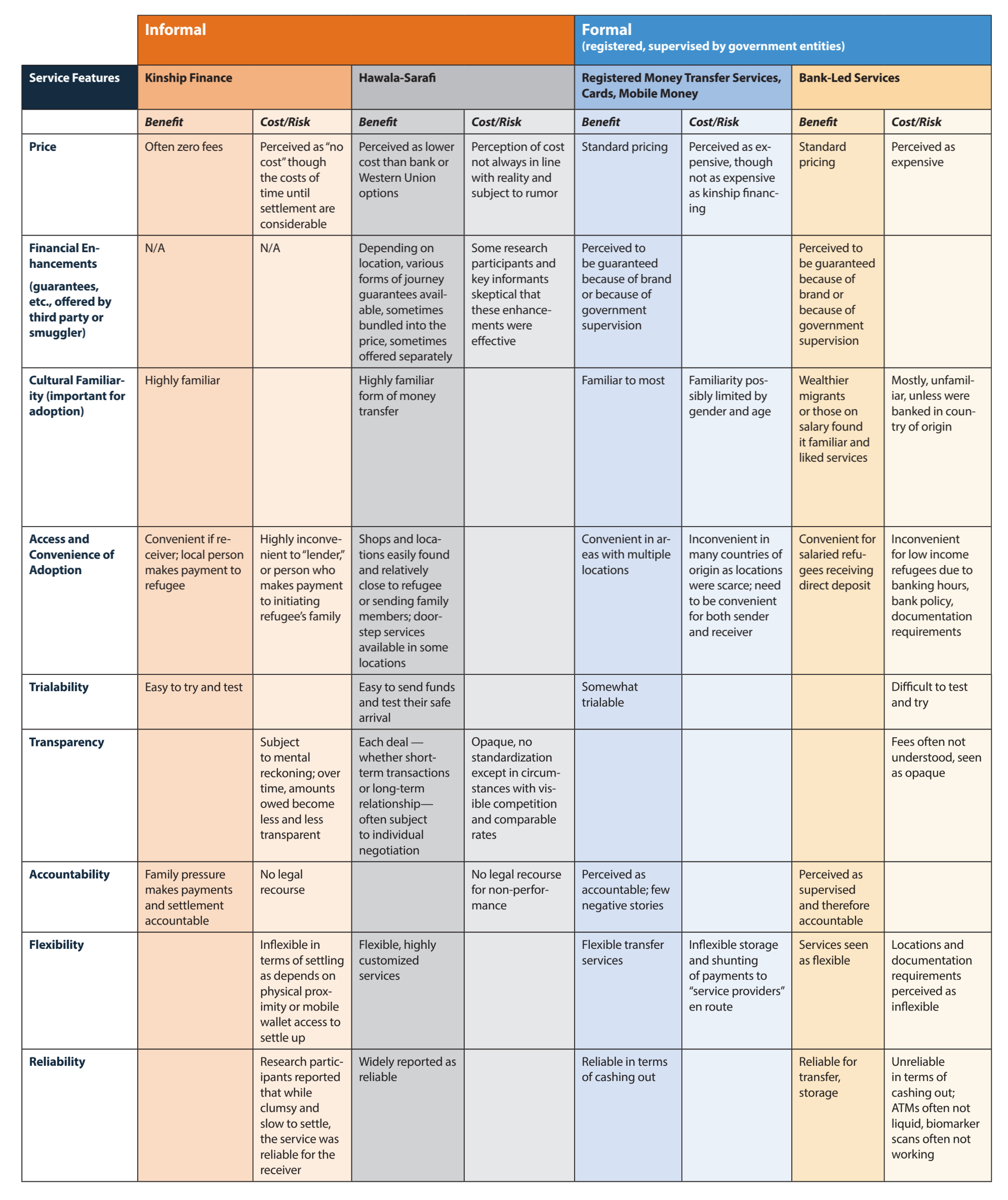
Chapter 4. Humanitarian Cash Assistance and Refugees’ Financial Portfolios
The comparison of modalities of humanitarian assistance—including between nonfood items (NFIs), aid in kind, vouchers, and cash—has received extensive attention in existing literature (Bailey and Harvey 2015, Smith et al. 2011). In-depth examinations of cash transfers to refugees have also received recent attention among both researchers and humanitarian practitioners (Armstrong and Jacobsen 2016, Spiegel 2015, Campbell 2014). Instead, in this section, we focus on humanitarian cash transfers as a dimension of refugees’ financial portfolios on the move.
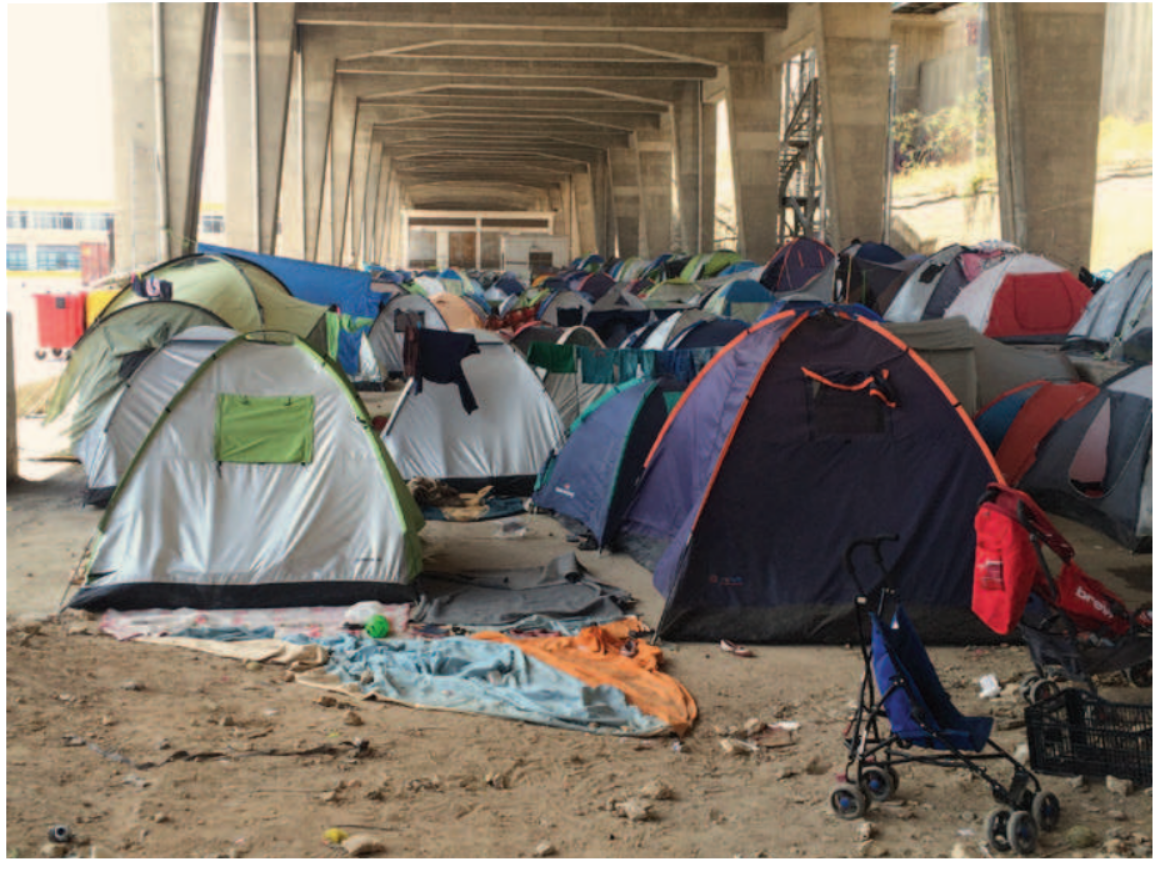
This chapter shifts attention away from the journey and towards forms of assistance available at particular locations—however temporary those locations may be. Indeed, some of the individuals receiving cash assistance at our sites of study would identify themselves as still being “on the move,” hoping to continue their transit towards Western Europe, even if they were relatively stationary when we met them. The chapter also shifts attention to the role of NGOs as another key outside actor shaping refugees’ financial portfolios and experiences. We specifically focus on the experiences of international NGOs distributing humanitarian assistance (in both cash and other forms) to refugees located in Greece, often in partnership with Greek organizations. Though some of the insights are echoed in our other countries of study, we focus primarily on Greece in this section because humanitarian assistance emerged as a key element of refugees’ financial portfolios during preliminary data collection, and our team was able to conduct subsequent fieldwork to delve deeper into this topic at this site. At the time of this study, seven international agencies were involved in cash and digital cash distribution in Greece, a process that is becoming increasingly consolidated under the banner of UNHCR.
We begin by exploring NGO perspectives on the benefits and challenges of different modes of assistance, including in-kind aid, digital cash, physical cash, and coupons/ vouchers. We then delve into NGOs’ decision-making processes regarding whether to embrace digital cash assistance and how to determine its amount. We also examine key informants’ perspectives on the gender and age dimensions of cash assistance. Next, we turn to refugees’ perspectives on different modalities of assistance, and delve into their views of digital cash (and specifically on barriers to use). We close by examining refugees’ strategies for stretching their cash assistance and for navigating the logistics and rumors surrounding access to different forms of aid.
4.1 NGO Perspective on Benefits and Challenges of Different Modes of Assistance
In Greece, Jordan, and Turkey, local and international NGOs, often in coordination with government and UN agencies, offer cash assistance to qualified refugees. The assistance is in the form of physical cash and e-cash, also called digital cash or digital money. NGOs have been distributing physical cash in lieu of in-kind distributions in areas where markets are functional, where refugee customers have access to stores, and where transporting physical cash is safe. They also have issued refugees paper-based coupons and vouchers to be spent at specific stores. Coupons and vouchers have reduced some of the risk to staff of distributing quantities of physical cash, but require substantial administration—contracting specific stores to recognize vouchers and then reconciling payments.
More recently, NGOs worldwide have begun using e-cash instead of physical cash. This is true in Jordan, Turkey, and Greece. NGOs register refugee users and issue them a bank card or account. Each month the NGO checks the refugee’s household status and updates their registration. Household members may move away from an area or new members may arrive, in which case the NGO will adjust the amounts that each household receives. The NGO then loads the refugee’s digital account (a bank card, e-voucher, or mobile e-wallet) with the appropriate sum of e-cash. The refugee then accesses their e-cash through store point-of-service (POS) devices, ATMs, and in some cases the internet.
The NGOs we interviewed held mixed views on whether distributions to refugees ought to be “in kind”—such as food and NFIs—physical cash, e-cash, or a mix. The matrix below summarizes major choices and challenges from the supply side of cash assistance in Turkey, Greece, and Jordan. As the matrix shows, key factors for consideration from the NGO perspective include (a) ease and safety of distributing assistance; (b) traceability of refugees’ spending as a way to comply with donor requirements; © ease of reloading/redistributing assistance; (d) ease of imposing conditions on how the assistance could be used; and (e) the existence of a path to refugee financial inclusion.
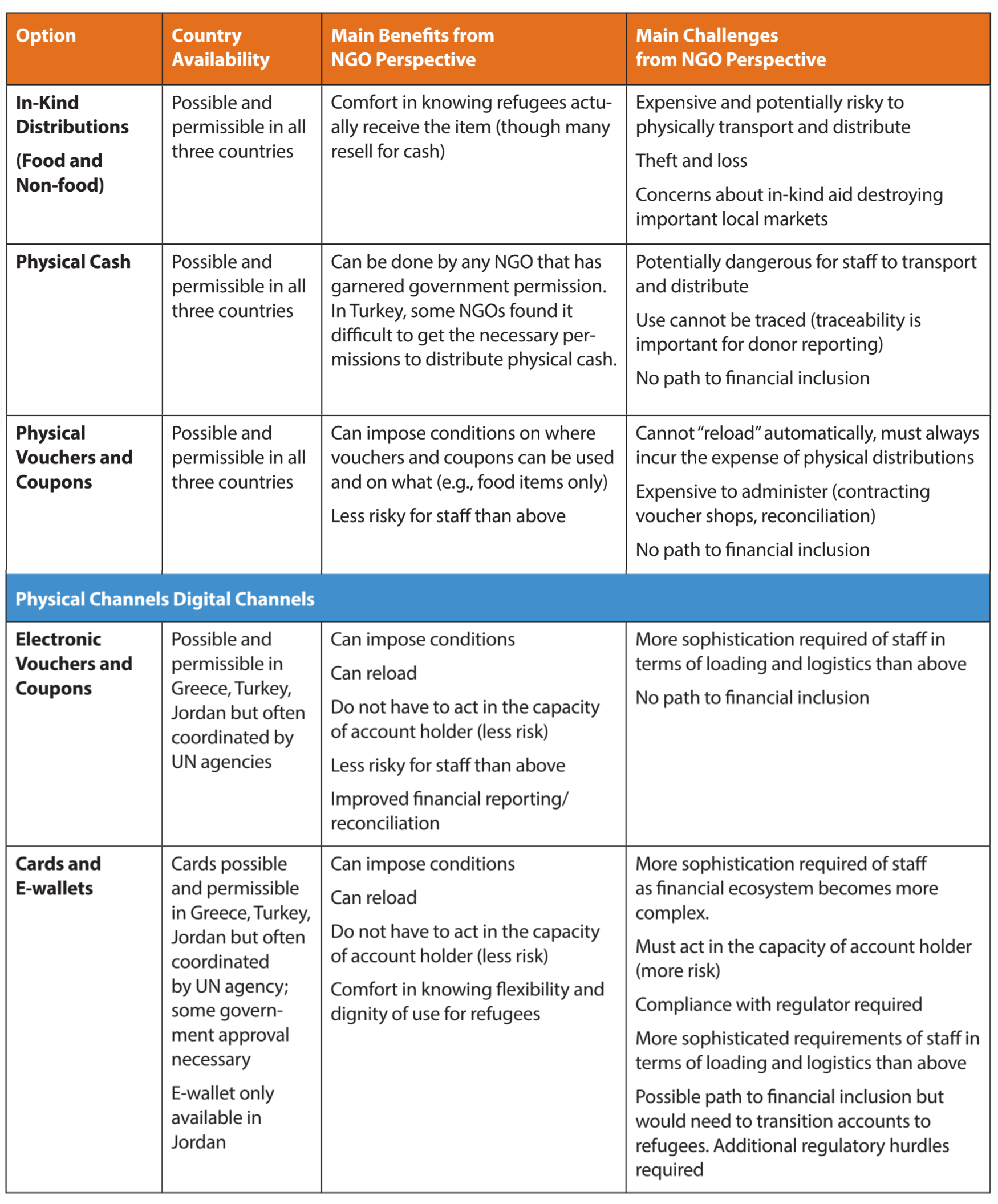
Some NGOs hope that refugees become included in the financial mainstream, referring to financial inclusion in banking and digital financial services that are government-licensed and supervised. Their theory is that as refugees access ATMs, store POS devices, and mobile e-wallets, they will become comfortable with regulated digital financial services. The logic progresses: Refugee comfort in managing digital transactions will translate into comfort accessing other kinds of digitally enabled financial services. For example, refugees would use the digital account as a way to store their own money— not only cash assistance from NGOs, but money from wages or family. Storing their money digitally could keep it safe from theft and help them save. Their digital trail could even help them access credit, as seen in the success of products such as m-Shwari that is popular in Kenya (Cook and McKay 2015).
Currently, financial inclusion through cash assistance is a goal and not a reality. The accounts that hold the e-cash balances are in the name of the NGO. The refugees receiving e-cash assistance only have sub-accounts, not individual accounts. This means refugees cannot add to their balances with their own money or transfer funds in and out of their sub-account. They are not included yet in the financial mainstream. It is possible to envision a time when e-cash assistance will be channeled to an individual refugee account. They will then be able to apply for credit, transfer their own funds, and transform physical cash wages into digital money on their card or wallet. Technologically, all this is possible today. But the risk of regulatory failure prevents cash assistance from traveling to individual accounts. Until regulatory risk is addressed, financial inclusion via e-cash assistance will not come about.
Jordan is a shining exception to a trend that favors risk reduction over service to its citizens and refugee populations. The Central Bank of Jordan (CBJ) is working to make e-wallets useful for cash assistance and other transactions. They have enshrined their commitment in a set of declarations at the September 2016 Global Policy Forum of the Alliance for Financial Inclusion. A forthcoming paper captures a statement made by the Executive Manager for Payment Systems, Domestic Banking for CBJ:
We [Jordan] were committed from day zero to provide refugees with healthcare, education, shelter, all these things, but never access to financial services. And when we introduced our vision to start working on access to financial services… we realized the problem is major for everyone, not only for refugees. But why focus on refugees? They represent almost 30% of the population. We can never ignore that (Hawkins and Wilson, forthcoming).
4.2 Factors Driving Digital Cash Assistance: The NGO Perspective
Five key factors drove NGO decisions about whether they would adopt digital cash assistance over physical cash or in-kind solutions. These were related to (a) efficiency and scale; (b) familiarity and comfort levels; © considerations of financial inclusion; (d) dignity of and flexibility for end users; and (e) traceability and conditionality of funds.
A. Efficiency and Scale Factors
For a variety of reasons, digital solutions appealed to the NGOs that are already using them. They believe in the long run that digital cash solutions are less expensive if distributed at a moderate scale. For instance, in Greece, CRS and Mercy Corps distribute cards to thousands of beneficiaries a month in multiple camps:
We manage thirteen camps scattered throughout the mainland of Greece and the islands. Naturally, we are looking for ways to reduce cost, increase replicability, while ensuring safety of staf and reliability of services.
—Key informant in Greece
But smaller NGOs interviewed in Jordan were reluctant to attempt digital solutions, in part because they did not have the staff capacity to learn an entirely new way of distributing humanitarian assistance.
B. Familiarity (and Comfort-Level) Factors
As just noted, smaller NGOs accustomed to in-kind distributions were hesitant to adopt a new mode of delivering assistance. They were unfamiliar with negotiating with new actors in a digital-financial ecosystem. They were new to the workings of international payment intermediaries, card companies, banks, and a host of regulators:
The smaller NGOs in Jordan claimed they would be overwhelmed if they had to learn a new way of servicing refugees without significant support. They also saw distributing physical cash or goods as a way of staying in touch with refugee issues. They worried that a digital system would separate them from beneficiary insights.
—Researcher’s fieldnotes, Jordan
Larger NGOs familiar with managing massive projects and able to hire to meet the demands of new digital channels were more eager to innovate efficient ways of doing business. They were also familiar with donor pushes for innovation, and donors underwrote their technological upgrades in service delivery.
C. Financial Inclusion
While the NGO representatives we interviewed stated that financial inclusion—bringing refugees into mainstream regulated financial systems—was not their primary concern, they nonetheless worked with regulators to be compliant.
NGOs issuing and reloading debit cards were taking full responsibility for customer due diligence compliance required by regulators. In other words, the debit card accounts were held by the NGOs, which then created a sub-account for each refugee beneficiary. NGOs bore all risk of money-laundering, corruption, fraud, and terrorism. Taken together, global-standard setting bodies call these AML/CFT risks (anti-money laundering/corruption, fraud, and terrorism). That NGOs were willing to step up and take these risks comforted the card companies and their payment partners (Derner and Shetret 2015).
NGOs interested in formal or digital financial inclusion—in systems where all supply actors were licensed and supervised by government—were dissatisfied that their beneficiaries could not progress out of NGO-held cards to refugee-held cards. They had hoped that eventually refugees would have full agency over their own accounts. At the time of our research, a pathway from an NGO-issued debit card to a refugee-held debit card did not exist. (Note: Some cases in East Africa show that indeed refugees can fully own their accounts. In Rwanda, for example, refugees receiving cash assistance have their own bank accounts.) But in Greece and Turkey, many logistical and regulatory hurdles blocked a sub-account from transforming into an individually held account. In Jordan, early experiments are taking place with e-wallets being fully held by refugees.
Refugees themselves, however, rarely echoed a wish for an individual account (debit card, mobile money, or e-wallet). Our research team was able to observe a day-long troubleshooting session in Lesbos. NGOs hold troubleshooting sessions regularly to help refugees who have lost their PINs or cards or who were confused about their balances. During the session, we did hear beneficiaries ask if they could reload their NGO-issued debit card. Upon learning they could not, they expressed mild disappointment. At the same time, only two refugees who had already been banked in their own countries made this inquiry. The other ninety had publicly expressed no concern.¹²
Beyond holding their own accounts, NGOs had other financial inclusion hopes for beneficiaries. They wanted them to use their digital assistance to save funds. But, as we examine later, refugees had too many concerns to be able to save funds on a card or an e-wallet.
Despite barriers, financial inclusion remained a goal of many of the larger NGOs:
We see debit cards as an on-ramp to broader financial inclusion. The theory is that they will first use our cash assistance cards; then, motivated by convenience and safety, they will open their own accounts for spending or saving. From there, they could become eligible for a credit card or other financial services.
—Key informant in Greece
D. Traceability and Conditionality of Funds
NGOs largely agreed that they preferred to refrain from placing burdensome conditions on refugee assistance. Refugees were already confused by bank policy restrictions, such as ATMs declining transactions due to entry of a wrong PIN or due to attempted withdrawal of amounts in excess of balances.
Often to no avail, the NGO representatives we spoke with spent great measures of time trying to convince donors that flexible, unconditional use of refugee assistance had greater humanitarian impact than did conditional uses. They argued that, while some refugees would indeed purchase cigarettes with unconditional cash assistance, most would buy food, clothing, and other necessities for their families. One internal NGO report stated that, as of November 2016, 4.5 percent of money distributed went to the purchase of cigarettes, whereas 95.5 percent went to the purchase of food, clothing, communications, medical treatment, and transportation. Discussing this report, a key informant in Greece shared,
We are able to trace in-store use digitally and follow up with regular surveys and interviews. Through these mixed forms of assessment, we can track monthly expenditures. Overwhelmingly, cash assistance is used for basic needs and transportation.
—Key informant in Greece
The traceability of digital cash appealed to donors. Even if the NGOs they funded refrained from placing conditions on which purchases could be made from which stores, they could at least study the data generated by card transactions. Because some refugees used their cards at stores where POS devices generated store-level data, donors felt secure that they could at least track which stores were getting refugee business. NGOs could also view account balances, withdrawal amounts, and other means of gauging refugee behavior, which donors found very appealing. They took comfort in knowing that their cash assistance would be used for the intended purposes: food, medicine, transportation, etc.
NGOs could also detect movement of refugees across national boundaries. As refugees moved from Greece northward, transactions from their NGO-issued debit cards left digital footprints. Interestingly, the international NGOs in Greece made a point of telling refugees that they could not use cards outside of Greece when clearly, in some instances, NGO-gleaned data showed otherwise.
E. Dignity and Flexibility for End-Users
Many NGOs believed that digital cash distributions offered refugees the most dignified way of receiving humanitarian assistance. Retrieving cash from an ATM or using a card for shopping allowed refugees to experience their money in a way that was consistent with the norms of their new social environment. Digital cash gave users maximum versatility in planning their budgets, choosing the best purchases for their families, or storing surplus funds. NGOs saw the move to digital cash as very much in line with their humanitarian mission. In the words of a key informant in Greece:
I see cash and digital assistance, even if it is very small, as a dignity payment. They can use $50 to pay for nice haircuts for themselves and their children or to buy a gift for a special occasion.
—Key informant in Greece
4.3 Determining Cash Assistance Amounts
In all three countries of study, cash assistance amounts were discussed and decided upon by a coordinating group of NGOs, government departments, and UN agencies.
Many of the NGO representatives we interviewed used a “minimum economic basket” or MEB to determine cash assistance amounts. The MEB was periodically updated to reflect changes in store prices for basic goods.
For example, in Greece, NGOs coordinated their digital cash distributions to reflect the MEB guidelines for individuals and families. In early 2017, in camps that made food aid available alongside cash, an individual head of household received €90 per month and €50 for each additional member, up to seven household members. As camps with cooking facilities were phased out, NGOs upwardly adjusted assistance to €150 per month for the head of household and €550 for households with the maximum seven members.
4.4 Digital Assistance: Gender and Age
The NGO representatives we interviewed had differing opinions on whether digital assistance was more empowering or “agentive” for refugees than in-kind assistance, and which gender and age groups may experience more or less agency. Key informants raised two questions related to this theme in our conversations. These questions represent opportunities for further directed research on these specific topics. We summarize the debate around them below.
A. Gender
Question: If women were issued cards as heads of households, would they be more likely to use them than men, and if they did, would they feel more in control of household assets?.
Though we did not conduct an in-depth systematic study on this sub-topic, debates based on internal observations were robust among the NGO actors we interviewed. Some observed that women traveling with husbands or other male relatives would immediately hand over their cards with PINs to male members of their households. We confirmed later that many women, often caring for young children or aging parents, indeed found this practice the most convenient. It also gave men who were used to providing for their families a task that mirrored as closely as possible their roles within their pre-displacement households.
At the same time, some NGOs were uncomfortable with reinforcing what they believed to be disempowering gender norms. In the words of one key informant in Greece, “women should have full agency over their decisions.” Control of money was a way many key informants defined agency. Others contended that agency did not necessar - ily carry the same meaning in different cultural contexts, particularly with regard to financial assistance. Yet other key informants commonly articulated a more distanced position with regard to the relationship between instruments of financial assistance and gender norms. As a key informant in Greece said, “It would be nice if women felt comfortable accessing card-based cash, but practically speaking, it does not make sense for us to use humanitarian programming as a way to force our own agendas.” On the refugee side, some concern was felt about women who wanted to access their cash—or at least make decisions on how their cash assistance was used—but felt powerless to do so. Our research had difficulty investigating this, as many women were reluctant to discuss this particular matter (or did not delve into the details of their financial journeys in the first place). To the extent that we were able to probe this, it was through other women in the camp or neighborhoods, who would point out that women residing nearby experienced this problem:
Their husbands and sons insist on taking the card, even if it not in their name, and retrieving the money. These women never see the cash and never have the chance to spend it on their priorities.
—Syrian woman in Greece
Various NGOs have attempted to inform women heads of households about their rights to access their own money. Additional research is needed to understand the success of those efforts.
B. Age
Would youth be able to manage cash assistance via cards more conveniently and efficiently (and just as responsibly) than in-kind assistance?
Unaccompanied minors were, at the time of writing, not eligible to receive digital cash assistance in the countries of study.¹³ They did receive in-kind assistance in the form of food, clothing, shelter, and other items, but not cash. Numerous key informants expressed concern that assistance would be used to buy cigarettes or alcohol, and that the latter purchase would result in violence or the threat of violence (particularly in camps) on an ongoing basis.
As a key informant stated, “It’s not just men: Women drink, too, and become abusive.” Reports of alcohol misuse were sufficient to affect NGO-wide policies on the distribution of cash to minors, regardless of whether or not a particular camp or neighborhood was experiencing problems centering on youth and alcohol. While adults, too, could use cash assistance for alcohol, conversations with key informants suggested this issue was of particular concern with regard to minors and the potential violence they would be presumed to cause.
NGO actors interested in exploring the possibility of offering cash assistance to minors articulated two reasons for their stance. First, they had observed or had heard reports that young people needing cash were either liquidating in-kind distributions to get the money they wanted or were turning to prostitution and sex work. Three different key informants spoke to this concern, particularly with reference to young men and boys in Greece:
The young men and boys go into Athens city center at night from the camps, and they use transactional sex with older Greek men to make money.
—Key informant, Greece
Pimps mostly hang out at the port and in parks. For the boys, it’s a way to earn money. It’s very visible—spend enough time in a park or near the port, and you will see it for yourself.
—Key informant, Greece
It’s interesting; all the journalists ask us if we are hearing a lot about rape of refugees. We have heard some things about rape, and we always report them and follow up on them. But mostly, we hear about transactional sex and boys who turn to prostitution. The families need the money. We usually hear it from their older family members.
—Key informant, Greece
The second reason some NGOs are considering cash assistance to minors is that in-kind distributions are expensive and they do not always meet the needs of minors—particularly with regard to dignity. Some key informants stated they needed more than just the basics—food, clothing, shelter, medicine—to get by. They needed the occasional nice
T-shirt, football, or knapsack. For this reason, one organization in Greece would take unaccompanied minors shopping each month. As one former recipient in Greece (now an adult) reported, “Once a month, it feels like Christmas.” While these excursions were welcome respites from camp life, and were often combined with field trips, they were expensive for the NGO to execute.
Finally, some NGOs agree that digital cash assistance to minors could promote positive behavior around budgeting and could lead youth toward more financially inclusive services. Additional research is needed to continue exploring the effects of cash and digital assistance to minors, particularly with regard to reducing maladaptive livelihood strategies, preventing exploitation, and promoting positive behavior.
4.5 Refugee Perspectives on Benefits and Challenges of Different Modes of Assistance
The refugee experience of digital cash assistance was generally positive. Interests of research participants at times diverged from interests of supply-side actors (banks, telecommunications organizations, NGOs, donors, governments.) While the supply-side actors valued efficiency (lower costs of distribution), effectiveness (getting funds to the right people on time), and occasionally agency/empowerment (women accessing and managing household cash assistance), the demand-side actors (the refugees) valued flexibility, familiarity, and convenience.
In Greece, Jordan, and Turkey, refugees received assistance in a variety of ways. Instruments of assistance varied, as did the amounts, duration, frequency, and type, and as did the range and multiplicity of sources. The conditionality of funds varied as well, ranging from none (refugees could do whatever they wanted with their assistance) to narrow (e.g., to pay rental deposits to landlords).
The matrix below summarizes major forms of in-kind and cash assistance in Turkey, Greece, and Jordan from the refugee perspective. We have listed the modalities from least flexible or fungible to most. In this instance, we did not disaggregate by whether the option was digital or physical as before. In some cases, a paper voucher may be more flexible than a store gift card, though one is physical and the other digital. Cash is by far more flexible than any form of digital payment, even though, as we examine below, it also has drawbacks.
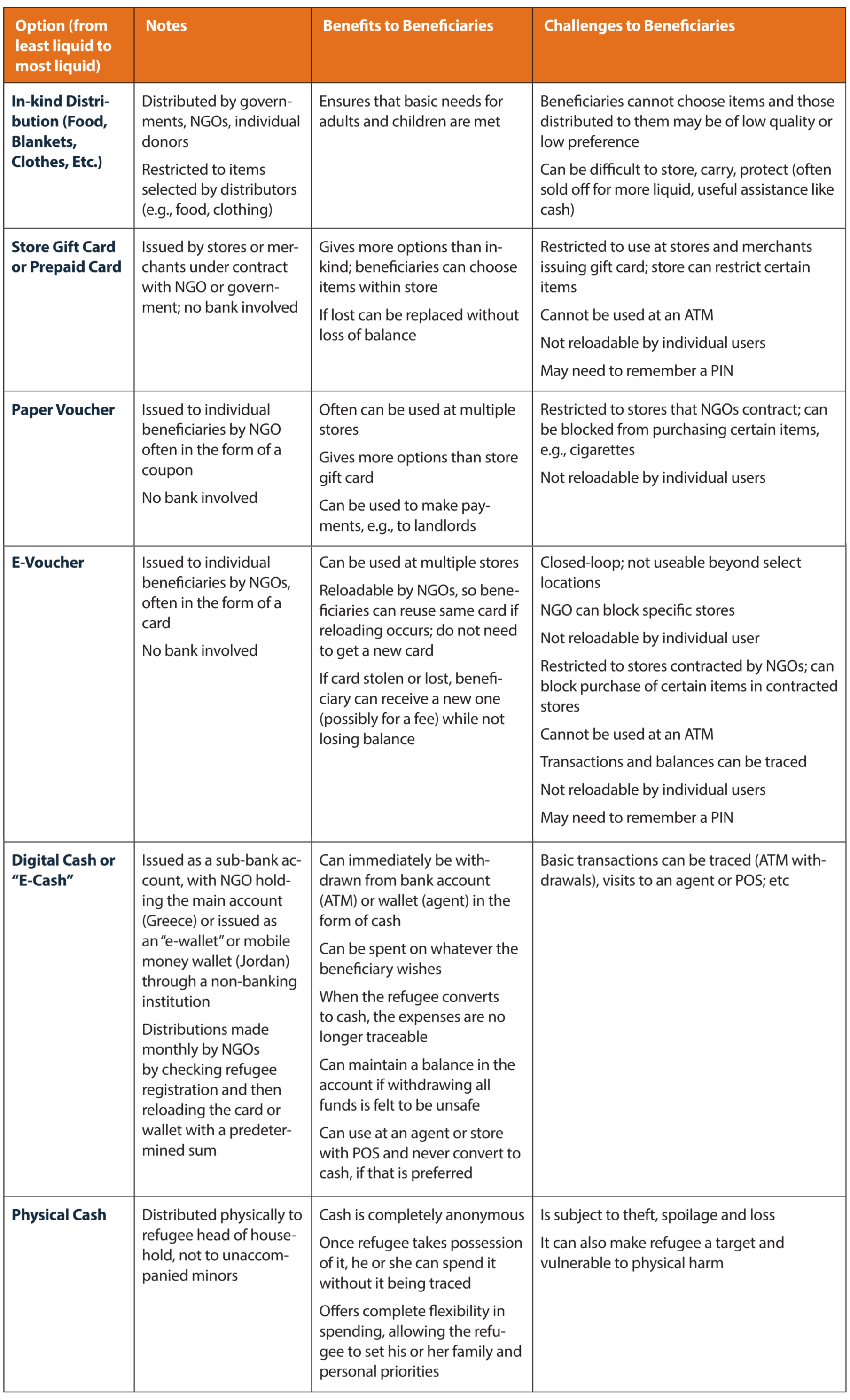
4.6 Refugee Perspectives on Digital Cash Assistance
Across all three of our country cases, research participants appreciated the digital cash assistance received, particularly once they fully understood the restrictions, conditions, and practical tasks of accessing funds. In Greece and Turkey, research participants particularly appreciated that they could visit ATMs with their cards and retrieve cash. Similarly, they liked that they could shop at larger stores, making purchases with their cards. In Jordan, we did not interview anyone with an e-wallet, but did interview those with cards. Many noted that receiving cash in physical form would have been far more convenient for them. Others liked in-kind food distributions and direct payments to landlords, or a mix of forms of assistance. Values that underpinned responses included flexibility and familiarity.
A. Flexibility
Refugees valued the flexibility of resources on offer. Cash was seen as the most fungible and in-kind distributions as the least fungible. Cash could be used for any purchase or payment. While in-kind distributions, store cards, and e-vouchers could be sold, they were sold at a discount. Interoperability—the ability to use their cards with a variety of banks and merchants—also mattered. Users liked open-loop cards that could be used across banks and merchants, as opposed to closed-loop cards that could only be used within specific store networks. Reloadable cards—with e-cash loaded onto existing cards—were also seen as a benefit (no new PIN required). Very few refugees expressed that individual reloadability (i.e., the ability to add money transfers from family to the stored value on a card) as a priority. Similarly, they did not express a significant interest in converting their own physical cash to a digital value on their cards (a major feature of digital or e-wallets) The exception to this was single male research participants traveling back and forth to Egypt from Syria for work. They were wiring their physical cash in Jordan to themselves in Egypt for later retrieval. A versatile e-wallet likely would be useful and represents an opportunity for future study.
B. Familiarity
The familiarity of a digital channel or interface depended both on the refugee’s country of origin (and their financial ecosystem prior to displacement) and on the context in “the country of access.” Such context included language, currency, financial service retail interfaces, and custom. Cultural and gender norms affected familiarity as well.
We explore the range of options by illustrating two examples on the extreme ends of the familiarity spectrum.
We encountered a female refugee hailing from Afghanistan who is illiterate, had never accessed a bank or an ATM in her home country, and is faced with accessing her cash assistance at a Greek ATM. She became our example of extreme unfamiliarity. She speaks Dari, but does not read it. She faces a new alphabet (Roman or Greek); a new directionality of writing (left to right); a new language (Greek, English, sometimes German and French); a new currency (Euro); and a new interface (an ATM, and up to nine transactional menus). To travel to Greece, she financed her journey using the Hawa - la-sarai system. She is issued a debit card by an NGO. She must recall and enter her PIN and insert her card in the right way, or it will be declined or swallowed. In Afghanistan, her husband received his wages in cash and managed most of the household budget. Her role was to mind the children and the livestock.
Now let us describe another example—one of extreme familiarity—a Syrian man in Jordan. He is literate and numerate. He speaks and reads Arabic. Before the civil war, he traveled back and forth to Jordan and so understands the Jordanian dinar, its conversion to Syrian pounds, and vice versa. He had a bank account in Damascus and became accustomed to retrieving money from an ATM. For him, the process of taking a debit card with digital cash loaded onto it by an aid agency and converting it to physical cash is easy. He is familiar with the alphabet, the language, the currency, and the ATMs (the menus, how to remember and use a PIN, and how to check the receipt). For him, handling money is customary. Before the war, he had become used to working and receiving payments in Syria via a bank account.
Familiarity Extremes
Example:
A single, illiterate Afghan female head-of-household tasked with retrieving cash from an ATM in Greece. No previous bank or ATM experience.
Extreme Unfamiliarity
- New language
- New alphabet
- New directionaity of alphabet
- New currency
- New financial access channel (a formal sub-account.)
- New user interface (ATM)
- New gender role
Example:
A married, literate Syrian man with previous bank account and ATM access in Syria, tasked with retrieving cash from an ATM in Jordan
Extreme Familiarity
- Same language
- Same alphabet
- Same directionality of alphabet
- Familiar currency
- Similar financial access channel (a formal sub-account)
- Same user interface
- Same gender role
The polarity just described potentially has great bearing on how two very different kinds of refugee users would first encounter accessing and managing cash assistance. In the first example, that of the illiterate Afghan woman (a common example in Greece), the refugee is encountering multiple experiences for the very first time. She must decipher new shapes of letters that spell words alien to her. She must learn to slot her card in the right direction, enter a PIN that she must memorize, and decode a new currency. Those would be her tasks if all went well. But if she were to take too long to select the next menu, enter an incorrect PIN, or select an incorrect key, she could face a swallowed or declined card. Or, if successful, she would then need to manage her collection of euros, understand their value as paper currency, and then the value of an assortment of coins that came as change when she paid a vendor. She would also need to decide how to manage anyone who may offer help (within her family and neighbors or among strangers) and manage the risks and opportunities those interactions represented.
In the second example, the literate Syrian would face far fewer alien experiences. He would be knowledgeable in how to use ATMs, in how to manage the Jordanian currency that was dispensed, in how to use the change that came as a result of making store payments. His role in fetching cash would align with his previous role as breadwinner in Syria.
However, as time went on, the distances that divide these two experiences may become smaller. As a Syrian man in Greece said, “When it comes to our money, we learn how to get it.”
4.7 Digital Cash Assistance as Part of Refugees’ Financial Portfolios
Most research participants expressed deep appreciation of the aid they received, including digital cash assistance. However, in all three countries, frustrations brimmed: refugees complained about being at the mercy of aid and expressed a desire to work.
He now received 95 JD/month from UNHCR. In the beginning, his neighbors helped him feel at home. He has good relationships with them, he says, but has never been given or been able to offer financial help to those around him. He says 90% of Syrians are working to make extra money under the table, but they can’t admit this for fear it will affect the little aid they do receive. “It’s well known that Syrians love to work, ” he says. “Even if I could earn 1000 JD just sitting on my back, I wouldn’t do it. ”
—Researcher’s field notes from conversation with Syrian man in Jordan
Though grateful for digital cash assistance, many noted that amounts were insufficient and lasted only a portion of the month. But others reported that this form of assistance nicely complemented different kinds of aid received in the form of vouchers (“coupons”) and in-kind distributions:
Once in Syria, he registered with UNHCR. The assistance he received from them was comprehensive, and included cash, in-kind food assistance, and health visits. He accessed his cash by using an ATM card and would go to the bank to take the cash out. He said getting used to this process was difficult at first, but he quickly learned how to use the card through the help of his friends. He was able to find some work in Syria, piecemeal work at local shops, for which he received daily payments in cash. He used his daily to salary to pay for daily expenses.
—Researcher’s fieldnotes from conversation with Iraqi man in Jordan
We explored how research participants patch together livelihoods and an economic portfolio in Chapter 2 of this report. For the purposes of this section, we can conclude that, overall, different forms of aid—digital cash, physical cash, and in-kind—did not flow to households in an integrated or uniform manner. Instead, individual households were left to tirelessly stitch their own quilt of digital cash assistance, coupons, landlord support, camp-issued distributions, and other kinds of aid. Each aid quilt was unique, marked by the number of household members fabricating it, their age, gender, and position in the household, and the household’s social standing within the neighborhood or camp.
While newcomers rued the unrelenting work of investigating, understanding, and accessing digital cash and other forms of available aid, seasoned refugees understood that uneven, disproportionate assistance could work in their favor. Their deft arbitrage, however, still had its costs. Sending various members of the household off to access blankets in one place, money in another, and food in a third required extensive coordination.
They needed to strategize deployment of close and extended family members toward faraway ATMs, voucher-accepting merchants, in-kind distribution queues, registration tables, document procurement bureaus, inicky iris scan machines, and more. Depending on their location, refugees had to memorize bus routes and to navigate a circuitry—often broken—of free shuttles, special taxis, and car rides offered by volunteers.
Refugees reported the expense of these efforts relative to time spent, monetary costs, and the physical risks and psychic pain endured:
The general challenge, for many, he says, is dealing with the IRIS machines. This is the way most people receive their financial assistance, but in this location, there is only one machine in each bank (compared to four or five per bank elsewhere), and that it’s usually broken or malfunctioning. Some people attempt to collect money 2, 3, 4 days in a row with no success. The four branches of the bank are very crowded come collection time. The crowds are volatile, people often physically fight in line, and it’s not safe. I ask him who he sees in line at the bank, and he says women, the sick, and the elderly have to make it through this mess as well. The bank tellers are also very rude to the refugees, he says. All these factors result in some refugees declining to receive the financial aid at all through the IRIS system, due to the degrading and rude treatment they must endure. Bank officers never help, he says, but rather they have to take care of each other in order to keep each other safe.
He goes all the way to another city to avoid this mayhem when it comes time for him to collect his assistance. One third of the money he does receive goes towards paying for the trip there and back. “It’s only symbolic help, ” he says.
—Researcher’s ieldnotes from conversation with Iraqi man in Jordan
4.8 Refugees’ (Gendered) Perspectives on Digital Cash versus Food and Coupons (Vouchers)
The prevailing wisdom from the supply side is that cash (in both digital and physical forms) is more flexible and fungible—and thus more useful—than structured, conditional forms of aid such as coupons (vouchers) and in-kind distributions (Aker 2014).
Moreover, it does not lead to increased spending on alcohol and cigarettes (Evans and Popova 2014). Those interviewed appreciated digital cash assistance, many preferring it to other forms:
I also receive coupons from UNHCR, but I would prefer to receive cash. Cash is better and more flexible. The coupons I can only use at specific malls, which control (in a negative way) the prices of essentials.
—Iraqi man in Jordan
When asked to choose between cash and coupons, cash often came up as the winner among refugees:
The members of the focus group noted that cash was preferred (over coupons) for flexibility. The coupons (“VISA”) come in the form of Visa cards. They receive SMSs on their mobile phones each month when money has been added to the account.
—Researcher’s fieldnotes from observation at an organization’s focus group with Syrian women
But, as noted previously, many saw both cash and coupons as key components of their financial portfolios:
When asked about the diference/preference of cash vs. coupons, the women reported using the coupons for food and other household items, cash used for rent, diapers, and the rest put aside to use for various daily expenses.
—Researcher’s fieldnotes from observation at an organization’s focus group with Syrian women
At the same time, some research participants reported that, while a combination of cash and coupons was helpful, if pressed to make a choice, they might choose coupons:
She received food coupons from International Organization for Migration for 6 months, and has also received assistance from the Red Crescent. The value of the coupons can change, she notes, and says the higher value coupons require being registered with the IRIS system… She says the coupons were very helpful and, in general, people can use them now in more places than they were able to before. They are useful as well because food is a real priority. She says men maybe use cash for personal expenses (she referenced cigarettes, specifically) and that’s why she prefers the coupons, as they help ensure food security.
—Researcher’s fieldnotes from interview with Syrian woman in Jordan
A different research participant reinforced the point surrounding the gender dynamics of different forms of assistance:
She prefers to receive coupons because if men take the cash, she says they will spend it on other things. With coupons, she says, she knows her family will eat.
—Researcher’s field notes from interview with Syrian woman in Jordan
And even more emphatically, a refugee asserted:
Food is the best form of assistance; I can give it to my kids. With money, I spend it, but with food I can feed my kids.
—Syrian woman in Jordan
She was not alone in her response. People of all genders reported a feeling of safety in in-kind distributions, believing such assistance would more likely ensure that the basic needs of their family would be provided for.
Gender also played a role in how research participants perceived in-kind distributions versus cash or digital cash. In Greece, for example, many female research participants in camps expressed special gratitude for distributions of sanitary napkins and diapers, finding these items bulky and difficult to carry, especially if walking long distances or if hoisting themselves, several children, and multiple bags of groceries onto buses and other modes of public transport. They reported that generic brands of sanitary pads and diapers were adequate. They appreciated when items were accessible “just around the corner.” Married women also were grateful that they did not need to negotiate payment for these items out of a family budget, as some spouses did not regard them as necessary.
4.9 Refugee Perspectives on Barriers to Using Digital Cash
Steep obstacles—often (intentionally or unintentionally) put in place by NGO, government, and bank policies—studded a refugee’s path to easy retrieval of digital cash. Refugees threaded their way through an obstacle course of changing document requirements, broken IRIS scanners, cashless ATMs, and long, disorderly, and sometimes violent queues. They commandeered different household members to manage different retrieval tasks based on gender, age, idleness, and literacy. And, depending on the country, the retrieval tasks they needed to perform were more or less daunting, at least in the beginning. Below, we have clustered the most common barriers.
A. Literacy, Financial Literacy, Lack of Familiarity, and Confusion
As already described, confusion was a recurrent narrative in accessing digital cash assistance. The root causes included the varied policies of different NGOs. Amounts differed, frequency differed, and the imposed conditions on use differed. Whether users had to pay fees for withdrawal also differed. Some NGOs charged fees; others did not. So too did possible access points.
Another root cause for confusion was the degree of financial literacy of the refugee. Here, we are referring to the refugee’s financial literacy in their home country or in their environs of displacement. Some were new to accessing cash through digital means and revealed their inner turmoil in several ways. They would linger too long between menus of an ATM and face the problem of “the machine eating my card.” They would forget their PINs with the same result. They would select the wrong amounts. If they withdrew fewer funds than they had intended, they would walk away with very little spending power only to return to face the same overwhelming machine and its unnerving sequence of tasks:
For many, it was their first time using a card, and they relied on workers at the grocery store to help them figure it out. Passwords were written on pieces of paper and given to them. They bring these passwords with them to the store, which is not very secure. Also, if they lose the card, they lose the money. They can get another one from UNHCR, but the money would be lost along with the card.
—Researcher’s fieldnotes from conversation with Syrian woman in Greece
ATMs were not always located close to stores. Refugees often forgot balances on their debit cards (though some who saved receipts remembered). As they selected items in a store, they worried that they would reach the counter with purchases that would exceed their balance. They feared at checkout that their confusion would slow the movement of the queue, inconveniencing those behind them. If store cashiers were kind, they would help refugees calculate their purchases, a helpful service if the refugee knew their balances. A researcher in Jordan summarized:
When using the card, she must calculate and add her expenses as she shops, as she doesn’t want to be over or too far under at the register. She also notes that the card limits her to only certain shops and malls, when she would prefer to shop other places.
—Fieldnotes from interview with Syrian woman in Jordan
Jordan’s options for an e-wallet, offered by telcos, will address some of these issues by showing balances and transactions. As of this writing, e-wallets were available in Jordan, but were not yet widespread. No research participants we interviewed had one.
Another contributing cause to confusion was rumor. In the absence of clear, consistent policies on amounts distributed, false intelligence—rumor—filled the information breach. For example, as one researcher was exiting a camp in Greece, camp residents surrounded her. They were inquiring desperately about news of whether cash assistance was being halted. In fact, NGOs had just completed a survey to determine changes in their “minimum economic basket,” agreeing to adjust them upward. All the camp residents had heard was that changes were ahead, and they had inferred the worst. Rumors about varying amounts of cash distributions between camps and urban neighborhoods flowed, as did rumors about different NGO policies. The end result was a tangle of misperceptions and befuddlement and the continued spread of false information.
B. Gatekeeping
In Greece, refugees appreciated the coordinated approach of NGOs. Most reported that amounts and access were fair, even if monthly registration seemed a burden on their time. They appreciated the continued trouble-shooting efforts of international NGOs, which consisted of face-to-face problem-solving over lost PINs, lost cards, swallowed cards, misunderstood and misremembered balances, etc.
In contrast, in Jordan, some refugees complained of uneven access to assistance, of power plays by UN agencies and NGO staff. Some reported that to get assistance, “you needed to know someone on the inside”:
Unless you know someone at UNHCR, you don’t get help. You might occasionally get money for fuel in winter, and CRP distributes every few weeks. We got something from them at the beginning of Ramadan.
—Syrian man in Jordan
Since UNHCR itself was not distributing cash in Jordan, this complaint was misinformed. However, the perception that one needed insider access to an NGO distributing cash was common.
C. Fear of Vanishing Assistance
In a perpetual scramble to transform a messy array of small grants, family transfers, loans from neighbors, and advances from landlords into a dependable stream of money, refugees worried that taking funds—both digital cash and cash—from one NGO would ruin their chances of getting assistance from another.
Refugees would gladly accept one-off assistance. But, when doing so, they feared the consequences. A common refrain of research participants in Jordan, Turkey, and Greece showed that refugees perceived they would disqualify themselves from receiving future digital cash assistance if seen to be taking cash from elsewhere. They routinely faced this dichotomy: Take the needed, isolated, targeted assistance now and jeopardize future streams of aid, or forgo immediate assistance in favor of a long-term steady flow of small grants.
Though all forms of cash assistance—including remittances from relatives—were seen to be vital for a healthy financial portfolio, assistance from relatives, depending on their predictability and expected sums, was particularly valued—so much so that if a refugee had to choose between transfers originating from kin versus from a donor, they might choose a kin-generated transfer:
He says his wife was at a transfer office one day and witnessed a man trying to receive money (100 JD) from his brother in Germany. She says the transfer agent asked to see the man’s ID card as well as his UNHCR card/papers and that the agent said he would inform UNHCR that he was receiving the transfer. The man walked away from the transaction and didn’t take the transfer at all.
—Syrian man in Jordan
Research participants worried about digital cash balances on their debit cards at the end of the month. Many had traveled from Jordan to Greece to Turkey, or to Greece via Egypt or Lebanon. Policies on digital and physical cash assistance varied, often depending on whether the card they held was an e-voucher, a prepaid card of a different variety, or a debit card. Policies among distributors of digital cash varied or were perceived to vary.
In some locations, refugees reported that balances at the end of the month were swept and, if unused, would vanish for good. In other locations where NGO policies regarding sub-accounts were well-coordinated, they made a special effort to let users know balances would carry over from month to month. Some encouraged refugees to save funds in their sub-accounts, to refrain from fully converting their monthly allotment into cash. Research participants in Greece appeared to understand that they could save in these accounts and that these accounts were a safer place to save than in their tents, apartments, or make-shift shelters. Despite this encouragement, only a minority was inspired to save in this way.
4.10 Making Cash Assistance Last
As stated earlier, many refugees reported that their cash assistance only lasted for a portion of any given month, estimating that after ten days, they could not make ends meet from aid. That said, we did meet some refugees who prided themselves on making their digital cash stretch to the end of the month:
I receive €290 each month. Another family helps me retrieve the money from the ATM. I give my card and my PIN to them, and they bring back the full €290. I manage my budget very carefully. Once a week I buy vegetables, and each month I go to the butcher and buy a whole slaughtered sheep for about €100 – 150. I hang the sheep on wire hangers over there. [She points to a walkway wall, cinder block with a few wires hanging from a nail and a few pieces of dried meat still stuck to the wires.]. Each day or several times a week, I pull strips of the dried meat from the wire, soften and cleanse it in hot water, and then simmer it in oil with onion, garlic, tomatoes, and spices. I serve it with rice or bread. The money lasts the whole month.
—Afghan woman in Greece
Another Afghan woman in the same location claimed to create savings through good cash management. She was residing in a Greek camp with her husband and six children. The camp offered cooking facilities and had daily food distributions. She would select items she felt were tasty enough for her family and disregard other distributions. In addition to the food, as head-of-household she received €310 per month for the six of them:
I set €50 aside as savings each month. I withdraw it from the machine and store it in my shelter. From the camp I take these items: pampers (which double as sanitary pads), milk, onions, and potatoes. When I shop, I buy spaghetti, meat, and eggs at the grocery store. I spend €20- €30 each week. We have at least some meat with meals every week. I also spend on my health and for doctor’s visits and medical treatments for my children. I also budget for train and bus expenses. I have relatives in Afghanistan and Germany but do not receive funds from them.
—Afghan woman in Greece
We heard of other strategies for stretching assistance to the end of the month—or even for creating a remainder that grew over many months. Strategies ranged: Some research participants ate communally with other families. They shopped together as well, saving on bulk purchases. Others kept money with trusty neighbors (usually extended family), if their neighbors’ shelters were more secure. Funds kept this way were out of easy reach, a strategy not only to protect money from theft but also to keep it away from the daily temptations of buying cigarettes or candy for children.
Chapter 5. Identity on the Move
Who one is and being able to prove it turns out to be two of the thorniest problems for a refugee.¹⁴ Identity determines who can access systems of protection and assistance, which experiences different systems prioritize over others, and how refugees interface with bureaucracies of care.
In this section, we separate “who one is” from “being able to prove it.” While interrelated, the constructs of identity and proof of identity can change at different points in a journey for personal, gendered, ethnic, religious, and political reasons. Refugees may not want to prove who they are; in fact—quite the opposite—they may wish to prove they are other than who they are.
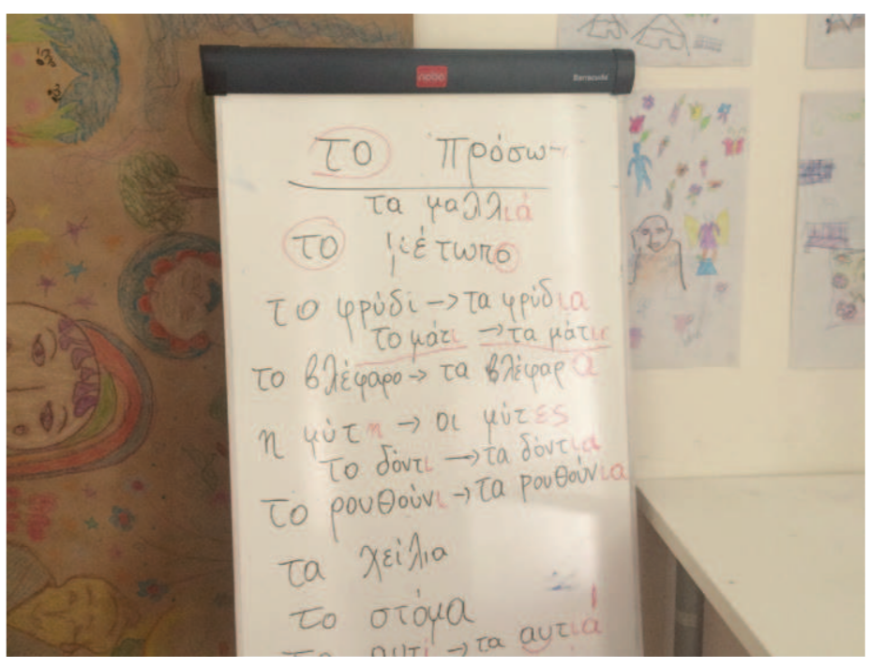
Our research further suggests that regimes of care (Ticktin 2011), consisting of a network of actors that provide aid, legal counseling, medical services, interpretation, and an array of other services, replicate and reinforce hierarchies, which privilege some experiences of violence and forms of vulnerability over others (Hyndman 2000). In this section, we discuss how refugees and humanitarian actors perceive these hierarchies, how they are linked to the issue of identity, and how they intersect with ethnicity, religion, and social class. We examine “how compassion acts as a form of policing, choosing a few exceptional individuals and excluding the rest” (Ticktin 2011, p. 127). At the same time, “it becomes clear that individuals themselves are not content to behave as passive victims of the labeling process” (Fassin and Rechtman 2009, p. 97). We, therefore, also discuss refugees’ strategies for subverting and responding to perceived hierarchies.
The intertwined issues of the hierarchical priorities of refugee assistance and refugee identity (both personal and documented) are of two-fold significance: First, these hierarchies shape refugees’ interactions with many of the formal and informal actors discussed throughout our report, from the humanitarian system to money transfer agents. Any discussion of these systems with regard to “refugees” writ large would be incomplete without shedding light on the cleavages and divisions within and among the undifferentiated refugee category. Second, documentation of identity is a crucial component of many of the financial transactions described herein, and it is, therefore, essential to understand both the ways in which it may be an obstacle to refugees accessing services and the ways in which refugees develop strategies for circumventing identity-related challenges.
A. Lack of “Desirable” Country of Origin
Key informants and refugees alike noted the importance of national origin in the priority system—often invisible and unstated, but still present—for passage through borders, legal claim processing, and receipt of humanitarian assistance. A key informant familiar with asylum claim processing in Greece shared, “The asylum system is based on nationality, not vulnerability, which leads to real and perceived discrimination.” When we asked key informants to explain the construction of hierarchies, explanations ranged from the bureaucratic (“there are not enough people to process all these claims”) to the expressly political (“Syrians led a more urgent crisis”). Perceptions on the construction of urgency emerged among refugee narratives as well. A male Afghan refugee in Greece stated: “Why are Syrians treated better than us when we’ve had our war for longer?”
A Palestinian refugee in Greece elaborated:
I have problems because nobody cares about the Palestinians now. If you are Syrian, Iraqi, okay. Everybody knows there is a war in your country. But there is also war in Palestine. Why do the organizations make differences?
—Palestinian man in Greece
An Afghan woman echoed the perception that Syrians were prioritized over other refugees:
In Turkey, with the help of my mother’s uncle and by asking around, we left for the coast. We traveled eighty of us in a small raft. I felt certain we were going to die. We left at midnight and arrived at dawn in Chios. A Greek man found us as he was walking along and alerted the police, who came to us within an hour. We were completely soaked to the bone and for two weeks did not have a change of clothes. We were told at the camp: First Syrians, then you. We stayed in a large tent, filled with angry men throwing stones, breaking glass. The only protection we had was the blankets we hung to form walls.
—Afghan woman in Greece
B. Religious Identity as Both Potential Asset and Source of Vulnerability
Refugees stated that a declared, perceived, or assumed religious identity (often intersecting with ethnic ones) could either facilitate their passage through certain spaces or create more obstacles. An Iraqi man reported the following about his and his wife’s experience with arriving in Jordan: “I didn’t tell them I would register with UNHCR because I heard that they don’t want Christians to leave Iraq. I said my wife and I were coming for fertility treatments.” A Syrian woman in Jordan said that her names (first, middle, and last) are all Christian, so she has been able to “play the game and get aid from a few Christian organizations and churches as well.”
These identities also affect the livelihood options available to certain people on the move. A young Hazara man from Afghanistan confirmed this in a researcher’s fieldnotes:
He asks where I am from, and I tell him I am Greek. “You know there is no money in Greece. ” We laugh, and I ask what he does. He says, “Some people work in farms, but they want bigger men there, they don’t want me. People always ask me if I’m Chinese… “Chinese, no good at farm. ”
—Researcher’s fieldnotes from interview with Afghan man in Greece
The same man noted that his physical features were an obstacle to his livelihood throughout his journey:
“That was not enough. I had to work. There was no work in Iran for people like me. Too dangerous. ” He stopped in Turkey for eight months. In Turkey, he worked construction. “People kept saying, Chinese men don’t know how to build. ”
—Researcher’s fieldnotes from interview with Afghan man in Greece
Refugees’ strategies for addressing these challenges include selectively revealing only certain portions of their identity, as shown in the examples of the Iraqi man and Jordanian woman above, or even converting to obtain an identity that may open up more favorable outcomes:
“I am in prison [figuratively] here. In Iran, I had a great job. I came here with two sons. I came nine months ago. We converted to Christianity here so that we could not be returned to Iran. We are seeking asylum. When we get the passport, we will go farther… I cannot go back to Iran. If I return, I would be in the minus. ”
—Iranian woman in Greece
C. The Importance of Family Status and Femininity
Refugees—particularly single men who started their journey alone and have subsequently joined other men en route—reported that humanitarian distribution privileges women and families. Families, in this context, were most frequently conceived heteronormatively, to include a male and female parent and children. An excerpt from a conversation with one Syrian and two Palestinian men in Greece confirmed this:
In the early days, there were different lines: food for Afghans, food for Syrians. That’s it. The other problem is the lines are all for families first. Look at the food distribution. It’s all women. The NGOs give food to women and the kids. The men eat last.
When humanitarian actors attempt to conceptualize vulnerability, their articulations often mirror the “women and children” paradigm (Enloe 1993, Carpenter 2005), leaving men out of imaginations of need—and thus often out of priorities for assistance and protection.
D. Men on the Move Face Particular Barriers
Our conversations with refugees revealed that men and boys—particularly those unaccompanied by female partners or children—faced particular barriers along the migration route. Our findings are consistent with research on masculinities in conflict (Sommers 2011, Baird 2012) and peacetime (Connell 2005, Kimmel 2013), though those bodies of literature do not primarily focus on masculinity in displacement or on refugee subjects. A key informant who works on humanitarian distribution in Greece stated, “They [refugees] have nothing to do all day. We see it in our work in the camps. They sit around all day, especially the men. You don’t want young men sitting around idle all day.” A different key informant echoed, “The men in the camps… they are troublemakers. The women and children are fine. But we have to keep an eye on the men.” A third key informant agreed: “Single men are the black sheep of this crisis.” When asked about an organization’s humanitarian activities in the camps, one key informant in Greece stated that what set this group’s work apart was that “we distribute blankets and food to everyone, no distinction. Even single men.” Collectively, these insights suggest that barriers arise both because humanitarian actors often do not see male refugees as potentially vulnerable subjects in need and because gender norms constrain male refugees’ options and require them to battle with gendered attitudes in order to receive assistance (Khattab and Myrttinen 2017).
5.2 Lack of Documentation or Proof of Identity
While the previous section discussed the factors of identity that may have been assets or obstacles for certain refugees at different points along the journey, in this section we turn our attention to the documentation of those identities, which varied greatly.
We encountered some refugees who had brought extensive documentation with them— ranging from high school graduation diplomas to professional qualifications (such as an aesthetician’s license or a Teaching English as a Second Language certificate) and from drivers’ licenses to passports.
However, many of our research participants lacked proof of identity—even when living in their country of origin, prior to being displaced. Typically, the granting of national IDs is tied to certain activities—for example, visiting a health clinic, completing military service, registering to vote, or opening a bank account. To illustrate, multiple Syrian men discussed that when they entered the military, their personal identification was taken away and replaced with a military ID, which would not have allowed them to leave the country until they completed their military service and were granted a passport.
In other cases, research participants did have proof of identity but were explicitly told by either smugglers or friends and relatives who had made the journey earlier to leave it behind. A Syrian woman in Greece shared the following about her journey out of Aleppo:
You need a good driver who knows which way to go and what the signals are. The driver told us not to bring any documents: no passports, no IDs, nothing. We couldn’t bring suitcases or anything that shows that we are leaving. I left with my children and the clothes on my back.
—Syrian woman in Greece
A key informant in Greece echoed that refugees were often coached (by other refugees) to not bring documentation that might jeopardize their eligibility for passage, protection, or access to humanitarian assistance. “Do not bring your passport because they can prove you are not Syrian, is how it goes,” said this key informant about the situation of non-Syrians on the move.
In yet other cases, refugees reported having lost documents at border crossings or documents having been damaged or destroyed, particularly in the boats from Turkey to Greece. Even when documents exist, refugees and key informants reported problems that can lead to them being less useful, such as the documents not being in English (or in a Latin character language) or not reporting dates of birth in formats that processing agencies can recognize (International Human Rights Clinic at Harvard Law School and Norwegian Refugee Council 2016).
Certain refugees described that having or displaying documented ID may have even been a risk factor. A Syrian man in Turkey recalled his journey out of Syria, noting “there were checkpoints everywhere then. Each checkpoint had a different policy. Some checked IDs, military status, other things.” A key informant in Greece confirmed that refugees with military IDs, particularly from Syria, could be running a greater risk as defectors—even among other refugees—and repeated that such refugees often tend to get rid of their own identification so it is not a liability for them. A Syrian man in Turkey shared:
I didn’t have a passport because I had never needed to apply for one before— it was too expensive, and it was too late to try and do it by the time we needed to leave. Trying to apply for a passport would have gotten me arrested.
—Syrian man in Turkey
5.3 Refugees’ Strategies to Cope with Identity Issues
Divorcing refugees’ coping strategies—which are, indeed, at times illicit or informal— from the structural factors that create hierarchies of vulnerability and priorities for assistance within and among refugees would provide an incomplete picture of the systemic barriers refugees face while on the move. As such, the following strategies ought to be read in conjunction with the earlier discussion on ways in which the humanitarian and legal systems privilege certain refugees while sidelining the claims of others who may remain vulnerable and in need of assistance and protection.
A. Forged Documents
Research participants in search of visas, passports, work permits, asylum papers, or camp residency permits employed a number of strategies to procure these documents. Depending on whether refugees were transiting or settling, their goals varied. They wanted to work in construction, move forward in their journeys, visit health clinics, enroll their children in school, or receive cash transfers from relatives and/or from NGOs.
A common example we heard was about smugglers providing a passport as part of a bundled package of services. The consequences for detection of a false document took many forms, bribes among them. But worse could happen, including being turned away at crossings or being imprisoned:
In 2016, March, I flew to Beirut for an interview for a scholarship. I brought one bag, didn’t expect to stay. I was able to enter Lebanon with my passport that had a fake sticker, but it was discovered on my way out, and they put me in prison for three days and took my IDs. They asked me to produce a new passport and contacted the Syrian embassy. Eventually, a lawyer got my passport back, and I sent it to my sister in Damascus, who was able to get a new one issued and put hold on arrest warrants.
—Syrian man in Turkey
Clearly, this refugee had the means to acquire a passport to begin with and then to contact a lawyer for assistance. Those with fewer means had fewer options. Some had their documents taken from them by smugglers as a means for securing payment. Others with no documents were held in detention by police.
Purchasing documents prior to a journey was considered ideal, but purchasing documents in the camps was reportedly common as well, particularly for work permits. As a male Syrian told us in Greece: “You can buy IDs in the Turkish refugee camps for $300. It helps if you want to work.”
Many refugees, if not most, tried to comply with requirements as best they could but found the process of compliance daunting and at times impenetrable. An excerpt from ieldnotes in Greece read:
They [the family we are interviewing] show us their papers in Greece. They are standard police forms from Samos, including an appointment with the asylum office. The papers are in Greek, including the ones that tell them the time and location of their appointment. They have no way of getting to the appointment, or access to a map, or a way of reading the documents they are required to bring. They registered in Samos in May, and their appointment is scheduled in Athens in July. —Researcher’s fieldnotes in Greece
B. Pretending, Posing, and Transforming
Purchasing documents might be the first step in coping with identity barriers. But, if a refugee had resources, it was just the beginning. Refugees from Iraq and North Africa have hired coaches to help them speak the Syrian dialect, to use Syrian expressions from a given hometown, or to use words unique to Syria. Some learned ways in which they could improve their chances of passing as Syrian in advance of their displacement. Some learned on the move. Others hailed from countries even less prioritized by various systems of protection and assistance than Iraq, Iran, or Afghanistan—which themselves were reportedly less prioritized than Syria. An Algerian refugee hoping to “pass” as Iraqi narrated:
On Samos, the police transported me to a different part of the island to process me. It did not take long. I told them I was Iraqi. They did not request papers and put a bracelet on me. From there, I got to the town of Samos. Inside the town is a refugee camp. As I exit the bus and walk a bit, I notice people like me (North African) talking to refugees being registered. I hang back. The refugees are talking to them in an Arabic that I understand, but sounds slightly different from my own dialect. They are pretending to be Syrian, and I can hear the people registering them trying to trip them up by asking things like the name of a local Syrian chicken. But the refugees were found out, fingerprinted and—I later learned—sent to prison. I can see that from their accents, they have been detected. My heart pounds. I back away from the queue and vanish into the town, again, like a tourist. For twenty days, I stayed as a tourist in Samos town. I did not really have a plan. I befriended a Greek who spoke French and bought me a ticket (on his identity card) for Athens.
—Algerian man in Greece
But with the right resources, a true transformation of identity—one that included not only documentation but also appearance, attitude, accents, all the trappings of assimilation—could be purchased. We heard that, for prices ranging in the thousands of dollars, full make-overs were available in Istanbul. Complete with hair removal or transplants, removal of tattoos, hairstyling, and coaching on comportment, one could appear European in relatively short order. A member of our research team reflected at the end of a series of interviews:
She [the refugee] reported having shaved her very hairy arms in preparation for her flight to Geneva, which she was soon to take with her younger brother. Their father had paid a smuggler €3,000 for her and her brother to have forged passports with photos that looked almost exactly like them. She said their father had taken them shopping for modern clothing so that they could blend in in the crowd at the airport – the father confirmed and joked about buying them clothes that make them look just like Europeans (knee-high skirts or pants, hair down, nail polish etc.) —Fieldnotes from conversation with Afghan refugee in Greece
A male Iraqi refugee in Greece confirmed this: “For S100 here in the camp you can buy documents. But for S4,000, you can transform into a Westerner. They perfect your hair, shape your beard, buy clothes, tell you how to walk and hold yourself.”
Transformations also pertained to family status to improve the likelihood of being eligible for assistance. The most common strategy we encountered was refugees’ attempts to reconfigure themselves to resemble a family structured with male and female parents accompanied by children. This occurred particularly among male refugees who had left their point of origin alone. A commonly cited strategy was the practice of what one key informant termed “renting children.” Male refugees who meet families along the way (some of whom were their acquaintances at the point of origin and others whom they met while displaced) will agree to help a different family’s children pass through a crossing, in order to not appear as single men and, thus, be denied passage. A Syrian woman shared that her husband arrived in Jordan by helping an injured girl, an acquaintance of their family, cross through the border by posing as her uncle.
Highlighting the position of children among families—related by blood or constructed on the move—has been key for refugees, particularly when tensions arise with authorities. As two Syrian women narrated in Greece about their crossing from Syria to Turkey: “We had a plan. If we got caught, we would show them our children.” Families also leveraged children to access benefits that are specifically designated for minors.
This was particularly the case when teenage children—whether over or under 18 years of age—strategically stated ages that would entitle them to certain benefits. The lack of documentation (due to loss of documents on the move or lack of documents for many under-18 refugees in the first place) facilitated this strategy. These conceptions render visible the “child politics” and “child fundamentalism”¹⁵ (Berents 2016, Pupavac 2001, Baird 2008), whereby “‘the child’ is so often invoked as a discursive category with which one cannot disagree” (Baird 2008, p. 291).
Yet again, it is essential to emphasize that the refugees we encountered repeatedly reiterated that their preference would have been to secure passage through borders or access to systems of assistance as themselves, with their authentic ethnic, religious, or family identity, and with any documentation they may have successfully brought with them. However, they resorted to the above strategies when they found or perceived that their identity was lower in the list of priorities for assistance or protection and when they were, thus, shut out of systems that they deemed essential to their survival.
5.4 Identity, Documentation and Financial Transactions: The Official Story and the Workarounds
When we asked refugees or authorized money transfer operators about the forms of documentation they used to retrieve funds, their answers were consistent with store signage or brochures. There was the “official story,” which conformed to public information, and then there were the workarounds, the coping strategies that allowed undocumented or poorly documented refugees to access their funds.
A. The Money Transfer Operator (MTO) Perspective
Registered MTOs recounted their due diligence efforts to confirm identity. For instance, in Jordan, an agent of an authorized money transfer office told us that acceptable forms of identification include passports, national identity cards, drivers’ licenses, or labor cards, which can be obtained from the Jordanian government. Sometimes he gets requests to complete transactions without proper identification, but says he’s unable to do that and must turn people away. He reported that some refugees are challenged because they do not always have official documents, but most do have identification: “Once every two days, I turn someone away. I turn people away from all nationalities.” He also stated that sometimes he gets customers who don’t know they need the documents, so he explains the process so they may return with proper documentation.
The same agent continued to explain that friends and relatives can help: “If someone does not have an ID, I recommend that he bring a relative to transfer in his name. The individual with the identification must be present to make the transfer.”
We asked another agent, “What if someone doesn’t have proper documentation? Do you turn them away?” He said that technically he’s not allowed to be flexible about this: If they don’t have the documents, he’s not permitted to do the transfer for them. However, he said that sometimes, if someone doesn’t have the actual documents, he will accept a picture of them (often through WhatsApp or Facebook) and let them go through with the transfer.
B. The Refugee Perspective
Refugees also described their workarounds when they lacked proper documents to retrieve money from Western Union or other official transfer offices. An Afghan refugee in Greece explained that he had lost his passport, which meant he could not receive funds sent by his father via Western Union. He had a solution:
In Athens, there is a saraf that fronts as a Pakistani store. My father gives me a code (over the phone), and I show the code to the Pakistani. He uses his passport to access the funds through the Western Union. My father uses a saraf in a similar way in Afghanistan (because he doesn’t have a passport either).
—Afghan man in Greece
But this workaround is not without its costs. For every transaction, the saraf takes 10 percent. He explained that the saraf-Western Union practice—dubbed “Eastern Union” by a Jordanian key informant—is common, and not just in Athens, but also in camps surrounding it.
A Syrian man in Greece echoed: “You need a passport, but you can just borrow one from somebody else.” Borrowing documentation from others was considered a good workaround. Key informants corroborated this narrative: Refugees can access Western Unions with the help of interpreters—they ask the interpreters or workers in camps to use their passports to help them access their money. Taxi drivers often offer use of their passports to help refugees access funds from the Western Union, but like the sarafs in Athens, they take a cut. In the words of one key informant, “Taxi drivers are the richest people in Serbia and Hungary now.”
Conclusion and Opportunities for Further Research
“No one leaves home unless home is the mouth of a shark.”
—Warsan Shire, Teaching My Mother How to Give Birth
Through initial inquiries about the role of money and financial transactions in shaping refugees’ journeys, this exploration has highlighted many dimensions of the experience of forced displacement. As the research project unfolded, conversations about money opened up opportunities to discuss refugees’ daily lives in transit and the ways in which forced displacement has reconfigured social relationships. For the vast majority of the refugees we met, money is limited, a constant source of anxiety, and an essential component of their journeys. Without an understanding of money, we fail to understand how refugees make decisions about when they move, in which direction and configuration, whom they trust to facilitate their passage along the way, and how they interact with a variety of formal and informal actors, including smugglers, the humanitarian system, and state security forces.
Four overarching themes have emerged in addition to the specific insights discussed in the preceding chapters. First, the availability of money—particularly in cash form— shaped refugee experiences, options, challenges, and coping strategies. It affected in which configuration (alone or with family members) and direction people led and the routes they took to get there. It influenced their choice of smugglers and the terms of their transactions with the networks facilitating their journeys. It was a key factor in determining the stops refugees had to make along the way, as well as any revisions to their original imagination of aspirational destinations. Crucially, money shaped refugee relationships—with kinship networks, formal and informal money transfer agents, the humanitarian system, and each other.
Second, financial transactions highlight the ways in which the formal and informal networks underpinning forced migration do not exist in separate spheres, but selectively converge and intertwine. Smuggling and the transactions underpinning it do not take place wholly “underground” or “in the shadows” (Nordstrom 2004). Understanding money and refugee financial transactions—and the risks and potential opportunities these represent—requires constantly weaving between official or formal networks and underground or informal ones and between various notions of legitimacy and legality.
Third, “on the move, ” or perpetual, protracted transit, is a state of forced displacement that needs to be better understood in its own right. Many of the refugees we encountered had not reached a country of resettlement (either aspirational or actual) and considered themselves to be in transit, even if they had not been able to move past the site at which we encountered them for a long time. These arcs of perpetual motion—and the obstacles that interrupted them—have implications for refugees’ financial portfolios, coping strategies, and relationships.
Finally, the hierarchies that various systems and actors created—even unwittingly—among refugees significantly affected their experiences. As we have emphasized throughout the report, refugee identity—both in terms of gender, age, country of origin, religion, and family status and in terms of their documentation—affected which refugees could access protection, assistance, or services. It shaped their relationships to formal and informal authorities, to kinship networks, and to other refugees. It is not enough, therefore, to speak of “refugees” as an undifferentiated category. We must, instead, look within the category to understand the ways in which ethnicity, gender, race, and other dimensions of identity affect the refugee experience—and we also must interrogate the ways in which different systems may prioritize certain refugee experiences to the exclusion of the rest.
This research project has also illuminated numerous opportunities for further research. Areas that emerged as in need of further study during this phase of our research project include¹⁶:
- The role of social networks in shaping the refugee experience. Our research study has highlighted the importance of social networks in the financial journeys of refugees. Subsequent studies can shed light on how refugees forge and maintain social networks—often cross-border and cross-nationality—while in transit. This can involve an analysis of how gender, nationality, religion, and family status shape those networks.
- The financial journeys of refugees traveling alone. Much of our research has focused on the experiences of refugees fleeing alongside their families or neighbors. To the extent that we were able to integrate narratives of refugees fleeing alone (due to family separation, financial restrictions, or other reasons), their experiences appeared to differ significantly from those traveling in groups in ways that merit further research.
- The evolving role of formal financial institutions. As protracted displacement and refugee transit continue at the time of writing, it will become increasingly important to trace whether and how refugees’ interactions with formal financial institutions change over time. This includes, but is not limited to, studying refugees’ interactions with banks and use of a variety of financial instruments (such as e-wallets and debit cards).
- Host community perspectives. This study has focused primarily on the experiences of refugees and on the perspectives of actors who interface with their financial journeys (such as money transfer agents and key actors in the humanitarian system). Host community perspectives would complement this analysis, particularly considering the challenging financial journeys many residents of host communities faced in our countries of study as this research was unfolding. Studying host community attitudes could include, but not be limited to, understanding the perspectives of local authorities (e.g., mayors, police chiefs) and examining the attitudes of local residents towards refugees and financial inclusion.
- The social networks of smuggling. As we discuss throughout the report, smuggling is a key node through which to understand refugees’ financial journeys and overall experiences. Throughout the study, we identified opportunities for further research on the social networks of smugglers, including but not limited to, an examination of the role of gender and ethnicity in shaping smuggler-refugee interactions, relationships between smugglers and state security forces or police, and relationships between smugglers and other key actors involved in the refugee experience in potentially licit but informal ways (such as, for example, taxi drivers and humanitarian actors).
- Discrimination and harassment of refugees (and fear of discrimination/harassment). Our study has shown how, at multiple points, both the fear and the reality of discrimination and harassment shaped refugees’ behavior in their financial journeys. Future studies can delve more explicitly into specific “pain points” that increase refugees’ vulnerability to discrimination, as well as trace whether and how attitudes towards refugees change as they become more integrated into host communities.
- Longitudinal research on the experiences of refugees over time. Our research study unfolded over the course of a year and, even within this period, we noted significant shifts in the experiences, challenges, and coping strategies of refugees at our various research sites. Tracing these experiences over a longer time, both in the countries of “aspirational settlement” and in countries of transit that are evolving into destinations, can reveal insights on the evolution of financial journeys over time, particularly in situations of protracted transit and/or uncertain resettlement.
Footnotes
Works Cited
Scheper-Hughes, Nancy, and Philippe I. Bourgois. 2004. Violence in War and Peace. Blackwell Oxford.
Smith, Gabrielle, Ian MacAuslan, Saul Butters, and Mathieu Tromme. 2011. “New Technologies in Cash Transfer Programming and Humanitarian Assistance.”
Sommers, Marc. 2011. “Governance, Security and Culture: Assessing Africa’s Youth Bulge.” International Journal of Conflict and Violence 5 (2): 292.
Spener, David. 2004. “Mexican Migrant-Smuggling: A Cross-Border Cottage Industry.” Journal of International Migration and Integration 5 (3): 295–320.
Spiegel, Paul B. 2015. “The State of the World’s Refugees: The Importance of Work, Cash Assistance, and Health Insurance.” Jama 314 (5): 445–46.
Ticktin, Miriam. 2016. “What’s Wrong with Innocence.” Series on Refugees and the Crisis of Europe. Cultural Anthropology. Accessed October 21. https://culanth.org/ieldsights/902-what-s-wrong-with-innocence.
———. 2011. Casualties of Care: Immigration and the Politics of Humanitarianism in France. University of California Press.
Van Hear, Nicholas. 2006. “‘I Went as Far as My Money Would Take Me’: Conflict, Forced Migration and Class.” In Forced Migration and Global Processes: A View from Forced Migration Studies, edited by F. Crepeau, D. Nakache, M. Collyer, N. Goetz, A. Hansen, R. Modi, A. Nadig, S. Spoljar-Vrzina, and M. Willigen, 125–58. Oxford: Lexington Books.
Van Liempt, Ilse, and Jeroen Doomernik. 2006. “Migrant’s Agency in the Smuggling Process: The Perspectives of Smuggled Migrants in the Netherlands.” International Migration 44 (4): 165–90.
Vogt, Wendy. 2016. “Stuck in the Middle with You: The Intimate Labours of Mobility and Smuggling along Mexico’s Migrant Route.” Geopolitics 21 (2): 366–86.
Wedeen, Lisa. 2009. “Ethnography as Interpretive Enterprise.” In Political Ethnography: What Immersion Contributes to the Study of Power, edited by Edward Schatz, 75–94. The University of Chicago Press.
Wibben, Annick T. R., ed. 2016. Researching War: Feminist Methods, Ethics and Politics. Routledge.
Wilcox, Lauren B. 2015. Bodies of Violence: Theorizing Embodied Subjects in International Relations. Oxford Studies in Gender and I.
Wilson, Kim, and Roxanne Krystalli. 2017. “Financial Inclusion in Refugee Economies: An Essay.” Institute for Business in the Global Context, The Fletcher School. http://letcher.tufts.edu/CEME/Featured-CEME-Senior-Fellows/~/media/CC882A166CB2476CA6C5DB62739FF5CC.ashx
Wood, Elisabeth Jean. 2003. Insurgent Collective Action and Civil War in El Salvador. Cambridge University Press.
El-Zoghbi, Mayada, Nadine Chehade, Peter McConaghy, and Matthew Soursourian. 2017. The Role of Financial Services in Humanitarian Crises. Access to Finance FORUM, Reports by CGAP and its Partners, No. 12, April.