
Written by: Anargiros Z. Frangos, Jr., and Kim Wilson
Table of Contents
Introduction
“Under the Immigration and Nationality Act (INA), U.S. citizens and legal permanent residents (LPRs) may petition the U.S. Citizenship and Immigration Services (USCIS) to sponsor a qualifying relative. If the sponsor can establish the proper familial relationship and USCIS determines they have enough assets to support that person, they will be eligible to receive LPR status.”¹
For the vast majority of Mexicans wishing to immigrate to the United States, being sponsored by a qualifying relative is not possible. Even for those who are eligible, waitlists to receive a visa can stretch for years if not decades. Facing this impediment, often in addition to other obstacles. Due to legal immigration, many Mexican immigrants decide to immigrate instead by using the services of a smuggler, or coyote. Once a member of a family is established in the United States, they can then attempt to reunite with members of their family, helping them immigrate in the same way.
My Curiosity
My interest in this research is deeply personal, as I am the grandchild of an immigrant.
Growing up, I often heard the story of how my grandfather left the island of Ikaria at the age of twelve. His father was working on a merchant ship as an ordinary sailor, and he signed onto the same ship as a cabin boy. For three years, he sailed into ports throughout Europe, the Middle East, and as far away as Australia. Eventually, the ship made the transatlantic crossing and docked in Boston. My grandfather said goodbye to his father, went on shore leave, and did not return. The Greeks called this “jumping ship.”
He did not have a visa. He had only attended a village school for a few years. He spoke no English, and he had very little money. He left his father, mother, brother, and sisters behind, but he still decided to come. Today, he would be called an illegal immigrant or an undocumented worker.
I know very little of my grandfather’s early life in the U.S. I know that his first job was delivering flowers, and the florist gave him a nickel to take the streetcar. However, according to family lore, he ran behind the streetcar so he could pocket the nickel.
Like many other Greek immigrants, he lived in overcrowded apartments and boarding houses. Residents worked staggered shifts, so when some were at work, others were off, and they could make use of the same beds. The Greeks called this “hot bedding” because when you got into bed, it was still warm from the last occupant. Later, my grandfather moved to Philadelphia, and within a few years, he saved enough money to open a restaurant. He forged a path to citizenship either by serving in the Army during the First World War or by marrying my grandmother, who was a legal immigrant. The story is told both ways.
My grandfather died long before I was born. If I could have spoken to him, I would have tried to understand his life in Greece and his life in the U.S. I would have asked him to describe his journey, how he learned to survive and then thrive here, and if he thought it was worth it in the end.
Since I cannot ask him these questions, I posed similar ones to recent Mexican immigrants. Who are they as people? What do they want from life? What does it mean to be an immigrant, legally or illegally, in the U.S.?
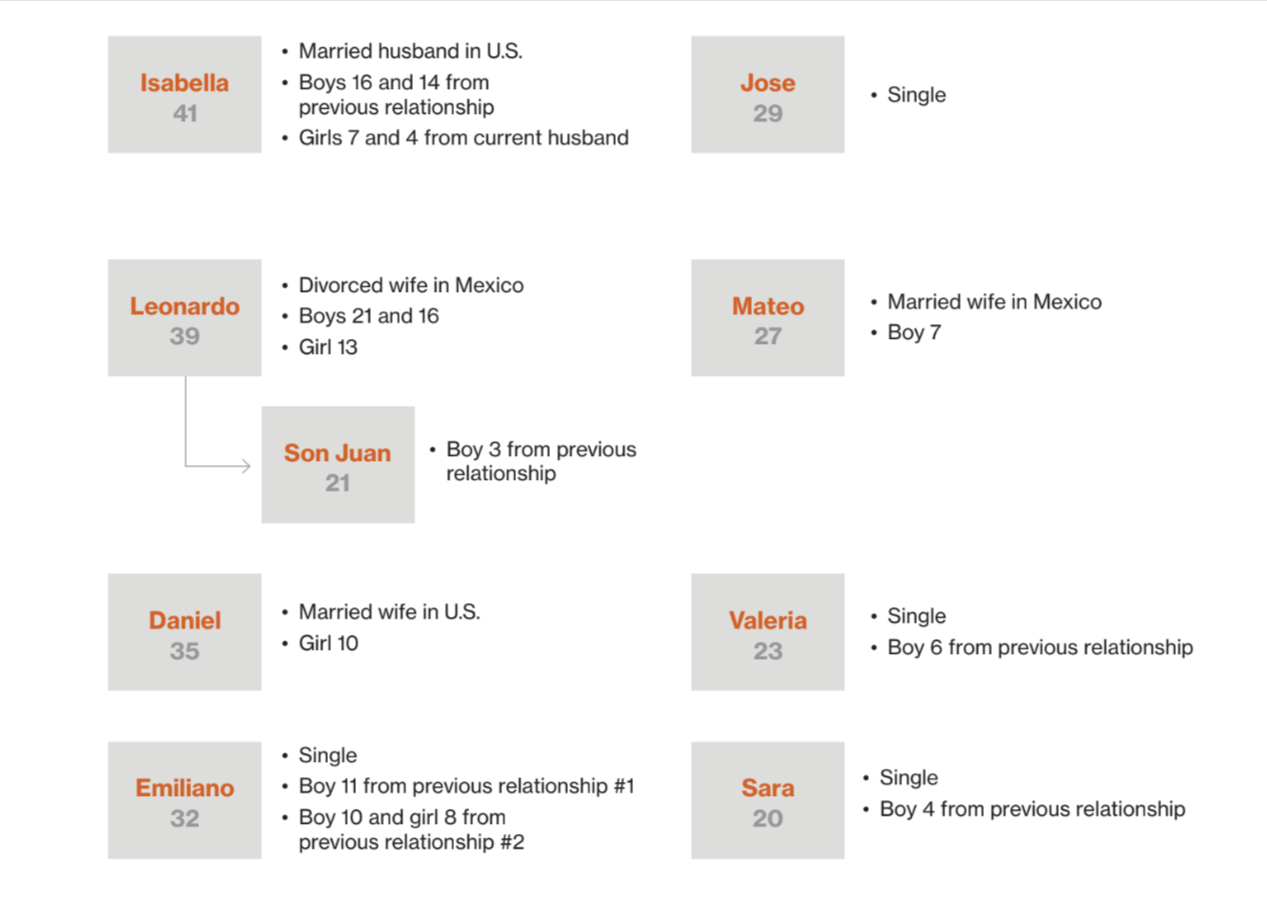
To answer these questions, I interviewed fifteen migrants from Puebla, Mexico, living in New Rochelle, New York. I eventually concentrated my research on five adult siblings from the same family and the son of one of these siblings. None had legal status in the U.S., and at the time of our initial interviews, they had been in the U.S. for as long as 14 years and for as little as one month.
The interviews were conducted primarily in Spanish and were facilitated by an immigrant from Puebla, Mexico, who is now a U.S. Citizen. The interview respondents were recruited by this same individual, and we conducted the interviews in her living room. The presence of this individual, who is deeply connected to and trusted by the immigrant community from Puebla, Mexico, allowed the interviews to become relaxed and informative conversations.
After the initial interviews, I conducted follow-up sessions, or I had the facilitator pose specific questions to a few individuals to obtain additional information and clarify specific answers.
My Insights
Wage Differentials
According to the Organization for Economic Cooperation and Development (OECD), the average annual wages in 2020 constant prices and 2020 USD PPP were $69,392 in the U.S. and $16,230 in Mexico, creating a real wage differential of 4.3x.² Among the individuals interviewed, the calculated real wage differential was 7.4x. This significant real wage differential created a substantial pull factor. As one respondent said,
“People always have to work. It doesn’t matter if they have to work here (in the U.S.) or in Mexico, but at least here they get paid.”
The higher real wage differential among the individuals interviewed may be partially attributable to the fact that on average, they had only a high school education, and while in Mexico worked almost exclusively in the informal economy It may also be partially attributable to the generally higher-than-average wages paid in New York State, and the fact that all individuals interviewed worked more than 40 hours per week.
Given the limited consumption and high savings rates prevalent among many respondents, nominal wage differentials may be a more appropriate indicator of the actual pull factor than real wage differentials. As an example, one individual paid $400 a month to rent a room in a three-bedroom apartment. She shared the room with another unrelated woman, and there were four other adults and one child sharing the other two bedrooms. Her other expenses were limited to food, a cell phone, and transportation to work, a few clothes, and necessary personal items. She was able to save $2,000 a month, just over 60% of her after-tax earnings. When asked how she lived, she simply said she lived on “what was left over” after her rent and her savings. Her savings were equal to 8.6x the gross income she had been earning in Mexico prior to immigrating.
Across all individuals interviewed, savings averaged 6.7x the gross income that they had been earning in Mexico prior to immigrating. To put this in perspective, the average starting salary of a Fletcher graduate is $68,633. Facing significant student debt and high housing costs, it is difficult for many to see how they will be able to achieve a comfortable middle-class existence.
But what if they could take an isolated-exhausting-dangerous-hardship posting overseas, but in return save $459,841 a year³ after paying for their most basic living expenses. This would be a life-altering amount of savings, which would allow the graduate to pay off their student debt in a few months, buy a house outright in two or three years, and fully fund a comfortable retirement in less than a decade. How many graduates would find that risk-reward trade-off compelling?
Endemic Corruption and Violence in Mexico
One respondent summarized the situation in Mexico, saying, “Everything is corruption.” In fact, every respondent gave at least one example they had personally experienced of being forced to pay a bribe to a Mexican government official during their migration journey. Not paying is not an option. One suggested that:
“the police in Mexico can do whatever they want. It is so bad that if people are killed, they don’t even mention it, as if the person were just like a little animal.”
The narcos themselves can be much worse. Two respondents related a story of how a coyote attempted to cross the border with his group of migrants without paying the narco gang that controlled that particular segment of the border. To send a message, the insulted gang murdered 29 of the 30 migrants, leaving only one client and the coyote to tell the tale.
In the border region, Mexico is effectively a failed state. The Mexican security services at all levels appear to be corrupt, extorting bribes from migrants as they travel through Mexico. The narcos control the routes across the border and are able to charge a fee or “piso” to every migrant who wishes to cross.
All respondents stated that the state of Puebla, which is in central Mexico, is significantly calmer than the border region. There is still endemic low-level corruption, but respondents said violence in Puebla is less common. When violence does occur, it is normally among narco gangs and does not often impact the average citizen.
Corruption and violence were not acting as a push factor for my respondents; however, it was something that they were exposed to along their journey.
Practical Impossibility of Immigrating Legally
Every interviewee looked at me askance when I asked if they came to the U.S. with a visa or using a coyote. Each of them said matter-of-factly, “Con coyote.” Not only did they not arrive using a visa, but they also knew no one personally who was able to obtain a visa.
Section 1325 in Title 8 of the United States Code, “Improper entry of alien,” provides for a fine, imprisonment, or both for any non-citizen who: enters or attempts to enter the United States at any time or place other than as designated by immigration agents; or eludes examination or inspection by immigration agents; or attempts to enter or obtains entry to the United States by a willfully false or misleading representation or the willful concealment of a material fact. The maximum prison term is six months for the first offense with a misdemeanor and two years for any subsequent offense with a felony. In addition to the above criminal fines and penalties, civil fines may also be imposed.⁴
Many respondents were detained while attempting to cross the border. One said that the agents were actually “very polite.” “They asked the people not to run or anything because they did not want to be aggressive.” The agents took my respondent to a processing center where they took his photo and fingerprints and made copies of his credentials. He was then bused back to Mexico. Less than 24 hours after being returned to Mexico, he said to his companion,
“Okay, let’s go to a hotel, and tomorrow we will try again.”
Another respondent was detained four times: he was detained after being spotted by a helicopter as crossed the Rio Grande; he was detained while resting in a bodega, trying to gather his strength for the next leg of his journey; he was detained when the car that picked him up broke down on a highway; and finally, he was detained at an immigration roadblock just outside of Houston. He said, “I had no luck!” Each time he was detained, the U.S. Border Patrol deported him. His second, third, and fourth attempted entries were felonies punishable by up to two years in prison, but he was released so quickly that he made all of these crossing attempts in a span of six weeks. The only fines he incurred were the $25 bribes he had to pay each time he was deported. The Mexican border and customs officials would not allow him to leave the border crossing area and return to Mexico until he paid.
Once a Mexican is detained while crossing the border, they are barred by law from obtaining a visa and immigrating legally. For the individuals I interviewed, all this meant is that they would be barred by law when previously they were barred by the reality of the inaccessible legal process.
One respondent summarized this perspective, stating,
“It is impossible to get a visa. You need someone in the United States that will sponsor you. Even if you could get a visa, it is more expensive to pursue the process legally. It is really not that difficult to just cross the border.”
Crossing the Border with a Coyote is Highly Organized and Relatively Low Cost
Increased United States border enforcement, combined with narco control of the Mexican side of the border, has made it more difficult, more dangerous, and more expensive to cross, but it has in no way made crossing impossible.
Immigrants who crossed a decade or more ago were less likely to be detained and had to pay significantly less during the journey. These migrants paid an average of $2,000. Now the cost of the entire journey from Puebla to New Rochelle can range from $8,000 to $10,000, according to my respondents.
The individuals I spoke with explained that the journey from Puebla, Mexico to New Rochelle, New York, had four distinct stages: 1) traveling from Puebla to a central meeting point close to Mexico City; 2) traveling from the central meeting point to a safe house close to the border; 3) crossing the border; and 4) traveling from a safe house in a U.S. city to New Rochelle.
The more recent immigrants I interviewed, those who had been in the United States less than a year, all crossed the border at Piedras Negras. These immigrants provided vivid descriptions of their experiences, which are synthesized below.
Traveling from Puebla to a Central Meeting Point Close to Mexico City
My respondents explained that the first step in the journey begins with finding a coyote that has been recommended by reliable people. Ideally, the coyote would be from the same town or municipality as the person who wants to migrate.
It is even better if the migrant’s extended family knows the coyote’s extended family. Finally, it is critical that the coyote only charges their fee after a successful crossing. Some coyotes ask for part of the money up front, but as one respondent stated,
“These are the coyotes that you want to avoid.”
Coyotes, according to my respondents, compete for business by offering products differentiated by physical exertion required, crossing time, and price. Physically demanding options that involve hiding out during the day and hard hiking through rough wilderness at night are less expensive. However, this option is only suitable for physically fit, younger migrants. Options that involve a quick dash across the border in more developed areas or crossing at a port of entry hidden in a vehicle such as a tractor-trailer are more expensive and thus more suited for children or those who cannot sustain a more physically demanding journey. The crossing strategy of the hard-hiking coyotes appears to be complete avoidance of contact with the U.S. Border Patrol. The crossing strategy of the easier-crossing coyotes appears to rely on speed or trickery.
Once a coyote has been engaged, the respondents said migrants usually travel to an agreed-upon central point close to Mexico City to meet up with their coyote and other migrants that will accompany them. A few respondents travelled directly to a border city and then met their coyote. This is viewed as a much more dangerous option, as migrants in border cities are tempting targets for kidnapping. The narco gangs that effectively control these cities know that families of these migrants will be paying thousands of dollars to the coyotes once they successfully cross the border. Thus, these families have thousands of dollars to pay in ransom.
My respondents indicated that whether migrants travel to a central meeting point or to the border directly, they always travel with a trusted companion so that they can look out for each other. This companion can be a sibling, an in-law, or a friend. Traveling alone appears to be a non-starter. It is simply too dangerous.
Travelling from the Central Meeting Point to a Safe House Close to the Border
The bus terminals in Acambay and Hidalgo, close to Mexico City, are often used as meeting points. A group of four or five coyotes jointly charter a bus, and each of the coyotes and their clients meet at an appointed time at the terminal. Each coyote may have between ten and fifteen clients, so there can be up to 75 people on a migrant bus. The coyotes tell their clients the number and location of the bus, and from there, everything is organized for them. One respondent described, “It was almost like a tourist excursion.”
The bus is stopped many times before reaching its destination. At each stop, a police or military official gets on the bus and counts the number of people. To calculate the bribe, the official multiplies the number of people on the bus by the bribe required per passenger. The bus driver collects the money and notes down the amount. When the bus arrives at its destination, each of the passengers is charged their piso; however, the list price of the piso is reduced by the amount paid in bribes along the way.
The narco control of the smuggling routes is so complete that no police or military officials ask for a bribe unless they are sanctioned by the narcos to do so. The narcos know exactly who is asking for bribes and how much, and it is easier for them to let these law enforcement entities collect the money for themselves along the way rather than having the narcos collect it all at once and then redistribute it.
As was mentioned previously, it is possible for migrants to travel to the border on their own. However, not only is this dangerous, but individuals who do must pay the full piso and do not receive a discount for any bribes paid along the
way. My respondents, therefore, found it more convenient, less dangerous, and lower cost to take a coyote-organized-narco-approved excursion to the border.
My respondents also noted that if a migrant is detained by the U.S. Border Patrol and then returned to Mexico, they are able to stay at the same safe house before they try again for a reduced price, which is typically only 1/3 of the original list price. The narcos have registered these migrants, so they know if they were previously there. Like hotels, narco-controlled safe houses offer discounts to repeat customers.
Crossing the Border
Coyotes traveling together cooperate in the transportation of their clients to the border, but that is where the cooperation ends. Each coyote is then responsible for taking their individual clients across. Migrants wait at the safe house, usually a ranch, until the coyote feels that it is a good time to cross. While at the ranch, according to our respondents, the migrants are protected, but not entirely safe. There have been cases where rival gangs have fought over human smuggling routes. Rival gangs are known to attack a ranch, kidnap the migrants there, and take them to another location. At a minimum, the gangs will demand an additional piso, but they may also demand a ransom from the migrants’ relatives in the United States.
When the coyote determines that a crossing is feasible, they take the migrants in small trucks to the crossing point. The coyote normally sends a scout ahead who will report back about any U.S. Border Patrol activity. The migrants wade into the Rio Grande, or as they call it, the Rio Bravo, and begin walking. They walk through the night—daylight means extreme heat and the chance of being sighted—and then disperse and rest during the day. According to our respondents, migrants trek for three nights through very rough country. The pace is rapid, exhausting the trekkers.
The most prepared migrants walk with many liters of water, sports drinks, and high-energy, lightweight food like chocolate. However, many are not prepared, and groups often run out of water. My research respondents reported that the best coyotes know where to find water in the desert, and the migrants replenish their water stores at rock pools that collect rainfall. Migrants who cannot keep up or become separated from the main group are left behind. They are told by the coyote, so claim our respondents, to wait until daybreak and then make themselves as visible as possible to the U.S. Border Patrol. However, not all are found, and our respondents reported that during their journeys, it was not unusual to walk past the skeletal remains of less fortunate migrants.
The U.S. Border Patrol deploys planes, helicopters, drones, 4x4’s, quads, horses, and dogs. Still, most of the migrants I interviewed said that they saw none of these things or saw them only at a distance and that they were easily avoided.
The common story of our respondents continues. After walking for three nights, the migrants are well inside the United States. Squeezing them into a pickup, a U.S.-based associate of the coyote retrieves the migrants and brings them to San Antonio or Houston. There, they are placed in another safe house.
Traveling from a Safe House in a United States City to New Rochelle
Once at the safe house, the migrants contact their family members and to assure them that they have safely crossed the border and are in the United States. Their family then wires the required fee to a bank account specified by the coyote. The migrants are not allowed to leave the safe house until the fee is paid.
Typically, the migrants are well-treated in the safe house. They shower, clean their clothes, are fed, and then just wait. However, female migrants are very vulnerable at this point in their journey. They are in an apartment or home, unable to leave, and effectively at the mercy of the coyote, his associates, and other male migrants. To experience some modicum of security, migrants to stay close to their trusted companion, further restricting their movements.
Once the coyote has received the funds, the migrants are free to leave. For an additional fee, they are driven to New Rochelle either directly or via an indirect route, depending on other pickups and drop-offs the driver has scheduled. Once in New Rochelle, the migrants are safe with family and friends and almost immediately begin looking for work. They need to work. They have to pay off the loan that funded their journey.
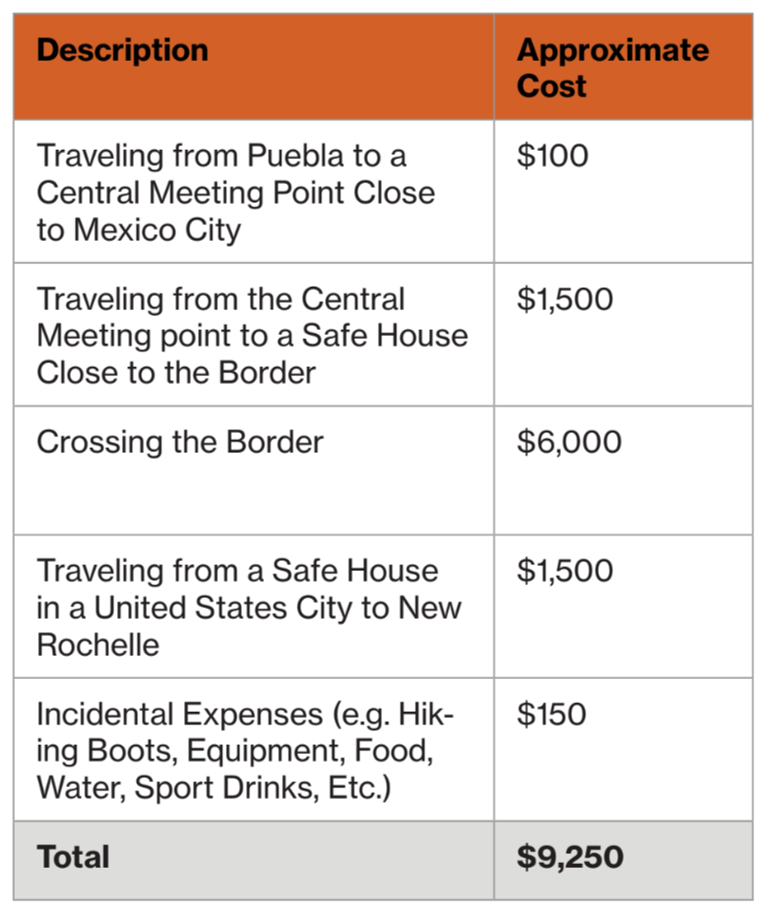
Given their low wages in Mexico, many of our respondents were unable to save the $8,000 to $10,000 needed for the journey. They were, however, able to easily borrow these sums interest-free from family and friends living in the U.S. Once the new migrants crossed successfully and found employment in the U.S., they could typically repay their loan within six to twelve months. To them, the cost of crossing the border was not prohibitive.
Immigrants Are Using Rotating Savings and Credit Associations, Called Tandas, to Build Up Large Lump Sums
A tanda is a form of Rotating Savings and Credit Association. Tandas are common in Mexico, and immigrants have brought this tradition with them and continued it in the U.S. In a tanda, a group of individuals mutually agree to save a fixed amount of money each week. Every week, one individual then takes home all of that week’s savings as their payout. This process continues until every member of the tanda receives their payout. If it works, everyone has received exactly what they put in. Those who received the money early obtained an interest-free loan, which they then paid off through subsequent contributions. Those who received their money at the end saved with a zero-interest rate.
Tandas, my respondents reported, help members save by creating mutual savings obligations. Not paying your weekly tanda contribution is almost unthinkable. With the exception of rent, tanda members will make their contributions ahead of every other bill. The amount of money that members save is significant, with weekly saving amounts averaging between $200 and $500. Lump sum payouts range from $3,600 to $5,000 for my respondents. Given that 56% of Americans are unable to cover an unexpected $1,000 bill, this is an impressive amount of savings.⁵ Because in some tandas members can negotiate the timing of when they receive their lump sum payouts, tandas offer financial flexibility. Most members try to match their payouts to their intended purchases.
To manage risk, tanda organizers and members must have confidence in each other. Members who receive their payout early in a cycle could potentially default on future contributions. However, the tanda members I interviewed reported that such defaults are rare. To ensure that tandas run efficiently, organizers use informal but effective credit checks combined with interlocking guarantees — often, members will guarantee the newcomers they invite into the group.
Members use their payouts for a variety of purposes, both in the U.S. and in Mexico. Respondents said they use the money for large consumer purchases like furniture, appliances, and cars, or for housing. For instance, the pay-out can be put toward rental security deposits or for first and last month’s rent. They also use payouts to assist relatives and friends to cross into the U.S. To support family back in Mexico, members remit their lump sum payouts to fund investments in land, homes, rental apartments, and businesses.
In sum, respondents reported that tandas help immigrants secure financial stability in the U.S., assist family members in migrating to the U.S., acquire the resources needed for their family to live a middle-class life in Mexico, and fund the acquisition of assets in Mexico. Many had hopes of returning to Mexico and wanted land, housing, or a business to come back to.
Immigration is Placing Significant Stress on Families
Among the fifteen immigrants I interviewed, there were only three intact nuclear families, and one individual who was single and had no children. All others had children who were living with extended family members in Mexico or children who were living with their former spouses/partners.
Many respondents had children with their partners in Mexico when they were in their early teens. Having children at this early age put extreme financial pressure on these individuals as they were put into a position to care for children at a time when they did not have the skills needed to earn a living wage in Mexico. None of my respondents were with their original partners. I concluded that a combination of financial stress, parental disapproval, and immaturity had led to the breakup of these relationships.
Many entered into more mature, stable relationships in their 20s. However, they were still unable to support their spouses/partners and all of their children, a fact that nudged them toward the decision to migrate. The U.S. promised a larger income. The decision to migrate effectively became a decision to separate from one’s spouse/partner and leave one’s children. During our interviews, a refrain repeated itself.
“Everyone says that they will go back [to Mexico] in a few years, but nobody ever goes back.”
All of the recent immigrants I interviewed indicated that they were going to stay here for a few years and then return to Mexico. Yet, all who had been here a number of years said that they initially thought the same, but decided to
stay.
Many of the new immigrants said that they were not happy. Yes, they were making a lot of money, but they missed their spouse/partner, and even more, they missed their children. They said that they talked to their family often over FaceTime and WhatsApp, but that at times this made things almost worse. They would like their children to join them, but they feel that the crossing is just too dangerous.
One respondent said he had, in fact, returned to Mexico. He went back because he missed his children. Once there, he wanted to stay with his family permanently in Mexico, but his wife had become accustomed to the higher standard of living enabled by his remittances, and he could not earn enough in Mexico to meet her changed expectations. Therefore, he was compelled to return to the U.S. He never went back to Mexico again. He and his wife divorced, and his children grew up without a father. However, he continued to send money home and thus indirectly supported his ex-wife’s new live-in boyfriend.
Another respondent said that he came to the U.S. to pay off a debt incurred caring for his premature daughter. He continues to support her and his other children, but he has not seen them in over ten years, and if he remains in the U.S., he has no realistic hope of ever seeing them again.
The most poignant story I heard was of a respondent who said he grew up in Mexico very comfortably in an apartment with his mother. His father, who lived in the U.S., then had purchased the apartment for her. In Mexico, this respondent had sufficient resources to attend a technical college. However, he last saw his father when he was ten. He felt that growing up without a strong male influence, he fell prey to bad influences, bad decisions, and bad behavior, and dropped out of college after one year. He has a three-year-old son that he fathered when he was just seventeen. The mother was only fourteen. Her parents did not approve, and they made them break up. The child no longer lives with his mother. His mother has another child with a new man, and she gave her firstborn son to her own mother to raise. The interviewee wants to go back to Mexico to claim his son. He grew up without a father. He does not want his own son to grow up without both a mother and a father.
Given the increased difficulty, danger, and expense of crossing the border, my respondents said is no longer feasible to move back and forth across the border. For them, crossing to the U.S. is almost always a one-way trip. Their relationships destroyed, and after many years in the U.S., my respondents really had nothing to go back to, so they remained in the U.S. By remaining in New York, they have been able to secure a more comfortable life for the children that they no longer know.
Immigrants are Working, Paying Taxes, and Holding Out in Hope of an Amnesty
To quote the law:
“All U.S. employers must properly complete Form I-9 for each individual they hire for employment in the United States. This includes citizens and noncitizens. Both employees and employers (or authorized representatives of the employer) must complete the form.”
“On the form, an employee must attest to his or her employment authorization. The employee must also present his or her employer with acceptable documents evidencing identity and employment authorization. The employer must examine the employment eligibility and identity document(s) an employee presents to determine whether the document(s) reasonably appear to be genuine and to relate to the employee and record the document information on the Form I-9.”⁶
Civil and potentially criminal penalties can be imposed on employers for failure to comply with this requirement. While this may be the law, it appears to be ignored by both employers and employees.
None of my respondents had legal permission to work in the United States, but all were able to obtain employment within weeks, if not days, of arriving. They obtained employment in restaurants as servers, busboys, and cooks. They obtained employment working in retail establishments. They worked in landscaping and construction. There was no shortage of employment opportunities.
The migrants I interviewed were here to work. They were not here to obtain benefits. In fact, they were reluctant to even claim benefits for their American-born children. One respondent related how a nephew, born in the U.S. and therefore an American citizen, was autistic. This nephew was entitled to substantial assistance from both the federal and state governments. However, his parents had not applied for this assistance because they were concerned that doing so would increase the probability of them being discovered, deported, and separated from their child. In addition, they were concerned that taking benefits would hurt their chances if there ever were a change in the law or a general amnesty.
One interviewed migrant was working at a pet store. He paid around $4,500 in Social Security and Medicare taxes and $6,000 in federal and state withholding a year but received no associated benefits or tax refunds. He has been told that he cannot reduce his Social Security and Medicare taxes, but he can amend his W-4 in order to reduce his withholding. He does not want to do this because he does not want to trouble his employer or draw any attention to himself from the tax authorities.
Respondents who worked in businesses with physical locations, such as restaurants and retailers, normally worked with false social security numbers. These numbers were either invalid or belonged to someone else. Employers could check social security numbers in a matter of minutes using online E-Verify systems, but our respondents said that employers wanted an I-9 on file and plausible deniability, not the truth.
Respondents who worked in landscaping or construction were typically paid in cash, off the books. However, many obtained Tax Identification Numbers (TINs), filed as independent contractors, and voluntarily paid Social Security and Medicare taxes as well as federal and state income taxes. These individuals did not declare all of their income. However, they did declare a substantial part of their income. They did this in order to: 1) provide a record that they were living in the U.S.; 2) demonstrate that they were earning a sufficient income to support themselves; and 3) show that they were paying taxes on this income.
One respondent had been filing and paying taxes for more than a decade in order to create a paper trail in case the law changed in her favor. She is hoping for a general amnesty, but after all this time, “no hay nada” (nothing).
Conclusion
It was easy to imagine my grandfather sitting comfortably among the individuals that I interviewed. The language would have been different, the food would have been different, but everything else would have been the same. Like them, he would have been amazed by how much more money could be earned in the United States. He would have worked 60 to 80 hours a week and been appreciative that he had a job. He would have understood the poverty and insecurity that drove them to emigrate. He would have shared their crowded apartments and been grateful that he had his own bed. He would have helped and relied on his family and friends. He would have sent money back to his home country to support his extended family and helped other relatives get to America. He would have understood the importance of limiting consumption and maximizing savings in order to advance himself. He would have hoped for a better life for his children. Finally, he would have dreamed of becoming an American citizen.
I believe that in the over 100 years that have passed since my grandfather first set foot in Boston, the immigrant experience has not changed. But America has changed. My grandfather had a path to citizenship. If he learned English, obeyed the law, worked the jobs no one else wanted, paid his taxes, and did everything that was asked of him someday... someday. At that time, America took much from the immigrant, but it also gave to them, working hand in hand, meeting the immigrant’s hope with a promise of acceptance. For some reason, we as a nation are continuing to take, but despite immigrants’ continuing hope, we have withdrawn the promise of acceptance.
Appendix A:
Interview Guide: English
Mr. Frangos is conducting a study for Tufts University, which is located in Boston, Massachusetts. He will use the information gathered in this study to write an academic paper, which he needs to complete in order to obtain his degree. The study has nothing to do with the United States or New York State government, and none of the information will be shared with the government. Your real name will not be used in the academic paper, nor will any identifying information be used.
This interview is completely confidential. You can choose not to answer any
questions that make you feel uncomfortable. You can stop the interview at any time, and there will be no consequences. The interview will be conducted using Zoom and will be recorded so that all the information can be captured. Mr. Frangos’ grandfather immigrated to the United States when he was 15 years old. This was over 100 years ago. He was a merchant sailor, and when his ship docked in Boston Harbor, he simply left the ship and never went back. He did not have a visa or papers. Today, he would be called undocumented. He had only attended school until he was 12 years old, but could read and write Greek. He spoke no English, he had very little money, he left his mother, father, brothers, and sisters in Greece, but he still decided to come. Mr. Frangos never met him, as he died before he was born. If he could have spoken to him, he would have tried to understand about his life in Greece and his life in America. He would have asked how and why he came to the United States. If it was hard to get here, how he was able to survive in a new country, and if he thought it was worth coming here? The questions Mr. Frangos will be asking are the same questions he would have asked his grandfather.
Introduction:
- What is your name?
- How old are you?
Home Town:
- Where did you come from in Mexico?
- What is the name of the town?
- What is the name of the closest city, and how far away is it from your town?
- Is it small or large? What is it like? What is the best thing about the town? What is the worst thing?
- Did you live in your own home or apartment, or did you live with your family?
- Can you describe what your home was like?
Family:
- Tell me about your family in Mexico?
- Are your parents still living?
- What do your parents do for a job?
- How many brothers and sisters do you have?
- Are they older or younger?
- Do they go to school or do they work?
- Are they still in Mexico, or did they come to the United States also?
- If they came to the United States, did they come before you or did they come after you?
Decision to Come to the United States:
- What made you decide to leave your home and family and come to the United States?
- How important were immediate financial considerations, personal safety considerations (crime and violence), personal or political freedom, or future opportunities?
Arranging and Paying for the Trip to the United States:
- Did you use a coyote?
- How did you find the coyote?
- How much did the trip cost?
- Did you pay all the money in advance, or did you pay a little at a time at various points in your journey?
- How did you make sure if you paid the money that the coyote would actually help you travel to the United States?
- You said you paid (insert $ amount)?
- How did you save all of this money? Did you borrow it from someone? If you borrowed the money, how are you supposed to pay it back?
- What will happen if you can’t pay it back at all or if it takes you longer to pay it back?
The Journey:
- How long did the journey take?
- Can you describe the journey? Please give me as much detail as possible?
- Please talk about traveling in Mexico to the border, crossing the border and then traveling to New York?
- Did you travel on your own or with a group?
- Did the same coyote help you the entire time, or did you get handed off to another coyote?
- What was the hardest part of the journey?
- Was there ever a time when you did not feel safe or were afraid?
- When did you know that you had finally made it?
Initial Housing, Permanent Housing, and Work:
- When you arrived, who did you first stay with?
- Did they help you find permanent housing?
- Did they help you find a job?
- Was it hard to find work?
- What type of jobs have you had in the United States?
- Are these the same type of jobs you had in Mexico?
Work, Savings, and Remittances:
Mexico:
- How much money could you save in Mexico each week?
- Where did you save this money? Did you use a bank, or a tanda, or did you just keep it in a safe place?
United States:
- How much money can you save each week in the United States?
- Do you keep all of this money for yourself or do you send some back to Mexico?
- If you send money back to Mexico, to whom do you send it?
- So, after you send money back to Mexico how much money do you save?
- Where do you save this money? Do you use a bank, or a tanda or do you just keep it in a safe place?
Savings – Tanda:
If They Use a Tanda, Please Ask the Following:
- How much do you save?
- How many people are in the tanda?
- How do you get your number?
- How do you know the other people in the tanda, and do you ever meet them?
- How do you know the tanda organizer?
- How do you give money to the organizer?
- How do you get money from the organizer?
- What does the organizer get out of running a tanda (1st number, some money, prestige in the community)
- How do you know you will get the money if you have a later number?
- What makes a tanda better than saving on your own or using a bank?
United States – Papers:
- How do you work in the United States without papers?
- Do you simply get paid cash?
- If you are given a check, are you paid with a W-2 or a 1099?
- Did you have to give your employer a Social Security number?
- How did you get this Social Security number?
- If you bought a number, how much did it cost you?
- Did you buy any forms of working permits or documentation?
- Do you have a driver’s license or any other documentation from New York State, is it real?
Formal Financial Services:
- Do you have a checking account?
- If you don’t have a checking account how do you pay your bills?
- If you don’t have a checking account how do you cash your checks?
- Do you have a savings account?
- Do you have a credit card?
- If you need to borrow money – how do you do it?
Conclusion:
- What is the best thing about being in the United States?
- What is the hardest or worst thing about being in the United States?
- What do you miss most about living in Mexico?
- What don’t you miss about living in Mexico?
- Is life for you better here than it was in Mexico?
- Do you think that you will go to Mexico eventually, or do you want to stay here?
Appendix B:
Interview Guide: Spanish
El Sr. Frangos está realizando un estudio para la Universidad de Tufts, que se encuentra en Boston, Massachusetts. Utilizará la información recopilada en este estudio para redactar un trabajo académico que debe completar para obtener su título. El estudio no tiene nada que ver con el gobierno de los Estados Unidos o del estado de Nueva York, y ninguna información se compartirá con el gobierno. Su nombre real no se utilizará en el trabajo académico, ni se utilizará ninguna información de identificación. Esta entrevista es completamente confidencial. Puede optar por no responder a las preguntas que le hagan sentir incómodo. Puede detener la entrevista en cualquier momento y no habrá consecuencias. La entrevista se realizará mediante Zoom y se grabará para que se pueda capturar toda la información.
El abuelo del Sr. Frangos emigró a los Estados Unidos cuando tenía 15 años. Esto fue hace más de 100 años. Era un marinero mercante, y cuando su barco atracó en el puerto de Boston, simplemente lo abandonó y nunca regresó. No tenía visa ni papeles. Hoy lo llamarían indocu-mentado. Solo asistió a la escuela hasta los 12 años, pero sabía leer y escribir griego. No hablaba inglés, tenía muy poco dinero, dejó a su madre, padre, hermanos y hermanas en Grecia; pero aun así decidió venir. El Sr. Frangos nunca lo conoció, ya que murió antes de nacer. Si hubiera podido hablar con él, habría intentado comprender su vida en Grecia y su vida en Estados Unidos. Habría preguntado cómo y por qué vino a Estados Unidos. Si fue difícil llegar aquí, ¿cómo pudo sobrevivir en un nuevo país y si pensó que valía la pena venir aquí? Las preguntas que hará el Sr. Frangos son las mismas que le habría hecho a su abuelo.
Introducción:
- ¿Cuál es su nombre?
- ¿Cuántos años tienes?
Pueblo Natal:
- ¿De dónde vienes en México?
- ¿Cuál es el nombre de la ciudad?
- ¿Cuál es el nombre de la ciudad más cercana y a qué distancia de tu ciudad?
- ¿Es pequeño o grande? ¿A qué se parece?
- ¿Qué es lo mejor de la ciudad?
- ¿Qué es lo peor?
- ¿Vivía en su propia casa o apartamento o vivía con su familia?
- ¿Puede describir cómo era su hogar?
Familia:
- ¿Cuéntame de tu familia en México?
- ¿Vives todavía tus padres?
- ¿Qué hacen sus padres por un trabajo?
- ¿Cuántos hermanos y hermanas tienes?
- ¿Son mayores o menores?
- ¿Van a la escuela o trabajan?
- ¿Están todavía en México o vinieron también a Estados Unidos?
- Si vinieron a los Estados Unidos, ¿vinieron antes que ustedes o vinieron después de ustedes?
Decisión de Venir a Estados Unidos:
- ¿Qué le hizo decidir dejar su hogar y su familia y venir a los Estados Unidos?
- ¿Cuán importantes fueron las consideraciones financieras inmediatas, las consideraciones de seguridad personal (crimen y violencia), la libertad personal o política u oportunidades futuras?
Organizar y Pagar el Viaje a Los Estados Unidos:
- ¿Usaste un coyote?
- ¿Cómo encontraste al coyote?
- ¿Cuánto costó el viaje?
- ¿Pagó todo el dinero por adelantado o pagó poco a poco en varios puntos de su viaje?
- ¿Cómo se aseguró si pagó el dinero de que el coyote realmente lo ayudaría a viajar a los Estados Unidos?
- ¿Dijo que pagó (inserte el monto de $)?
- ¿Cómo ahorraste todo este dinero? ¿Lo tomas- te prestado de alguien? Si pidió prestado el dinero, ¿cómo se supone que lo devolverá? ¿Qué pasará si no puede devolverlo en absoluto o si tarda más en devolverlo?
El Viaje:
- ¿Cuánto duró el viaje?
- ¿Puedes describir el viaje? Por favor, dame el mayor detalle posible.
- Por favor, hable sobre viajar en México a la frontera, cruzar la frontera y luego viajar a Nueva York.
- ¿Viajaste solo o en grupo?
- ¿El mismo coyote te ayudó todo el tiempo o te entregaron a otro coyote?
- ¿Cuál fue la parte más difícil del viaje?
- ¿Hubo alguna vez en que no se sintió seguro o tuvo miedo?
- ¿Cuándo supiste que finalmente lo habías logrado?
Vivienda Inicial, Vivienda y Trabajo Permanentes:
- Cuando llegaste, ¿con quién te quedaste por primera vez?
- ¿Le ayudaron a encontrar una vivienda permanente?
- ¿Te ayudaron a encontrar trabajo?
- ¿Fue difícil encontrar trabajo?
- ¿Qué tipo de trabajos ha tenido en Estados Unidos?
- ¿Son estos el mismo tipo de trabajos que tenía en México?
Trabajo, Ahorros y Remesas:
México:
- ¿Cuánto dinero podrías ahorrar en México cada semana?
- ¿Dónde guardaste este dinero? ¿Usó un banco o una tanda, o simplemente lo guardó en un lugar seguro?
Estados Unidos:
- ¿Cuánto dinero puedes ahorrar cada semana en los Estados Unidos?
- ¿Te quedas con todo este dinero para ti o envías algo de regreso a México?
- Si envía dinero a México, ¿a quién se lo envía? Entonces, después de enviar dinero a México,
- ¿cuánto dinero ahorrará?
- ¿Dónde guardas este dinero? ¿Utiliza un banco o una tanda o simplemente lo guarda en un lugar seguro?
Ahorros – Tanda:
Si Usan una Tanda, Pregunta lo Siguiente:
- Si usan una tanda, pregunte lo siguiente:
- ¿Cuánto ahorras?
- ¿Cuántas personas hay en la tanda?
- ¿Cómo consigues tu número?
- ¿Cómo conoces a las otras personas de la tan-da y cómo las conoces?
- ¿Cómo conoces al organizador de la tanda?
- ¿Cómo le das dinero al organizador?
- ¿Cómo se obtiene dinero del organizador?
- ¿Qué obtiene el organizador de ejecutar una tanda (1er número, algo de dinero, prestigio en la comunidad)?
- ¿Cómo saber que recibirá el dinero si tiene un número posterior?
- ¿Qué hace que Tanda sea mejor que ahorrar solo o usar un banco?
Estados Unidos – Papeles:
- ¿Cómo se trabaja en Estados Unidos sin papeles?
- ¿Simplemente le pagan en efectivo?
- Si le dan un cheque, ¿le pagan con un W-2 o un 1099?
- ¿Tuvo que darle a su empleador un número de seguro social?
- ¿Cómo consiguió este número de seguro social?
- Si compró un número, ¿cuánto le costó?
- ¿Compró alguna forma de permiso de trabajo o documentación?
- ¿Tiene una licencia de conducir o cualquier otra documentación del estado de Nueva York que sea real?
Servicios Financieros Formales:
- ¿Tiene una cuenta corriente?
- Si no tiene una cuenta corriente, ¿cómo paga sus facturas?
- Si no tiene una cuenta corriente, ¿cómo puede cobrar sus cheques?
- ¿Tienes cuenta de ahorros?
- ¿Tienes una tarjeta de crédito?
- Si necesita pedir dinero prestado, ¿cómo lo hace?
Conclusión:
- ¿Qué es lo mejor de estar en Estados Unidos?
- ¿Qué es lo más difícil o lo peor de estar en los Estados Unidos?
- ¿Qué es lo que más extrañas de vivir en México?
- ¿Qué no extrañas de vivir en México?
- ¿Es la vida para ti mejor aquí que en México?
- ¿Crees que eventualmente irás a México o quieres quedarte aquí?
Footnotes
📝 This article was originally published as a report by the Henry J. Leir Institute at The Fletcher School of Law & Diplomacy and Tufts University.
Download the original essay below ⬇️