
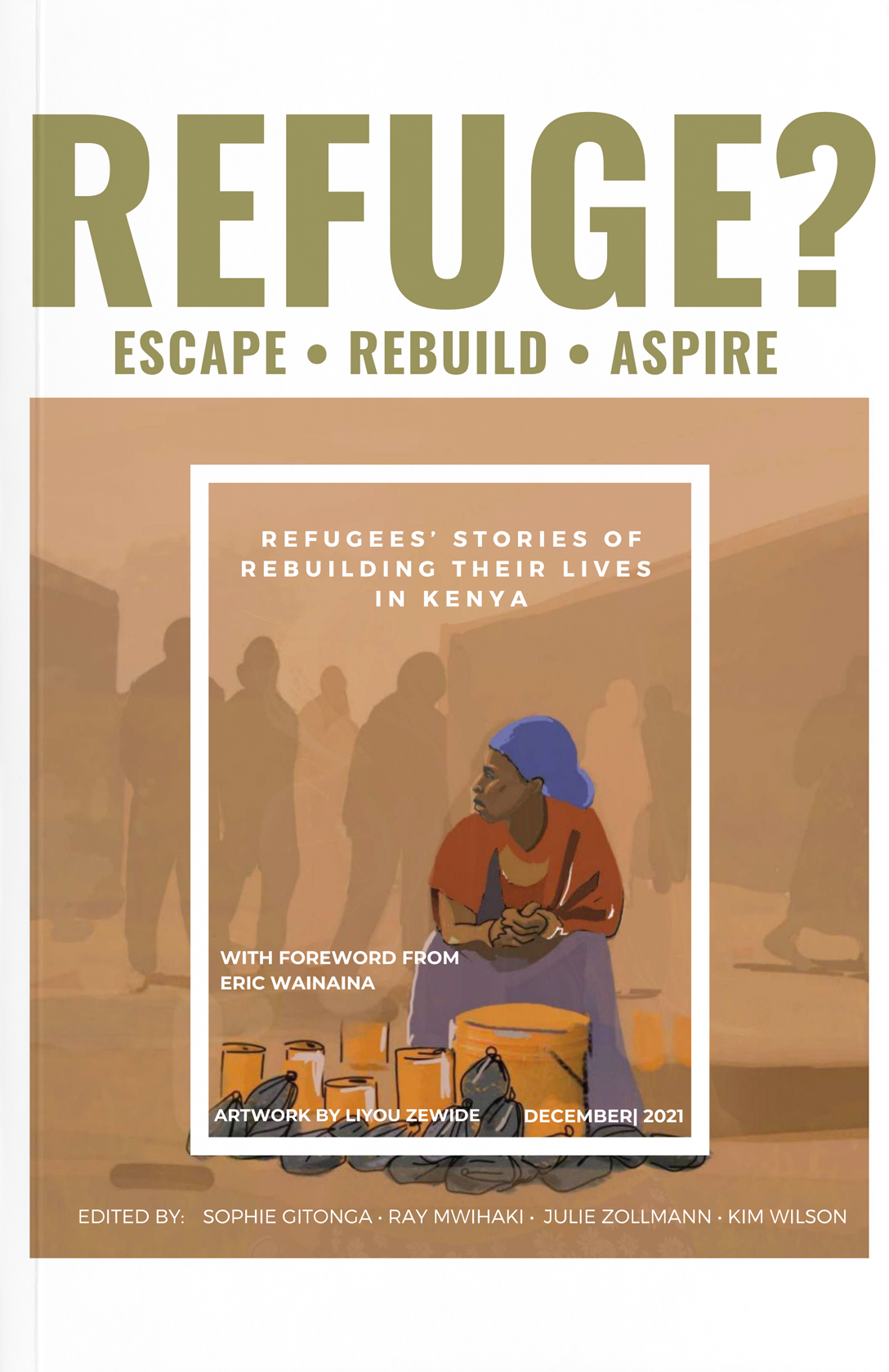
Refuge? Refugees Rebuild Their Lives in Kenya
This collection examines refugees’ own stories of rebuilding in Kenya. Through their reflections, we see the disorientation of displacement as they walk us through the fears, hopes, and barriers they face while making a life in a new country.
Overview
This new collection pulls together refugees’ own stories of flight and resilience in Kenya. Through their reflections, we see the disorientation of displacement, the hope many find in Kenya—particularly through education—and the barriers people face trying to work and build a full economic life in a country that is never quite home, even after many years, or for those born inside a refugee camp.
As of January 2021, more than half a million refugees were living in Kenya, forced from their homes by political violence and its aftermath in Somalia, South Sudan, the Democratic Republic of Congo, Ethiopia, Rwanda, Uganda, and Burundi. While Kenya has hosted refugees since independence, larger flows began in the 1980s, and by the 1990s, the government had begun restricting refugees’ socio-economic freedoms. By 2014, it was a criminal offense for refugees to travel outside Kakuma and Dadaab without permission. Refugees are routinely harassed for their documents, often while waiting long periods for those documents to be processed or renewed. While on paper, refugees have the right to work, in practice, work permits are issued extremely sparingly. Even refugees’ ability to use banking infrastructure and M-Pesa has been curtailed in punitive reactions to terror attacks, which the government blames on its refugee population. In late 2019, the President signed a new Refugee Act into law, raising hope for a new era of inclusive practices, including greater freedom to work, but the promise to close the country’s refugee camps in the middle of 2022 makes some question the government’s commitment to the new direction outlined in the Act.
These stories come from refugees initially hailing from the Democratic Republic of Congo, Ethiopia, South Sudan, Somalia, Rwanda, Uganda, and Burundi. All of these stories were written during the COVID-19 pandemic. We hope this collection speaks to anyone wanting a clearer sense of what it means to seek refuge in Kenya, and a deeper understanding of the broader migrant experience at large.